



Value Betting in Prediction Markets: Finding Mispriced Event Contracts
The systematic approach to finding contracts where the market has mispriced probability — the core discipline that separates profitable prediction market traders from those who lose to fees and noise.
Overview #
Value betting is the practice of identifying contracts where the market's implied probability differs meaningfully from the true probability — enough to overcome transaction costs and generate positive expected value.
This is the fundamental skill of prediction market trading. Without a systematic approach to finding value, you're basically guessing — and fees guarantee that random guessing loses money over time.
Fi documented how institutional capital is treating prediction market prices as serious financial data in Tradeweb Takes Minority Stake in Kalshi — Prediction Market Data Coming to Institutional Screens — which means the easy mispricings are increasingly being arbitraged away by professional capital. Finding value now requires genuine analytical edge.
Fi documented how institutional capital is treating prediction market prices as serious financial data in Tradeweb Takes Minority Stake in Kalshi — Prediction Market Data Coming to Institutional Screens — which means the easy mispricings are increasingly being arbitraged away by professional capital.
The Core Formula: Expected Value #
Every value bet starts with Expected Value (EV) calculation:
EV = (Your Probability × Gain) + ((1 - Your Probability) × Loss)For a YES contract purchased at price P (where gain = 1-P and loss = P):
EV = P_you × (1 - P_market) + (1 - P_you) × (-P_market)
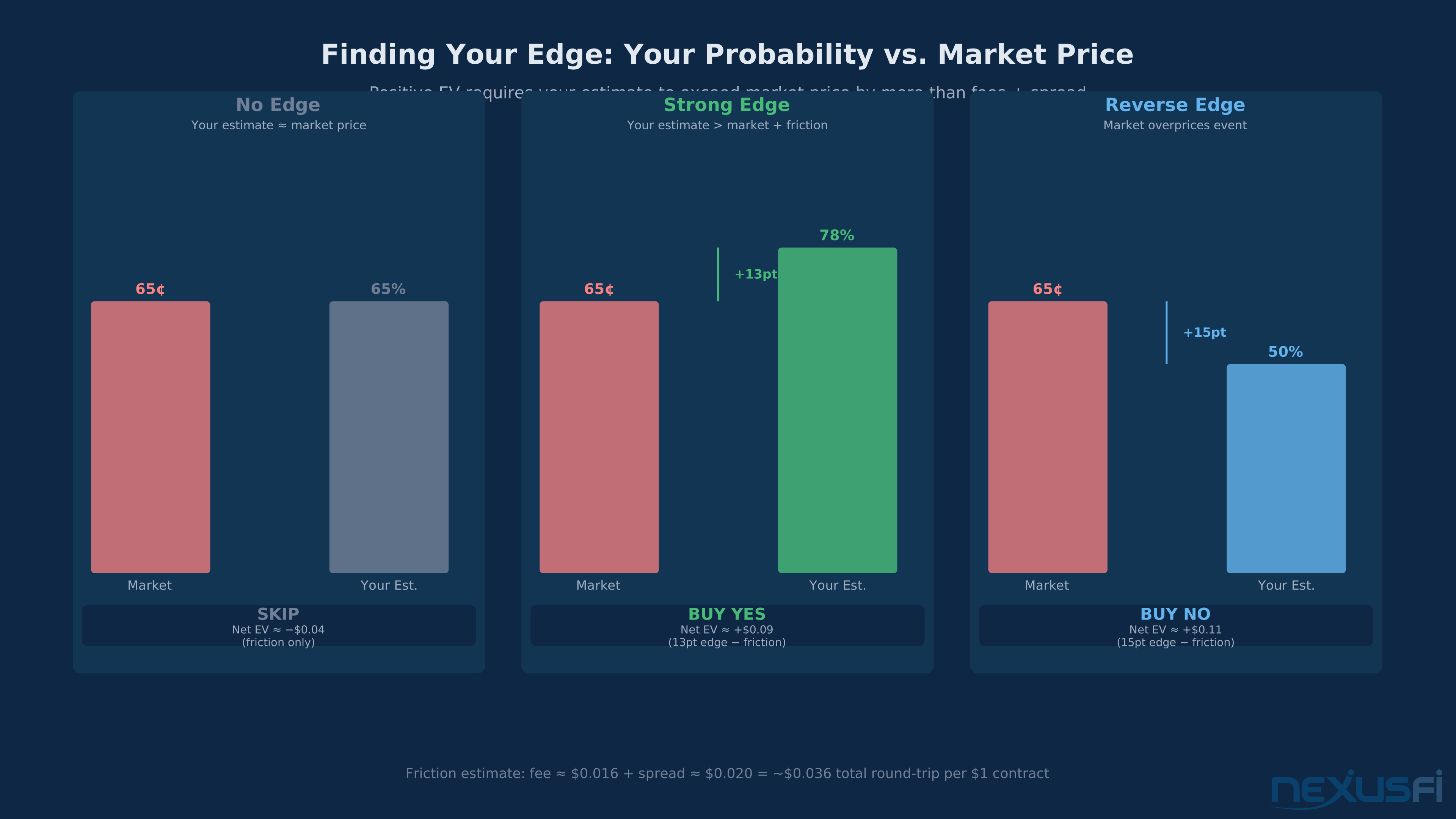
EV = P_you - P_market
In plain terms: your edge = your probability minus the market's implied probability.
This edge must exceed friction (fees + spread) to be profitable.
The Full EV Calculation #
For a YES contract at price P_market:
- Your probability estimate: P_you
- Raw edge: P_you - P_market
- Entry fee: 7% × P_market × (1 - P_market) [Kalshi]
- Spread cost: approximately $0.01-0.03 for liquid markets
- Net EV: Raw edge - Entry fee - Spread cost
Only trade when net EV ≥ 3%. The 3% buffer accounts for estimation error in your probability estimate.
Value Sources: Where Mispricings Actually Come From #
1. Information Asymmetry #
You know something the market doesn't, or you've processed public information more carefully.
Example: An economic data release is coming. Most market participants use consensus forecasts from economist surveys. You've built a model that incorporates more granular data (regional employment, shipping indices, credit card spending). Your model predicts 3.4%, consensus is 3.1%, market prices the contract at 62¢ for "above 3.2%." Your model shows 78% probability — a potential 16-point edge.
This is the most sustainable edge source because it comes from genuine skill. Information asymmetry compounds as your analytical tools improve.
2. Narrative vs. Base Rate Divergence #
Media coverage moves prices disproportionate to actual probability changes.
Example: A negative headline about a candidate runs across major outlets. The prediction market drops from 58¢ to 41¢. But historical data shows that similar negative press 8 weeks before an election moves poll numbers by 1-2 points, translating to maybe 3-4% probability change. The 17¢ drop represents overreaction.
Base rate traders exploit narrative-driven mispricing by anchoring to historical frequencies and buying (or selling) when sentiment has overcorrected.
Key skill: Knowing the base rate before looking at the current narrative. Once you see the narrative, your prior becomes contaminated. Estimate the historical base rate first, then update for current information.
3. Thin Market Mispricing #
Low-activity contracts are priced by fewer participants, creating more frequent deviations from fair value.
Example: A contract on a state-level election result has only 2,000 contracts outstanding and 12 active traders. The posted price of 55¢ was set by someone last Tuesday and hasn't traded since. Your analysis suggests 70% probability based on polling data. An 15-point edge in a thin market — but verify you can exit if you need to.
Thin market value requires accepting the risk of a wider exit spread and potentially difficulty exiting at all before resolution.
4. Resolution Criteria Misunderstanding #
The market prices based on one interpretation; you've read the criteria carefully and know the correct interpretation.
Example: A contract reads "above 3.5% CPI" priced at 72¢. Market participants are trading on the expected CPI-U headline. But the criteria specify Core CPI. Core is currently running 50bps below headline. The "correct" probability (based on Core CPI) might be 45% — the market is pricing the wrong measure.
This is rare but represents pure edge when found. Careful criteria reading is the discipline.
5. Correlated Event Arbitrage #
Two related events should have correlated prices. When they diverge, one is mispriced.
Example: Contract A: "Will US GDP be above 2.0% for Q3?" priced at 68¢. Contract B: "Will the Fed cut rates in September?" priced at 42¢. Strong GDP tends to make Fed cuts less likely. A 42¢ cut probability seems low if you're expecting strong GDP — or the 68¢ GDP probability seems high if you believe cuts are coming. One of these is inconsistent. Which is more liquid? Which has better supporting analysis?
Building a Value Betting Process #
Step 1: Select Your Domain #
Be selective. Trade only in areas where you have genuine analytical advantage. Common value domains:
Economic data releases (best for analytically-oriented traders):
- Strong base rates available from historical data
- Well-defined data sources and release schedules
- Your models vs. consensus forecasts = measurable edge
Political elections (best for political analysts):
- Polling aggregation models can outperform thin market prices
- Narrative-driven price swings create mean-reversion opportunities
- Resolution can take weeks (liquidity timing matters)
Sports (best for sports analytics specialists):
- Deep historical data available
- Market prices often driven by public narrative and favorites bias
- Requires sport-specific domain knowledge
Avoid: Markets where you have no information advantage. Randomly selecting prediction markets to trade guarantees fee-driven losses.
Step 2: Develop Your Probability Estimation Method #
For each domain you trade:
- Identify the base rate (historical frequency of similar outcomes)
- List the factors that move probability above or below base rate
- Build a systematic update process (don't just go with your gut)
- Track your estimates vs. outcomes to measure calibration
For economic data: Build or find a model that forecasts the relevant indicator. Compare your forecast to consensus. If your forecast deviates, check whether the market reflects consensus or your estimate.
For elections: Find a reputable polling aggregator. Build or find a model that translates poll leads to win probabilities. Compare to prediction market prices.
Step 3: Calculate Edge Before Every Trade #
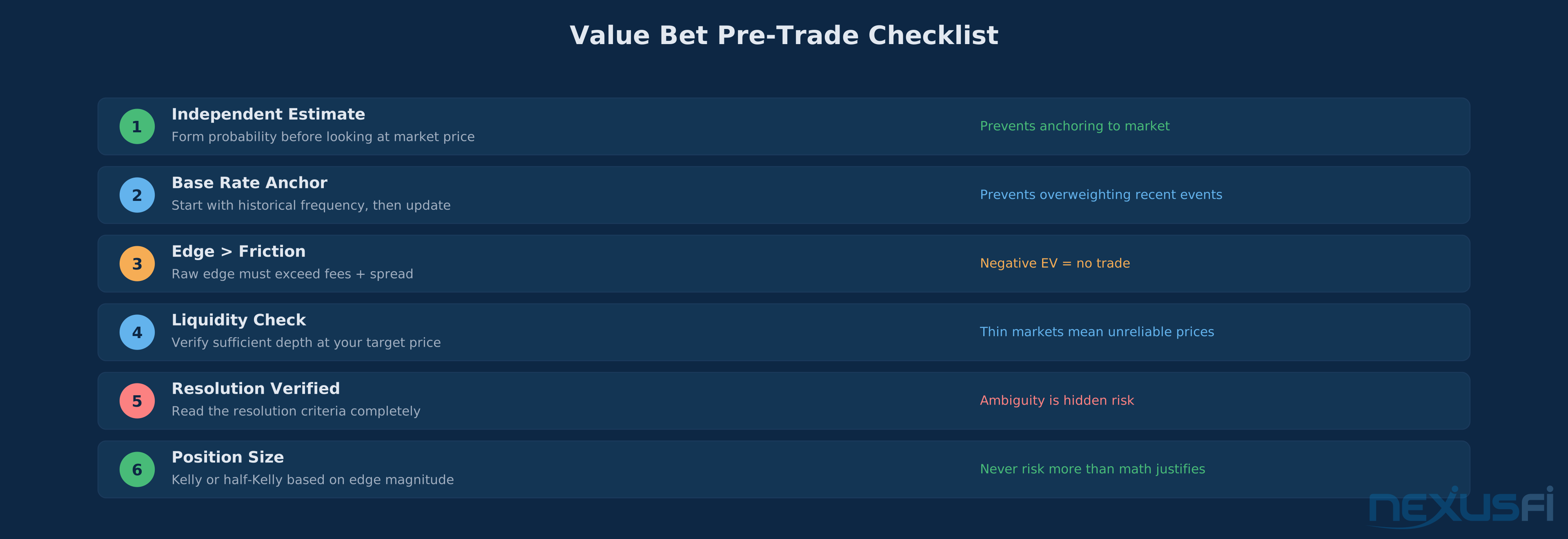
Never deviate from the EV formula. A trade that "feels" like value without calculation isn't value betting — it's intuition betting.
For each candidate trade:
1. State your probability estimate explicitly
2. Calculate raw edge (your estimate - market price)
3. Calculate fees and spread
4. Calculate net EV
5. Trade only if net EV ≥ 3%
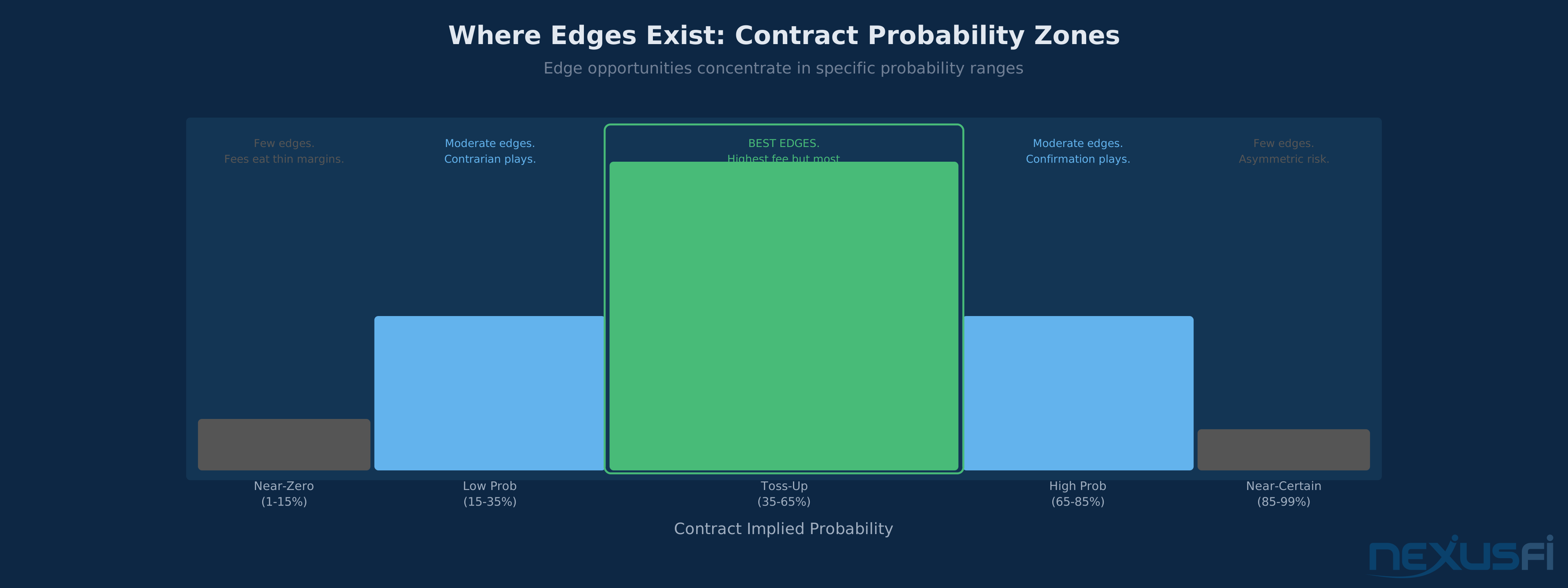
If step 2 produces an edge below 5%, stop. You're in noise territory.
Step 4: Size Proportionally to Edge #
Not all value bets are equal. Larger edges justify larger positions. The Kelly Criterion provides a framework:
Kelly fraction = (Edge / (1 - P_market)) for YES betsIn practice, use 25-50% of the Kelly fraction ("fractional Kelly") to reduce volatility from estimation error. Full Kelly is theoretically optimal but extremely volatile in practice.
Example: Edge = 10 percentage points. Market price = 60¢. Kelly = 10% / 40% = 25% of bankroll. Half-Kelly = 12.5% of bankroll in this contract.
Step 5: Track and Measure #
Value betting only works at scale — individual trades produce binary outcomes (you're right or wrong). Your edge becomes visible across many trades.
Track for each trade:
- Contract, entry price, your probability estimate
- Edge calculated at entry
- Outcome (resolved YES or NO)
- Actual profit/loss
After 50+ trades, calculate:
- ROI by edge bucket: Did high-edge trades outperform low-edge trades?
- Calibration: Are your 70% picks winning 70% of the time?
- Domain performance: Which domains are generating positive EV vs. negative?
Common Value Betting Mistakes #
Mistake 1: Confusing Conviction With Edge #
Being highly confident is not the same as having edge. You might be 90% confident the Fed won't cut rates — and the market might also be at 90¢ for "no cut." No edge, no trade, regardless of conviction.
Edge requires the market to be wrong relative to you. Your conviction is only relevant insofar as it represents better information or analysis than what the market already reflects.
Mistake 2: Chasing Recent Success #
Winning your last three trades feels like finding the secret. It's not — it's variance. Prediction markets are naturally binary and high-variance. Three wins in a row can happen randomly. Track over 50+ trades before concluding your strategy is working.
Mistake 3: Anchoring to Your Entry Price #
You bought YES at 60¢ with a 75% probability estimate. News arrives that shifts the true probability to 50%. The market moves to 48¢. Your position is now at a loss.
The wrong response: Hold because you "paid 60" and selling at 48 "locks in a loss." The right response: The entry price is irrelevant. Does today's 48¢ represent value given your current 50% estimate? No — the edge has evaporated. Exit.
Mistake 4: Ignoring the Correlation Between Estimates #
You take 10 simultaneous positions based on 10 different probability estimates. But if those estimates are correlated (all depend on the same underlying economic variable), you're not diversified — you're concentrated.
Example: 5 contracts all betting that inflation will surprise to the upside in different ways. If inflation doesn't surprise, you lose all 5. This isn't 5 independent bets; it's one bet with 5 exposure points.
A Day in the Life of a Value Bettor #
Pre-market (7-8 AM): Check economic calendar for upcoming releases. Build/update probability estimates for relevant contracts. Compare estimates to market prices. Flag any contracts with edge > 5%.
Market hours: Monitor flagged contracts. For time-sensitive events (surprise announcements, breaking news), reassess rapidly whether new information creates or destroys edge in current positions.
Post-market: Log trade outcomes. Update calibration tracking. Review contracts that moved much and whether the movement matched your analytical framework.
Weekly: Review overall P&L by domain and edge bucket. Identify which estimation methods are generating consistent edge vs. which are noise. Adjust process.
Citations #
- @Fi: Tradeweb Takes Minority Stake in Kalshi — Institutional capital entering prediction markets and narrowing easy mispricings
- @Fi: Kalshi Hits $1 Billion in Super Bowl Trading Volume — Market scale and liquidity context
- @Fi: CFTC Withdraws Prediction Market Ban, Signals New Rulemaking Under Chairman Selig — Regulatory environment shaping market access
- Kalshi, Polymarket, Prediction Markets etc — NexusFi community discussion of prediction market mechanics
- How are prices calculated? — Kalshi Help Center
Knowledge Map
Prerequisites
Understand these firstGo Deeper
Build on this knowledgeReferences This Article
Articles that build on this topicCitations
- — Event Contracts - New Way to trade the CME Futures markets (2022) 👍 6
- — CME Launching Binary Option Trading (2022) 👍 1
- — NADEX Binary Options Cost Breakdown Comparison (2017) 👍 3
- — Nadex AMA - Dan Cook (2019) 👍 5
- — CME Group Event Contracts Blast Past 100 Million Traded (2026)