



Wash Sale Rule and Futures Contracts: Section 1256 Exemption Explained
Stock traders dread December. They're running the clock on 30-day holding periods, managing "substantially identical" replacement trades, and trying not to turn a clean tax-loss harvest into a disallowed wash sale. Futures traders don't have this problem — and most don't fully understand why, which means they're leaving real money on the table every year.
The wash sale rule under IRC §1091 doesn't apply to Section 1256 contracts. Full stop.
Overview #
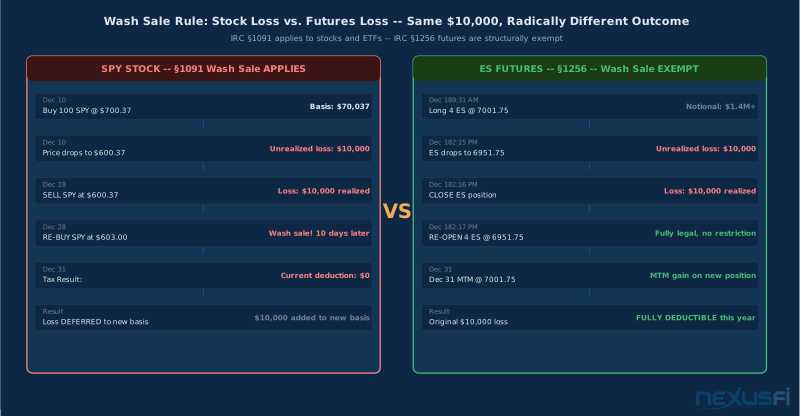
The wash sale rule exists to prevent traders from taking a tax loss while maintaining economic exposure to the same position. Sell SPY at a loss, buy it back the next day, and you've got a deductible paper loss while your actual position hasn't changed — at least not for long. Congress didn't like that, so IRC §1091 disallows the loss when you reenter a "substantially identical" position within 30 days on either side of the sale.
Section 1256 contracts — regulated futures on CME, CBOT, NYMEX, ICE, and foreign equivalents — operate under a completely different tax system. Instead of realizing gains and losses only when you close a trade, §1256 forces recognition at year-end via mark-to-market: the IRS treats every open contract as if it were sold at fair market value on December 31. The consequence is that the "sale and reacquisition" framework of §1091 simply doesn't fit. There's no discrete "sale date" to measure a 30-day window from. The gain or loss on a futures position is recognized annually regardless of whether you close the trade.
Two topics deliberately stay out of scope here. First, the Section 475(f) mark-to-market election for Trader Tax Status (TTS) — that's a separate, commonly confused regime that converts futures gains/losses from capital to ordinary income. Second, the deep mechanics of Form 6781 beyond what a typical self-filer needs. Both get linked where relevant.
The Wash Sale Rule in Plain English #
Before explaining why you're exempt, you need to understand what you're exempt from. Equity traders deal with this constantly.
How IRC §1091 Works #
The wash sale rule applies when:
- You sell stock or securities at a loss
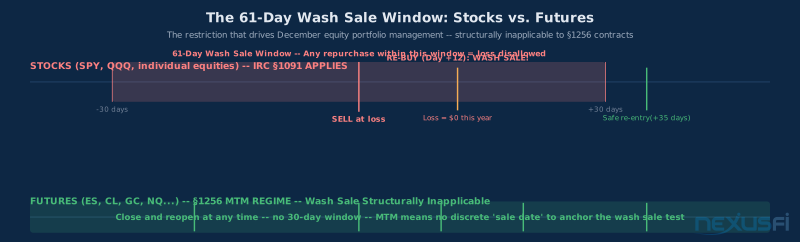
- You acquire "substantially identical" stock or securities within 30 days before or after the sale
That's a 61-day window total — 30 days before, the day of sale, and 30 days after. The IRS calls it a "wash" because the economic exposure is basically unchanged.
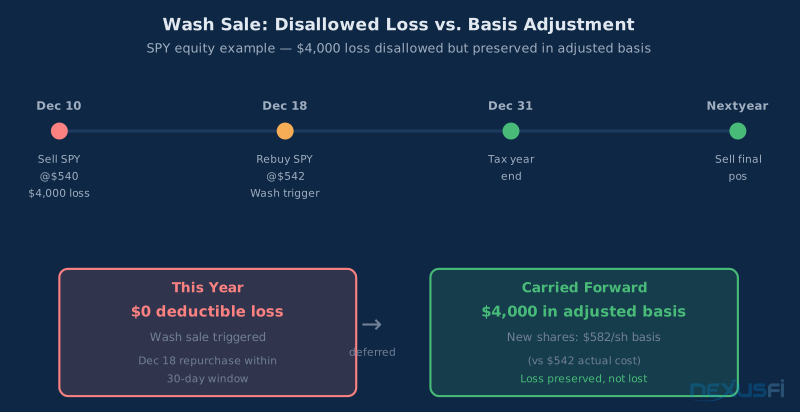
When a wash sale triggers, the loss isn't permanently lost — it's disallowed for the current year and added to the basis of the replacement shares. Eventually the loss shows up when you sell the replacement position, but the timing is out of your control. If the replacement shares keep gaining value, that carryover loss basis matters less and less.
Here's what the numbers look like in practice. Say you bought 100 shares of SPY at $580, the position dropped to $540, and you sold on December 10th to harvest a $4,000 loss. Then on December 18th you buy SPY back at $542 because you think the dip is over.
- Loss realized: $4,000
- Wash sale triggered: Yes (repurchased within 30 days)
- Loss deductible this year: $0
- Basis adjustment on new shares: $542 + $40 per share carryover = $582 per share effective basis
- Tax value this December: Nothing
The disallowance extends further: you can't dodge the rule by buying options on the same underlying instead of the shares themselves, or by buying the shares in a different account (including an IRA). The "substantially identical" test looks at economic equivalence, not account location.
What Happens to the Disallowed Loss #
The adjusted basis carries forward. If your new SPY shares eventually get sold at $600, your gain calculation starts from $582 (adjusted basis) instead of $542 (actual purchase price), which reduces the taxable gain by exactly the amount of the disallowed loss. The deduction wasn't eliminated — it was deferred, sometimes indefinitely.
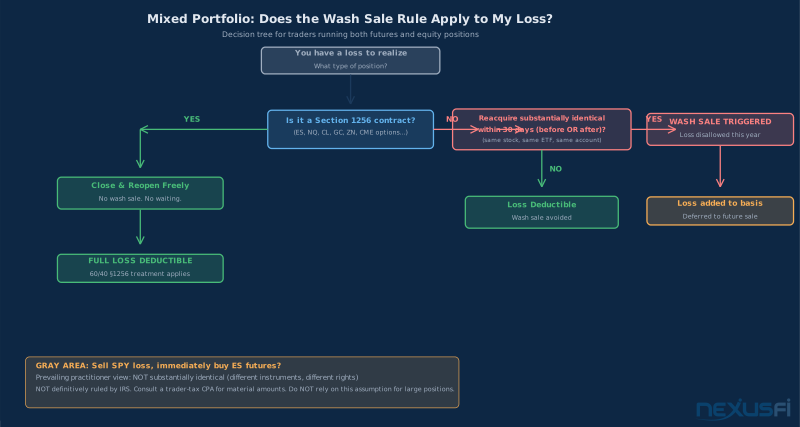
Mixed Portfolio Trap The wash sale exemption applies to Section 1256 contracts in isolation. If you hold both ES futures and SPY shares, closing SPY at a loss while holding a substantially identical ES position creates more complex wash sale analysis. See the "Mixed Portfolio" section before assuming blanket exemption.
That deferral is the problem. If you're harvesting losses to offset gains in the current tax year, a wash sale turns a clean deduction into a future basis adjustment with uncertain timing. For active traders making dozens or hundreds of similar trades, tracking wash sales across brokerage accounts, managing 30-day windows around each loss trade, and reconciling adjusted bases is a compliance nightmare. And if you're still holding replacement positions at year-end with embedded gains, the deferred loss effectively disappears into the unrealized appreciation.
Why Equity Traders Obsess Over This in December #
December is when equity traders spend real time and energy managing wash sale risk. The most common strategies:
- Wait 31 days: Sell at a loss, wait 31 days, repurchase. Clean deduction, but you're out of the position for a month.
- Switch to a similar-but-not-identical instrument: Sell SPY, buy IVV (both S&P 500 ETFs, but different funds — IRS hasn't definitively ruled them substantially identical, though this is actively debated).
- Tax-loss harvest into different sectors: Sell broad-market ETF at a loss, buy sector ETFs to maintain approximate exposure without triggering substantially identical.
All of this is time-consuming, creates its own basis-tracking complexity, and doesn't always work the way traders expect. Which is why the futures exemption is so valuable.
Why Section 1256 Contracts Are Exempt #
The statutory exemption isn't spelled out as "wash sales don't apply to futures." It's structural. The wash sale regime is architecturally incompatible with how §1256 accounts for gains and losses.
The Mark-to-Market Foundation #
IRC §1256(a)(1) states that all Section 1256 contracts held at the close of the taxable year are treated as sold at their fair market value on the last business day of the year. The resulting gain or loss is recognized in that year.
This creates a at the core different realization pattern. For stocks:
- Loss is realized when you close the trade
- Wash sale test measures from the closing trade date
- 30-day window is anchored to a specific sale event
For §1256 contracts:
- Gain/loss is realized (a) when you close the trade, and (b) at December 31 via MTM for any open positions
- There is no "clean" sale date to anchor a 30-day wash sale window to for year-end open positions
- The MTM recognition event doesn't fit the "sale + reacquisition" framework §1091 was designed for
IRS Publication 550 (Investment Income and Expenses) makes this explicit: "Wash sale rules do not apply to losses from sales or trades of commodity futures contracts and foreign currencies."
The community has understood this for years — it shows up repeatedly in threads where traders compare futures vs. equities tax treatment.
What "Section 1256 Contract" Actually Means #
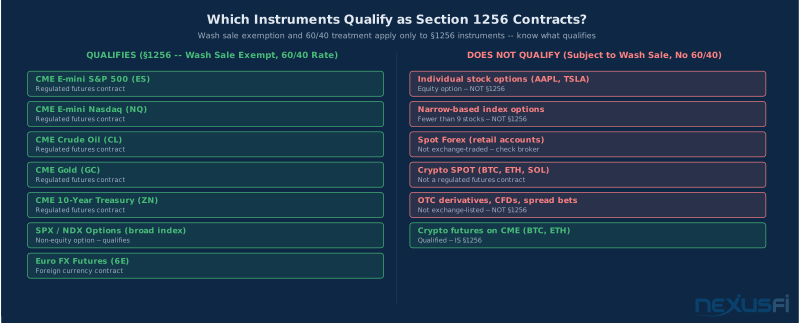
Not every derivative is a §1256 contract. The exemption is specific. Section 1256(b) defines qualifying contracts as:
- Regulated futures contracts — listed futures on US designated contract markets (CME, CBOT, NYMEX, COMEX, ICE) that require daily mark-to-market settlement by the exchange
- Foreign currency contracts — certain interbank forex forward contracts
- Non-equity options — options on regulated futures contracts, options on broad-based stock indices (like SPX options), and similar instruments
- Dealer equity options — specific to securities dealers, not relevant to retail traders
For practical purposes, if you're trading ES, NQ, CL, GC, ZN, ZB, SI, NG, 6E, RTY, or any other listed futures contract on a US exchange — you're in §1256 territory. Same for options on those contracts, and options on broad-based indices like SPX.
What's NOT §1256:
- Individual stock options (even on the same underlying as a futures contract)
- Narrow-based index options
- Equity swaps
- Most CFDs (not exchange-listed regulated futures)
- Crypto spot trading (though regulated crypto futures on CME ARE §1256)
The Incompatibility Explained #
Here's the conceptual issue Congress would have faced trying to apply wash sale rules to futures. The wash sale rule assumes:
- A discrete sale event generates a realized loss
- The taxpayer reacquires the "same" position within 30 days
- The economic exposure was continuously maintained through the substitution
With §1256 contracts, criterion #3 effectively always applies (mark-to-market means annual realization regardless of closing), and criterion #1 has no fixed meaning for open positions at year-end. You can't have a wash sale triggered by December 31 MTM — the MTM isn't a sale, it's a deemed sale that creates a fresh cost basis for the next year. The position doesn't need to be "repurchased" because it was never actually sold.
The result: for pure futures positions, the §1091 wash sale framework simply has no traction. The legislative history of §1256 (enacted in ERTA 1981 as part of the move to mandatory MTM accounting for regulated futures) confirms this wasn't an accident — Congress intended futures to operate under a at the core different recognition system.
The 60/40 Tax Math -- Your Actual Advantage #
The wash sale exemption is the absence of a disadvantage. The 60/40 split is a positive advantage.
Under IRC §1256(a)(2), net gains and losses from Section 1256 contracts are treated as:
- 60% long-term capital gains or losses
- 40% short-term capital gains or losses
This applies regardless of your actual holding period. A position held for 3 seconds gets the same 60/40 treatment as one held for 3 months.
The Math at Each Bracket #
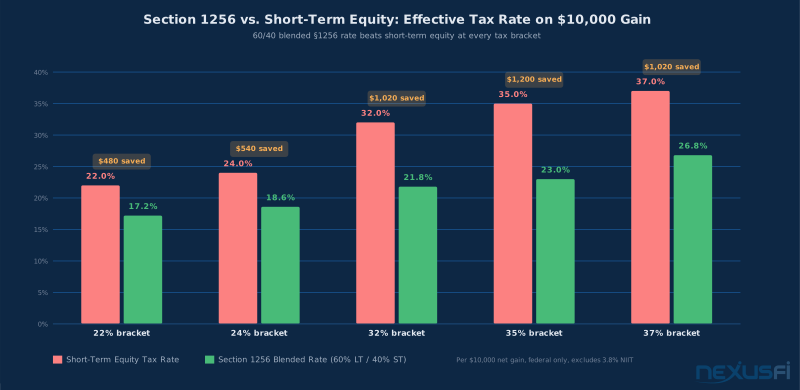
Let's calculate the effective tax rate on $10,000 of net §1256 gains at different brackets:
24% ordinary income bracket (MAGI ~$100K-$200K):
- Long-term capital gains rate: 15%
- Short-term (ordinary income) rate: 24%
- §1256 blended rate: (60% × 15%) + (40% × 24%) = 9.0% + 9.6% = 18.6%
- vs. short-term equity gains: 24%
- Savings: 5.4 percentage points per $10K = $540 saved
32% ordinary income bracket (~$200K-$383K):
- Long-term capital gains rate: 15%
- §1256 blended rate: (60% × 15%) + (40% × 32%) = 9.0% + 12.8% = 21.8%
- vs. short-term equity: 32%
- Savings: 10.2 percentage points = $1,020 per $10K
37% ordinary income bracket (highest bracket):
- Long-term capital gains rate: 20%
- §1256 blended rate: (60% × 20%) + (40% × 37%) = 12.0% + 14.8% = 26.8%
- vs. short-term equity: 37%
- Savings: 10.2 percentage points = $1,020 per $10K
Add Net Investment Income Tax (IRC §1411, 3.8%) on top for high earners if MAGI exceeds $200K (single) or $250K (MFJ) — it applies to both §1256 gains and equity gains, so it doesn't change the comparison.
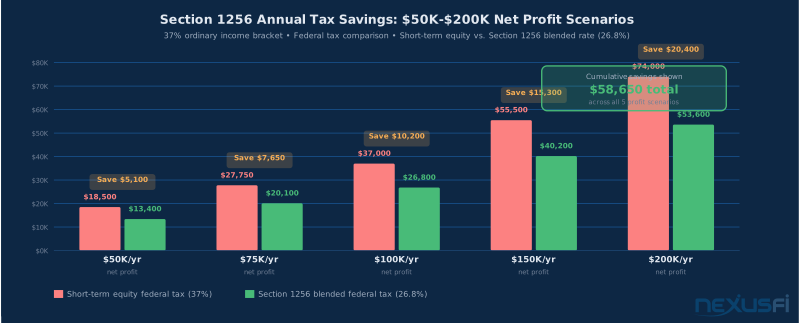
A trader at the top bracket consistently making $100,000/year net on futures saves approximately $10,200 annually just from the 60/40 rate differential compared to short-term equity trading. That's real money.
Losses Get the Same Split #
The 60/40 treatment applies to losses too, which is worth understanding. A $10,000 net §1256 loss breaks down as:
- $6,000 long-term capital loss
- $4,000 short-term capital loss
Capital losses offset capital gains of the same type first, then cross over. The $6,000 LT loss offsets long-term gains before touching short-term gains. This matters for portfolio tax planning — if you have significant long-term equity gains you're protecting, §1256 LT losses are directly useful.
If you have no offsetting gains, the standard $3,000 capital loss limitation (IRC §1211(b)) applies. You can deduct $3,000 of net capital losses against ordinary income per year, with the remainder carried forward indefinitely — still split 60/40 in the carryforward.
As @SMCJB laid out in NexusFi's Tax Thread: "Most Futures & Futures Option contracts are taxed as Section 1256 Contracts which means that they are taxed 60% at your long term capital gains rates and 40% at your short term capital gains rate no matter what the holding period. Hence in the highest tax bracket your Section 1256 tax rate is 26.8%."
Comparing to Equity Taxation by Holding Period #
| Strategy | Holding Period | Max Tax Rate |
|---|---|---|
| Futures §1256 | Any (seconds to years) | 26.8% + 3.8% NIIT |
| Equities short-term | < 1 year | 37% + 3.8% NIIT |
| Equities long-term | > 1 year | 20% + 3.8% NIIT |
| Equities long-term (lower brackets) | > 1 year | 15% or 0% |
Futures beat short-term equity much. Against long-term equity at the 20% rate, futures at 26.8% look worse — but that comparison only applies if you actually hold equity positions for over a year. For active traders whose equity positions are mostly short-term anyway, futures' 26.8% beats 37% by a wide margin.
@Luger made the calculation concrete in a 2012 Traders Hideout thread: "I am in the 25% bracket...Tax rate on broad based index futures = (60% × 15%) + (40% × 25%) = 19% — Pay IRS $190 for every $1,000 made. Tax rate regular short-term equities at 25% = $250 for every $1,000 made. Difference = $60 per $1,000 made." The math is the same at every bracket — futures consistently win on the tax rate for active traders.
Form 6781: Where the Numbers Go #
Section 1256 gains and losses are reported on Form 6781 (Gains and Losses from Section 1256 Contracts and Straddles). Understanding the form flow saves confusion at filing time.
The Basic Structure #
Form 6781 has three parts:
- Part I: Section 1256 contracts marked-to-market (your regulated futures)
- Part II: Gains and losses from straddles (if applicable)
- Part III: Unrecognized gains from positions held at close of year
For most futures traders, only Part I matters.
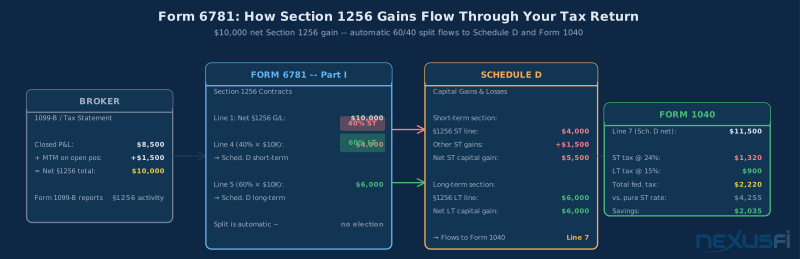
Part I, Line 1: Enter the total net gain or loss from all your §1256 contracts. This comes from your broker's Form 1099-B or their consolidated tax statement. Most futures brokers provide a summary of §1256 activity directly — some even calculate the 60/40 split for you.
Part I, Line 4: 40% of line 1 (your short-term portion) Part I, Line 5: 60% of line 1 (your long-term portion)
These flow to:
- Schedule D, Line 4 (short-term gains/losses from Part I): Combines with other short-term capital transactions
- Schedule D, Line 11 (long-term gains/losses from Part I): Combines with other long-term capital transactions
From Schedule D, the net capital gain/loss flows to Form 1040, Line 7.
Reconciling With Your Broker #
Here's where traders get confused: your broker's 1099-B (or year-end tax statement) shows your actual closed trading P&L. But §1256 also requires year-end MTM recognition of any open positions. If you have unrealized gains or losses on December 31st, those are taxable in the current year.
Most modern futures brokers handle this correctly in their tax documents, but always verify:
- Check that the §1256 summary includes both closed trades and the December 31 MTM adjustment for any positions held into the new year
- If you closed a position in January that was open at December 31, verify that the prior-year MTM adjustment and the current-year close are both reflected correctly
- Reconcile the reported P&L against your own records — data errors happen
If your broker's tax statement shows only closed-trade P&L without MTM adjustments, you have a problem. Contact them to clarify, or engage a CPA who specializes in trader taxation.
The 3-Year Loss Carry-Back (Most Traders Miss This) #
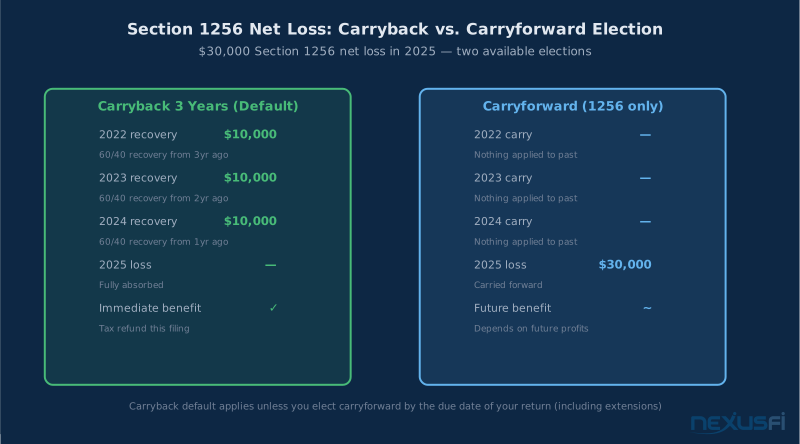
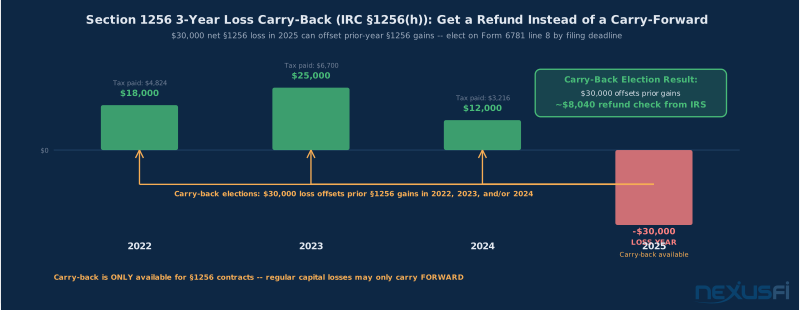
IRC §1256(h) grants futures traders a unique privilege: you can carry back a net Section 1256 loss to the three preceding tax years, offsetting prior §1256 gains only. This is reported on Form 6781, line 8, and is elected by filing an amended return for the carry-back year.
Why this matters: capital losses normally can only be carried forward. The §1256 carry-back is an exception that lets you get an immediate refund on taxes paid in prior profitable years.
Example: A trader had §1256 gains of $50,000 in 2022 and 2023, then suffered a $30,000 net §1256 loss in 2024. Without the carry-back, they'd carry forward the $30,000 loss to 2025. With the carry-back, they can amend 2022 and/or 2023 to apply the $30,000 loss against prior gains, generating a refund check. The election must be made by the filing deadline (including extensions) for the loss year.
This is one of the least-known advantages of §1256 — and the most valuable for traders who have a bad year after several profitable ones.
The Futures Trader's Practical Playbook #
Let's translate the legal framework into actual trading decisions.
No 31-Day Waiting Period #
The most immediate practical consequence: you can harvest losses without interrupting your trading. For equity traders, harvesting a loss requires either sitting out of the position for 31 days or finding a similar-but-not-identical substitute. Futures traders face neither constraint.
Equity scenario: You're long 10 contracts of SPY with a $15,000 unrealized loss by late November. You want the deduction but believe SPY will recover in December. Your options are bad ones — exit the position and wait 31 days (missing potential recovery) or buy a "similar" ETF and hope the IRS doesn't call it substantially identical.
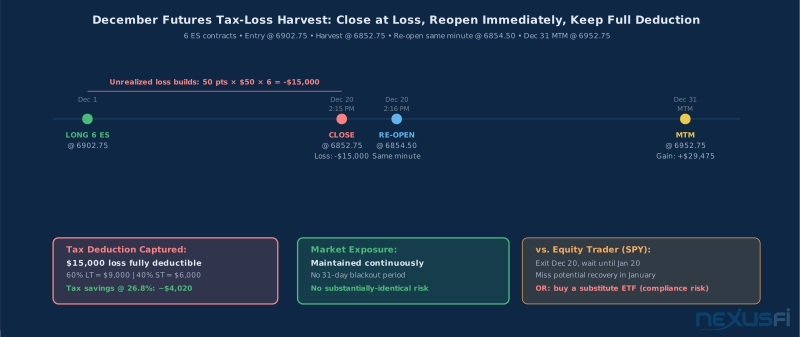
Futures scenario: You're long 10 ES contracts with a $15,000 unrealized loss by late November. Close the position, take the loss. Then buy 10 more contracts immediately if you want. The loss is fully deductible and your market exposure is restored within seconds. No compliance risk, no timing game.
The ability to manage positions for trading reasons — not tax reasons — is a genuine quality-of-life advantage for futures traders.
Same-Day Re-Entry Without Penalty #
This creates trading flexibility that equity traders simply don't have. Intraday futures traders who close losing positions and re-enter the same direction don't need to think about wash sales. A scalper who takes 40 trades per day in ES, closes some at losses, and re-enters the same side is in no compliance jeopardy whatsoever.
For equity daytraders, this is a compliance landmine. Each loss trade followed by a re-entry within 30 days is a potential wash sale. Managing that across dozens of daily trades requires software assistance, careful record-keeping, and potentially significant tax surprises at year-end.
Unlimited Loss Harvesting in December #
The December advantage is significant. In the final weeks of the year, futures traders can freely close any losing positions to realize tax losses, then reopen the same positions immediately to maintain market exposure. There's no constraint.
Equity traders in December are running complex optimization problems: which positions to harvest, how long to stay out, which replacement instruments are "safe" from a substantially-identical perspective, and how to sequence all of this across accounts. Futures traders can manage positions based purely on market view.
Concrete example: A futures trader in late December with $40,000 of realized gains and $20,000 of open unrealized losses in various contracts can close those losing positions on December 27th, recognize $20,000 of losses that offset gains (reducing the taxable position from $40,000 to $20,000), and reopen the same positions immediately on December 28th. Total tax impact: saves approximately $5,000+ in taxes at a 26.8% blended rate on the $20,000 now-recognized loss versus a $40,000 taxable year.
Year-End Tax Planning for Futures Traders #
The December 31 mark-to-market date creates specific planning opportunities that don't exist for equity traders.
The Year-End MTM Is Both a Gift and a Deadline #
On December 31, every open §1256 position is treated as sold at its closing price. This means:
- If you have unrealized gains in open futures positions, those gains are recognized and taxable in the current year — even if you don't close the trade.
- If you have unrealized losses in open futures positions, those losses are recognized and deductible — even if you don't close the trade.
This cuts both ways. If you're sitting on large unrealized gains in open futures positions and want to defer taxation, you need to close those positions before December 31 and reopen them in January (paying the current year's tax, but with a fresh cost basis for next year). Or simply accept the MTM and plan your estimated taxes so.
If you're sitting on unrealized losses in open positions, those losses will be recognized at year-end regardless. You don't need to close the position to capture the deduction — MTM does it automatically.
Key planning implication: In late December, review all open futures positions. Calculate your year-to-date net §1256 P&L including MTM of open positions at current prices. This is your projected taxable position. Then decide whether any adjustments (closing positions to lock in losses, closing winning positions to defer if your bracket changes) make sense from a tax perspective.
The 3-Year Carry-Back — Act Before the Filing Deadline #
If you have a net §1256 loss for the year, the carry-back election under §1256(h) must be made on your tax return (Form 6781, line 8) by the filing deadline including extensions. You can carry the loss back to any of the three preceding years, but only to offset prior §1256 gains — not other capital gains.
Carry-back year priority: most taxpayers apply the loss to the year with the highest §1256 gains first, to maximize the refund. Work with your CPA to improve the allocation across the three available years.
Missing this election is a real cost. If you had a bad futures year, filing a timely carry-back election can generate a meaningful refund check rather than carrying a loss forward into an uncertain future.
Managing the $3,000 Capital Loss Limitation #
Futures losses that exceed the current year's capital gains face the same $3,000 annual deduction limit against ordinary income as any other capital loss. The §1256 carry-back election provides an alternative path, but if you can't use the carry-back (because you have no prior §1256 gains to offset) or the carry-back doesn't fully absorb the loss, you're carrying forward the remainder.
Carry-forward losses retain their 60/40 character. A $15,000 §1256 loss carry-forward is tracked as $9,000 long-term and $6,000 short-term in future years. When those losses eventually offset future §1256 gains, the character matching applies automatically via Form 6781.
Quarterly Estimated Tax Planning #
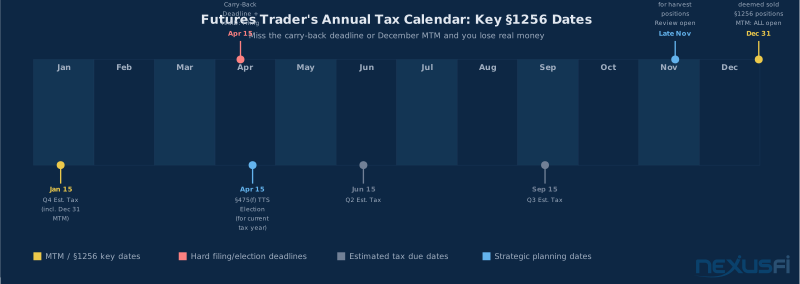
Your total §1256 tax liability isn't known until December 31 — quarterly estimates (due April 15, June 15, September 15, January 15) need calibration. Safe harbor: pay 100% of last year's tax (110% if prior-year AGI exceeded $150,000), or 90% of the current year's expected liability. For consistent futures traders, 110% of last year is safest — it eliminates underpayment penalties regardless of current-year results.
Key Dates, Forms, and Deadlines #
Quick-reference table for futures tax compliance:
| Date | Event | Action Required |
|---|---|---|
| December 31 | MTM valuation date | All open §1256 positions deemed sold at closing price |
| January 15 | Q4 estimated tax due | Include MTM from Dec 31 in calculation |
| January/February | Broker tax documents | Receive 1099-B and/or §1256 summary |
| March 15 | Carry-back refund deadline (S-Corps) | If applicable |
| April 15 | Tax filing deadline | Form 6781 due with return; §1256 carry-back election |
| April 15 | Q1 estimated tax due | First quarterly payment for current year |
| April 15 | §475(f) TTS election deadline | If electing for the coming tax year (must be done by prior year's return deadline) |
Forms you'll need:
- Form 6781: Section 1256 gains and losses (primary form for futures traders)
- Schedule D: Capital gains and losses (Form 6781 flows here)
- Form 1040: Main return (Schedule D flows to Line 7)
- Form 8949: Only for non-§1256 positions in your account
- Form 1040-ES: Quarterly estimated tax payments
Common Mistakes and How to Avoid Them #
Assuming the Exemption Covers Everything in the Account #
The most common error. "Futures are wash-sale exempt" is true for your futures positions. It's not true for your stocks, equity ETFs, or equity options. In a multi-asset portfolio, you need to track wash sales on the non-futures components as carefully as a pure equity trader.
Missing the December 31 MTM #
Traders who came from equities sometimes don't realize they owe taxes on unrealized futures gains held through December 31. The MTM recognizes the gain regardless of whether you close the trade. In mid-December, run a projected year-end P&L including MTM on all open positions at current prices, and adjust Q4 estimated tax if necessary.
Not Electing the §1256 Carry-Back #
The 3-year carry-back under §1256(h) is the most-missed election in futures taxation. After any losing futures year, check with your CPA whether carry-back to prior §1256 gains makes sense. Make the election on Form 6781, line 8, by the filing deadline — missing it means carrying the loss forward instead of getting a refund now.
Treating All Derivatives as §1256 #
Common non-qualifiers: crypto spot (not CME futures), equity options on individual stocks, narrow-based index options, OTC derivatives, CFDs. If you trade both CME ES options and individual stock options, only the ES options get §1256 treatment. The stock options face wash sale rules and no 60/40 split.
Broker Reporting Errors #
Futures brokers occasionally misreport §1256 activity around the December 31 MTM calculation. Always verify your broker's §1256 summary against your own records. If the numbers don't reconcile, contact the broker before filing — don't accept erroneous numbers on a filed return.
The Bottom Line #
The wash sale exemption for §1256 futures isn't a minor technicality — it at the core changes the economics of loss harvesting, position management, and year-end planning. No 30-day waiting periods. Same-day re-entry. Unlimited December loss harvesting. The 60/40 rate advantage on every position. A 3-year loss carry-back that equity traders don't get.
The limitation is equally clear: these advantages cover your §1256 futures positions. Your equity positions face full wash sale rules, and offsetting futures/equity positions can trigger §1092 straddle complications.
The line between "exempt" and "not exempt" in a mixed account is where the compliance work happens. Work with a CPA who specializes in trader taxation — the community has noted repeatedly that general-practice CPAs often don't know the §1256 framework, carry-back rules, or MTM timing nuances in detail.
For a deep dive into 60/40 mechanics across scenarios, see Section 1256 Contracts and the 60/40 Tax Rule. For the mark-to-market election that converts gains to ordinary income, see Section 475(f) Mark-to-Market Tax Election. For the record-keeping system that supports accurate §1256 reporting, see Futures Trading Record Keeping and Tax Reporting.
Knowledge Map
Go Deeper
Build on this knowledgeCitations
- — Differences between SPY and ES Intraday Trading (2021) 👍 9“60% of futures profits are taxed at a long term capital gains rate (a lower %), and only 40% are taxed at the higher short term rate -- plus 22.75 hour trading window vs SPY's 16 hours.”
- — Problem: E-Mini Futures 1099-B Tax Form Doesn't Include Commissions (2022) 👍 1“Phillip Capital 1099-B for E-Mini futures doesn't include routing fees, TT License fees, or market data fees -- traders need to reconcile from statements for accurate Section 1256 reporting.”
- — Problem: E-Mini Futures 1099-B Tax Form Doesn't Include Commissions (2026) 👍 1“Section 1256 Box 11 on 1099-B contains Net Realized P/L and standard commissions -- routing fees and platform licenses are separate deductions traders report independently.”
- — Irs.gov (2024)
- — Irs.gov (2024)
- — Law.cornell.edu (2024)
- — Cftc.gov (2024)
- — Cmegroup.com (2024)
- — Irs.gov (1993)