



Micro Channels and Tight Channels in Day Trading: Al Brooks' Framework for Trading Extreme Urgency
Overview #
Micro Channels and Tight Channels in Day Trading: Al Brooks' Framework for Trading Extreme Urgency
If the markets have a red-alert mode, micro channels are it.
When you watch price carve out a series of small, controlled bars — each one a nearly identical step in the same direction, barely giving the opposing side a breath — you are watching one of the most reliable continuation signals in price action trading. Al Brooks calls these micro channels, and his core rule is unambiguous: when you see one, never trade against it.
This article is your complete guide to identifying micro channels and their close relative tight channels, understanding the order flow dynamics that create them, and deploying the breakout-pullback entry that consistently extracts value from these high-urgency structures. It also covers the ending signals that most traders miss — because knowing when a micro channel is finished is just as important as knowing how to trade one.
Micro channels appear across all time frames and liquid markets, but they're especially common and tradeable in the ES (E-mini S&P 500) futures — the world's most liquid index futures contract and the market that Al Brooks himself uses as his primary reference. The examples throughout this article are drawn from ES trading, but the mechanics apply equally to NQ, CL, GC, and any other deeply liquid futures instrument.
The Channel Spectrum: From Normal to Micro #
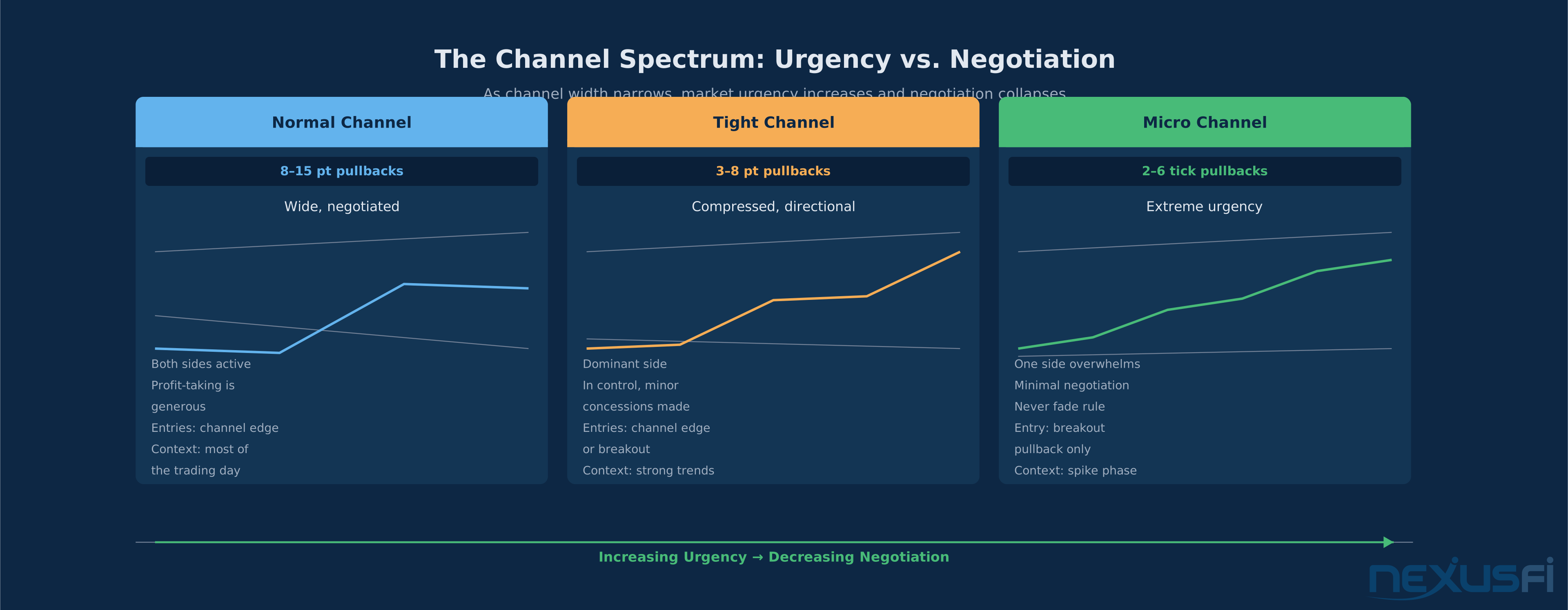
Before isolating micro channels, it helps to understand where they sit on the spectrum of channel structures.
Normal channels are what most traders visualize when they hear "trend." Price makes progress in one direction, pulls back meaningfully (often 30-50% of the prior leg), and then continues. The channel is wide enough to breathe — you can see negotiation happening at the boundaries, sellers or buyers testing the edge before the dominant side reasserts. A normal upward channel on a 5-minute ES chart might have pullbacks of 8-15 points. There's rhythm to it, back-and-forth that still resolves in one direction.
Tight channels are a notch more urgent. Pullbacks narrow to 3-8 points on the same 5-minute ES chart. The market is still making small concessions to the opposing side, but the dominant flow is clearly in control. Tight channels often form mid-trend, after a spike phase has established directional conviction and price settles into a more sustainable (though still directional) grind.
Micro channels are the extreme end. Pullbacks compress to 1-4 points on a 5-minute ES chart — or effectively to 2-6 ticks on a 1-minute chart. There is almost no negotiation. The market is moving as if it has somewhere urgent to be, and the opposing side can barely register a tick of protest before price resumes. The channel lines are nearly parallel, the bars are nearly identical in slope, and breakouts through the channel edge snap back immediately rather than following through.
What distinguishes micro channels is not just tightness but urgency. Urgency means: the aggressive side (buyers in a bull micro, sellers in a bear micro) is not waiting for a better price. They are hitting market orders, consuming limit orders, and moving price without pausing to let order flow rebalance. This is a at the core different market condition from the negotiated back-and-forth of normal channels.
The channel spectrum is a measurement of negotiation. The wider the channel, the more both sides are negotiating. The tighter the channel, the more one side is dominating without conversation.

Anatomy of a Micro Channel: What You're Looking For #
A micro channel has six identifying characteristics, and you want to see most of them before labeling what you're watching as a true micro channel:
1. Narrow channel width. The most obvious feature. On a 1-minute ES chart, the distance between the upper and lower channel trendlines is 5 ticks or less during active formation. On a 5-minute chart, 10 ticks or less. The key comparison is to the session's recent pullback behavior: if the last hour saw 8-12 tick pullbacks and now pullbacks are 2-3 ticks, you're watching the structure compress into micro territory.
2. Consistent slope. Both trendlines — the one drawn across the swing highs and the one drawn across the swing lows — are sloped in the same direction. This is what makes it a channel rather than a wedge. The width stays roughly constant as price advances, which tells you the dominant side is applying even, sustained pressure.
3. Tiny pullbacks that don't threaten the trend. Each individual pullback is so small that it doesn't produce meaningful overlap. A bull micro channel shows bars where each low is higher than the prior low, and each high is higher than the prior high — but the lows barely dip before price recovers. These pullbacks represent profit-taking by the longs, not genuine selling pressure from bears entering new shorts.
4. Low bar-to-bar overlap. In a normal channel, adjacent bars share a significant portion of their range. In a micro channel, bars barely overlap — each bar's open is close to the prior bar's close, and each bar closes near its extreme. On a bull micro channel, most bars close in the upper third of their range. On a bear micro, most close in the lower third.
5. Rapid boundary retests. When price touches the lower trendline of a bull micro channel, it bounces within one or two bars. It doesn't sit at the trendline for three or four bars negotiating. The retest is quick because the dominant side (buyers, in a bull micro) are already waiting at that level. They know the structure, and they reload immediately.
6. Frequent shallow breakouts that fail. Price regularly pokes above the upper trendline of a bull micro channel for a bar or two, then pulls back into the channel. These are not genuine breakouts — they're brief expansions of the dominant side's aggression that immediately get absorbed or profit-taken. The important thing is that they don't follow through: price returns to the channel edge and continues the micro pattern.
When you see all six of these features simultaneously, you're watching a textbook micro channel. In practice, you often see five of the six — the identification requires judgment, not mechanical rule-following.
The key observation is the clean, repetitive structure — the identical cadence of each push and pullback that makes micro channels visually distinctive once you've seen a few.

The Urgency Signal: Why Micro Channels Form #
The order flow mechanics behind micro channels explain why they're so tradeable and why the never-fade rule is so reliable.
Normal trending markets involve a constant negotiation between buyers and sellers. Buyers place limit orders below the current price to buy at a better level. Sellers place limit orders above the current price to sell at a better level. Both sides are working within a price-discovery framework, and the result is the back-and-forth you see in normal channels.
Micro channels form when this negotiation collapses in one direction.
In a bull micro channel, buyers are no longer waiting for a better price. They're using market orders — hitting the offer immediately rather than sitting at the bid waiting for price to come to them. This aggressive buying sweeps through the available limit orders on the ask side, forcing market makers and passive participants to reprice higher. The small pullbacks you see represent moments when the aggressive buyers briefly pause (taking profits or waiting for the next trigger), but the pause is so short that the remaining limit orders on the bid side are quickly absorbed and price resumes upward before any meaningful selling can organize.
This creates a self-reinforcing dynamic: the more aggressively buyers push price up, the more sellers who were waiting at "better" levels find their limit orders either skipped past or no longer advantageous. They either chase up or step aside, which removes the available supply that would normally slow the advance. Buyers are ascending through layers of offer-side liquidity with minimal resistance.
The result is the micro channel's defining visual signature: almost identical, parallel bars with tiny pullbacks and rapid boundary retests.
What triggers this aggressive order flow? Several contexts reliably produce micro channels:
Trend day continuation. On a strong bull trend day, each pullback draws in additional buyers who missed the earlier move. The mounting urgency comes from participants who know the day's character and don't want to miss further upside. Each micro pullback is a loading opportunity that gets overwhelmed with buy orders faster than any selling can organize.
Breakout from a range. When a multi-hour trading range finally breaks decisively, participants who were waiting on the sidelines for direction confirmation all enter at once. The surge of one-sided order flow compresses into a micro channel structure.
Approaching a major level. When price is 10-20 points from a major objective — a prior high or low, a round number, a high-volume node from a previous session — urgency increases as the dominant side presses hard to reach that level. The nearer the objective, the tighter the channel often becomes.
Program acceleration. Algorithmic trading programs that are tracking trend momentum will often increase their order size as a trend strengthens. When multiple programs simultaneously increase buying (in a bull micro) or selling (in a bear micro), they can generate the compressed, parallel structure of a micro channel even in the absence of any external news trigger.
The Never-Fade Rule: Brooks' Core Principle #
Al Brooks is explicit: you never short a bull micro channel. You never buy a bear micro channel. The never-fade rule is absolute during the active formation of the structure.
The reason is probability. Micro channels form because one side has overwhelming order flow advantage. To fade them is to assume that this advantage will reverse immediately — to take a position against the most dominant force on the tape. The math doesn't work.
Consider what happens when you short into a bull micro channel. Your stop must go above the recent high (the channel's upper edge). But if the micro channel is intact, price is going to retest that edge within 1-2 bars — the same rapid boundary retest that defines the structure. Your stop is in the strike zone of normal micro channel behavior. You're going to be stopped out not because you were wrong about the larger trend, but because you positioned yourself in the exact price zone where the dominant buyers reload.
The "death by a thousand cuts" description is precise. Each individual loss is small because you're trading tight structures. But those small losses accumulate rapidly when you're consistently on the wrong side of a micro channel.
The only exception to the never-fade rule is when you have clear structural evidence that the micro channel has ended. Specifically:
- The breakout pullback fails to hold the breakout level
- Ranges are expanding, producing noticeably larger bars
- Overlap is increasing — adjacent bars are sharing more of their range
- Multiple bars accept price on the opposite side of the channel edge
This exception requires multiple confirming signals, not just "it looks extended." The common mistake is looking at a micro channel that has run 20 bars and thinking "surely it can't continue" — a judgment about duration, not structure. Micro channels can persist for 30, 40, even 50 bars on a strong trend day. Duration alone is never sufficient justification to fade.
Never fade a micro channel in progress. The never-fade rule holds until you see at least two confirmed ending signals. Duration and extension alone never count as structural evidence.
The counterintuitive truth: if you missed the micro channel, wait. The breakout-pullback entry or ending signals will both arrive — each offers far better probability than forcing a countertrend entry.
The Breakout-Pullback Entry: Your Primary Setup #
The high-probability way to trade micro channels is not to buy in the middle of one (too much uncertainty about where the channel is) and not to buy at the channel edge (requires precision that's hard in real-time). The professional approach is the breakout-pullback.
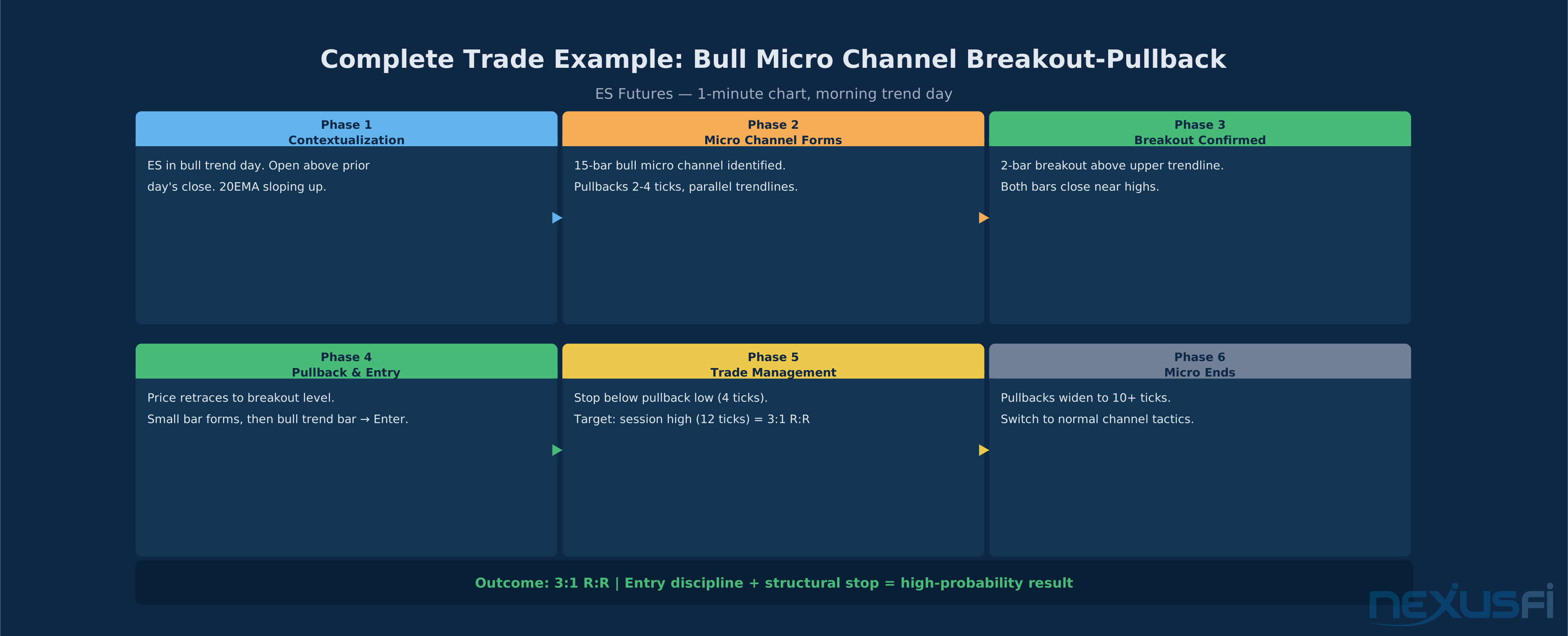
Here's the complete sequence for a bull micro channel breakout:
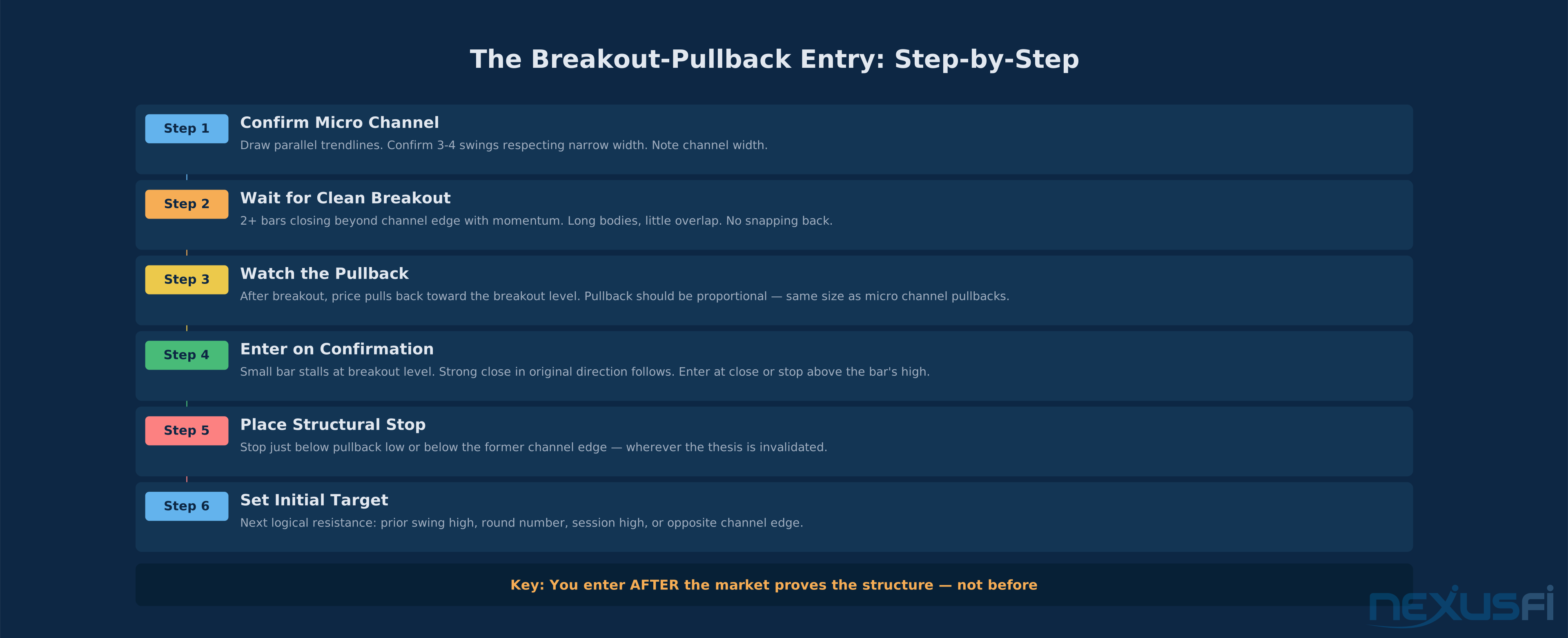
Step 1: Confirm the micro channel. You need to see at least 3-4 swings respecting the same narrow channel width. Draw the two parallel trendlines. Note the channel width, which will inform your stop placement.
Step 2: Wait for a clean breakout above the upper trendline. A clean breakout means at least 2 bars closing above the upper trendline, with minimal overlap and preferably long bodies. Single-bar breakouts that immediately close back inside the channel don't count — those are the shallow failures mentioned earlier in the identification criteria.
Step 3: Watch for the pullback. After the confirmed breakout, price will often pull back toward the breakout level. This is not the micro channel reasserting itself — it's profit-taking by the traders who were long from inside the channel, or brief hesitation as the dominant order flow reloads. The pullback should be small: roughly the same magnitude as the pullbacks you saw inside the micro channel.
Step 4: Enter on the pullback when it shows confirmation. The signal you're looking for is a bar that: (a) stalls near the breakout level without closing back inside the former channel, and (b) is followed by a strong close in the direction of the original micro channel slope. For a bull micro, this means a small bar near the breakout level followed by a bull trend bar. You enter at the close of that bull trend bar, or on a stop order just above its high.
Step 5: Place your stop. Your stop goes just below the bottom of the pullback bar, or just outside the lower edge of the original micro channel — whichever is more conservative. Because micro channels are narrow structures, stops are naturally tight. This is one of the great advantages of trading these setups: the structure's tightness gives you a logical, small stop that defines your risk precisely.
Step 6: Set your first target. The minimum initial target is the next logical resistance level — often the next swing high above the breakout point. For a micro channel that has been advancing for 30 minutes, this might be the current session's high or a prior-day reference level. If momentum continues after the initial target is reached, trail a portion of the position.
The psychology of the breakout-pullback is important to understand. You're entering after the breakout confirmation, not before. This means you've given up some potential profit compared to the traders who were long inside the micro channel. But you've also much reduced your risk: you're entering with clear evidence that the breakout has occurred and that it's holding, rather than guessing that it will hold.
@Bacon's advice in the Elusive Price Action thread captures the broader channel trading philosophy that applies here: "If you're using a range strategy, then your stops will be very tight (just a very few ticks) above the resistance (for the short cycle) or below the support (for the long cycle) because if price violates your channel boundaries, then the situation is changed (no longer in a channel) and you need to get out anyway."
The principle is the same for micro channel breakout entries: the breakout level is your line in the sand. If the pullback violates it materially, the setup is invalidated and your stop protects you from a larger loss.
Entering within the channel vs. on breakout pullback. Some experienced price action traders do enter from inside the micro channel — buying at the lower trendline during a bull micro. This can work when you have a strong read on the trend day context and can identify which pullbacks are genuine channel retests versus ones that might signal an ending. For traders newer to micro channel analysis, the breakout-pullback entry is more forgiving because it requires the market to prove the structure with two confirming signals (the breakout and the pullback hold) before you commit capital.
Stop Placement and Target Setting #
Getting the entry right is only half the work. Position management in micro channel trades requires specific attention because of the structure's narrow width.
Stop placement principles:
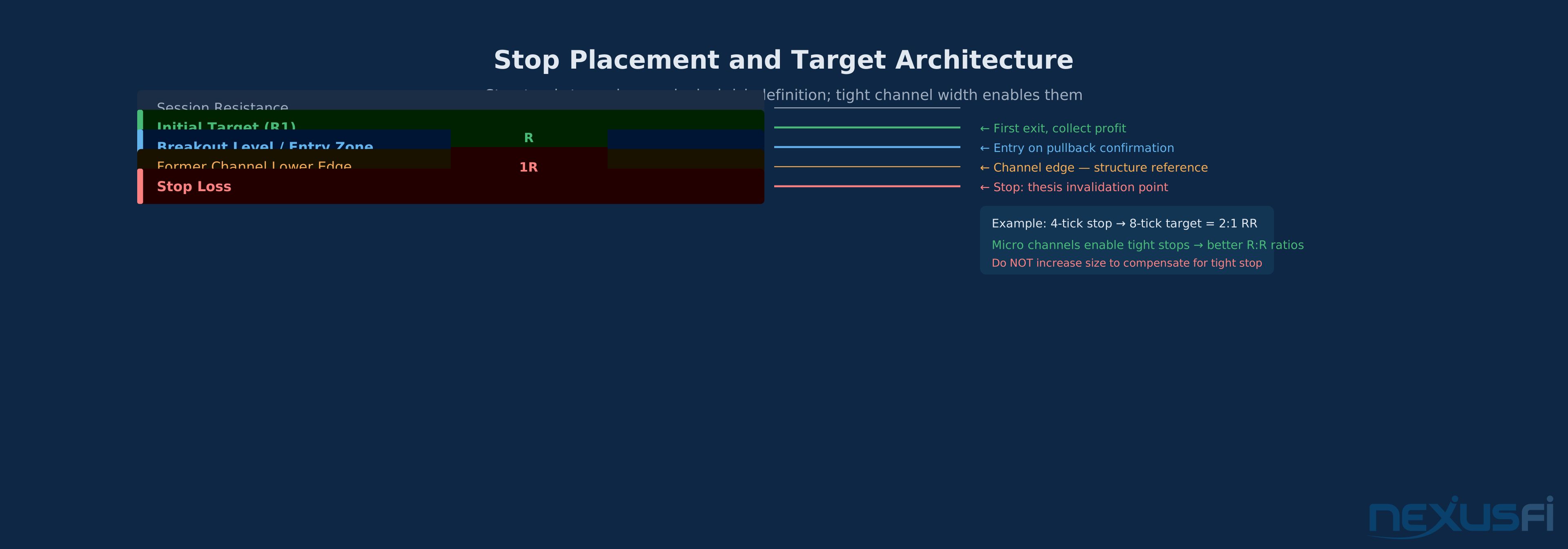
Structure-based stops, not emotional stops. Your stop should go where your thesis is invalidated, not at an arbitrary tick value. For a bull micro channel breakout-pullback entry, invalidation means the pullback has pushed back inside the original channel to the point where the breakout can no longer be considered confirmed. A good practical rule: your stop goes just below the lowest point of the pullback bar (with 1-2 ticks additional buffer for ES spread and slippage).
Avoid placing stops inside the former channel. If the breakout level is at 5,600.00 and your entry is at 5,600.50, placing a stop at 5,599.75 puts it just inside the former channel boundary — exactly where price would trade on a brief re-test of the breakout level. Better to place it at 5,599.25 or lower, giving the structure room to breathe while still reflecting a true thesis invalidation.
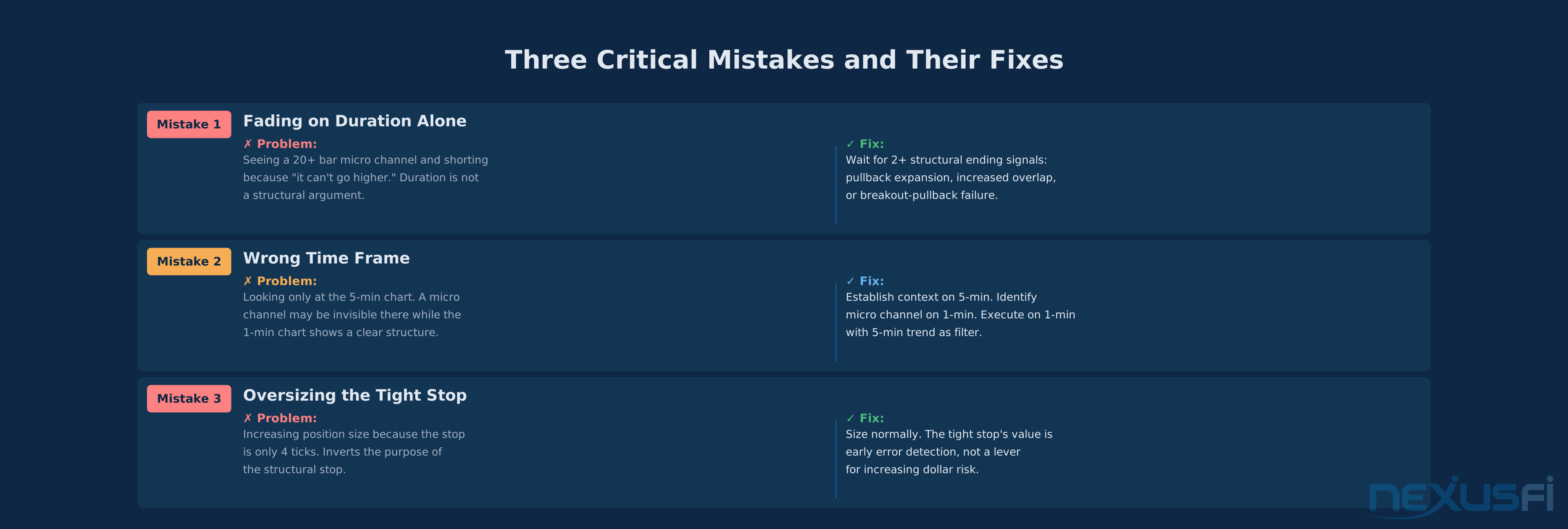
Size appropriately for the tight stop. Micro channel setups often have naturally tight stops — sometimes as small as 4-6 ticks on a 1-minute ES chart. This can tempt traders to increase position size because "the risk is small." Resist this. The tight stop increases the probability of being stopped out on normal noise, and an oversized position that gets stopped multiple times will accumulate meaningful losses. Size normally and let the tight stop work as designed: it identifies when you're wrong early, before the loss compounds.
Target setting principles:
First target: the opposite micro channel edge or the next resistance level. If you've entered on the breakout-pullback from a bull micro channel, your minimum target is the next significant resistance: a prior swing high, a round number (4,300, 4,350, etc. in ES), or the upper edge of a larger containing channel.
Trail above the initial target. If price reaches the initial target and continues with momentum — showing strong closes, minimal overlap, and rapid continuation — trail a portion of the position. Micro channel breakouts sometimes develop into full trend legs that run 20-40 points in ES. You don't need to catch all of it, but there's no reason to take all profits at the first target if the structure continues to support the trade.
Manage using expanding structure. When the structure that started as a micro channel has transitioned to a normal channel (see the next section), switch to normal channel management rules: buy near the lower trendline, sell near the upper trendline, and don't expect the urgency of the micro phase to continue.
How Micro Channels End #
Recognizing the end of a micro channel is arguably more important than recognizing its beginning. The ending signals tell you to stop looking for continuation entries and start watching for the transition structure that will define your next opportunity.
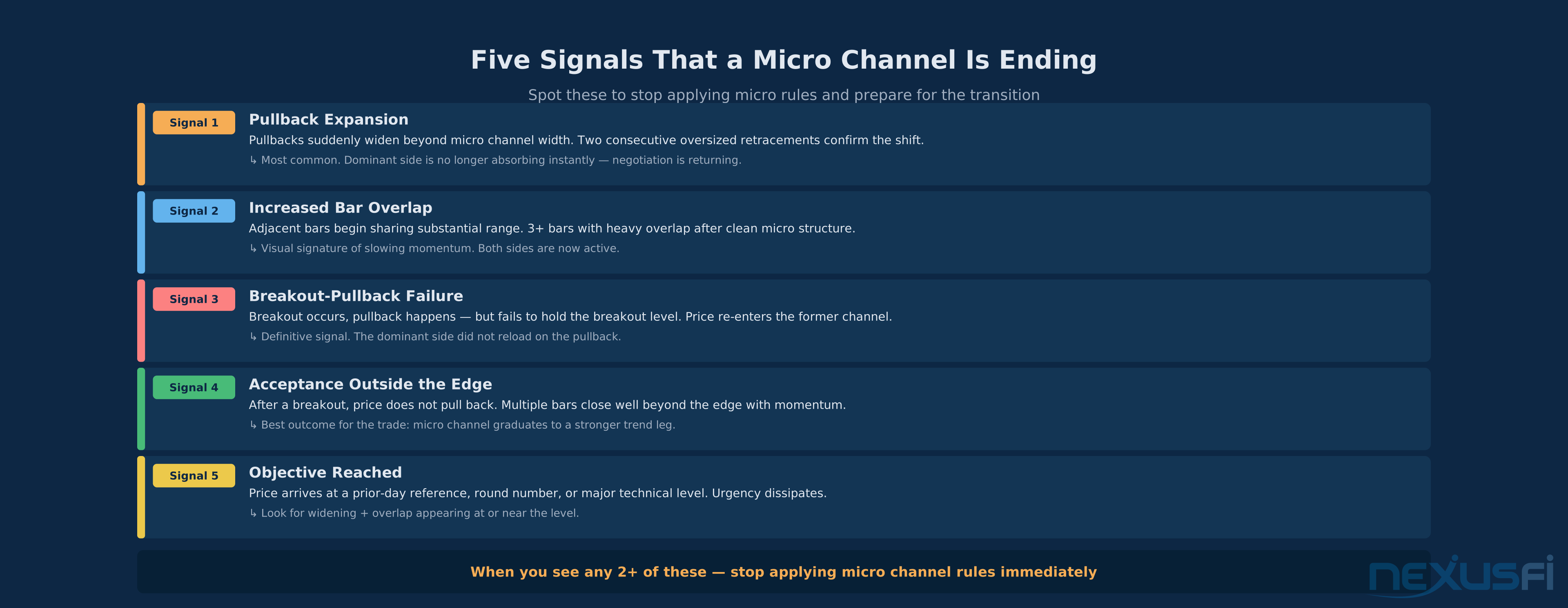
There are five primary ending signatures:
1. Pullback expansion. The most common ending signal. The pullbacks — which have been 2-6 ticks during the active micro channel — suddenly become 10-15 ticks or more. A single large pullback doesn't always signal the end (it might be a brief spike against the trend before continuation). But when two consecutive pullbacks are noticeably larger than anything seen during the micro phase, the structure has changed. The dominant side is no longer absorbing the opposing side instantly — some genuine negotiation is returning.
2. Increased bar-to-bar overlap. Adjacent bars begin sharing much more of their range. Instead of each bar closing near its extreme and the next bar opening near that level, you start seeing bars where the open and close are both inside the prior bar's range. This is the visual signature of slowing momentum and increasing two-sided activity. When you see three or more bars with heavy overlap after a clean micro channel, the urgency is dissipating.
3. Breakout-pullback failure. The definitive signal. A breakout occurs through the channel edge, the pullback happens — but instead of holding the breakout level, price continues through it and back into the former channel with momentum. This tells you the breakout was not genuine: the dominant side did not use the pullback as a reload opportunity. If a second breakout attempt also fails, the micro channel is very likely over.
4. Acceptance outside the channel edge. Rather than a failed pullback, this is the opposite scenario: price breaks the channel edge and instead of pulling back, it continues decisively. Multiple bars close well beyond the channel edge with momentum and minimal overlap. This is the best outcome for traders who entered on the breakout-pullback: it means the micro channel phase has transitioned directly into a stronger trend leg.
5. Objective reached. Micro channels often run to a specific price objective — a prior high or low, a round number, a major technical level. When price reaches that level, the urgency that drove the micro channel dissipates. The dominant side has achieved its objective; it no longer needs to aggressively push price. You'll see the micro channel ending characteristics appear at or near these levels, often accompanied by increased volume and wider-ranging bars.
Micro channels sit at the extreme end of the "breakout/spike" phase of this cycle. Their natural ending leads to either a tight channel (slightly wider, slightly less urgent), a normal channel, or a trading range consolidation. Understanding which transition is occurring helps you identify your next entry context.
The Transition: What Comes After #
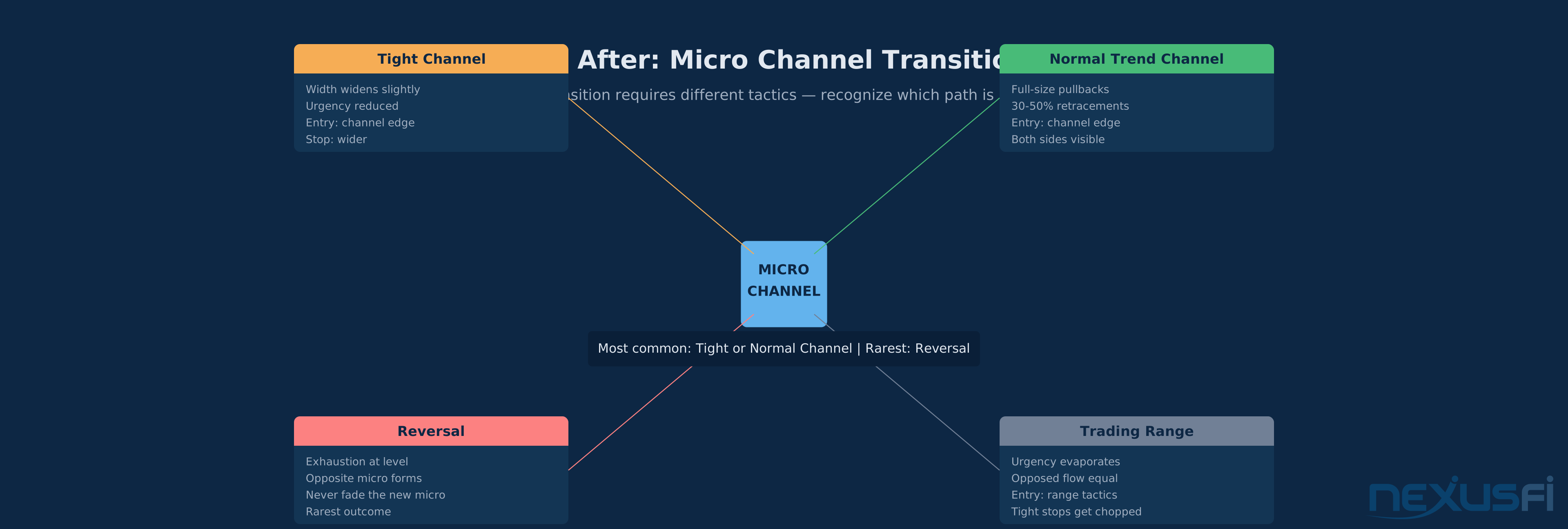
Micro channels don't end in a vacuum — they transition into one of four structural outcomes, and each requires a different trading approach:
Transition 1: Micro to Tight Channel. The pullbacks widen slightly but the trend direction continues. You switch from the breakout-pullback entry (which required the urgency of a micro channel) to channel edge entries (buying near the lower trendline of the new, wider channel). Stops get wider to accommodate the larger pullbacks.
Transition 2: Micro to Normal Trend Channel. A more significant deceleration. Pullbacks become full-size retracements (30-50% of the prior leg), the parallel channel lines are clearly wider, and two-sided activity is apparent. Standard trend channel trading applies: entries at the channel edge with measured-move targets at the opposite edge or beyond.
This acceleration-from-the-channel behavior is the micro channel breakout in a larger context: a normal channel suddenly compresses back into micro behavior for one leg before resuming the normal channel width.
Transition 3: Micro to Trading Range. The urgency completely evaporates. The dominant side that was pressing price so aggressively either takes its profits or runs into a wall of opposing interest at a major level, and price begins to chop sideways. This is the worst transition for trend followers because the same tight stops that worked perfectly in the micro channel will get chopped out repeatedly in the trading range. Recognition is critical: when you see overlap increasing, bars reversing within prior bars' ranges, and the channel lines converging, move to trading range tactics or step aside.
Transition 4: Micro to Reversal. The rarest outcome. The micro channel exhausts itself into a major level, and the opposing side responds with such overwhelming force that the reversal leg is itself powerful. In a bull micro channel that runs into major resistance, a genuine reversal often begins with a bear micro channel moving in the opposite direction — the same urgency, same structure, now pointing down. This is when the never-fade rule reapplies immediately, but in the new direction.
The pattern @snax describes — tight trading ranges compressing before a breakout — is precisely the environment that generates micro channels. Compression followed by urgency, urgency that eventually eases into a channel. This is the rhythm of trending markets.
Micro Channels Within the Larger Context #
A micro channel never exists in isolation. It is always one component of a larger multi-timeframe picture, and trading it intelligently requires awareness of where the micro structure sits within the broader tape.
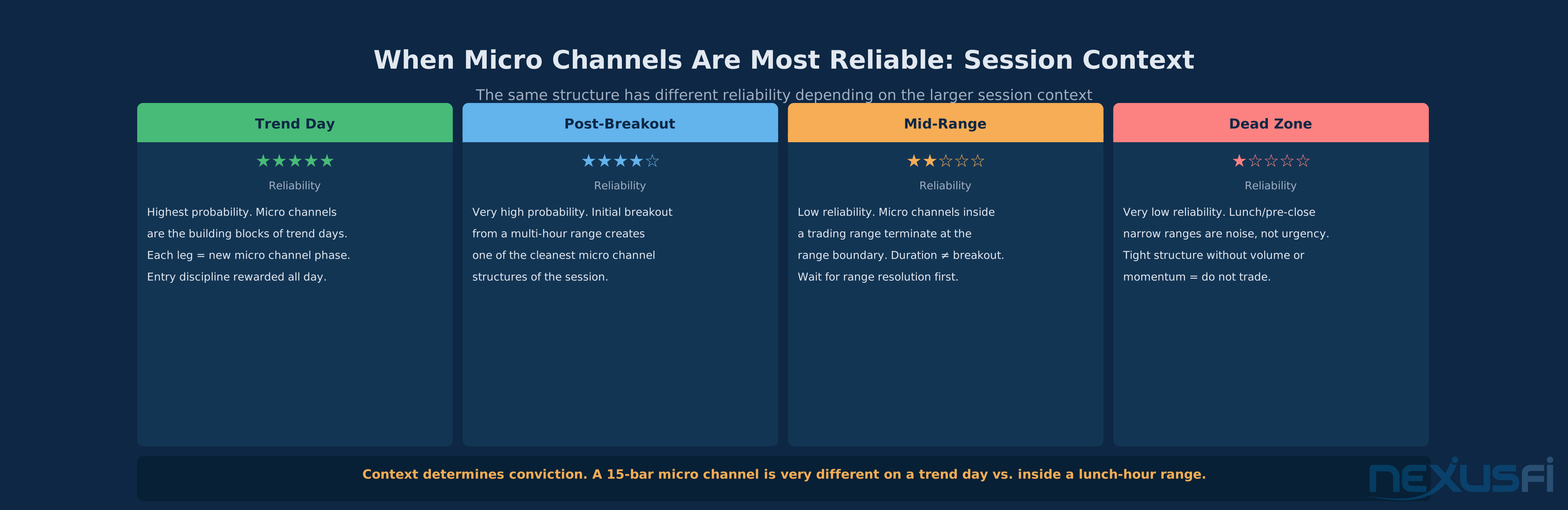
On a trend day, micro channels are the most reliable trading environment. The day's dominant order flow creates the conditions for sustained micro channel behavior across multiple legs. Each leg may be a micro channel of 15-30 bars followed by a brief normal pullback, then another micro channel leg. On a trend day, the breakout-pullback entry can be applied to every micro channel formation, and the probability of continuation is highest because the larger context supports it.
During the middle phase of a trading range, micro channels are unreliable and often dangerous. A 20-minute micro channel that forms inside a 3-hour trading range is likely to terminate at the trading range boundary rather than break through it. The same structure that signals extreme urgency on a trend day signals a temporary imbalance within a balanced environment on a range day. Context changes the interpretation.
Common Mistakes and How to Avoid Them #
Mistake 1: Fading at arbitrary levels. The most common error. A micro channel runs 15 bars and the trader thinks "it can't go any higher" and shorts. The micro channel continues for another 20 bars. The trader has no basis for the fade except duration — and duration alone is not a structural argument.
Fix: Only consider a fade after you see at least two of the five ending signals described above. Duration is not an ending signal.
Mistake 2: Using the wrong time frame. Micro channels are most visible on the 1-minute or 2-minute chart. Looking at the 5-minute chart might show a normal channel while the same period's 1-minute chart is clearly micro. Conversely, what looks like a micro channel on a 2-minute chart might be a single bar's worth of noise on the 15-minute chart. Always confirm the structure on at least two time frames before treating it as tradeable.
Fix: Establish larger context on the 5-minute chart, identify the micro channel on the 1-minute chart, execute on the 1-minute while confirming the 5-minute trend context.
Mistake 3: Entering the breakout-pullback too early. The trader enters at the first bar of the pullback rather than waiting for confirmation that the pullback is ending. The pullback continues, stops the trader out, and then price resumes in the original direction — exactly as the breakout-pullback thesis predicted, just a few bars later.
Fix: Wait for the first sign that the pullback has ended: a small bar near the breakout level followed by a strong close in the original direction. Patience costs you a few ticks of entry price and gains you substantially higher probability.
These three mistakes share a common thread: the fix always requires more patience and structural confirmation, not more aggressive action.
The Practical Checklist #
Before every micro channel trade:
To enter: Confirm channel width is compressed (5 ticks or less on 1-min ES), at least 3-4 swings respecting narrow parallel trendlines, minimal bar overlap, rapid boundary retests. Confirm a clean breakout has occurred (2+ bars closing beyond the edge with momentum). Wait for a pullback that stops near the breakout level. Enter only on a confirming reversal bar at that level.
For stops and targets: Stop goes just below the pullback low or outside the former channel — wherever the thesis is invalidated. First target is the next logical resistance (prior swing high, round number, session high). Trail on continuation.
To recognize the end: Watch for any two of these: pullbacks expanding beyond micro channel width, increased bar-to-bar overlap, breakout-pullback failure (price returns inside the former channel), or price reaching a major reference level. When you see them, stop applying micro channel rules.
Knowledge Map
Go Deeper
Build on this knowledgeReferences This Article
Articles that build on this topicCitations
- — YM day trading with price action - My Journey (2014) 👍 1“Price had a bear spike and channel move. There were 2 pushes down in the channel before price moved up to the top of the channel and steadily broke out of the bear channel. A micro bull channel above the ema can be drawn.”
- — PATs - Price Action Trading - Elite Members Common Journal (2016) 👍 3“I don't know what planet I was on because I was fading an uptrend. Also price was in a bull micro-channel and as Al Brooks would say, you NEVER short a bull micro-channel, only look to go long. It was like death by a thousand cuts.”
- — The Elusive Price Action: How to Trade (2010) 👍 14“If you're using a range strategy, then your stops will be very tight (just a very few ticks) above the resistance (for the short cycle) or below the support (for the long cycle) because if price violates your channel boundaries, then the situation is changed.”
- — Price Action Ripper's Journal (2014) 👍 8“The market has two native states: Trend or Trading Range. Trends consist of Breakout (spike) and channels phases. Channels tend to expand until they form a range. All trends end in some kind of range and then will breakout again in either direction.”
- — Crossing the Abyss: An Adventure Guide by Snax (2022) 👍 5“March 15 & 16 were the beginning of the bull spike that has now transitioned into a channel as it eases off the momentum. We had tighter trading-ranges over the previous two weeks, with several days of gentle bear channels.”
- — PA Dax CL, ES and Bund Price Action Trading Log (2018) 👍 5“When a trend is trading in a channel, what you would expect when it touches the bottom of the channel is that bears will take profits and bulls will scalp. However, 1 out of 4 times the trend will accelerate out of the channel.”
- — Microtrendlines and Microchannels (2020)
- — Trading Price Action Trends (Wiley) (2011)
- — Making a Living with the Micros (2021) 👍 2“The most important lesson I have learned in the past year has been to stop trying to fade every bull run. That is what I used to do. I would scalp every supposed top and get gored by lots of big bad bull horns most days. I don't do this any more.”
- — Spoo-nalysis ES e-mini futures S&P 500 (2016) 👍 18“After the break out of the wedge you had another small pullback and another breakout. This is clear stair stepping behavior. Price did not trade back below breakout. All of this is clear bull strength/pressure and should be respected.”