



Futures Broker Technology Infrastructure: Co-Location, Direct Market Access, and the Stack That Determines Your Fill Quality
Overview #
You picked a futures broker. Now you're wondering why your orders fill at a different price than what you saw on the screen. Or why your algo, which works perfectly in simulation, loses the edge in live trading. Or why a trader on a forum swears their fills are consistently better than yours on the same contract.
The answer almost never lives in your strategy. It lives in the pipes.
The technology stack connecting your order to the exchange matching engine is a chain of physical and software layers — and every link in that chain adds latency, introduces variability, and shapes whether your execution reflects what the market actually offered. Most retail traders never think about this. The ones who do can answer a simple question: at what tier does my order touch the exchange?
This article breaks down the full broker technology stack — co-location, direct market access, FIX protocol, smart order routing, CME Globex connectivity, and the infrastructure tiers that separate a retail account from an institutional one. Not to convince you that you need a co-located server (you probably don't). But so you understand exactly what you're getting from your broker, what you're paying for, and where your execution quality actually comes from.
What Execution Quality Actually Means #
Before getting into infrastructure, you need a working definition of what good execution looks like. It's not just about speed.
Execution quality has three components:
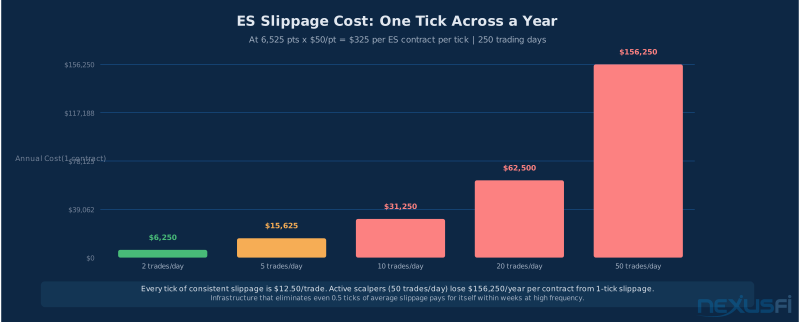
Fill price vs. quoted price (slippage) — Did your limit order fill at the limit, better, or worse? Did your market order move the price before it filled? At ES with a contract value around $32,625 (at 6,525 points x $50/point), even one tick of slippage is $12.50. Trade 10 times a day, 250 trading days, and one tick of consistent slippage costs $31,250/year on a single contract.
Fill probability — For limit orders, did the order get filled when price touched that level? A broker with better queue position and routing gets you a fill; a slower broker misses it.
Consistency under stress — During fast markets, system stability, and volatility spikes, does execution quality hold? Or does latency balloon and fills deteriorate exactly when you need them most?
All three of these trace back to the infrastructure stack.
The Order Path: From Click to Fill #
Before you can evaluate broker technology, you need to understand the full path an order takes from your machine to the exchange matching engine. That path has more stops than most traders realize.
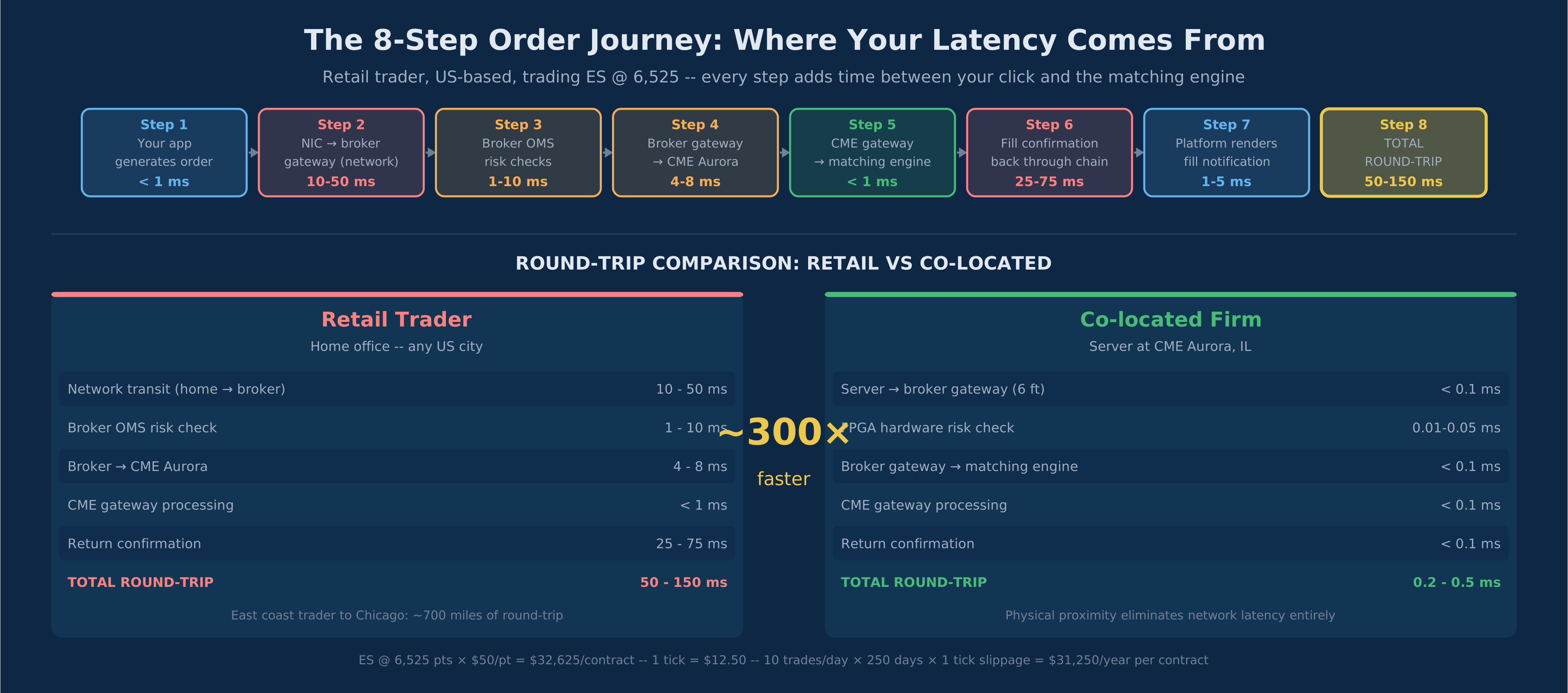
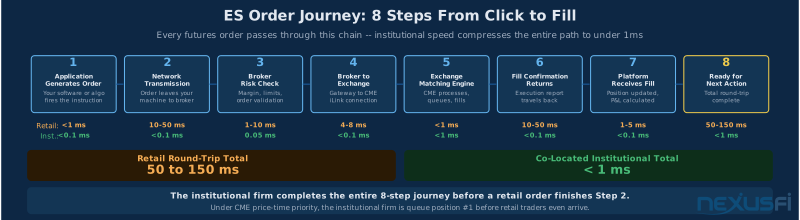
Step 1: Your application generates the order. Whether you're clicking a DOM in NinjaTrader or your algo's code fires an order, the instruction starts on your machine or server. The latency here is local — your CPU, your network card, your OS.
Step 2: Order transmits from your machine to the broker's gateway. This is the first external hop. If you're trading from a home connection in New York, your order travels ~700-1,000 miles to the broker's servers, typically adding 10-50 milliseconds of round-trip latency just from geographic distance. If you're running on a VPS in the same data center as your broker, this hop drops to microseconds.
Step 3: Broker's gateway performs pre-trade risk checks. Every broker is required to run pre-trade checks: account has margin, position limits aren't exceeded, order is valid. How fast this happens varies enormously. A high-quality institutional gateway processes this in microseconds using dedicated hardware. A retail broker's shared infrastructure may take several milliseconds.
Step 4: Order routes to the exchange gateway. The broker's system sends your order to CME Globex's iLink gateway. How fast this happens depends on whether the broker's servers are co-located at the exchange, somewhere else in Chicago, or in a data center 1,000 miles away.
Step 5: Exchange receives, queues, and fills the order. CME's matching engine processes orders strictly on price-time priority. The earlier your order arrives at a given price level, the better your queue position. If two orders arrive at the same price, the one that arrived first gets filled first. Latency — specifically, consistent, low-latency delivery to the exchange — directly determines your queue position.
Step 6: Execution report returns to you. The fill confirmation travels back through the same chain. For a market order, you need this fast to know you're in. For complex strategies with legs, the round-trip determines how quickly you can execute the next leg.
The total round-trip for a typical retail trader in the US: 50-150 milliseconds. For a co-located institutional firm: 200-500 microseconds. As @Fat Tails mapped out, the path has eight distinct steps: "market price change at the exchange (1), exchange sends market data via UDP multicast (2), data provider receives market data (3), data provider distributes data to subscribers (4), entry order is transmitted from your PC to access point of the broker (5), broker performs credit control in order to check your margin (6), broker transmits entry order to exchange (7), exchange processes the entry order (8)." [7] The institutional advantage comes from shrinking steps 2-8 to near zero.
Co-Location: What It Is and Who Actually Needs It #
Co-location means physically placing your trading server in the same data center as — or as close as possible to — the exchange's matching engine.
For CME Globex, that means Aurora, Illinois. CME operates its matching engines in the Aurora data center, and the exchange allows approved firms to rent server cabinet space in the same facility. When your server is co-located at Aurora, the physical distance between your order and the matching engine is measured in feet, not miles. Network round-trip drops from tens of milliseconds to single-digit microseconds.
NexusFi member @SMCJB described it well: "When your software generates an order it sends it to the brokers gateway which is 6ft away. After a quick credit check your broker sends the order to the exchange matching engine which is also 6ft away. The whole process can take well under a millisecond." [1]
That's not a modest improvement. It's a different category of market access.
Who runs co-located servers:
- High-frequency trading firms
- Proprietary trading firms running latency-sensitive strategies
- Hedge funds with systematic short-holding-period strategies
- Market makers who need to quote and hedge in tight timing windows
- Some sophisticated retail traders running automated systems
NexusFi member @hyperscalper ran an extended discussion on this: "LOWEST POSSIBLE LATENCIES (COLOCATION?) In most of what I'll discuss, U.S. futures out of Chicago (Aurora) at the CME, for example, is the physical location of the exchanges. Internet communication may add enormous delays if you are a long way from Aurora." [2]
Practical access for retail traders:
You don't need to rent your own cage at CME. Several paths give you proximity benefit:
Broker co-location: Some brokers (Advantage Futures, Phillip Capital, others) operate their gateway servers at Aurora. When you use these brokers, your order goes to their Aurora-based gateway, skipping the coast-to-coast hop.
VPS near the exchange: Virtual private servers hosted in or near Aurora data centers. Your algo runs there, and orders go to the broker's nearby gateway. Member @kamaiu noted: "I'd recommend getting on a platform that is co-located with CME in Aurora, IL like Sierra Chart (Teton Order Routing) or Rithmic." [3]
Platform co-location: Some trading platforms (Sierra Chart with Teton routing, Trading Technologies, NinjaTrader's hosted options) are already co-located. The platform server is in Aurora; your home machine sends signals to the platform server, and the order executes from the platform's co-located position.
@ChrisK5 from the NexusFi Brokers forum put the capital requirements in perspective: "If you want to go direct market, you need at least half a million to a million in capital at most brokers. Places like Phillip Futures, Advantage Futures offer co-located DMA for smaller traders, though the minimums and costs are higher." [4]
Direct Market Access: What It Means and Why 'Direct' Is Often Marketing #
Direct market access (DMA) means your order travels from the broker's gateway directly to the exchange matching engine with minimal intermediation. No internal routing delays, no order aggregation, no internalization.
Here's what DMA actually guarantees:
- Your order hits the exchange as an individual, identifiable order -- not bundled with other client orders
- Pre-trade risk checks are performed at the gateway level, typically in microseconds
- You get exchange-level order confirmations with exchange timestamps
- You have access to the full CME order type suite
The DMA problem:
Almost every retail broker claims to provide "direct market access." Most don't — at least not in any meaningful sense. True DMA means your order goes straight from the broker's risk gateway to the exchange iLink session, without additional routing logic, internalization, or aggregation. Retail platforms typically process orders through a central risk/order management system (OMS) that applies additional logic before routing to the exchange.
This OMS adds latency. It's not fraud; it's necessary for retail risk management. But calling it "DMA" is generous.
"Direct market access" is widely misused in futures broker marketing. True DMA bypasses the broker's internal OMS entirely. Ask specifically: does my order route directly from your gateway to CME iLink? A broker that hedges on this answer is running retail order management.
NexusFi member @SMCJB explained the distinction when switching to institutional infrastructure: "Non-DMA software like TT has credit modules that your broker can access and set limits. They have communal data gateways. While still fast, every one of these additional steps creates additional latency." [5]
Sponsored access:
One tier above standard DMA is sponsored access — an arrangement where a broker "sponsors" a client to connect directly to the exchange, basically lending the broker's exchange membership while the client's own trading code runs in the client's co-located server. This is almost exclusively available to institutional firms with multi-million-dollar accounts and sophisticated risk management systems.
As @Fat Tails described: "High frequency trading firms typically have a sponsored access allowing them to bypass the authorization process imposed by the broker. To execute HFT strategies they require Ultra-Low Latency." [6]
FIX Protocol: The Language of Institutional Trading #
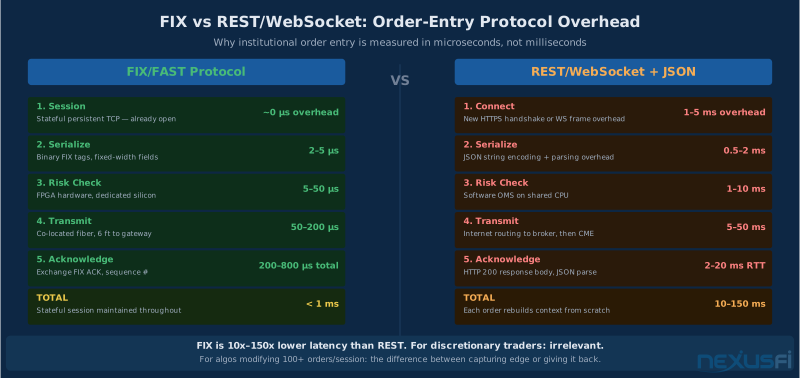
FIX (Financial Information eXchange) protocol is the standardized messaging format used for electronic order entry and market data in institutional trading. If your broker offers a FIX API, you're getting the most direct, lowest-overhead connection method available outside sponsored access.
CME Globex uses FIX/FAST for both order entry (via iLink gateways) and market data. The "FIX" part handles the messaging format; "FAST" (FIX Adapted for Streaming) compresses market data for more efficient transmission.
What FIX gives you that REST/WebSocket doesn't:
Latency: FIX is a binary-efficient, stateful protocol. REST APIs add HTTP overhead, JSON parsing, and stateless connection management. A well-implemented FIX connection can process order acknowledgements in microseconds; a REST API adds at minimum several milliseconds of overhead just from protocol translation.
Order state management: FIX maintains a stateful session with sequence numbers. If the connection drops, FIX has built-in replay — you can request missed messages and reconcile order state. REST APIs leave this burden on your code.
Full order type support: Some advanced CME order types (post-only, minimum quantity, reserve orders) are only fully supported through FIX, not through simplified broker APIs that abstract order complexity.
Deterministic behavior: FIX has defined behavior for every scenario — timeout handling, sequence gaps, heartbeat management. With a well-implemented FIX session, you know exactly what will happen when things go wrong.
Sierra Chart's FIX-based Teton Order Routing is a well-regarded example of co-located FIX connectivity accessible to retail traders. NexusFi member @Kuuluud noted Sierra Chart uses "a FIX connection to Trading Technologies with routing to TT in same data center. You can use server side OCO and Bracket orders." [8]
CME Globex Connectivity: Tiers, Gateways, and What They Mean #
CME Globex is the electronic trading platform for CME Group's futures markets — ES, NQ, CL, GC, ZB, and hundreds of other contracts. All Globex orders go through iLink gateways using the FIX/FAST protocol.
The gateway hierarchy:
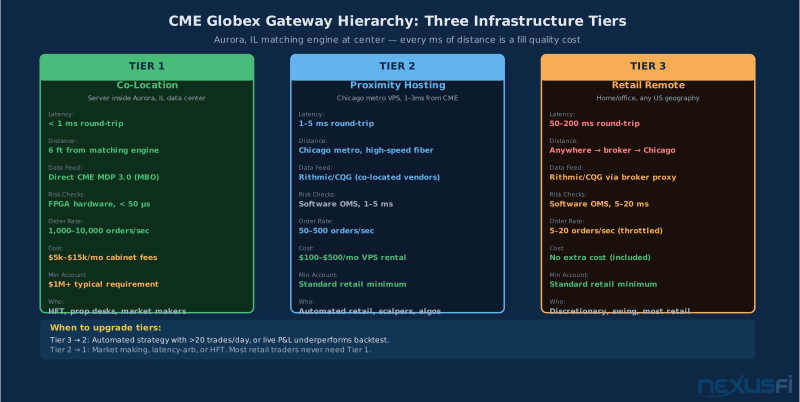
Tier 1 (Co-located): Server cabinets inside the Aurora data center with dedicated low-latency fiber connections to the matching engine. Round-trip latency: under 100 microseconds. Available only to approved firms willing to pay co-location fees ($2,000-$10,000+/month for cabinet space, plus connectivity charges).
Tier 2 (Proximity hosting): Data centers in the Chicago metro area (often within 1-3ms of Aurora) with high-speed fiber to the exchange. Some brokers operate their gateways here, getting most of the latency benefit at lower cost. Round-trip: 1-5ms.
Tier 3 (Remote access via broker gateway): The broker's gateway is somewhere in the US, and your order travels from your location to the broker, then from the broker to the exchange. Round-trip from home to exchange: 50-200ms depending on your location.
Most retail traders operate at Tier 3. Some, through co-located platform solutions, get Tier 2 benefit. Institutional and HFT firms operate at Tier 1.
Data feed architecture:
CME provides two market data feed types: MDP 3.0 (Market Data Platform), which includes both market-by-order (MBO) and market-by-price (MBP) feeds, and the direct exchange data streams that only certified firms can access. Retail traders get CME data through vendor aggregators (IQFeed, Rithmic, CQG, etc.), which add 10-100ms of latency but handle normalization, connection management, and delivery. Direct CME feeds require CME certification and significant infrastructure investment.
Infrastructure Tiers: The Full Comparison #
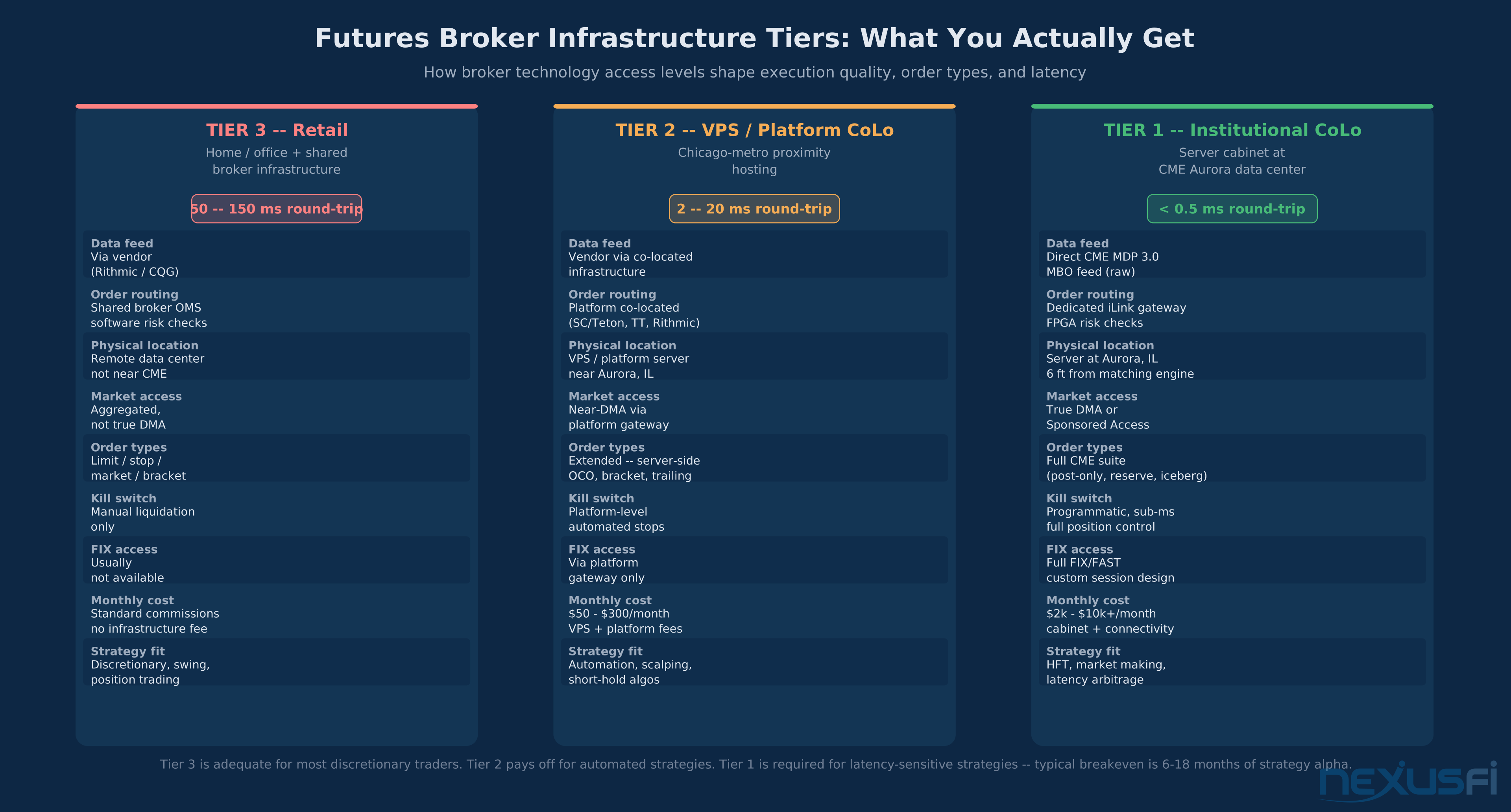
The "tier" concept extends beyond just co-location to every dimension of how your orders interact with the exchange:
Order rate limits: How many orders/second can you submit before the gateway throttles you? A retail account at a typical broker: 5-20 orders/second. An institutional gateway: 1,000-10,000 orders/second. This only matters for automated strategies with high modification frequency.
Permitted order types: The full CME order type list includes dozens of types beyond the basic limit/stop/market. Post-only orders, minimum quantity fill orders, reserve orders, matched-trade orders — many of these are only accessible through FIX connections and only for accounts with appropriate access tiers.
Position limits: Beyond CFTC accountability levels, brokers impose their own position limits by account tier. Institutional accounts get higher limits, more flexibility on limit increases, and faster approval processes.
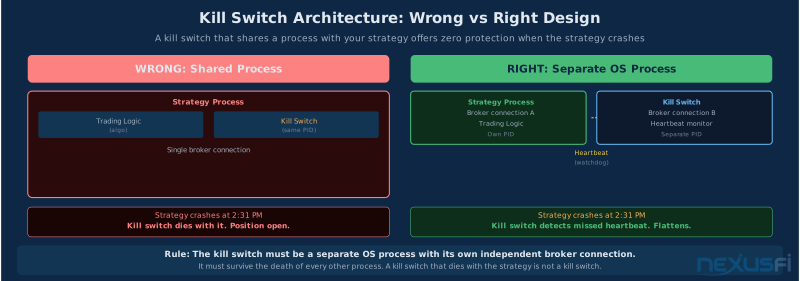
Kill switch controls: Institutional tiers get configurable kill switches — hard position limits, loss limits per session, gross exposure limits — with clear, documented behavior. Retail platforms have simpler risk controls that work for most purposes but can create problems for automated traders who need precise control over emergency liquidation behavior.
Risk check speed: The fastest institutional pre-trade risk checks happen in microseconds using dedicated FPGA hardware. Retail risk checks using software on shared infrastructure happen in milliseconds. The delta matters for high-frequency strategies; it's irrelevant for manual discretionary trading.
The Latency Chain: Where Your Time Actually Goes #
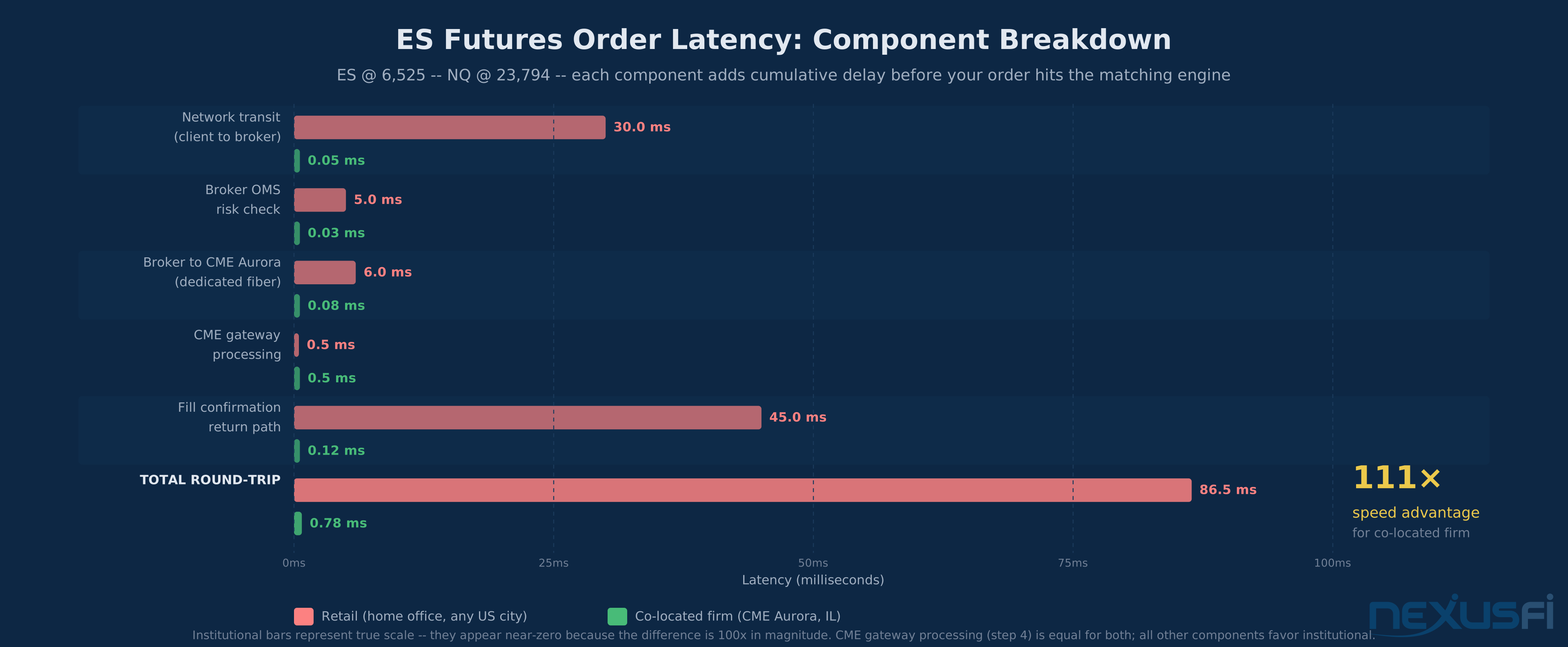
To make this concrete, here's the latency breakdown for a US-based retail trader vs. a co-located institutional firm, both trading ES:
Retail trader (home office, east coast US):
- Local application to NIC: <1ms
- NIC to broker gateway (east coast VPS or cloud): 2-5ms
- Broker gateway internal processing (OMS): 1-10ms
- Broker gateway to CME Aurora (dedicated fiber): 4-8ms
- CME gateway to matching engine: <1ms
- Fill confirmation back through chain: same latency in reverse
- Total round-trip: 50-150ms (including network variability)
Co-located institutional firm (Aurora data center):
- Local server to broker gateway (6 feet away): <0.1ms
- Broker gateway internal processing (FPGA-based): 0.01-0.05ms
- Broker gateway to CME matching engine (same building): <0.1ms
- Fill confirmation back: <0.1ms
- Total round-trip: 0.2-0.5ms
That 300x difference in round-trip time means a co-located firm can submit, receive confirmation, and submit a follow-on order before the retail trader's original order even reaches the exchange.
Queue Position: Why Latency Determines Fill Priority #
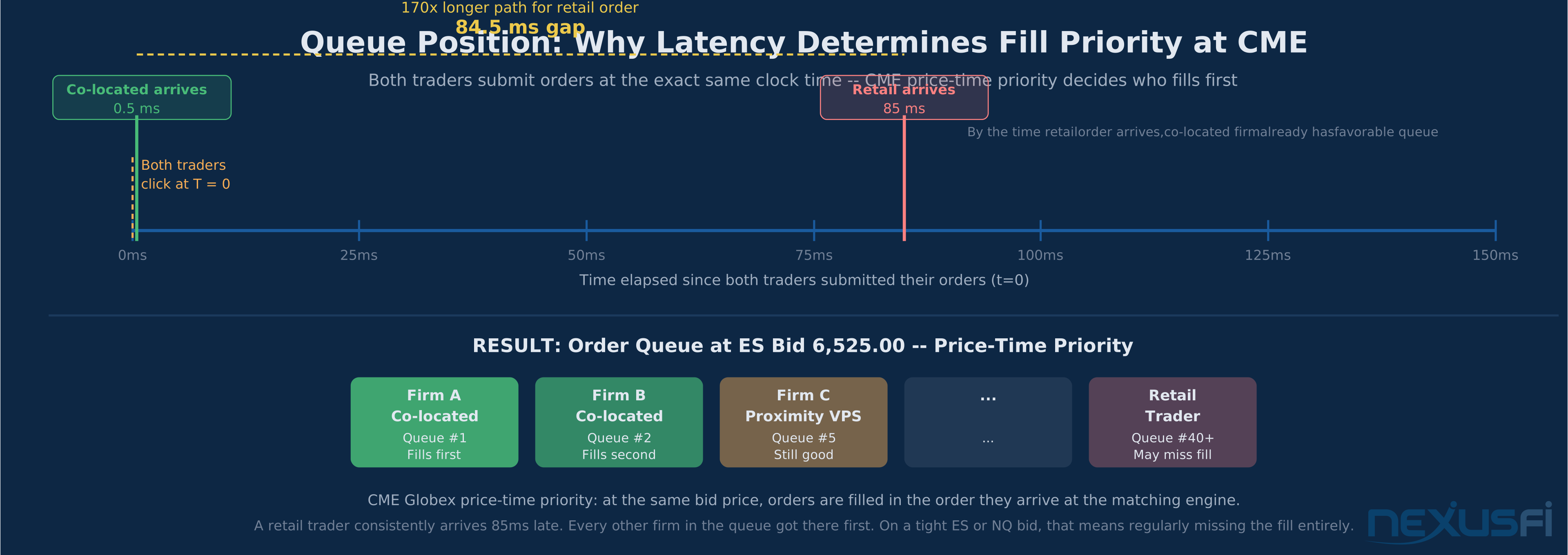
Consider two traders clicking "buy" simultaneously at ES 6,525. Under CME's price-time priority, they don't arrive at the matching engine simultaneously.
The co-located firm's order reaches the matching engine in 0.5ms. The retail trader's order arrives 85ms later. By the time the retail order arrives, the co-located firm already has queue position #1. Any other institutional traders in between are #2, #3, and so on. The retail trader is #40-something.
When liquidity is thin and the market moves against that bid, the fills start from position #1 and work down. The retail trader's order — arriving systematically late every time — regularly ends up behind the fills. The price touches the level and moves away before position #40+ gets filled.
This isn't market manipulation. It's the mechanical consequence of CME's price-time priority rule. @SMCJB captured the institutional reality: "When your software generates an order it sends it to the brokers gateway which is 6ft away. After a quick credit check your broker sends the order to the exchange matching engine which is also 6ft away." [1]
For discretionary traders, this latency disadvantage is irrelevant — they're not competing for queue position on individual ticks. For scalpers and automated strategies, it's a systematic edge erosion across hundreds of trades.
Rithmic and CQG: The Data Infrastructure Layer #
Most retail futures traders interact with CME data through one of two primary infrastructure providers: Rithmic and CQG. Understanding what these providers actually do helps explain why broker choice is inseparable from data quality.
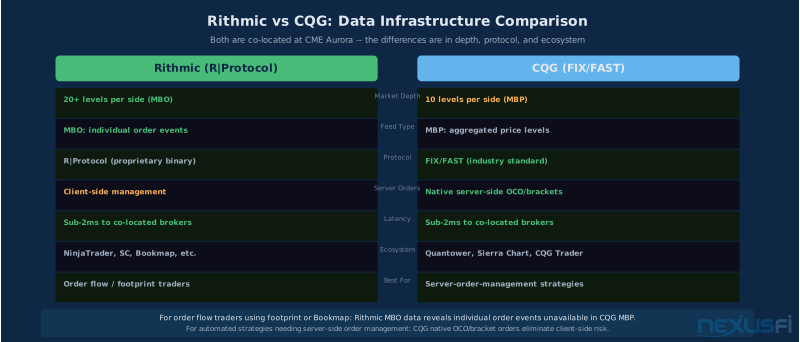
Rithmic (R | Protocol):
Rithmic is a technology company, not a broker. They operate co-located servers at CME Aurora and other major exchanges, receiving raw exchange data feeds (including CME's MDP 3.0 MBO feed) and normalizing, routing, and delivering them to brokers and their clients.
Rithmic's R | Protocol provides:
- MBO (market-by-order) data -- individual order add/modify/delete events
- 20+ levels of depth on each side of the book
- Sub-millisecond data delivery to co-located brokers
- Order entry with round-trips in the sub-2ms range for brokers at Rithmic's infrastructure
CQG (FIX/FAST protocol):
CQG provides an alternative data and connectivity layer. Their infrastructure is also co-located and provides similar depth of market and order routing capability. CQG is historically stronger on server-side order management (native OCO, bracket orders held on the server rather than on your local machine).
NexusFi member @Fi discussed the practical differences: "Rithmic displays 20+ levels of depth, while CQG shows 10 levels per side. Latency matters too — the Rithmic data feed architecture processes CME's MBO feed more granularly at its ingestion point." [12]
What this means for you:
When your broker uses Rithmic or CQG, you're not getting CME data directly. You're getting it after it travels: CME → Rithmic/CQG infrastructure → broker gateway → your platform. Each hop adds latency. The Rithmic/CQG hop is small (they're co-located), but it's not zero. Brokers that connect directly to CME without a middleware layer can offer lower latency — but they need to build and maintain the CME certification and infrastructure themselves.
Smart Order Routing: What It Actually Does #
For single-venue CME products (ES, NQ, CL, GC, ZN), SOR's value is primarily operational — handling rejections, throttle responses, and cancel/replace coordination without creating stuck orders. For calendar spreads and multi-leg strategies, SOR handles leg risk when one side fills and the other hasn't — that's where routing logic actually matters for retail traders.
Market Data Path: From Matching Engine to Your Screen #
The discussion of execution infrastructure would be incomplete without addressing market data — because the data path is where retail traders are most consistently disadvantaged, and most don't realize it.
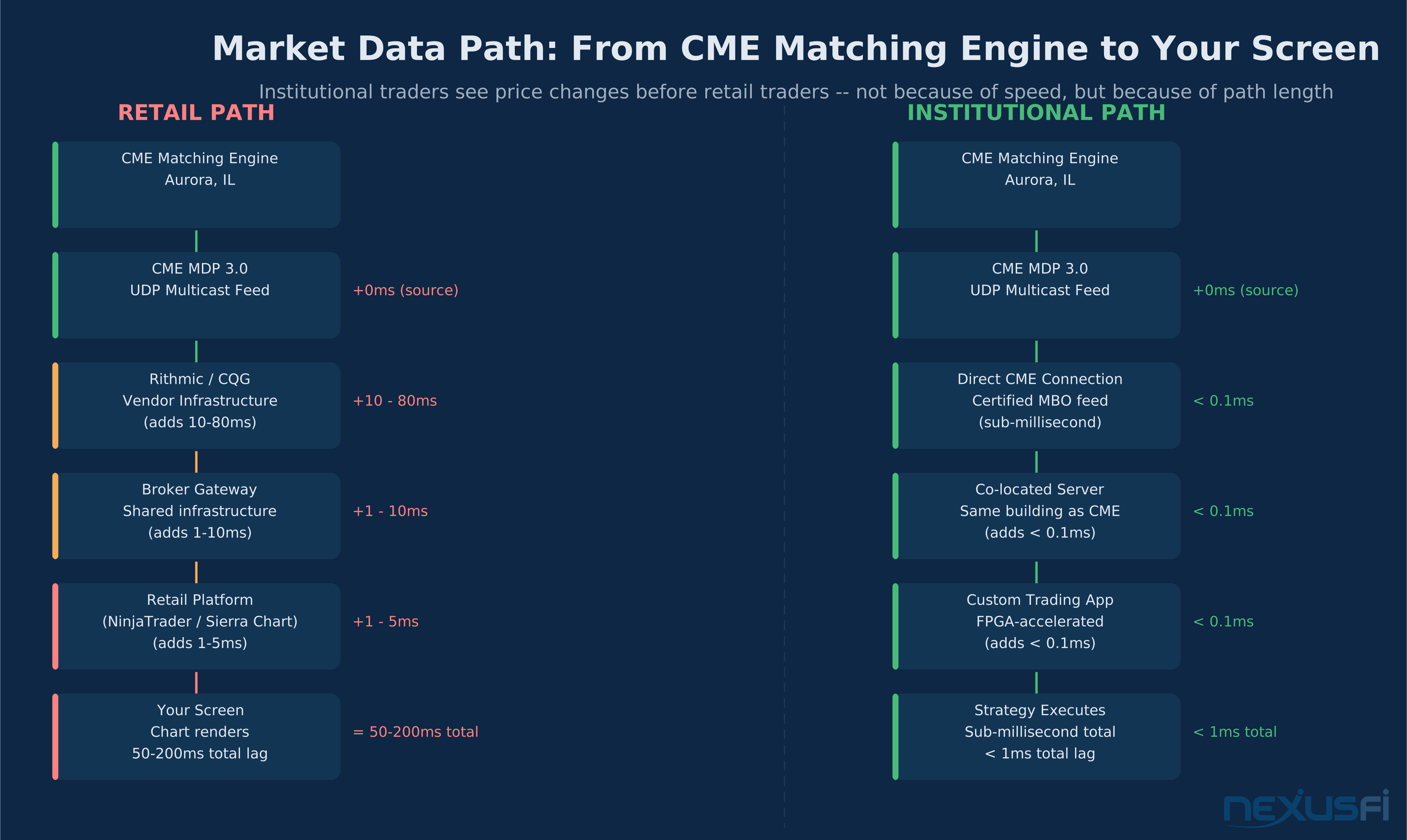
When a trade executes on CME Globex, the matching engine broadcasts that event via UDP multicast. From that point, two very different paths deliver the information to market participants:
Retail path: CME → Rithmic/CQG vendor infrastructure (adds 10-80ms) → broker gateway (adds 1-10ms) → retail platform (adds 1-5ms) → your screen = 50-200ms total data lag.
Institutional path: CME → direct certified connection (<0.1ms) → co-located server (<0.1ms) → custom application = <1ms total data lag.
The practical consequence: when a major order moves ES from 6,525 to 6,524, the institutional firm processes this in under 1ms. Their algo can respond — whether to take the other side, modify a resting order, or exit a position — before the retail vendor feed has even received the data update.
Does this affect discretionary traders? No. But it explains why certain momentum strategies that worked in backtesting fail in live trading: the backtest used the same data the retail platform sees, not the actual sequencing of information as institutional participants received it.
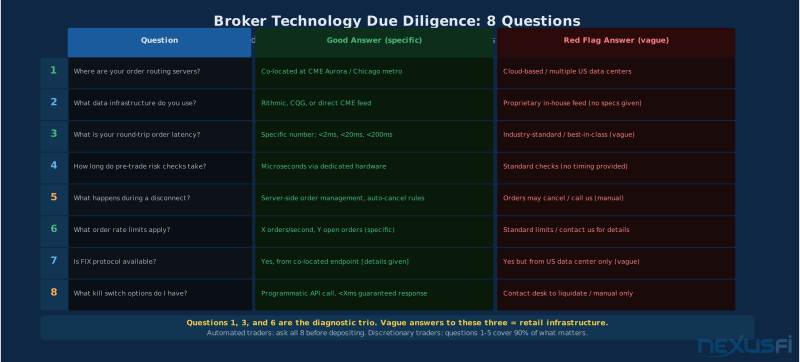
The Due Diligence Checklist: What to Actually Ask Your Broker #
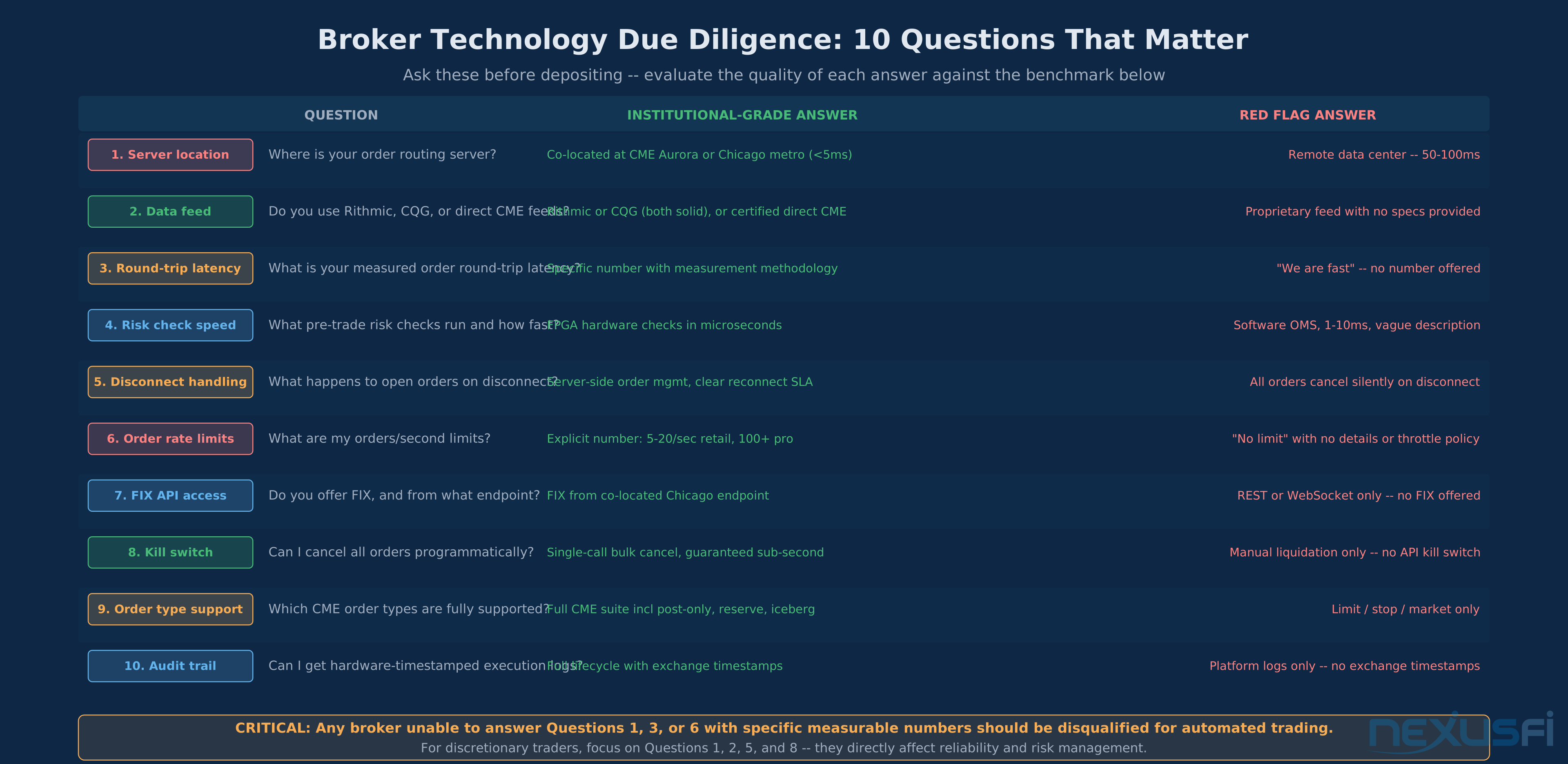
Generic broker comparison sites ask about commissions, platforms, and customer service. For technology-aware traders, these questions matter more:
1. Where are your order routing servers located?
The answer you want: "Co-located at CME Aurora" or "Chicago metro area, within 2ms of CME." Red flag: "Cloud-based" without specifics, or "multiple US data centers" which often means no proximity to the exchange.
2. What data infrastructure do you use — Rithmic, CQG, or direct?
Rithmic and CQG are both solid choices with known performance characteristics. Direct CME connectivity can be faster but is harder to evaluate without data. "In-house proprietary feed" can be excellent or terrible — ask for latency specifications.
3. What's your round-trip order latency specification?
Any broker worth using should be able to give you a number. Retail-grade: 50-200ms. VPS-optimized: 5-20ms. Professional/co-located: <2ms. Be skeptical of claims without measurement methodology.
4. What pre-trade risk checks run on my orders, and how long do they take?
This clarifies whether you're getting true DMA or retail order management. A broker with real DMA will describe microsecond-level hardware checks. A retail OMS will describe software checks that take 1-10ms.
5. What happens during a disconnect?
Does the broker have server-side order management that holds your working orders during brief disconnects? Or do orders cancel? What's the reconnect procedure, and how does order state reconcile after reconnect?
6. What order rate limits apply to my account?
If you're running an automated strategy, you need to know whether your expected order frequency will hit gateway throttles. Ask specifically: orders per second, open orders per account, and maximum daily orders.
7. Can I access FIX protocol, and if so, from what endpoint?
If you're building automation, FIX access from a co-located endpoint matters. Some brokers offer FIX from their US data center only; others from their proximity infrastructure.
8. What kill switch options do I have?
For automated traders: can you cancel all working orders via API with a single call? What's the guaranteed response time? Is there a broker-side emergency liquidation option you can trigger programmatically?
NexusFi member @sam028 noted the practical payoff of infrastructure investment: "I had unsolicited comments from users claiming their VPS monthly fee was absorbed in few trades (positive slippage). A lot of latency reduction also means that order management code becomes simpler." [9]
And @grahamg put the bottom line clearly: "Distance to your data provider and order server is the decider. VPS is only beneficial latency wise for automated systems." [11]
What Retail Traders Actually Get (and What They Should Expect) #
Let's be direct about this. If you're a discretionary trader holding positions for minutes to hours, or even an automated trader with holding periods longer than 30 seconds, none of the co-location and microsecond latency discussion matters to your P&L.
Here's what retail traders actually get from a competent broker:
Reliable connectivity with reasonable uptime. The Rithmic and CQG infrastructure layers have redundant connections and 99.9%+ uptime. For most strategies, the occasional connectivity hiccup matters far more than baseline latency.
Clean order state management. Your orders are submitted, acknowledged, and filled or cancelled in an orderly fashion. You get execution reports you can trust.
Access to the full contract universe. All CME products, all expirations, all standard order types. The broker handles the exchange connectivity overhead.
Pre-trade risk infrastructure. Your broker's risk checks protect you from catastrophic errors — putting in an extra zero, accidentally submitting 100 contracts instead of 10.
What retail traders don't get:
- True DMA with direct exchange connectivity
- Sub-millisecond order-to-fill latency
- Co-location without explicit arrangement
- Full CME order type suite (post-only, reserve, minimum quantity)
- Configurable kill switches and risk controls
- Institutional-grade observability (hardware timestamps, full order lifecycle audit trail)
As @Big Mike noted on NexusFi: "There is largely not much you can do about this [latency], short of leasing a server near the exchange in Chicago." [10]
That's still true. For most traders, the right response is to design strategies that don't depend on competing with institutional infrastructure — not to chase marginal latency improvements that won't change outcomes for discretionary or medium-term automated approaches.
Summary: The Stack, Simplified #
The infrastructure stack connecting your order to the exchange matching engine shapes every fill you get. The gap between retail and institutional is real — but its impact depends entirely on your strategy.
| Layer | Retail Reality | Institutional Reality | Impact |
|---|---|---|---|
| Physical location | Home/office, any geography | Co-located at Aurora, IL | 50-300x latency difference |
| Data delivery | Via vendor (Rithmic/CQG) | Direct CME feed | 10-100ms data lag for retail |
| Order routing | Broker OMS, software risk checks | Direct exchange gateway, FPGA checks | 1-10ms additional retail latency |
| Order types | Basic limit/stop/market/bracket | Full CME order suite | Access to advanced order types |
| Queue position | Late arrivals = back of queue | Consistent early arrival | Systematic fill quality advantage |
| Kill switch | Manual liquidation | Programmatic, sub-ms response | Risk management ceiling |
| Transparency | Black-box execution reports | Hardware-timestamped audit trail | Visibility into execution quality |
The gap is real. For most traders, it doesn't matter in practice. For a specific class of strategy — high-frequency, high-modification-rate, latency-arbitrage — it's the entire game. Know which category you're in, choose your infrastructure so, and don't pay for latency you don't need.
Before choosing a broker, ask the eight due diligence questions outlined in this article. Any broker that can't answer #1, #3, or #6 with specific numbers is operating retail-grade infrastructure — know that going in.
Knowledge Map
Go Deeper
Build on this knowledgeReferences This Article
Articles that build on this topicCitations
- — Which the best faster VPS to retail (2022) 👍 8“When your software generates an order it sends it to the brokers gateway which is 6ft away. After a quick credit check your broker sends the order to the exchange matching engine which is also 6ft away. The whole process can take well under a millisecond.”
- — Discussion of a Micro Scalping Day Trading Facility (2021) 👍 2“LOWEST POSSIBLE LATENCIES (COLOCATION?) In most of what I'll discuss, U.S. futures out of Chicago (Aurora) at the CME, for example, is the physical location of the exchanges. Internet communication may add enormous delays if you are a long way from Aurora.”
- — TradeStation Terrible Order Execution Yet Worse Customer Service! (2022) 👍 3“I'd recommend getting on a platform that is co-located with CME in Aurora, IL like Sierra Chart (Teton Order Routing) or Rithmic. Interactive Brokers has dated tech and I wouldn't use them.”
- — CME Aurora Illinois Co-location? (2017) 👍 2“If you want to go direct market, you need at least half a million to a million in capital at most brokers. Places like Phillip Futures, Advantage Futures offer co-located DMA for smaller traders.”
- — I Am A Self-Directed Trader About To Broker With JP Morgan's Institutional Side (2022) 👍 5“Non-DMA software like TT has credit modules that your broker can access and set limits. They have communal data gateways. While still fast, every one of these additional steps creates additional latency.”
- — Faster than Rithmic ? CME direct rough cost ? (2012) 👍 5“High frequency trading firms typically have a sponsored access allowing them to bypass the authorization process imposed by the broker. To execute HFT strategies they require Ultra-Low Latency.”
- — How to measure data feed latencies between continents? (2014) 👍 9“The path includes: market price change at the exchange (1), exchange sends market data via UDP multicast (2), data provider receives market data (3), data provider distributes data to subscribers (4), entry order is transmitted from your PC to access point of the broker (5), broker performs credit control in order to check your margin (6), broker transmits entry order to exchange (7), exchange processes the entry order (8).”
- — Sierra Chart Futures Order Routing Service With Data an option? (2020) 👍 2“Order routing is through a server managed by Sierra Chart with a FIX connection to Trading Technologies with routing to TT in same data center. You can use server side OCO and Bracket orders.”
- — speedytradingservers.com review (2016) 👍 5“I had unsolicited comments from users claiming their VPS monthly fee was absorbed in few trades (positive slippage). A lot of latency reduction also means that order management code becomes simpler.”
- — Who trades Crude without slippage with which broker? (2011) 👍 7“There is largely not much you can do about this [latency], short of leasing a server near the exchange in Chicago. You can also reduce latency by using a wired connection at your home.”
- — Dealing latency with ZenFire & NT (2013) 👍 2“Distance to your data provider and order server is the decider. VPS is only beneficial latency wise for automated systems - Remoting in would add at least the same delay.”
- — CQG or Rithmic Data with... (2025)“Rithmic displays 20+ levels of depth, while CQG shows 10 levels per side. Latency matters too -- the Rithmic data feed architecture processes CME's MBO feed more granularly at its ingestion point.”