



Futures Broker API Access: What Your Broker's Technology Stack Actually Gives You and What It Doesn't
Overview #
Overview #
Every futures trader who wants to automate eventually hits the same wall: your broker says "we have API access" and hands you a documentation link. What they don't tell you is that "API access" covers everything from a REST endpoint that takes 200 milliseconds to place an order to a FIX session running on co-located hardware that executes in under 2 milliseconds. The gap between those two realities is the difference between a hobby project and a production trading system.
This article is the decision framework for choosing the right API access tier for your trading. Not how to code against any specific API — that's a platform-by-platform deep dive. This is about understanding what infrastructure you actually need, what it costs, and where the marketing claims diverge from operational reality. Whether you're a systematic retail trader running Python scripts on a laptop or an institutional shop evaluating FCM direct access, the connectivity architecture you choose determines your execution quality ceiling before you write a single line of strategy logic.
The futures industry's API environment breaks into three distinct tiers — retail broker APIs, institutional gateway access, and exchange-direct connectivity — and most traders either overbuild for their strategy's requirements or underbuild for their latency sensitivity. Both mistakes cost money. The first costs infrastructure dollars you didn't need to spend. The second costs slippage that erodes your edge.
Key Factors #
The Connectivity Hierarchy -- What counts
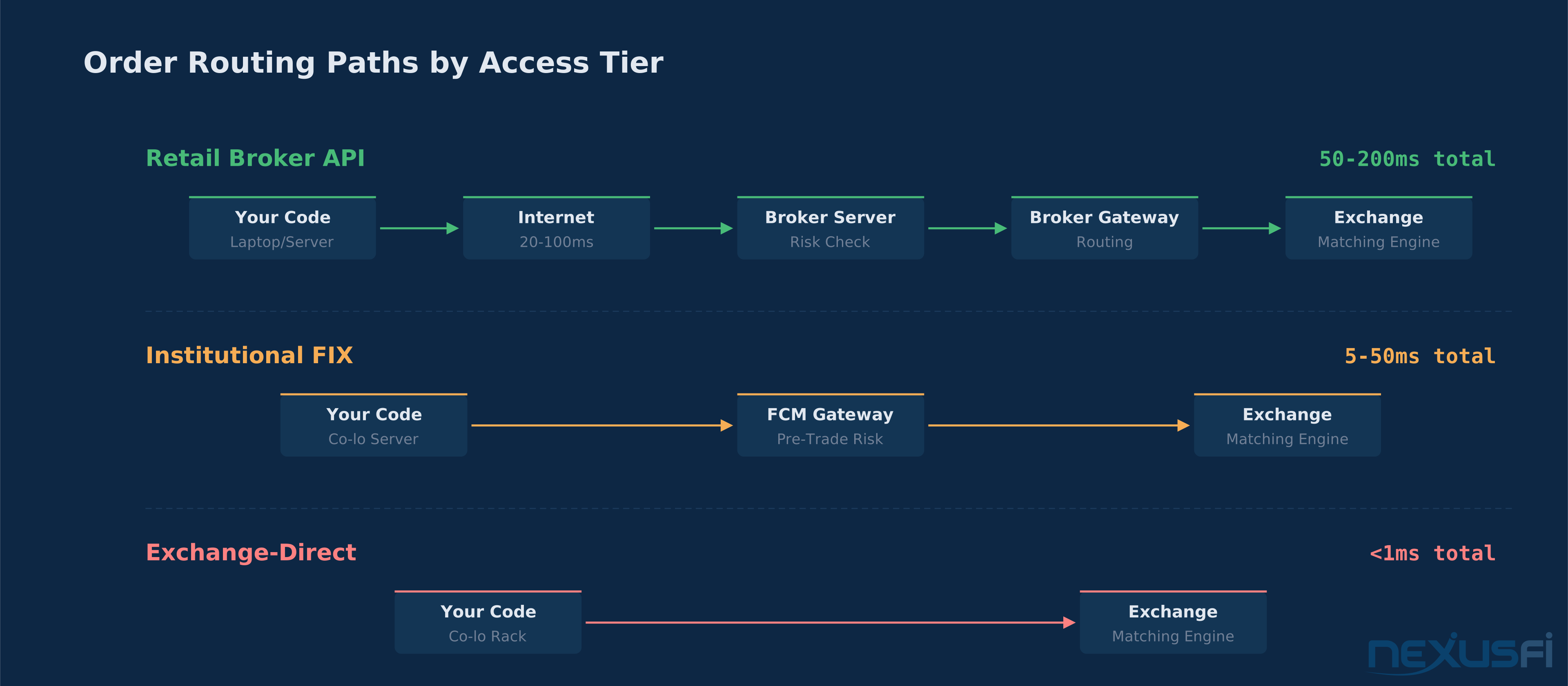
Before comparing specific APIs, understand the architecture. Your order takes a path from your code to the exchange matching engine. Every hop in that path adds latency, and every intermediary adds a point of failure. The path looks different depending on your access tier.
As @SMCJB explains it with a clarity that's hard to improve on: your software creates an order, and that order has to get to the exchange matching engine. "Even though you're in Chicago, and the exchange is in Chicago, your order is actually travelling all the way to Florida and back" if your broker's gateway sits in Florida. [1] The routing path matters more than the raw protocol speed.
Here's the hierarchy, ranked by what impacts your execution quality most:
1. Protocol Type and Latency Floor. FIX protocol sessions run persistent TCP connections with sub-millisecond message transit on co-located infrastructure. REST APIs add HTTP overhead — connection setup, serialization, parsing — that creates a floor around 20-50ms even on fast networks. WebSocket streams split the difference for market data but typically still route orders through REST endpoints. Your protocol choice sets the theoretical minimum latency your system can achieve.
2. Order Routing Path. Where does your order physically travel? Retail brokers often route through their own servers (possibly in a different state) before reaching the exchange gateway. FCM direct access can eliminate intermediary hops. Exchange-direct connectivity (like CME's iLink) puts your order on the shortest possible path to the matching engine. @SMCJB nails this: "Example C. Your software is hosted at your broker's co-located space in Aurora. Your order had to travel 106 feet to get from your software to the exchange." [1]
3. Market Data Quality and Depth. Your strategy is only as good as the data feeding it. L1 data (best bid/ask) is available through most APIs. Full order book depth — every price level with order count — is another story.
[2] If your strategy depends on order book imbalance or queue position, you need this depth — and most retail APIs don't provide it.
4. Rate Limits and Throttling. Every API has limits on messages per second. REST APIs typically cap at 2-10 requests per second for order operations. FIX sessions handle hundreds of messages per second but still have exchange-imposed throttling. CME's Globex platform enforces messaging limits per session that vary by product group. Hit these limits during a volatile session and your orders queue locally while the market moves.
5. Pre-Trade Risk Controls. Every FCM sits between you and the exchange with a risk gate. These pre-trade checks verify position limits, margin requirements, and order size before forwarding to the exchange. Retail brokers add their own layer on top. Institutional access provides more granular control over these risk parameters — and faster processing through the risk gate. For automated systems, the speed of risk evaluation directly affects your effective latency.
6. Reliability and Session Management. FIX sessions maintain sequence numbers and support gap-fill recovery after disconnects. REST APIs are stateless — lose your connection and you need to reconcile order state manually. For automated trading, the reconnection behavior of your API determines how quickly you recover from network blips. A 30-second reconnect during a fast market can turn a winning position into a margin call.
Access Tier Comparison
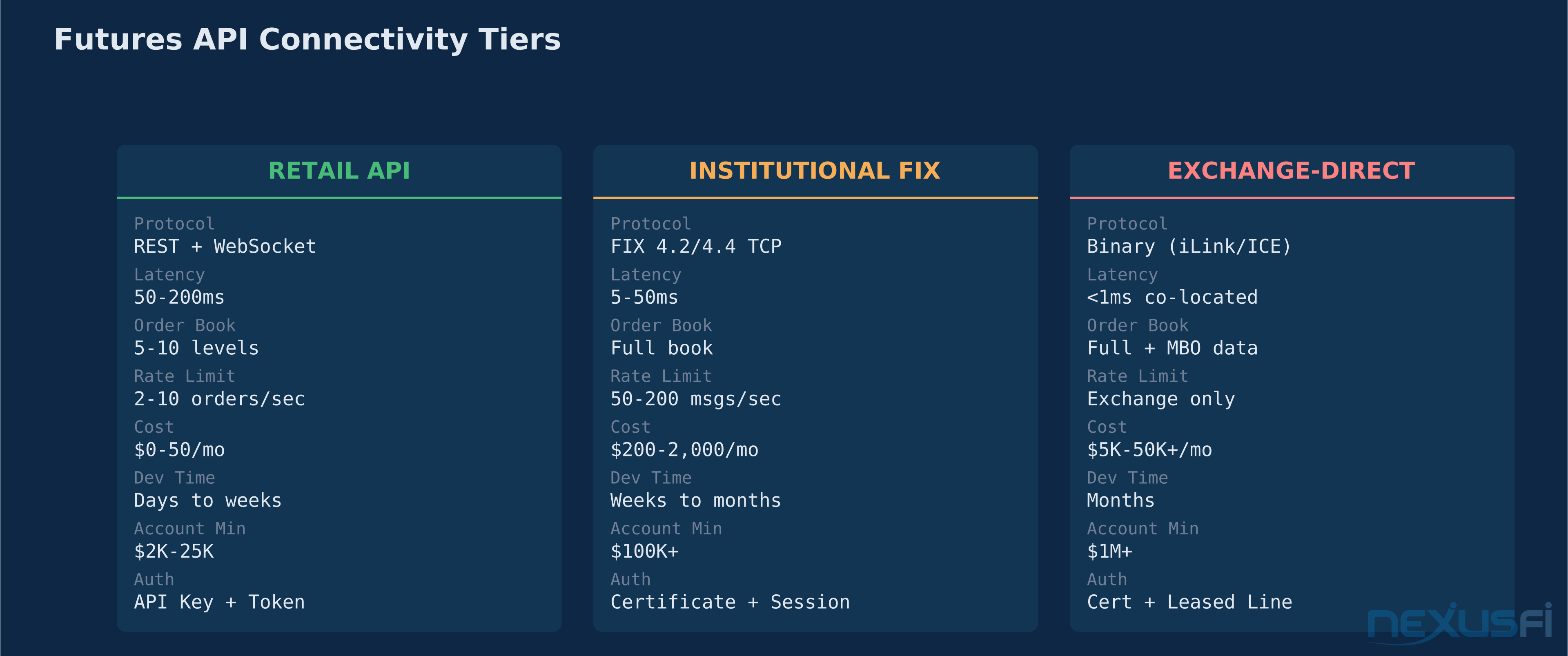
The futures API environment breaks into three tiers. Choosing the right one is about matching your strategy's actual requirements — not aspirational latency targets.
| Factor | Retail Broker API | Institutional Gateway (FIX) | Exchange-Direct |
|---|---|---|---|
| Protocol | REST + WebSocket | FIX 4.2/4.4 over TCP | Binary (CME iLink, ICE) |
| Typical Latency | 50-200ms | 5-50ms | <1ms co-located |
| Order Book Depth | 5-10 levels | Full book available | Full book + MBO data |
| Rate Limits | 2-10 orders/sec | 50-200 msgs/sec | Exchange limits only |
| Authentication | API key + token | Certificate + session | Certificate + leased line |
| Paper Trading | Included, simplified | Separate test environment | Exchange certification required |
| Monthly Cost | $0-50/mo data fees | $200-2,000/mo | $5,000-50,000+/mo |
| Development Effort | Days to weeks | Weeks to months | Months |
| Account Minimum | $2,000-25,000 | $100,000+ | $1M+ (typically) |
How It Works #
Retail Broker APIs: REST and WebSocket
Most retail futures brokers now offer some form of API access. The common pattern: a REST API for order management and account queries, paired with a WebSocket feed for streaming market data. Authentication is typically API key-based with rotating tokens.
The practical experience varies wildly by broker. Interactive Brokers' TWS API has been around for decades and supports Java, C++, Python, and C# — but as
The execution side works, but the data feed through the retail API has known limitations for time-sensitive strategies. [3]
Tradovate offers a modern REST/WebSocket API with JSON payloads. NinjaTrader provides its own addon framework for strategy development. The key limitation across all retail APIs: they add an intermediary processing layer between you and the exchange. Your order goes to the broker's server, gets risk-checked, then forwarded to the exchange gateway. That intermediary hop adds 20-100ms minimum.
For strategies with holding periods measured in minutes to hours, this latency is irrelevant. For anything operating on sub-minute timeframes, it constrains your execution quality.
Institutional Gateway Access: FIX Protocol
The Financial Information eXchange (FIX) protocol is the institutional standard for electronic trading. FIX sessions are persistent TCP connections that maintain message sequence numbers, support heartbeat monitoring, and provide structured execution reports for every order state change.
FIX connectivity for futures typically means connecting to your FCM's (Futures Commission Merchant) gateway. The FCM receives your order via FIX, runs pre-trade risk checks, and forwards it to the exchange. Key advantages over REST: the session stays open (no connection overhead per order), message ordering is guaranteed via sequence numbers, and the execution report model gives you definitive order state at every stage.
The NexusFi community has real-world experience here. @rounder8 tested multiple APIs and found CQG's data "seems accurate" with "servers located in the important financial hubs" and built-in algorithmic orders like "Dom-triggered-stop, Iceberg and Trailing Limit." But CQG's API uses "old C++ COM technology which makes it hard to use" and the order book updates are "emitted in a very inefficient way." [3] Rithmic got praise for "very good data quality" with full order book depth including "how many limit orders is in order book level." [3]
FIX implementations vary. Some brokers offer simplified FIX sessions that map to their REST backend — you get FIX message format without the latency benefits. True FIX gateway access means your messages route directly to the FCM's exchange gateway with minimal intermediary processing. Ask specifically where the FIX session terminates.
Exchange-Direct Connectivity
Exchange-direct access means connecting to the exchange's own API gateway — CME's Globex via iLink, ICE's WebICE, Eurex's Enhanced Trading Interface. This eliminates the FCM's order routing layer for execution (though clearing still goes through your FCM).
Exchange-direct connectivity requires certification. CME requires conformance testing for any new iLink connection to verify your system handles order types, cancel/replace workflows, and error conditions correctly. This certification process takes weeks to months and involves exchange staff reviewing your implementation.
The latency advantage is real but relevant only for specific strategies.
The article details how tick-to-trade requirements went from 250 microseconds in 2009 to sub-microsecond by the time FPGAs became common. [4] For most systematic retail and professional traders, this level of infrastructure is unnecessary — and prohibitively expensive.
The Order Lifecycle via API
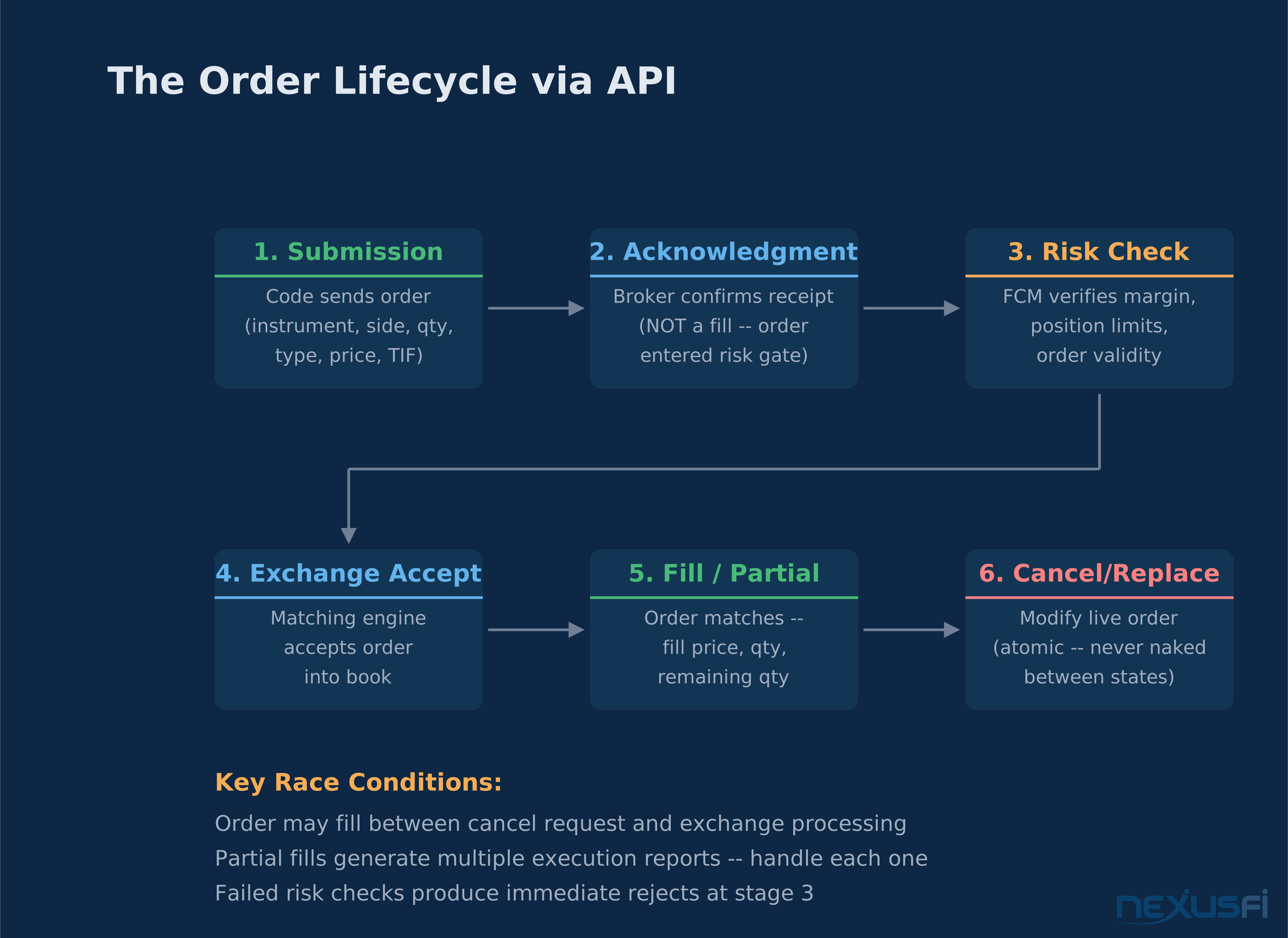
Understanding the order lifecycle matters because your API interaction model depends on it. Here's what happens when your code sends an order:
1. Submission. Your code sends an order request (REST POST, FIX NewOrderSingle, or binary message). This includes instrument, side, quantity, order type, price (if applicable), and time-in-force.
2. Acknowledgment. Your broker/FCM confirms receipt. This is NOT a fill — it means the order entered the risk gate. REST APIs return an order ID. FIX sends an ExecutionReport with OrdStatus=New.
3. Risk Check. The FCM's pre-trade risk system verifies margin adequacy, position limits, and order validity. Failed risk checks produce immediate rejects. The speed of this check varies from microseconds (co-located) to milliseconds (retail).
4. Exchange Acceptance. The exchange matching engine accepts the order into its book. You receive confirmation with the exchange-assigned order ID.
5. Fill/Partial Fill. When your order matches, you receive execution reports with fill price, quantity, and remaining quantity. Partial fills generate multiple reports. Your system must handle these correctly — a common bug is treating a partial fill as a complete fill.
6. Cancel/Replace. Modifying a live order requires a cancel/replace request. The exchange treats this atomically — your order is never "naked" between cancel and replace. But there's a race condition: the order might fill between your cancel request and the exchange processing it. Your code must handle "too late to cancel" responses.
Authentication Models
Authentication complexity scales with access tier:
Retail APIs use API keys with short-lived tokens. Typically: generate an API key in the web portal, request an access token via OAuth-like flow, include the token in request headers. Tokens expire (usually 24 hours) and need refresh logic. IP whitelisting is optional but recommended.
FIX sessions use certificate-based authentication. You generate a key pair, exchange certificates with your FCM, and the TLS handshake authenticates both sides. Session credentials (SenderCompID, TargetCompID) are pre-configured. The logon message includes additional credentials. This is more secure than API keys but requires proper certificate management — expiring certificates are a common cause of production outages.
Exchange-direct adds network-level authentication. Leased lines or cross-connects physically restrict who can send traffic to the exchange gateway. Combined with certificate authentication and IP filtering, this creates defense-in-depth. The operational overhead is significant: managing certificates, monitoring connection health, maintaining backup connectivity paths.
Decision Framework #
Match Your Access Tier to Your Strategy
The right API tier depends on three variables: your strategy's latency sensitivity, your account size, and your technical capability. Here's the framework:
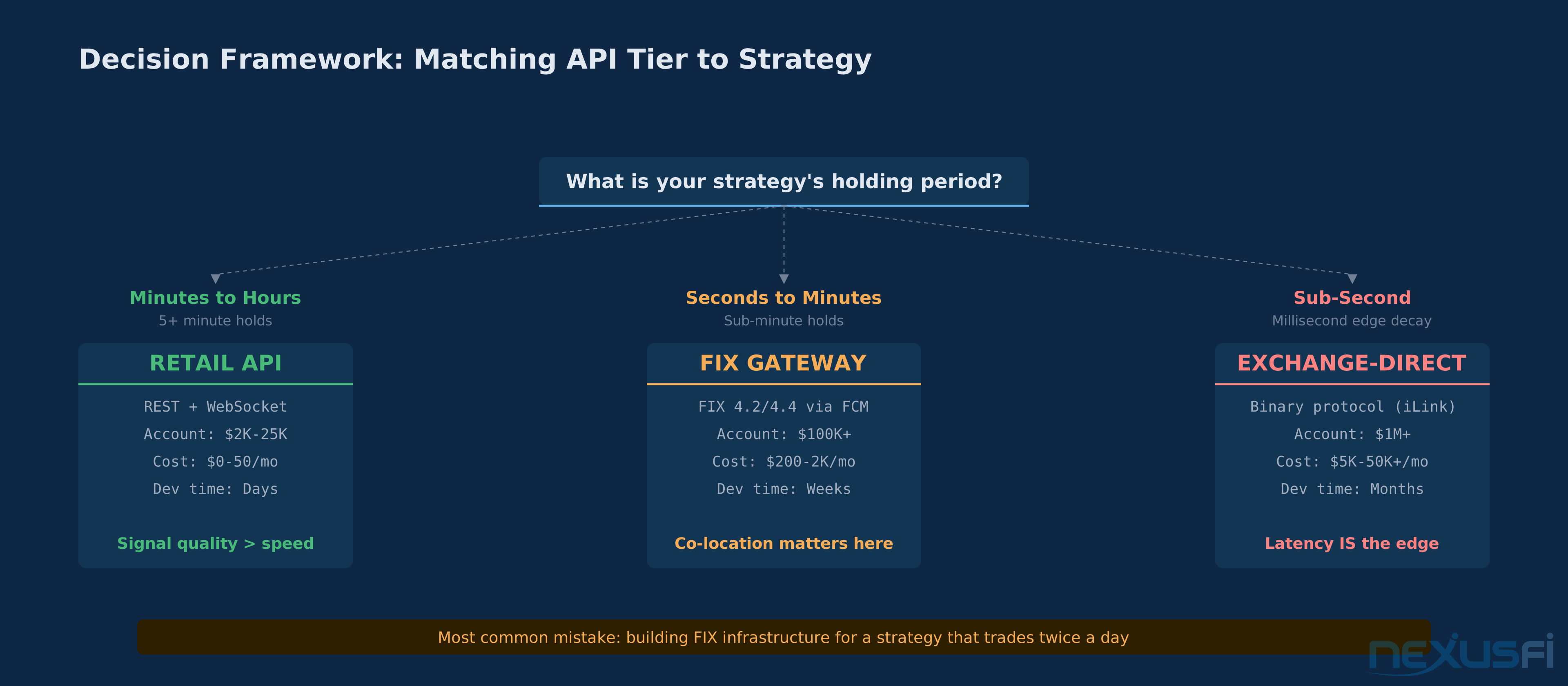
If you're a retail systematic trader ($25K-$500K account, holding periods in minutes to hours): Use a retail broker REST/WebSocket API. NinjaTrader, Tradovate, or Interactive Brokers all work. Your strategy's edge doesn't come from execution speed — it comes from signal quality. Spend your engineering time on research, not infrastructure. The 50-200ms latency is invisible for strategies that hold positions for 5+ minutes.
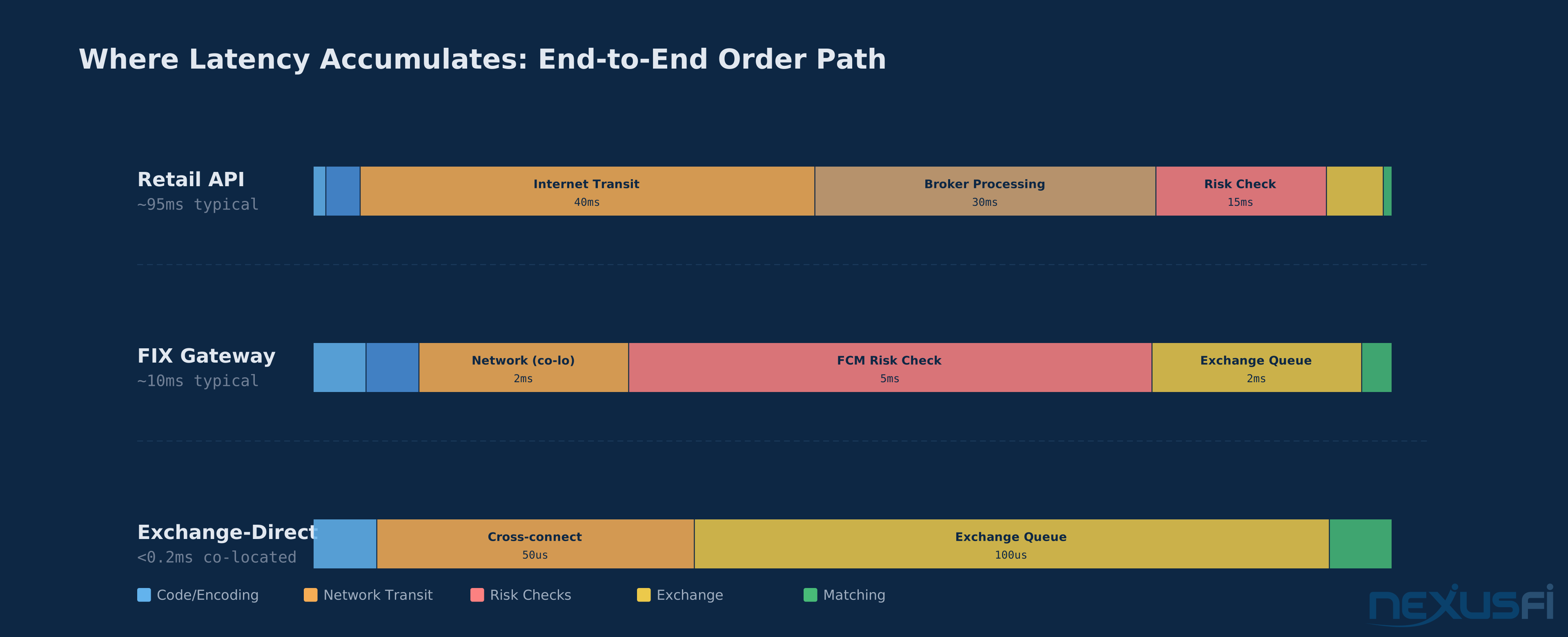
If you're a professional trader ($500K-$5M, holding periods in seconds to minutes): FIX gateway access through CQG, Rithmic, or your FCM's direct interface. This is where the infrastructure decision actually matters. @FreeToChoose measured real-world Rithmic performance: "1.5 to 2 milliseconds for ES futures, on Rithmic server timestamps from order received to completed/processed with the CME exchange. Another 25 milliseconds to send the order from east coast to Rithmic server in Chicago." [2] That 25ms internet transit is your bottleneck — co-location eliminates it.
If you're institutional ($5M+, sub-second strategies): Exchange-direct connectivity with co-located infrastructure. You need dedicated FIX sessions, possibly binary protocol implementations, and co-located servers. The cost is $5,000-50,000+/month for infrastructure alone, and the development effort is measured in months. But if your strategy's edge decays in milliseconds, there's no alternative.
The most common mistake: retail traders who spend months building FIX infrastructure for a strategy that trades twice a day. If your strategy generates 5-20 signals per day with 10+ minute holding periods, a REST API handles it fine. Save the engineering effort for strategy improvement.
Data Feed Decisions
Your market data source is as important as your order routing. The latency chain has two sides: how fast you see the market, and how fast you react to it.
@iantg, who built a system using Rithmic's API while co-located in the same building as the CME matching engine, broke down the complete latency chain: "The bid and ask feed has a timestamp down to the microsecond from the exchange. You can test the delta between this timestamp and when your application receives the update." Even co-located, "depending on how volatile the market was, this was the largest aspect of my latency chain." Other retail applications he tested were "around 250 milliseconds behind the exchange timestamps." [5]
That 250ms gap between exchange timestamp and your application seeing the data is the real constraint. It's not the API protocol — it's the intermediary processing (feed handlers, normalization, UI rendering). Automated systems eliminate the UI rendering cost, but the feed handler overhead remains.
alt="Latency chain breakdown showing where delay accumulates for retail, FIX, and exchange-direct APIs" loading="lazy" width="800" height="450">
Getting Started #
Testing and Paper Trading Environments
Every broker offers some form of paper trading or sandbox environment. Use them — but don't trust them completely.
Paper trading environments differ from production in ways that matter for automated systems: the matching engine is simplified (you often get filled at the limit price without waiting in queue), latency is typically lower (the test servers handle less traffic), and market data may be delayed or simulated. These differences mean your backtest-to-paper-to-live performance transition will always degrade. The question is by how much.
Build your testing in stages:
Stage 1: Connectivity. Can your code authenticate, subscribe to market data, and place/cancel orders? This catches integration bugs before strategy logic matters.
Stage 2: Order State Management. Does your code correctly handle partial fills, cancels during fills, rejected orders, and disconnection/reconnection? Simulate failure modes explicitly — don't wait for production to discover them.
Stage 3: Strategy Validation. Run your strategy on paper with realistic assumptions about fill quality. Add slippage to limit order fills. Assume you get filled at the worse price during fast markets.
Stage 4: Small Live. Trade minimum contract sizes in production. Compare actual execution quality (fill prices, latency, reject rates) against paper trading results. This delta tells you how much your infrastructure is costing or saving you.
SDK and Language Support
Language support varies by tier:
Retail APIs: REST APIs work with any language that can make HTTP requests. Python is the dominant choice for retail algorithmic traders — libraries like requests and websockets handle the transport layer, and you're writing strategy logic within days. The NexusFi community reflects this: @rediar shared an open-source Interactive Brokers Java API system, noting "there seems to be a lack of fully functional examples online." [6] Community examples fill gaps that vendor documentation misses.
FIX: QuickFIX (open-source) provides C++, Java, Python, and C# implementations. CQG and Rithmic provide their own SDKs — Rithmic uses .NET, CQG uses COM for its Virtual API (which @rounder8 described as "buggy, really hard to work with" [3]). The SDK quality matters: a buggy SDK creates production risk that no amount of strategy alpha can overcome.
Exchange-direct: C++ dominates. Binary protocols require manual message parsing, and latency-sensitive implementations need memory management control that garbage-collected languages can't guarantee. Some shops use Rust for new implementations.
Limitations and Honest Drawbacks #
What Vendors Won't Tell You
Paper trading fills are lies. Every paper trading environment fills limit orders at the limit price. In production, your limit order sits in a queue behind everyone who arrived first. Queue position determines whether you get filled at all, and paper trading can't simulate this. If your strategy depends on passive limit order fills, expect a significant performance gap between paper and live.
"Low latency" is meaningless without context. Brokers advertise latency numbers that measure only their internal processing — not the full path from your code to the exchange. The number that matters is your total round-trip: code generates order -> order reaches exchange -> exchange acknowledges. Ask for end-to-end latency measurements, not marketing latency numbers.
Rate limits hit when you need throughput most. Volatile markets generate the most signals and the most order modifications. They also generate the most load on broker infrastructure, which is exactly when rate limits and throttling kick in. Design your system to handle rate limit responses gracefully — queue orders locally, prioritize cancels over new orders, and have degradation logic for when you can't modify orders fast enough.
Reconnection behavior varies dramatically. When your FIX session drops (and it will), some brokers support automatic reconnection with gap-fill. Others require a full logon sequence with state reconciliation. REST APIs are stateless, so reconnection means querying all open orders and positions to rebuild your local state. The reconnection path is the most under-tested part of most automated systems and the most likely to cause losses.
Co-location doesn't solve bad strategies.
[5] Most automated traders who invest in co-location don't need it. The strategy's edge comes from signal quality, not execution speed. Co-locate only when your strategy's expected value demonstrably increases with latency reduction.
API documentation lags reality. Vendor API documentation is frequently outdated, incomplete, or wrong. The NexusFi community exists partly because of this — traders sharing real-world API experiences fills the documentation gap. Plan to spend significant time on integration testing beyond what the documentation suggests should work. @rounder8's comparative API review [3] is the kind of real-world assessment you won't find in any vendor's marketing material.
The Hidden Cost Equation
The true cost of API access extends well beyond the monthly fee:
Development time is the largest hidden cost. A retail REST integration takes days. A FIX integration takes weeks to months. Exchange-direct takes months. This development time has opportunity cost — time building infrastructure is time not improving your strategy.
Maintenance burden scales with complexity. APIs update. Exchanges change message formats. Certificate renewals happen at inconvenient times. FIX session parameters change when your FCM migrates infrastructure. Budget ongoing engineering time proportional to your infrastructure complexity.
Monitoring requirements increase with automation. You need to know when your connection drops, when orders reject, when latency spikes, and when positions diverge from expected state. Building monitoring is often more work than building the trading logic.
Knowledge Map
Go Deeper
Build on this knowledgeReferences This Article
Articles that build on this topicCitations
- — Which the best faster VPS to retail (2022) 👍 8“Your software creates an order, that order has to get to the exchange matching engine.”
- — please suggest a trading platform with API access (2019) 👍 2“Response time on Rithmic live platform is simply amazing.”
- — Direct API connectivity to exchanges (2013) 👍 9“After testing bunch of APIs I decided to list here pros and cons of each.”
- — HFT High Frequency Trading (2013) 👍 13“Light passing through fiber takes 49 microseconds to travel 10,000 meters.”
- — Rithmic Latency Calculations (Plus trading remotely) (2022) 👍 5“Other retail applications I tested were around 250 milliseconds behind the exchange timestamps.”
- — IB Algo Example (2018) 👍 8“Wanted to share the Interactive Brokers Java API.”