



How Futures Brokers Make Money: Revenue Models, Fee Structures, and What Every Trader Must Know
Overview #
When you pay $3.70 round-turn to trade one ES contract, you might assume that money goes to your broker. It doesn't.
That $3.70 is a stack of fees flowing to multiple parties — the exchange, the clearing firm, the data network, a regulatory body, and finally, somewhere in there, your broker. The broker's actual cut might be $0.40 of that $3.70.
Understanding where your trading costs actually go — and how your broker makes money beyond just commissions — is one of the highest-leverage pieces of knowledge a futures trader can have. It changes how you negotiate, how you read your broker's incentives, and whether you can trust that your broker's recommendations align with your interests.
This isn't about making you paranoid about your broker. Most FCMs are straight businesses running sustainable operations. But "know your broker" means knowing how they make money, not just knowing their margin rates.
Key Revenue Streams #
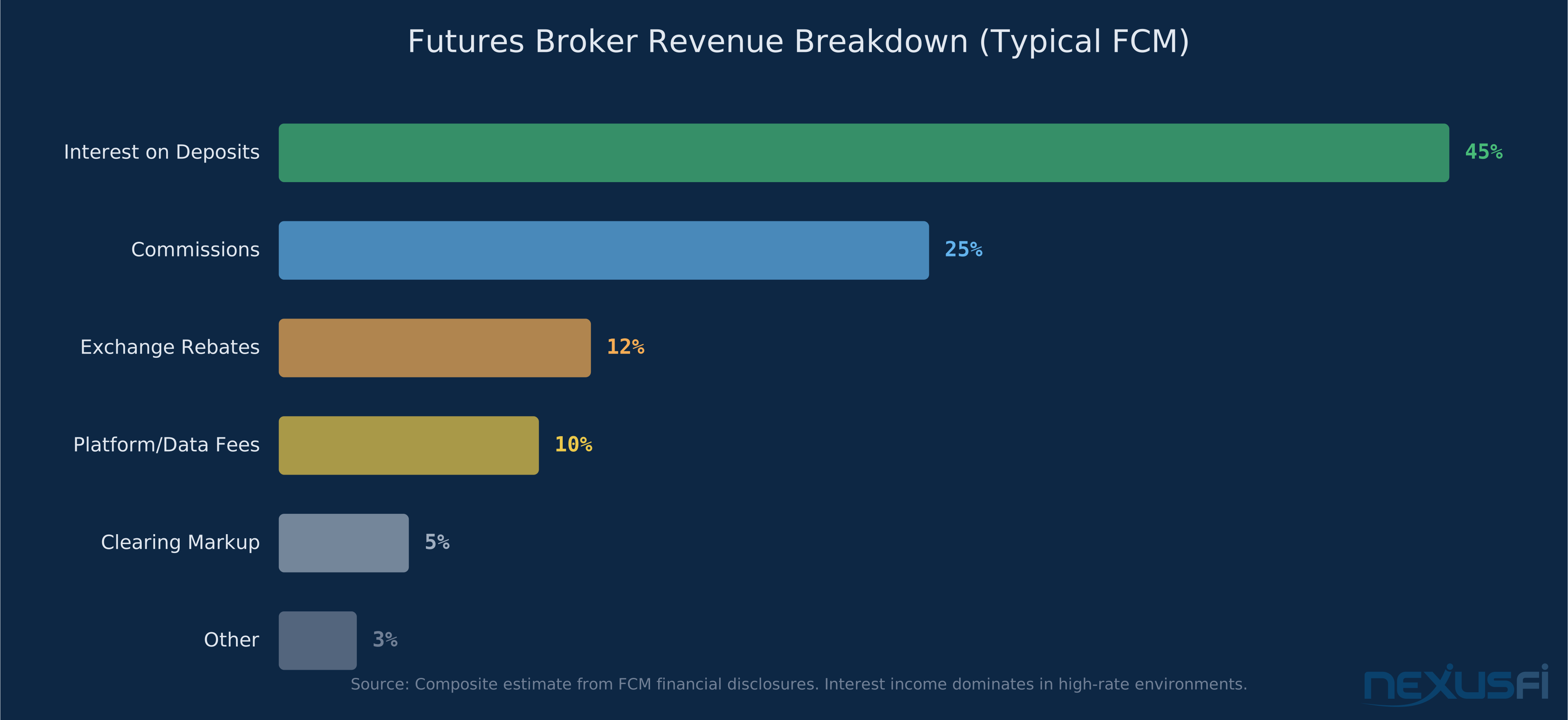
Futures brokers (technically, Futures Commission Merchants or FCMs, and the Introducing Brokers that route through them) have five primary revenue lines. They're rarely equal in size, and the mix shifts dramatically based on interest rate environments, customer volume, and whether the firm is retail-focused or institutional.
Commission Revenue — The Visible Piece #
Commission is the number brokers advertise, but it's also the smallest and most negotiable piece of your all-in cost.
When AMP quotes you $0.40/side for ES, that $0.40 is the entire broker commission. At $0.80/round-turn, that's the amount flowing directly to AMP as revenue from your trade. For a broker processing 50,000 round-turns per day across its customer base, that's $40,000 daily in commission revenue — before any other revenue lines.
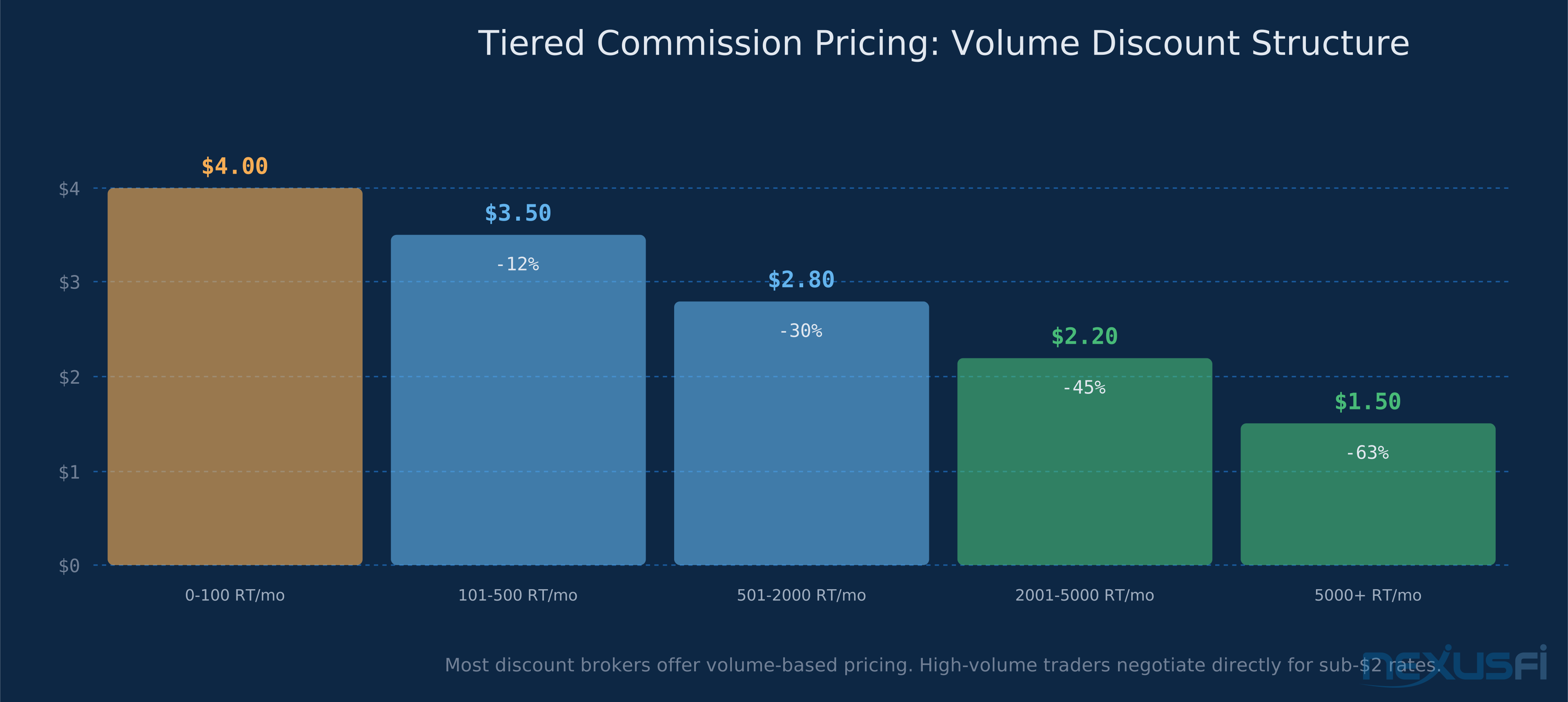
Commission rates vary wildly. Retail traders at full-service brokers might pay $2.00-$5.00/side. Discount futures brokers like AMP, Optimus, or Tradovate sit in the $0.15-$0.60/side range. High-volume traders who negotiate directly can get under $0.10/side.
The thing is, commission rate comparisons are almost meaningless without accounting for what sits around them.
[1]
When comparing brokers, always get the all-in per round-turn cost for your specific instrument. Ask: exchange fee + NFA fee + clearing fee + data network fee + broker commission. Commission alone tells you almost nothing.
Exchange Fees and Clearing Fees — The Pass-Through Stack #
These aren't broker revenue. They flow through your broker to the exchange and clearing infrastructure. But brokers quote them differently, which creates comparison confusion.
For a typical ES trade routed through AMP with CQG data, @josh broke down the round-turn cost precisely: Exchange fee ($0.40), NFA ($0.04), clearing ($0.10), CQG data network ($0.20). That's $0.74 before you even count broker commission. With Rithmic instead of CQG, the data component rises to $0.50, making it $1.04/RT before commission.[2]
The exchange fee goes directly to CME Group. It's non-negotiable for retail traders and set by the exchange. CME does offer volume-based incentive programs for high-frequency market makers processing hundreds of millions of contracts annually — but for the traders reading this article, the exchange fee is fixed.
The NFA fee ($0.02/side as of 2024) is a regulatory assessment. It goes to the National Futures Association to fund oversight of the industry. Small, non-negotiable.
Clearing fees go to the FCM in its capacity as clearing firm, or to a third-party clearing firm the introducing broker routes through. At some brokers, the "clearing" line is where the broker is effectively hiding additional revenue. Watch for cases where the broker's commission is quoted at $0.00 but clearing is $0.50 — the math works out the same way.

When a broker quotes zero commission and high clearing fees, they're not giving you a deal — they've moved the revenue line. What matters is the total cost per round-turn, not which bucket the money sits in.
Interest Income on Customer Margin Deposits — The Invisible Giant #
This is often the single largest revenue line for any FCM with a significant customer base, and most retail traders have no idea it exists.
Here's how it works: When you deposit $10,000 to trade futures, that money doesn't sit idle. Your broker holds it in a segregated account (required by CFTC rules), but those funds can be invested in permitted instruments — U.S. Treasury bills, government agency securities, and similar low-risk instruments. The interest generated on those investments flows to the FCM.
The math is compelling. In 2021, when Fed Funds was near zero, interest income from customer deposits was basically nothing. By 2023, with Fed Funds at 5.25%, a broker holding $500 million in customer deposits was generating approximately $26 million annually in interest income — without executing a single trade, hiring a single sales rep, or building a single feature.
That spread — charging margin interest and paying nothing on deposits — is interest income by another name.[4]
In the futures world specifically, the mechanics are slightly different from FX or equities because of segregation requirements. But the fundamental dynamic is the same: brokers earn the return on your idle capital, and the question is how much (if any) they pass back to you.
Some institutional-focused brokers do pass a portion back. Interactive Brokers has historically paid competitive rates on idle cash balances. Most retail futures brokers do not. When you ask your broker "what do you pay on my margin deposits," the answer tells you a lot about which customer segment they're optimized for.

In a high interest rate environment, a broker keeping $100,000 of your margin earns approximately $5,000/year in interest on your capital while charging you commissions. This is not a conflict of interest per se — it's the disclosed revenue model — but it's worth knowing. Ask your broker about their interest income policy before depositing.
Exchange Volume Rebates — The Institutional Layer #
CME, ICE, and other futures exchanges run tiered incentive programs that pay rebates to high-volume participants who provide liquidity. These rebates flow back to the FCM (or directly to the trader's account, in some arrangements) based on the volume of resting limit orders that get filled against incoming market orders.
For retail traders, this is largely invisible. The exchange's market-making rebate programs are designed for firms processing millions of contracts monthly. But the dynamics affect you indirectly.
When brokers with large institutional client bases receive exchange rebates, they often pass some portion back to their institutional customers as negotiated commissions below the listed rate. This is how a prop firm or large hedge fund can pay effectively negative net commissions in certain situations — the rebate exceeds the commission.
[6]
For retail traders, the actionable takeaway is: if you trade with limit orders and have sufficient volume, ask your broker whether they can share exchange rebates. Some will. Most retail traders don't reach the threshold where this conversation is worth having, but active traders doing 2,000+ round-turns monthly on CME products should at least ask.
Platform and Technology Revenue — The Hidden Monthly Fee #
This revenue stream is often more significant than broker commissions for retail-focused FCMs.
Data fees, platform licensing, and technology subscriptions generate predictable monthly revenue independent of whether you trade. For a broker with 5,000 active accounts, even $15/month in average technology fees generates $75,000 monthly in recurring revenue — without a single trade being executed.
The structure varies much:
- Some brokers include basic data and a platform in the all-in per-trade cost (AMP with CQG at $0.20/RT covers basic data access)
- Some charge separately for data access: $10-30/month for CME exchange data (non-professional rate) — this is a pass-through, but it's real money
- Platform monthly fees: brokers that resell or license NinjaTrader Brokerage or specialized order management tools may charge monthly platform subscriptions
- API access fees for automated traders running their own order management systems
Technology fees create an interesting dynamic: they're fixed costs regardless of your activity level. A trader executing 10 round-turns/month at $3.70 all-in pays $37 in per-trade costs plus potentially $30/month in data fees — meaning data costs are doubling their total monthly trading expense. A trader doing 1,000 round-turns/month pays the same $30 in data but $3,700 in per-trade costs, making data a rounding error.
Low-volume traders should calculate their total monthly cost including fixed fees. If you're trading fewer than 50 round-turns per month, data and platform fees may be a larger cost than commissions. High-volume traders should focus exclusively on per-trade all-in cost.
Why Payment for Order Flow Doesn't Exist in Futures #
This deserves its own section because it's one of the most important structural differences between futures and equities — and understanding it should give you confidence in futures as a venue.
In equity markets, brokers like Robinhood, TD Ameritrade, and Schwab route retail orders to market makers (Citadel, Virtu, Two Sigma) who pay for the right to be on the other side of your trade. The payment for order flow (PFOF) model is legal, disclosed, and controversial — but it's real.
[3]
Futures markets don't work this way. Full stop.
When you submit an order for ES or CL, that order goes directly to CME Globex's matching engine. CME runs a centralized limit order book with strict price-time priority. There is no mechanism for a broker to route your order to a preferred counterparty in exchange for payment. The exchange determines who fills your order based on price and time — period.
This is why futures commissions have a floor: brokers can't monetize order routing the way equity brokers can. They have to charge enough commission (or generate enough interest income) to actually run the business. A futures broker offering $0 all-in commissions would be running at a loss — there's no hidden revenue stream to subsidize it.
@artemiso was direct about the equity PFOF dynamic: "There's no such thing as free trading... A broker's duty has always been to ensure best execution and to act with no conflict of interest, and you could say that such a practice is an unethical violation of both duties."[5] In futures, this particular conflict simply doesn't exist. Your order hits a transparent electronic order book, and you get exchange best price — not "best price minus the premium the broker extracted from your order flow."
Futures are structurally cleaner than equities on execution integrity. The exchange is the sole matching engine. Your broker cannot route your order to a preferred counterparty for a kickback. What you see on the DOM is what you can trade.
The Conflict of Interest Map #
Not every revenue stream creates a conflict. Some are perfectly aligned with your interests; others require vigilance.

Aligned interests:
Commission revenue — broker wants you to trade actively and profitably. Profitable traders stay; blow-ups leave. There's a legitimate economic incentive to keep you viable and trading. Exchange rebates from limit orders also align — they reward liquidity provision, which is generally smart execution practice.
Potential misalignment:
Interest income on margin deposits — broker's income rises with higher margin requirements. A broker that sets internal day-trade margins higher than the exchange minimum is collecting more float on your capital. Ask why their intraday margins are set where they are.
Technology lock-in — proprietary platforms create switching costs. After you've built a suite of custom indicators in a broker's proprietary tool, changing brokers becomes a real operational cost. Brokers know this. It reduces your price sensitivity over time.
High-churn retail model — as @Big Mike observed about certain discount FCMs, some retail-focused brokers build their business around new traders who fund with small amounts, blow up, and refund repeatedly. "They don't want 'problem' customers who ask questions, because then you start costing them money."[3] This isn't a conflict in the legal sense, but it does mean some brokers aren't economically incentivized to help you improve.
Genuine conflict (legal but real):
Proprietary trading — FCMs are permitted by CFTC rules to trade their own accounts. An FCM operating a proprietary trading desk has theoretically different interests than you as a customer. "No Dealing Desk" (NDD) language in a broker agreement means they're not taking the opposite side of your trade. This matters more for OTC instruments (FX, CFDs) than for exchange-traded futures, where your order hits an anonymous matching engine regardless — but it's still worth knowing whether your FCM runs a prop desk alongside its clearing operations.
Calculating the True All-In Cost #
Here's how to figure out what you're actually paying per round-turn, without being misled by quoted commission rates.
The components:
- Exchange fee (per side, set by exchange — non-negotiable)
- NFA fee ($0.02/side in 2024 — non-negotiable)
- Clearing fee (per side — sometimes negotiable if you're high-volume)
- Data network fee (CQG, Rithmic, TT, or broker data — per side or monthly)
- Broker commission (per side — most negotiable)
- Monthly fees amortized over your trade volume (platform, data subscriptions)

The difference compounds violently over time. A trader doing 500 round-turns/month at $2.10 all-in pays $1,050/month in transaction costs. The same activity at $5.00 all-in costs $2,500/month — a $1,450/month difference that can determine whether a mildly profitable strategy stays profitable at all.
True all-in cost per RT = (Exchange + NFA + Clearing + Data network + Commission) x 2 + (Monthly fixed fees / Monthly round-trips)
Request a complete fee schedule from any broker before depositing. Specifically ask: "What is my all-in cost per round-turn for [instrument] with [data provider]?" Then ask: "Are there any monthly fees not included in that number?" Both questions are required. Commission alone tells you almost nothing.
What Brokers Make on Different Trader Types #
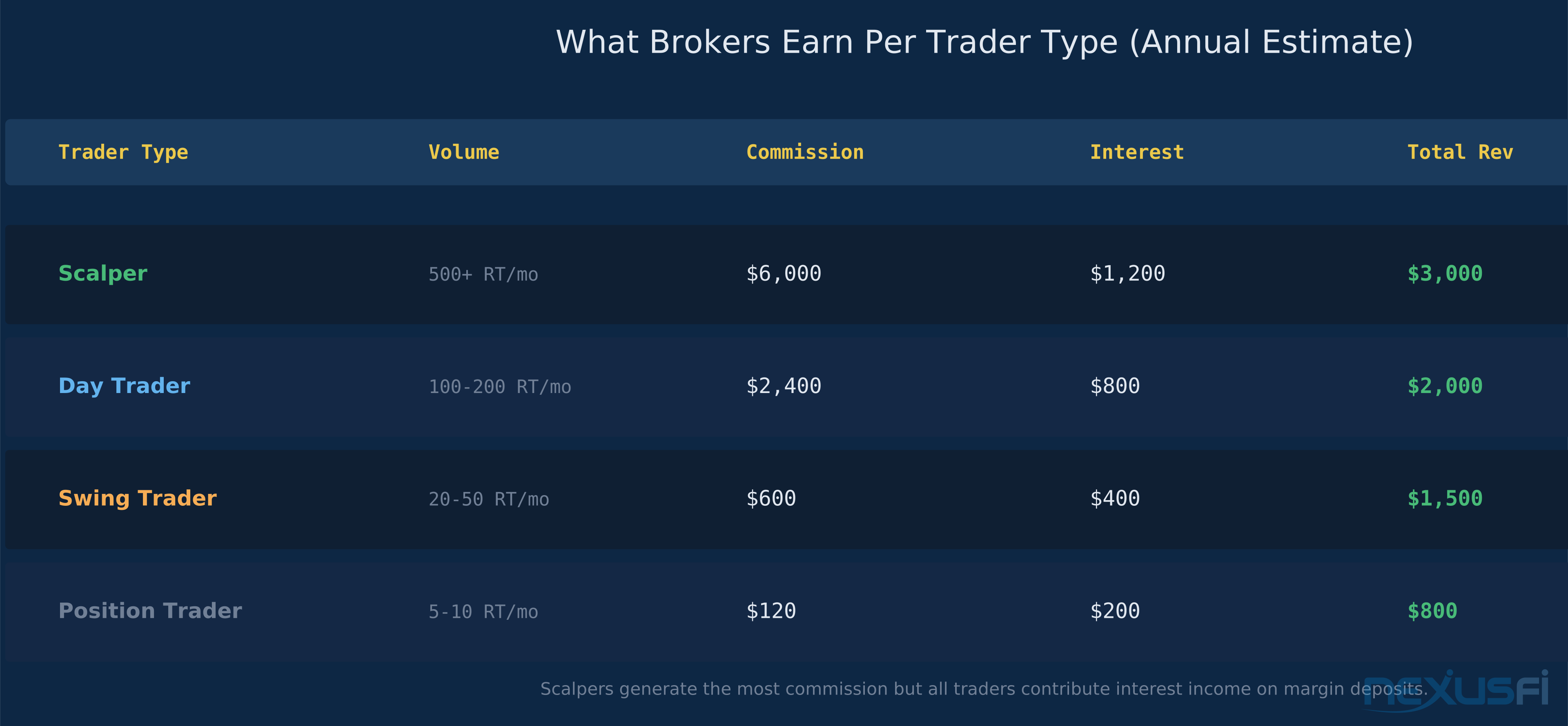
Understanding broker revenue by trader segment explains why you get treated differently depending on your profile.
The new retail trader — Highest per-trade commission paid, lowest absolute volume, highest probability of blowing up and re-depositing. Revenue model: commission + platform fees + interest on deposits + expectation of account re-funding cycles. This trader is valuable to retail-focused FCMs precisely because of predictable turnover.
The active retail trader (50-500 RT/month) — Negotiated commission rate, moderate volume, longer account lifetime. Revenue model: commission at compressed rate + data fees (significant as % of total) + interest income. This is the bread-and-butter customer for most discount FCMs.
The high-frequency or systematic trader — Extremely low commission (often sub-$0.10/side), ultra-high volume, significant infrastructure requirements. Revenue model: minimal commission, API/connectivity fees, clearing at volume. These traders are sometimes commission-negative after exchange rebates — broker makes money on clearing, data, and related services.
The institutional account — Negotiated everything, multi-million dollar accounts, sophisticated operations. Revenue model: clearing fees, interest on very large balances, give-up fees, prime brokerage services, execution analytics. Direct commissions are basically zero.
The broker's internal economics invert from what you'd expect: new retail traders generate the highest per-trade commission revenue but require the most support and have the highest churn. Systematic traders generate minimal per-trade revenue but provide stable, predictable volume with minimal support cost. Institutional accounts generate almost no commission income but contribute much via interest income and service fees.
Questions to Ask Your Broker #
These questions separate brokers who are aligned with your success from those who are indifferent to it:
"What is my all-in cost per round-turn for [specific instrument] with [specific data provider]?" — Not commission. All-in. If they quote only commission, that's a red flag.
"What do you pay on idle cash balances in my account?" — In a 5% rate environment, this is real money. A broker paying 0% on your $50,000 margin deposit is collecting ~$2,500/year on your capital. Some brokers pass this back; most don't.
"Do you operate a proprietary trading desk?" — For exchange-traded futures, this is less material than for OTC products, but it's still a reasonable question about conflicts of interest structure.
"What is the process for negotiating my commission as my volume increases?" — Most brokers won't proactively offer lower rates as you grow. You have to ask. A broker who has no negotiation process is optimized for retail churn, not trader retention.
"Are there any monthly fees, minimum activity fees, or data fees not included in the all-in per-trade cost?" — This question catches the hidden fixed costs that make low-volume trading more expensive than the per-trade rate implies.
Knowledge Map
Go Deeper
Build on this knowledgeReferences This Article
Articles that build on this topicCitations
- — Costs associated with trading futures? (2020) 👍 7“In futures, the term commission usually just means the relatively small piece that goes to the broker, while commission and fees includes the data/trade network and exchange per-trade fees.”
- — AMP Futures / AMP Global Review (2020) 👍 4“Exchange $0.40, NFA $0.04, clearing $0.10, CQG $0.20 per round-turn before commission.”
- — Futures vs CFD with AMP futures, Forex.com and Cityindex.co.uk (2020) 👍 3“With futures, you cannot sell order flow. What's important is to make sure you really understand your complete end-to-end cost per trade.”
- — Advantage Futures (2020) 👍 6“If you buy USD sell EUR, they will pay you 0% on the USD deposit and charge you 1.5% on the EUR margin, hence the trade has a 1.5% carry cost.”
- — Startup found a way to give $0 Commission to trade equities (2014) 👍 3“There is no such thing as free trading. A broker's duty has always been to ensure best execution and to act with no conflict of interest.”
- — Spoo-nalysis ES e-mini futures S&P 500 (2013) 👍 2“Many trading venues employ what is known as a maker-taker model of payment for order flow.”
- — zero commission and Stops (2022) 👍 2“The traders, one way or another, have to pay the money that the other players receive, and they do, in the form of poorer fills.”