



Paper Trading and Futures Simulators: What They Get Right, What They Get Wrong, and When to Go Live
Overview #
Every futures trader starts somewhere, and for most, that somewhere is a simulator. Paper trading — executing trades in a simulated environment with no real capital at risk — is one of the most universally recommended steps in trader development. Brokers offer demo accounts, platforms ship with built-in simulators, and prop firms gate their entire evaluation process through simulated environments.
Here's the problem: simulators lie.
Not maliciously. Not always. But the gap between what a simulator shows you and what live markets actually deliver is wider than most traders realize — and that gap has ended more trading careers than bad strategies ever have. A trader who "crushes it" on sim for three months, then blows up their first live account in two weeks, isn't experiencing bad luck. They're experiencing the predictable consequence of training in an environment that systematically overstates their edge.
This article breaks down how futures simulators actually work under the hood, where they deviate from live execution, what they're genuinely useful for, and how to build a transition plan that doesn't end with a blown account. If you've ever wondered why your sim results don't translate to live performance, the answer is mechanical, psychological, and entirely fixable — once you understand what's actually happening.
Key Concepts #
Types of Futures Simulators #
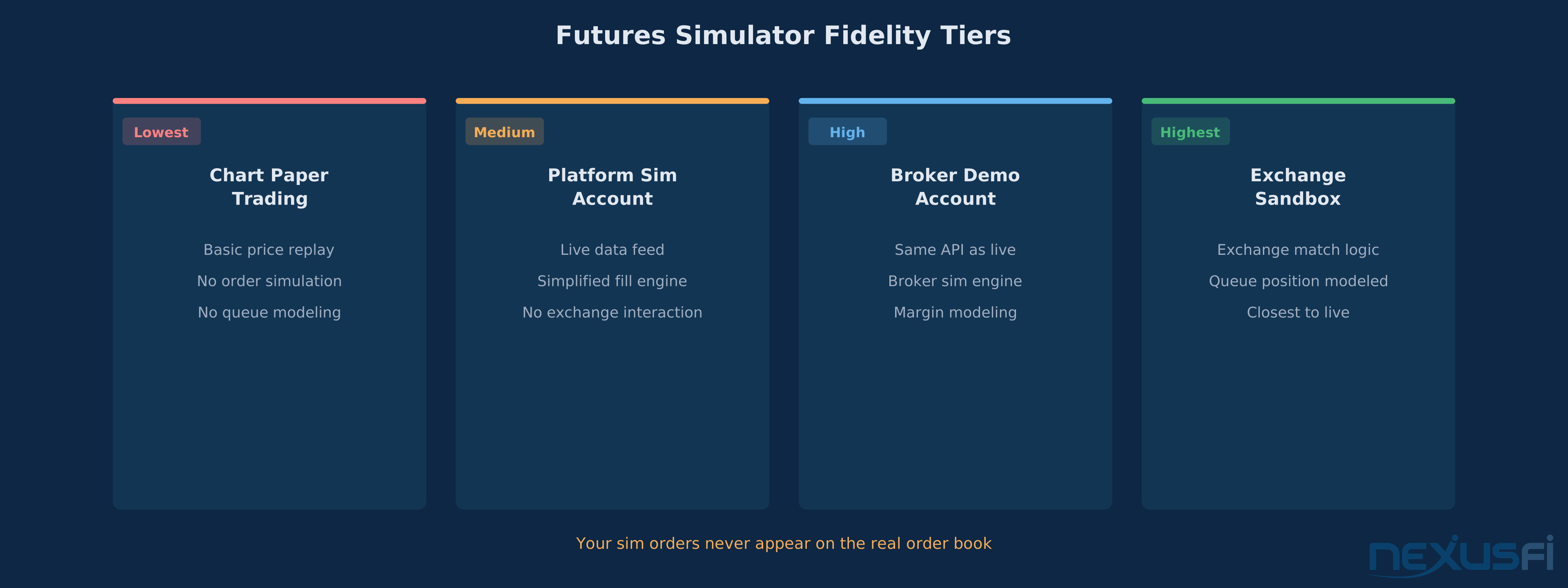
Not all simulators are created equal, and understanding the fidelity tier you're working with matters enormously.
Broker-provided demo accounts are the most common entry point. These connect to live market data (sometimes delayed) and simulate order execution against that data stream. Your orders never touch the exchange — the broker's sim engine decides whether and when you get filled. Some brokers run their sim environments on the same API and order management system as their live accounts (CQG, Rithmic-based platforms), while others run simplified parallel systems with different execution logic.
Platform-level paper accounts are built into trading software like NinjaTrader, Sierra Chart, or MultiCharts. These typically overlay simulated execution on top of live or replayed market data. The platform's sim engine handles fill logic independently of any broker infrastructure. Quality varies dramatically — some platforms model queue position and partial fills, others give you instant fills at the displayed price regardless of market conditions.
Exchange-connected sandboxes are the highest-fidelity option. CME offers a certification environment, and some institutional platforms provide sandbox modes that simulate exchange matching logic more closely. These are rare for retail traders but exist in prop firm evaluation contexts.
Historical replay simulators let you practice against recorded market data at accelerated or real-time speed. These are useful for pattern recognition and workflow practice, but their execution modeling is typically the most simplified — fills happen at the replay timestamp with no queue or liquidity consideration.
The critical distinction: your sim orders don't appear on the actual order book. As @matthew28 explains on NexusFi, "The limit orders do not show on a sim account so you could place a 200 lot order and it will make no difference to what is showing for the actual resting orders on the bid or offer. So if there is fifty contracts actually bid or offered at a price and you place a 200 lot sim order at that price, the DOM or heatmap chart will still show 50 lots at that price." This single fact is the root of most sim-to-live execution discrepancies.
How Sim Fill Models Work #
Simulator fill engines generally fall into two categories, and which one your platform uses at the core changes what your results mean.
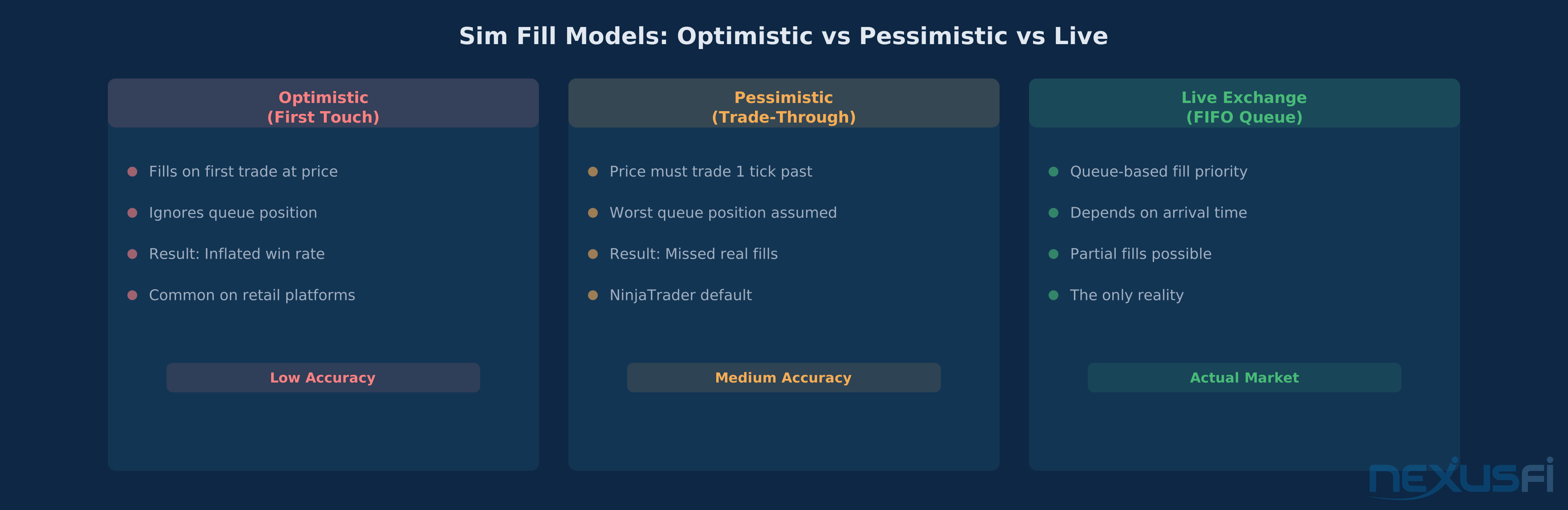
Optimistic fill models fill your limit orders on first touch — the moment the market trades at your price, you're filled. This is the default on many retail platforms and it systematically inflates your results. In live markets, your limit order sits in a queue behind every other order at that price. If there are 500 contracts ahead of you at 5200.00 on ES, the market needs to trade through 500+ contracts at that price before you get filled. First-touch fills skip this entirely.
Pessimistic fill models require price to trade through your level by one tick before filling you. If your limit sell is at 5200.00, price must trade at 5200.25 (one tick through) before the sim fills you. This ensures that even if you were last in queue, you'd have been filled. It's more conservative, but it introduces its own distortion — you'll miss fills that would have happened in live markets where your queue position was favorable.
Neither model is accurate. The real market uses FIFO (first-in-first-out) queue priority at the exchange level. Your actual fill depends on when your order arrived relative to every other order at that price, and that information simply doesn't exist in a simulated environment.
What Simulators Do Well #
Simulators genuinely excel at several things that have nothing to do with predicting profitability:
- Workflow training: Learning order entry, bracket management, OCO behavior, and platform mechanics without financial consequences
- Pattern recognition: Developing the ability to read price action, identify setups, and recognize market conditions in real-time
- Strategy logic validation: Confirming that your entry criteria, stop placement, and target logic produce coherent trades — even if the exact P&L is unreliable
- Risk management rehearsal: Practicing position sizing, daily loss limits, and the mechanical discipline of stopping when your rules say stop
What simulators don't do well: predict your actual execution quality, your psychological response to real losses, or your true edge in live markets.
The Execution Gap: Sim vs Live #
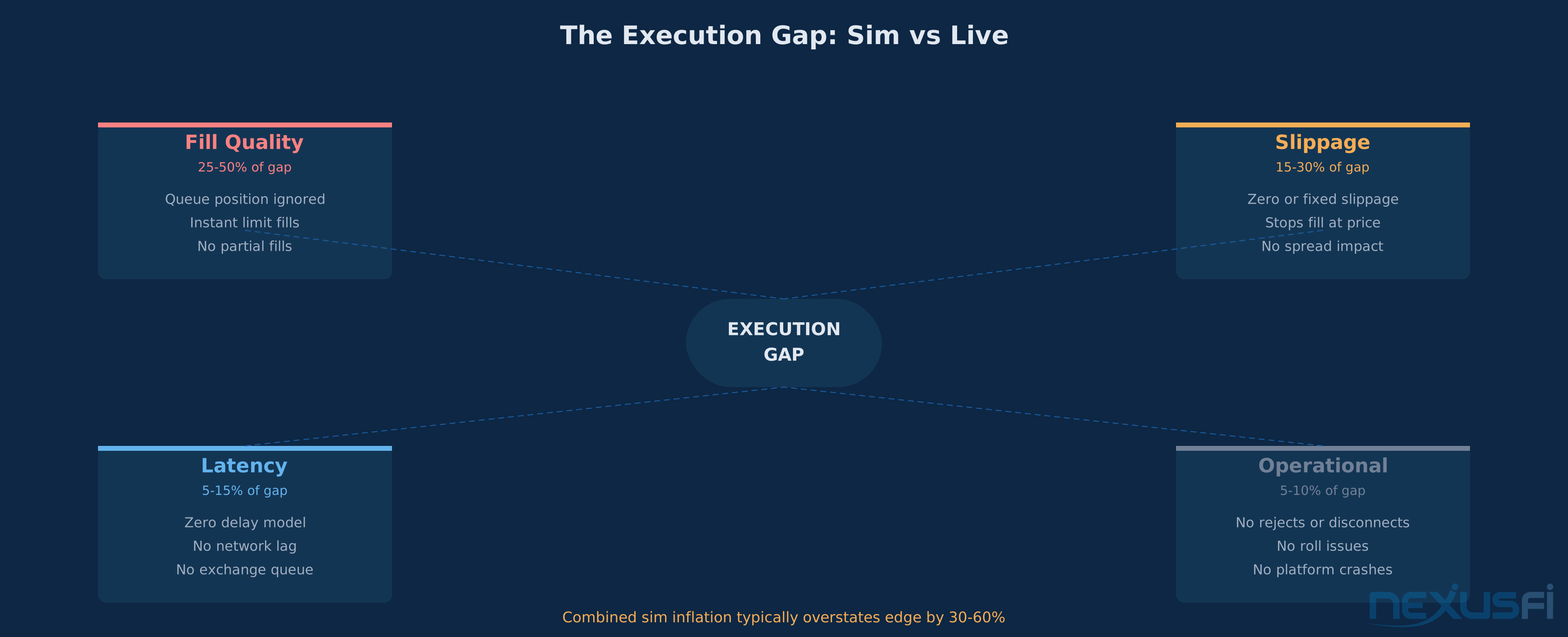
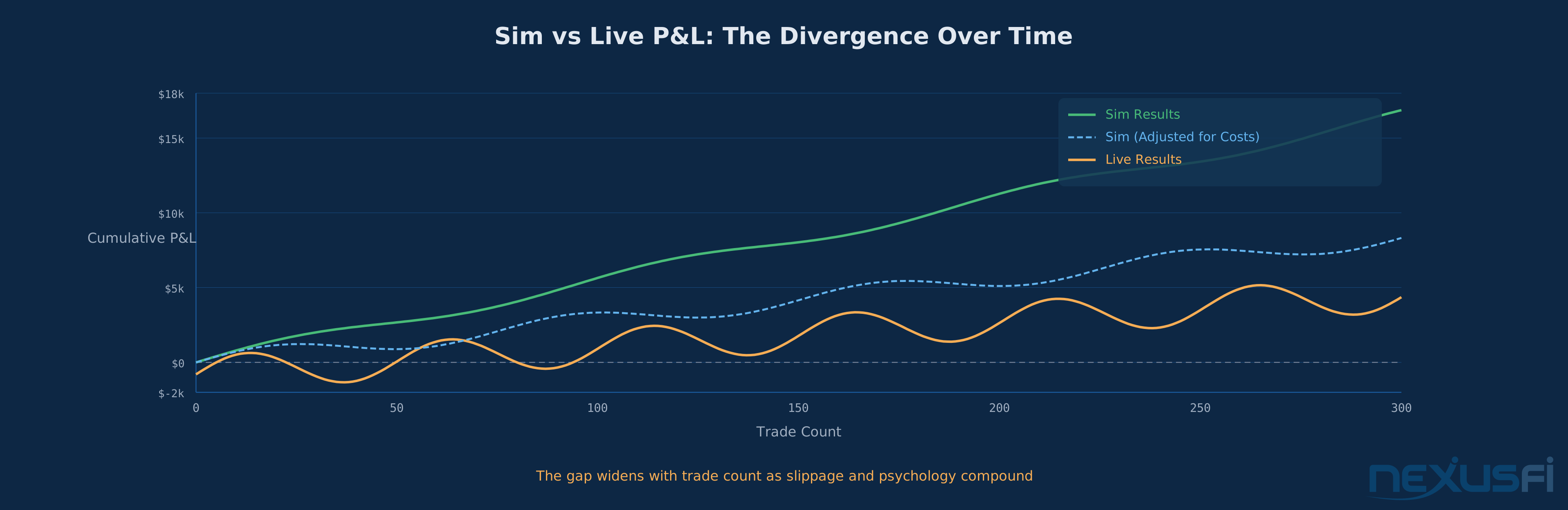
This is where most traders get burned. The execution gap between simulated and live futures trading has four components, and each one consistently biases sim results in the trader's favor.
Fill Quality and Queue Position #
In a simulator, your limit order fills when the market touches your price. In live markets, your limit order fills when every order ahead of you in the queue has been filled AND an aggressive counter-order matches yours.
On thick products like ZN (10-Year Treasury Notes), where thousands of contracts rest at each price level, queue position is everything. You can watch price trade at your level for minutes without getting filled because you're 2,000 contracts back in the queue. Your sim account would have shown an instant fill. On thinner products like NQ, where the order book is shallower and price moves faster, queue position matters less — but it still matters.
The platform you choose for sim trading directly determines how misleading your results will be.
Slippage #
Simulators typically understate slippage — sometimes dramatically. In live futures trading, slippage occurs on every market order and every stop order (which becomes a market order when triggered). The amount depends on current liquidity, volatility, and your order size.
He reports experiencing over $2,000 of slippage on a single Gold contract during a thin Sunday session.
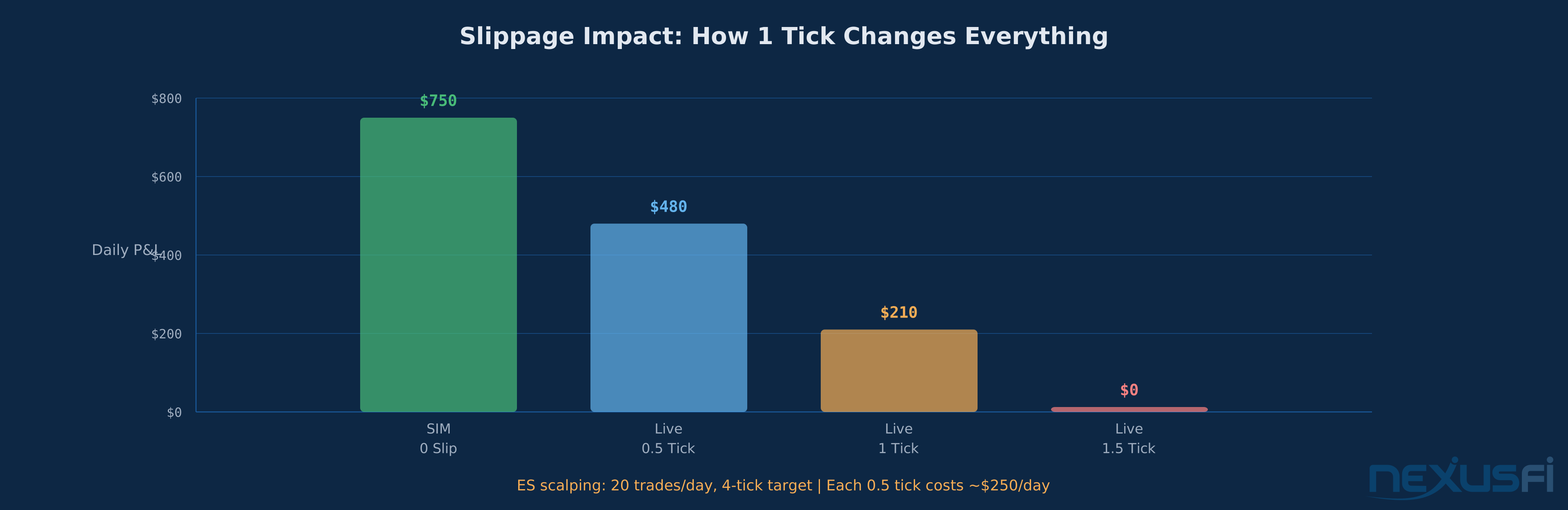
The math compounds quickly. If you're scalping ES for 4 ticks per trade and your sim shows zero slippage on entries and exits, but live trading costs you 1 tick of slippage per round trip, you've just lost 25% of your gross profit. For strategies with small per-trade targets, simulated slippage assumptions are the difference between a profitable system and a losing one.
Latency #
Sim environments have effectively zero latency — your order is "submitted" and "filled" within the same processing cycle. Live futures trading involves multiple latency layers:
- Internet latency: Your order travels from your computer to your broker's server (typically 10-100ms for retail)
- Broker routing latency: Your broker processes and forwards your order to the exchange (variable)
- Exchange matching latency: The exchange processes your order against the book (sub-millisecond at CME, but queue time varies)
For swing traders taking 2-3 trades per day with wide stops, latency is irrelevant. For scalpers working 2-4 tick targets on NQ, the difference between clicking and getting filled can be the difference between a winning and losing trade. Sim environments don't model this at all.
Operational Failures #
Live trading includes an entire category of events that simulators never produce:
- Order rejects from the exchange (price outside limits, contract halted, position limits exceeded)
- Connectivity drops requiring reconnection and position reconciliation
- Platform crashes mid-trade
- Data feed interruptions that leave you trading blind
- Contract roll complications when your front-month position needs to migrate
None of these happen in sim. When they happen live, your response determines whether a recoverable situation turns into a catastrophe. If you've never practiced recovering from a disconnect while holding a position, your first live experience with it will not go smoothly.
Common Pitfalls of Over-Reliance on Sim #
The False Confidence Trap #
The most dangerous outcome of extended paper trading isn't poor preparation — it's overpreparation for an environment that doesn't exist. A trader with six months of profitable sim results has proven exactly one thing: they can trade profitably in a simulated environment. That's not nothing, but it's not what they think it is.
The false confidence manifests in specific ways:
- Oversized positions: "I trade 10 lots profitably on sim" translates to "I trade 10 lots with perfect fills and no emotional stakes." Live 10-lot execution in futures is materially different from sim 10-lot execution.
- Tight scalping strategies: Systems that rely on 2-3 tick targets with limit-order entries are the most vulnerable to sim inflation. Queue position and slippage destroy the edge that sim results suggest exists.
- Aggressive averaging: Adding to losers works more often in sim because your additional entries get filled at displayed prices. Live, you're chasing a moving market with degrading fills.
Ignoring Transaction Costs #
Sim accounts often omit or understate commissions, exchange fees, and NFA fees. A round-trip on ES might cost $4.50-5.50 per contract in total fees. On 20 trades per day, that's $90-$110 before you've made a single dollar. Sim traders who don't subtract realistic commission assumptions from their P&L are measuring a fantasy.
The Overtrading Incentive #
With no financial consequence for losses, sim environments naturally encourage overtrading. Taking 30 trades in a session on sim is painless. Taking 30 trades live, with real commissions and real slippage on each one, is expensive even before considering the psychological toll. Traders who develop high-frequency habits on sim often discover that their strategy isn't viable at the trade frequency their sim results assumed.
Topstep and the Sim Abuse Problem #
Prop firms discovered this problem early. As @matthew28 notes, "Topstep for instance had a problem with sim traders exploiting the sim environment to reach the profit targets which is why they brought in a rule where they could reset an account they considered to be 'sim abuse'." When the evaluation is simulated but the payout is real, traders have every incentive to exploit sim-specific execution advantages.
Psychology: Why Sim Skill Doesn't Transfer Automatically #
The Emotional Gap #
This is where the conversation gets uncomfortable, because the psychological difference between sim and live trading isn't something you can intellectualize away. You have to experience it.
@lancelottrader, who journaled years of his NQ trading path on NexusFi, describes the experience vividly: "Due to the psychological 'damage' that resulted from years of failure and lost money, there has often been an inner fear that has gripped me not only when I put on a trade, but even as I was about to place one. This would manifest in a large surge of adrenaline and I could literally feel my heart start to pound. My shirts would be soaked in the underarm area. I would see some perfect setups and simply could not pull the trigger." His observation cuts to the core: "It finally dawned on me that when I'm on SIM, none of these things occur. I just take the trade and see what happens."
This isn't a character flaw or a sign of weakness. It's neurochemistry. Your brain processes simulated loss and real financial loss through different pathways. Loss aversion — the well-documented tendency to feel losses roughly twice as intensely as equivalent gains — simply doesn't activate when nothing real is at stake.
The Behavioral Cascade #
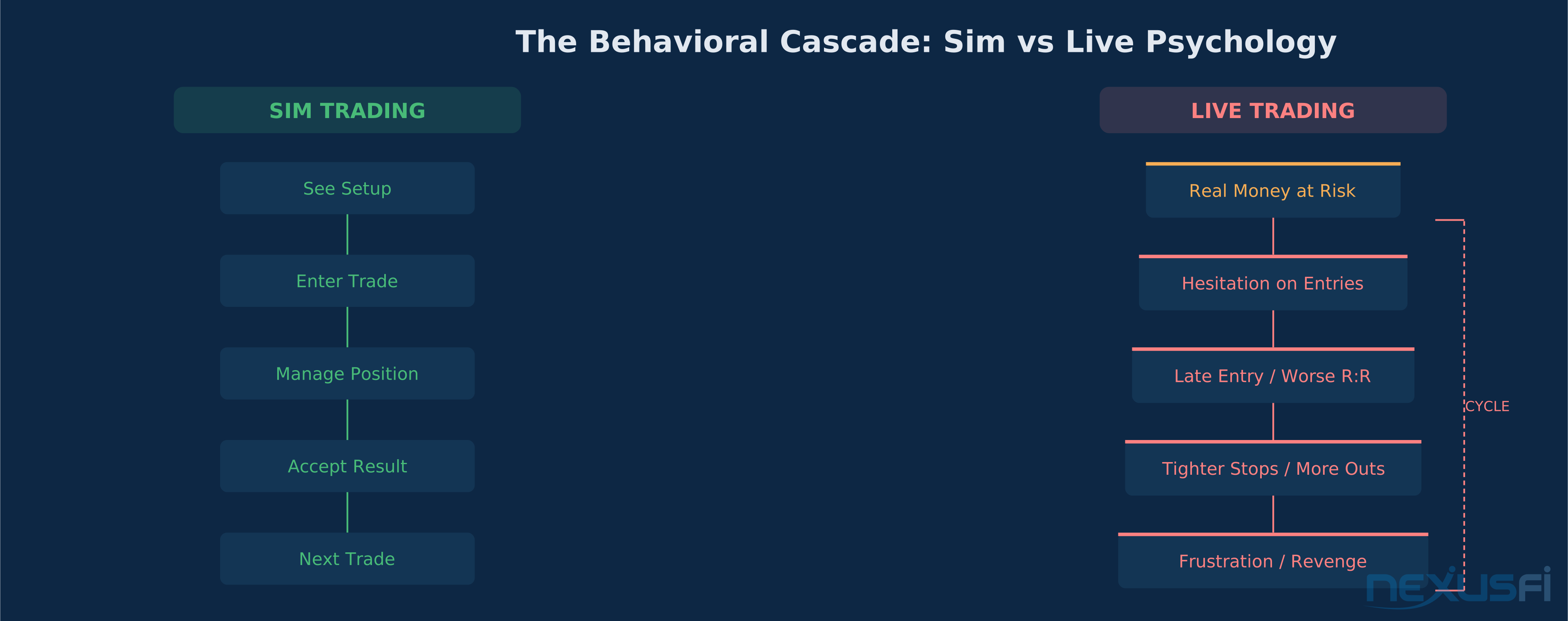
Each of these behavioral shifts degrades performance independently. Together, they create a cascade:
- Hesitation causes late entries, which reduces your risk/reward ratio
- Tighter stops increase your stop-out rate, which creates more frequent losses
- More frequent losses compound irritation, which impairs judgment
- Impaired judgment leads to revenge trades or frozen decision-making
- The cycle reinforces itself until the trader either adapts or blows out
The Sim-to-Live Failure Loop #
This loop is self-reinforcing because each failed live attempt adds psychological damage that makes the next attempt harder, while each return to sim rebuilds false confidence through unrealistic execution.
Breaking this loop requires understanding that sim profitability is a necessary but insufficient condition for live profitability. The transition itself is a distinct skill that must be developed separately.
The Transition Framework: Paper to Live #
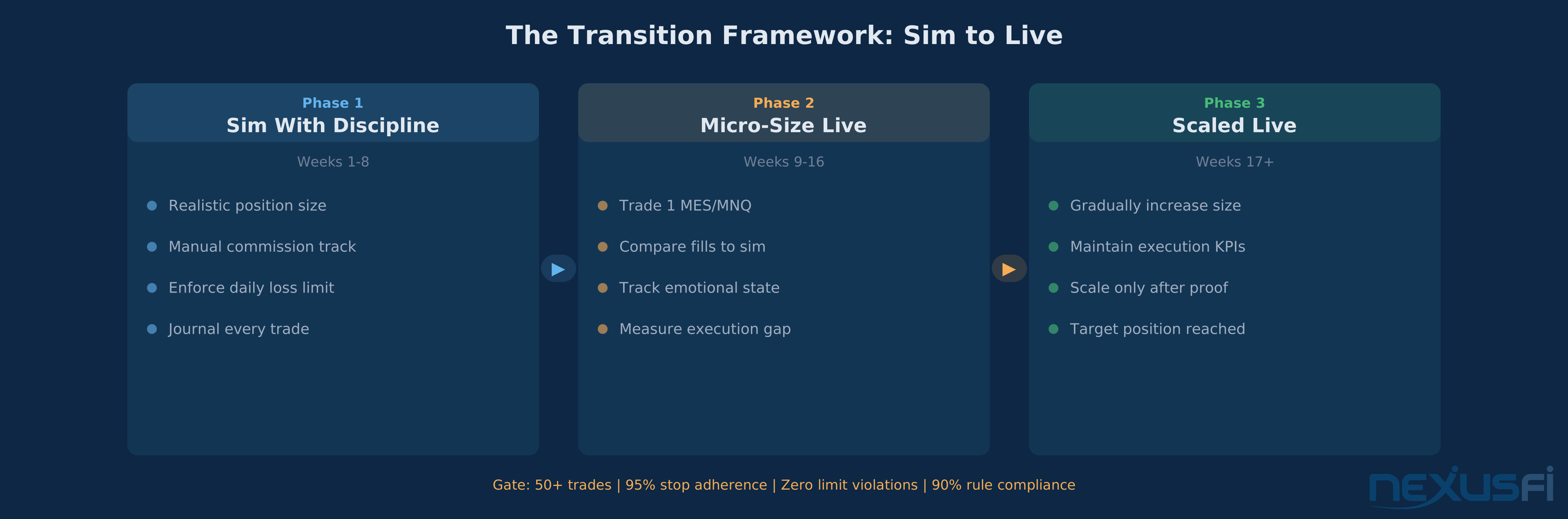
Phase 1: Sim With Discipline (Weeks 1-8) #
Use sim for what it's actually good at: workflow training and strategy logic validation. During this phase:
- Trade with realistic size — the same contract count you'll use live, not inflated sim size
- Subtract realistic commissions from every trade manually if your sim doesn't model them
- Enforce daily loss limits as if they were real — when you hit your limit, stop
- Journal every trade with the same rigor you'll use live
- Add realistic slippage assumptions: 1 tick per side on ES/NQ market orders, 2+ ticks on stops in fast markets
The goal is not to prove profitability. The goal is to confirm that your execution workflow is smooth, your entries and exits are mechanical, and your risk management rules are embedded in muscle memory.
Phase 2: Micro-Size Live (Weeks 9-16) #
This is the critical bridge. Trade 1 Micro E-mini contract (MES, MNQ, MCL) with real money. The financial exposure is minimal — 1 MES contract has 1/10th the point value of ES — but the psychological exposure is real.
During this phase, you're not trying to make money. You're calibrating:
- How do your actual fills compare to your sim fills?
- How does your emotional state change with real money at risk?
- Do you hesitate on entries? Tighten stops? Overtrade after losses?
- What does real slippage look like on your specific strategy?
Track every metric. Compare sim results to micro-live results trade-by-trade. The delta between them is your execution gap, and you need to know its exact size before you scale up.
Phase 3: Scaled Live (Weeks 17+) #
Only after you've demonstrated consistent, disciplined execution on micro contracts should you scale to standard-size futures. Even then, scale gradually — 1 ES, then 2, then your target position size. Each step up reintroduces some psychological pressure, and you need to confirm that your execution quality holds at each level.
Objective Gate Criteria #
Don't transition between phases based on feelings. Use measurable criteria:
- Minimum sample size: 50+ trades in each phase before evaluating
- Execution consistency: Stop-loss adherence above 95% (you actually take the stop when your rules say to)
- Daily limit compliance: Zero violations of daily loss limit across the evaluation period
- Strategy adherence: 90%+ of trades match your predefined criteria (no revenge trades, no FOMO entries)
- Emotional stability: You can describe your mental state as "controlled" or "neutral" for 80%+ of trading sessions
Note what's absent from this list: profitability. A trader who follows their rules perfectly and loses small amounts is better prepared for live trading than a trader who makes money through undisciplined sim trading.
Evaluating Simulator Quality #
Not all simulators are equal. When choosing a platform for paper trading, evaluate these dimensions:
Fill Model Transparency #
Does the platform document how its sim engine handles limit orders, stops, and market orders? Can you configure slippage? Is the fill model optimistic (first-touch) or pessimistic (trade-through)? If the platform doesn't disclose this, assume optimistic — and assume your results are inflated.
Data Quality #
Is the sim using live, tick-by-tick market data or delayed/aggregated data? Delayed data is adequate for learning the platform but useless for evaluating strategy performance. Some demo accounts use 10-15 minute delayed data, which makes any execution timing analysis meaningless.
DOM and Order Book Fidelity #
Can you see the full depth of market in the sim? Does the DOM update at the same rate as a live account? For traders developing order-flow-based strategies, DOM fidelity is essential for practice to translate.
Session and Contract Handling #
Does the sim correctly handle trading session boundaries (RTH open/close, Globex sessions)? Does it handle contract rollover? Simulators that ignore session transitions miss one of the highest-slippage periods in futures trading.
API Parity #
For algorithmic traders, does the sim API match the live API? Can you submit orders through the same code path you'll use in production? API discrepancies between sim and live environments have destroyed more automated strategies than bad algorithms.
Practical Application: Best Practices #
Treat Sim Like a Lab, Not a Proving Ground #
The most productive approach to paper trading treats it as a controlled experiment environment rather than a proof of profitability. Use sim to isolate variables:
- Test a new entry technique while keeping everything else constant
- Practice a new platform's order entry workflow before going live
- Validate that a strategy's logic produces coherent trades (even if exact P&L is unreliable)
- Rehearse recovery procedures: what do you do when you're down 3 trades in a row?
Build Your Performance Baseline #
Run parallel tracking: execute your strategy on sim and on micro-live simultaneously for at least 2 weeks. The difference in results is your execution gap. This number is invaluable — it tells you exactly how much to discount any future sim results.
Practice the Hard Parts #
Most traders use sim to practice winning. Use it to practice losing instead:
- What happens when you hit your daily loss limit? Practice stopping.
- What happens when you get three consecutive losers? Practice staying disciplined.
- What happens when the market gaps against your position at the open? Practice damage control.
The hard parts of trading aren't the wins. They're the losses, the waiting, and the discipline to follow rules when every instinct says to deviate. Sim is a safe environment to build those habits — but only if you actually practice the hard parts instead of just the fun parts.
Know When to Leave #
The biggest risk in paper trading isn't that you'll leave too early. It's that you'll stay too long. Extended sim trading builds habits that are calibrated to an unrealistic execution environment. At some point, the only way to learn live trading is to trade live. The transition framework above provides the structure, but the decision to make the leap is ultimately a judgment call.
His eventual solution wasn't more sim time — it was accepting the reality of loss and trading anyway.
Paper trading is a tool. A powerful one, but a tool. It can teach you workflow, validate strategy logic, and build basic habits. It cannot teach you to trade live. That's a different skill, and the only classroom that offers it is the live market.
Knowledge Map
Prerequisites
Understand these firstGo Deeper
Build on this knowledgeReferences This Article
Articles that build on this topicCitations
- — Demo accounts order fill (2023) 👍 5“The limit orders do not show on a sim account so you could place a 200 lot order and it will make no difference to what is showing for the actual resting orders on the bid or offer.”
- — Slippage Now 2023 vs Past (2023) 👍 6“I see people routinely UNDERstating slippage (especially sim trading scammers on YT and Twitter). Maybe I define slippage differently, but I compare the hypothetical fill from my strategy backtest engine, and compare it to my actual fill.”
- — Account blown up (2015) 👍 5“Biggest thing I experienced going from SIM to REAL was the fact fills in SIM are no where near how they work in real life. Examples: Stop-Loss on Simulation: On simulation you can set your Stop-loss the market hit's it and your trade is closed out.”
- — Target slippage ninja trader 8 (2022) 👍 4“Price has to go above that target by one tick. Are you talking about sim trading on Ninja? The target is a limit order so your order is in a queue somewhere amongst the orders at that price.”
- — The Beast Slayer, Lance's NQ Trading Journal (2021) 👍 26“Two emotions that have plagued me for years and often made my trading experience very unpleasant and unhealthy were Fear and Anger.”
- — The Beast Slayer, Lance's NQ Trading Journal (2018) 👍 25“Yes, in a way. The additional practice and honing of skills gives more confidence . That decreases fear somewhat. However, the dynamic of live trading is always going to have a different psychological component than SIM.”
- — How did YOU learn to successfully trade futures? (2018) 👍 7“I agree with you. Sim trading does not reveal the crippling subtleties of ones personality. Its all the little things that add up to define you as a trader. A few thoughts: 1. When you are live trading you will hesitate. You wont on sim. 2.”
- — Paper VS Real (2016) 👍 4“Well that is your first mistake, attempting to apply any form of 'logic' to the TOS simulator in association with futures markets. The OP's story of woe is one I have heard many times.”