



Micro E-mini Futures (MES, MNQ, MYM, M2K): The Complete Guide to CME Fractional-Sized Contracts
Overview #
Overview #
Micro futures are fractional-sized versions of CME Group's most popular futures contracts, trading at 1/10th the notional value of their E-mini counterparts. The Micro E-mini S&P 500 (MES) controls roughly $28,000 of exposure versus the ES at $280,000. Same underlying market, same price movement, same exchange — just a smaller bite.
CME launched the first four Micro E-mini index contracts — MES, MNQ, MYM, and M2K — in May 2019, and they became the fastest-adopted new product in CME's history. Within months, micro index volume rivaled E-mini volume on some sessions. The product line has since expanded to include Micro WTI Crude Oil (MCL), Micro Gold (MGC), Micro Silver (SIL), Micro Bitcoin (MBT), and Micro Ether (MET).
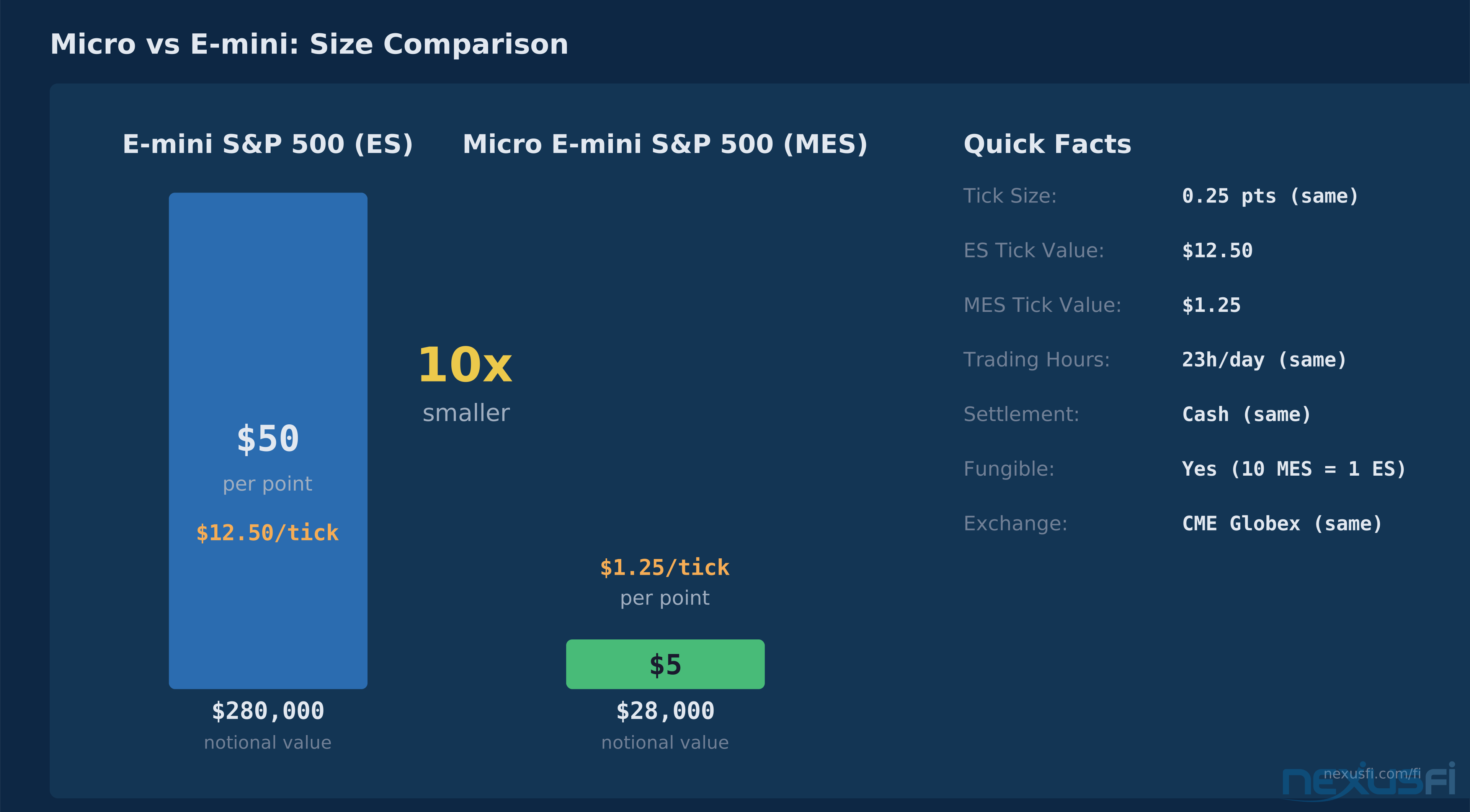
The appeal is straightforward: proper position sizing without the capital requirements of full-size contracts. A 10-tick adverse move on ES costs $125. That same move on MES costs $12.50. For traders learning to read price action with real money on the line, building scaling strategies, or managing risk in smaller accounts, micros turned what was previously an expensive market into an accessible one.
Don't confuse accessible with trivial. These are the same regulated, centralized, exchange-traded instruments as their full-size parents. They carry the same overnight margin requirements proportionally, the same leverage mechanics, and the same potential for loss. The difference is granularity — micros let you dial risk with surgical precision instead of choosing between "too much" and "nothing."
Key Specifications #
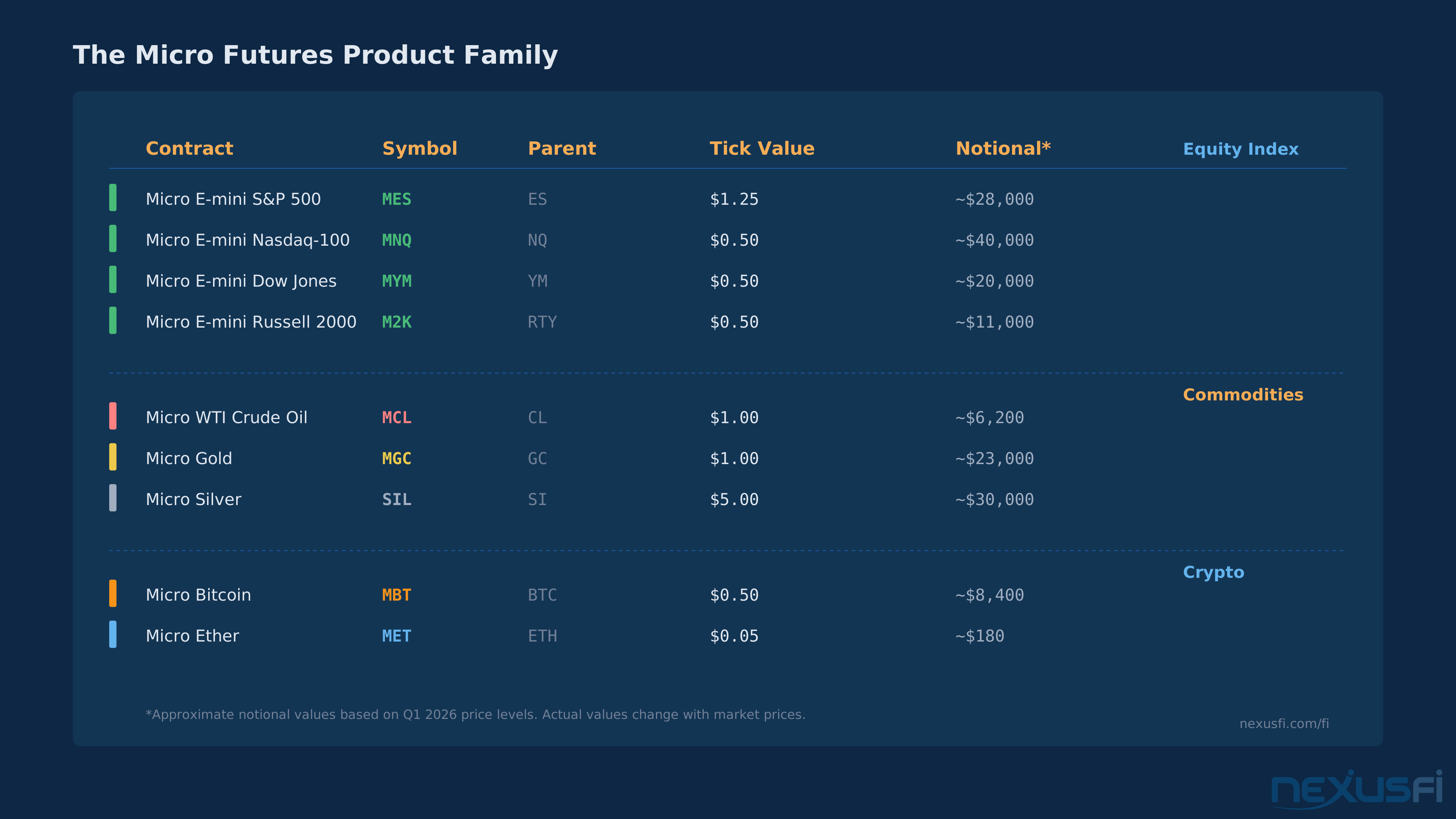
Every micro contract mirrors its parent contract's price movement and tick size. The only difference is the multiplier — what each tick is worth in dollars. Here are the complete specs for all actively traded micro futures:
Micro Equity Index Futures
The four original micro index contracts cover the most liquid equity benchmarks in the world:
Micro E-mini S&P 500 (MES) — $5 multiplier, 0.25 tick size, $1.25 per tick. The flagship micro contract and the highest-volume micro product globally. Cash-settled quarterly.
Micro E-mini Nasdaq-100 (MNQ) — $2 multiplier, 0.25 tick size, $0.50 per tick. Tracks the tech-heavy Nasdaq-100. Higher percentage volatility than MES — a 100-point NQ move is $200, versus $500 on the full NQ contract.
Micro E-mini Dow Jones (MYM) — $0.50 multiplier, 1.00 tick size, $0.50 per tick. The Dow micro trades in whole-point increments. Lower volume than MES/MNQ but adequate for retail size.
Micro E-mini Russell 2000 (M2K) — $5 multiplier, 0.10 tick size, $0.50 per tick. Small-cap exposure at micro size. Thinnest of the four index micros but still liquid during RTH.
All four are cash-settled and share the same quarterly expiration cycle as their parents. Day trade margins run $40-100 depending on broker. Overnight margins are set by CME at roughly 1/10th of the parent contract's overnight margin.
Micro Commodity Futures
Micro WTI Crude Oil (MCL) — 100 barrels, 0.01 tick size, $1.00 per tick. Launched July 2021 after years of community lobbying. Cash-settled (unlike the physically-delivered CL), which makes it simpler for retail traders — no risk of accidental delivery. [9]
Micro Gold (MGC) — 10 troy ounces, 0.10 tick size, $1.00 per tick. Strong liquidity — the mini gold contracts (QO) have been largely displaced by micros. Technically physically deliverable, but brokers auto-liquidate before delivery for most retail accounts.
Micro Silver (SIL) — 1,000 troy ounces, 0.005 tick size, $5.00 per tick. Higher tick value than other micros — each tick costs more, making SIL the "least micro" of the micro contracts. Good liquidity during metals trading hours.
Micro Crypto Futures
Micro Bitcoin (MBT) — 1/10th of 1 BTC, $5.00 tick size, $0.50 per tick. Regulated CME exposure to Bitcoin without the counterparty risk of unregulated crypto exchanges. Volume has grown substantially since launch.
Micro Ether (MET) — 1/10th of 1 ETH, $0.50 tick size, $0.05 per tick. Smallest dollar-per-tick of any CME micro product. Adequate liquidity during active crypto sessions.
The Fungibility Factor
Micro equity index and gold contracts are fully fungible with their full-size parents. If you're long 10 MES contracts, your broker can offset that against 1 short ES contract — the positions net to zero. This means you can scale seamlessly between sizes without closing and reopening positions.
The notable exception is crude oil. CL is physically delivered while MCL is cash-settled, so they aren't fungible. You can't offset 10 MCL against 1 CL — they're treated as separate positions. [2]
How Micro Futures Work #
Same Price, Different Multiplier
Micro contracts track the exact same underlying index or commodity as their parent. When the S&P 500 E-mini moves from 5600.00 to 5601.00 (4 ticks), your MES contract gains $5.00 versus $50.00 on the ES. The chart is identical, the levels are identical, the Volume Profile is identical. You're trading the same market — just with a different dollar-per-tick.
This matters for analysis. You don't need separate charts for MES and ES. Every support level, every VPOC, every Value Area boundary on the ES applies directly to MES. The order book is separate (MES has its own bid/ask), but the price movement is locked together through arbitrage.
Margin Mechanics
Overnight margins for micros are roughly 1/10th of their parent contract. CME sets these based on the same SPAN methodology used for full-size contracts. Day trade margins are broker-set and can be dramatically lower — some brokers offer $40-50 per contract for day trades, though this doesn't mean you should trade with that level of leverage.
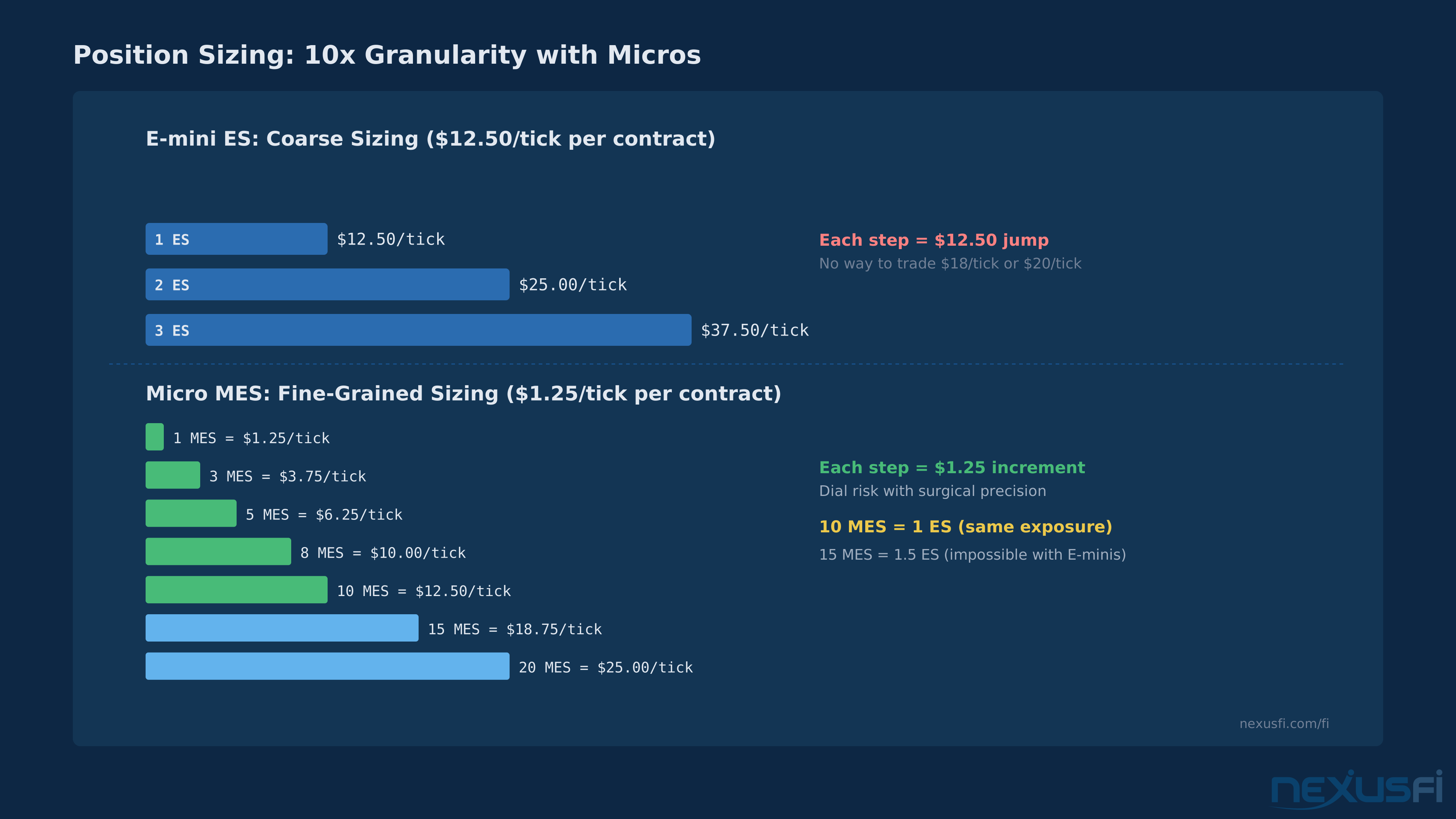
The math on position sizing changes at the core with micros. With a $10,000 account trading ES, you have exactly one choice: 1 contract, with roughly $500 per tick of margin consumption. With MES, you can trade anywhere from 1 to 10 contracts, dialing your exposure from $1.25/tick up to $12.50/tick. Each contract increment is a 10% step in risk. That granularity is the real product innovation.
Contract Months and Rollover
Micro equity index contracts follow the same quarterly cycle as their parents — March, June, September, December (H, M, U, Z). Rollover timing is identical, typically 8 days before expiration when open interest shifts to the next contract month. MCL follows the monthly CL cycle. MGC follows GC's bi-monthly schedule.
Continuous contract data works the same way — your platform stitches together front-month contracts using the same back-adjustment methodology. No difference in chart history or analysis.
The Commission Problem -- And How to Solve It #
Here's the hard truth about micros that nobody in the marketing materials mentions: on a per-tick basis, commissions are dramatically more expensive than E-minis.
An ES round-turn at a competitive broker runs about $4.00-5.00 all-in (broker + exchange + clearing fees). That's roughly 0.08 ticks of the $50/tick contract. An MES round-turn at the same broker runs about $0.80-1.50 all-in. Sounds cheap — until you realize that's 0.64 to 1.20 ticks of the $1.25/tick contract. You're paying 8-15x more in tick-equivalent terms.
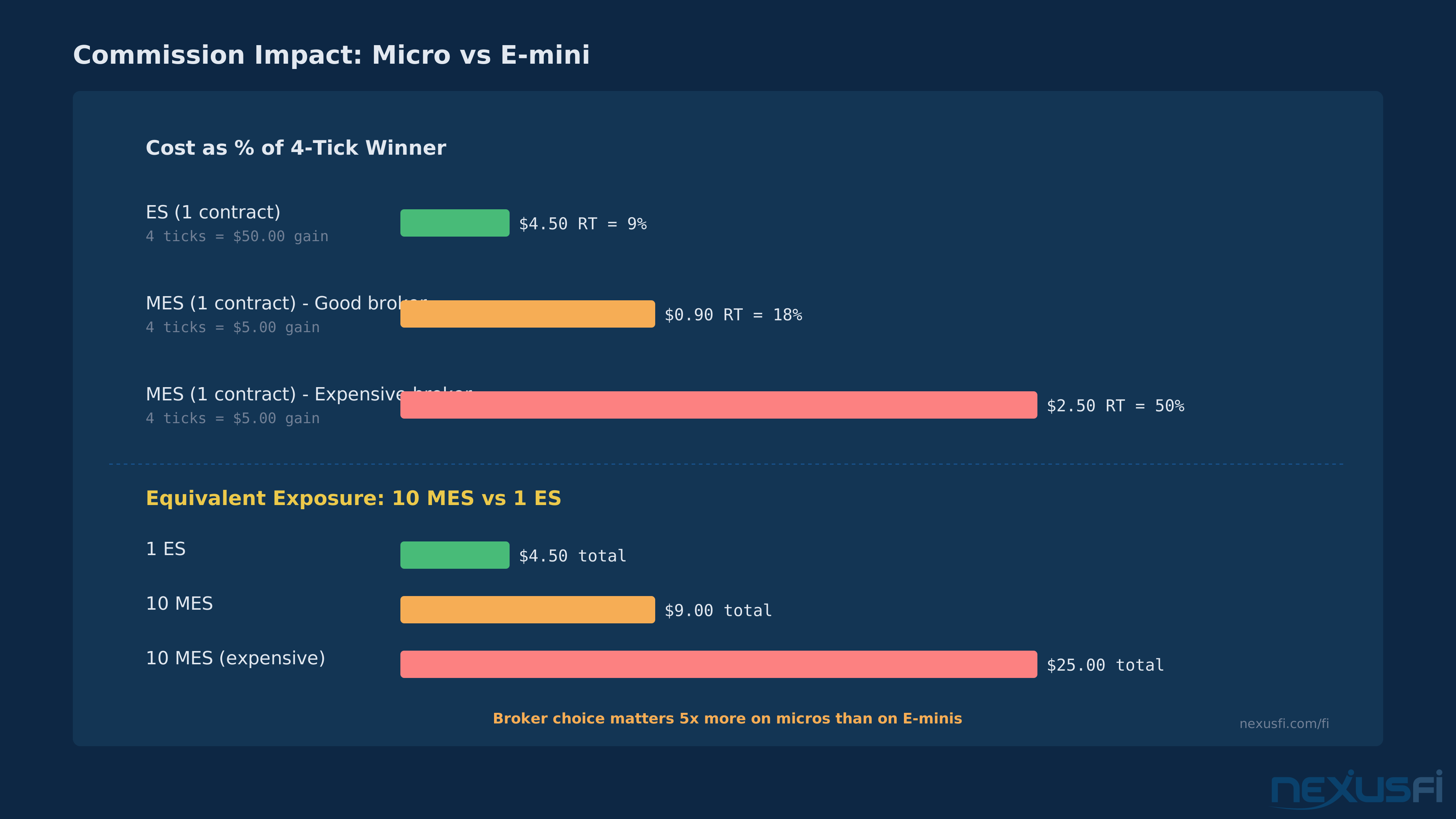
The impact gets brutal when you scale up. Trading 10 MES contracts (equivalent to 1 ES) costs $8.00-15.00 round-turn versus $4.00-5.00 for the single ES.
The lesson: broker choice matters exponentially more with micros. The difference between $0.80 and $2.50 per round-turn is invisible on ES. On MES, it's the difference between commissions consuming 15% versus 50% of a 4-tick scalp. Shop aggressively for the lowest all-in rate, and understand that the "headline" commission often excludes exchange fees, clearing fees, and data feed costs.
Scalping strategies that work on ES may not survive the commission drag on MES. If your average winner is 3-4 ticks on ES, the same strategy on MES needs to overcome a proportionally higher commission hurdle. This doesn't make micros bad for scalping — it means you need to account for the cost structure honestly.
Liquidity and Execution #
Micro equity index contracts have matured into genuinely liquid markets. MES regularly trades 1.5-2.5 million contracts per day, with MNQ not far behind. During RTH, the bid-ask spread on MES is typically 1 tick (0.25 points = $1.25), identical to the ES spread. Slippage on market orders is minimal for reasonable size.
The depth of book is thinner than ES. Where ES might show 500+ contracts resting at the best bid, MES might show 50-100. This matters less than it sounds — for retail size (1-20 contracts), you're getting filled at the quoted price the vast majority of the time. The only scenario where thin depth hurts is during fast markets or news events, where the MES book can gap wider than the ES book for brief moments.
Micro commodity contracts are more variable. MGC has built solid liquidity — the mini gold contracts (QO) are effectively dead, displaced by micros. MCL trades well during RTH but can be thin during overnight sessions. Micro crypto contracts have decent volume during their active hours but spreads can widen much during low-activity periods.
[5] That's the right mental model. Micros are designed for smaller position sizes. If you're trading 50+ MES contracts regularly, you've outgrown the product.
Practical Applications #
Learning With Real Money
The biggest use case for micros is bridging the gap between simulation and full-size futures. Sim trading teaches mechanics but doesn't teach psychology. The emotional difference between risking $0 and risking $1.25 per tick is enormous — and it's still a fraction of risking $12.50 per tick on ES.
[6] You learn what it feels like to hold through a pullback, to take a loss, to watch a winner turn into a loser — all for the cost of a coffee rather than a car payment.
Multiple NexusFi traders have documented their micro-to-mini progression in detail. The pattern that works: start with 1 MES, prove consistency over 10-20 trading days, add a second contract, prove consistency again, keep scaling. The traders who blow up are the ones who jump straight from micros to ES without the intermediate steps.
Precision Position Sizing
This is where micros genuinely transform risk management for experienced traders — not just beginners. Instead of choosing between 2 ES contracts ($100/tick) and 3 ES contracts ($150/tick), you can run 22 MES contracts ($27.50/tick) or 25 MES contracts ($31.25/tick). The position sizing grid becomes 10x more granular.
With a $13,000 account, that's a maximum of 6 MES contracts, keeping max loss per trade around 1% of equity. "You have to trade the size where a loss is like a simple finger-prick (1%), not a blood donation (10%) or a dismemberment (50%) or a catastrophic margin-call death (100%)." [7]
Scaling In and Out
Micros enable scaling strategies that are impossible with E-minis at smaller account sizes. You can enter with 3 MES at the first signal, add 2 more on confirmation, and scale out in increments as the trade develops. Each unit is $1.25/tick — small enough to add without dramatically shifting your risk profile.
@Rural WA State describes the psychological benefit: "I can hold a position much longer without feeling the severe pain I had trading E-minis. This allows my position more time to work." [8] Smaller position size per contract means wider stops are survivable, which means you can ride trends that would have stopped you out on ES.
Portfolio Diversification
With micros, a $25,000 account can carry simultaneous positions in equities (MES), crude oil (MCL), and gold (MGC) — something impossible with full-size contracts at that capitalization level. This opens up intermarket strategies, hedging, and true portfolio construction for retail traders.
When to Graduate From Micros #
Micros aren't meant to be a permanent home for every trader. At some point, the commission drag makes it more efficient to trade the parent contract. The transition point depends on three factors:
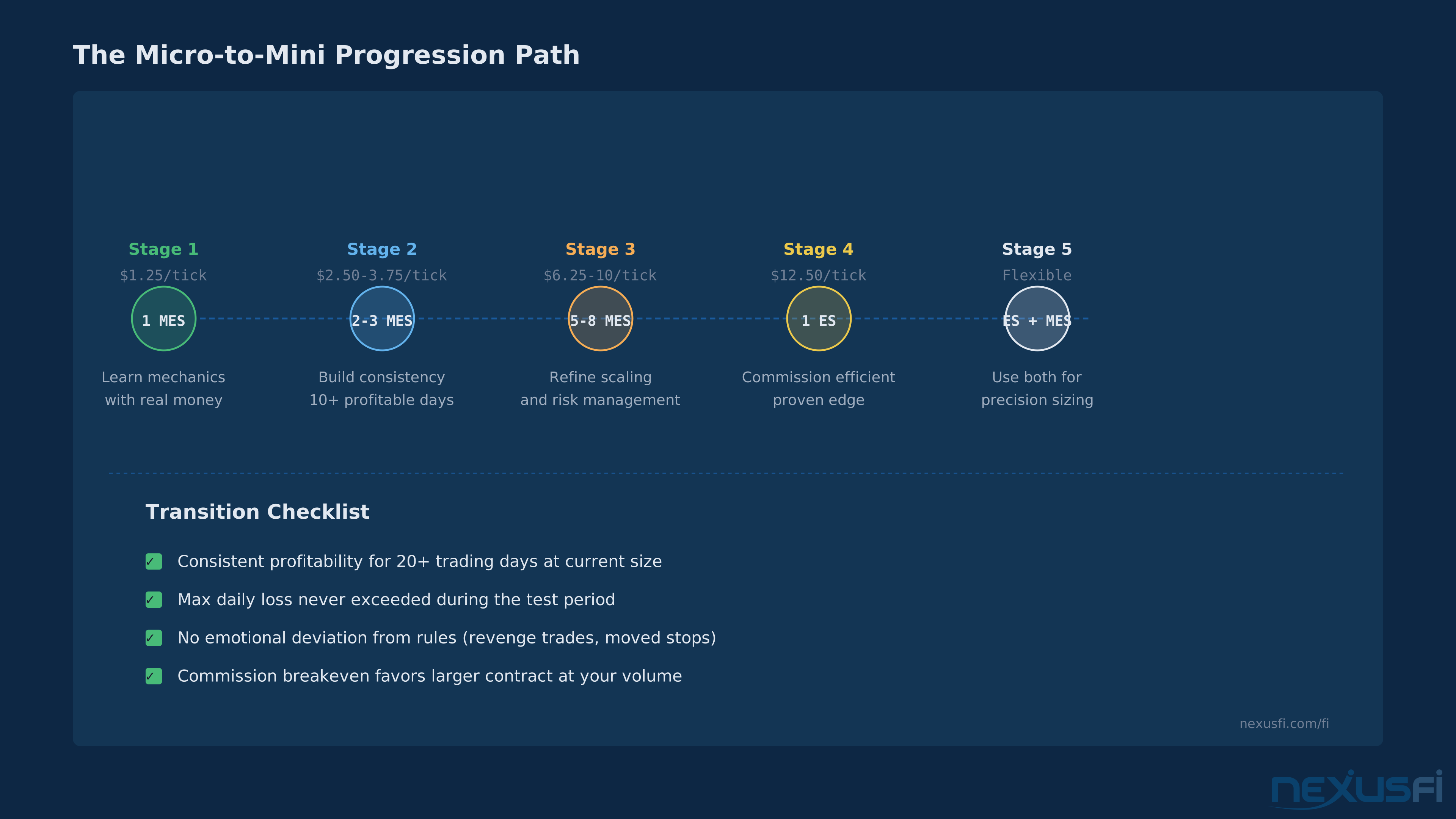
Commission breakeven. Calculate the all-in cost per tick for both instruments. If you're paying $0.90 round-turn per MES contract and $4.50 per ES contract, the breakeven is 5 MES contracts (5 x $0.90 = $4.50 = same cost as 1 ES with identical notional exposure). Beyond 5 contracts, you're overpaying in micros.
Consistent profitability. The transition should be triggered by demonstrated edge, not account size. Being profitable with 1-3 MES contracts for 30+ consecutive trading days is a reasonable benchmark before stepping up to ES. The strategy and discipline must be proven at the lower size first.
Psychological readiness. A 10-tick loss on MES costs $12.50. The same loss on ES costs $125. If that $125 number would cause you to deviate from your rules — wider stops, averaging down, moving targets — you're not ready for ES. The dollar amount must be in the "I don't care" zone where it doesn't affect your decision-making.
Some traders never fully "graduate" — they use micros for testing new strategies, adjusting position size during volatile periods, or maintaining exposure during lower-conviction setups while trading ES for their A+ trades. That's not a weakness. That's smart capital allocation.
Options on Micro Futures #
CME lists options on MES, MNQ, and several other micro contracts. These bring defined-risk strategies to the micro universe — you can buy MES puts for downside protection, sell covered calls against MES positions, or construct vertical spreads with small premium outlays.
The practical challenge is liquidity. Options on micros have wider bid-ask spreads than options on ES, and the open interest is thinner, especially on out-of-the-money strikes. For simple directional plays (buying puts or calls) the liquidity is adequate. For complex spread strategies, you may get better fills on the parent ES options.
What Micro Futures Are Not #
Micros are not a substitute for proper risk management. A $500 account trading 5 MES contracts is taking the same proportional risk as a $5,000 account trading 5 ES contracts — the smaller dollar amount doesn't change the percentage at risk. Leverage is leverage, and micros can blow up a small account just as efficiently as E-minis blow up a larger one.
They're also not free money machines. The same market dynamics, the same overnight gaps, the same volatility events that affect ES affect MES identically. A flash crash costs you less in dollar terms on MES, but if that loss represents 50% of your account, the financial and psychological damage is the same.
Finally, micros don't teach you to trade — they teach you what trading feels like. The analytical skills, the pattern recognition, the discipline — those come from screen time, study, and deliberate practice. Micros provide a lower-cost classroom, but you still have to do the homework.
Knowledge Map
Go Deeper
Build on this knowledgeReferences This Article
Articles that build on this topicCitations
- — Trading the new CME E-Micro's (E micro) MES, MNQ, MYM, M2K and other micros (2019) 👍 23“I'm personally very glad that this has been public. It has been hard biting my tongue for a while while this was being developed. I think this will save many traders from blowing up.”
- — Physical or Cash Settlement for day trades (2023) 👍 2“I'm not sure I understand your question (or maybe you didn't mean what you actually asked) The main NYMEX Crude Oil contract ("CL") is a physically delivered contract.”
- — When do micros stop making sense? (2021) 👍 5“$40.32 round trip on 18 contracts on micro vs 8.60 round trip with 2 contracts on e-mini with TOS. Over 1 month of trading that's $666 difference. The simple answer is trade the e-mini if the trade frequency and duration are the exact same.”
- — Trading the new CME E-Micro's (E micro) MES, MNQ, MYM, M2K and other micros (2020) 👍 8“Hi, You don't have a good fee structure with your current broker/clearer. Look around, you can trade it for $0.98 per turn including Rithmic/CQG fees. This has nothing to do with the micros.”
- — Trading the new CME E-Micro's (E micro) MES, MNQ, MYM, M2K and other micros (2020) 👍 6“Hi Turtle, The spread is pretty tight almost all of the time. It gets very think and may show a wider spread on news or eco releases, but it is completely tradable, in my opinion, as a replacement for the ES at a reduced risk.”
- — Trading the new CME E-Micro's (E micro) MES, MNQ, MYM, M2K and other micros (2019) 👍 8“I have never traded any of the existing micros, in currencies, but my impression after following several traders who have is that the major point is not to make money (yes, that does seem strange), because (a) transaction costs are high, which has go...”
- — Making a Living with the Micros (2021) 👍 23“Money Management: Position Sizing I wrote about Money Management previously. But there is more to discuss, especially in light of the new CME micro index contracts that facilitate "good money management" for beginning- and small-account traders.”
- — Trading the new CME E-Micro's (E micro) MES, MNQ, MYM, M2K and other micros (2019) 👍 8“Micro futures have not only allowed me to be able to trade more than one contract at a time(and make more money), but it also saved my bacon yesterday when Prez Trump made his tweet about not putting a tariff on autos.”
- — The next CME Micro, MICRO CRUDE, coming July 12th (2021) 👍 7“SMCJB, You are darn quick on the trigger with these announcements. Yes, Micro-CL is on the way (FINALLY).”