



Bitcoin Basis Trading: Cash-and-Carry Arbitrage Between CME Futures and Spot Bitcoin ETFs
Overview #
Bitcoin basis trading sits at the intersection of regulated derivatives and the spot cryptocurrency market. The trade earns a structural premium — the price difference between CME Bitcoin futures and spot Bitcoin — by locking in that spread at entry and holding through expiration when the two prices converge to zero. Done correctly with spot Bitcoin ETFs like IBIT and FBTC as the spot leg, it generates bond-like returns with near-zero Bitcoin price risk.
The January 2024 launch of spot Bitcoin ETFs changed the calculus entirely. Before IBIT and FBTC, executing this trade meant holding actual Bitcoin on a crypto exchange — carrying the custody risk that sank FTX, Celsius, and Voyager. Post-ETF, the spot leg sits in a SIPC-protected brokerage account alongside your CME futures margin, making this trade accessible to any futures trader with a standard US brokerage account.
Annualized returns: 3--8% in bear markets, 10--25% in bull runs, occasionally above 30% at peak euphoria. The structural premium exists because leveraged Bitcoin buyers pay extra for futures convenience vs managing BTC custody. Basis traders harvest that premium by taking the other side.

Understanding the Basis #
The basis is the premium (or discount) of a CME Bitcoin futures contract over the current spot price of Bitcoin. When futures trade above spot — which they do most of the time — the market is in contango, and the basis is positive. That premium is your annualized return if you're short futures and long spot.
The annualized basis formula is:
Annualized Basis = [(Futures Price / Spot Price) − 1] × (365 / Days to Expiry)
Example: If spot BTC is $100,000, the March CME contract trades at $101,500 with 60 days to expiry:
= [(101,500 / 100,000) − 1] × (365 / 60) = 1.5% × 6.083 = 9.13% annualized
That 9.13% is what you lock in at entry — regardless of where BTC goes. Spot up 50%? Your futures loss roughly offsets your IBIT gain. Spot down 30%? Your futures profit roughly offsets your IBIT loss. The basis is the residual, and at expiration when futures settle to the CME CF Bitcoin Reference Rate, that residual converges to zero and you collect your carry.
Historical basis levels track market sentiment closely. Q4 2024 bull run (BTC near $100k): quarterly contracts showed 18--25% annualized basis. Summer 2024 consolidation ($58--62k range): compressed to 4--6%. In severe selloffs, BTC futures go into backwardation (futures below spot) — during those periods the trade doesn't work.
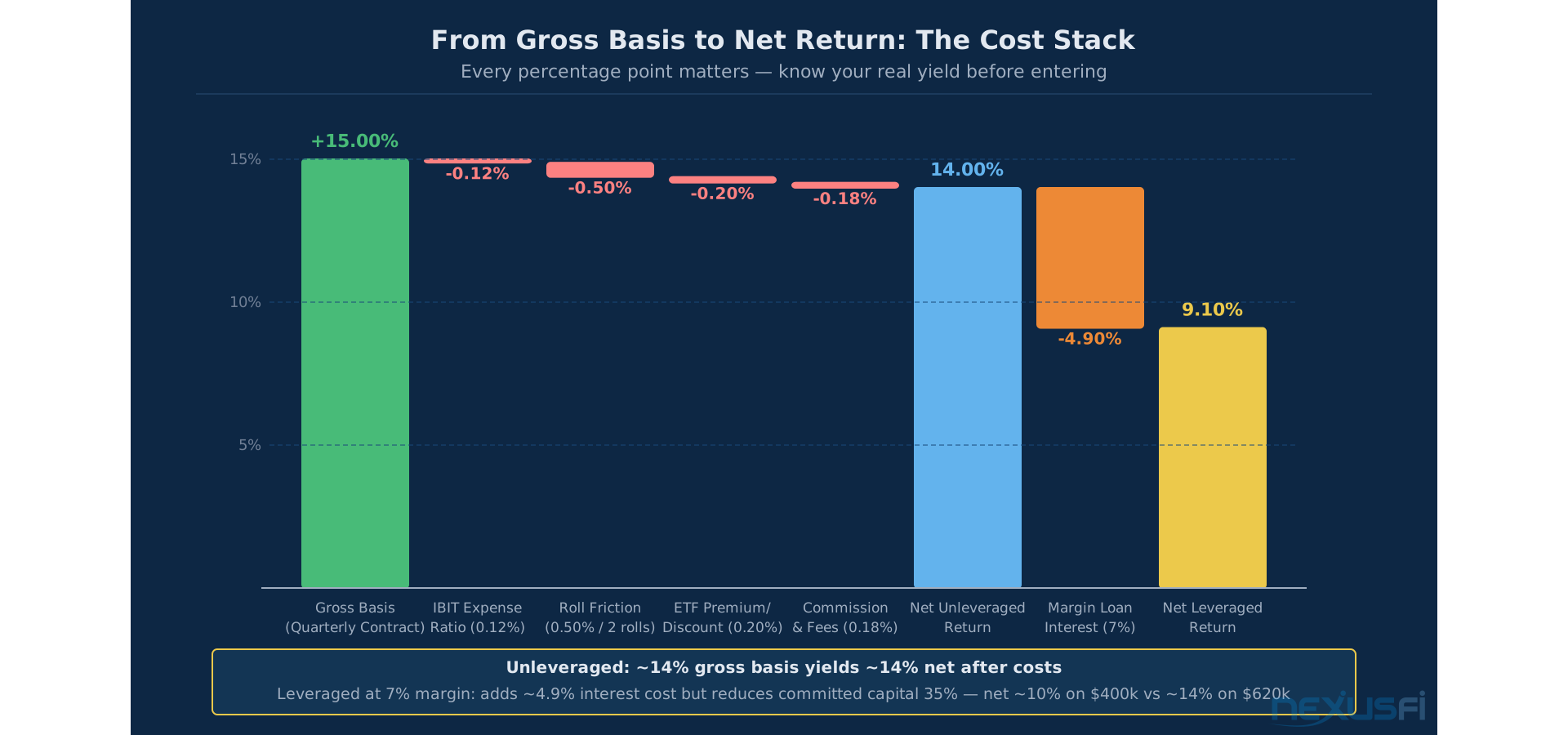


The hurdle rate: from 15% gross basis, subtract IBIT's 0.12% expense ratio, ~0.5% roll friction, and ~0.2% ETF premium/discount variance — leaving ~14.2% net unleveraged. With a 7% margin loan, the net compresses to ~9--10% on less capital, still outperforming short-duration fixed income at near-zero market risk.
Cash-and-Carry Mechanics #
The trade has exactly two legs. Leg one is a long position in spot Bitcoin exposure — today, that means buying shares of IBIT (BlackRock's iShares Bitcoin Trust) or FBTC (Fidelity's Wise Origin Bitcoin Fund). Leg two is a short position in CME Bitcoin futures contracts of equivalent notional value. At expiration, both legs close simultaneously: the futures cash-settle to the CME CF Bitcoin Reference Rate, your IBIT is sold at market (close to the same reference), and the basis differential becomes your profit.
At BTC = $100,000, one standard CME BTC contract controls 5 BTC, or $500,000 notional. If the March contract trades at $101,500 when you enter, your locked-in basis is $7,500 — $1,500 per BTC × 5 BTC. When BTC is at $115,000 at expiration, your IBIT has gained $75,000 while your short futures has lost $67,500, netting you $7,500. When BTC is at $85,000, your IBIT has lost $75,000 while your short futures has gained $82,500, again netting $7,500. The math works in every scenario because both legs reference the same underlying price at settlement.
Front month vs quarterly: Front-month contracts show lower basis but tighter spreads. Quarterly (H/M/U/Z) carry higher basis with only 2 rolls per year vs 12 for monthly — the standard choice for basis traders. At 10% annualized basis, quarterly means two round-trips per year; monthly means eight.
Roll mechanics: When your contract approaches expiration, you have two choices: let it settle (close both legs and realize your profit), or roll the futures position to the next contract while keeping your IBIT. A roll means closing the expiring short and simultaneously opening a new short in the next contract. The "roll yield" is the P&L impact of the term structure at the time you roll — if the next contract carries a higher premium than the one you're closing, the roll yield is positive. If basis has compressed and the next contract is cheaper, you're locking in a lower return going forward.
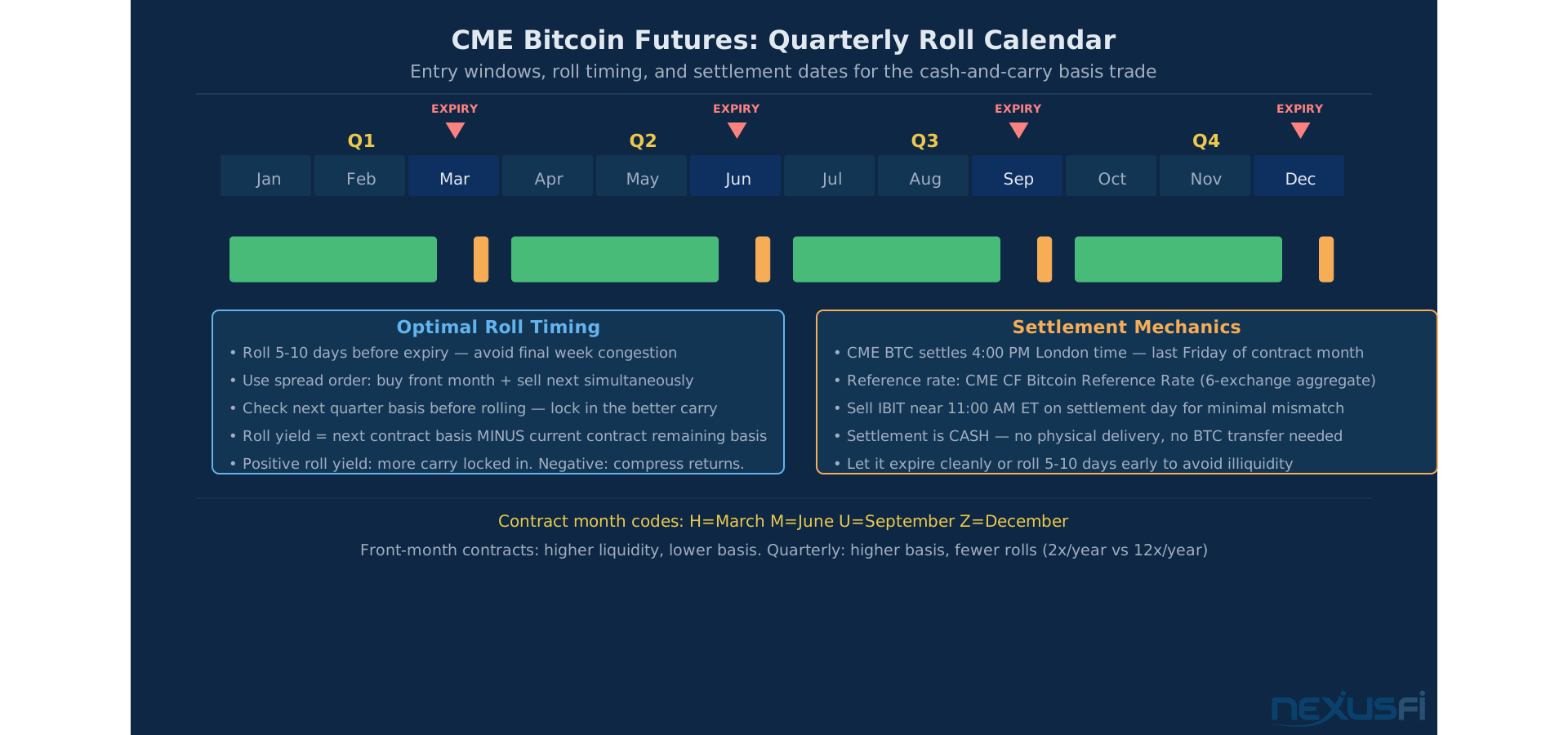
Settlement timing: CME BTC futures cash-settle at 4:00 PM London time on the last Friday of the contract month, using the CME CF Bitcoin Reference Rate (aggregated from Bitstamp, Coinbase, Gemini, itBit, Kraken, LMAX Digital). Sell IBIT near that time. IBIT's AP mechanism keeps the ETF within a few basis points of NAV, making mismatch risk minimal under normal conditions.
CME Bitcoin Futures Specifications #
Standard CME BTC futures control 5 BTC per contract. The tick size is $5.00 per BTC, making the tick value $25.00 per contract (5 BTC × $5). Initial margin requirements have historically ranged from 35--42% of notional — at $100,000 BTC, that's $80,000--$84,000 for one contract covering $500,000 notional. Maintenance margin runs about 90% of initial. These figures change daily with volatility; always verify on the CME product specification page before entering a position. As @SMCJB noted: "the exchange margin requirements for Bitcoin is 37% of notional... With Bitcoin up $1,430 today margins will be increasing $2,910 tonight" — daily margin adjustments are real and must be planned for.

The Micro Bitcoin Futures contract (ticker: MBT) covers 0.1 BTC — exactly 1/50th of the standard contract. At $100,000 BTC, that's $10,000 notional per contract with an initial margin of approximately $1,600. The trade scales linearly: 50 Micro contracts = 1 standard contract in notional exposure, with identical settlement mechanics. The practical trade-off is transaction costs — 50 Micro contracts cost roughly 10x as much in commissions per BTC equivalent compared to one standard contract. For small accounts or testing the strategy, Micro is ideal. @stumbras noted when Micro contracts launched that fee structure made Micro-Standard arb impractical — but the basis carry trade itself remains viable at any scale.
CME BTC futures trade Sunday through Friday 6:00 PM — 5:00 PM ET. Six monthly contracts plus four quarterly available simultaneously. Daily price limits at 20% above/below prior settlement — circuit breakers can affect rebalancing during extreme moves.
The Spot ETF Revolution #
Before January 11, 2024, executing this trade meant buying actual Bitcoin on a crypto exchange and holding it for weeks or months while maintaining a short CME position. The custodial risk was the primary constraint: FTX collapsed in November 2022 with $8 billion in customer funds. Celsius froze withdrawals in June 2022. Voyager Digital filed for bankruptcy in July 2022. Every dollar sitting on a crypto exchange carried non-trivial exchange default risk. As @Onecarl78 noted in 2021, the pre-ETF structure was "very capital intensive" and practically unworkable for most traders.
The pre-ETF mechanics were operationally painful. Separate accounts (crypto exchange + futures broker) meant no cross-margining. As @SMCJB explained: "CME and ICE both have a 35% of notional amount margin requirement and neither provide offset for coins held. Hence to perform cash and carry with regulated futures you actually need 135% of the Bitcoin value." That's $675,000 to trade a $500,000 position.

IBIT changed all of that. BlackRock's Bitcoin ETF shares trade in your regular brokerage account with SIPC protection. The AP mechanism keeps IBIT within 0.05% of NAV (BlackRock IBIT product page), vs GBTC's historic 20--40% discounts. At brokers offering portfolio margining (Interactive Brokers and select others), IBIT offsets short CME futures, reducing effective margin substantially.
Expense ratios: IBIT 0.12% ($600/yr on $500k), FBTC 0.25% ($1,250/yr) — trivial vs the basis yield. More relevant: ETF premium/discount at entry. January 2024 launch saw IBIT at 0.5--0.8% premiums (reduced effective basis); today negligible but can spike during high-volatility periods.
Capital Requirements and Implementation #
Capital requirements for the standard structure at $100,000 BTC: $500,000 in IBIT (matching the 5 BTC notional), $80,000 in CME margin, and a recommended $40,000 buffer for margin call protection. Total committed capital: approximately $620,000. At a 10% annualized basis, that generates $50,000 per year in gross carry — an 8.1% return on committed capital. The basis yield is higher than the ROC because you're holding excess margin as a buffer.

Leveraged approach: Borrow against IBIT to reduce cash outlay. Structure: deposit $400,000, buy $500,000 IBIT on 25% margin, use remaining cash for CME margin, borrow ~$100,000 at 7%. Net: $43,000 carry on $400,000 capital — 10.75% ROC. Risk: dual margin calls (CME + brokerage) if BTC spikes sharply.
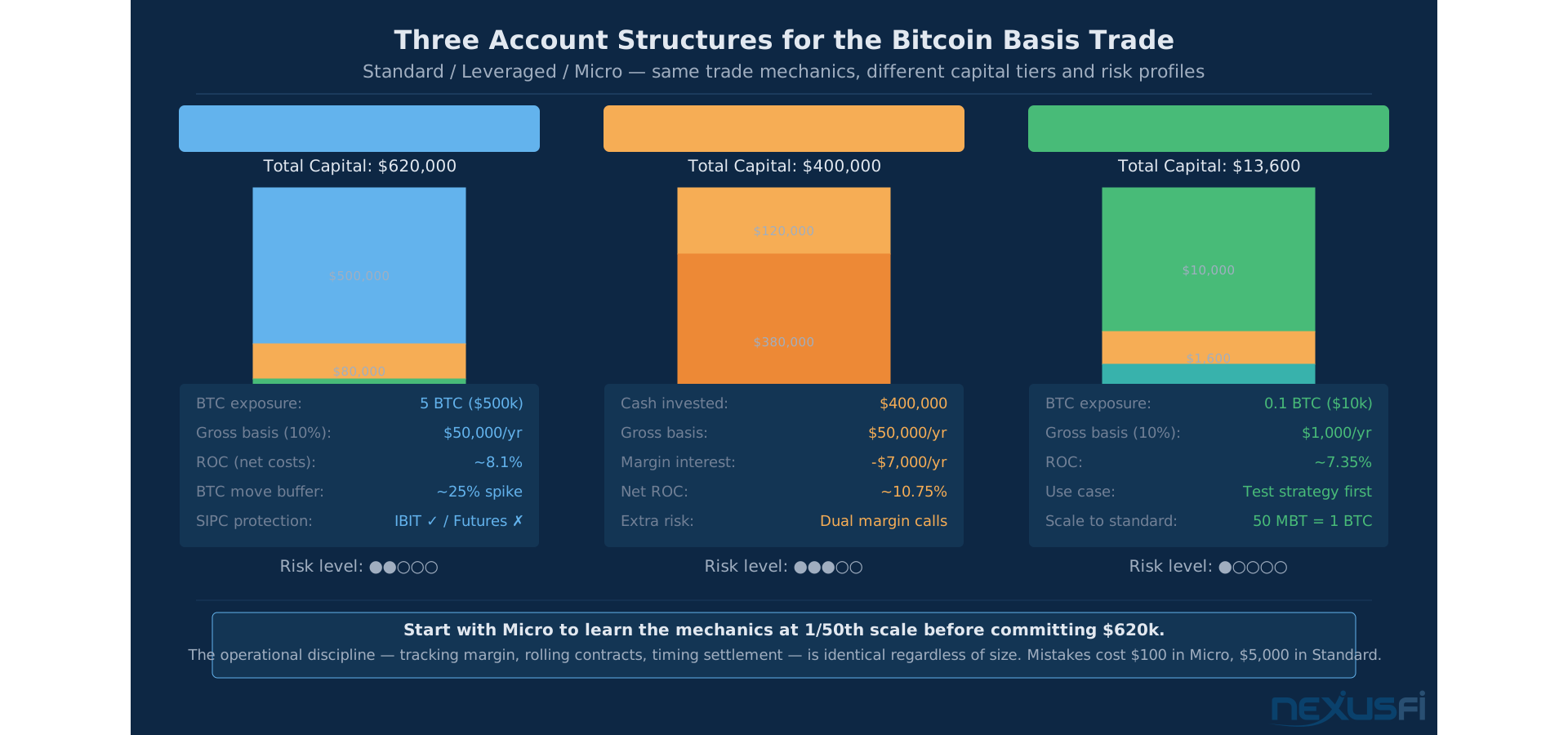
Micro contracts for smaller accounts: 50 Micro BTC contracts (= 5 BTC = 1 standard contract) require $10,000 in IBIT and $80,000 in CME margin — the same margin as the standard approach but with smaller IBIT cost given precise sizing. For 0.1 BTC exposure (1 Micro contract): $10,000 IBIT + $1,600 margin + $2,000 buffer = $13,600 total. This enables testing the strategy at small scale before committing full capital. The ROC at 10% basis is 7.35% — slightly lower because the margin buffer represents a larger percentage of the total capital. At brokers like NinjaTrader Brokerage where Micro Bitcoin commissions are competitive, the cost drag is manageable for accounts under $100,000.
Portfolio margining: At Interactive Brokers and select approved brokers, IBIT counts as an offset to short CME futures, reducing margin to $30--40,000 instead of $80,000 and saving $40--50,000 in committed capital. Requires $110,000--125,000 minimum account and broker approval.
Risk Factors #
Basis widening before convergence — the primary pain point. The trade earns its return at expiration, not continuously. Between entry and expiration, the basis can widen rather than compress, creating mark-to-market losses on your short futures leg. If BTC rallies 15% in two weeks, futures might rally 15.5% — your short futures shows a $77,500 loss while your IBIT shows a $75,000 gain. The net is a $2,500 loss on paper. This is timing risk, not structural risk — the convergence at expiry is guaranteed by settlement mechanics. But the interim loss triggers margin calls, and that's where the trade fails in practice.

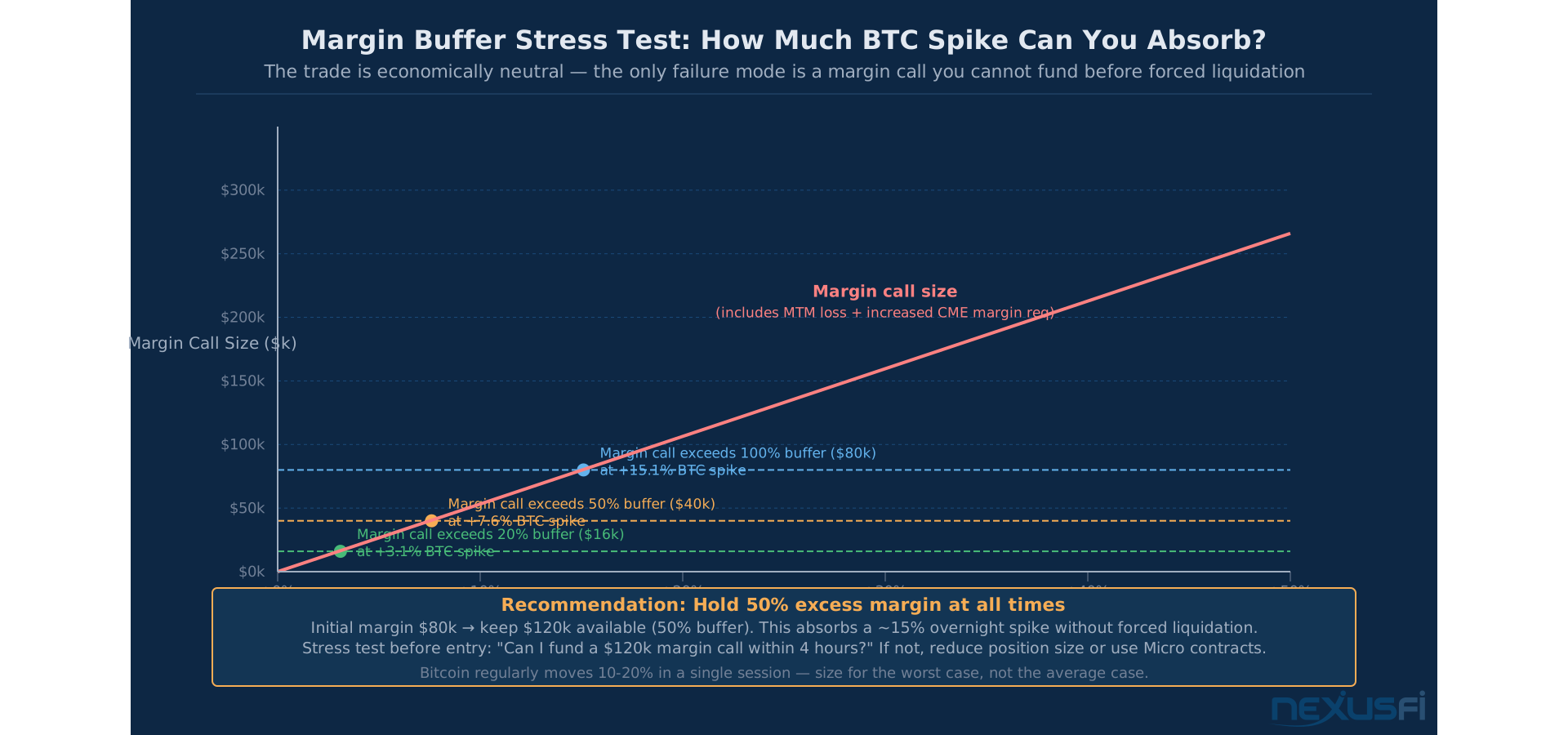
Margin call risk — the practical failure mode. 15% overnight BTC spike: short CME futures loses $75,000 MTM; CME increases margin to $92,000; total call ~$87,000 within 24 hours. Your IBIT gained $75,000 on paper but that's unrealized. If you can't fund the call, your broker force-closes the short futures — leaving unhedged IBIT exposure, the directional position you were trying to avoid.
The solution is simple but requires discipline: maintain 30--50% excess margin at all times. For a $80,000 initial requirement, keep $104,000--$120,000 available. This buffers a 15--20% BTC move without forced liquidation. Stress-test your position: "What is the maximum BTC move in a single session that would trigger a margin call I cannot meet?" If the answer is less than 20%, your buffer is insufficient.
Margin call failure mode: BTC spikes 15% overnight. Your short CME futures shows -$75,000 MTM. CME increases margin requirements to $92,000. Total margin call: ~$87,000 due within 24 hours. Your IBIT has gained $75,000 — on paper. If you can't access that gain fast enough to fund the futures call, your broker force-liquidates the short futures. You're left with unhedged IBIT exposure and a locked-in realized loss. The trade was sound; the execution failed. Always keep 50% excess margin buffer before entering.
ETF premium/discount risk. IBIT typically trades within 0.05% of NAV but can spike to 0.3% on high inflow/outflow days. A 0.2% premium at entry + 0.2% discount at exit = 0.4% drag on a 1.5% basis. Check IBIT's premium/discount before entry on ETF.com. Use limit orders for large positions.
Settlement timing and early settlement. CME settles to the CME CF Reference Rate at 4:00 PM London time (11:00 AM ET). Sell IBIT near 11:00 AM ET on settlement day to minimize tracking mismatch. Early settlement (Rule 588) is rare — occurred briefly during March 2020 COVID crash — but maintain buffer reserves to handle unexpected early closure.
FCM and counterparty risk. Futures margin accounts are not SIPC-covered — recovery is protected by CME's guarantee fund under CFTC Regulation 1.22 but not guaranteed 100% (see CFTC customer fund protections). Use top-tier FCMs: Interactive Brokers, Advantage Futures, Ironbeam, or Tradovate. IBIT in a standard brokerage account has SIPC protection up to $500,000.
Basis Cycle Dynamics #
The structural driver of the basis is demand for leveraged long Bitcoin exposure via futures. This premium was observed as early as December 2017 — @SMCJB noted that holding physical BTC while shorting CME futures paid "approximately 0.5-0.9%/month extra" — before spot ETFs made it safely accessible. When retail and institutional buyers crowd into CME futures for leveraged exposure — willing to pay a premium for the convenience of not managing custody — the basis expands. When that demand recedes and liquidations dominate, the basis compresses. The best time to enter is early in the bull cycle when basis is 10--15% annualized: the premium is attractive, institutional arbitrageurs haven't yet saturated the trade, and the risk of rapid basis widening is lower than at peak euphoria.

Peak euphoria (25--30%+ basis) is the worst entry point. The trade is crowded — institutions, hedge funds, and ETF arbitrageurs all on the same side. When momentum reverses, all exit simultaneously: basis collapses from 28% to 8% before your contract expires, while a concurrent BTC price drop triggers margin calls. Worst risk-reward in the cycle.
Backwardation (futures below spot) means negative basis — no carry to harvest. Exit cleanly if backwardation hits while in a trade (rolling costs become negative). Wait for contango to return.
Entry signals: CME open interest rising 15%+ week-over-week; perpetual swap funding rates turning positive; spot ETF daily inflows of $300M+; BTC making higher highs on strong spot volume.
Crowding risk signals (avoid new entries): Basis above 25% annualized on front-month contracts; perpetual funding rates at 0.10%+ per 8 hours; Google Trends for "Bitcoin" above 80% of historical peak; open interest at all-time highs with price at all-time highs.
CME Futures vs Perpetual Swaps #
Both trades involve long spot and short a derivatives contract to harvest a premium — but they're at the core different. On offshore exchanges (Binance, Bybit, OKX), perpetual swaps pay funding every 8 hours. During the Q1 2024 bull run, funding hit 0.20% per 8 hours — equivalent to 219% annualized — for a few weeks. But funding rates reset every 8 hours and can flip negative in bear markets.

But the perp funding rate is variable — it resets every 8 hours and can flip negative (shorts pay longs) in bear markets. You can't lock in your return at entry the way you can with CME. You're constantly deciding whether to roll, exit, or hold as the rate changes. And you're holding coins on an offshore exchange — the exact custody risk that FTX's collapse made visceral.
CME basis trades lock in your return at entry — you know on day one what you earn at expiry. The downside is capital efficiency: $600,000 minimum for one standard contract. Perp traders use less capital via leverage, but face auto-deleveraging risk from offshore exchanges and no locked-in return.
Tax Treatment #
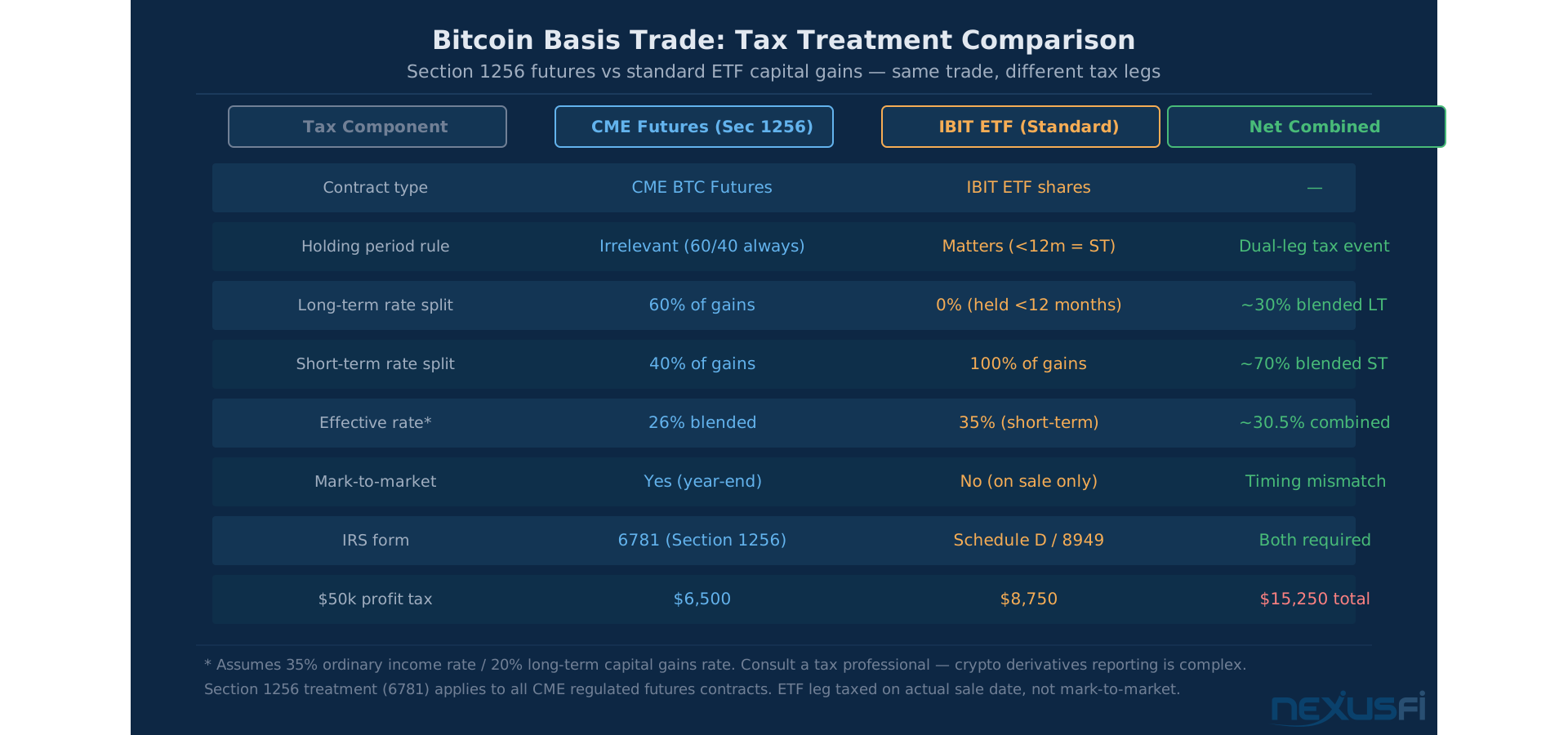
Bitcoin basis trading creates a dual-leg tax situation that needs professional guidance. The broad framework for US traders:
CME futures leg (Section 1256): All CME Bitcoin futures are Section 1256 contracts — 60% of gains taxed at long-term rates (regardless of holding period), 40% short-term, ~26% effective rate for most traders (see IRS guidance on Section 1256 contracts). Mark-to-market applies at year-end. ETF leg (IBIT/FBTC): Standard capital gains. Rolling quarterly means selling IBIT every 3 months — short-term gains at 35% for most traders.
Combined rate on $50,000 basis profit: ~30.5% ($15,250 tax) — more favorable than pure ordinary income (35%) but less than long-term capital gains (20%). Consult a tax professional with crypto derivatives experience. The Section 1256 mark-to-market interaction with ETF realization events creates complexity that generic tax software handles poorly.
Practical Execution Framework #
Best entry checklist before committing capital: (1) Annualized basis on target contract is >=10%; (2) IBIT premium/discount is <0.15% (check ETF.com before each entry); (3) You hold 50%+ excess margin available in cash, not just in IBIT unrealized gains; (4) No FOMC meeting, major BTC options expiry, or CME settlement within 10 days; (5) CME open interest is rising or stable (confirms new demand, not liquidation). All five conditions must pass — wait if any fails.
Entry criteria: Calculate the hurdle rate before every entry. Start with the annualized basis for your target contract (front-month or quarterly). Subtract: ETF expense ratio (0.12% for IBIT, 0.25% for FBTC), expected roll friction (~0.5% annually for quarterly rolls), and financing costs if you're using margin leverage. If the net exceeds your required return — typically 5% minimum, 8%+ to justify the operational overhead — enter the trade. If basis is in backwardation or below 5% annualized, wait.
Leg-in execution: enter both legs simultaneously within the same session. Legging in (IBIT first, then futures) creates directional exposure in the gap — a 2% BTC move between executions locks in P&L that has nothing to do with the basis. Pre-calculate notional: IBIT purchase amount ÷ (BTC price × contract size) = contracts to short.
Daily monitoring checklist:
- Futures MTM P&L for the day (should roughly offset IBIT P&L)
- Net spread P&L (combined position -- should be stable)
- Current basis level vs entry basis (is it converging or diverging?)
- Days to expiry (convergence accelerates in final 2 weeks)
- Available margin headroom (distance to maintenance margin)
- IBIT premium/discount to NAV (flag if >0.15%)
A working basis trade: combined P&L stable and slowly trending positive as expiry approaches. Individual legs show large swings — expected. Investigate if net P&L trends steadily negative: ETF tracking failure, settlement methodology change, or unusual institutional flow disrupting convergence.
Exit mechanics: Cleanest exit: let futures expire and sell IBIT near 11:00 AM ET on settlement day (CME CF Reference Rate calculation time). To roll: use a spread order to close the expiring contract and open the next simultaneously, 5--10 days before expiry. Exit early if: net P&L shows consistent directional drift; margin calls are recurring; IBIT premium/discount has widened and won't recover; or basis has compressed from your entry level with little remaining to harvest.
Citations #
- @SMCJB (NexusFi Cryptocurrency Forum, 2021): "CME and ICE both have a 35% of notional amount margin requirement and neither provide offset for coins held. Hence to perform cash and carry with regulated futures you actually need 135% of the Bitcoin value." -- on pre-ETF capital requirements
- @SMCJB (NexusFi Cryptocurrency Forum, 2021): "if you were long Bitcoin and sold the CME future against it you would need to sell your Bitcoin at expiry at a price as close as possible to their Benchmark Index" -- on CME cash settlement mechanics
- @SMCJB (NexusFi Cryptocurrency Forum, 2021): "Rumor is HFs are short Bitcoin futures, with the speculation that they are short futures, versus long actual coins, collecting the yield, which is currently about 8%" -- institutional basis trade confirmation
- @SMCJB (NexusFi Cryptocurrency Forum, 2019): "the exchange margin requirements for Bitcoin is 37% of notional... With Bitcoin up $1,430 today margins will be increasing $2,910 tonight" -- on daily margin adjustment mechanics
- CME Group -- Bitcoin Futures Product Specifications: Official contract specifications, settlement methodology, and margin requirements
Go Deeper with Elite Membership
NexusFi Elite Members discuss live basis trade execution, current basis levels, roll timing strategies, and broker portfolio margining approvals in the Cryptocurrency and Trading Reviews forums. Access 20,000+ Elite traders sharing real P&L and execution insights.
Version 1 — Published June 2026
Knowledge Map
Prerequisites
Understand these firstGo Deeper
Build on this knowledgeReferences This Article
Articles that build on this topicCitations
- — Exiting BTC with a Cash and Carry Premium Arbitrage (2021) 👍 2“if you were long Bitcoin and sold the CME future against it you would need to sell your Bitcoin at expiry at a price as close as possible to their Benchmark Index”
- — Exiting BTC with a Cash and Carry Premium Arbitrage (2021) 👍 3“CME and ICE both (currently) have a 35% of notional amount margin requirement and neither provide offset for coins held. Hence to perform cash and carry with regulated futures you actually need 135% of the Bitcoin value.”
- — Rumor: HFs Long Bitcoin Futures vs Short Physical (2021) 👍 6“Rumor is HFs are short Bitcoin futures, with the speculation that they are short futures, versus long actual coins, collecting the yield, which is currently about 8%.”
- — Bitcoin Futures CME/CBOE margin requirements (2019) 👍 3“the exchange margin requirements for Bitcoin is 37% of notional for non hedge activity... With Bitcoin up $1430 today margins will be increasing $2910 tonight if prices stay here”
- — Exiting BTC with a Cash and Carry Premium Arbitrage (2021)“Interesting problem and unsure if there is an actual simple solution. The carry trade actually hurt Warren Buffet with the volatility in BTC this year and caused them to step away. The futures are very capital intensive (except for the micro).”
- — My 2 cents... (2017) 👍 1“So if you hold physical bitcoins, you can hedge them in deferred months and the market is paying you approximately 0.5-0.9%/month extra. I suspect this implies something about the risk of holding actual Bitcoins.”
- — The New Micro Contract - MICRO BITCOIN coming May 2021 (2021) 👍 2“It is just pure money grab with such fees, hopefully many traders will stay away until fees reduced to the level of other micros.”
- — Official CME contract specifications, margin requirements, and settlement methodology
- — Official IBIT ETF product page -- expense ratio, authorized participant structure, tracking methodology
- — IRS guidance on Section 1256 mark-to-market tax treatment for regulated futures contracts
- — CFTC guidance on FCM customer fund segregation and protections for futures account holders