



US-Regulated Bitcoin Perpetual Futures (BTCPERP): America's First Regulated Perp and What It Changes for Traders
Overview #
On May 29, 2026, the CFTC issued an Order for Approval to KalshiEX, LLC for the listing of BTCPERP — a perpetual contract that references the spot price of bitcoin, classified as a futures contract. Four days later, on June 3, Kalshi went live.
That's not just a new product launch. It's the first time a perpetual futures contract has ever been offered under US regulatory oversight.
Offshore perpetual swap volume hit $92.9 trillion in 2025. Every dollar of that traded on unregulated venues, outside CFTC jurisdiction, with no customer fund segregation guarantees and no clearinghouse backing. US institutions that wanted continuous bitcoin exposure either accepted that counterparty risk or rolled CME quarterly contracts every three months at a cost.
That calculus just changed.
What Makes a Perpetual Future Different #
A standard futures contract has a fixed expiration date. When that date arrives, the contract settles — either in cash or by delivery of the underlying asset — and the position is closed. CME bitcoin futures (BTC and MBT) work this way: they expire quarterly, and traders who want continuous exposure have to roll their position to the next contract, paying the bid-ask spread and any roll premium twice per year minimum.
A perpetual future has no expiration. There's no settlement date. Positions can be held indefinitely.
That creates an obvious problem: without a convergence date, what keeps the perpetual price anchored to the spot bitcoin price?
The answer is the funding rate.
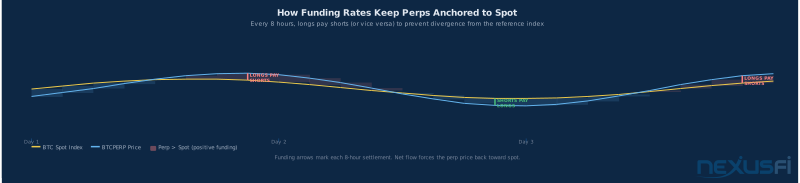
Funding rates transfer payments between longs and shorts every 8 hours, forcing the perpetual price back toward the spot reference index when they diverge. Without a fixed expiration, this mechanism is the only thing anchoring the product to fair value.
The Funding Rate: What It Is and What It Actually Costs #
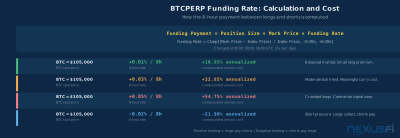
Funding payment formula and four illustrative rate scenarios showing annualized carry cost. At 0.05% per 8 hours — typical during crowded bull markets — a long position pays 54.75% annualized to hold. This cost must be factored into every position sizing calculation.
The funding rate is a periodic payment between longs and shorts. On Kalshi's BTCPERP, this occurs every 8 hours — at 00:00, 08:00, and 16:00 UTC.
The direction of the payment depends on where the perpetual is trading relative to the spot reference index:
- Perp above spot (premium): Longs pay shorts. The payment punishes longs for driving the price too high and rewards shorts for selling into the premium.
- Perp below spot (discount): Shorts pay longs. The payment punishes shorts for driving the price too low and rewards longs for buying the discount.
The rate itself is calculated based on the difference between the perpetual's mark price and the spot index. When the two are equal, the funding rate approaches zero.
For traders doing the math: a 0.01% funding rate per 8-hour period sounds trivial. Over a year (365 days, three funding periods per day = 1,095 periods), that compounds to roughly 10.95% in annualized funding cost. At 0.05% per period — the high end during bull market euphoria — the annualized cost reaches 54.75%.
That's not a fee. That's a position cost that can dominate P&L in range-bound markets and become catastrophic in trending markets if you're on the wrong side of positioning.
Funding rates are not exchange fees — they flow between traders. When longs pay shorts, the exchange collects nothing; it facilitates the transfer. But the cost to a long position holder can be substantially higher than commissions during periods of persistent positive funding. Model it explicitly in every position sizing calculation.
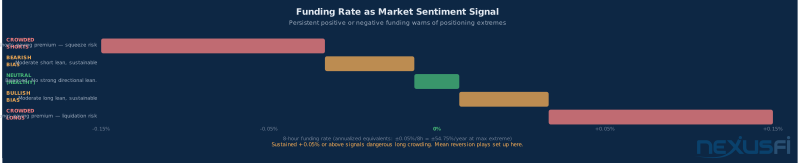
Funding rate zones from crowded shorts (negative extreme) to crowded longs (positive extreme). The neutral zone around 0% represents balanced positioning. Extreme readings in either direction historically precede sharp reversals as the crowded side faces cascading liquidations.
Funding as a Sentiment Indicator
The funding rate is one of the most underutilized signals in crypto derivatives trading. Because it reflects the real-money cost of holding leveraged directional exposure, persistent funding at extremes reveals dangerous positioning.
@SMCJB described the cash-and-carry trade mechanics on NexusFi in 2021 while offline perpetuals were first gaining institutional attention, noting that the challenge wasn't the concept but the counterparty risk on unregulated venues. The BTCPERP changes that equation entirely.
Here's what sustained funding levels tell you:
- Positive funding 0.01-0.05% per 8h: Moderate long bias. Retail longs are paying a small premium for bullish exposure. Sustainable in trending markets.
- Positive funding above 0.05% per 8h: Crowded longs. Longs are paying over 54% annualized to hold their position. The crowd is on one side. Mean reversion risk is high. Major moves down frequently begin here.
- Negative funding below -0.01% per 8h: Short bias. Shorts are paying for their positions. Less common than positive crowding during bull markets.
- Deeply negative funding: Panic selling, forced liquidations, or genuine bearish conviction. Often a contrarian buy signal in longer-term frameworks.
The funding rate is real-time positioning data. CME quarterly futures don't give you an equivalent signal — the basis between quarterly and spot reflects similar information, but it's one reading per contract, not a continuous 8-hour heartbeat.
The Regulatory Structure: Why This Is Different From Offshore #
The CFTC issued its approval under Section 5c(c)(4) of the Commodity Exchange Act and Commission Regulation 40.3. Kalshi operates as a Designated Contract Market (DCM) — the same regulatory category as CME Group.
This isn't a gray area or a regulatory carve-out. It's the same legal framework that governs every CME futures contract traded in the US.
What that means in practice:
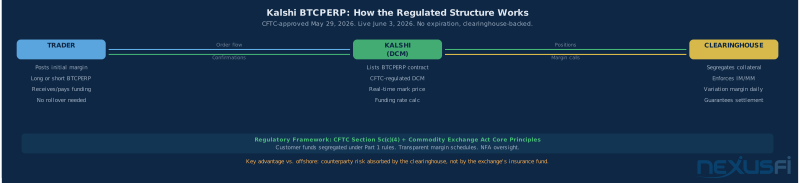
The three-party structure of a CFTC-regulated perpetual: trader positions flow through the exchange to a clearinghouse, which enforces margin requirements and guarantees settlement. Customer funds are segregated under Part 1 rules — the same standard applied to CME futures brokers.
Customer Fund Segregation
Under CFTC Part 1 rules, customer margin must be kept in segregated accounts separate from the broker's and exchange's own funds. This is non-negotiable for DCMs.
Offshore platforms — Binance, Bybit, OKX — operate under varying jurisdictions with their own fund protection rules (or lack thereof). When FTX collapsed in November 2022, over $8 billion in customer funds were commingled with exchange operating capital. That structural risk is eliminated on a CFTC-regulated venue.
Clearinghouse vs. Exchange Insurance Fund
Offshore exchanges typically maintain an "insurance fund" to cover losses from liquidations that don't fully close out — when a position's margin runs to zero before the position can be closed, the insurance fund absorbs the difference. The problem is that insurance funds are funded by the exchange, sized at the exchange's discretion, and have no regulatory minimum.
US-regulated perpetuals use a clearinghouse model. The clearinghouse is a separate legal entity, capitalized to regulatory minimums, that guarantees the performance of every contract. If a clearing member fails, the clearinghouse uses its own resources before customer funds are touched.
This doesn't eliminate risk. Price gaps and extreme volatility can still exceed margin buffers. But the protection is structural rather than discretionary.
Transparent Liquidation Rules
One of the least understood risks in offshore perpetuals is the liquidation engine. Offshore exchanges can liquidate positions using mark prices they calculate internally, close positions at prices that don't reflect market conditions, and apply "auto-deleveraging" (ADL) where profitable positions are forcibly closed to offset losing ones without warning.
Under CFTC regulation, mark price methodology must be disclosed, liquidation rules must follow the contract's stated terms, and traders have legal recourse if those rules are violated. ADL as offshore platforms practice it would require explicit CFTC approval.
Comparing the Products: A Trader's Decision Framework #
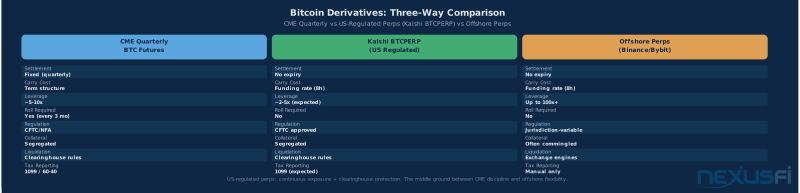
Side-by-side structural comparison of CME quarterly BTC futures, Kalshi BTCPERP, and offshore perpetuals across eight key dimensions. The choice between products depends on your leverage needs, compliance requirements, and tolerance for counterparty risk.
When to Use CME Quarterly BTC Futures
CME quarterly futures (BTC, MBT, and Micro BTC) remain the best choice when:
- You need to execute calendar spread strategies (long front month, short back month to play the basis)
- Your fund mandates quarterly settlement for reporting purposes
- You're using bitcoin futures as part of a multi-asset futures portfolio already cleared through CME
- You want the highest institutional liquidity in a regulated venue (CME BTC still has deeper order books than early-stage BTCPERP markets)
@SMCJB mapped the regulatory futures environment accurately in 2021, noting CME Micro Bitcoin as the first practical entry point for retail-scale regulated bitcoin exposure. That analysis still holds — the Micro BTC (0.1 BTC notional, ~$10,500 at current prices) remains the most accessible CME bitcoin product.
When to Use BTCPERP
The perpetual is better when:
- You want continuous directional exposure without rolling every 3 months
- You're running a cash-and-carry strategy and need the perp leg on a regulated venue (see below)
- You're hedging bitcoin spot holdings and need continuous short exposure
- You're an institution that can't trade offshore but wants the flexibility of perpetual mechanics
- You want to use funding rate signals as a sentiment overlay in your trading framework
When Offshore Perps Are Still Used
Offshore perpetuals will remain relevant for:
- Traders who require leverage above 5-10x (US-regulated perps will likely cap at lower multiples)
- Non-US traders without access to Kalshi
- Altcoin perpetuals (Kalshi initially lists only BTC; altcoin regulated perps will follow)
- Ultra-high-frequency strategies that require the speed of crypto-native infrastructure
The Cash-and-Carry Strategy in a Regulated Context #
The cash-and-carry trade is the institutional use case that makes US-regulated perpetuals most immediately valuable. The setup:
- Buy spot bitcoin on a regulated custodian
- Short an equivalent notional amount of BTCPERP on Kalshi
- Collect funding payments when the perp trades at a premium to spot (longs pay shorts)
- The position is delta-neutral -- bitcoin price movements up or down are hedged
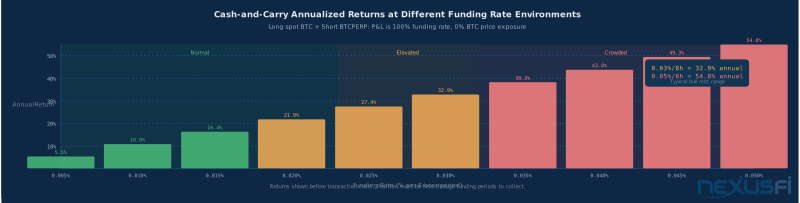
Cash-and-carry annualized return at different 8-hour funding rates. The strategy is delta-neutral (BTC price movement is hedged), so the entire return comes from funding payments collected. At typical bull market funding of 0.03%/8h, the annualized carry is 32.9%.
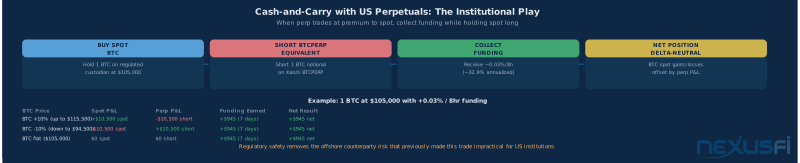
Delta-neutral cash-and-carry trade: long spot BTC, short equivalent BTCPERP notional. All three price scenarios produce the same net result — the funding rate collected is the return, regardless of BTC price direction. The key metric is funding rate, not BTC direction.
At 0.03% funding per 8-hour period — typical during moderate bullish markets — the annualized carry on this position is roughly 32.9%. That return is uncorrelated to bitcoin's price direction. The risk is:
- Funding goes negative: If funding flips to negative (perp trades below spot), you pay instead of receive. In the cash-and-carry framework, you'd close the position when funding inverts.
- Spot custody risk: Bitcoin held on a custodian has its own risks. This trade requires a custodian with adequate insurance and security practices.
- Basis risk: If the perp decouples much from spot for an extended period, the mark-to-market on the short position can require additional margin before funding payments arrive.
Prior to BTCPERP, US institutions running this trade faced a structural problem: the perp leg had to go offshore, introducing counterparty risk that made the trade unacceptable for most institutional compliance frameworks. The regulated perp solves this.
Funding Rate Arbitrage: Advanced Variation
A more complex version of the cash-and-carry exploits the difference in funding rates between BTCPERP and offshore perps:
- If BTCPERP funding is +0.05% / 8h while Binance BTC perp funding is +0.07% / 8h, long BTCPERP and short Binance perp captures a 0.02% / 8h spread
- Delta-neutral between venues
- The return is the funding rate differential
This trade requires both regulated and offshore infrastructure and introduces offshore counterparty risk on the Binance leg — but it's a lower counterparty exposure than full offshore since the net position is zero-delta and sized to collect the spread only.
Margin and Liquidation Mechanics #
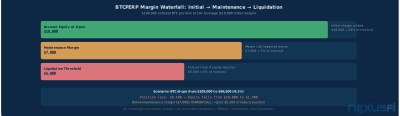
Margin hierarchy for a $100,000 notional BTCPERP position at 10x leverage. The US clearinghouse model issues a margin call when equity hits maintenance ($7,000), giving the trader time to post additional margin or reduce size before forced liquidation at $5,000. Offshore platforms skip the margin call step.
What US Regulation Requires
Under the Commodity Exchange Act, all DCM margin requirements must be:
- Published and transparent in advance
- Applied consistently under stated contract terms
- Subject to CFTC review and approval
This means Kalshi must disclose its initial margin requirements, maintenance margin levels, and liquidation trigger thresholds before you open an account. There are no surprise rule changes.
Check the contract specification document before trading BTCPERP. The key parameters: contract size (notional), tick size, initial margin percentage, maintenance margin percentage, funding rate calculation methodology, and reference index composition. These determine your true cost and risk.
Expected Margin Levels
Based on CFTC regulatory guidance and the typical margin regime for regulated crypto futures, expect:
- Initial margin: 10-20% of notional (implying 5-10x leverage at most)
- Maintenance margin: 7-15% of notional (slightly below initial margin)
- Variation margin: Daily mark-to-market adjustments credited or debited to your account
These are much higher margin requirements than offshore platforms (which offer 1-2% initial margin for 50-100x leverage). This is intentional — the CFTC's mandate includes market stability, and extreme leverage in volatile crypto markets is inconsistent with that mandate.
The Liquidation Process
Under a clearinghouse model, when your account equity falls below maintenance margin, you receive a margin call — not an immediate liquidation. You have time to post additional margin or reduce your position before forced liquidation occurs.
Offshore platforms frequently liquidate positions at the maintenance margin threshold or below, without warning and without the opportunity to post additional margin. The US clearinghouse model restores the margin call process that most futures traders already understand from CME products.
Who Can Trade BTCPERP #
Kalshi is a US-based DCM. To trade BTCPERP, you need:
- US residency (or foreign participants using authorized FCMs with CFTC-compliant access)
- KYC verification (government ID, address verification)
- An account with Kalshi or a registered FCM that provides BTCPERP access
Non-US traders who want regulated perpetual exposure will need to wait for equivalent approvals in their jurisdiction. The Coinbase/Deribit letter from May 2026 (CFTC Staff Letter 26-17) addresses how US FCMs can provide access to offshore perps classified as "foreign futures" — a different regulatory pathway that has its own compliance requirements.

What Comes Next: The Competitive Environment #
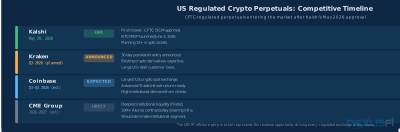
Competitive environment for US-regulated crypto perpetuals following Kalshi's May 2026 CFTC approval. Kraken announced 30-day entry, Coinbase and CME Group are expected to follow. CME entry would create the deepest institutional liquidity in a regulated perp market.
Kalshi's approval was explicitly described as a "major step forward in delivering on President Trump's goal of cementing America as the crypto capital of the world" by CFTC Chairman Michael Selig. The policy signal is clear: more regulated perps are coming.
Kraken announced plans to list CFTC-regulated perps within 30 days of Kalshi's launch. Coinbase, Bybit (via its US subsidiary), and CME Group are all expected to follow. The $92.9 trillion in annual offshore perpetual volume represents a revenue opportunity that no regulated exchange will ignore.
What to watch:
- CME Group: If CME lists a regulated perpetual, it immediately has the deepest institutional liquidity and the most established clearing relationships. This would be the product institutional traders would migrate to.
- Contract specs evolution: Initial Kalshi specs will likely be conservative. As the market develops and the CFTC gains comfort with the product, leverage limits and margin requirements may be adjusted.
- Altcoin expansion: Kalshi stated plans to expand to more than a dozen cryptocurrencies pending regulatory review. Ether perpetuals, Solana perpetuals, and other major crypto assets are the natural expansion path.
- Basis convergence: As institutional money migrates from offshore to regulated venues, the funding rate differential between offshore and US-regulated perps will likely compress. Early-mover traders can position to collect these convergence trades.
The 12-year evolution of regulated Bitcoin derivatives culminating in CFTC-approved perpetuals. Each milestone expanded the market's accessibility to institutional capital: CME quarterlies in 2017, CME Micro in 2021, spot ETFs in 2024, and perpetuals in 2026. The next frontier is multi-asset regulated perps.
How to Trade BTCPERP: A Practical Framework #
Opening a Position
The mechanics are similar to trading any futures contract:
- Choose your notional size. BTCPERP is quoted in BTC. Decide how many BTC of exposure you want.
- Calculate your required margin. If initial margin is 10% and you want $50,000 notional exposure, you need $5,000 in margin.
- Set your liquidation price awareness. Know at what price your position reaches maintenance margin. Build a buffer beyond that -- do not trade at the margin minimum.
- Account for funding in your P&L model. Before entering a long position, check the current funding rate. If funding is +0.05% / 8h, you're paying 54.75% annualized to hold. Is your expected return higher than that holding cost?
Monitoring a Position
Unlike quarterly futures, there's no expiration countdown to manage. Instead, monitor:
- Funding rate changes: Persistent funding at extremes can reverse quickly. Set alerts for funding rates above +0.03% or below -0.01%.
- Mark price vs. index deviation: Large deviations (perp much above or below spot) are early warning of imminent large funding payments.
- Margin ratio: Keep your account equity at least 150% of maintenance margin. Never operate near the liquidation threshold.
The Single Most Important Rule
Do not take the lack of a rollover date as permission to ignore position management. The absence of expiration is not the absence of risk. Funding costs accumulate continuously. Liquidation can occur at any time if margin is insufficient. Perpetuals require more active monitoring than quarterly futures, not less.
The same constraint applies to BTCPERP long positions when Bitcoin declines sharply. The perpetual will mark against you in real-time. Margin calls arrive faster than they do in quarterly futures because the funding mechanism means the contract tracks spot with minimal basis lag.
The Bottom Line for NexusFi Traders #
The BTCPERP launch is the most significant structural development in US crypto derivatives since the CME listed bitcoin quarterly futures in December 2017.
For traders who've been working around the absence of regulated perpetuals — using CME quarterlies for regulated hedging and accepting the roll cost, or using offshore perps and accepting the counterparty risk — the BTCPERP is the first time those tradeoffs can be avoided.
For traders new to perpetual mechanics, the funding rate is the core concept that has no equivalent in traditional futures. Spend time understanding it before trading. The calculation is simple; the market dynamics it creates are not.
The product will evolve. Contract specs will tighten. Competitors will enter. Liquidity will deepen. But the regulatory watershed happened in May 2026, and the infrastructure it enables — cash-and-carry, institutional hedging, regulated speculation — is now accessible to any US futures trader with a Kalshi account.
That's a significant change. Build your understanding of it now, before the volume makes the entry points expensive.
Knowledge Map
Go Deeper
Build on this knowledgeReferences This Article
Articles that build on this topicCitations
- — CFTC Approves BTCPERP Contract Submitted by KalshiEX, LLC -- CFTC
- — Kalshi Goes Live With America's First Regulated Bitcoin Perpetual Futures -- Bitcoin Magazine
- — Exiting BTC with a Cash and Carry Premium Arbitrage (2021) 👍 2“Your futures position will lose $38k and your Bitcoin position will make $38k. The exchange will want their $38k for the futures loss.”
- — New Micro Contract :- Micro Ether coming 5-Dec-21 (2021) 👍 10“CME Micro Bitcoin | 0.1 coins, Notional ~ $6.4k CME Ether | 50 Ether, Notional ~ $225k”
- — Is Bitcoin done ? take a look... (2025) 👍 1“CME vs Crypto Exchanges: No counterparty risk (CME clearing), Cash settled (no wallet headaches), Regulated reporting.”
- — Where can I trade BTC FUTURES, and what are margin amounts (2020) 👍 2“Margin on both is 37% of notional. So with Bitcoin at $9,400 a CME contract is $47,000 notional so $17,390 in margin.”
- — CFTC Staff Letter 26-17: Deribit Perpetuals as Foreign Futures
- — What if a broker declare bankruptcy!!! Ftx first whose next? (2022) 👍 6“Unlike many offshore exchanges which register in jurisdictions with lax rules (like the Bahamas, Malta, etc) which means you specifically do not have protections like customer fund segregation.”