



Crypto Derivatives Trading: Futures, Perpetuals, and Options
Overview #
Crypto derivatives give traders leveraged exposure to digital assets without holding the underlying tokens — but they work differently enough from traditional futures to bite experienced professionals who don't pay attention to the differences. The mechanics of perpetual swaps, the liquidation engine, mark price vs last price, funding rates — none of this exists in the CME world, and underestimating it costs money.
This article is a technical bridge. If you trade ES, NQ, or CL futures and you're moving into crypto derivatives, here's what you need to know. The concepts map closely to traditional futures — but the implementation details are where the traps live.
The crypto derivatives market is massive. Top-10 offshore exchanges processed over $92 trillion in perpetual swap volume in 2025. CME Bitcoin futures trade alongside Binance perpetuals that move $20 billion daily. Deribit dominates options with 85%+ market share. This is a mature, institutional market — but it plays by its own rules.
Key Concepts #
Futures: The Familiar Foundation #
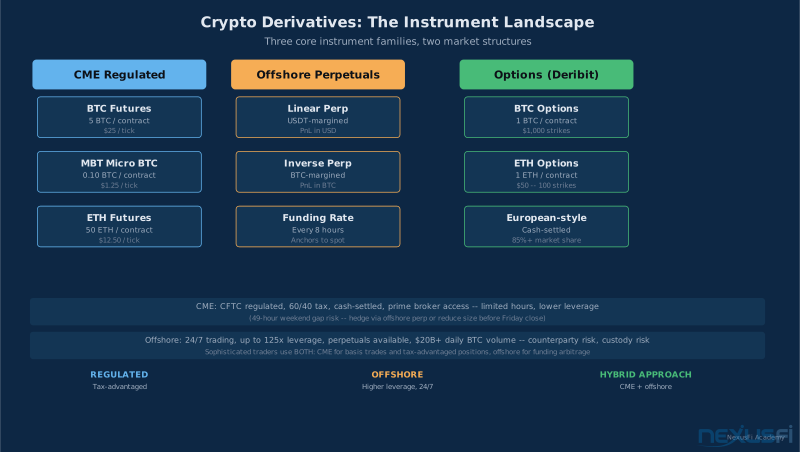
Dated futures in crypto follow the same structure as traditional commodity futures — fixed expiry, cash or physical settlement, standardized contracts. CME leads the regulated space:
- Bitcoin Futures (BTC): 5 BTC per contract, $5 tick = $25 per tick value. Cash-settled to the CME CF Bitcoin Reference Rate. Margin runs approximately $15,000--$25,000 per contract depending on volatility.
- Micro Bitcoin (MBT): 0.10 BTC per contract, $1.25 per tick. One-tenth the size of full BTC. Ideal for retail traders and precise hedging — if you want to run a basis trade without committing to full 5 BTC lots, MBT gives you that flexibility.
- Ether Futures (ETH): 50 ETH per contract, $0.25 tick = $12.50 per tick.
CME crypto futures run Sunday to Friday, 6pm--5pm ET with a one-hour break. That 49-hour weekend gap is one of the most important risk management considerations for CME traders — more on this in the risk section.
Perpetual Swaps: The Dominant Instrument #
Perpetual swaps are non-expiring futures that track spot price through a periodic funding rate mechanism. No expiry means no roll cost and no calendar spread risk — which is why they dominate offshore trading volume.
Binance BTC perpetuals move north of $20 billion daily. OKX, Bybit, and others add comparable volume. This dwarfs CME Bitcoin futures by a factor of 10 or more, which matters when you're looking at execution quality and market impact.
The trade-off: perpetuals live on offshore, unregulated exchanges. The counterparty is the exchange, not a clearing house. The insurance fund, not CFTC oversight, is your backstop.
Perpetuals are synthetic — they don't represent ownership of BTC or ETH. They represent a bet on the price, settled in USDT or BTC depending on contract type. When you're short a perpetual and the exchange collapses, you have a claim against the exchange's estate, not the underlying asset.
Options: Deribit's Moat #
Crypto options are almost entirely a Deribit market. Deribit launched in 2016, built the institutional infrastructure (block trades, RFQ, sophisticated API, maker rebates), and the liquidity network effect made it basically a monopoly. Over 85% of BTC and ETH options volume runs through Deribit.
Both BTC and ETH options are European-style (no early exercise) and cash-settled in the underlying crypto. BTC options: 1 BTC per contract, $1,000 strike intervals near-the-money. ETH options: 1 ETH per contract, $50--100 strike intervals.
Expirations run daily, weekly, monthly, and quarterly — a rich term structure that sophisticated vol traders use to position on both directional and volatility views.
Linear vs. Inverse Contracts: The Critical Distinction #
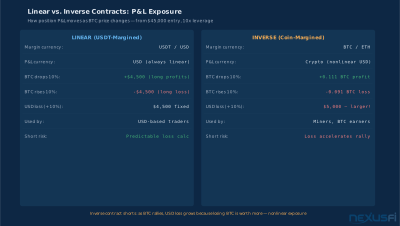
This is the concept that trips up traditional futures traders most often. Linear contracts are USDT or USDC-margined — your PnL is in dollars, your margin is in dollars. Straightforward. Inverse contracts are coin-margined — your margin is BTC or ETH, and your PnL is calculated in the underlying asset.
The mechanics create a nonlinear exposure that isn't immediately obvious. Take a short position in an inverse BTC/USD contract at $40,000:
- You short 1,000 contracts at $100 each = $100,000 notional = 2.5 BTC position value
- Price drops to $30,000 (profitable): P&L = 1,000 × $100 × (1/$30,000 - 1/$40,000) = +0.833 BTC profit
- Price rises to $50,000 (losing): P&L = 1,000 × $100 × (1/$50,000 - 1/$40,000) = -0.5 BTC loss
The problem: when you lose 0.5 BTC at $50,000, that's $25,000. The same loss in dollar terms at $40,000 would have been only $20,000. Your USD-denominated loss accelerates as BTC price rises because you're losing the appreciating asset.
The inverse contract "double-negative" trap: when you're short and wrong, your loss in USD grows faster than a linear contract because your collateral (BTC) is appreciating while your position is losing. Liquidation risk compounds asymmetrically. Institutional desks predominantly use linear (USDT-margined) contracts for this reason.
Most offshore exchanges offer both. Inverse contracts appeal to miners (natural BTC revenue flow) and traders who want BTC-denominated returns. For USD-based traders doing basis trades or hedging, linear is cleaner.
The settlement mechanics of coin-margined contracts create a hidden execution risk that catches basis traders off guard:
Mark Price, Index Price, and Last Price #
Three prices exist simultaneously on any derivatives exchange. Understanding which one triggers your liquidation is not optional.
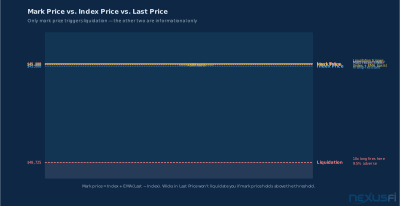
Last Price is the most recent trade on the derivatives exchange. It's the number that tickers display. It's also the price most vulnerable to thin-order-book manipulation — a coordinated effort to push last price with a small market order can move it substantially.
Index Price is the volume-weighted average of BTC spot prices across multiple major exchanges (Coinbase, Kraken, Bitstamp, and others). It represents fair value of the underlying asset, smoothed across venues.
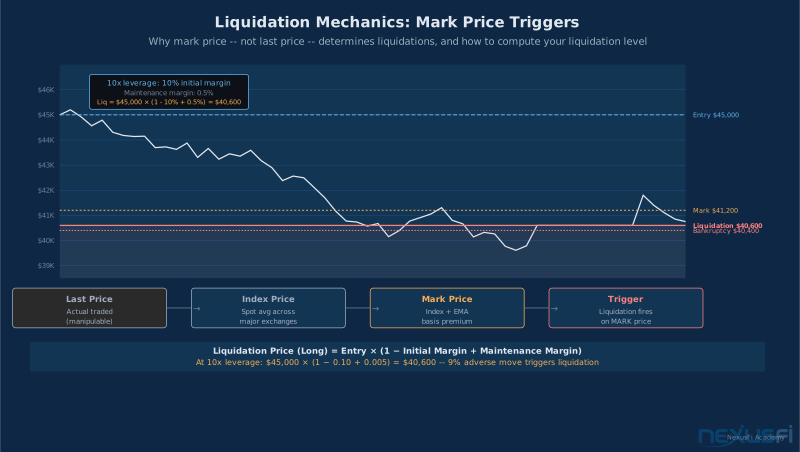
Mark Price is the liquidation trigger. Typically: Mark Price = Index Price + Moving Average of (Last Price - Index Price). The EMA-basis smoothing ensures the mark price tracks the index closely while dampening manipulation attempts.
Example: BTC perpetual at $45,100 (last), index at $45,000, 30-minute EMA basis = +$80 → mark price = $45,080. Your liquidation triggers at the mark, not the last. This matters when last price wicks lower on thin volume — your position survives as long as the mark price doesn't cross the liquidation threshold.
Monitor mark-to-last price divergence during volatility. When the spread exceeds 0.1--0.2%, aggressive participants may be attempting to push last price to trigger liquidations while mark price (and your actual liquidation trigger) sits higher.
Perpetual Swaps and Funding Rates #
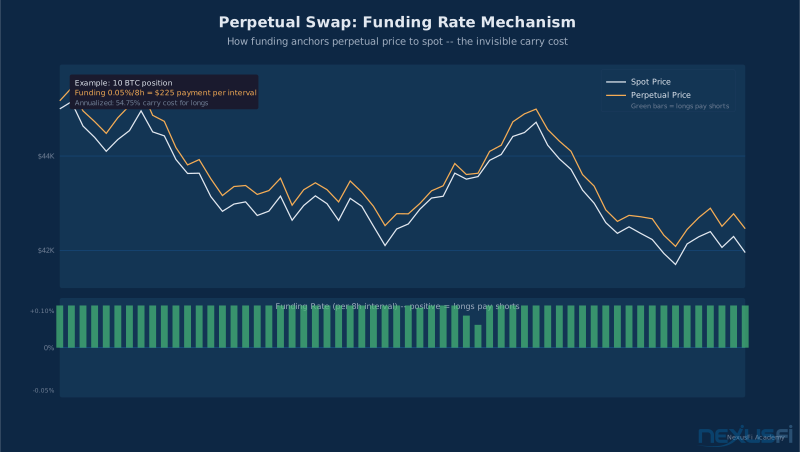
The funding rate is the mechanism that prevents perpetual swaps from drifting permanently away from spot. Without it, a heavily bid perpetual could trade 20% above spot indefinitely. The funding rate fixes this by making the expensive side pay the cheap side every 8 hours.
Standard schedule: 00:00 UTC, 08:00 UTC, 16:00 UTC.
Direction:
- Positive funding (perp > spot): Longs pay shorts
- Negative funding (perp < spot): Shorts pay longs
Calculation: Funding Rate = [(Mark Price - Index Price) / Index Price] × (8h / Funding Interval) + interest component. The interest component on most exchanges is +0.01% per 8 hours.
Real numbers: If BTC spot is $45,000 and the perpetual is $45,090 (0.2% premium), the 8-hour funding rate = 0.2% / 3 = 0.0667% per interval. On a 10 BTC position ($450,000 notional): 10 × $45,000 × 0.000667 = $300 per 8-hour period. Annualized: 0.0667% × 3 × 365 = 73%.
That's carrying cost. Most retail long holders don't model this, and it shows in their P&L.
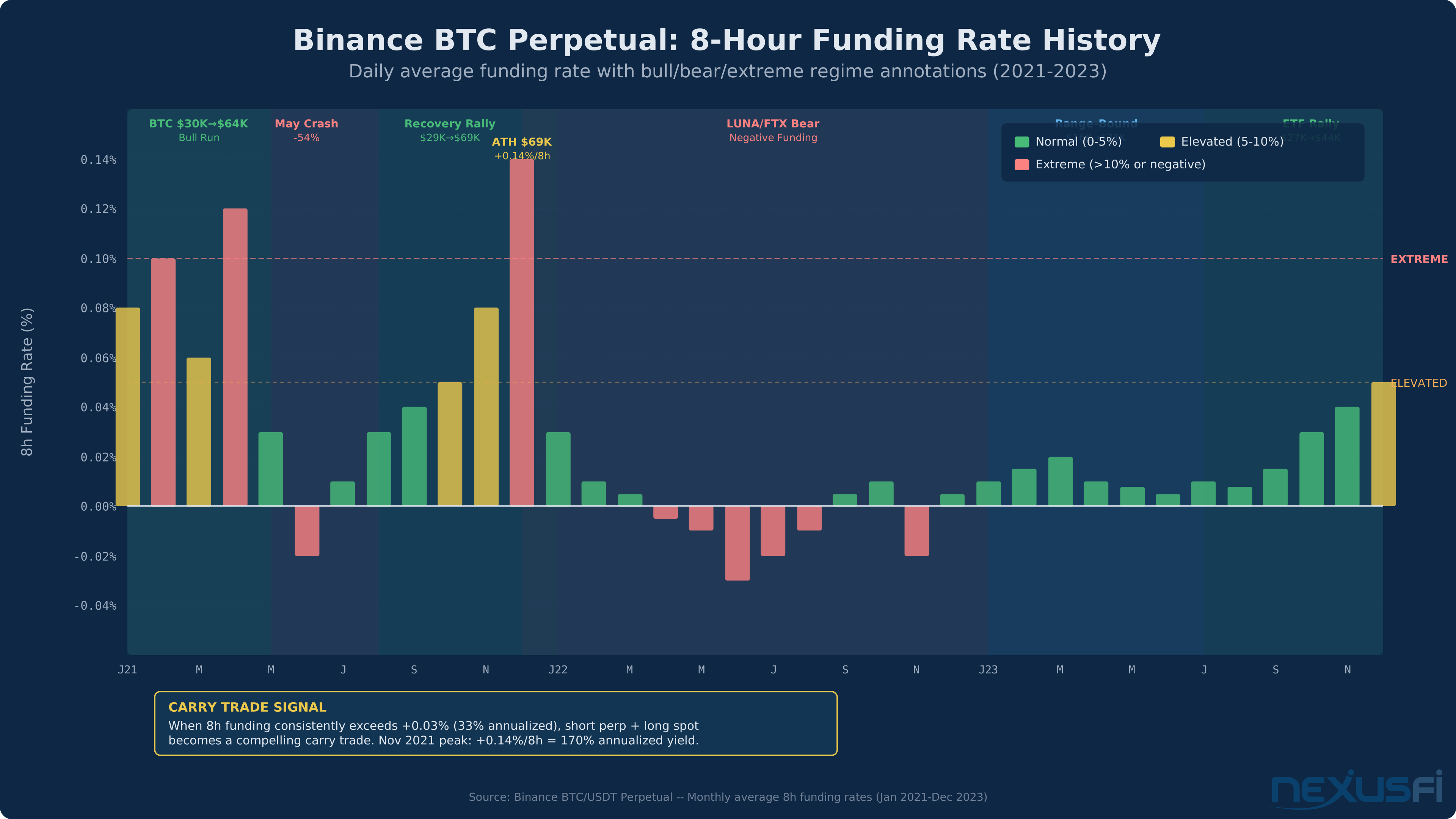
Historical ranges (Binance BTC perpetual):
- Late 2021 bull market: +0.01% to +0.10% per 8h
- 2022 bear market: -0.005% to +0.03% per 8h
- Extreme events (liquidation cascades): +0.30% per 8h
Funding timing matters: If you enter a long position 1 second after the funding window closes, you pay nothing for nearly 8 hours. Close 1 second before the next window and you've avoided the entire payment. Swing traders who hold multi-day positions need to model expected funding over the hold period, not just at entry.
Funding as a yield play: When annualized funding consistently exceeds 30%, short perp + long spot becomes an attractive carry trade. You collect the funding from longs while spot exposure is neutral. During the 2021 bull run, this trade ran at 40--80% annualized for months on end before the November unwind.
Margin and Liquidation Mechanics #
This is the section where most TradFi traders get humbled. Crypto liquidation mechanics are more aggressive, more automated, and less forgiving than anything in traditional futures.
Cross vs. Isolated Margin #
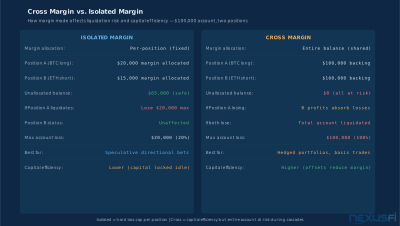
Isolated margin: You allocate a fixed amount of capital to a single position. That's your max loss. If the position gets liquidated, the rest of your account is untouched.
Use case: speculative directional bets where you want hard loss limits.
Cross margin: Your entire account balance serves as margin for all positions. Profitable positions support losing ones. The account gets liquidated if total equity falls below the maintenance requirement across all positions.
Use case: market makers, basis traders, and portfolio strategies where offsetting positions should reduce required margin.
Professional shops run cross margin for their hedged books — if you're long spot and short a perpetual, cross margin lets the profitable leg support the losing leg during temporary divergences.
Liquidation Price Calculation #
Long position: Liquidation Price = Entry Price × (1 − Initial Margin Rate + Maintenance Margin Rate)
At 10x leverage (10% initial margin, 0.5% maintenance):
- Entry $45,000 × (1 − 0.10 + 0.005) = $45,000 × 0.905 = $40,725
That's a 9.5% adverse move to liquidation. BTC regularly moves 5--10% in a day. Overnight or weekend gaps can exceed this.
Liquidation Price (Long) = Entry × (1 − IM + MM) Liquidation Price (Short) = Entry × (1 + IM − MM)
Where IM = Initial Margin Rate, MM = Maintenance Margin Rate At 10x: IM = 10%, MM typically 0.5%
Auto-Deleveraging (ADL) #
ADL is counterparty risk unique to offshore venues. During the May 2021 cascade and the November 2022 FTX collapse, ADL events affected traders who were profitable and had taken no unusual risk. Monitor the ADL indicator on your exchange's position display. When you're in the red zone during high volatility, reduce position or take profit.
Insurance Fund #
Reputable exchanges maintain an insurance fund to absorb losses when liquidated positions close below the bankruptcy price. Binance's BTC insurance fund held over 40,000 BTC. OKX publishes real-time fund balances.
Monitor insurance fund drawdown during volatile periods — rapid depletion signals elevated ADL risk.
Basis Trading: Cash-and-Carry in Crypto #
Basis trading in crypto follows the same logic as in any futures market: buy the cheap instrument, sell the expensive one, wait for convergence.
Spot-Futures Basis #
The basis on CME BTC futures represents the annualized cost of carry. In a normal (contango) market:
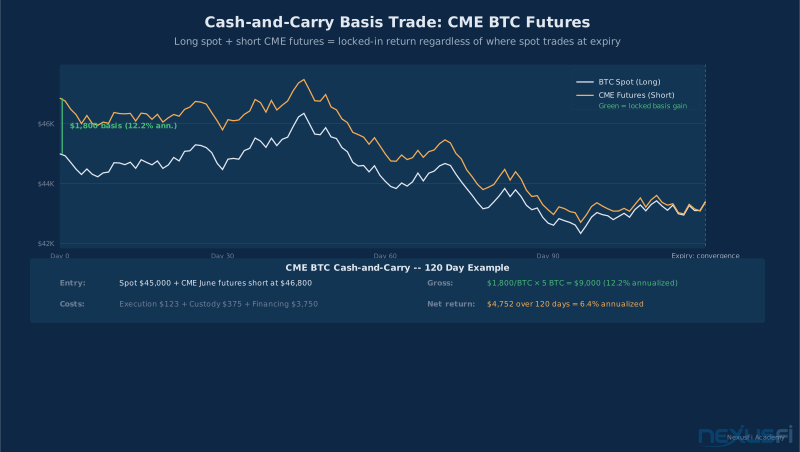
Annualized Basis = (Futures Price − Spot Price) / Spot Price × (365 / Days to Expiry)
Example: BTC spot $45,000, CME June futures (120 days) $46,800: Basis = ($46,800 − $45,000) / $45,000 × (365/120) = 12.2% annualized
This basis exists because futures buyers are paying a premium for the convenience of leveraged exposure without spot custody risk.
Classic Cash-and-Carry #
The trade: buy 5 BTC spot at $45,000, sell 1 CME BTC June futures at $46,800. Lock in the $1,800/BTC premium. At expiration, regardless of where spot trades, the futures converge to spot and you collect the basis.
After accounting for execution, custody, and financing on a 120-day trade, the $9,000 gross basis reduces to approximately $4,752 net — 6.4% annualized. Minimum threshold: 8--10% for CME, 15%+ for offshore to compensate for counterparty risk.
Perpetual Funding vs. Dated Futures Basis #
The decision between running a cash-and-carry with dated CME futures vs. shorting a perpetual comes down to holding period and risk tolerance:
Hold < 30 days: Perpetuals. No roll cost, immediate entry/exit, funding often mean-reverts.
Hold > 90 days: Dated futures, if the basis exceeds expected average funding. Locked-in return, no funding uncertainty.
When basis > 15% annualized: Strong case for CME cash-and-carry.
When funding consistently > 0.03% per 8h (33% annualized): Strong case for perp shorts.
CME Regulated vs. Offshore Venues #
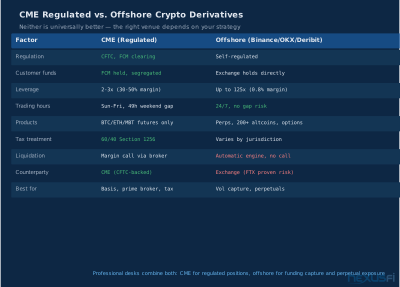
The regulated/offshore divide is the most important venue decision crypto derivatives traders face. Neither is universally better — they serve different functions.
CME: The Regulated Standard #
CME Bitcoin futures offer institutional-grade infrastructure at the cost of flexibility. What you get:
- CFTC regulation: Transparent surveillance, margin methodology, customer protection rules
- FCM clearing: Your broker stands between you and the exchange, not the exchange holding your funds
- 60/40 tax treatment: Section 1256 — 60% of gains taxed as long-term, 40% short-term, regardless of holding period. Meaningful for high-frequency basis traders
- Cash settlement: No custody of actual Bitcoin, no key management risk
- Prime broker access: Large desks can integrate CME positions into multi-asset portfolios
What you give up: limited hours (49-hour weekend gap), lower leverage (typical initial margin 30--50% of notional vs. 0.8--10% offshore), smaller product set (no perpetuals, fewer altcoins), and less liquidity than the largest offshore venues.
MBT (Micro Bitcoin Futures) solve the capital efficiency problem for basis traders. When you want to rebalance a hedged book quickly against a perp leg, MBT's $1.25 tick and 0.10 BTC size let you manage inventory with surgical precision.
Offshore Venues: Volume and Flexibility #
Many experienced traders have discovered what offshore venues offer — and what they lack — the hard way:
Binance, Bybit, OKX, and Deribit collectively account for the overwhelming majority of crypto derivatives volume. What they offer:
- 24/7 trading — no weekend gap
- Up to 125x leverage (though sustainable leverage is far lower — see risk section)
- Perpetual swaps: continuous exposure without roll costs
- Deeper altcoin derivatives markets
- Maker rebates and competitive fee structures
- Immediate settlement
The risk profile is at the core different from CME. Your funds sit on the exchange. Counterparty risk is real — FTX demonstrated this catastrophically in November 2022. Regulatory uncertainty can result in access restrictions by jurisdiction. ADL exposes profitable traders to forced closures during cascades.
Sophisticated traders typically use both venues in combination: CME for the regulated, tax-advantaged leg of basis trades and for positions requiring prime broker integration; offshore for funding capture, perpetual exposure, and rapid tactical positioning. The combination extracts the advantages of both without concentration in either.
Options on Crypto #
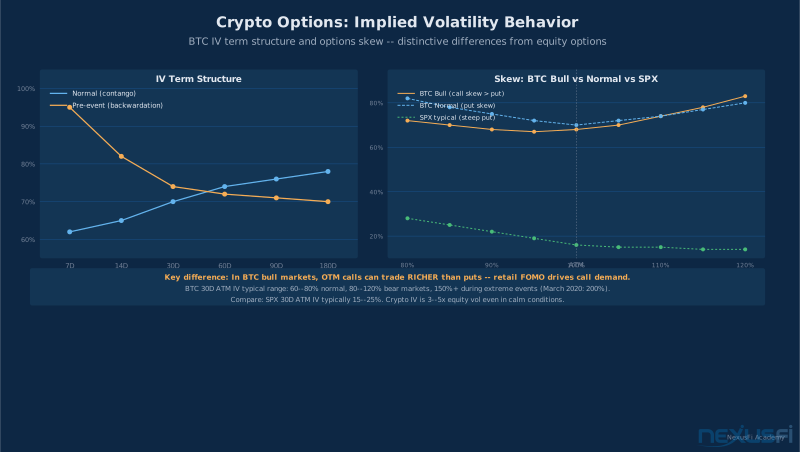
Crypto options look similar to equity options on the surface — calls, puts, strikes, expirations, Greeks — but the vol dynamics are different enough to warrant attention.
Deribit Market Structure #
Deribit processes over 85% of BTC and ETH options volume. BTC options: 1 BTC per contract, $1,000 strike intervals near ATM. ETH options: 1 ETH per contract. Both are European-style (no early exercise) and cash-settled in the respective crypto. Trading runs 24/7.
Deribit's dominance created a concentrated vol market. When large institutional flows hit, they move the whole surface. The market-maker community is sophisticated and cross-margined with futures and spot positions.
Implied Volatility: Very Different from Equities #
BTC 30-day ATM implied volatility:
- Normal markets: 60--80%
- Bull markets: 50--70%
- Bear markets: 80--120%
- Extreme events: 150%+ (March 2020 saw 200%)
ETH IV typically runs 5--10 vol points above BTC. Compare this to SPX, which runs 15--25% ATM IV in normal conditions. Crypto is 3--5x equity vol even in calm periods.
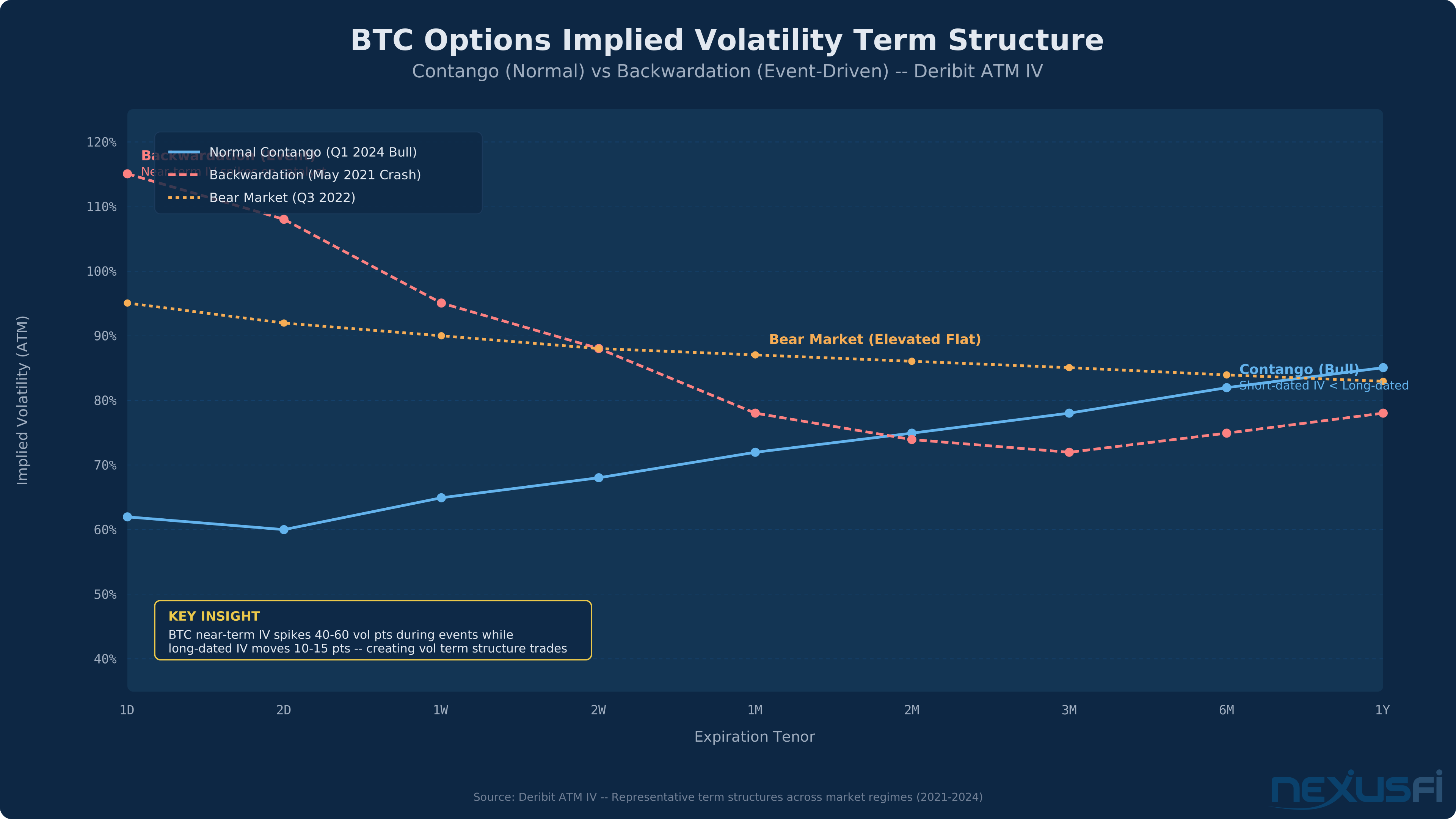
Term structure in contango (normal): Short-dated IV below long-dated. 7-day might be 65%, 30-day 72%, 90-day 78%. The uncertainty premium increases with horizon.
Term structure in backwardation (event-driven): Near-term IV spikes above long-dated when a specific event creates near-term risk. Regulatory announcements, halving events, or macro catalysts can invert the curve for days — 7-day IV at 95% while 90-day sits at 72%.
Skew: Where Crypto Inverts Convention #
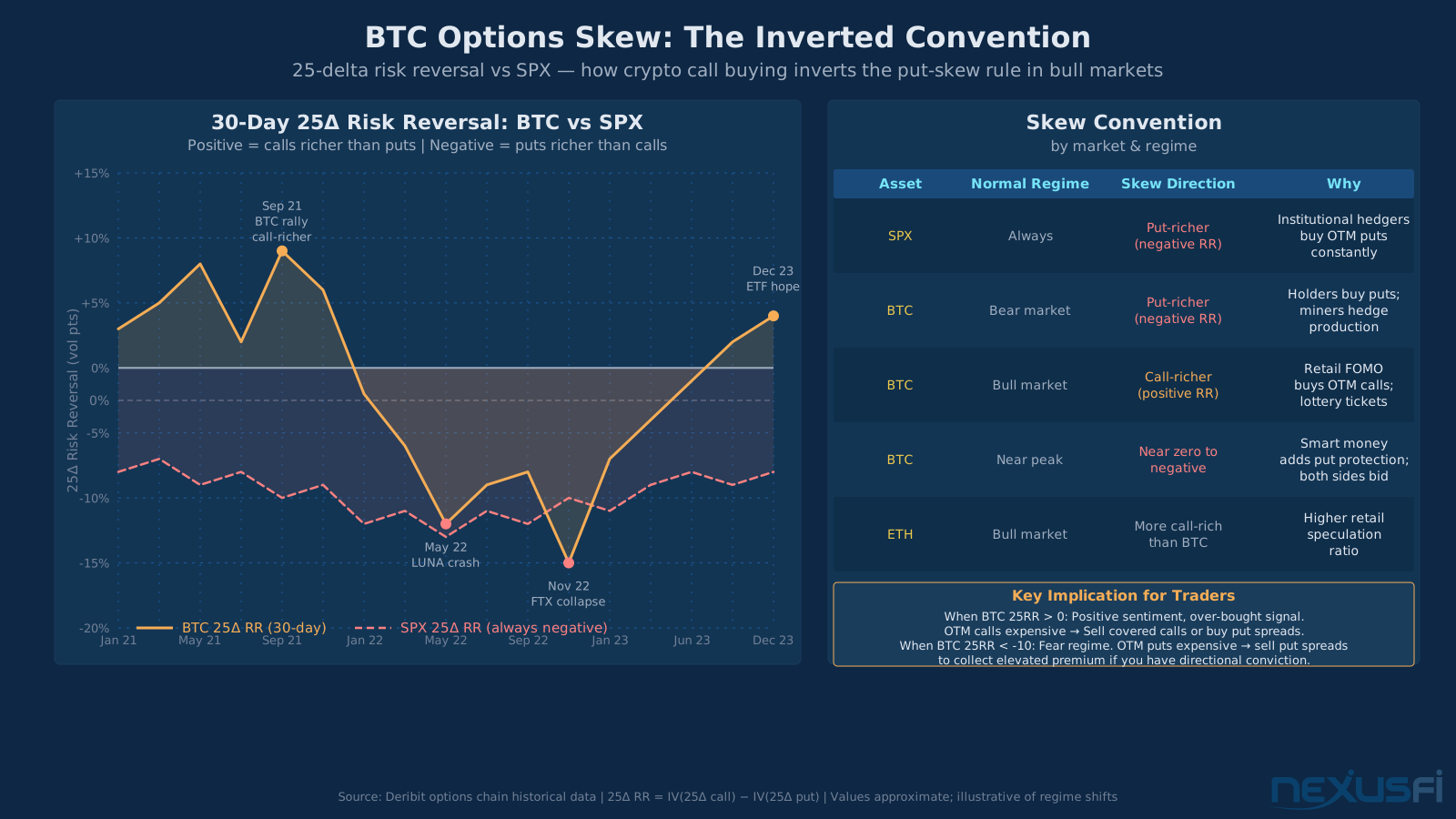
In equity options, put skew dominates. Institutional hedgers buy OTM puts for portfolio protection, creating persistent put-richer-than-call skew. VIX spikes as puts get bid.
Crypto breaks this convention in bull markets. Retail FOMO drives aggressive OTM call buying — "lottery ticket" demand for $100K BTC calls when spot is at $60K. The result: call skew can exceed put skew, inverting the equity convention.
December 2023 example: BTC spot $42,000. 30-day $50,000 call (19% OTM): 72% IV. 30-day $35,000 put (17% OTM): 75% IV. Near parity — in SPX terms the put would be substantially richer.
At longer tenors, institutional put demand (miners hedging production, treasuries hedging BTC holdings) reasserts and put skew returns to normal.
Put/call open interest ratio as a sentiment gauge: Ratio > 1.0 means more put open interest (bearish/protective). Ratio < 0.7 means more call OI (bullish/speculative). These extremes often precede positioning exhaustion.
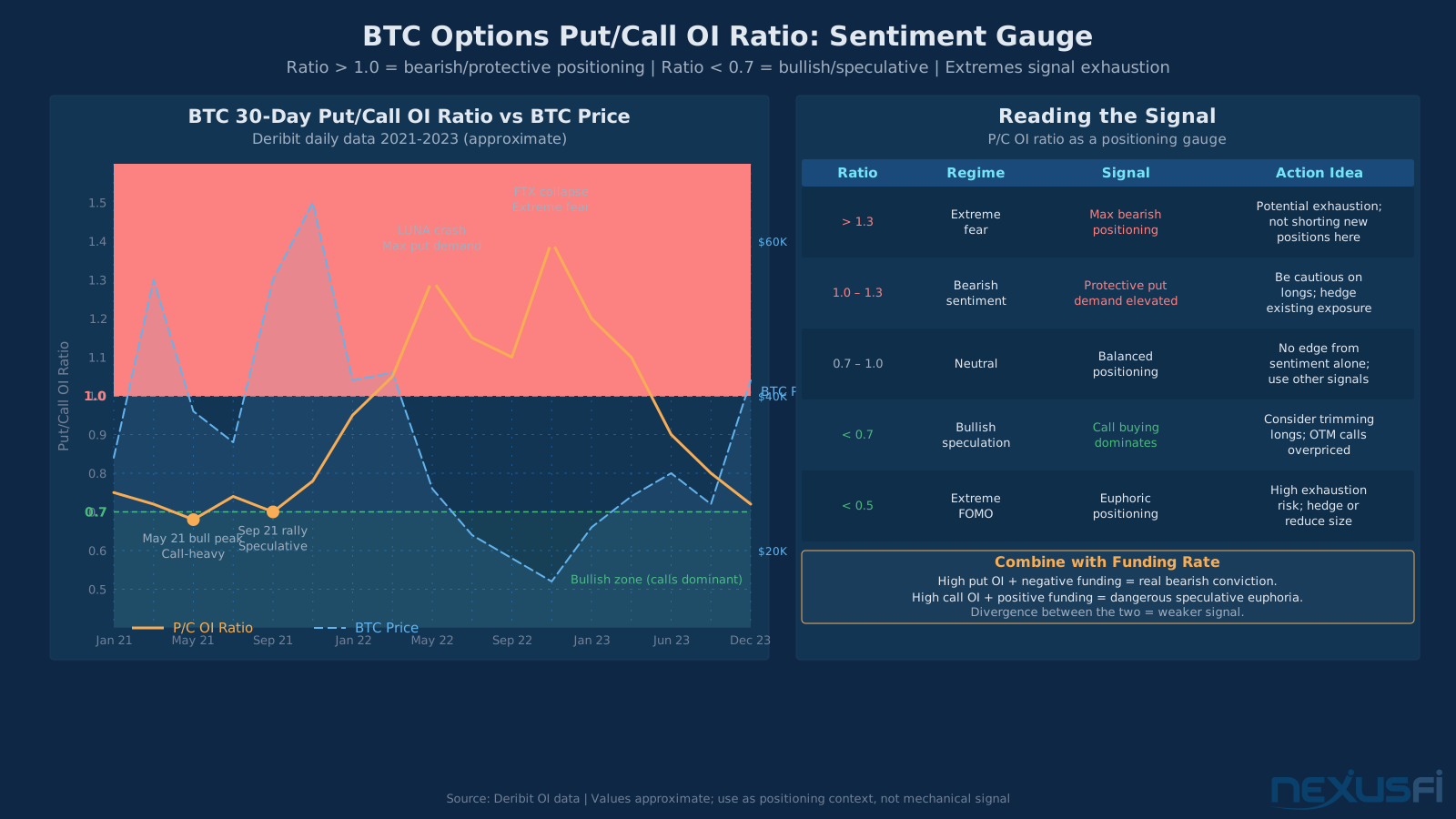
When BTC funding is extremely positive (longs paying heavily), watch for accelerating put-skew steepening. Elevated funding means overleveraged longs — when those positions unwind, downside demand for puts rises sharply and IV can spike 20--40 vol points in hours.
Risk Management for 24/7 Markets #
Traditional futures risk management breaks in crypto. Fixed trading hours, circuit breakers, and regulated margin calls are replaced by continuous liquidation engines, no weekends off, and self-service margin management.
The 24/7 Problem #
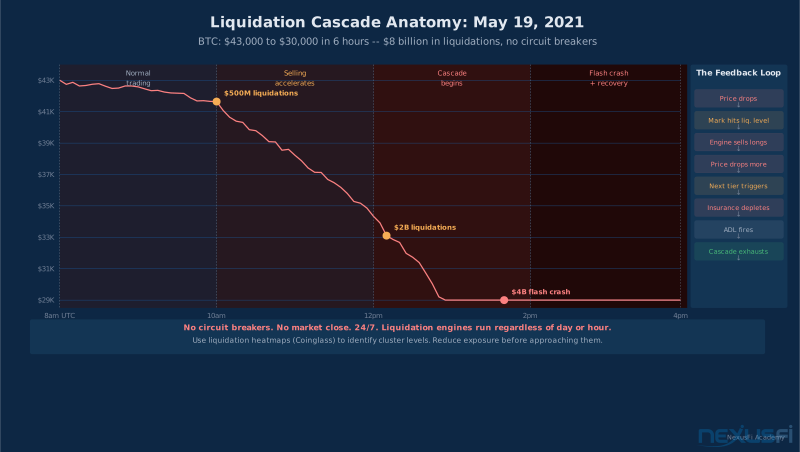
CME ES and NQ have market hours. News breaks, you have time to evaluate before your position is at risk. Crypto never stops. The May 22, 2021 Saturday price move — BTC from $42,000 to $30,000 in 24 hours, $8 billion in liquidations — happened while many traders were asleep.
Protocols for 24/7 markets:
- Never carry overnight leverage above your sleep-through threshold: If you can't stomach watching $50,000 evaporate at 3am, your leverage is too high.
- Price alerts at key levels: Not just your stop, but at the liquidation clusters below (via Coinglass liquidation heatmaps).
- Reduce before weekends (CME traders): The 49-hour gap window is where the worst CME gaps originate.
Weekend Gap Mitigation for CME Traders #
The standard professional approach: hedge CME exposure with an offsetting offshore perpetual position through the weekend window.
Example:
- Long 10 CME BTC contracts Friday 5pm ET (50 BTC notional)
- Short 50 BTC on Binance perpetual Friday 5pm ET
- Close Binance hedge Sunday 6pm ET after CME reopens
Cost: approximately 3 funding intervals × 0.01--0.03% per interval = 0.03--0.09% total. For a $200,000 CME position, that's $60--$180 to insure against gap risk.
The gap problem extends beyond futures to ETF wrappers too — any crypto instrument with limited hours creates the same exposure:
Sustainable Leverage #
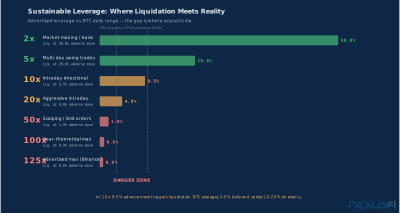
The leverage numbers advertised by offshore exchanges (125x on Binance, 100x on Bybit) are theoretical limits. At 125x, a 0.8% adverse move liquidates you. BTC moves 0.8% in minutes.
Professional leverage by strategy:
- Basis trading / market making: 2--5x
- Multi-day swing trades: 3--8x
- Intraday directional: 5--15x (with hard stops)
At 10x leverage (10% initial margin), a 9% adverse move hits liquidation. BTC averages 3--5% daily range, spikes to 10--20% on events. The math doesn't favor anything above 10x on overnight positions unless you have system-level stops below that threshold.
Liquidation Cascade Risk #
Cascades are the most dangerous risk unique to crypto derivatives. The mechanism:
- Price moves adversely, overleveraged positions reach liquidation
- Liquidation engine market-sells (for longs) or market-buys (for shorts) into the tape
- This moves price further, triggering the next tier of liquidations
- Feedback loop accelerates
- Insurance fund depletes, ADL fires
In six hours on May 19, 2021, BTC fell from $43,000 to $30,000 — $8 billion liquidated, no circuit breakers.
Liquidation heatmaps (Coinglass, TradingView) and on-chain analysis tools show where liquidation clusters concentrate. Large clusters below current price represent "fuel" — if price reaches those levels, the cascade accelerates. Large clusters above current price represent short-squeeze fuel.
When price approaches a major liquidation cluster shown on the heatmap, the expected behavior is not linear continuation — it's an acceleration event. Reduce exposure before reaching the cluster, not at the cluster level. By the time price hits the cluster, the cascade is already in motion and limit orders may not fill at expected prices.
Knowledge Map
Go Deeper
Build on this knowledgeReferences This Article
Articles that build on this topicCitations
- — No Fee Futures Trading (2020) 👍 1“While sounding sexy, perpetual bitcoin swaps/derivatives/futures are basically the same as trading cash FX rather than actual futures.”
- — Webinar: Ethereum Futures from CME Group (2021) 👍 6“The rumor is HFs are short Bitcoin futures, with the speculation that they are short futures, versus long actual coins, collecting the yield.”
- — Where can I trade BTC FUTURES, and what are margin amounts (2020) 👍 2“Margin on both is 37% of notional. So with Bitcoin at $9,400 a CME contract is $47,000 notional so $17,390 in margin.”
- — Cryptocurrencies 101 -- what I've learned so far (2021) 👍 3“If you trade a Bitcoin Future, it is taxed as a futures contract. If you trade Bitcoin itself though it is taxed as a cryptocurrency.”
- — How much do you know about Bitcoin? (2021) 👍 1“The flash crash this week was arguably much deeper than it should have been because liquidation engines got bogged down and exchanges essentially shut down for 1-2 hours because they couldn't handle the volume, resulting in a sell only market.”
- — Is anyone taking a stance on Bitcoin in light of the imminent ETF approval? (2024) 👍 2“Gaps are the big concern as Bitcoin trades 24 hours and the ETF takes the night off. Bitcoin can move 5% or more overnight.”
- — Exiting BTC with a Cash and Carry Premium Arbitrage (2021) 👍 1“Coin exchanges like Binance do offer coin margined contracts, but as SMCJB stated, it is unregulated. So Binance contract is great since I only need 100% capital, but since I settle in BTC too, then I need to sell after the contract to lock in the USD gains.”
- — Exiting BTC with a Cash and Carry Premium Arbitrage (2021) 👍 1“The carry trade actually hurt Warren Buffet with the volatility in BTC this year and caused them to step away. I know of no coin margined futures contracts and the futures are very capital intensive.”
- — Bitcoin Futures by the CME (2019) 👍 3“Maintenance margin was $21,053 per contract. With last nights settlement of 11380 and initial margin was $23,158 per contract.”
- — How much do you know about Bitcoin? (2021)“I learnt to trade on Crypto and my first trade was Bitcoin. I moved to futures to avoid Exchanges failing under load, massive slippage and exorbitant commissions.”
- CME Group — Bitcoin Futures Contract Specifications (2024)
- Deribit — BTC Options Contract Specifications (2024)
- — What if a broker declare bankruptcy!!! Ftx first whose next? (2022) 👍 6“FTX was not a broker in the same sense as a broker on a regulated exchange. It was in fact itself an exchange, in a totally unregulated environment. Trading only on a regulated exchange is essential if you want any safety for your money.”
- — Cryptocurrency Trading Platforms (2021) 👍 1“A few of the futures exchanges even pay you to create liquidity (Limit orders). Just be aware to familiarize yourself with the concept of Funding with Cryptocurrency Perpetual Derivatives. These can work for your benefit.”