



Order Book Data and Depth of Market: What Every Futures Trader Needs to Know About the Engine Behind Every Trade
Overview #
Order Book Data and Depth of Market: What Every Futures Trader Needs to Know About the Engine Behind Every Trade
The limit order book is the beating heart of every futures exchange. Every price that moves, every fill you get or don't get, every moment when support holds or collapses — it all comes down to what's happening in the order book. Understanding how that data flows, what it means, and how to use it without getting burned by its limitations is the difference between trading informed and trading blind.
This isn't a theoretical exercise. The order book drives your fills, your slippage, your entry timing, and your ability to read whether a level is going to hold. Get this right and you have genuine edge in understanding what the market is doing in real time.
Key Concepts #
Limit Order Book (LOB): The exchange's live record of all resting buy and sell orders at every price level. The LOB is the full state of the market's unmatched interest.
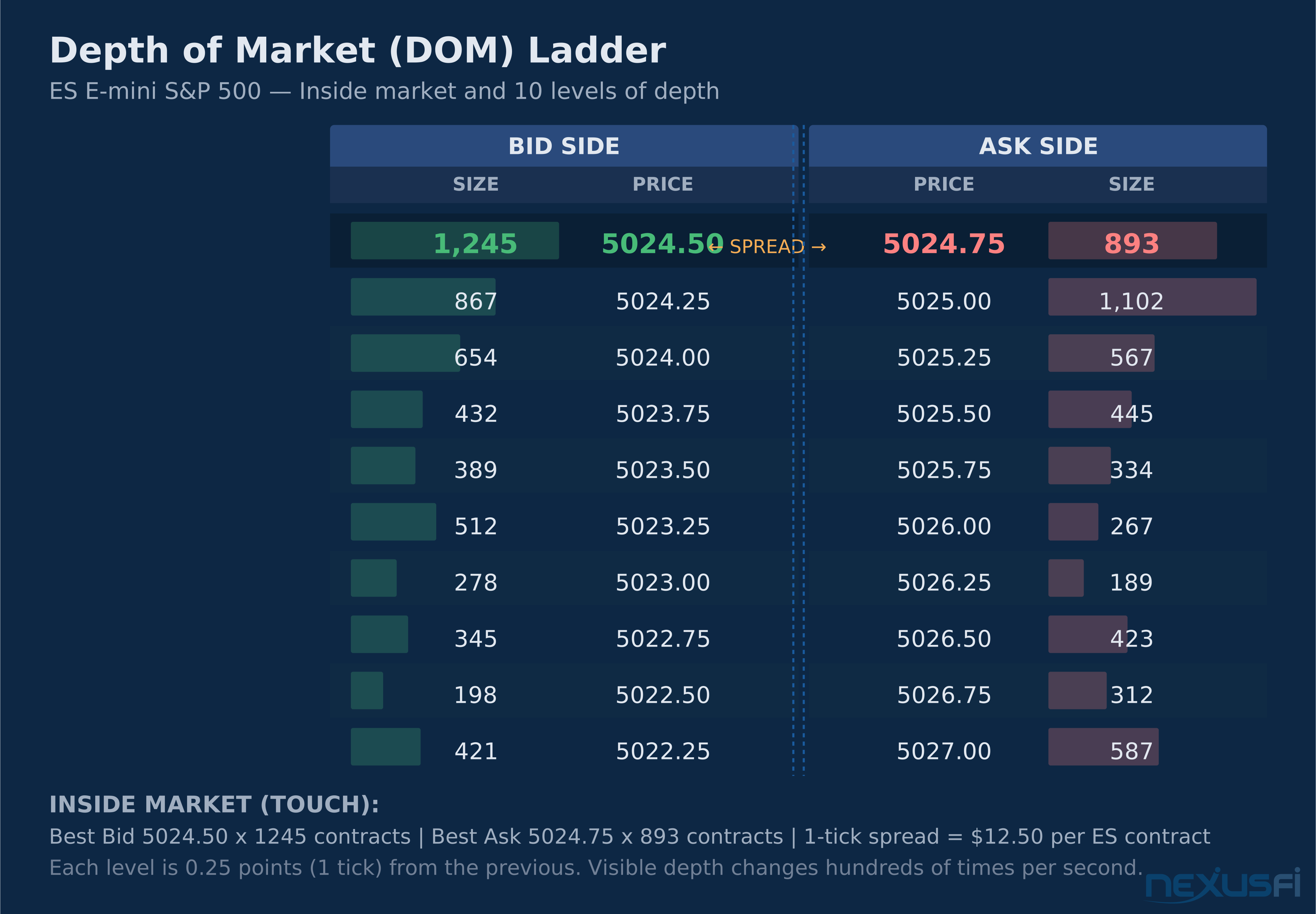
Depth of Market (DOM): A trader-facing visualization of the limit order book — typically displayed as a ladder showing bids and asks across multiple price levels. Your DOM window is a rendering of the LOB, built from the exchange's data feed.
Bid side: The buy side of the book. Resting limit buy orders, sorted by price descending. Best bid is the highest price buyers are willing to pay.
Ask/offer side: The sell side. Resting limit sell orders, sorted by price ascending. Best ask is the lowest price sellers will accept.
Spread: The gap between the best bid and best ask. In liquid futures like the ES, this is typically 1 tick. In thinner markets, it can be many ticks.
Inside market: The best bid and best ask together. Also called the "touch."
Depth: The displayed liquidity available beyond the inside market — the layers of resting orders at prices away from the touch.
Tick size: The minimum price increment for a given futures contract. ES ticks at 0.25 points. Crude oil (CL) ticks at $0.01. The tick size is the resolution of the price grid.
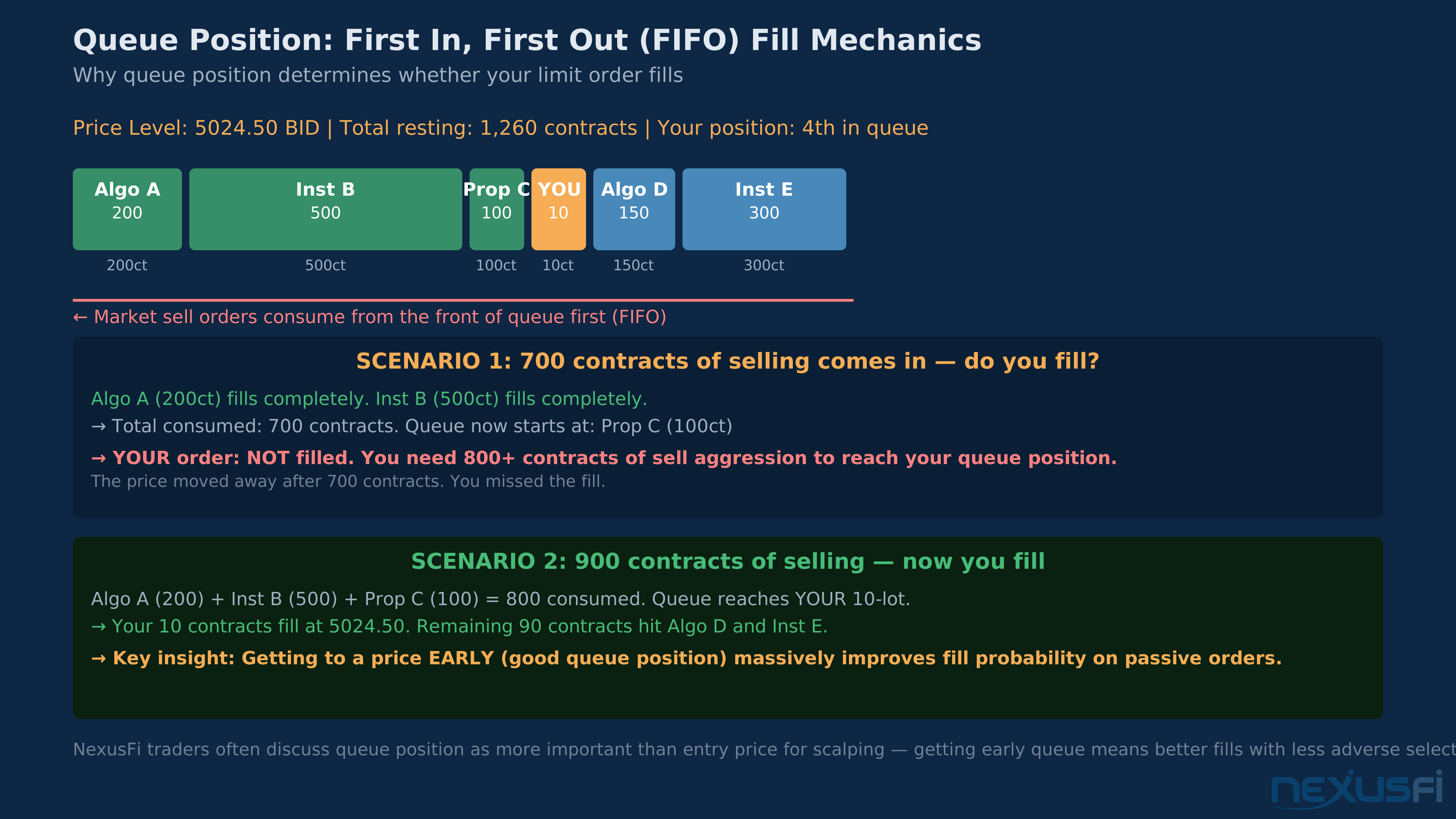
Queue position: Your position in the resting order queue at a specific price. First in, first out — time priority means the earlier your order arrived, the closer to the front of the queue you are.
Imbalance: Asymmetry between bid-side and ask-side displayed liquidity. More bids than asks is bullish imbalance, more asks than bids is bearish imbalance.
Aggressor: A trader who crosses the spread — places a marketable order that immediately hits resting liquidity. Aggressors are "takers" of liquidity.
Passive/resting order: A limit order that sits in the book waiting to be filled. Passive orders are liquidity "makers."
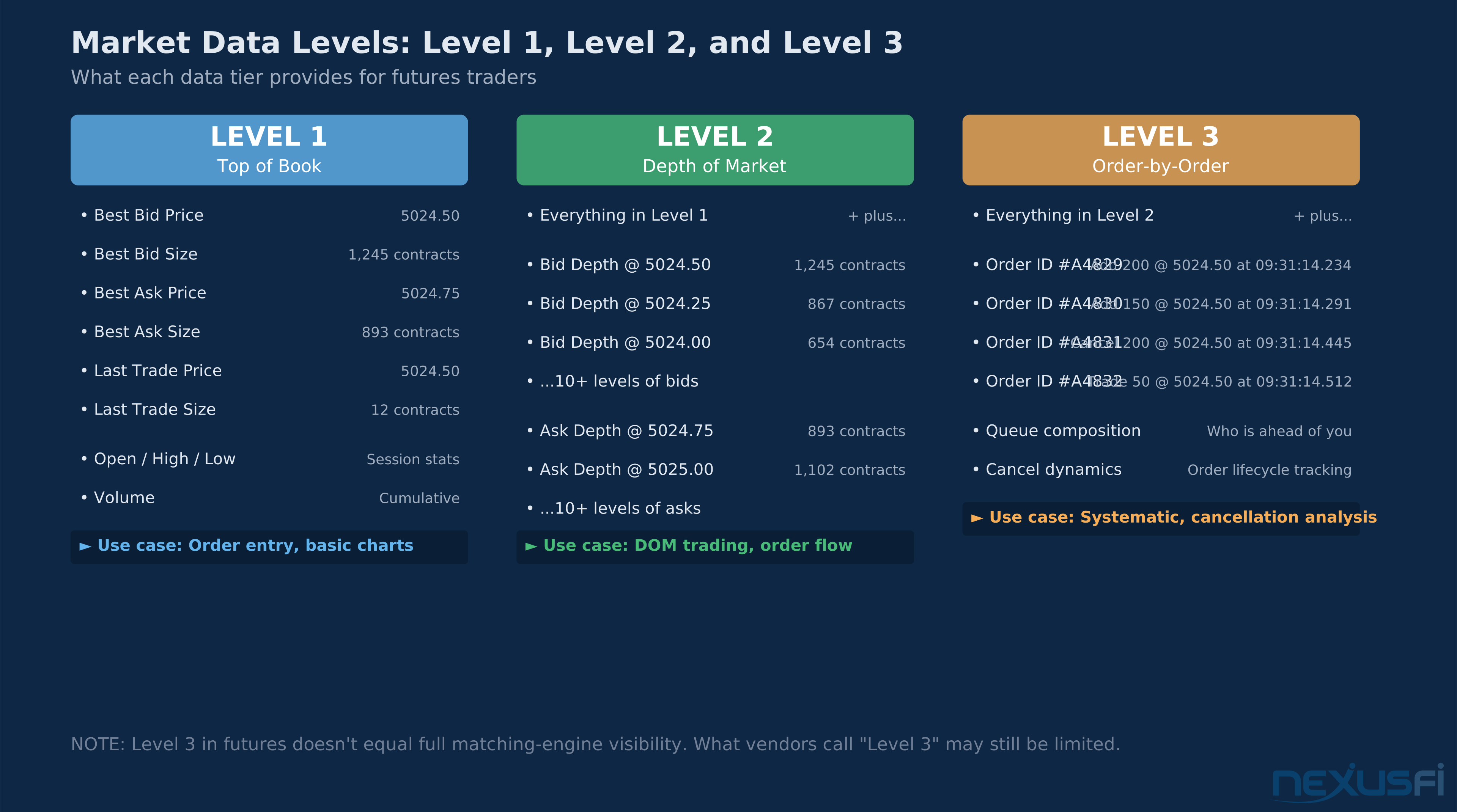
Level 1 data: The best bid, best ask, and last trade. The minimum information tier.
Level 2 data: Depth of market — multiple levels of bid and ask depth, aggregated by price level. What most DOM traders use.
Level 3 data: Order-by-order detail — individual order adds, modifications, and cancels, often with order identifiers. More granular than Level 2, more complex to process, more restricted to obtain.
How the Limit Order Book Actually Works #
The LOB is the exchange's continuous double auction in action. At any given moment, it shows every resting limit order's price and quantity. When you enter a market order, it sweeps through the book from the touch inward, matching against resting liquidity until your order is filled or the book is exhausted.
The mechanics:
Price priority: Better prices always go first. A bid at 5000.50 fills before a bid at 5000.25.
Time priority: At the same price, the first order in gets the first fill. This is the standard for most futures — it's called FIFO (first in, first out). Some markets use pro-rata allocation for large passive orders, but FIFO dominates in US equity index futures.
Queue dynamics: At a busy price level on the ES, you might see 500-2,000 contracts resting. Your 5-contract limit order is somewhere in that queue. If 450 contracts ahead of you get filled before price moves, you get filled. If only 400 get filled before a reversal, you don't.
Queue position matters more than most retail traders appreciate. Getting to a price early, before it gets crowded, meaningfully improves fill probability on passive orders.
The Data Feed: What the Exchange Actually Sends You #
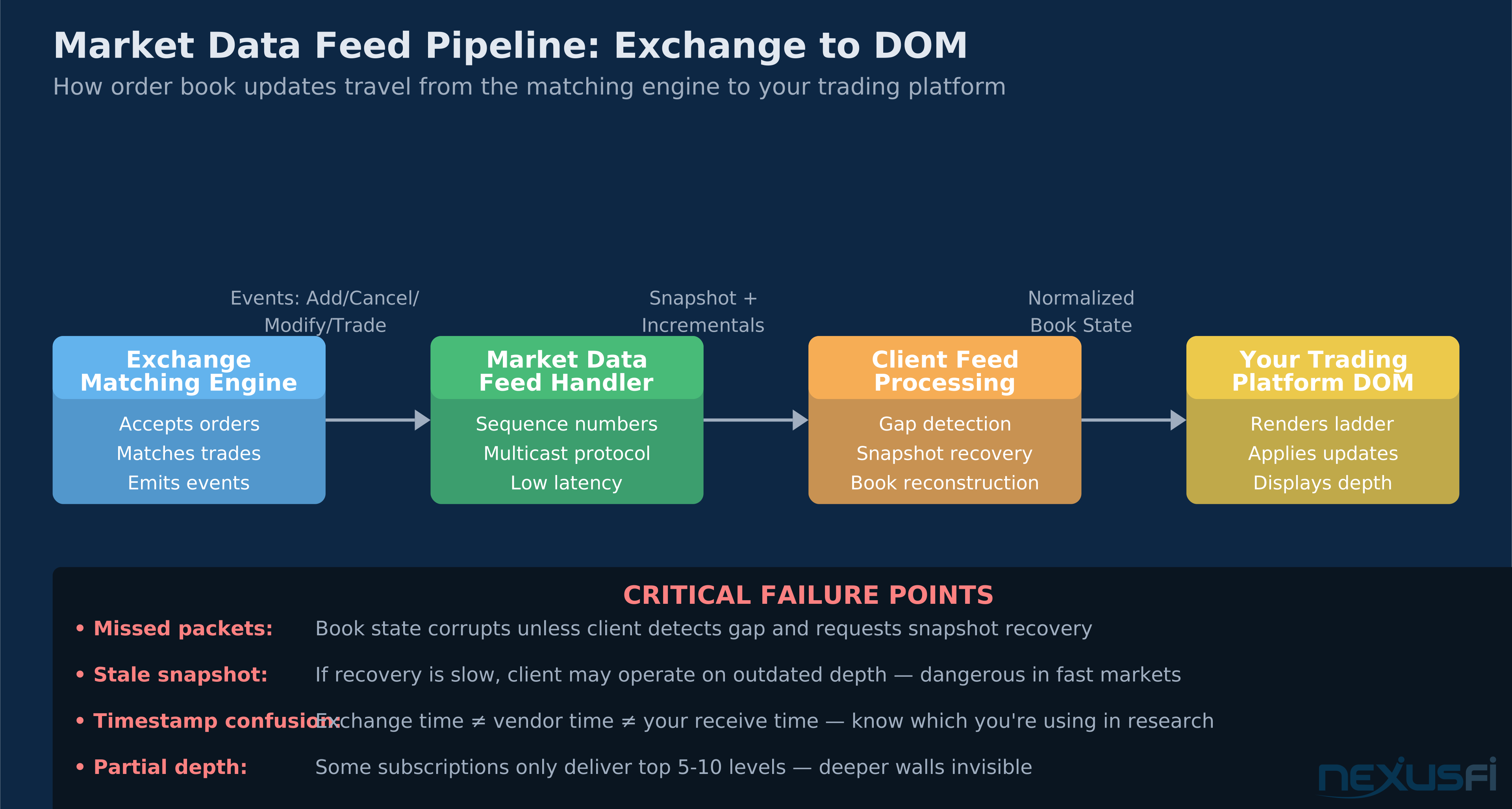
The exchange doesn't broadcast a static picture of the book. It sends an event stream. Every add, modify, cancel, and trade generates a message. Your trading platform receives this stream and reconstructs the DOM from it.
The typical flow:
1. Initial snapshot: When you subscribe to a contract's market data, you receive a full snapshot of the current book state. This is the baseline.
2. Incremental updates: After the snapshot, you get incremental messages — "add 200 contracts to the bid at 5000.25," "cancel 150 contracts at the ask at 5000.75," "trade 50 contracts at 5000.50." Your software applies these messages in sequence to maintain a current picture of the book.
3. Sequence numbers: Every message has a sequence number. If your software receives message 1001 and then 1003, it knows message 1002 was dropped. At that point it needs to resync — typically by requesting a fresh snapshot and reapplying subsequent messages.
What this means for traders: the DOM you see is only as accurate as your feed handler's reconstruction. If your broker's market data server drops packets and doesn't resync cleanly, you're looking at a stale or corrupted view of the book. On fast markets — NFP releases, FOMC minutes, major gap opens — this matters enormously.
@hyperscalper, one of the most technically sophisticated DOM traders in the NexusFi community, flagged the computational challenge directly. With the ES and NQ, peak update rates can overwhelm naive implementations:
"I'm happy to discuss various methods of 'digging deeply' into the Market Depth. Of course everything you do will want to be as efficient as possible, since peak update rates for MNQ will be roughly..."
-- @hyperscalper, NexusFi: https://nexusfi.com/showthread.php?t=57723&p=888406#post888406
That's a real feed processing problem that determines whether the DOM you see is accurate during the moments that matter most.
Level 1, Level 2, and Level 3: What's the Actual Difference? #
Level 1 #
Top-of-book only: best bid, best ask, last trade, session stats. Enough for order entry but not for reading the book.
Level 2 #
Aggregated depth at multiple price levels — quantity resting at each bid and ask price across multiple levels, updated as orders arrive, modify, or cancel.
Level 2 tells you how much is available at each price, but not the breakdown into individual orders. If 500 contracts are bid at 5000.25, Level 2 shows "500" — it doesn't tell you if that's one 500-lot or fifty 10-lots. The DOM ladder in NinjaTrader, Sierra Chart, Jigsaw Trading, or any other serious platform is a visualization of Level 2 data.
Level 3 #
Individual order-level events: each add, modify, and cancel carries an order ID. Enough information to reconstruct exactly which orders are in the queue and in what sequence. True visibility into queue composition (within public data limits).
Level 3 is what you need to accurately model queue position, track order lifecycle, and analyze cancellation dynamics. It's available from most exchanges but requires separate subscriptions, more complex infrastructure, and often higher fees.
One nuance worth preserving: in futures, "Level 3" as publicly distributed doesn't mean full internal matching-engine visibility. Exchanges publish what they choose to publish. For most day traders, Level 2 is sufficient. Level 3 is the territory of systematic traders building order flow models, researchers studying market microstructure, and anyone trying to understand cancellation dynamics at the granular level.
@matthew28 captured why depth matters practically:
"...huge variation in the sum of the ten levels shown in the order book. These are Depths of Market (DOMs) from the Jigsaw trading company so in the middle columns they show the volume that traded against the orders..."
-- @matthew28, NexusFi: https://nexusfi.com/showthread.php?t=45531&p=695812#post695812
That variation in depth across levels is exactly why understanding what the exchange sends matters.
Order Book Imbalances: What They Show and Where They Fail #
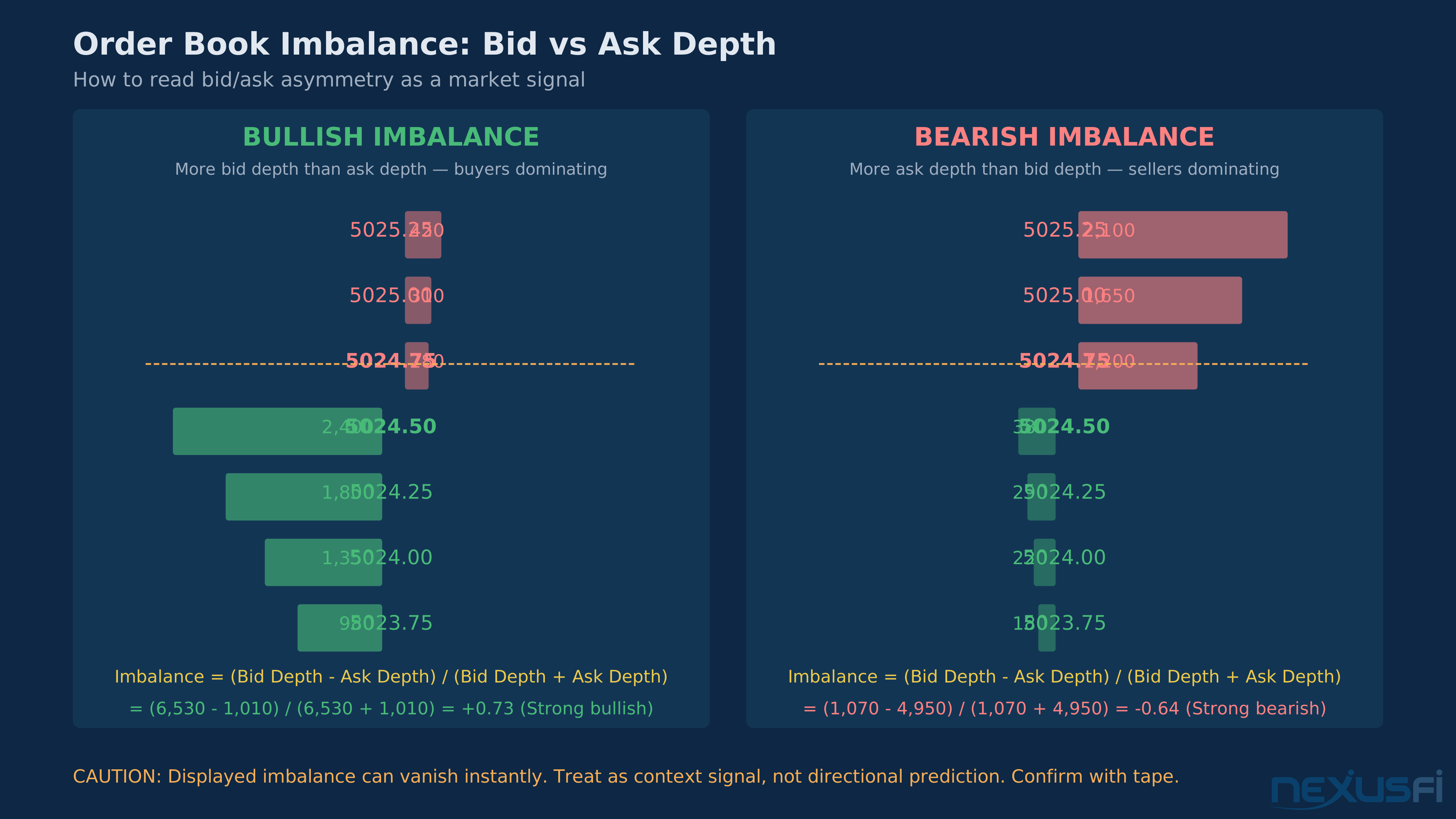
Order book imbalance is the most commonly extracted signal from DOM data. If there's more visible liquidity on the bid side than the ask side, that's bullish pressure. More ask-side depth than bid-side suggests selling interest.
The standard formula:
Imbalance = (Bid Depth - Ask Depth) / (Bid Depth + Ask Depth)
A value near +1 means overwhelming bid dominance. Near -1 means overwhelming ask dominance.
Variations include:
- Weighted imbalance: Levels closer to the touch carry more weight than levels far away
- Depth slope: How quickly depth builds away from the touch (gradual buildup vs a sudden wall)
- Delta imbalance: Not the current state, but the change in imbalance over a defined window
Where Imbalance Helps #
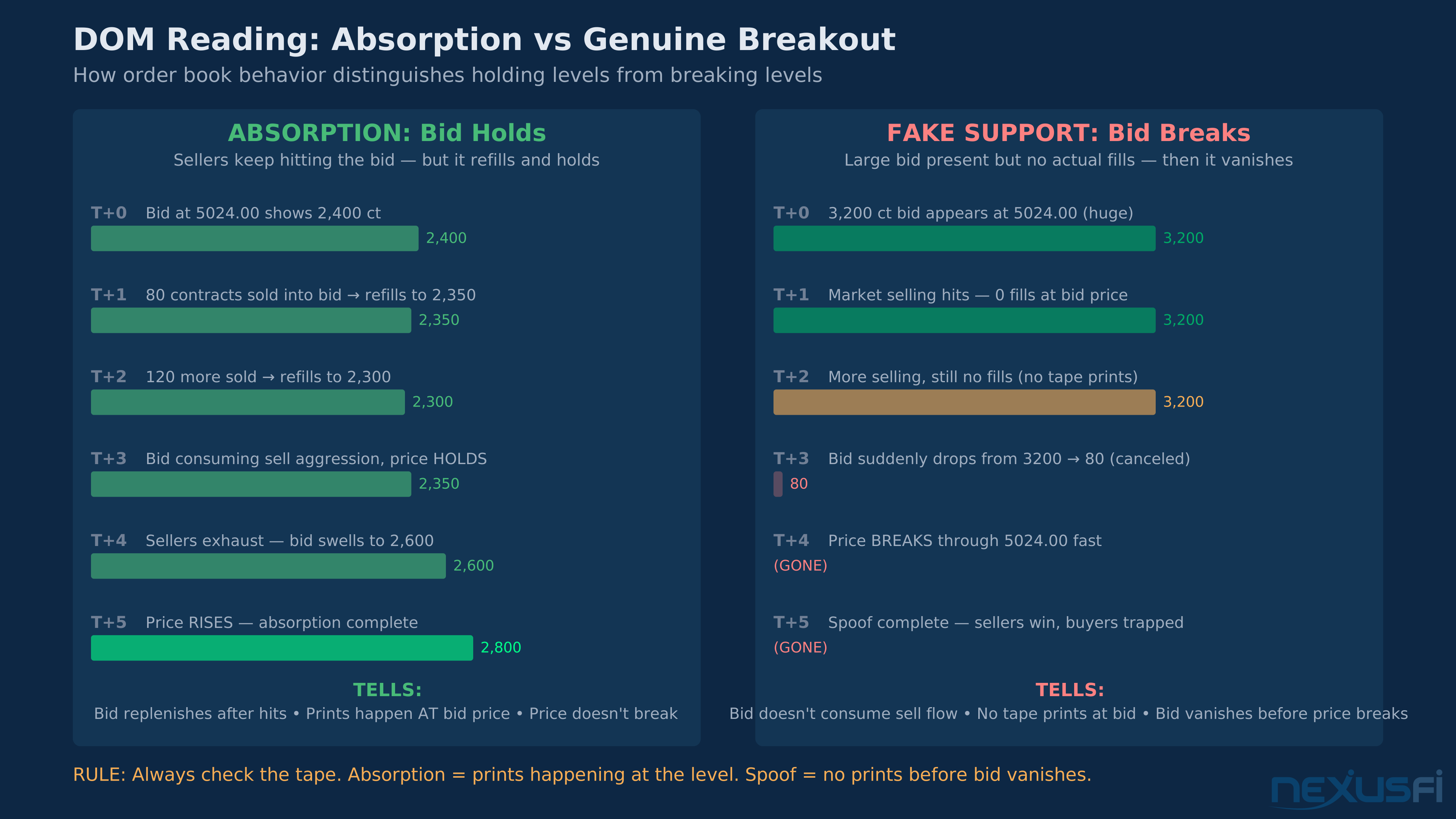
Absorption reads: If aggressive selling keeps hitting the bid but the bid refills rapidly and price doesn't drop, that's absorption. The sellers are meeting genuine demand. The DOM is showing it before price confirms it.
Breakout quality: A breakout through resistance where the ask-side starts disappearing and thin offers remain above often moves further and faster than one capped by constant offer replenishment.
Execution timing: Joining a deep bid queue at a key support level, when the book shows strong demand and the tape confirms buying, is different from joining a bid that looks like a ghost town.
Liquidity thinning events: Ahead of scheduled events (FOMC, NFP), the book often thins dramatically as participants pull liquidity. That structural change is visible in the DOM well before price moves.
Where Imbalance Fails #
Here's what most DOM beginners miss: displayed order book size is not real. It's intent declared through a limit order, but that intent can be revoked in milliseconds.
The dangerous mental model is: "big bid = support." A 2,000-contract bid at 5000.00 can vanish entirely in a single market data message. @Jigsaw Trading put it directly:
"Well, a lot of spoofing goes on and generally that involves stacking the order book on one side to fool people into trading in the other direction..."
-- @Jigsaw Trading, NexusFi: https://nexusfi.com/showthread.php?t=10820&p=120657#post120657
Beyond spoofing, even legitimate large traders pull and replace orders constantly — for inventory management, algorithmic repricing, risk-adjusted quoting. The result is that large visible size is often ephemeral.
The correct model: imbalance is a context signal, not a prediction. Use it to interpret what the book is doing, not to predict what it will do next.
Spoofing, Layering, and Manufactured Depth #
Spoofing is placing large limit orders without intent to trade, to influence others' behavior, then canceling before execution. It's illegal under Dodd-Frank and CFTC regulations, but it happens, and understanding what it looks like protects you from being manipulated by it.
What Spoofing Looks Like on the DOM #
Classic patterns:
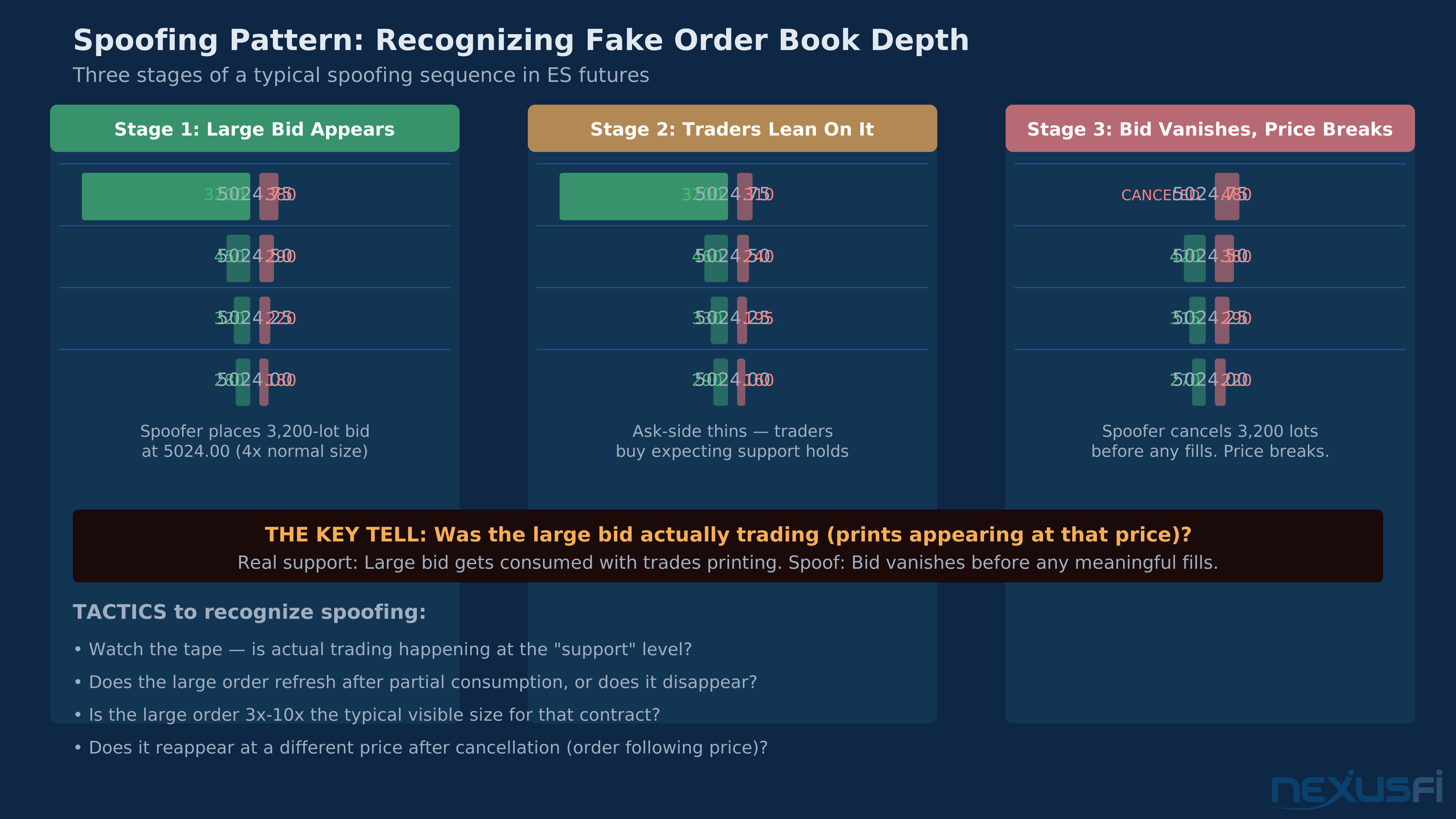
- A large order (often 5-20x typical size) appears at or near a price level
- Price doesn't move through it — other participants may lean on it, assume support/resistance
- As price approaches the large order, it vanishes — often in a single cancel message
- Price rips through the level that "should" have held
Layering is a related technique: placing multiple smaller orders at consecutive price levels to create the appearance of thick, stacked liquidity on one side.
@tpredictor made a useful observation:
"High frequency traders may also have strategies that are based on their position in the book. They may not be spoofing to fool other traders but they pull their orders when the resting depth below them drops below a certain threshold..."
-- @tpredictor, NexusFi: https://nexusfi.com/showthread.php?t=41383&p=620837#post620837
Not every large cancel is a spoof. Some of it is algorithmic risk management — a market maker reducing exposure when depth below them thins. @Jigsaw Trading defined flipping precisely:
"Spoofing is simply submitting limit orders that you will pull before they get filled. Flipping is a process of spoofing one side of the market and then flipping to the other side..."
-- @Jigsaw Trading, NexusFi: https://nexusfi.com/showthread.php?t=25797&p=300729#post300729
What to Do With This #
Watch for confirmation: is the size actually being traded, or just being displayed?
Real support: Price reaches a large bid, the large bid holds as size gets consumed (trades print), price then bounces
Fake support (potential spoof): Price approaches a large bid, the large bid disappears before any meaningful trades print at that price, price drops
The tape (time and sales) tells you which is happening. DOM shows you what's resting, tape shows you what's actually trading.
Exchange Differences: Why CME, ICE, and Cboe DOM Trade Differently #
Not all order books behave the same. The venue, the contract, and the participant base all shape how the DOM behaves.
CME (Chicago Mercantile Exchange) #
Home to the most actively traded futures contracts in the world: ES (E-mini S&P 500), NQ (E-mini Nasdaq-100), CL (crude oil), GC (gold), 6E (euro futures), ZB (30-year bond), ZN (10-year note).
CME's order books in flagship contracts are deep, fast, and highly electronic. The participant base is massive — institutional hedgers, prop trading firms, algorithmic market makers, and retail day traders all compete in the same pool. For DOM-based day trading, CME's major index futures are where most of the serious order flow trading happens.
ICE (Intercontinental Exchange) #
ICE handles energy contracts (WTI crude, natural gas, Brent crude), agricultural futures, and some financial products. The liquidity profile differs — some ICE energy contracts have deep books during active hours, but participation thins quickly outside US trading hours.
Traders migrating from CME-style DOM trading to ICE products often find the book dynamics less predictable — more susceptible to large moves from a single participant, more sensitive to localized news.
Cboe #
Cboe is primarily known for options and volatility products (VIX futures, SPX options). The participant base, liquidity profile, and typical order book behavior are calibrated to different instruments and trading styles. Don't assume CME-style DOM dynamics apply elsewhere.
@matthew28 noted the different dynamics in Eurex products:
"With futures if I want to buy I can tap in a limit order on the DOM to add to the order book queue..."
-- @matthew28, NexusFi: https://nexusfi.com/showthread.php?t=56022&p=823613#post823613
That basic queue mechanic is universal, but everything around it — typical depth, cancel rates, queue replenishment, institutional participation patterns — varies by contract.
Market Microstructure: How the Order Book Drives Price Discovery #
Price discovery isn't random. It's a process that happens through the interaction of orders in the book.
The Basic Mechanism #
Price rises when aggressive buyers exhaust available ask-side liquidity at the current level. If 1,000 contracts are offered at 5000.50 and 1,200 contracts worth of market buy orders hit that level, 200 contracts trade through to 5000.75. That's price discovery — the market finding where supply actually exists.
Resiliency #
Resiliency is how quickly liquidity returns after being consumed. A highly resilient book — where market makers immediately replace consumed liquidity — is harder to move directionally. You need sustained aggression.
In liquid CME contracts like the ES, resiliency is extremely high during normal conditions. A 200-contract lift of the offer is immediately replaced. But during major events, resiliency drops dramatically — market makers pull quotes, the book thins, and even moderate-sized orders move price much.
Microprice #
Microprice is a refinement of mid-price that accounts for queue sizes:
Microprice = (Ask Price × Bid Size + Bid Price × Ask Size) / (Bid Size + Ask Size)
When the bid has 1,000 contracts and the ask has 200, the market has more pressure at the bid. Microprice reflects this by weighting the mid toward the ask.
Queue Depletion Signals #
One of the most reliable DOM signals is not imbalance itself but queue depletion at the touch. When the inside offer drops from 800 contracts to 400 to 200 across multiple prints, and market buy orders are consistently lifting it, that's a picture of supply being exhausted.
@Jigsaw Trading's observation on this dynamic:
"...a LOT of trading is non-directional. You will often see the eMini S&P500 futures marching down but every 5 or 6 ticks there will be a big bid, where thousands of contracts will trade and yet the market continues lower..."
-- @Jigsaw Trading, NexusFi: https://nexusfi.com/showthread.php?t=40835&p=626780#post626780
That's the absorption pattern — large resting bids getting consumed without stopping the directional move. The DOM shows it happening in real time.
Practical Applications for Futures Day Traders #
Entry Timing at Key Levels #
You've identified support at 5000.00. Price comes back to test it. The DOM gives you additional information:
- Is there real depth at the bid? Is the bid replenishing as it gets hit?
- Are market sell orders consuming the bid and getting absorbed (prints happening at the bid price, price not breaking)?
- Or is the bid being pulled as price approaches (fake support)?
The entry on genuine absorption is different from the entry on a clean bounce without the book confirming demand. Getting this distinction right — through DOM and tape together — is how experienced traders time entries at levels that look identical on a bar chart.
Breakout Quality Assessment #
Not all breakouts are equal. A breakout where the ask-side depth was thinning in the bars before the break, market buy aggression was building, and the break happens on sustained buying — that's a different breakout than one where offer depth was thick and constant, and the break happened on a single large market order that immediately got filled from above.
The first scenario is a genuine supply/demand imbalance resolving. The second is a temporary sweep that often reverses. DOM and tape show you which is which.
Scalping and Queue Position #
For scalpers, order book data is fundamental rather than supplemental. The core scalping approach — taking liquidity at spreads, capturing 1-2 tick moves — requires queue position, imbalance confirmation, and fast exit timing.
@hyperscalper's discussion makes clear this is technically demanding:
"ANALYSIS requires some fast processing. Case in point, ES and some discussion of NQ futures. Just to give you a rough idea of how difficult Depth of Market Analysis can be, from an implementation standpoint..."
-- @hyperscalper, NexusFi: https://nexusfi.com/showthread.php?t=52641&p=817276#post817276
When to Ignore the DOM #
Major news releases (FOMC, NFP, CPI): In the seconds before and after major announcements, market makers pull their quotes entirely. The DOM goes thin or empty. Execution quality degrades sharply.
Thin contracts and off-hours: Using DOM signals on a contract with 50 contracts on the inside market has limited analytical value. The signals that work in deep, active markets don't generalize to thin ones.
@nirvikalpasamadhi's direct assessment:
"...a good but problematic tool to use, because the liquidity can be fake. I filter the market/stop orders on times and sales according to the volume the active market order match with the passive limit order side."
-- @nirvikalpasamadhi, NexusFi: https://nexusfi.com/showthread.php?t=41407&p=623995#post623995
"Problematic" is right if you treat DOM as a standalone signal. Used as one layer in a multi-signal read of the market, it's powerful.
Is 5 Levels of Depth Enough? #
A common practical question: does it matter if you're only getting the top 5 bid and ask levels?
@Jigsaw Trading addressed this directly:
"It's very complex but Futures does not give them the opportunities the stock markets do. Plus DOM traders aren't there for a tick, they should be going for bigger prizes, following the trading with some other..."
-- @Jigsaw Trading, NexusFi: https://nexusfi.com/showthread.php?t=58967&p=873153#post873153
For most absorption reads and entry timing, the top 5 levels is sufficient — the signals that matter most are near the touch. For deeper structural analysis (seeing where large stacks are sitting well away from price, identifying manufactured walls), more depth helps.
What you get with top 5 bid/ask levels:
- All the inside market information needed for entry timing
- Enough depth to see developing imbalances
- Adequate data for absorption/rejection reads at key levels
What you miss:
- Far-from-touch stacking (spoofing walls set up 10+ ticks away)
- The shape of the full depth profile
For scalping and intraday trading, 5-10 levels is workable. For deep research into order book structure, you want full depth.
Data Storage and Backtesting with Order Book Data #
The Data Volume Problem #
Order book data is enormous. A single active futures session generates millions of book update events. Storing this in a useful format requires decisions about:
- Raw event storage: Every add, cancel, trade with timestamp and sequence number. Most accurate but very large.
- Normalized snapshots: Point-in-time snapshots of the full book at regular intervals (e.g., every 100ms). More manageable, some temporal resolution lost.
- Pre-computed features: If you know what signals you're testing (e.g., imbalance over the top 5 levels, every 50ms), pre-compute those features. Orders of magnitude smaller.
Backtesting Realities #
Backtesting order book strategies naively produces unrealistically good results. The most common pitfalls:
Perfect fill assumption: If your backtest assumes you're immediately filled at any displayed price when your signal triggers, it's wrong. In reality, queue position, latency, and order routing all affect whether your limit order fills before price moves away.
Look-ahead bias in book state: Your strategy fires on the current book state. In live trading, there's latency between the book updating and your order reaching the exchange. In a backtest running on recorded data, this latency is invisible.
Cancellation model: If your strategy involves resting limit orders, the backtest needs a model for when those orders fill. A simplistic "fills at price" model will overestimate fill rates in busy queues.
Better backtesting approach:
- Use event-driven simulation, processing messages in sequence order, never looking ahead
- Implement a realistic latency model (even 10-50ms of assumed latency dramatically changes fill rates for scalping strategies)
- Use queue position estimation: if 400 contracts are resting at a price before your order arrives, assume those 400 fill before you do
- Test across multiple volatility regimes — what works in low-vol sideways markets often breaks down in high-vol trending ones
Providers for Historical Order Book Data #
- CME DataMine: Historical depth for all CME futures, direct from the exchange
- Rithmic: Historical tick and depth data for subscribers
- CQG: Similar historical data offerings
- TickData LLC: Third-party vendor covering multiple exchanges
How DOM Fits Into a Complete Market Read #
DOM alone is not a trading system.
The traders who use order book data effectively treat it as one layer in a multi-dimensional market read:
Price/session structure: Where is price relative to VWAP, prior day high/low, opening range?
Volume profile: Where is the Point of Control? Are we in a high-volume node or a low-volume node?
Delta/footprint: What's the running delta — cumulative net aggression from buyers vs sellers?
DOM/order book: What's the current liquidity structure? Is the book absorbing or rejecting?
Tape: What are the actual prints showing? Large prints on the bid or ask? Consistent aggression in one direction?
All five together give you a read that's substantially more reliable than any one in isolation. @bgtrader captured an interesting dimension of this:
"...kind of like a dangling worm on a hook and then the rest of the market jumps in and auto-trading systems get triggered..."
-- @bgtrader, NexusFi: https://nexusfi.com/showthread.php?t=2366&p=52541#post52541
The market's reflexive behavior — where visible large orders in the DOM trigger automated responses that then trigger more automated responses — is real. Understanding that dynamic means understanding how the DOM influences behavior, not just reflects it.
Common Mistakes and How to Avoid Them #
Treating large visible orders as real: The most common beginner mistake. "There are 3,000 contracts on the bid here, this is strong support." Always confirm with tape — is size actually trading at that price?
Using DOM as a standalone directional predictor: Imbalance, absorption reads, queue depletion — these are context signals. They tell you about current liquidity conditions. They don't predict where price will be in 5 minutes.
Applying CME equity index DOM logic to other contracts: A scalping approach built on ES/NQ DOM behavior probably needs significant adjustment before it works on crude oil, bond futures, or Eurex products.
Over-trading every DOM fluctuation: The book updates hundreds of times per second. Reacting to every tick of the imbalance gauge is reaction, not analysis.
Backtesting on "cleaned" data: Historical data cleaned by vendors may not match what you'd see live. Strategies optimized on clean data sometimes behave poorly with real feed messiness.
Bottom Line #
Order book data in futures is most valuable for understanding where liquidity sits, how it changes, who is aggressive, and whether price is being absorbed or rejected. It is least reliable when treated as a crystal ball.
The key principles: use DOM as a confirmation and timing tool, not a standalone direction predictor. Combine it with tape, volume profile, and session structure. Treat displayed size with skepticism — it can vanish in a single cancel event. Watch for whether large orders are actually trading or just appearing and disappearing. Understand that feed quality matters enormously, especially during fast markets.
For serious traders: learn Level 2 depth first, understand the feed mechanics, practice reading absorption and rejection at key levels, and always confirm what the DOM shows with what the tape is printing.
That's the game.
Knowledge Map
Go Deeper
Build on this knowledgeReferences This Article
Articles that build on this topicCitations
- — How I Day Trade and Micro Scalp the NASDAQ Futures; with Recommendations“I'm happy to discuss various methods of 'digging deeply' into the Market Depth. Of course everything you do will want to be as efficient as possible, since peak update rates for MNQ will be roughly...”
- — basic questions about futures“...huge variation in the sum of the ten levels shown in the order book. These are Depths of Market (DOMs) from the Jigsaw trading company so in the middle columns they show the volume that traded against the orders...”
- — Why does the market move towards the heavier side of the order book?“Well, a lot of spoofing goes on and generally that involves stacking the order book on one side to fool people into trading in the other direction...”
- — Is Spoofing alive and well?“High frequency traders may also have strategies that are based on their position in the book. They may not be spoofing to fool other traders but they pull their orders when the resting depth below them drops below a certain threshold...”
- — Flipping spoofing“Spoofing is simply submitting limit orders that you will pull before they get filled. Flipping is a process of spoofing one side of the market and then flipping to the other side...”
- — Eurex Products Advice - FDAX/FDXM/FESX“With futures if I want to buy I can tap in a limit order on the DOM to add to the order book queue...”
- — Market Depth Historical Graph“...a LOT of trading is non-directional. You will often see the eMini S&P500 futures marching down but every 5 or 6 ticks there will be a big bid, where thousands of contracts will trade and yet the market continues lower...”
- — Is Orderflow An Outdated Concept?“ANALYSIS requires some fast processing. Case in point, ES and some discussion of NQ futures. Just to give you a rough idea of how difficult Depth of Market Analysis can be, from an implementation standpoint...”
- — e-mini futures trading“...a good but problematic tool to use, because the liquidity can be fake. I filter the market/stop orders on times and sales according to the volume the active market order match with the passive limit order side.”
- — Is DOM worth using if I only have access to best 5 bid and ask levels?“It's very complex but Futures does not give them the opportunities the stock markets do. Plus DOM traders aren't there for a tick, they should be going for bigger prizes, following the trading with some other...”
- — DOM bands indicator“...kind of like a dangling worm on a hook and then the rest of the market jumps in and auto-trading systems get triggered...”