



TD Sequential and DeMark Indicators: The Exhaustion Countdown for Futures Trading
TD Sequential is one of those indicators that either clicks immediately or frustrates the hell out of you. Tom DeMark spent decades refining this methodology, and serious futures traders have studied it because it identifies something no simple moving average can: structural exhaustion. Not "the market is overbought" — actual countdown-to-exhaustion with defined cancellation rules, specific bar conditions, and price level validation.
Here's what makes TD Sequential different from every other indicator you've used: it doesn't smooth price. It counts. Nine consecutive closes lower than the close four bars prior tells you something meaningful about the commitment of sellers. Thirteen non-consecutive bars where closes reach new lows relative to two bars back? That's DeMark saying the fuel is almost gone.
This article covers the complete TD Sequential methodology — Price Flip, TD Setup, TDST Lines, TD Countdown, cancellation rules, and how to actually trade it on ES and NQ futures without getting wrecked by the parts every tutorial leaves out.
Overview #
Tom DeMark originally developed TD Sequential in the 1970s while working with commodity traders. The methodology was later refined and commercialized through DeMARK Analytics, with the core rules published in "The New Science of Technical Analysis" (1994) and Jason Perl's "DeMark Indicators" (2008) — which is the more accessible reference that NexusFi members have relied on.
The core premise: markets exhaust themselves through repetitive price behavior. When closes persistently trend in one direction relative to closes four bars prior (Setup phase), then reach extreme levels relative to two-bar-prior highs/lows (Countdown phase), exhaustion is signaled. The market has made its case — sellers have shown up for 9 straight bars, then the countdown confirmed 13 extreme bars. Now what?
TD Sequential doesn't tell you the market will reverse tomorrow. Unlike divergence signals that compare price action to indicator behavior. It tells you the structural conditions for exhaustion are present. That distinction matters enormously in futures trading, where you can be right about exhaustion and still get blown out if you take the position too early or size it wrong.
TD Sequential is a countdown, not a trigger. A completed Countdown signals that exhaustion conditions exist. Entry confirmation still requires price action — a bar failing to make a new low/high, a close reversal, or a break of the most recent significant swing level.
The system has three sequential phases:
- TD Price Flip — The prerequisite condition that starts counting
- TD Setup — Nine consecutive qualifying bars
- TD Countdown — Thirteen non-consecutive bars confirming exhaustion
Each phase has specific rules. Miss any rule and you don't have a valid signal — you have a partial count that means nothing.
TD Price Flip: The Starting Gun #
Before any Setup can begin, a Price Flip must occur. This is the simplest part of the system and the most ignored.
Buy Price Flip: The current bar's close is less than the close four bars prior. This follows at least one bar where the close was greater than or equal to the close four bars prior.
Sell Price Flip: The current bar's close is greater than the close four bars prior. This follows at least one bar where the close was less than or equal to the close four bars prior.
In plain English: a Price Flip is a reversal in the 4-bar momentum comparison. You need to see this flip before the Setup count starts at 1.
On ES futures, a Price Flip on the daily chart might look like: yesterday's close (5,847.25) was higher than the close four days prior (5,812.50), so that was a "higher" bar. Today's close (5,801.00) is lower than the close four days prior (5,812.50) — that's the flip. Buy Setup begins counting at 1.
Why four bars? DeMark's research across multiple instruments showed that the four-bar lookback captured the most statistically significant momentum comparison without over-fitting to specific market behavior. No deep statistical justification needed — don't spend time on theory — spend time understanding what the count tells you.
TD Setup: The Nine-Bar Foundation #
The Setup is where most traders start, and it's mechanically straightforward. The nuance is in what a completed Setup actually means.
Buy Setup Rules #
Starting from the Price Flip (bar 1):
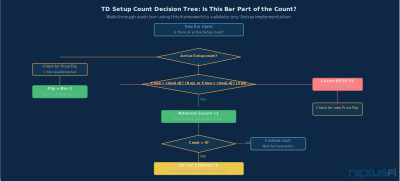
- Each consecutive bar must close below the close four bars prior
- The count resets to zero if any bar fails the condition
- A completed Buy Setup requires nine consecutive qualifying bars
- Numbers 1 through 9 print beneath each qualifying bar
That's it. Nine consecutive closes, each below the close 4 bars earlier. Miss one — literally one bar that closes higher than its 4-bar reference — and the count resets. Not to the close bar, back to zero. The next Price Flip starts a new Setup.
Sell Setup Rules #
The mirror: nine consecutive closes, each above the close four bars prior. Numbers print above each qualifying bar.
What a Completed Setup Actually Means #
A completed 9-count means sellers (Buy Setup) or buyers (Sell Setup) have shown sustained, directional commitment. In momentum trading terms across nine consecutive bars. This doesn't mean the market will reverse at bar 9. What it means:
- The market has entered a potential exhaustion zone — the sellers who pushed this lower have been active for nine straight bars of relative weakness
- Price levels created during the Setup become structural references (TDST Lines — covered next)
- The Countdown phase can now begin — the 13-bar exhaustion count starts with the bar after Setup completion
On ES daily charts, a Buy Setup that completes near a prior significant level (prior Monthly POC, major VWAP anchor, prior year's low) carries substantially more weight than a Setup completing in open air. Context doesn't change the count — but it changes how much you care about it.
Setup Perfection #
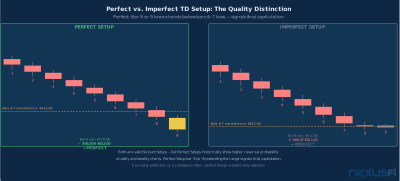
DeMark defined a "perfect" Setup that historically has higher reversal probability:
Perfect Buy Setup: The low of Setup bar 8 or 9 is lower than the lows of bars 6 and 7.
Perfect Sell Setup: The high of Setup bar 8 or 9 is higher than the highs of bars 6 and 7.
When Setup bar 8 or 9 extends beyond the prior bars' extremes, it suggests final capitulation or euphoria — the market stretched further than the prior bars to complete the count. NexusFi members who have spent time with DeMark note that perfect Setups tend to produce cleaner reversals, especially on daily and weekly timeframes.
Track whether your Setups are "perfect" — bar 8 or 9 low (Buy) or high (Sell) extending beyond bars 6 and 7. Perfect Setups warrant more attention. Imperfect Setups are still valid but historically less reliable as reversal signals.
![TD Buy Setup nine consecutive closes below close[-4], numbered 1-9, with TDST resistance 6752 and support 6571](/a/images/demark-td-buy-setup-9bar-count.svg)
TDST Lines: The Structural Levels Nobody Talks About #
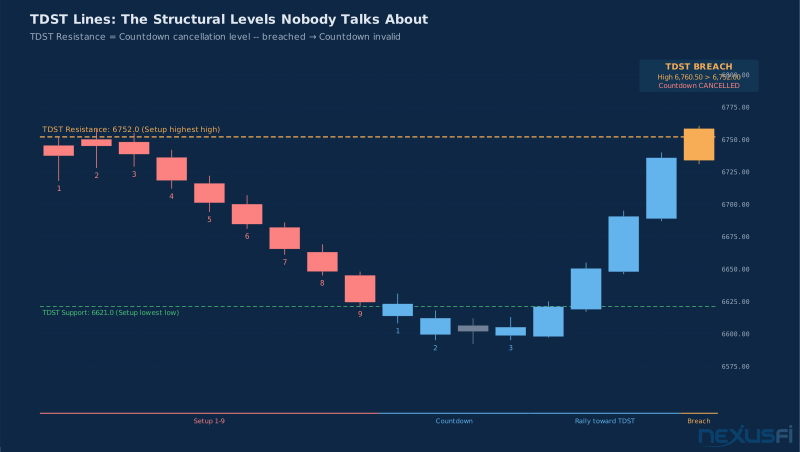
Every completed Setup creates two TDST (Tom DeMark Setup Trend) lines. These are among the most underappreciated elements of the entire system.
How TDST Lines Form #
For a completed Buy Setup (9 consecutive lower closes):
- TDST Resistance: The highest high of the entire 9-bar Buy Setup
- TDST Support: The lowest low of bars 1 through 9
For a completed Sell Setup (9 consecutive higher closes):
- TDST Support: The lowest low of the entire 9-bar Sell Setup
- TDST Resistance: The highest high of bars 1 through 9
The key TDST line for each Setup is the "defensive" one:
- Buy Setup's TDST Resistance: if price trades above this during Countdown, the Countdown is cancelled
- Sell Setup's TDST Support: if price trades below this during Countdown, the Countdown is cancelled
Why TDST Lines Matter #
These levels represent the price range of the entire exhaustion move. If price during Countdown violates the extreme of the Setup that generated it, the "exhaustion" interpretation fails — the market found fresh directional commitment rather than reaching a turning point.
On ES futures, a TDST Resistance level at 5,892.00 (from a completed Buy Setup) means: if the market, during the subsequent Countdown, trades above 5,892.00, the Countdown is cancelled. The bulls found enough buying at a price the Setup suggested was exhaustion — they won.
TDST lines often cluster with other reference levels (prior session highs, VWAP bands, volume profile nodes). When a TDST line aligns with these, it strengthens both as a reference level.
TD Countdown: The Thirteen-Bar Exhaustion Confirmation #
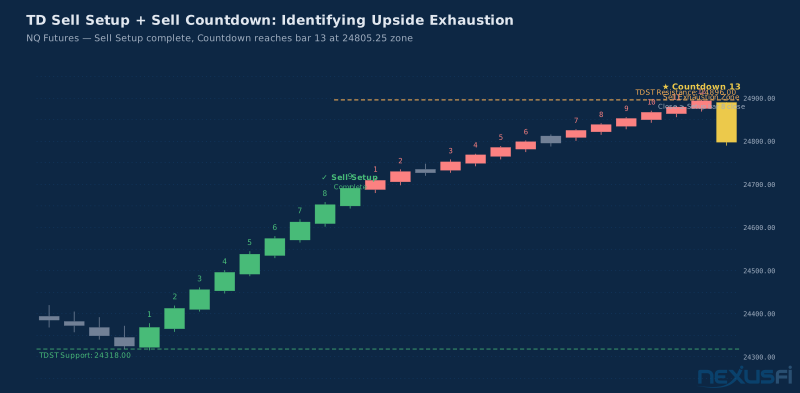
Countdown is where TD Sequential separates itself from simple oscillators. This is the phase that actually measures exhaustion — and it's non-consecutive, which creates far more flexibility than the Setup phase.
The Non-Consecutive Rule #
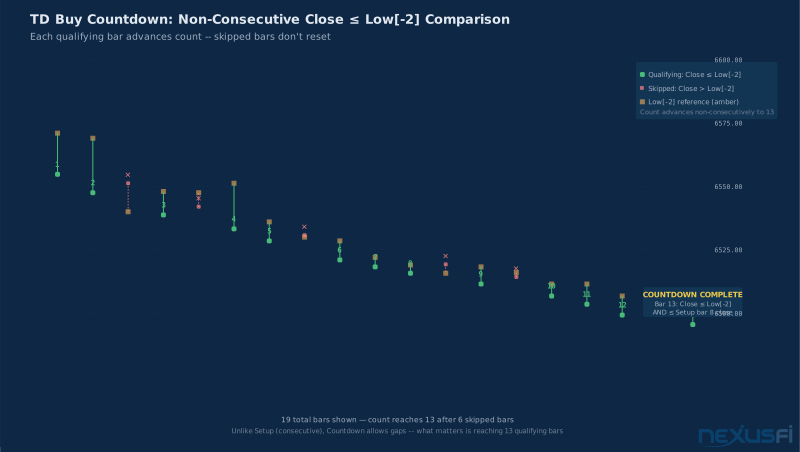
This is the most critical distinction between Setup and Countdown: Setup bars must be consecutive. Countdown bars do NOT.
For Countdown to progress, each qualifying bar adds one to the count. Non-qualifying bars are ignored — the count neither advances nor resets. This allows Countdown to proceed through consolidations, brief retracements, and false starts without invalidating.
Buy Countdown Rules #
Starting immediately after a completed Buy Setup (bar 9):
For each bar to qualify and advance the count:
- The bar's close must be ≤ the low two bars prior (close ≤ low[-2])
Count progresses from 1 toward 13. Non-qualifying bars are skipped. Count continues until:
- It reaches 13 (completion — exhaustion confirmed)
- It gets cancelled (see Cancellation Rules below)
Additional Condition for Bar 13: On the 13th qualifying bar, the close must be:
- ≤ the low of bar 8 of the Setup phase
If the 13th qualifying Countdown bar doesn't meet this condition, the count waits at 12 until a bar qualifies both the close ≤ low[-2] condition AND closes ≤ Setup bar 8's low.
Sell Countdown Rules #
The mirror:
- Each qualifying bar's close must be ≥ the high two bars prior (close ≥ high[-2])
- The 13th bar's close must be ≥ the high of Setup bar 8
What a Completed Countdown Means #
Thirteen qualifying bars (closes at extremes relative to two-bar-prior reference) represent deep exhaustion. The market has repeatedly demonstrated that closes are reaching extreme levels on a non-consecutive basis — the bears (Buy Countdown) keep returning to mark new lows on closes, but the pattern is becoming unsustainable.
Countdown completion does NOT guarantee immediate reversal. It signals:
- Structural exhaustion is confirmed — the selling pressure has been measured
- The risk/reward for counter-trend entries improves substantially
- The next test of the Countdown low becomes high-stakes — either it holds and launches a reversal, or it breaks and the model was wrong
On intraday timeframes (5-minute, 15-minute ES/NQ), Countdown completions generate significant noise. The system was designed for daily and weekly charts. On 15-minute charts, you're getting Countdowns that complete every few hours in trending markets. Use Countdown completions on sub-30-minute charts only as context, not as primary signals.
Countdown Cancellation Rules: The Rules Everyone Gets Wrong #
The cancellation rules are where most public implementations of TD Sequential fail. Even well-regarded platform implementations miss the complete set. @Fi confirmed on NexusFi that the ToS SequenceCounter "nails the basic 9-count Setup logic... but that's maybe 30% of what TD Sequential actually is."
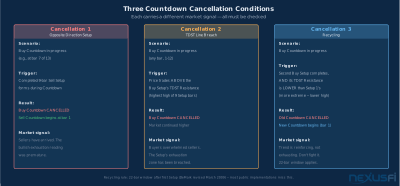
There are three cancellation conditions:
Cancellation 1: Opposite Direction Setup #
If a completed Setup in the opposite direction occurs while Countdown is in progress, the Countdown is cancelled.
Example: A Buy Setup completed (9-count lower closes), Countdown begins and reaches bar 7. Then a Sell Setup completes (9-count higher closes). The Buy Countdown at bar 7 is cancelled. A new Sell Countdown begins from scratch.
This makes intuitive sense — if the market has created a fully formed Setup in the other direction while you were counting down exhaustion, the original exhaustion reading is invalidated.
Cancellation 2: TDST Line Breach #
If price during Countdown trades through the TDST line of the Setup that generated it, the Countdown is cancelled.
For Buy Countdown: If price trades above the Buy Setup's TDST Resistance level (the highest high of the 9-bar Buy Setup), the Countdown is cancelled.
For Sell Countdown: If price trades below the Sell Setup's TDST Support level (the lowest low of the 9-bar Sell Setup), the Countdown is cancelled.
On ES daily charts, this frequently happens during choppy markets where a Setup forms in one direction but price quickly finds buying/selling to break through the Setup's range. When this happens, the exhaustion interpretation was wrong — the market had more directional fuel than the Setup suggested.
Cancellation 3: Recycling #
This rule is the most commonly missed. Recycling occurs when:
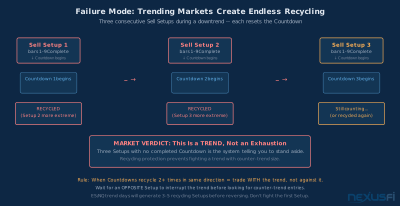
- A second Setup in the same direction completes before Countdown reaches 13
- AND the second Setup is more extreme (lower for Buy, higher for Sell) than the original
What "more extreme" means:
- For Buy Setups (lower closes): the second Setup's highest high (TDST Resistance) is lower than the first Setup's TDST Resistance
- For Sell Setups (higher closes): the second Setup's lowest low (TDST Support) is higher than the first Setup's TDST Support
When recycling occurs, the original Countdown is cancelled and a new Countdown begins from bar 1 based on the more extreme, newer Setup.
DeMark revised the recycling rule over time. @kaywai documented on NexusFi that as of March 2009, Tom DeMark changed the recycling trigger to 22 consecutive counts (previously 18). This means: if a second same-direction Setup completes within 22 bars of the first, and is more extreme, recycling occurs.
Recycling is the mechanism that prevents you from fighting strong trends. If the market keeps making new extreme Setups in the same direction, the Countdown keeps resetting. You're not getting an exhaustion signal — you're getting a structural trend that's compounding.
Trading TD Sequential on ES and NQ Futures #
Now that you understand the mechanics, here's how to actually use this on futures without blowing up.
Timeframe Selection #
TD Sequential was built for daily and weekly charts. On futures, daily charts work well for swing trading ES, NQ, CL, and GC. Weekly charts provide major structural signals — a weekly Countdown completion at a key price level is significant.
Intraday application:
- 60-minute ES/NQ: Usable. Generates 1-3 Setup completions per day in trending conditions. Countdown completions on 60-minute warrant attention.
- 30-minute: Borderline. High noise. Useful for context only.
- 15-minute and below: Not recommended for trading. Use as awareness only — "we're in countdown territory on 15-minute" is context, not a trade.
@KillerJukeBox on NexusFi noted using TD Sequential on 15-minute charts while entering on lower timeframes, which is a reasonable approach — let the structure exist on higher timeframes, execute on lower.
Trade Entry Logic #
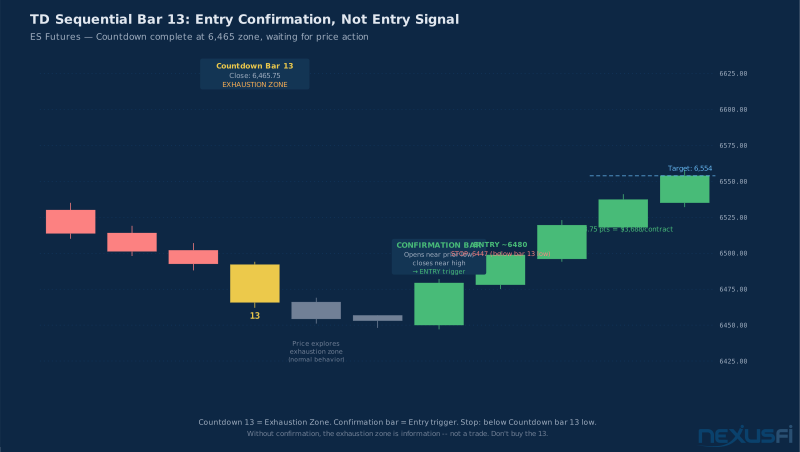
A completed Buy Countdown does NOT mean buy immediately. This is where most DeMark traders lose money. The signal says "exhaustion confirmed, look for reversal." Your job is to confirm the reversal is actually happening.
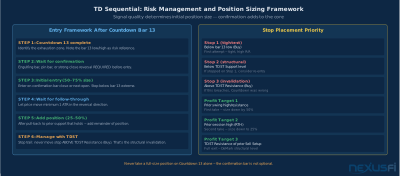
Entry framework after a completed Buy Countdown:
- Wait for a close reversal: A bar that opens below the Countdown low and closes above it (engulfing the prior bar's range on the close) is meaningful price action confirmation
- Look for volume spike: Capitulation on the final Countdown bar, followed by diminishing volume on the next bar, signals seller exhaustion is real
- Check the broader timeframe: A Buy Countdown on 60-minute that aligns with Daily chart support is far more powerful than a standalone 60-minute signal
- TDST line as stop reference: If you're long after a Buy Countdown, the TDST Resistance from the generating Setup is your risk level — if price trades above it, the Countdown was wrong
Entry Risk Management #
After a Buy Countdown completes:
- Initial stop: Below the Countdown's bar 13 low (the most recent extreme)
- Secondary stop: Below the Setup's TDST Support line
- Target: Prior swing high, prior VWAP anchor, or prior significant volume node
For Sell Countdown:
- Initial stop: Above Countdown bar 13 high
- Secondary stop: Above Setup TDST Resistance
- Target: Prior support structure
Position Sizing #
Because TD Sequential signals are structural (not precise), initial position sizing should be conservative — 50-75% of normal size on the initial entry. Add the remainder when price confirms with a break of the counter-trend move that follows the Countdown.
On NQ daily charts, a Sell Countdown completion might occur with NQ at 20,847.25. You'd short 50% of intended size, with stop at 21,200.00 (above TDST Resistance). If price sells off 200 points and retraces to 20,650.00 without making a new high, add the remaining 50% — you're now in with confirmation of the trend change.
Failure Modes and When TD Sequential Doesn't Work #
This is the section that makes the difference between a trader who uses DeMark well and one who loses money with it.
Trending Markets: The Recycling Trap #
In strong trends, TD Sequential will generate Setup after Setup in the trend direction. The Countdown keeps getting cancelled and recycled. You'll watch NQ complete a Sell Setup, start a Countdown that reaches bar 5, then another Sell Setup completes, recycles the Countdown, you're back to bar 1, rinse and repeat while NQ drops 1,500 points.
DeMark itself has a protection: if the market is recycling Countdowns repeatedly, that's the system telling you this is a trend, not an exhaustion. Step back and trade with the trend rather than fighting it.
@forgiven on NexusFi noted: "Even on a weekly chart the DeMark signals aren't that great, only a couple of nice reversals but mostly pullback signals that don't last very long." This is real and important — the system works at major structural turns, not at every short-term pullback.
News-Driven Moves #
A fundamental news event — Fed rate decision, unexpected NFP miss, geopolitical shock — can override any structural reading. If ES is on Buy Countdown bar 11 when the Fed surprises with a 50bp hike, expect the Countdown to get cancelled or produce a weak, short-lived reversal rather than a major turn.
Apply TD Sequential in the context of the fundamental calendar. Don't enter long on Countdown 13 the night before a major Fed decision when sentiment is already bearish.
Low-Volume Hours #
TD Sequential on the globex overnight session (outside 8:30-15:15 CT for ES/NQ) generates counts that lack institutional participation behind them. A Setup formed entirely in overnight low-volume trading has less weight than one formed during RTH. Ideally, Countdown bars should include significant volume — bars with above-average volume on the closing comparison are more meaningful.
The Timing Problem #
DeMark explicitly states that his indicators identify where exhaustion occurs, not precisely when the reversal begins. On daily charts, you might get a Countdown completion and then four more days of lower closes before the reversal. The system is telling you the zone — your execution is finding the entry within that zone.
Never interpret a completed Countdown as "the bottom is in." It's "the bottom is likely nearby." On ES daily charts, Countdown completions have historically been followed by 1-10 additional days of price exploration before the actual reversal. The position risk during this exploration period must be sized so.
The Implementation Gap #
@kaywai spent months documenting TD Sequential logic on NexusFi and noted that "recycling has since March 6, 2009 a 22 consecutive bar count (Tom Demark advised the change on Bloomberg)." Most public indicator implementations haven't kept up with DeMark's rule revisions. If you're using a free TD Sequential indicator, verify when it was last updated. The core Setup and Countdown logic is stable, but cancellation and recycling rules have evolved.
TD Sequential vs TD Combo: The Faster Signal #
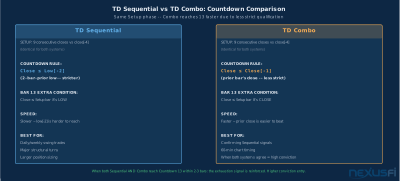
TD Combo is DeMark's accelerated version of the same exhaustion concept. While MACD measures momentum convergence/divergence, Combo measures close-to-close exhaustion velocity. The differences:
TD Combo Setup: Same as TD Sequential — nine consecutive closes with the 4-bar comparison. Identical Setup mechanics.
TD Combo Countdown: Different comparison. Each qualifying bar requires the close to be ≤ the prior day's close (Buy Combo) or ≥ the prior day's close (Sell Combo). Also counts to 13, non-consecutive, same cancellation rules.
Because the Combo Countdown compares against the prior close (not the 2-bar-prior low/high), it's more sensitive and generates signals faster. It reaches 13 before TD Sequential in most cases.
Traders use Combo for:
- Shorter-term swing trades where timing sensitivity matters
- Confirming TD Sequential signals (if both reach 13 within a few bars, the signal is reinforced)
- Faster signal in choppy markets where Sequential would cancel due to TDST breach
On ES 60-minute charts, having both TD Sequential and TD Combo reach Countdown 13 within 2-3 bars of each other is a high-conviction setup. The structural exhaustion message is being repeated through two different measurement systems.
TDST Lines as Standalone Levels #
Even traders who don't actively trade TD Sequential signals often mark TDST lines as reference levels. Here's why they're worth plotting regardless of whether you're using the full system:
TDST Resistance from a Buy Setup = the highest high of 9 bars that all closed lower than 4 bars prior. This represents the top of a defined selling campaign. Price returning to this level finds sellers who participated in the entire 9-bar move — they know this level.
On ES daily charts, TDST levels often align with:
- Prior weekly highs/lows (the Setup naturally anchors at prior week's extreme)
- Volume Profile nodes from previous sessions
- Previous month's opening range
When they don't align with other references, they still matter as independent structural levels. The TDST line is the only price level in technical analysis that's defined by a specific measured exhaustion process rather than a subjective support/resistance identification.
TDST lines are worth plotting even if you're not actively trading Countdown signals. They represent measured auction extremes — price levels where nine consecutive sessions confirmed directional exhaustion. These levels attract attention during subsequent price revisits.
Practical Application: ES Futures Daily Chart #
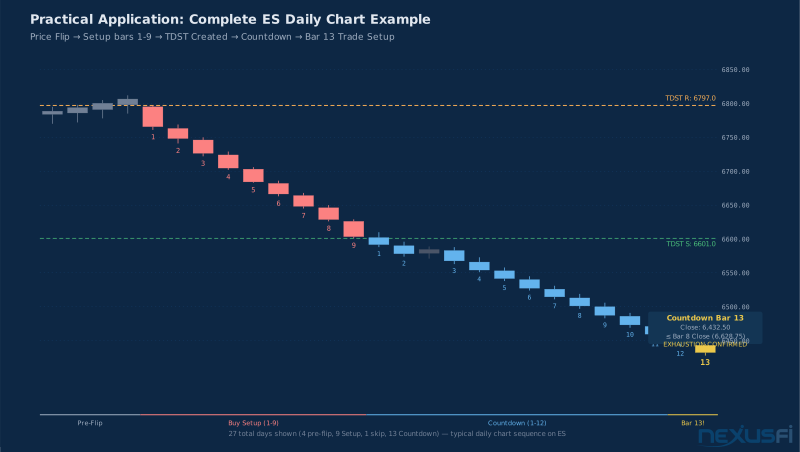
Let's walk through a concrete example with real structure — this is how the system works in practice on the ES daily chart.
Scenario: ES has been rallying for three weeks. Then:
Day 1: ES closes at 5,723.50. The close four days ago was 5,741.25. First close below the 4-day reference — this is bar 1 of a potential Buy Setup. Price Flip occurred on the day prior (close went from above to below the 4-bar reference).
Days 2-7: Each consecutive close is below the close four days prior. Bars 2 through 7 print below each bar. The Setup is progressing.
Day 8: Close at 5,674.25, which is 5,689.50's 4-bar reference. Bar 8 qualifies. Note: bar 8's low is 5,666.25.
Day 9: Close at 5,651.50, which is below the close four days prior (5,675.25). Bar 9 qualifies. The low is 5,643.00 — this is lower than bar 6 and 7's lows, so this is a "perfect" Setup. Buy Setup is complete.
TDST Lines created:
- TDST Resistance: highest high during the 9 bars = 5,738.75 (from bar 2)
- TDST Support: lowest low = 5,643.00 (bar 9)
Buy Countdown begins: Countdown bar 1 must close ≤ the low two bars prior.
The Countdown grinds through the next few weeks. Some bars qualify (closing below 2-bar-prior low), many don't. By Countdown bar 11, price has drifted to 5,598.00.
Day of Countdown bar 12: Close is 5,571.25. The low two bars prior was 5,591.00. 5,571.25 ≤ 5,591.00. Count advances to 12.
Day of Countdown bar 13: Must close ≤ the low two bars prior AND ≤ Setup bar 8's low (5,666.25). The close is 5,554.75. Two bars prior low was 5,572.50. 5,554.75 qualifies on both conditions. Countdown is complete.
Now what? Countdown 13 at 5,554.75 ES. The trading decision:
- TDST Resistance at 5,738.75 is the stop reference for any long position
- Wait for a close reversal — a day where ES opens near 5,554.75 and closes much higher
- Target: first meaningful resistance, which might be 5,640-5,660 zone (prior Setup lows, now potential resistance/support flip)
If ES makes another lower close after bar 13 — say 5,542.00 on the next day — you haven't been stopped out unless it trades above 5,738.75 (TDST breach). The Countdown is complete; the system gives you room for price discovery around the exhaustion zone.
Multi-Timeframe TD Sequential #
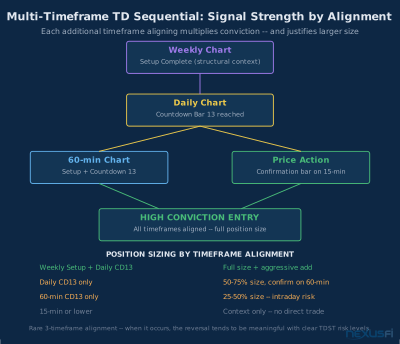
Professional use of TD Sequential involves reading the same instrument across multiple timeframes simultaneously — the same discipline covered in multi-timeframe analysis:
Daily Countdown 13 = Major structural exhaustion. Potential for multi-week rally (Buy) or decline (Sell).
60-minute Countdown 13 aligned with Daily Setup in progress = Near-term tactical exhaustion within a larger developing structure. Trade the 60-minute signal but manage it as a swing within the daily context.
60-minute Countdown 13 against the Daily Countdown direction = Counter-trend signal within a larger exhaustion move. Lower probability. Higher risk.
Highest probability structure: Weekly shows a completed Setup, Daily Countdown reaches 13 within that weekly Setup's directional move, and 60-minute confirms with a reversal bar. This three-timeframe alignment is rare — when it occurs, risk parameters at each TDST level are clear.
Platform Availability and Implementation Quality #
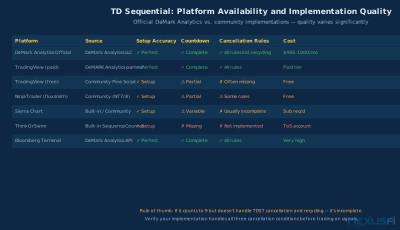
DeMark Analytics offers the official indicators via professional platforms at significant cost ($495-$1,000/month as @tigertrader noted on NexusFi). The official suite includes TD Sequential, TD Combo, TD Countdown, TDST Lines, TD Propulsion, TD Differential, and more.
Free/open-source implementations vary widely in accuracy:
- Most correctly implement the Setup 9-count
- The majority miss the precise Countdown comparison rules (some use close vs. low instead of close vs. low[-2])
- Cancellation rules are often simplified or absent
- Recycling rules post-March 2009 (22-bar threshold) are rarely updated
NinjaTrader hosts several community implementations of varying quality. @fluxsmith noted developing an ATS and indicator on NT7 after extensive backtesting. @kaywai spent months documenting the correct rules and coding an ~90% complete implementation.
TradingView's Pine Script community has multiple TD Sequential implementations; quality varies. DeMARK Analytics partnered with TradingView for official paid indicator access.
Jason Perl's book "DeMark Indicators" remains the most accessible authoritative reference for correct implementation rules. If you're coding your own or evaluating a public implementation, verify against Perl's specifications.
TD Sequential in Context: What It Is and What It Isn't #
After years of observing how traders use — and misuse — DeMark indicators, here's the honest assessment:
What TD Sequential does well:
- Identifies structural exhaustion zones on daily and weekly charts
- Creates objectively defined reference levels (TDST lines) that aren't subject to trader interpretation
- Provides a disciplined counting framework that removes discretionary "the market looks tired" thinking
- Works across all liquid futures markets (ES, NQ, CL, GC, ZB) with consistent rules
What TD Sequential does not do:
- Provide precise entry timing (the zone is defined; the entry timing is yours)
- Work as a standalone system on intraday charts below 60 minutes
- Survive fundamental shock events (news overrides structural counts)
- Eliminate the need for confluence with other analysis
Integrating TD Sequential with order flow and volume context produces better results than using it in isolation. A Buy Countdown 13 at a level where you also see heavy buying absorption in the order flow, bullish delta divergence, and a prior high-volume node — that's a trading signal worth taking with real size. A Countdown 13 in isolation on a clean chart with no other context gets smaller size and tighter stops.
The DeMark system's value is in its discipline. The counting rules prevent you from saying "the market looks exhausted" too early (you have to wait for the full count). The cancellation rules prevent you from fighting trends (recycle resets keep you out of counter-trend positions in trending markets). Use it as a framework for identifying exhaustion zones, not as a mechanical entry system.
Citations #
The content in this article draws on DeMark's published methodology and NexusFi community discussion spanning over a decade of practical implementation work.
Knowledge Map
Prerequisites
Understand these firstGo Deeper
Build on this knowledgeCitations
- — Demark Indicators part 1 - TD Setup (2009) 👍 5“For a TD Buy Setup, the close of the current bar must be lower than the close of 4 bars ago. A completed TD Buy Setup must have 9 consecutive closes, each one lower than the corresponding close 4 bars earlier.”
- — How can I get this counter to work properly - TD Sequential (2010) 👍 8“A countdown is only cancelled if i) a setup in the opposite direction is completed or ii) price bar trades below its tdst line or iii) recycling occurs. Under no other circumstances are countdowns cancelled.”
- — Demark Indicator (2014) 👍 4“It's $495 mo for the basic package and $1000 mo for DeMark Professional. They suggest reading Jason Perl's book and not Demark's books, and I wholeheartedly agree.”
- — KillerJukeBox's micro e-mini journal (2017) 👍 6“I do think there is a ton of value in Tom Demark's work when it comes to time analysis, so I do try to take TD Sequential and TD Countdown setups on 15min charts or above, but learning when to enter after a signal print takes some time.”
- — Eternal learners trading Journal (Demo) (2018) 👍 3“Its really not easy to code TD Sequential, even setup part took toll on me and I lost almost 2 weeks of time. I've developed my own version, but only setup count -- I'm not able to code countdown at the moment, its very complicated.”
- — T.D. Sequential (Tom Demark) For Think Or Swim TOS? (2025) 👍 2“The gap between close to correct and actually usable is massive with DeMark's system. The SequenceCounter nails the basic 9-count Setup logic but that's maybe 30% of what TD Sequential actually is. The biggest miss is the Countdown phase entirely.”
- Jason Perl, Bloomberg Press — DeMark Indicators (2008)
- — How can I get this counter to work properly - TD Sequential (2010) 👍 5“Recycling has since March 6, 2009 a 22 consecutive bar count (Tom Demark advised the change on Bloomberg). A countdown is not working if at best it can only do one sell countdown and one buy countdown.”
- — Demark Indicators part 1 - TD Setup (2013) 👍 3“I realize this is a very old thread, but it caught my eye as a method I could write an ATS for. I've done that and it backtests quite profitably, sim and live is next. I wrote the attached indicator after writing the ATS in order to verify its entries.”
- — How can I get this counter to work properly - TD Sequential (2010) 👍 4“I've set the point levels at 1, 2, 3, 5, 8, 13 and 21. My next step is TD Lines. I've a ~90% completed code for TD Sequential. The only things I can't figure out is how to cancel the TD Countdowns especially when I want a specific condition.”
- — Demark Indicators part 1 - TD Setup (2010) 👍 3“WRT your version, from what i see on the chart, your td setup is not consecutive (your green 1 is 6 bars away from your green 2). The sequential must be 9 consecutive bars -- that's the most critical rule.”
- Tom DeMark, John Wiley & Sons — The New Science of Technical Analysis (1994)