



Momentum Trading in Futures: Riding the Persistence of Price
Overview #
Momentum trading is the systematic exploitation of price persistence — the tendency of assets that have been moving in a direction to continue moving in that direction. In futures markets, where leverage amplifies both gains and losses, momentum is one of the most implementable systematic styles ever developed. As @tigertrader observes, markets trend roughly 20% of the time — the other 80% they're range-bound with little serial correlation. [1]
The core insight is simple: markets don't move randomly. Prices exhibit serial correlation — autocorrelation — driven by the structural behavior of market participants. Institutional rebalancing, hedging mandates, CTA trend-following programs, and the reflexive feedback loops of stop-loss cascades all create trends that persist longer than pure randomness would predict.
Momentum trading is mechanized participation in these trends, not prediction. You're not forecasting where price will go. You're systematically joining movements that are already underway, with rules for when to add, when to hold, and when to cut.
The futures market is especially fertile ground for momentum strategies. Unlike equities, futures provide direct exposure to macro-driven themes — interest rate policy, commodity supply/demand cycles, FX regime shifts — that naturally produce extended directional movements. Liquidity is centralized and transparent. Execution is clean. And futures enable genuine portfolio diversification across markets that often trend independently.
But momentum is fragile. Its edge evaporates in choppy, mean-reverting conditions. Drawdowns during regime transitions can be severe. And the strategy's inherent turnover makes transaction costs the primary performance drag in live trading. Understanding when momentum works and when it fails is as important as understanding the strategy itself.
Key Concepts #
Time-Series Momentum (TSMOM) — The most common form of futures momentum. You analyze each market's own price history — if it's gone up over the lookback window, you go long, if it's gone down, you go short. No comparison between markets needed, just the asset's own return trend.
Cross-Sectional Momentum (XSMOM) — Ranking assets by relative performance against each other. Long the strongest performers, short the weakest. More common in multi-asset hedge fund contexts. Requires a balanced, representative universe to avoid unintended sector tilts.
Lookback Window — The historical period you analyze for trend direction. Short-term (5-20 days) captures recent momentum and reacts quickly. Medium-term (20-60 days) filters noise while staying relevant. Long-term (60-130+ days) tracks macro trends that can persist for months. Each horizon has different return profiles and failure modes.
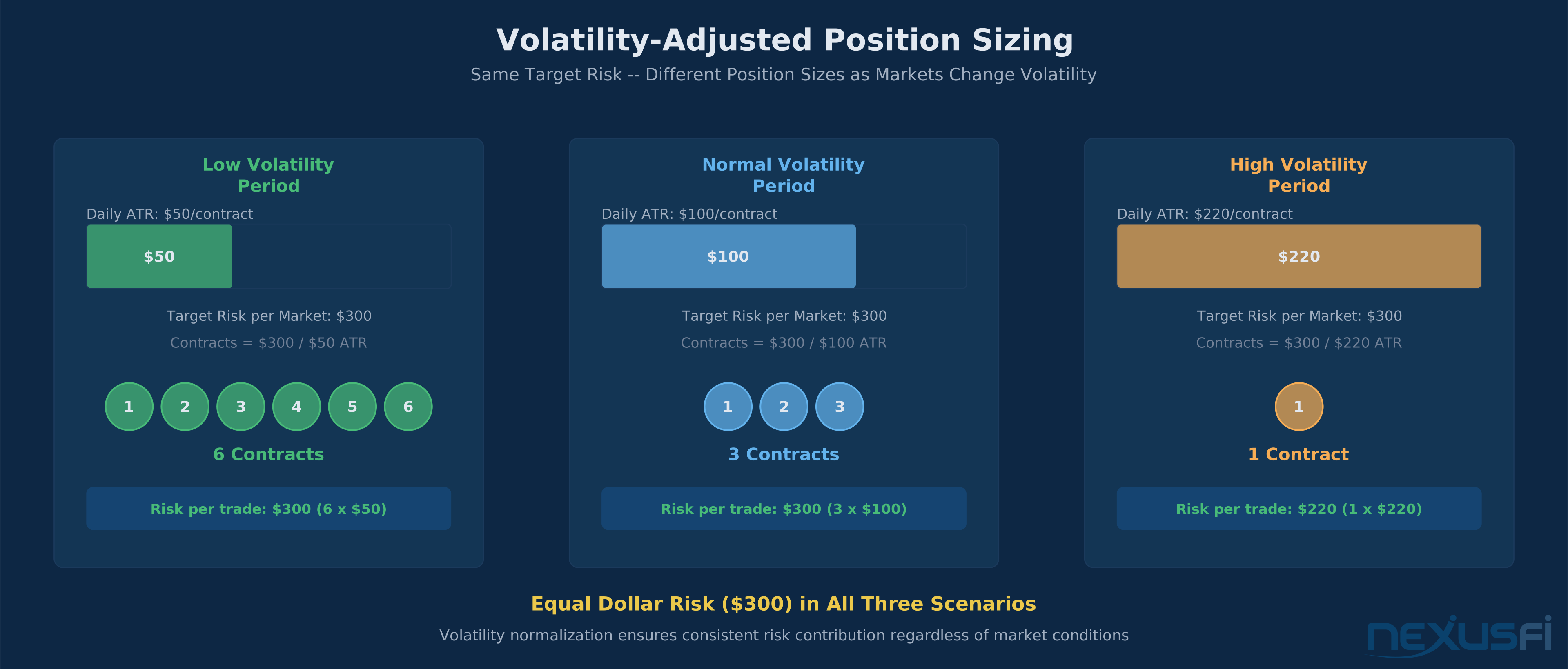
Volatility Normalization — Scaling position size by the inverse of market volatility so every position targets equal risk contribution. Without this, volatile markets (natural gas, VIX futures) dominate the portfolio and overwhelm signals from stable instruments (treasury bonds, equity index futures).
ATR (Average True Range) — The primary tool for measuring recent volatility. A 14-period ATR on daily bars gives a solid baseline for both position sizing and stop placement.
Regime — The market's current behavioral state. Trending regime: autocorrelation is positive, momentum strategies work. Choppy/mean-reverting regime: autocorrelation is negative, momentum strategies get whipsawed and lose money. Identifying regime correctly is the highest-value capability a momentum trader can develop.
Roll Yield — The gain or loss from rolling futures contracts forward as they approach expiration. Markets in backwardation (futures price below spot) generate positive roll yield for longs. Markets in contango generate negative roll yield. Roll mechanics create apparent trend signals that are actually just structural carry — a major source of backtest contamination.
VRP (Volatility Risk Premium) — The spread between implied volatility (what options markets expect) and realized volatility (what actually happened). When VRP compresses — implied and realized converge — momentum signals tend to degrade. Monitoring VRP provides an early warning of regime shifts before they become visible in price.
Fractional Kelly Sizing — The Kelly Criterion gives the theoretically optimal bet size to maximize long-run geometric growth. In practice, traders use a fraction of Kelly (often half) because the formula's assumptions about known probabilities don't hold in live markets. Fractional Kelly still targets growth while controlling ruin probability.
Gap Risk — The risk of large adverse price moves that occur when markets are closed, bypassing stop-loss orders entirely. Common in commodity futures on geopolitical events, agricultural markets on weather data, and equity index futures on overnight developments. Gap risk is why fixed-dollar stops are dangerous — you can lose multiples of your intended risk in a single event.
Quantitative Momentum Framework #
The mathematical foundation of futures momentum strategies is more compact than the strategy complexity suggests.
Base Signal (Time-Series Momentum)
The standard TSMOM signal measures the sign and magnitude of past returns over a lookback horizon:
For a single lookback horizon h, the raw signal is:
Signal = r(t-h, t) — the asset's return from h periods ago to today
For a position direction, the sign of this signal determines long/short. For a sized position, the magnitude determines confidence level. Most production systems use a multi-horizon ensemble:
Signal(t) = sum over horizons { w(i) * r(t-i, t) }
Where weights w(i) can be equal across horizons, exponentially decayed (recent windows weighted more), or empirically optimized (though optimization invites overfitting).
Volatility-Adjusted Position Sizing
Raw signals don't translate to positions directly. The volatility-normalized position formula:
Position = (Signal / Estimated_Vol) VolTarget AccountSize / ContractSize
Where:
- Signal is the multi-horizon composite (normalized -1 to +1)
- Estimated_Vol is EWMA or rolling ATR of daily returns
- VolTarget is your desired annualized portfolio volatility (typically 10-20%)
- AccountSize and ContractSize handle the dollar conversion
This ensures that a 100-point trend in S&P futures and a $2/barrel trend in crude oil both generate positions with equivalent risk contribution, despite the very different absolute magnitudes.
Multi-Horizon Ensemble Design
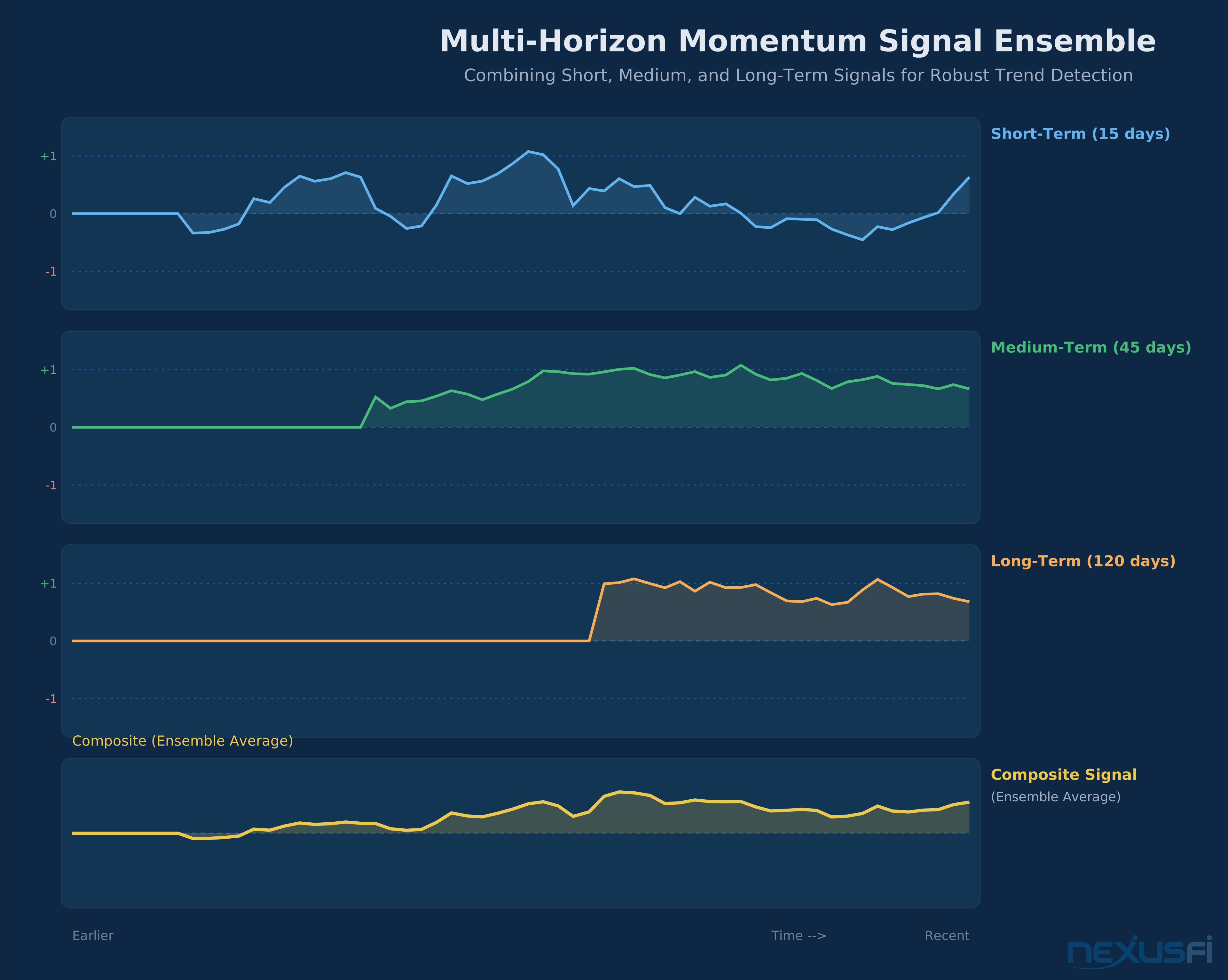
Combining three lookback windows captures different trend types:
Short (5-20 days): Fast-moving tactical momentum. High sensitivity, high turnover, captures quick breaks but generates whipsaw in choppy conditions. Best for liquid, actively-traded contracts.
Medium (20-60 days): The workhorse horizon for most CTA-style systems. Enough lag to filter intraday noise, enough sensitivity to catch most meaningful trends within a quarter.
Long (60-130+ days): Macro trend signals. Low turnover, major directional biases. Misses quick reversals but stays positioned through multi-month campaigns. Especially valuable in commodity and FX futures.
Ensemble weighting: equal weighting across three horizons is a strong default. Empirical optimization of weights produces marginally better in-sample results and meaningfully worse out-of-sample performance. The overfitting is almost always not worth it.
Signal Smoothing and Turnover Control
Raw multi-horizon signals are still noisy. Two practical filters:
- Exponential moving average of the signal itself (not just the returns). A 3-5 day EMA of the composite signal removes day-to-day noise without material lag.
- Threshold filter: only trade when the expected move exceeds your estimated round-trip cost by at least 2x. Signals close to zero represent statistical uncertainty, not directional conviction. Cutting these positions reduces churn without material reduction in returns.
Signal Construction #
Practical signal construction for futures requires attention to several implementation details that don't show up in backtesting frameworks but matter substantially in live trading.
Roll-Adjusted Returns
Futures contracts expire. You need continuous price series to compute meaningful returns across contract rolls. The standard approach: back-adjustment using the spread between the old front month and the new front month at the time of roll. This creates an adjusted series where the roll itself doesn't create a spurious price jump.
The problem: roll-adjusted series calculate correct returns but create artificial price levels that diverge much from actual traded prices over multi-year data. Use adjusted returns for signal calculation, never for absolute price comparisons.
Volatility Estimation for Scaling
The choice of volatility estimator matters more than most practitioners acknowledge:
Simple 20-day rolling standard deviation: easy to implement, lags volatility regime shifts by 2-3 weeks.
EWMA (Exponentially Weighted Moving Average): faster response with lambda parameter controlling half-life. Lambda of 0.94 (daily) is the industry default from RiskMetrics. Better than simple rolling for momentum sizing.
Parkinson volatility estimator using daily high/low: captures intraday range and doesn't require close-to-close returns. Provides roughly 5x efficiency improvement over simple realized vol. Useful in markets with meaningful intraday range.
GARCH forecasts: theoretically superior but computationally intensive and fragile in production. Reserve for research, not real-time systems.
Practical recommendation: EWMA with lambda 0.94 for most futures. Add a floor of the 60-day realized vol to prevent position sizing blowups when short-term vol temporarily collapses.
Outlier Handling
Momentum returns have fat tails. Single-day extreme moves (flash crashes, limit-up/limit-down events) distort volatility estimates for weeks afterward. Two approaches:
Winsorize returns at 3-5 standard deviations before computing signals. Replaces extreme values with the threshold — doesn't remove the information but prevents it from dominating the volatility estimate for the next 20 periods.
Strong volatility measures (median absolute deviation rather than standard deviation). Naturally resistant to outliers. Harder to implement in real-time systems but worth the effort in commodities markets where circuit breakers are common.
Signal Construction Checklist
Before using any momentum signal in live trading:
- Are returns computed on roll-adjusted, continuous contracts?
- Does volatility estimation exclude or dampen extreme events?
- Is position sizing floored to prevent unrealistic leverage during low-vol periods?
- Is there a transaction cost buffer — are you trading signals that justify round-trip costs?
- Is the signal tested on out-of-sample data, not the same period used for parameter selection?
Regime Awareness #
Momentum works when markets trend. It fails when markets chop. This sounds obvious but has profound implications for position sizing, signal design, and drawdown management.
Why Momentum Fails in Choppy Markets
In a trending market, price at t+1 is more likely to continue the direction of price at t — positive autocorrelation. Your momentum signal is on the right side of the trade more often than not.
In a choppy market, price at t+1 is more likely to reverse from price at t — negative autocorrelation. Your momentum signal is consistently on the wrong side. You buy breakouts that fail. You short pullbacks that recover. Each signal costs you the spread plus slippage. The losses accumulate.
The signature of a choppy momentum loss: frequent small losses, rare winners, persistent drawdown that doesn't resolve quickly. Contrast with trending momentum: occasional large drawdowns followed by sharp recoveries.
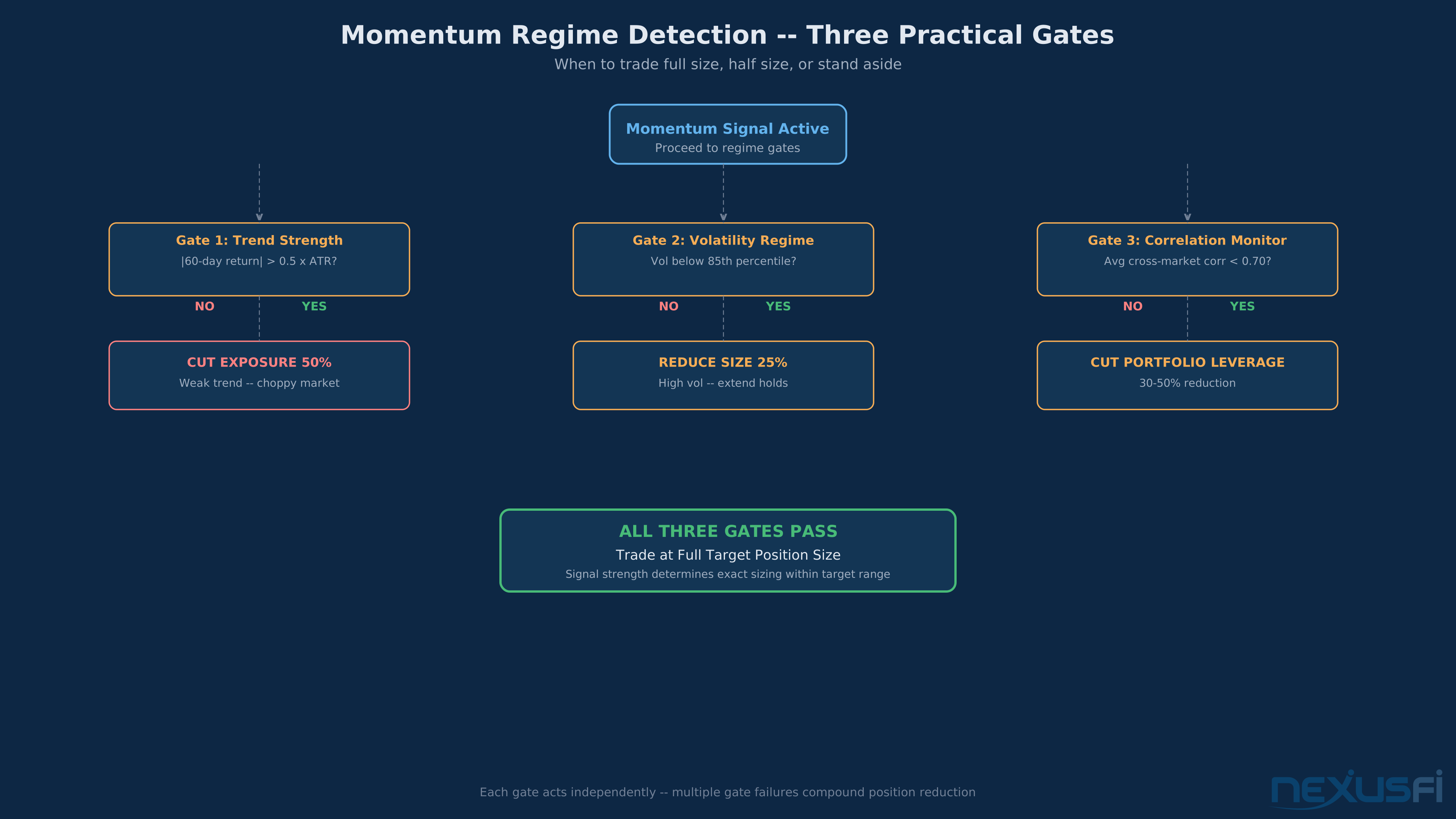
Three Practical Regime Indicators
Avoid complex regime classifiers. Hidden Markov Models and regime-switching regressions look spectacular in backtests and degrade badly out-of-sample. Three simple indicators work better in practice:
1. Trend Magnitude Gate
If the longer-horizon (60-day) cumulative return for a market is close to zero, that market is in a range. Cut exposure on that market by 50% or more. Reinstate when the longer-horizon trend reasserts.
Threshold: cut exposure when |60-day return| < 0.5 * (60-day ATR). This ratio measures trend strength normalized by recent volatility — a natural unit for comparison across markets.
2. Volatility Regime Gate
Calculate where current realized vol sits in its historical distribution. When vol is above the 85th percentile of its 2-year history, the market is in a stressed state. Extend holding periods, reduce aggressiveness on new entries, and prioritize exits over new positions.
When vol is above the 95th percentile, momentum signals frequently produce false breakouts as markets thrash between exhaustion and recovery. Material reduction in position sizing is warranted.
3. Cross-Asset Correlation Monitoring
During systemic shocks, correlations across futures markets converge toward 1.0. Your carefully diversified portfolio of 15 futures markets suddenly behaves like a single concentrated position. The diversification assumption that underpins your risk model has temporarily broken.
Monitor rolling 20-day correlation between your key markets. When average pairwise correlation exceeds 0.7 (historically rare in normal conditions), reduce portfolio leverage by 30-50%. This isn't about predicting the shock's direction — it's about recognizing that your risk model is temporarily unreliable.
Volatility Risk Premium as Leading Indicator
The spread between implied vol (from options markets) and realized vol is a subtle regime warning. When this spread compresses — when options traders are paying less premium above realized vol — it signals a market state where momentum signals tend to degrade before price data confirms the regime shift.
For equity index futures, monitor VIX versus 20-day realized vol on the S&P. For crude oil, use WTI options-implied vol vs realized. When implied and realized converge, tighten position sizing by 15-25% and raise entry thresholds.
Risk and Position Sizing #
Position sizing is where momentum strategy theory collides with account survival. The math is straightforward; the discipline to apply it consistently is not.
Volatility Targeting: The Core Framework
Target a fixed annualized volatility contribution from each market, then size positions so:
Contract Quantity = (AccountSize VolTarget weight) / (ATR * ContractValue)
For a $100,000 account targeting 15% annual vol with equal weighting across 10 markets (1.5% per market), using a market with daily ATR of $500 per contract:
Contract Quantity = (100,000 * 0.015) / 500 = 3 contracts
This approach ensures consistent risk contribution regardless of which markets are in the portfolio, adapts automatically as volatility changes, and prevents any single market from dominating portfolio performance.
Stop-Loss Placement
Fixed-dollar stops destroy accounts in futures. The market has no idea where your $1,000 stop is. It cares about levels of structural significance — previous highs and lows, value area boundaries, key moving averages.
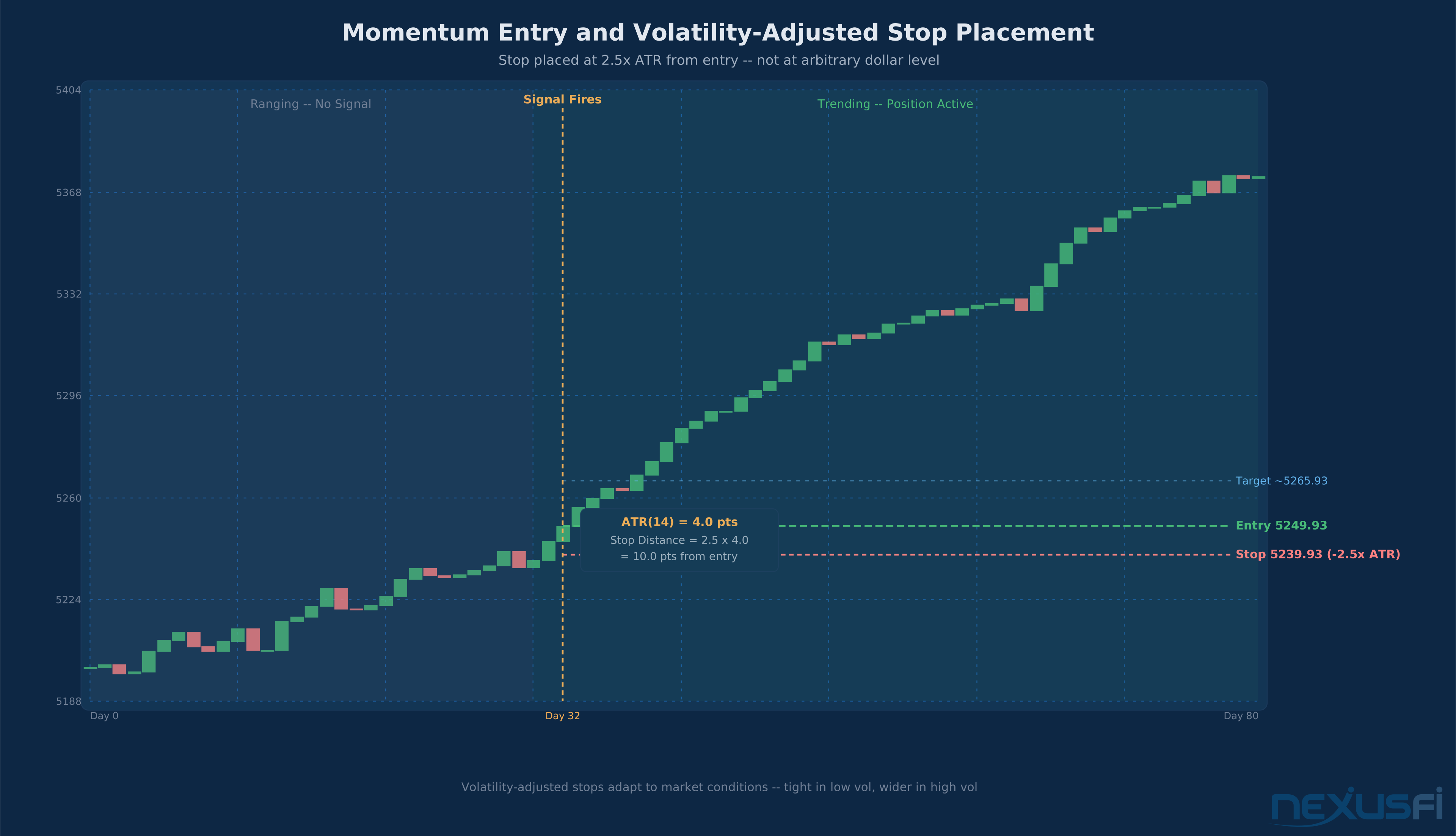
Volatility-adjusted stops are the only approach that makes sense mechanically:
Stop Distance = 2.0 - 2.5 * ATR(14) from entry
This ensures the stop is placed at a distance the market would need to make a statistically significant adverse move to reach. It scales automatically with market volatility, so the stop tightens when vol is low (less noise to absorb) and widens when vol is high (more noise to filter).
Portfolio Construction: Covariance Matters
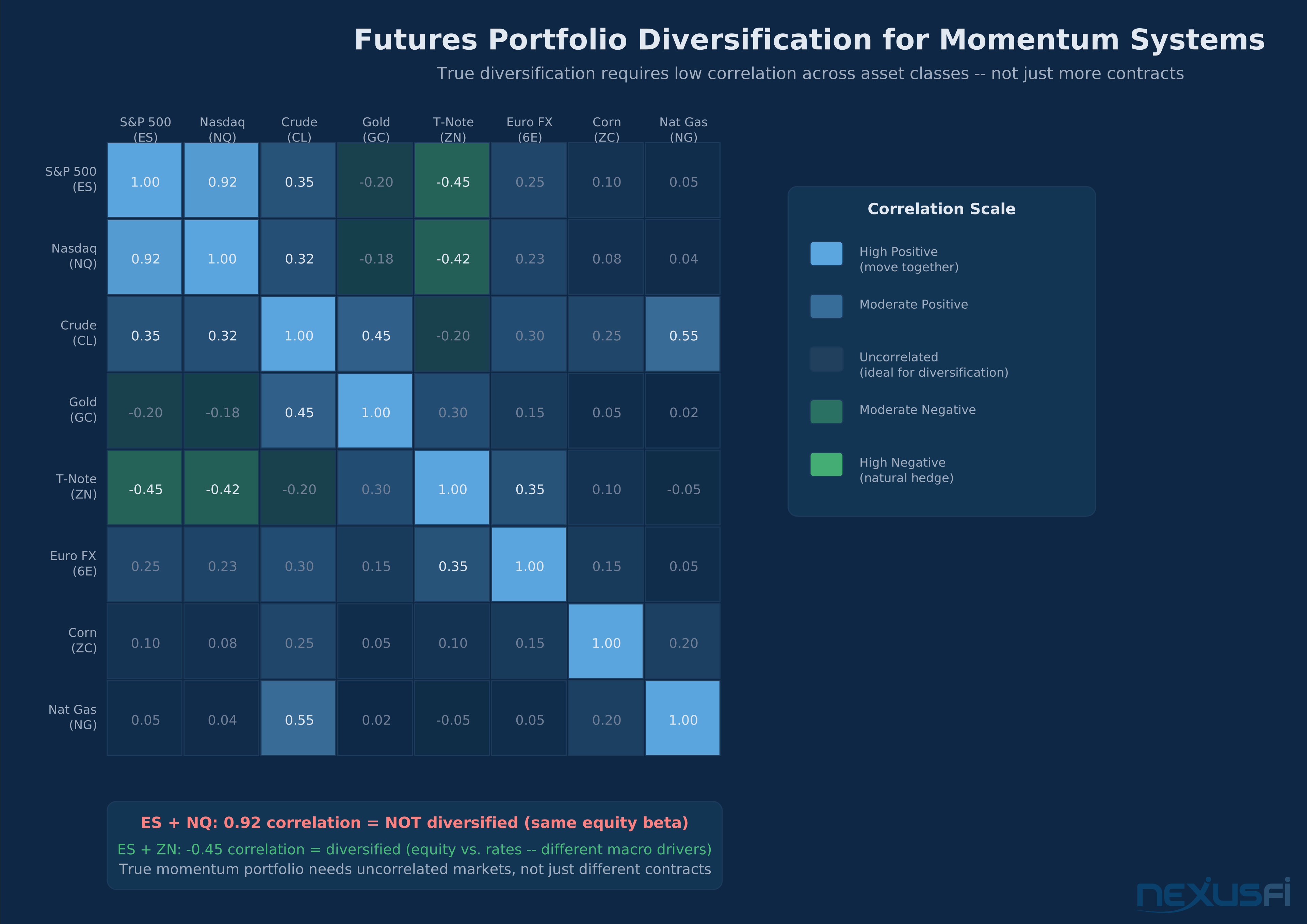
Running 10 momentum signals on uncorrelated markets is very different from running 10 signals on correlated markets. If your 10 futures contracts are all equity products (ES, NQ, YM, RTY, international equity index futures), your "diversified" portfolio is actually highly concentrated in equity beta.
Risk parity approach: weight each market so its volatility contribution to the portfolio is equal, then apply a covariance penalty for correlation. In practice:
Adjust position for correlated cluster: Position(i) / sqrt(avg_correlation_with_cluster_members)
For a highly correlated cluster (say, WTI crude, Brent crude, heating oil, gasoline), treat the cluster as one market for sizing purposes and split the single allocation across contracts.
Drawdown Management
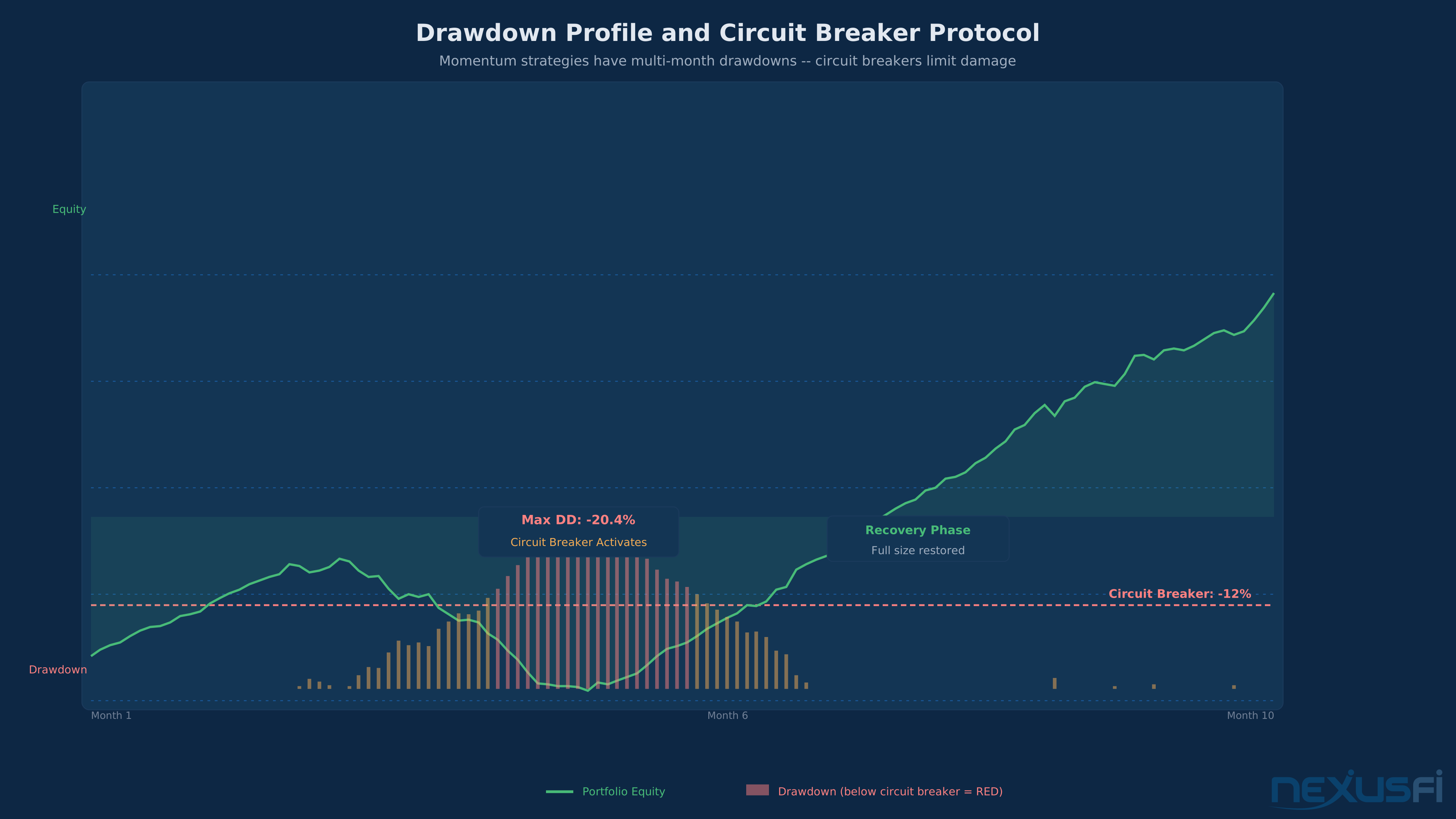
Momentum systems have multi-month drawdown periods that are structurally unavoidable — the strategy is wrong-footed during regime transitions and pays full cost during the adjustment. Experienced operators accept this. The risk is behavioral: drawdowns invite tinkering, which destroys the systematic edge.
Two mechanical drawdown controls:
Circuit breaker: If 60-day rolling portfolio drawdown exceeds X% (typically 2-3x expected monthly loss), cut all positions by 50%. Hold for 5-10 trading days, then gradually re-enter.
Equity curve filter: Calculate a 90-day moving average of your portfolio equity curve. When equity falls below this average, reduce position sizing by 25-50%. When equity recovers above the average, restore full sizing. This keeps you participating in trends while reducing damage during drawdown periods.
Gap Risk: The Hidden Killer
Momentum systems are typically net long or net short at end of day. Gap risk — adverse overnight moves — bypasses stop-loss orders entirely.
Management approaches:
- Limit overnight exposure per market (e.g., maximum 2% of account at risk overnight)
- Avoid holding large positions into known high-risk events (FOMC, USDA crop reports, geopolitical deadlines)
- Use options for tail protection on concentrated positions — a cheap out-of-the-money put on your largest long is inexpensive insurance against a -10% overnight move
- Fractional Kelly sizing naturally reduces ruin risk from gap events by keeping leverage modest
Execution and Trading Costs #
Transaction costs are the primary source of performance drag for momentum strategies. This isn't a minor detail — it's the difference between a 10% annual return and a 5% annual return.
Cost Components
Every round trip (entry + exit) in futures involves:
Commissions: $3-8 per contract round-trip depending on broker and volume. For a 10-contract ES position at $5 round-trip, that's $50 — small relative to a multi-point trend, but significant against a minor signal.
Spread cost: In liquid contracts (ES, CL, NQ), the bid-ask spread is typically 1 tick. In less liquid contracts (lean hogs, lumber, individual equity futures), spreads can be 2-5 ticks. At half a spread each way, this adds 0.5-2.5 ticks per trade.
Market impact: Large position entries and exits move the market against you. In ES, a 100-contract trade might create 0.5-1 tick of adverse impact. In smaller contracts, the impact per unit is higher. Impact scales roughly with sqrt(order_size / daily_volume).
Execution Strategy for Momentum Entries
Momentum signals aren't time-sensitive in the way scalping signals are. A trend that's been building for 20 days will still be valid if your entry is 0.5% worse than the theoretical price.
Use limit orders for position establishment. Place limits at or inside the current bid/offer depending on direction. If filling within 15-30 minutes isn't possible, accept a 1-2 tick slippage worst case and use a marketable limit order.
TWAP/VWAP algorithms for large positions: algorithmically splitting a 20-contract entry into 4 x 5-contract tranches over the first 30-45 minutes of the trading session provides meaningful impact reduction.
Avoid the first 10 minutes and last 15 minutes of regular trading hours for momentum entries. Spreads are widest, institutional algorithms are most active, and the price discovery is most volatile.
Rebalancing Frequency and Cost Management
The single most important cost control for momentum systems: reduce rebalancing frequency. Daily rebalancing of a 15-market momentum portfolio generates ~3-4x the turnover of weekly rebalancing, with minimal improvement in return.
Weekly rebalancing: reduce positions much only when signals flip direction or when volatility-adjusted sizing requires a major adjustment. This is the standard for institutional CTA programs.
Position increment trading: don't adjust every position on every signal. Only adjust when the required position change exceeds a minimum threshold (e.g., 0.25 contracts equivalent). Below-threshold adjustments cost more in execution than they gain in better signal adherence.
Cost-Adjusted Signal Testing
Before any momentum signal enters production, test it with realistic transaction costs included:
Use a slippage model: assume you pay half the daily ATR above the signal price for entries (in trending markets, you're often chasing). Use the same model for exits.
Test at multiple commission levels: if the strategy's Sharpe ratio drops below 0.5 at $10 round-trip commissions, it won't survive in live trading with real-world execution friction.
Calculate breakeven edge: the minimum per-trade expected profit needed to cover costs. Only trade signals that exceed this threshold by a margin of at least 2x.
Backtesting Methodology #
Momentum backtesting has a long history of producing spectacular results that fail in live trading. The failure modes are well-documented. Avoiding them is mechanical if you know what to check.
The Primary Failure Modes
Overfitting lookback parameters. Testing 50 combinations of lookback windows and selecting the best-performing set will always produce excellent in-sample results. The probability of this performance persisting out-of-sample is roughly the same as chance. Rule: commit to 3 lookback windows based on structural reasoning (short/medium/long), test them on 80% of data, validate on the reserved 20%. Don't revisit parameters after seeing validation results.
Ignoring roll costs. Continuous adjusted series don't include the cost of rolling positions from expiring to next-month contracts. For contango markets (most equity index and interest rate futures), this is a persistent drag. Quantify actual roll cost per market per year, subtract it from backtested returns.
Survivorship bias. If your futures universe is the current set of liquid contracts, you're missing markets that were delisted, went illiquid, or experienced structural breaks. The bias is smaller in futures than equities (fewer complete failures) but still material for long-term backtests.
Lookahead bias. Using a volatility estimate at time T that incorporates data that wouldn't have been available until T+1. Common error: using a daily close volatility to size the opening position on the same day.
Point-in-time data. Fundamental data (COT reports, USDA crop estimates) is frequently revised after initial release. Using revised data in backtests creates an edge that didn't exist historically.
Evaluation Metrics That Matter
Standard Sharpe ratio is a necessary but insufficient test. Add these:
Hit rate by regime: calculate win rate separately during trending periods and choppy periods. Expect >55% in trending, <45% in choppy. If win rate doesn't vary by regime, your strategy isn't actually momentum.
Return autocorrelation: run autocorrelation analysis on daily strategy returns. Positive autocorrelation means winning days predict winning days — this is momentum working. If autocorrelation is near zero, the strategy is pattern-matching noise.
Worst drawdown analysis: calculate drawdown at multiple time horizons (5, 10, 20 day windows). Compare to theoretical expectation. If worst historical drawdown is 50% above theoretical maximum, you have an unmodeled risk factor.
Cost sensitivity: run the full backtest at 0x, 1x, 2x, and 3x realistic cost assumptions. A strong strategy degrades gracefully. A marginal strategy collapses when costs double.
Structural Walk-Forward Testing
Train on the first 60% of your data. Test on the next 20%. If it works, combine (train on 80%), test on the final 20%. Never improve parameters after seeing any out-of-sample period. This is the only backtest regime that provides meaningful predictive validity.
Instrument-Specific Implementation #
Momentum behaves differently across futures asset classes. What works in equity index futures requires modification for energy, agricultural, and rates markets.
Equity Index Futures (ES, NQ, RTY, international)
The most liquid, most efficient momentum universe. Trends are macro-driven (earnings cycles, Fed policy, risk-on/risk-off rotations) and can persist for months. Roll yield is negative most of the time (contango). Medium to long-horizon signals (30-60+ days) work best. High daily volume makes execution impact minimal at typical trading sizes.
Watch: equity index futures trend together. A long ES / short NQ spread on momentum signals is genuinely diversified. Long ES / long NQ is just double equity exposure.
Energy Futures (CL, NG, HO, RB)
Macro supply/demand fundamentals drive multi-month trends. Natural gas is especially volatile — ATR-based sizing is essential here, otherwise gas will dominate any momentum portfolio. Roll yield varies dramatically: WTI crude has experienced both deep backwardation (positive carry for longs) and contango (negative carry). Model roll cost explicitly for energy markets.
Watch: geopolitical gap risk in crude. OPEC+ announcements, supply disruptions, and inventory data can produce 3-5% overnight gaps that bypass stops entirely. Size crude positions conservatively.
Agricultural Futures (ZC, ZS, ZW, KC, CT)
Seasonal patterns interact with momentum signals in ways that are structurally different from other asset classes. Crop report releases (USDA WASDE) can reverse month-long trends in hours. Consider reduced position sizing or systematic exits before major reports.
Roll yield is significant and meaningful for signal calculation. A continuous contract showing a 10% uptrend over 60 days might be 7% price and 3% roll — the signal is partially spurious. Explicitly model and subtract carry before computing momentum signals.
Interest Rate Futures (ZN, ZB, GE/SOFR, Eurodollar)
Macro-driven with very high sensitivity to central bank policy regime. Long-horizon momentum (60-130 day) works well in sustained rate environments. The signal quality degrades severely around major policy inflection points (Fed pivot cycles).
Roll yield is meaningful and varies with the yield curve shape. Flat/inverted yield curves reduce roll drag. Steep curves increase it. Model explicitly.
Very low ATR relative to notional value means volatility-based sizing requires large position counts. Be careful about position concentration in rates.
Currencies (6E, 6J, 6B, etc.)
Macro trending behavior over months, but sensitive to intervention risk (central bank FX intervention). The longer the trend, the higher the intervention probability for extreme movers. Consider a soft drawdown limit at which you take partial profits on large currency trends.
Practical Application #
Moving from theory to a functional momentum system requires integrating the components above into a systematic workflow.
The Starter Blueprint
This is the consensus production framework from systematic research and practitioner experience. It's not optimized, it's not clever, and it's not exciting. That's the point.
- Universe: Select 10-20 futures markets across different asset classes (equity index, energy, rates, FX, metals, agriculture). Confirm each has at minimum 2-3 years of reliable continuous price data and average daily volume sufficient for your position sizes.
- Data: Obtain clean, roll-adjusted continuous price series. Document the roll methodology (most data vendors default to nearest contract roll at first notice day). Verify continuity across historical contract changes.
- Signal: Compute time-series momentum signals at three horizons (15, 45, 120 trading days). Normalize each by its rolling EWMA volatility. Average the three normalized signals. Apply a 3-day EMA to smooth.
- Sizing: For each market, compute daily ATR(14). Target 1.5% annual volatility contribution per market (distributes equally for a 10-market portfolio targeting 15% total vol). Apply signal direction and magnitude to determine position size. Round to whole contracts. Apply minimum position threshold (don't hold fractional contracts).
- Regime gates: For each market, check trend magnitude gate (60-day return vs. vol). For the portfolio, check average cross-correlation. Apply 50% position reduction when either gate triggers.
- Rebalance: Weekly, every Friday close. Calculate target positions for all markets. Identify position changes exceeding 0.5-contract threshold. Execute changes Monday open using limit orders.
- Risk monitoring: Track 60-day rolling portfolio drawdown. At 2x expected monthly loss threshold, activate circuit breaker protocol (50% position reduction, 5-trading-day hold).
- Review: Monthly review of per-market performance, regime classification accuracy, and actual vs. expected transaction costs. Quarterly review of signal validity using out-of-sample data. Annual review of universe composition.
Common Failure Patterns to Avoid
The biggest mistakes are behavioral, not quantitative.
Overriding signals because they "feel wrong." You built the system because you don't trust your in-the-moment judgment. Trust the system during drawdowns, or don't build systematic strategies.
Adding complexity during drawdowns. When a momentum system is losing, the instinct is to add filters, change parameters, add indicators. These modifications are almost always curve-fits to the current drawdown pattern that destroy out-of-sample performance. If the strategy logic still makes structural sense, the right answer is to wait.
Conflating short-term losses with strategy failure. A momentum system with a 1.0 Sharpe ratio will still have periods of 3-4 months of drawdown. This is not failure — it's the statistical profile of the strategy. Knowing the expected drawdown duration and magnitude in advance is the only real psychological protection against abandoning a working strategy at exactly the wrong moment.
Underestimating costs. Paper trade for 3 months with realistic slippage before going live. Most traders consistently underestimate the friction of getting in and out of positions. If live costs exceed your backtest assumptions by more than 25%, investigate execution before changing the strategy.
Performance Expectations
Historical momentum performance across asset classes (based on documented CTA research):
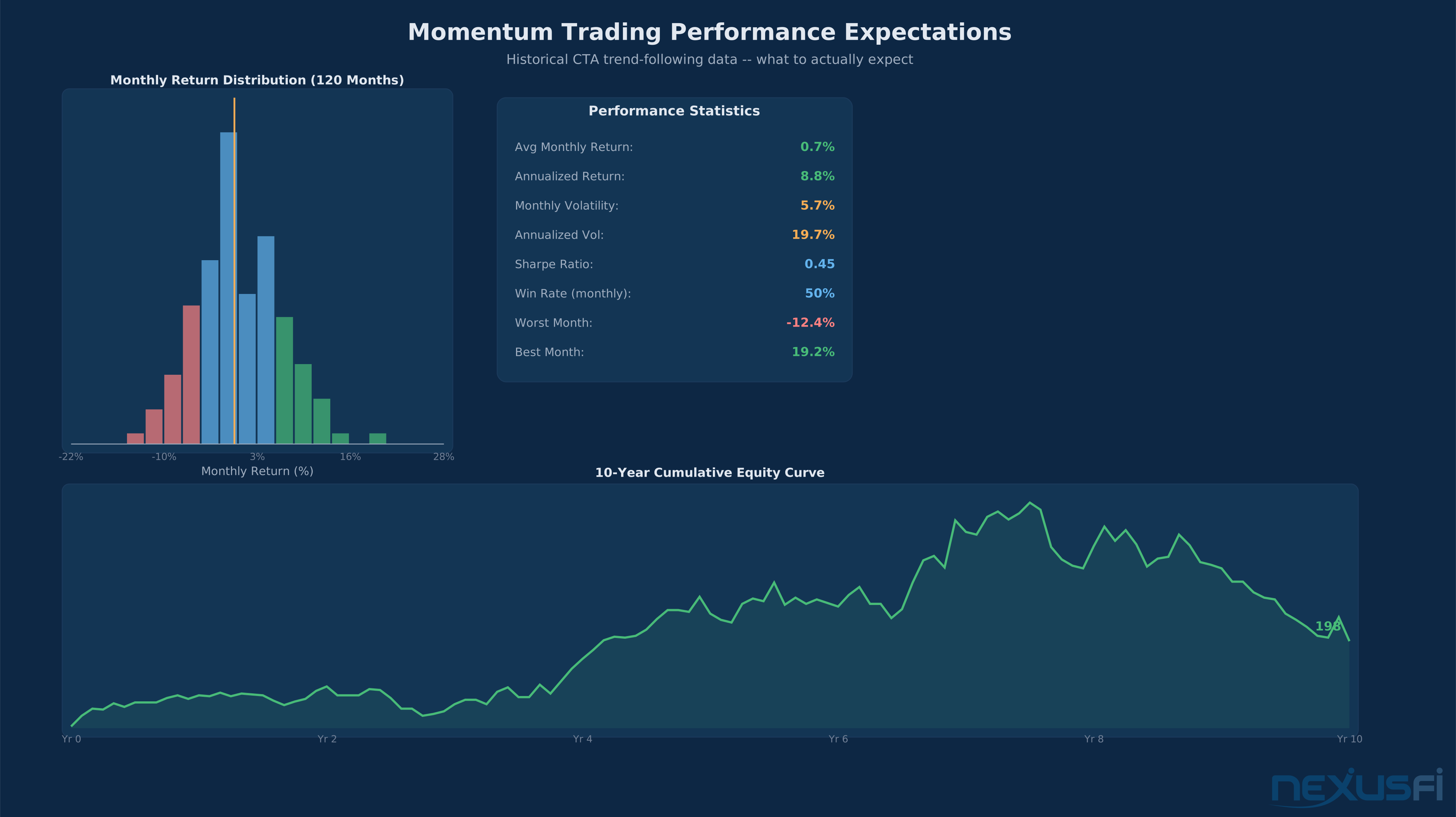
Long-term trend following programs: 8-15% annualized returns, 10-18% annualized volatility, Sharpe ratios of 0.5-0.8, maximum drawdowns of 20-35% over multi-year periods.
These numbers represent strategies with genuine diversification across 20+ markets and decades of performance history. Single-market momentum systems or shorter-horizon tactical momentum will show different profiles — often higher Sharpe in trending conditions, more severe failures in choppy periods.
Patience is the primary capital requirement. The documented trend-following premium requires multi-year holding periods to realize with statistical confidence. Traders who can hold positions through the inevitable multi-month drawdowns capture it. Those who abandon systematic approaches at the first sign of trouble don't.
Knowledge Map
Prerequisites
Understand these firstReferences This Article
Articles that build on this topicCitations
- — MOMENTUM vs. MEAN (2011) 👍 32“Markets like the ES and ZB which are heavily arbed and dominated by HFTs and algorithmic trading, are often lacking volatility, and are choppy and directionless. It would seem that not only including, but concentrating on a strategy that offered you the opportunity to capitalize on current market conditions would be economically prudent.”
- — TraderEX-CME-ES-Tradovate-one to three tic target. (2018) 👍 5“Pure momentum trading gets crushed when the market is sideways and kills when trending so stay out of the sideways motion. Look for breakouts but WAIT until the market trends. Get in the 2nd, 3rd or 4th consecutive candle in a trend.”
- — Trading Futures with Context (2014) 👍 25“I received a few emails and PM's the past two days from guys who are trying to trade futures with momentum -- they're all getting crushed because they don't understand when momentum works and when it doesn't.”
- — Trading Futures with Context (2013) 👍 9“Momentum fails to make a new high -- that's your first warning that the trend is exhausted. The signal was there; traders ignoring it get caught in the reversal.”