



CME New E-mini Broad Market Index Futures (2026): The Complete Guide to All-Cap Trading
Overview #
CME Group is expanding its equity index futures lineup for the first time since 2011 with four new E-mini contracts launching June 29, 2026, pending CFTC regulatory review. These contracts cover the full U.S. equity market — from large-cap tech to micro-cap industrials — addressing a gap that has existed since the E-mini suite was first built around the S&P 500.
Launch date: June 29, 2026 (pending CFTC review). All four contracts trade on the CME Globex platform and qualify as Section 1256 contracts under the tax code, giving them the 60/40 long-term/short-term capital gains split regardless of holding period.
What Just Changed #
CME Group announced on June 11, 2026 that it will expand its equity index suite with four new E-mini futures contracts, pending CFTC regulatory review. Trading begins June 29, 2026.
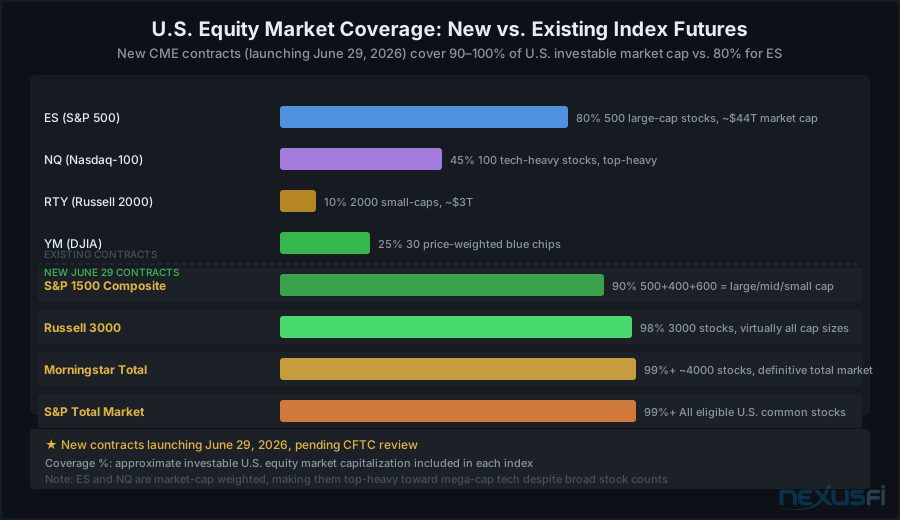
If you've been trading ES, NQ, or RTY, you've been working with instruments that leave real gaps in U.S. equity coverage. The S&P 500 (ES) covers roughly 80% of investable U.S. market cap and skews heavily toward the top 10 stocks — Apple, Microsoft, Nvidia, Amazon, Alphabet, and the rest of the Magnificent Seven collectively represent over 30% of the index. NQ is even more concentrated. RTY covers small caps but only about 10% of total market cap.
These four new contracts fill that gap. Together, they give traders the ability to trade or hedge the full U.S. equity market — from mega-cap tech to micro-cap industrials — through a single CME instrument with the capital efficiency of futures and the 60/40 tax treatment of Section 1256 contracts.
This isn't incremental. It's the most significant expansion of CME's equity index lineup since RTY launched in 2011.
The Four New Contracts #
Each contract tracks a different slice of the U.S. equity universe. Here's what you need to know about each one before June 29.
E-mini Morningstar U.S. Total Market Index Futures
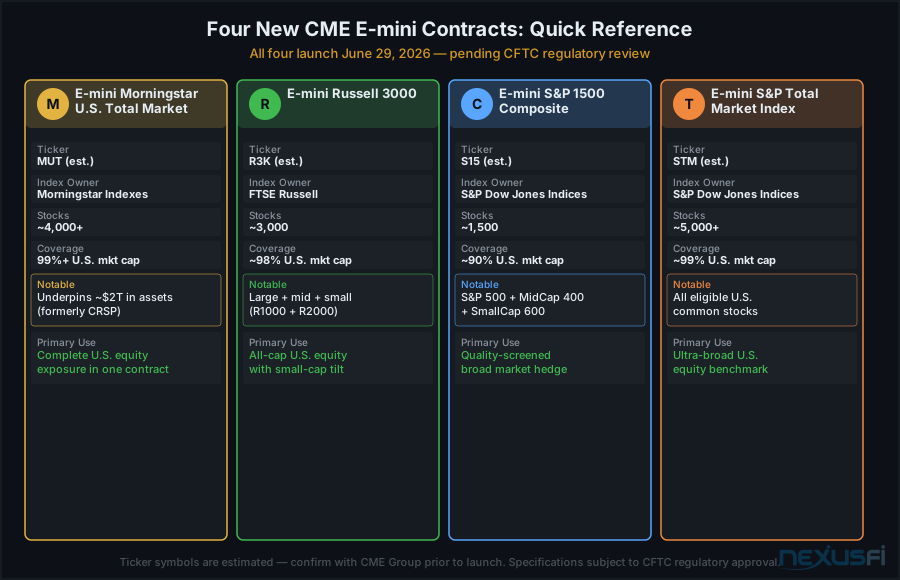
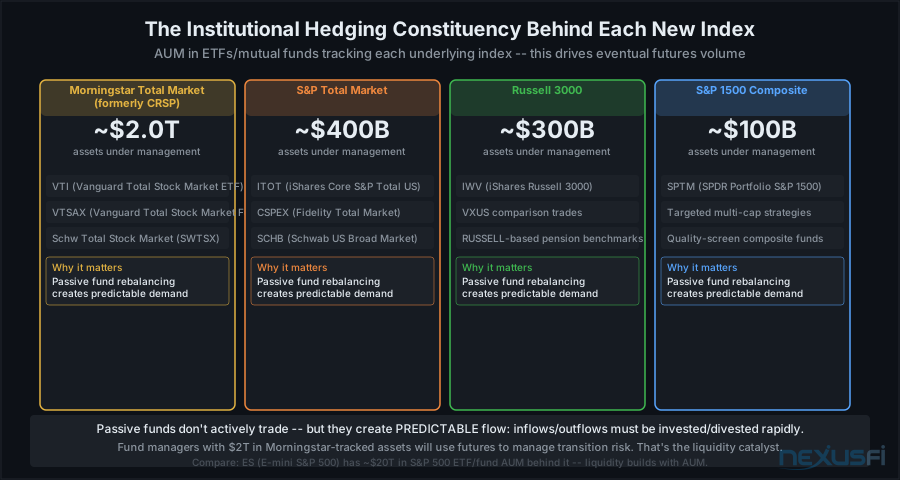
This is the most broadly scoped contract of the four, and arguably the most significant for institutional participants. The Morningstar U.S. Total Market Index is the successor to the CRSP Market Indexes — Morningstar acquired CRSP earlier in 2026 and is rebranding the series. The CRSP U.S. Total Market Index currently underpins approximately $2 trillion in assets, including the Vanguard Total Stock Market ETF (VTI) and Vanguard Total Stock Market Index Fund (VTSAX), which is the world's largest mutual fund.
That $2 trillion AUM number matters enormously for futures traders. It means this index has a built-in institutional hedging constituency — the fund managers running VTI and VTSAX will be natural users of these futures for managing inflows, outflows, and transition risk. Large institutional trades in index-tracking funds create predictable demand patterns that active futures traders have exploited in ES for decades. The Morningstar Total Market contract creates the same opportunity for the total-market segment.
The index covers approximately 4,000+ U.S. listed stocks across all market caps — large, mid, small, and micro. Coverage approaches 99%+ of U.S. investable market capitalization. For a futures trader, this means the contract behaves much more like "the entire U.S. stock market" than ES does. In periods where small and mid caps diverge from mega-cap tech — which happens regularly at market inflection points — this contract will tell a different story than ES.
As NexusFi member
The Morningstar Total Market's cap-weighted construction means mega-caps still dominate, but the inclusion of thousands of smaller names creates more distributed exposure than ES.
@josh — NexusFi Elite Circle
E-mini Russell 3000 Index Futures
The Russell 3000 is the combination of two indices futures traders already know well: the Russell 1000 (large cap) and the Russell 2000 (small cap, the RTY futures contract). Together they represent approximately 98% of U.S. investable market capitalization.
From a trading perspective, the Russell 3000 is the most intuitive of the four new contracts. If you already trade RTY (Russell 2000), you understand the FTSE Russell methodology — annual reconstitution in June, float-adjusted market cap weighting, specific eligibility criteria. The Russell 3000 adds the large-cap Russell 1000 component to create an all-cap benchmark.
The primary use case is spread trading against ES. The Russell 3000 vs. ES spread is basically a way to express views on small-cap performance relative to large cap. When the economy is expanding and risk appetite is high, small caps tend to outperform — the R3K/ES spread widens. When flight-to-quality kicks in or credit tightens, mega-caps hold better — the spread narrows or inverts. This is a cleaner expression of the large/small cap rotation trade than the RS2K/ES spread because the R3K includes large caps on both sides of the trade.
The Russell 3000 contract changes this calculus — because it captures all three segments, it becomes a more natural hedge for any diversified U.S. equity portfolio.
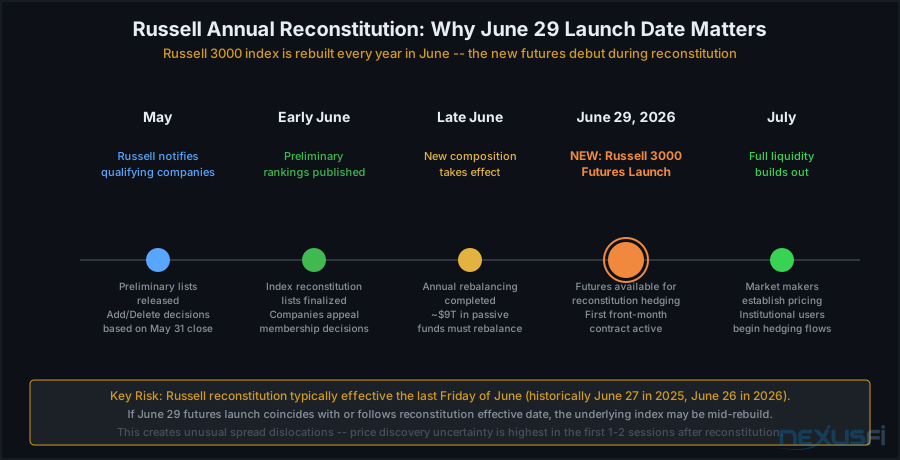
FTSE Russell reconstitutes the Russell indices annually, typically with the new composition taking effect after the last Friday in June each year. The launch of futures on June 29 aligns almost exactly with reconstitution timing — traders watching the reconstitution trade will want to pay attention to how these new contracts behave in their first few weeks of trading as the index itself is rebuilt.
E-mini S&P 1500 Composite Index Futures
The S&P 1500 Composite is the combination of three S&P indices: the S&P 500, the S&P MidCap 400, and the S&P SmallCap 600. If you've ever used the SPDR S&P 1500 ETF or looked at broad sector weightings across all three S&P indices, you already understand the underlying index.
What distinguishes the S&P 1500 from the Russell 3000 and the Morningstar Total Market is the S&P's quality screen. Every constituent in the S&P 500, 400, and 600 must meet profitability requirements — companies must demonstrate positive as-reported earnings before being added to any S&P index. This quality filter means the S&P 1500 excludes unprofitable companies that would be included in Russell or Morningstar total market indices. In practice, this matters most in the small-cap space where unprofitable companies make up a meaningful portion of the investable universe.
For hedging purposes, the S&P 1500 composite is ideal for equity book managers whose holdings skew toward profitable, established companies across all three size segments. Hedge funds with systematic long/short strategies built around S&P constituent selection will find these futures useful for neutralizing market beta.
The S&P 1500 covers approximately 90% of U.S. investable market capitalization. It's less complete than the Morningstar Total Market or S&P Total Market contracts in terms of stock count, but the quality screen arguably makes it a more investable benchmark for active managers.
E-mini S&P Total Market Index Futures
The S&P Total Market Index is S&P Dow Jones Indices' broadest U.S. equity benchmark, covering all eligible U.S. common stocks — approximately 5,000+ companies at any given time. This includes micro-caps and companies too small or too young to qualify for the S&P 1500.
The S&P Total Market differs from the S&P 1500 in two key ways: it includes micro-cap stocks, and it uses a more permissive eligibility screen. A company can be in the S&P Total Market without meeting the profitability requirements that govern the S&P 500, 400, or 600.
From a pure trading standpoint, the S&P Total Market futures will likely trade very similarly to the Morningstar Total Market futures, since both are attempting to capture the full U.S. equity universe. The practical difference is index construction methodology and the institutional constituency behind each. Vanguard's massive ETF complex is built around the Morningstar/CRSP methodology; S&P Total Market has its own set of ETF users.
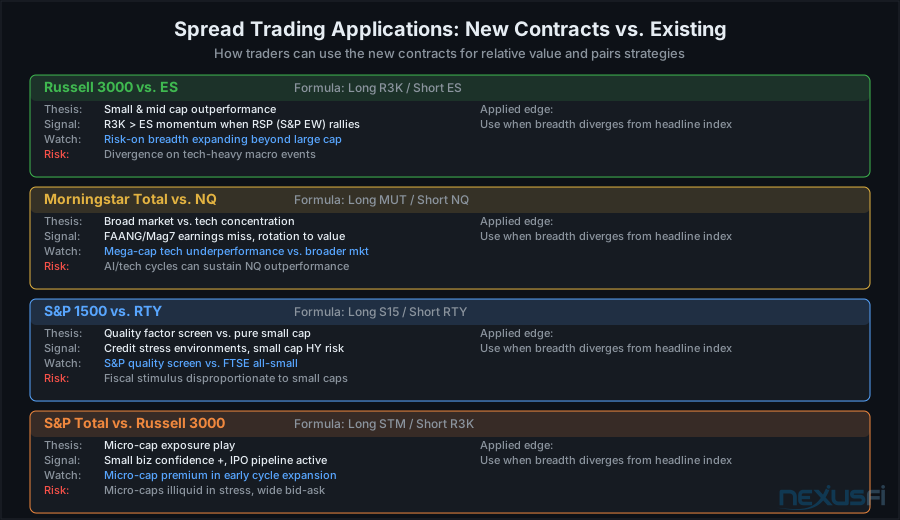
The spread between S&P Total Market and Russell 3000 represents a micro-cap factor play — isolating the performance of stocks too small to qualify for the Russell 3000. This will be a thin, specialized trade initially, but it creates a new tool for factor-based strategy development.
Why These Contracts Exist Now #
The timing of this launch isn't random. Three trends converged to make it viable.
First, passive investing has grown to represent over 50% of U.S. equity fund assets. The funds managing trillions in total market ETFs — VTI, ITOT (iShares Core S&P Total U.S. Stock Market), SCHB (Schwab U.S. Broad Market) — have significant hedging needs that can't be cleanly met with ES futures. When a passive manager gets $10 billion in inflows and needs to invest in the full U.S. market, they can use ES as a temporary hedge, but ES only covers 80% of their exposure. The remaining 20% in mid and small caps creates tracking error. These new contracts eliminate that tracking error.
Second, Morningstar's acquisition of the CRSP Market Indexes created a natural partnership opportunity with CME. CRSP has powered Vanguard's index methodology for decades; the rebranding to Morningstar opens the door to new licensing arrangements, including futures contracts. The "new multi-year index-based derivatives licensing agreement" mentioned in CME's press release is the direct result of this transition.
Third, the market structure has matured. The existing CME E-mini complex has demonstrated reliable liquidity and operational stability across multiple market cycles. Institutional participants are comfortable with CME's clearing, margin models, and settlement procedures. Adding four new contracts to this infrastructure is far lower risk than launching futures on a new asset class would be.
How They Compare to ES, NQ, and RTY #
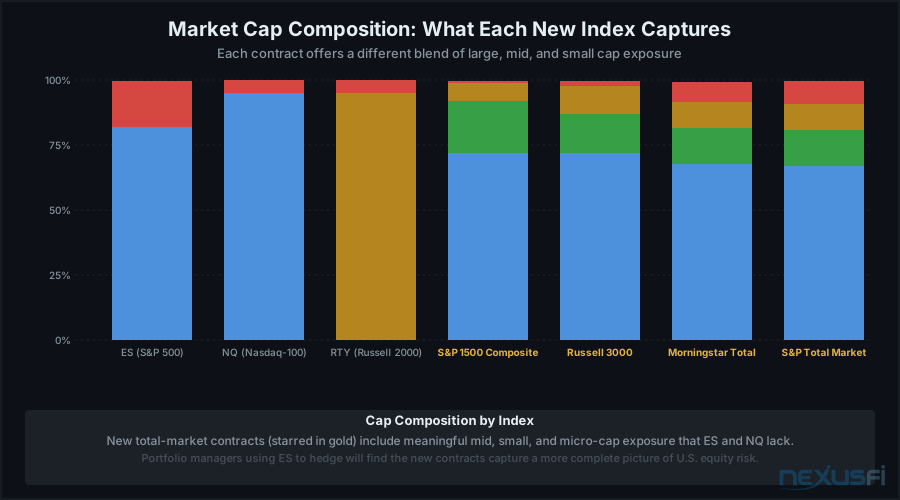
The existing CME equity index futures each represent a different slice of the U.S. market, but they leave gaps. Here's how the new contracts fill those gaps.
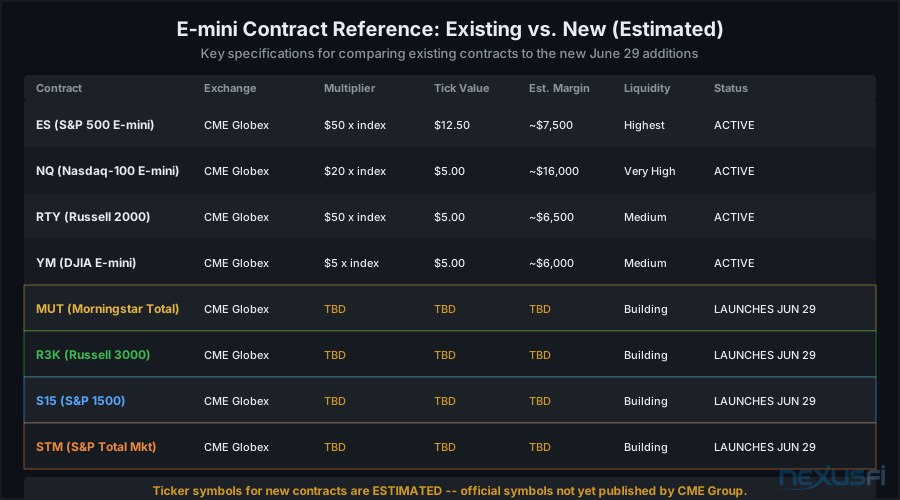
ES (E-mini S&P 500): 500 large-cap U.S. stocks, cap-weighted, approximately 80% of U.S. market cap. Extremely liquid — the most liquid equity futures contract in the world. ES is the default hedging instrument for most U.S. equity traders. Its limitation is concentration: the top 10 holdings account for over 35% of index weight as of 2026, making ES effectively a leveraged large-cap tech bet in disguise.
NQ (E-mini Nasdaq-100): 100 of the largest non-financial stocks (NQ futures guide) listed on Nasdaq, market-cap weighted. NQ is even more concentrated than ES — the top 5 holdings represent roughly 40%+ of index weight. Apple, Microsoft, Nvidia, Amazon, and Alphabet dominate. NQ is ideal for directional tech exposure but a poor hedge for a diversified equity portfolio.
RTY (E-mini Russell 2000): 2,000 small-cap stocks (RTY futures guide) U.S. stocks, approximately 10% of U.S. market cap. RTY provides small-cap exposure but covers only the Russell 2000 component — it misses mid-cap stocks entirely. Liquidity in RTY is meaningfully lower than ES or NQ.
New contracts: The four new futures bridge the coverage gap between RTY (small caps, 10% of market) and ES (large caps, 80% of market) while also providing all-cap alternatives with much lower concentration risk. For portfolio managers whose benchmark is a total-market or broad-market index rather than the S&P 500, the new contracts finally offer a clean hedging instrument.
The new contracts won't immediately displace ES — that institutional options/futures hedging ecosystem has built up over decades. But for the growing segment of the market that tracks total-market or broad-market benchmarks, the new contracts provide a much better tool.
Trading Applications #
The immediate practical question is: what do these contracts actually let you do that you couldn't do before?
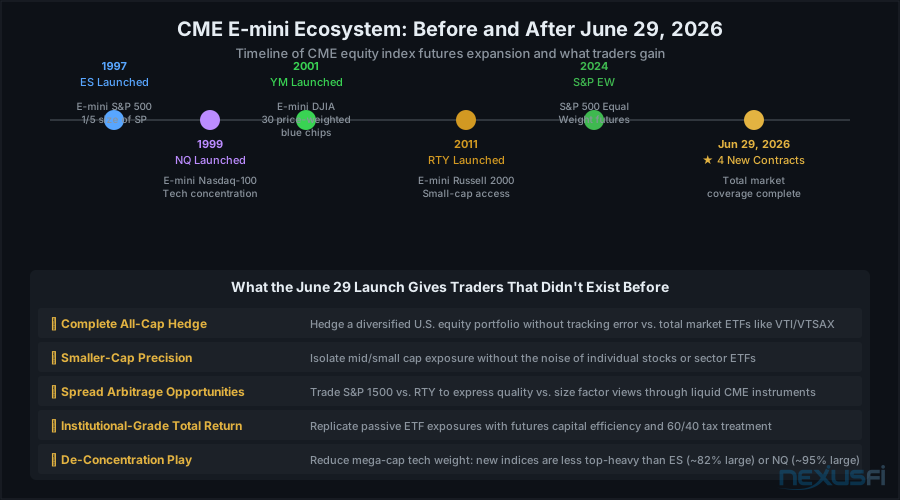
1. True total-market beta hedging. If you run a diversified U.S. equity portfolio that includes small and mid caps, you can now hedge your entire exposure in a single futures contract rather than using a combination of ES, RTY, and perhaps S&P MidCap 400 instruments. This eliminates basis risk from using mismatched hedges.
2. Capital-efficient broad market exposure. Futures provide leverage — see margin requirements and leverage — you can get $500,000 in notional equity exposure for a fraction of that in margin. For a trader who wants broad U.S. market exposure as a portfolio component, the new contracts offer a tax-efficient (60/40 long-term/short-term capital gains split under Section 1256), capital-efficient alternative to total-market ETFs.
3. Factor expression through spreads. The most interesting immediate use for active traders is spread trading: long one of the new contracts against short ES to isolate mid/small cap performance, or long/short two of the new contracts against each other to isolate specific cap size factors. These spreads become the cleanest expression of size factor views available in listed futures markets.
4. Earnings-season positioning. In periods where small and mid cap earnings diverge from mega-cap results — which happens frequently — traders can use R3K vs. ES to express that divergence without taking on single-stock risk.
5. Transition management. Institutional portfolio managers facing large transitions (e.g., moving from an S&P 500 strategy to a total-market strategy) can use the new contracts as temporary exposures while executing the physical equity transition.
Spread Trading Opportunities #
For active futures traders, the most immediately interesting application is the spread between the new contracts and existing instruments. A few specific setups worth watching from day one:
Russell 3000 vs. ES (R3K/ES spread): This is the cleanest large/small cap rotation trade available in listed futures. Long R3K, short ES expresses the view that mid and small caps will outperform large caps. The spread widens in risk-on environments with broad participation and narrows when safety flows concentrate money in mega-cap names. Historical data from ES/RTY spreads provides a framework, but R3K adds mid-cap participation that RTY lacks.
@kkfx — NexusFi Emini and Emicro Index Forum
Morningstar Total Market vs. NQ (de-concentration trade): Long Morningstar Total Market, short NQ expresses the view that mega-cap tech will underperform the broader market. This is a rotation trade — when Magnificent Seven earnings disappoint or AI investment themes cool, money tends to rotate into value, industrials, and smaller names. The Morningstar Total Market captures that rotation while NQ stays concentrated in the names that are underperforming.
S&P 1500 vs. RTY (quality factor): The S&P 1500 includes a profitability screen that RTY lacks. Long S&P 1500, short RTY expresses a quality vs. size factor tilt. In periods of credit stress or rising defaults, unprofitable small caps get hit hardest. The S&P 1500 holds up better because its components must demonstrate positive earnings.
The key challenge with all these spreads is contract value matching. Each new contract will have its own multiplier and tick size, so the dollar-weighted ratio for a neutral spread needs to be calculated carefully. Verify current contract specifications with CME Group as they're published ahead of the June 29 launch.
What Traders Need to Know Before June 29 #
A few practical considerations for traders planning to participate in the new contracts from launch day:
Liquidity risk in early trading. New futures contracts often have thin markets for weeks or months after launch. The S&P 500 Equal Weight futures, launched by CME in 2024, had very limited volume in their early weeks despite strong institutional interest. Expect wide bid-ask spreads and limited depth initially — use limit orders and be patient. Liquidity will build as institutional hedgers and market makers establish positions.
Track basis vs. underlying ETFs closely. In early trading, you may see basis divergence between the futures and the underlying ETFs (VTI, ITOT, SCHB, etc.) that wouldn't exist in mature contracts. This creates arbitrage opportunities but also risk — if you're using these contracts to hedge an ETF position, monitor the basis daily until it stabilizes.
Margin requirements will be published by CME. Check CME's website for initial margin requirements prior to launch. For comparison, ES requires approximately $7,000-$9,000 initial margin for the front month contract (subject to change). New contracts may have higher margin requirements initially to account for thinner liquidity and price discovery uncertainty.
June 29 aligns with Russell reconstitution. Russell indices are reconstituted annually, typically effective the last Friday of June. If the Russell 3000 futures launch on June 29 coincides with the 2026 reconstitution effective date, the first days of trading will occur as the underlying index itself is being rebuilt. This can create unusual price behavior and spread dislocations — a known phenomenon in Russell 2000 futures around reconstitution, and likely to appear in R3K futures as well.
Section 1256 treatment applies. Like all CME-listed futures contracts, these new E-mini contracts are Section 1256 contracts, meaning gains and losses receive the favorable 60/40 tax treatment (60% long-term, 40% short-term) regardless of holding period. This is a meaningful tax advantage versus ETF hedging strategies, which are subject to short-term capital gains rates if held less than a year.
Regulatory approval is pending. CME explicitly stated these contracts are pending CFTC regulatory review. While such approvals are typically routine, the June 29 launch date should be considered tentative until CFTC confirms approval. Monitor CME's announcements.
The Bottom Line #
The launch of four new E-mini contracts on June 29, 2026 is the most significant expansion of CME's equity index futures lineup in over a decade. For the first time, futures traders will have direct access to broad, all-cap U.S. equity exposure that reflects actual market composition rather than the mega-cap-heavy S&P 500 or tech-heavy Nasdaq-100.
The practical impact will unfold over months as liquidity builds. Don't expect to trade these contracts on Day 1 with the same depth as ES — it takes time for market makers to establish pricing, for institutional hedgers to build relationships with the new contracts, and for the bid-ask spreads to compress to tradeable levels. But the strategic opportunity is real: these contracts create new hedging tools, new spread opportunities, and a cleaner way to express views on market breadth and cap size factors.
Watch the Russell 3000 vs. ES spread first. It will be the most liquid of the new spread opportunities and the most tradeable expression of the large/small cap rotation that drives so much of the equity market's daily behavior. If these new contracts gain traction with institutional participants, that spread has the potential to become as important to equity index futures traders as the NQ/ES spread is today.
The full U.S. equity market is now tradeable in a single futures contract. That's not a small thing.
Knowledge Map
Go Deeper
Build on this knowledgeCitations
- — NEW CME S&P500 Equal Weight Futures Contract (2024) 👍 6“A cap-weighted index like SPX means that if AAPL moves up 3%, the bottom 14 companies could go to zero, poof, out of existence, and the index will be unchanged.”
- — Favorite instrument to trade (2021) 👍 4“ES is used to hedge SPX options, which itself is the world's primary equity hedging vehicle; this means institutions and dealers are active, which contributes to liquidity.”
- — Does Emini price movement directly reflect the basket of stocks? (2021) 👍 5“The SPX and DJIA are indexes and there is a formula, but the ES and YM are derivatives and do not have to move in sync with the underlying index they track.”
- — Pairs trading (2019) 👍 4“ES/RTY is spread between large, mid and small cap segments, but not very popular. The common spreads are NQ/ES, YM/ES, ES/EMD, EMD/RTY.”
- CME Group / PRNewswire — Prnewswire.com
- CME Group — Cmegroup.com
- — Is it worth tracking the ES and NQ? or CL? (2019) 👍 4“NQ has a more volatile, fast-paced behavior -- and I find NQ to usually feel like an exaggeration of the S&P 500, which is why adding a total-market alternative helps balance exposure.”