



Margin Requirements and Leverage in Futures Trading: What the Numbers Actually Mean and How They Can Destroy You
Overview #
Futures margin isn't what most people think it is. It's not a down payment. It's not the cost of a trade. It's a performance bond — collateral you post with the clearinghouse to guarantee you can cover your obligations. The distinction matters because it changes how you should think about every position you take.
Here's the math that keeps traders up at night: one E-mini S&P 500 contract at 5,400 controls $270,000 in notional value. The initial margin might be $13,200. That's roughly 20:1 leverage. Move against you 5% and you've lost $13,500 — more than your entire margin deposit. Your account doesn't just hit zero. It goes negative.
This article breaks down exactly how futures margin works, how leverage is calculated, and — most importantly — how the margin system can work against you during the worst possible moments.
Key Concepts #
Initial Margin (IM): The minimum collateral required to open a new futures position or add to an existing one. Set by the exchange (CME, ICE, etc.) and often increased by your broker's "house margin" requirements. This is the entry ticket — you can't establish a position without it.
Maintenance Margin (MM): A lower collateral threshold that applies to positions you already hold. If your account equity drops below this level, you get a margin call. For most CME products, maintenance margin is roughly 80-90% of initial margin.
Variation Margin: The daily mark-to-market settlement. Every trading day, your open positions are repriced to the settlement price. Gains credit your account. Losses debit it. This isn't theoretical P&L — it's real cash movement.
Performance Bond: The clearinghouse's term for margin. It's collateral securing your obligations, collected and monitored by your Futures Commission Merchant (FCM) on behalf of the clearing organization.
SPAN Margin: CME's Standard Portfolio Analysis of Risk system. It calculates margin requirements based on worst-case portfolio loss across multiple stress scenarios, granting credits for hedges and spreads.
Notional Value: The full market value of what a futures contract controls. For ES, it's the index price multiplied by $50. This is the number that matters for understanding your true exposure.
How Futures Margin Actually Works #
The margin call process follows a specific waterfall that every futures trader needs to internalize:
Step 1: Position Entry. You place an order. Your FCM checks whether your account has sufficient equity to meet initial margin. If yes, the trade executes and IM is blocked from your buying power. If no, the order is rejected.
Step 2: Daily Mark-to-Market. At the end of each trading day (or settlement cycle), every open position gets repriced to the official settlement price. Profitable positions add variation margin to your account. Losing positions deduct it. This cash movement is immediate — not "unrealized" in the stock market sense.
Step 3: Maintenance Monitoring. If your account equity (including all unrealized P&L from marked positions) drops below the maintenance margin requirement, a margin call is triggered.
Step 4: The Margin Call. Your broker demands you either deposit additional funds to restore equity to at least the initial margin level, or reduce/close positions until the remaining positions fit within your available margin. Response deadlines vary by broker — some give you until the next business day, others liquidate within hours.
Step 5: Forced Liquidation. If you don't meet the call, your broker closes positions to bring you back into compliance. They pick what to liquidate and when. You don't get a vote.
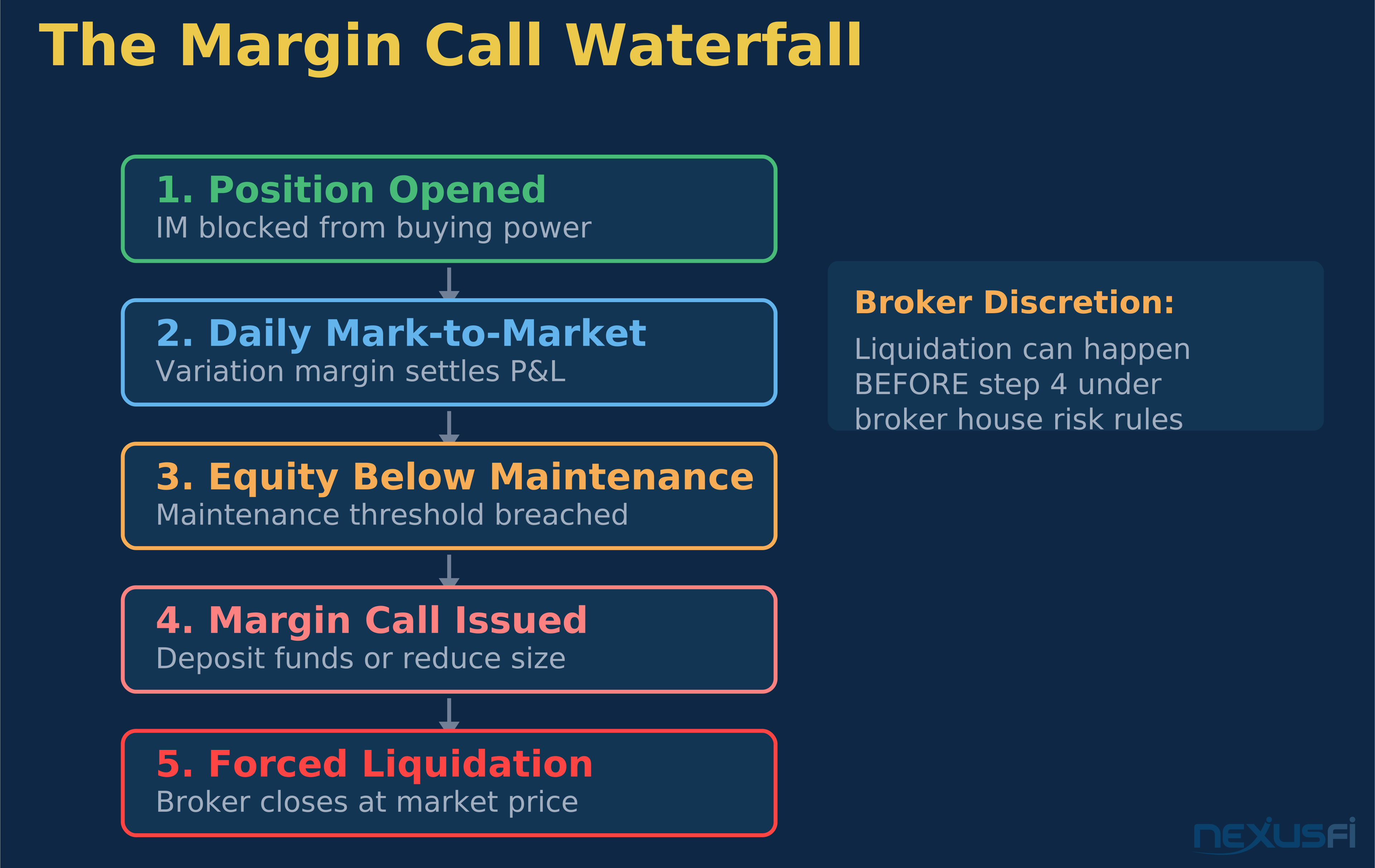
([NexusFi post] [5]). That last point is critical — brokers liquidate to protect themselves, not you.
Broker House Margins vs. Exchange Minimums #
The CME publishes minimum margin requirements. Your broker can (and often does) require more.
([NexusFi post] [6]). Shopping brokers for margin rates is fine, but understand the tradeoff: lower house margins mean less buffer before forced liquidation.
Calculating True Leverage #
Leverage in futures is straightforward to calculate but easy to underestimate. The formula:
Notional Value = Futures Price x Contract Multiplier
Leverage Ratio = Notional Value / Initial Margin
Here's what the numbers look like for major contracts (illustrative margins — check your broker and CME's current margin table for live figures):
E-mini S&P 500 (ES): Price 5,400 x $50 multiplier = $270,000 notional. With $13,200 initial margin, leverage is approximately 20.5x. Each full index point moves your account $50. A 50-point adverse move costs $2,500 per contract.
E-mini Nasdaq 100 (NQ): Price 19,000 x $20 multiplier = $380,000 notional. With $16,500 initial margin, leverage is approximately 23x. Each point moves your account $20. NQ's wider daily ranges mean the dollar volatility per contract regularly exceeds ES.
Crude Oil (CL): Price $62 x $1,000 multiplier = $62,000 notional. With $6,000 initial margin, leverage is approximately 10.3x. Each $1 move in crude moves your account $1,000. A $3 overnight gap — which happens multiple times per year — costs $3,000 per contract.
Gold (GC): Price $3,250 x 100 troy oz multiplier = $325,000 notional. With $11,000 initial margin, leverage is approximately 29.5x.
30-Year Treasury Bond (ZB): Price 118'00 x $1,000 multiplier = $118,000 notional. With $4,500 initial margin, leverage is approximately 26x.
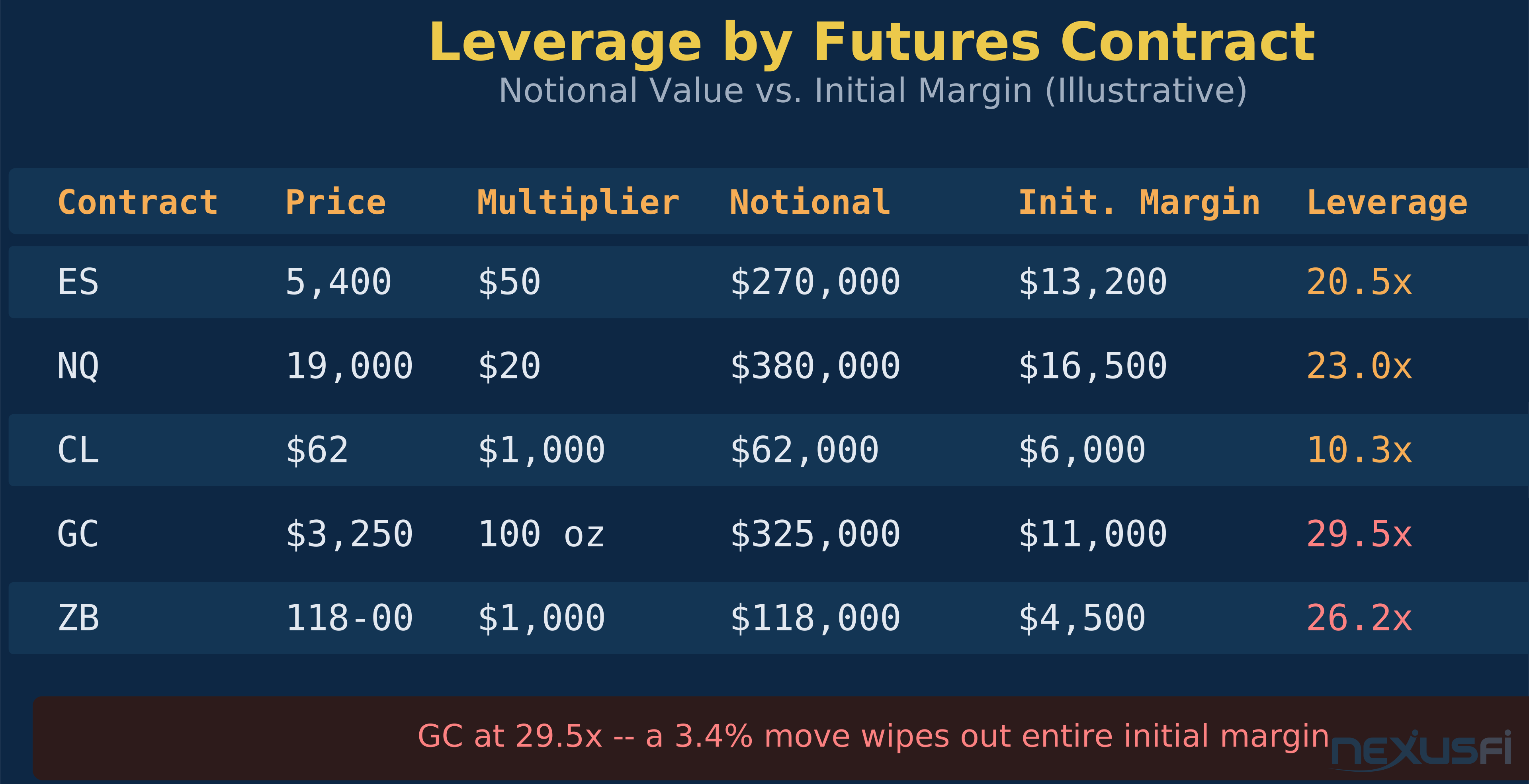
The leverage ratios tell you how much amplification you're carrying. But here's what they don't tell you: leverage is not static. When volatility spikes, exchanges increase margin requirements. When your account loses money, your equity-to-margin ratio deteriorates. Leverage works against you from both directions simultaneously.
([NexusFi post] [3]).
The SPAN Margin System #
CME's SPAN (Standard Portfolio Analysis of Risk) is the engine behind margin calculations. Developed by the Chicago Mercantile Exchange in 1988, SPAN has since been adopted by more than 50 exchanges and clearing organizations worldwide as the global standard for portfolio margining [8]. Instead of requiring flat per-contract margin for every position independently, SPAN evaluates your entire portfolio against multiple stress scenarios.
How SPAN works:
- For each position in your portfolio, SPAN builds a grid of hypothetical price moves (up, down, and extreme shocks).
- It calculates the worst-case loss across those scenarios.
- It applies credits for positions that offset each other — hedges, calendar spreads, and correlated positions reduce the total requirement.
- The result is a margin requirement that reflects your portfolio's actual risk profile, not just the sum of individual position margins.
Practical impact — spread margin reduction: If you're long one ES front month and short the next month (a calendar spread), SPAN recognizes that the two legs partially offset each other. Instead of requiring roughly $26,400 (2x $13,200), the spread margin might be $4,000-$7,000 because SPAN models the correlation between the two maturities.
Where SPAN breaks: The offsets depend on SPAN's correlation assumptions holding. During market dislocations — exactly when you need your hedge most — those correlations can break. The front month might move sharply while the back month barely budges (or moves in the same direction). When that happens, SPAN recalculates and your margin requirement can jump with no warning.
The order-of-execution trap: If you enter one leg of a spread before the other, you temporarily hold an outright position. You'll be margined at full outright rates until the second leg is filled and SPAN recognizes the spread. In fast markets, that gap can be dangerous.
Day Trade Margin vs. Overnight Margin #
Two completely different margin regimes apply depending on when you close:
Day trade margin is the reduced requirement for positions opened and closed within the same trading session. These rates are typically set by your broker (not the exchange) and can be dramatically lower — often 25% to 50% of overnight requirements.
Overnight margin is the full exchange-set (or broker-enhanced) margin for positions held through settlement. This is the "real" margin that covers gap risk, overnight volatility, and extended hours moves.
The spread between them is massive. For ES, day trade margin at many brokers is $500-$6,000, while overnight is $12,000-$15,000+. That's a 2x to 25x difference depending on your broker.
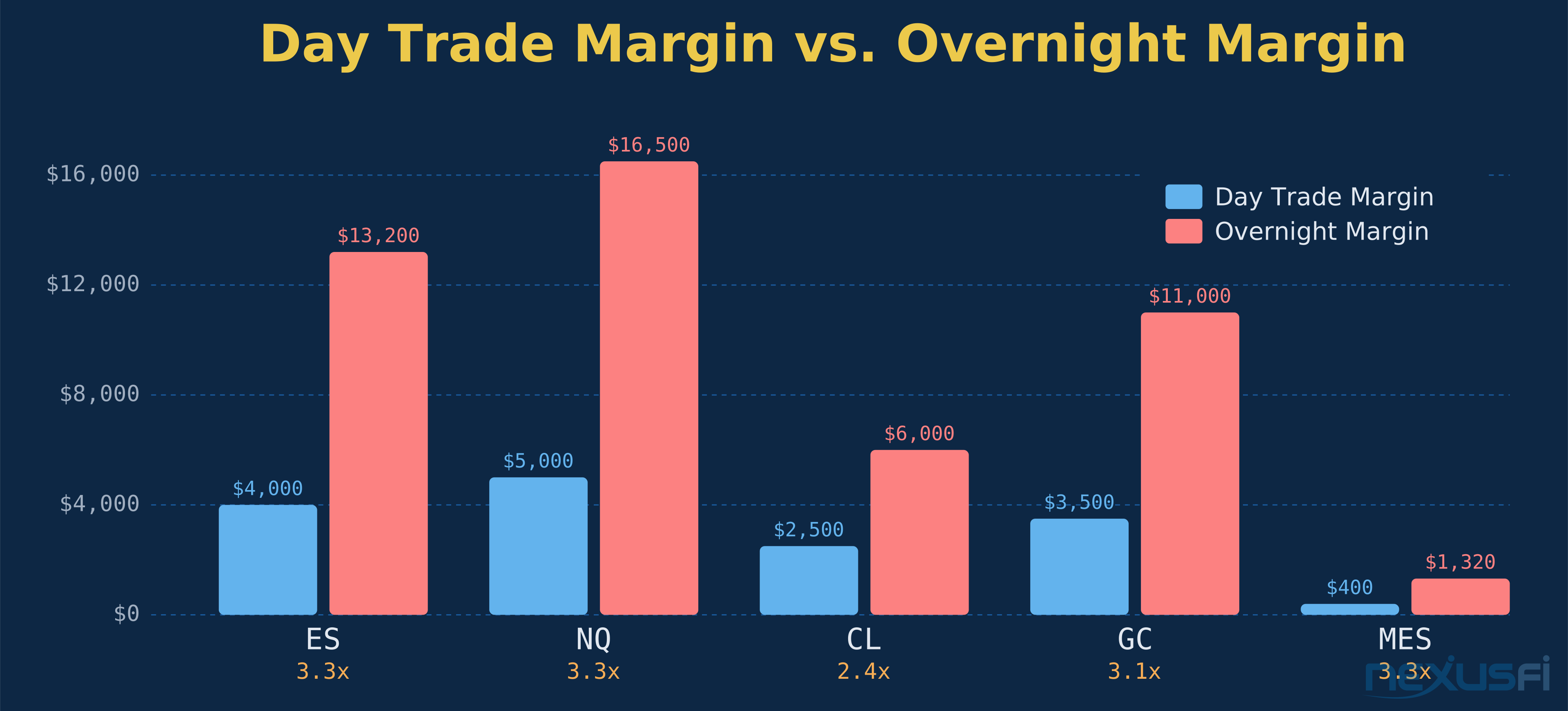
([NexusFi post] [2]).
The accidental overnight: This is one of the most common margin-related blow-ups. Trader enters a position sized for day trade margin. Market moves against them. They hold, waiting for a recovery. The session ends. The position converts to overnight margin. If the account can't support the higher requirement, an immediate margin call or forced liquidation follows — often at the worst possible price.
([NexusFi post] [7]). That 3-10x buffer is the difference between surviving drawdowns and getting wiped out.
When the Exchange Moves the Goalposts: Margin Changes During Volatility #
This is the most under-taught concept in futures risk management. Exchanges don't just set margin requirements once and leave them alone. They actively adjust margins based on volatility. When markets get volatile — exactly when you're most likely to be losing money — margin requirements increase.
The double jeopardy mechanism:
- Market moves against your position -> your account equity drops from mark-to-market losses
- Exchange raises margin requirements due to elevated volatility -> the threshold you need to stay above goes UP
- Your buffer shrinks from both sides simultaneously
- You get margin called even though you thought you had adequate cushion
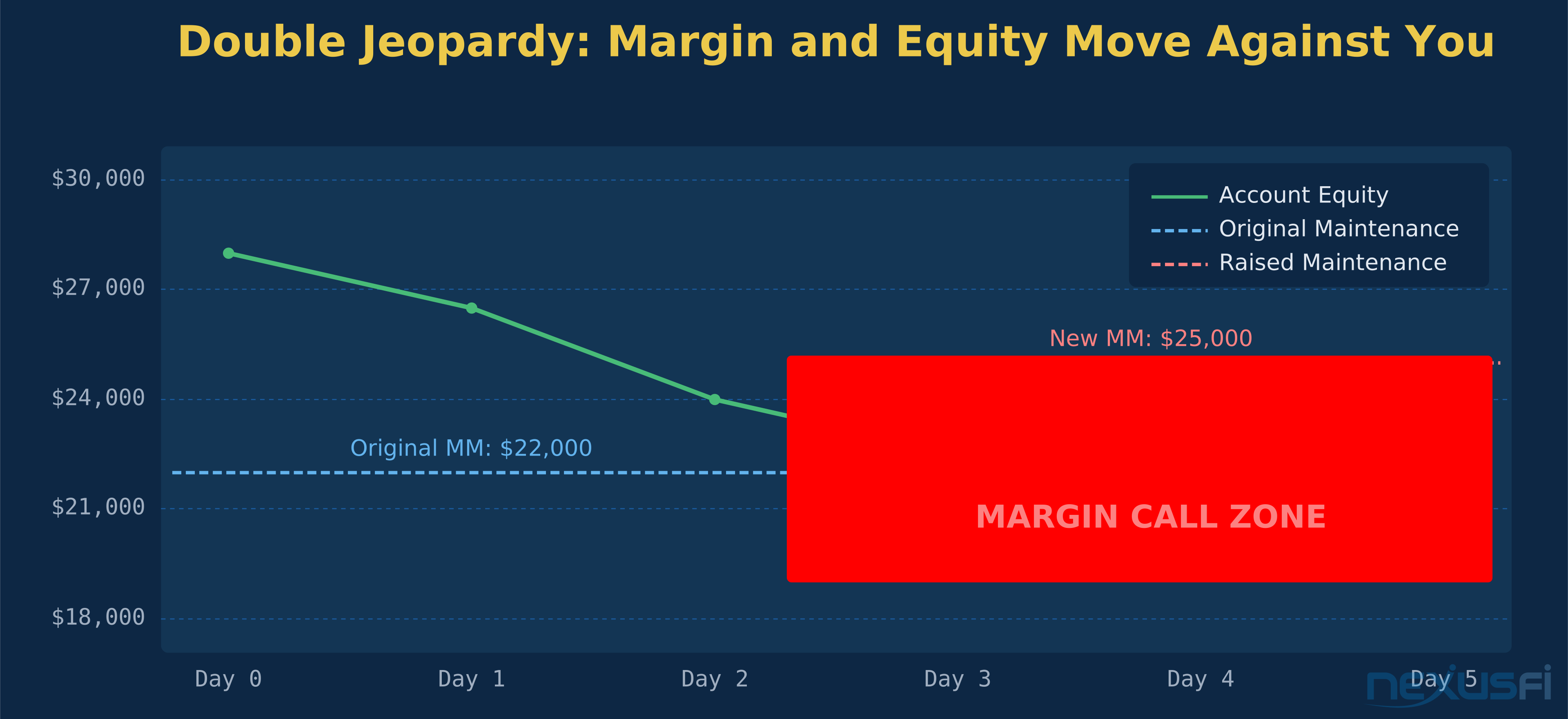
Real scenario: You hold 2 ES contracts with $26,000 account equity. Overnight margin per contract is $13,000, maintenance is $11,000. Total maintenance for 2 contracts = $22,000. Your buffer is $4,000.
Market drops 30 points. That's $3,000 loss (30 x $50 x 2 contracts). Equity drops to $23,000. Still above $22,000 maintenance. You think you're fine.
But the exchange has simultaneously raised maintenance margin by 20% due to elevated VIX. New maintenance per contract: $13,200. New total maintenance: $26,400. Your $23,000 equity is now $3,400 below the new maintenance threshold.
Margin call. Forced liquidation. At the bottom.
This isn't hypothetical. During the COVID crash in March 2020, CME raised E-mini S&P 500 margins six times between late February and late March — from $6,600 per contract to $12,000, an 82% increase in under a month [9]. Traders who were adequately margined on Monday got liquidated by Wednesday — not because their positions lost too much, but because the rules changed mid-game.
([NexusFi post] [1]). Read that again. Your account can go negative. Margin isn't a floor — it's just the minimum collateral the clearinghouse demands before they start liquidating.
Position Sizing: Risk First, Margin Second #
The most dangerous thing a futures trader can do is size positions based on margin availability. "I can afford 5 contracts" is not a risk management statement. It's a recipe for ruin.
The correct sizing formula:
Contracts = Max Dollar Loss Per Trade / (Stop Distance in Points x Dollar Per Point)Then and only then do you check: does the resulting position fit within your margin constraints with adequate buffer?
Example with ES:
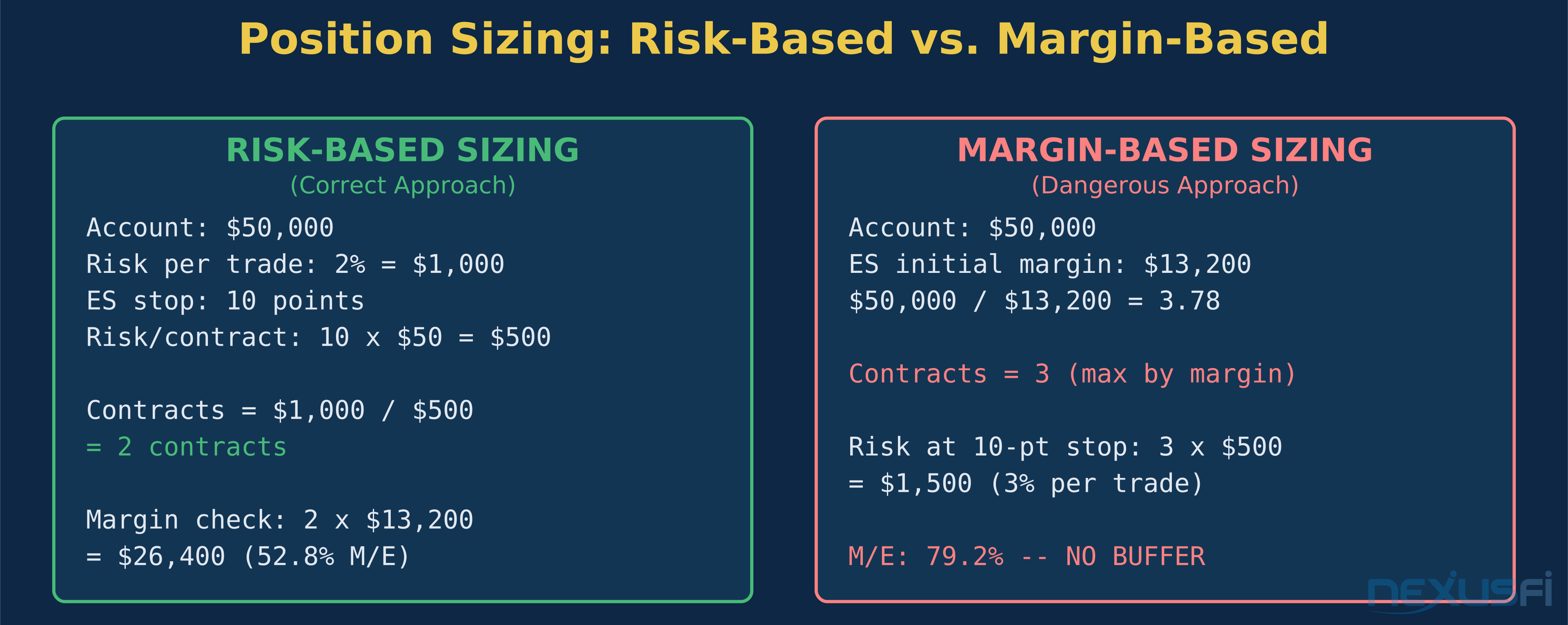
- Account equity: $50,000
- Risk per trade: 2% = $1,000
- Stop distance: 10 points
- Dollar per point per contract: $50
- Risk per contract at 10-point stop: $500
- Maximum contracts: $1,000 / $500 = 2 contracts
Now check margin: 2 x $13,200 IM = $26,400. That's 52.8% of your $50,000 equity. Manageable.
Compare to what margin alone would allow: $50,000 / $13,200 = 3.78, so margin allows 3 contracts. But at 3 contracts, a 10-point stop costs $1,500 — that's 3% of your account on a single trade. And that's before considering slippage, gap risk, and the possibility that your stop doesn't fill at your price.
([NexusFi post] [4]). That's margin-based sizing taken to its logical (and disastrous) conclusion.
The sizing hierarchy:
- Size by risk (dollars at risk per trade as % of equity)
- Validate against margin (does the position fit with buffer?)
- Stress test against margin increases (what if IM rises 25%?)
- Account for correlation (are other open positions adding to directional risk?)
Account Sizing and Professional Standards #
There's no official minimum account size for futures trading. The exchange doesn't care if you have $500 or $500,000 — as long as you meet margin requirements, you can trade. But "can" and "should" are different questions entirely.
The Margin-to-Equity ratio (M/E):
M/E = Required Margin / Account EquityProfessional risk managers target M/E ratios well below 50%. Many institutional desks won't exceed 25-30% margin utilization. The lower the M/E, the more buffer you have against drawdowns and margin increases.
Minimum viable account sizing by product (practical guidance):
The math is simple: take the overnight initial margin and multiply by a survival factor. A conservative factor is 3-5x overnight IM:
- ES: $13,200 IM x 4 = ~$53,000 minimum for 1 contract with adequate buffer
- NQ: $16,500 IM x 4 = ~$66,000 minimum for 1 contract
- CL: $6,000 IM x 4 = ~$24,000 minimum for 1 contract
- MES (Micro E-mini S&P): $1,320 IM x 4 = ~$5,300 minimum for 1 contract
- MNQ (Micro Nasdaq): $1,650 IM x 4 = ~$6,600 minimum for 1 contract
These numbers look high because they are. The alternative is trading undercapitalized, getting margin called during a normal drawdown, and losing both your money and your confidence.
The survival buffer in points:
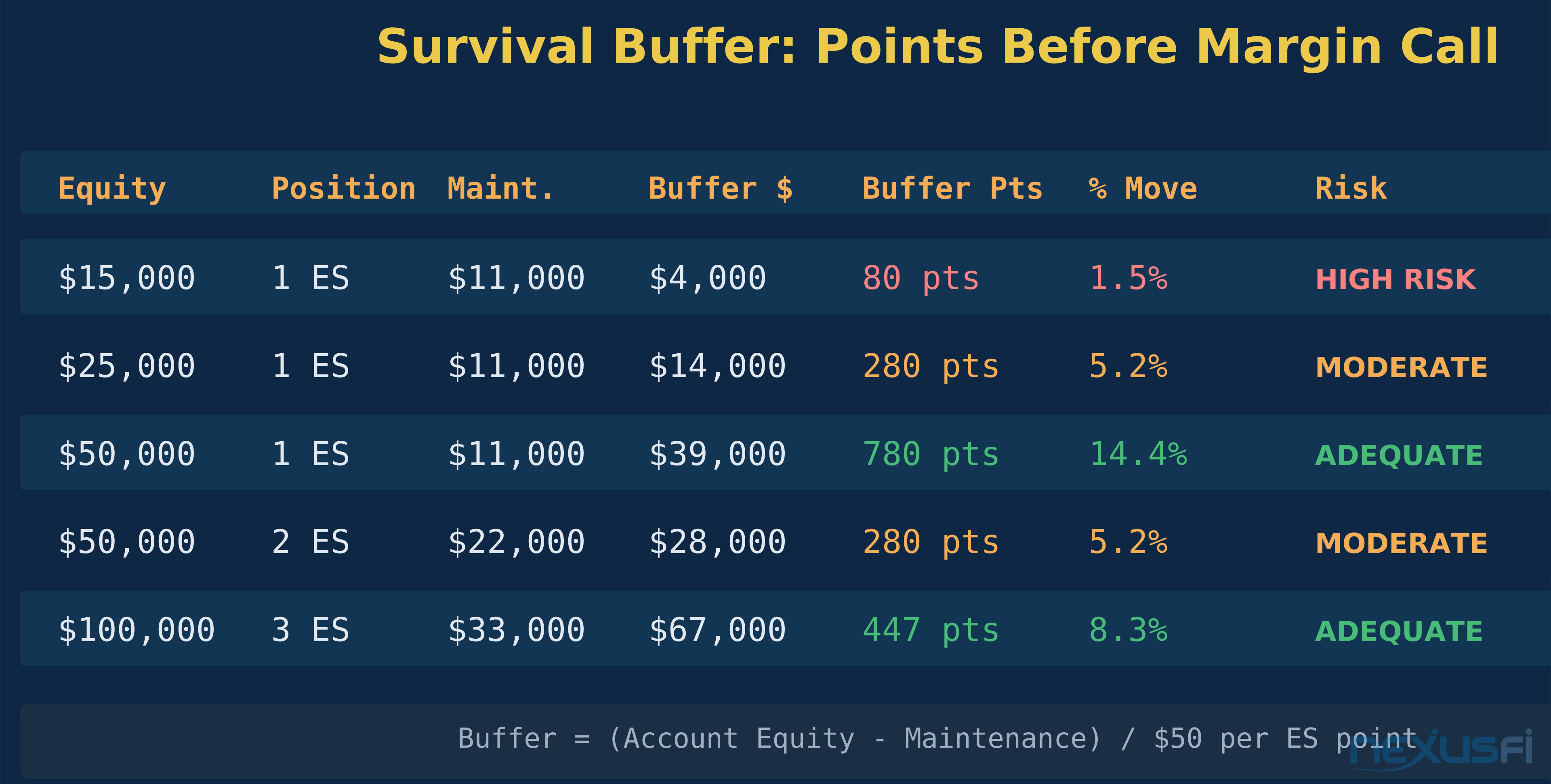
Buffer (points) = (Account Equity - Maintenance Margin) / Dollar Per Point Per ContractFor 1 ES contract with $50,000 equity and $11,000 maintenance:
- Buffer = ($50,000 - $11,000) / $50 = 780 points
That's a 14.4% move in the S&P before you'd face a margin call. Survivable.
For 1 ES contract with $15,000 equity and $11,000 maintenance:
- Buffer = ($15,000 - $11,000) / $50 = 80 points
That's a 1.5% move. ES can do that in a single session. Not survivable for swing or position trading.
The Blow-Up Math: How Accounts Actually Die #
Accounts don't blow up from one bad trade. They blow up from the combination of overleveraging, margin increases, and forced liquidation at the worst time. Here's the full mechanism:
Starting conditions:
- Account equity: $28,000
- Position: 2 ES contracts long
- IM required: 2 x $13,200 = $26,400
- MM required: 2 x $11,000 = $22,000
- M/E ratio: 94.3% (already dangerously high)
- Buffer to maintenance: $6,000 (120 ES points)
Day 1: ES drops 40 points. Loss = 40 x $50 x 2 = $4,000. Equity: $24,000. Above $22,000 MM.
Day 2: ES drops another 25 points. Loss = $2,500. Equity: $21,500. Below $22,000 MM. Margin call issued. Trader deposits $3,000 from savings. Equity: $24,500.
Day 3: CME raises maintenance margin to $12,500 per contract due to elevated VIX. New total MM: $25,000. Equity ($24,500) is below new MM ($25,000). Margin call again. Trader has no more cash. Broker liquidates 1 contract at market — which happens to be near the session low.
Aftermath: Trader now has 1 ES contract, $24,500 in equity, and has crystallized a $7,500 loss at the worst possible time. The "buffer" they thought they had evaporated because the yardstick moved.
This is not an extreme example. It's a normal volatility event with a slightly overleveraged account.
Practical Guidelines #
For day traders:
- Keep at least 3x day trade margin in your account per contract traded
- Set a hard time cutoff to flatten — 15 minutes before session close minimum
- Know your broker's exact day-to-overnight conversion time and rules
For swing/position traders:
- Target M/E ratios below 40% (below 25% is better)
- Budget for a 25% margin increase in your stress tests
- Calculate your survival buffer in points — if it's less than 2x the average daily range, you're undersized
For all futures traders:
- Size by risk, validate by margin — never reverse this order
- Your broker's margin is a minimum, not a recommendation
- Track M/E daily and reduce positions before margin forces you to
- Deposits take time to clear. If you might need emergency funds, wire them before you need them — not after the margin call
Knowledge Map
Prerequisites
Understand these firstGo Deeper
Build on this knowledgeReferences This Article
Articles that build on this topicCitations
- — losses can exceed deposits (2015) 👍 6“If you trade stocks and fully pay them - no leverage - then your losses cannot exceed your account size. The same applies to long option positions. The worst that can happen is that they expire worthless.”
- — understanding margin & leverage in emini and futures (2017) 👍 3“Please don't trade with real money until you first understand the leverage ramifications of the instrument you are trading. The amount of leverage allowed does depend on your broker. So ask them.”
- — understanding margin & leverage in emini and futures (2017) 👍 4“I must admit that that is different to how I have always understood it. If you only have a $1,000 in your account but you aren't forced to exit until your total position is down $1,000 as in your example above then that sounds like trading with no ma...”
- — Risk of trading micro futures (2020) 👍 3“It's a general disclosure. Not everyone uses a stop loss, and not everyone manages risk. When you open a position on margin, by definition you are effectively being 'loaned' money, and if the market does move quickly, you can be in a position such th...”
- — How does margin increase on losing trade? (2022) 👍 5“Margin is how much you have in your account. The minimum margin is how much is required per contract for you to be in a position.”
- — Futures Margin Leniency (2023) 👍 3“Interesting. I would say that the consensus opinion is that IB have some of the highest margin requirements and some of the most aggressive liquidation policies.”
- — Request for Advice on Roadmap for Quitting FT Job for Trading (2025) 👍 2“Futures cash requirements for position entry vary by broker. At tradovate all you need is the day initial margin to enter, and if you close by end of market thats all you ever need.”