



E-mini Russell 2000 (RTY) Futures: The Complete Trading Guide
Overview #
The E-mini Russell 2000
The contract trades $50 per index point on CME Globex, with a micro version (M2K) at $5 per point for smaller accounts. RTY doesn't get the attention ES and NQ receive, but it has a distinct personality that attracts a dedicated following: choppier price action, sharper mean-reversion tendencies, and an outsized reaction to domestic economic data that the large-cap indexes barely register.
Why does RTY matter? Because it's the purest "risk-on" equity futures contract available. When institutional money rotates into risk appetite, RTY leads. When credit tightens and fear takes over, RTY falls first and falls hardest. Understanding how RTY behaves
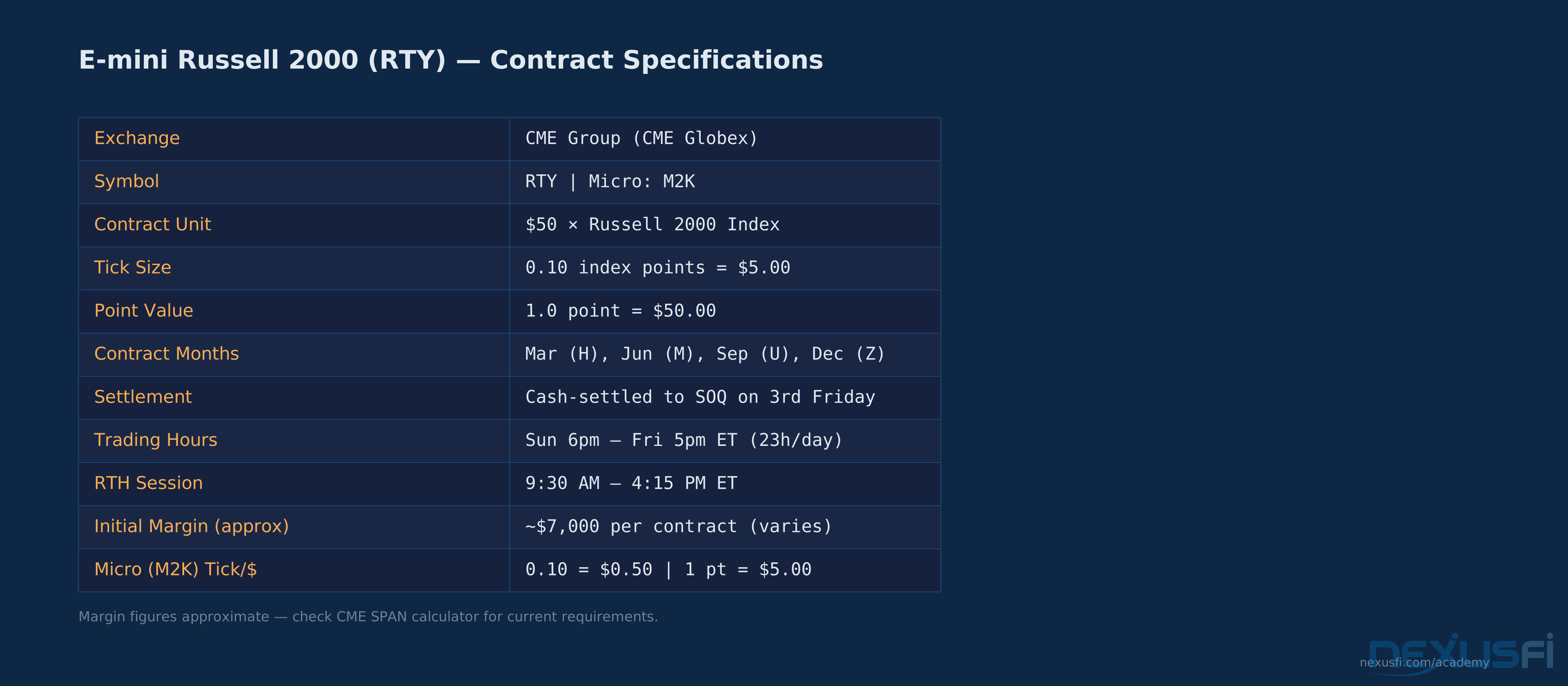
Key Specifications #
Contract Unit: $50 × Russell 2000 Index. With the index around 2,200, that's roughly $110,000 in notional exposure per contract
Tick Size and Value: 0.10 index points = $5.00 per tick. A full point move (10 ticks) is worth $50. This is identical to ES in dollar-per-point terms, but the smaller tick increment means RTY's minimum price change is $5 versus ES's $12.50.
Micro Contract (M2K): One-tenth the size of RTY
Trading Hours: Nearly 24 hours
Settlement: Cash-settled to the Special Opening Quotation (SOQ) of the Russell 2000 Index on the third Friday of the contract month. Quarterly expiration: March, June, September, December.
Margin: CME initial margin runs approximately $6,600-$7,500 per RTY contract, fluctuating with SPAN calculations and current volatility. Day-trade margins at most brokers range from $500 to $2,500 depending on the firm. M2K margins are roughly one-tenth of RTY.
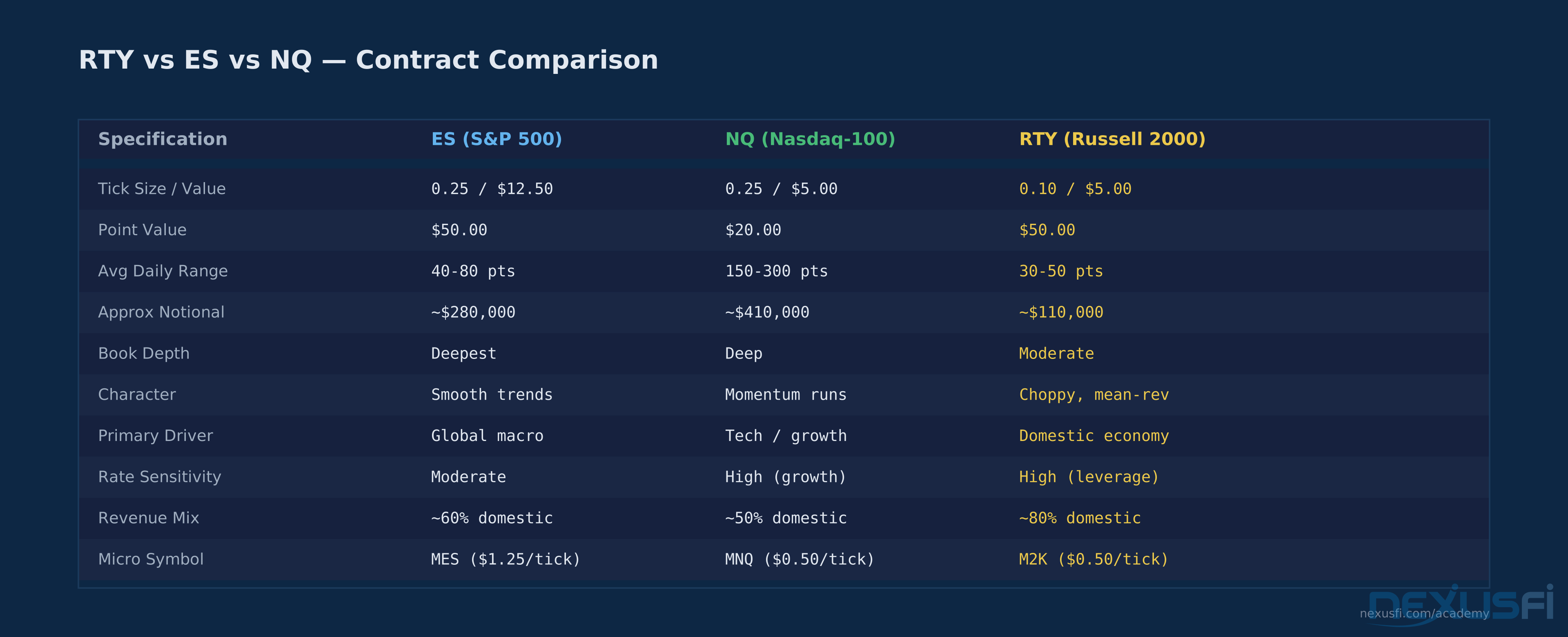
How RTY Differs from ES and NQ #
This is where RTY gets interesting
Volatility character: RTY's average daily range runs 30-50 points ($1,500-$2,500 per contract), which sounds smaller than NQ's 150-300 point range. But in percentage terms, RTY typically delivers 1.3× to 1.8× the daily percentage move of ES. The critical difference is how that volatility unfolds. ES tends toward smoother trends. NQ runs in momentum bursts. RTY chops. It grinds, reverses, traps, and mean-reverts with a frequency that drives trend-followers insane.
Book depth: RTY's order book is meaningfully thinner than ES. Slippage on anything above 20-30 lots is real and consistent. This isn't a deal-breaker for most retail traders working 1-5 contracts, but it matters for position sizing and stop placement. The spread sits at 1 tick (0.10 points) during RTH but widens to 2-5 ticks overnight.
Revenue composition: This is the key differentiator. Russell 2000 companies derive roughly 80% of revenue domestically, versus about 60% for S&P 500 companies and closer to 50% for Nasdaq-100 companies. That domestic revenue tilt means RTY reacts more strongly to US-specific economic data and less to global macro events.
As @matthew28 observed on NexusFi, "The YM seemed to move up and down similarly to the ES, so why look at both, whereas the RTY seemed like a nicer correlation trading the NQ." [2] That observation captures something important
What Moves RTY #
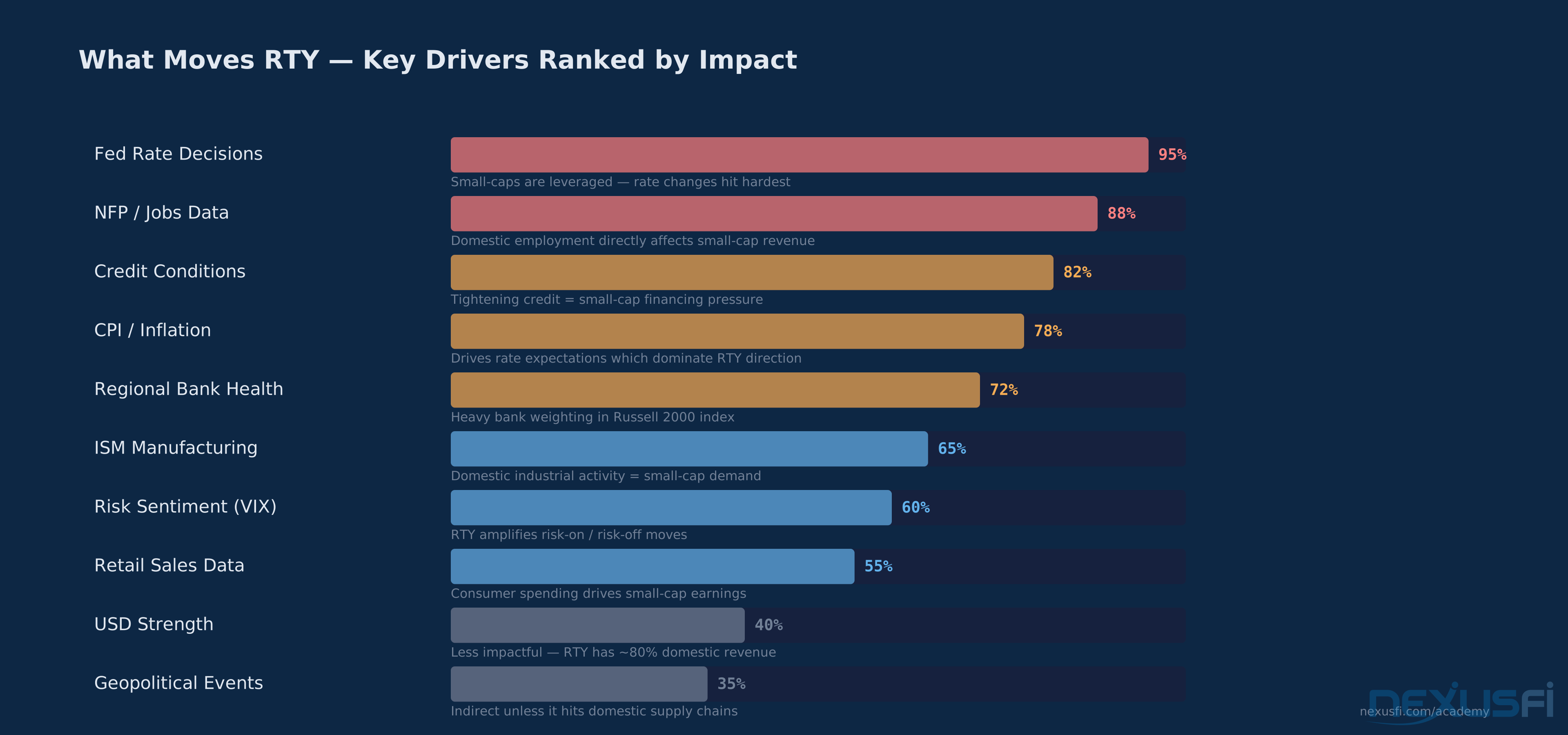
Interest Rates and Fed Policy #
Nothing moves RTY like the Fed. Small-cap companies carry more debt relative to earnings than large-caps, making them acutely sensitive to borrowing costs. When the Fed signals rate cuts, RTY typically outperforms ES by 2-3× on a percentage basis in the initial reaction. When the Fed surprises hawkish, RTY gets hit first and hardest.
The mechanism is direct: higher rates increase debt servicing costs for leveraged small businesses, compress multiples for growth-dependent small-caps, and tighten credit availability from regional banks
Employment and Consumer Data #
Nonfarm payrolls, CPI, retail sales, ISM manufacturing
Credit Conditions and Regional Banking #
The 2023 regional banking crisis (SVB, First Republic, Signature) demonstrated this dependency brutally. RTY dropped over 10% in weeks while ES held up better, precisely because the Russell 2000's heavy regional bank weighting meant the index was directly exposed to the sector in crisis.
Credit spreads widening, lending standards tightening, bank earnings deteriorating
Risk Sentiment #
RTY is the purest risk-on/risk-off instrument in the equity futures complex. When VIX spikes and institutional money de-risks, RTY underperforms ES because small-caps are the first allocation to get cut. When sentiment turns bullish and money flows back into risk, RTY leads the recovery. This makes RTY a useful sentiment gauge even if you don't trade it directly.
What Doesn't Move RTY (as Much) #
Dollar strength has a weaker effect on RTY than on ES or NQ because of the domestic revenue tilt. Geopolitical events matter less unless they directly impact US supply chains or consumer confidence. FAANG earnings
Seasonal Patterns and Key Events #
Russell Reconstitution (Late June) #
This is the single most predictable RTY event of the year. Every June, FTSE Russell reconstitutes the Russell 2000 index
Traders who understand the mechanics can position around the reconstitution: stocks being added to the index get bought by index funds, creating upward pressure, while deletions face selling. The net effect on RTY is often a volatility spike followed by directional resolution as the new composition takes effect.
January Effect #
Historically, small-caps outperform large-caps in January
Tax-Loss Harvesting (Q4) #
October through November brings selling pressure to small-caps as investors dump losers for tax benefits. This creates a seasonal headwind for RTY that often reverses in December as that selling concludes.
Practical Considerations #
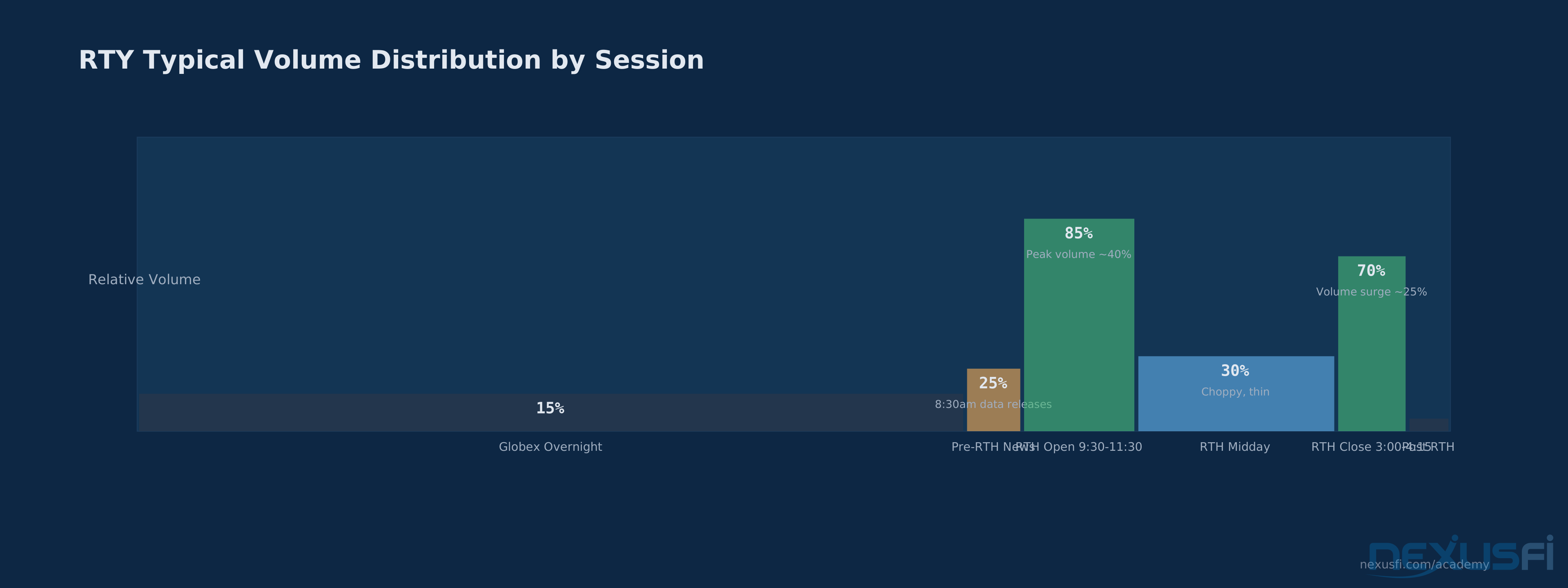
Session Timing #
RTY's liquidity is concentrated more heavily in RTH than ES. About 40% of daily volume trades in the first two hours after the open (9:30-11:30 AM ET), and another 25% in the closing hour (3:00-4:15 PM). The midday session (11:30 AM-3:00 PM) is noticeably thinner and choppier. The overnight session carries about 15% of volume with wider spreads and less reliable price action.
As @sstheo laid out in a set of disciplined trading rules: "Trade only during the first two hours of the New York session. No pre-market trading. No holding overnight." [3] That approach works especially well for RTY where the liquidity concentration is even more pronounced than ES.
Slippage and Order Management #
RTY's thinner book means you need to think about execution differently than ES. Market orders on 5+ lots can move the book. Limit orders are important. Stop orders can slip more than expected during fast markets
For day traders, this means keeping position sizes reasonable relative to the book depth. For swing traders, it means using limit orders for entry and being realistic about fill prices during volatile sessions.
Who Trades RTY #
RTY attracts a different crowd than ES:
- Prop firm traders: The lower margin and smaller notional make RTY popular for funded accounts. Many prop firm evaluations allow RTY trading.
- Spread traders: RTY/ES and RTY/NQ spreads are active strategies. As @benedmunds shared on NexusFi, "I've been actively trading the RTY/ES spread for a few months now and it's one of my more profitable strategies. I don't trade it on trend days, so I'm only looking to trade it on days that are mean reverting early in the session." [4]
- Macro traders: Rotation between large-cap and small-cap via ES/RTY spreads is a classic institutional play. As @kkfx noted, "The common spreads are NQ/ES, YM/ES, ES/EMD, EMD/RTY"
- Day traders focused on RTY specifically: Some traders, like @DowDaddy, commit entirely to RTY. "I realized focusing on 1 contract is very important. For me that is the Russell 2000 Index RTY. I am a short-term discretionary day trader. I use 15-Second Tick Index and RTY Line Chart, 2-Minute and 5-Minute candle charts." [6]
M2K for Scaling and Learning #
The Micro E-mini Russell 2000 (M2K) opens RTY to traders who don't have $7,000+ in margin for the full contract. At $0.50 per tick and $5 per point, M2K lets you trade the same instrument with one-tenth the risk. This is the right contract for new RTY traders building screen time, or for anyone scaling a small account methodically.
@sstheo's approach to micro scaling captures the right mindset: "After you are consistently successful on a sim account, open a live futures account and trade only the CME Micro E-mini contracts until your account is at least $5,000." [7] That advice applies to RTY just as much as ES or NQ.
When RTY Doesn't Work #
RTY has blind spots. On days dominated by a single large-cap earnings report (Apple, NVIDIA, etc.), NQ and ES react strongly while RTY barely moves
RTY also struggles during global macro shocks that don't have a clear domestic transmission mechanism. A European banking crisis, a China credit event, or an emerging market currency collapse will hit ES and NQ on the global contagion trade while RTY's domestic bias provides a partial buffer
The overnight session is especially treacherous on RTY. Wider spreads, thinner books, and the potential for sharp moves on overseas news that doesn't translate to domestic price action. As FuturesTrader71 noted, "Most of the bigger moves in this volatility actually took place overnight. This creates significant risk in that your stops may not trigger where you expect." [1]
Knowledge Map
Prerequisites
Understand these firstGo Deeper
Build on this knowledgeReferences This Article
Articles that build on this topicCitations
- — Trading the new CME E-Micros MES MNQ MYM M2K and other micros (2019) 👍 6“The risk here is $1.25 per tick per contract.”
- — Factors influencing intraday Stock indexes futures moves (2022) 👍 2“The RTY seemed like a nicer correlation trading the NQ.”
- — Micro E-mini Madness (1% per day) (2019) 👍 14“Trade only during the first two hours of the New York session.”
- — Pairs trading (2019) 👍 4“Ive been actively trading the RTY/ES spread for a few months now.”
- — Pairs trading (2019) 👍 4“The common spreads are NQ/ES, YM/ES, ES/EMD, EMD/RTY.”
- — Russell 2000 Mastery (2023) 👍 2“I realized focusing on 1 contract is very important. For me that is RTY.”
- — Micro E-mini Madness (1% per day) (2019) 👍 40“Open a live futures account and trade only the CME Micro E-mini contracts.”
- CME Group — E-mini Russell 2000 Index Futures Contract Specs (2026)