



Behavioral Biases in Prediction Market Trading
The cognitive errors that systematically cost prediction market traders money — and the systematic processes that counteract them.
Overview #
Behavioral biases are systematic patterns in human decision-making that deviate from rational probability estimation. In prediction markets, where your edge depends entirely on estimating probabilities more accurately than the market, these biases directly reduce profitability.
This article covers the most impactful behavioral biases for prediction market traders: what each bias is, how it manifests in event contract trading, and — most importantly — what you can do about each one.
In prediction markets, where your edge depends entirely on estimating probabilities more accurately than the market, these biases directly reduce profitability.
Why Behavioral Biases Matter More in Prediction Markets #
In equity markets, behavioral biases can be offset by long holding periods, dividend income, and the general tendency of assets to appreciate over time. A biased investor might still make money if they hold for decades.
Prediction markets offer no such cushion. Every contract resolves binary — YES or NO — on a defined date. There's no "hold until it comes back." Your probability estimate is tested against reality on every single trade, usually within days to weeks. Systematic errors in probability estimation show up in your P&L immediately.
The second unique factor: prediction market prices are themselves probability estimates. When you trade a prediction market, you're not just estimating an outcome — you're competing against every other participant's probability estimate. Your bias doesn't just cost you in terms of bad decisions; it costs you relative to everyone who has the same information but fewer cognitive errors.
Overconfidence Bias #
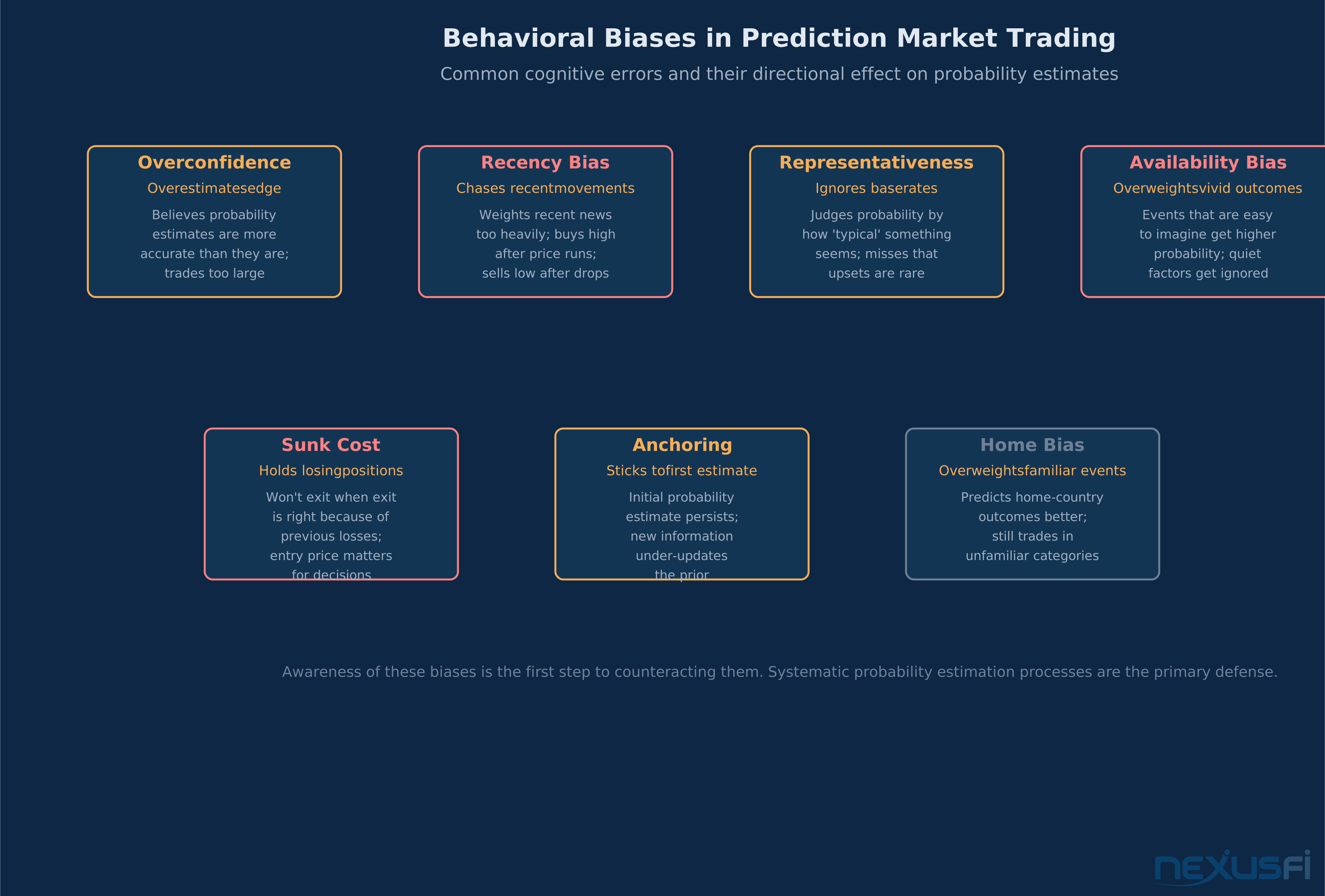
What it is: The systematic overestimation of the accuracy of your own probability estimates. Most people believe their estimates are more reliable than they actually are.
How it manifests in prediction markets: You estimate a 78% probability of YES and the market shows 65¢. The 13-point edge looks compelling. You size up. But if your true calibration is off by 8 points on average — meaning your "78%" estimates resolve YES about 70% of the time — your real edge is only 5 points, and you're likely over-betting.
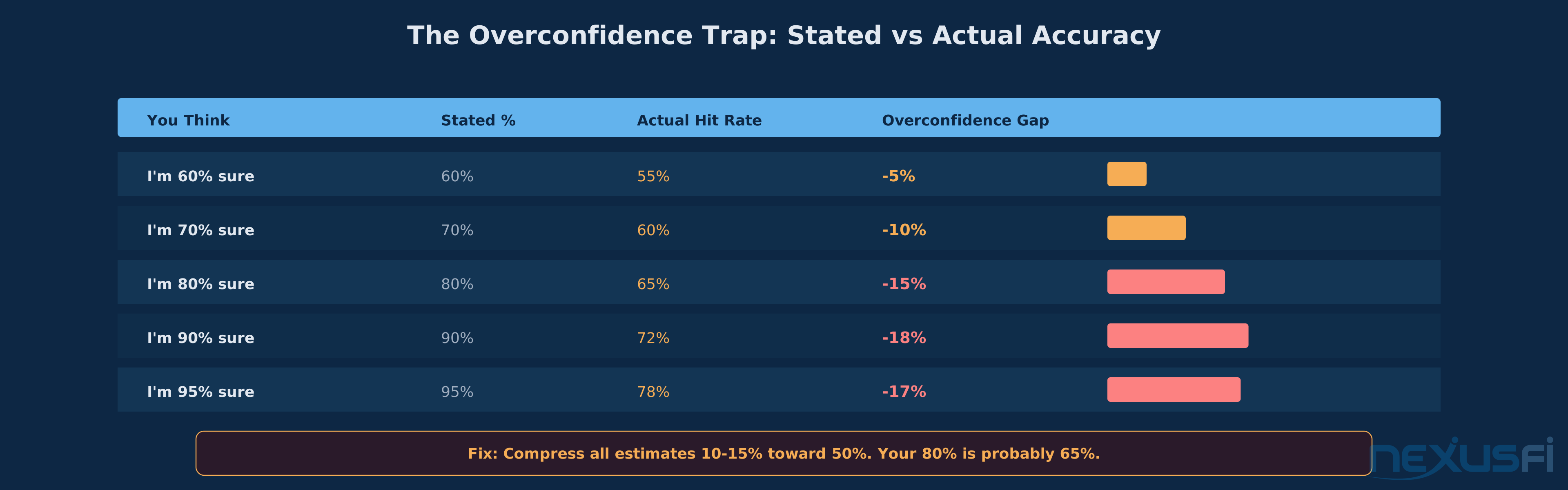
Overconfidence is pervasive in forecasting. Research consistently shows that people who say they're "90% confident" are correct only about 70-75% of the time. Prediction market traders tend to be more numerate and analytical than average, but overconfidence still appears in the data.
The test: Track your stated probability estimates against outcomes over 50+ trades. If your 80% estimates resolve correctly 80% of the time, you're well-calibrated. If they resolve correctly only 65% of the time, you're systematically overconfident by 15 points.
The fix: Apply a calibration adjustment. If your historical calibration data shows you're overconfident by 10 points, adjust all estimates down by 10 points before trading. This is uncomfortable but arithmetically necessary.
The second fix: use smaller position sizes until you have enough calibration data. A trader who has made 200+ prediction market trades and tracked their calibration can justify larger positions. A new trader has no calibration data and should trade small.
Recency Bias #
What it is: Overweighting recent events relative to longer historical base rates when forming probability estimates.
How it manifests in prediction markets: A candidate has a bad week of news coverage. Their election market drops from 65¢ to 55¢ in two days. You look at the stream of negative stories and decide the market has further to fall, buying NO at 45¢. But historical data shows that bad weeks don't systematically predict worse outcomes — they're mostly noise around a longer-term trend.
Recency bias is especially damaging in economic prediction markets. After a series of above-consensus CPI prints, traders assume the trend continues and overprice "above consensus" contracts. But economic data is mean-reverting — runs of surprises don't typically persist because they trigger the very policy responses that reverse them.
The test: Are your probability estimates correlated with recent price movements? If you tend to buy (or sell) contracts that have recently moved in the direction of your trade, you may be chasing recency rather than base rates.
The fix: Always estimate the base rate before looking at recent price action. The question is: "How often has this type of event occurred historically?" Then update from that base rate using the new information. Don't start from the recent price and work backward to justify it.
For economic data specifically: read the consensus forecast before looking at the current contract price. Form your probability estimate from your model or the consensus, then compare to the market — not the other way around.
Representativeness Bias #
What it is: Judging probability based on how "typical" or "representative" something seems, rather than actual base rates.
How it manifests in prediction markets: A political candidate gives an unusually forceful debate performance. It matches your mental model of "what a winning candidate looks like." You buy their contract at 72¢, even though the historical base rate for debate bumps translating to election wins is weak.
The classic representativeness error in prediction markets is overpricing dramatic, narrative-consistent outcomes. Scenarios that "make sense" get higher probability than the data supports; quiet, undramatic base rates get underweighted.
Example from NexusFi community trading: The small probability error documented in the tigertrader thread — where extreme outcomes (very small or very large probabilities) get mishandled. Most people either ignore very small probabilities entirely or treat them as impossible; representativeness drives the second error by leading traders to underestimate how rarely "obviously likely" outcomes actually fail.
The fix: Explicitly enumerate the base rate for every trade. "How many times has this type of event happened historically? What fraction ended in YES?" Then update for specific information. Don't let narrative substitute for calculation.
Availability Bias #
What it is: Overweighting outcomes that are easy to imagine or bring to mind, regardless of their actual frequency.
How it manifests in prediction markets: Catastrophic political events are more vivid and memorable than quiet stability. Traders consistently overprice dramatic negative outcomes — constitutional crises, market crashes, geopolitical shocks — relative to their actual base rates.
Conversely, long-running trends that have been stable for years become "boring" and get underpriced because they don't generate vivid mental images. Traders chronically underprice "nothing major changes" scenarios.
Practical implication: Be skeptical of contracts that price low-probability dramatic events. The availability bias suggests these are systematically overpriced. Look for contracts that price "everything stays roughly the same" — these may be underpriced.
The fix: Calibrate against frequency data. For any dramatic outcome you're tempted to trade, look up how often historically similar events have occurred. The data is almost always more boring than your vivid mental image of the possibility.
Sunk Cost Fallacy #
What it is: Allowing past losses or investments to influence current decisions, when only future outcomes should matter.
How it manifests in prediction markets: You bought YES at 65¢ and the contract has fallen to 45¢ based on new information. Your analysis now suggests the true probability is 40%. You should sell.
But you paid 65¢. Selling at 45¢ locks in a real loss. You hold instead, hoping for a reversal. The entry price of 65¢ has zero relevance to whether the contract is worth 45¢ today — but psychologically, it feels like it matters.
In prediction markets, the sunk cost fallacy is especially toxic because contracts resolve to 0 or 1. Holding a position that's moved against you because you "paid 65" means watching it resolve at 0. The exit price you're protecting yourself from is always better than $0.
The fix: Ask the question as if you don't own the position. "If I could enter this position right now for free, would I buy YES at 45¢ given my current probability estimate of 40%?" If the answer is no, sell.
This reframe separates the entry price (irrelevant) from the current probability estimate (all that matters).
Anchoring #
What it is: Insufficient updating of probability estimates when new information arrives. The first estimate anchors future estimates even when new data warrants large revisions.
How it manifests in prediction markets: Your initial estimate for a contract is 55%. Significant new information arrives — a major data release, an important endorsement, breaking news — that should revise your estimate to 75%. But you update only to 62%, because 55% is psychologically "sticky."
Anchoring creates predictable under-reaction to new information. Research on financial markets consistently shows prices update more slowly than Bayesian theory would suggest, and the residual drift is exploitable.
The fix: When updating your probability estimate, calculate the new Bayesian posterior explicitly. Don't just nudge your existing estimate — calculate what the new evidence implies from a clean slate, then compare to your prior estimate. If the gap is large, trust the math more than your intuition.
Building a Bias-Resistant Trading Process #
The consistent theme across all these biases: they are errors in process, not intelligence. Smart, analytical traders are just as susceptible as anyone else — sometimes more, because they're better at rationalizing biased decisions.
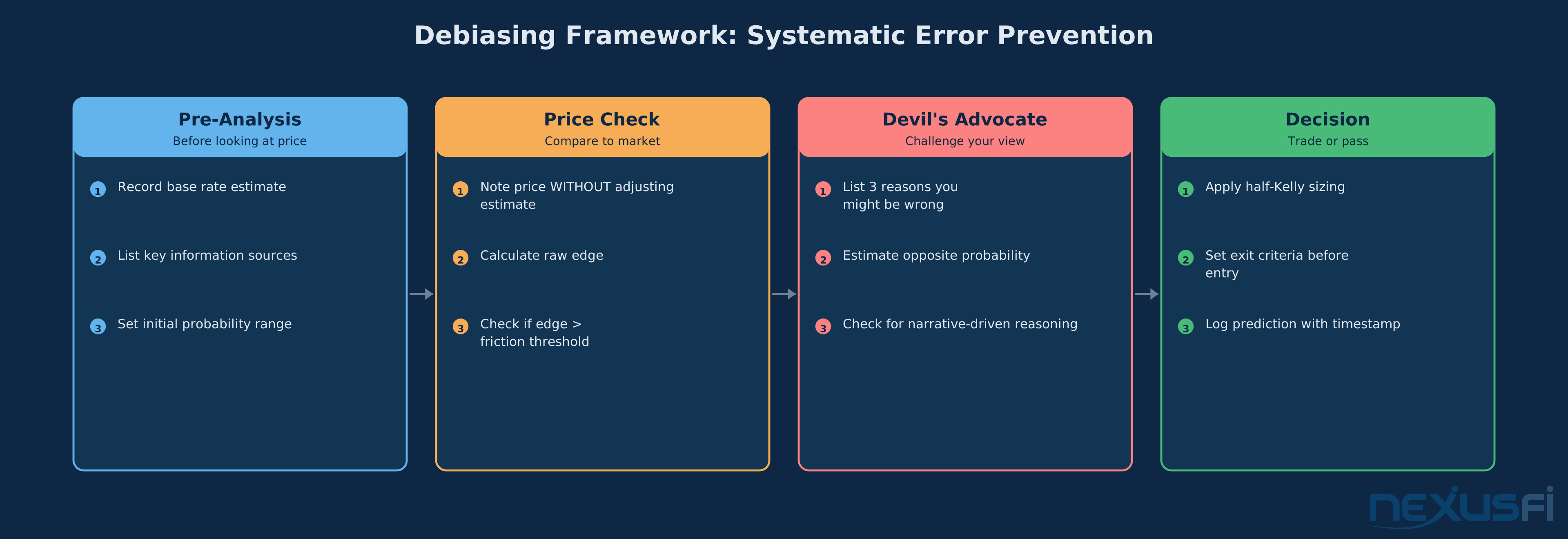
The defense is systematic process:
1. Pre-trade checklist: Before any trade, explicitly state:
- Your probability estimate (formed before checking price)
- The base rate this estimate is anchored to
- What specific new information moves you away from the base rate
- What price would falsify your thesis
2. Calibration tracking: Track every trade with your stated probability, the market price, and the resolution. Review calibration quarterly. Adjust estimates based on demonstrated bias.
3. Position sizing discipline: Size positions as a function of calculated edge, not conviction. If the formula says 3% of bankroll, don't double it because you feel strongly.
4. Exit rules: Establish exit criteria at entry. "I will exit this position if the contract reaches [price] or if [specific information] emerges." Exit when the criteria are met, not when it feels right emotionally.
5. Review losing trades for process failures: When you lose money, ask whether the loss came from bad luck (correct process, wrong outcome) or bad process (bias-driven decisions). Identify which biases were present.
Citations #
- @tigertrader: Spoo-nalysis ES e-mini futures — probability extremes — Community insight on systematic errors with small and large probabilities
- @HumbleTrader: HumbleTrader's next chapter — recency bias — Trader's first-hand account of recency bias patterns
- @Fi: Kalshi, Polymarket, Prediction Markets etc — Community analysis of prediction market decision quality
- @Fi: Value Betting in Prediction Markets — Systematic approach to counteracting biases through EV calculation
- Prediction Market Order Types: Limit Orders, Market Orders, and Order Book Mechanics — Structural understanding supporting disciplined execution
This article is part of the NexusFi Academy Prediction Markets series. Full series at /a/prediction-markets/.
Knowledge Map
Prerequisites
Understand these firstGo Deeper
Build on this knowledgeReferences This Article
Articles that build on this topicCitations
- — Event Contracts - New Way to trade the CME Futures markets (2022) 👍 6
- — Kalshi, Polymarket, Prediction Markets etc (2025)
- — NADEX Binary Options Cost Breakdown Comparison (2017) 👍 3
- — Nadex AMA - Dan Cook (2019) 👍 5
- — Cboe Eyes Prediction Markets With Regulated Binary Options (2026)