



Trading Prediction Market Resolution: What '90%' Really Means and How Contracts Actually Settle
Overview #
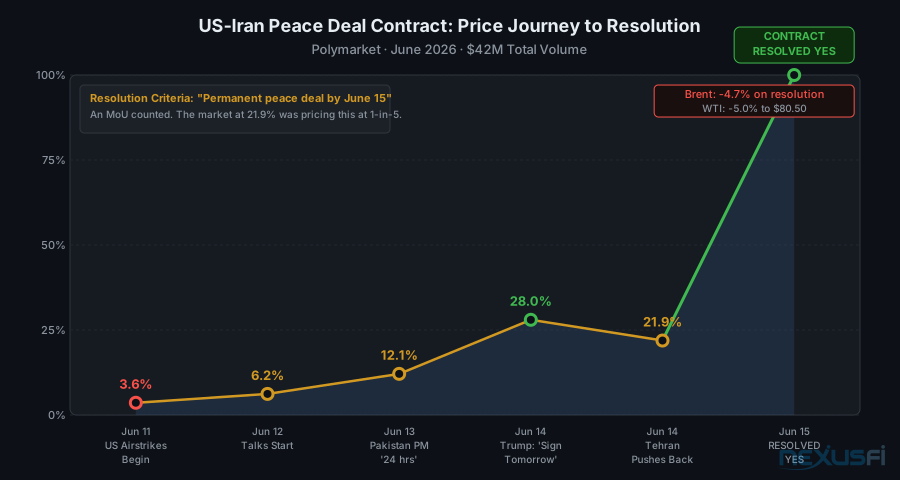
On the morning of June 14, 2026, a prediction market contract on Polymarket sat at 21.9%. The contract: US-Iran Permanent Peace Deal by June 15. It had spent most of May between 3% and 12%. It had briefly spiked to 28% after Trump announced Saturday that the deal would be signed the following day. Tehran pushed back. The price settled at 21.9%.
The NexusFi prediction markets thread that morning noted the resolution criteria carefully: as @Fi observed, "'permanent peace deal by June 15' is specific. An MoU extension, a ceasefire continuation, or a framework announcement that isn't formally signed does not resolve YES. The market at 21.9% is pricing in roughly a 1-in-5 shot that a formal signature lands by tomorrow midnight."
By the following morning, the contract had resolved YES. An MoU — a Memorandum of Understanding — counted. Brent crude fell 4.7%. WTI dropped 5% to $80.50. The contract went from 21.9% to 100% in hours.
Resolution criteria beat the narrative. Fi's analysis correctly identified the resolution risk. The contract resolved YES not because everyone agreed a "permanent peace" had occurred — many didn't — but because the exact wording of the Polymarket resolution clause applied the MoU signing to its definition. The contract spec, not the geopolitical narrative, determined the outcome.
That sequence contains every lesson this article covers. The market at 21.9% was pricing the event at roughly 1-in-5 odds — skeptical based on Tehran's pushback. What the market wasn't fully pricing was the exact wording of the resolution clause. A trader who read the contract spec and understood that a formalized MoU would satisfy "permanent peace deal" had genuine edge. A trader who assumed "real peace" and the contract definition were the same thing had a different risk profile entirely.
At 90%+ probability, prediction market tail risk is not about being wrong on the event. It's about being wrong on the settlement mechanics. Understanding those mechanics — how Kalshi, Polymarket, and CME event contracts actually move from "event happened" to "funds released" — is the edge most traders skip.
The Settlement Gap: Event vs. Payout #
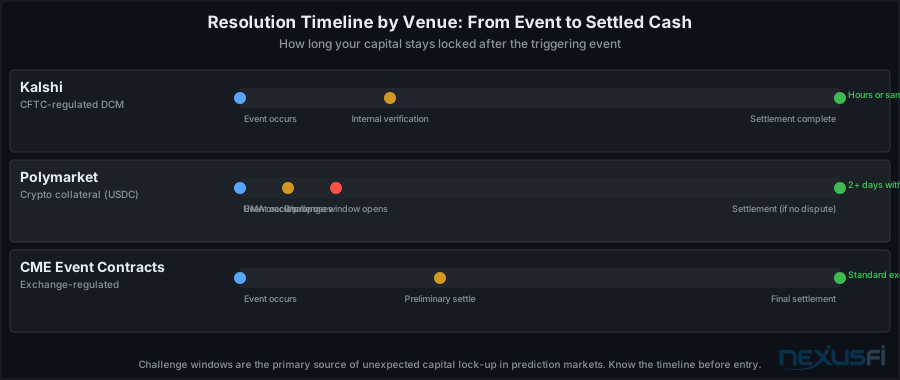
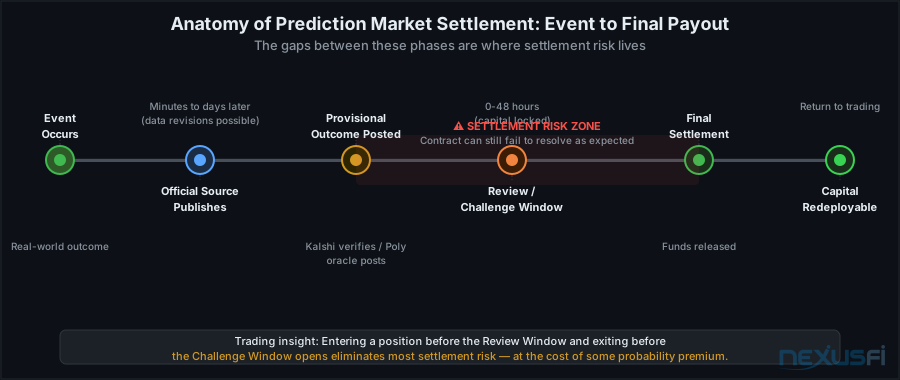
Every prediction market operates on a fundamental gap: the event you're trading and the payout you receive are separated by a settlement process that can take minutes, hours, or days. During that gap, capital is locked, disputes can be initiated, and data sources can revise. Most traders think of this gap as administrative overhead. The professionals who make money in high-certainty binaries think of it as a separate risk layer that must be priced and managed explicitly.
The gap has a name: the settlement risk zone. It begins when the provisional outcome is posted and ends when final funds are released. Inside that zone, three things can happen that the headline probability doesn't capture:
- Dispute initiation -- on Polymarket, any participant can challenge the provisional outcome during the open challenge window. On Kalshi, internal review can extend settlement.
- Data revision -- many official statistics are preliminary. If the contract uses "as originally reported" versus "final," a revision changes the settlement figure.
- Edge-case application -- the contract wording is applied to the specific facts of the event, not the general narrative. "Permanent peace deal" versus "MoU" is an edge-case definitional question. Those questions decide winners.
Professional binary traders don't just forecast events. They audit contracts. Before entering any high-certainty position, they read the resolution clause — the actual legal language, not the market title — and map every source of ambiguity against their expected hold time.
How the Three Major Venues Actually Settle #
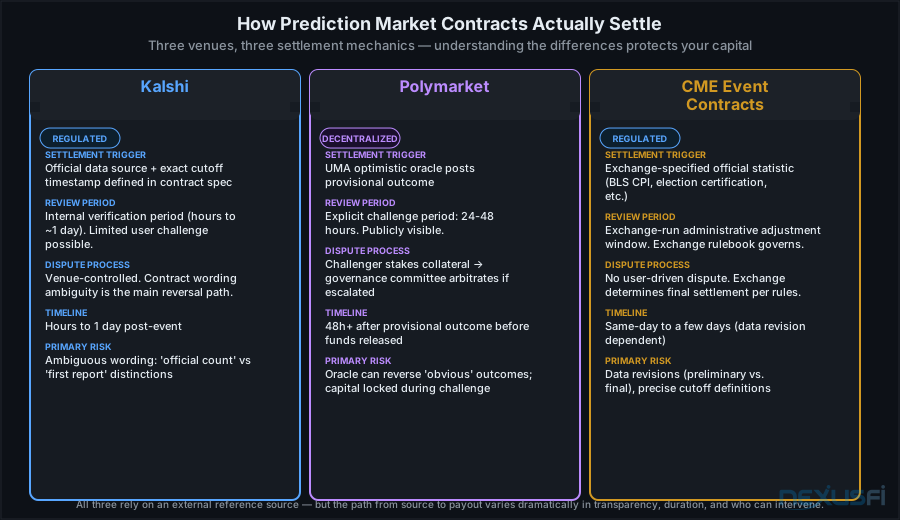
Understanding each venue's settlement mechanics is prerequisite knowledge for trading them at high-certainty levels. The differences between Kalshi, Polymarket, and CME event contracts are not minor — they determine how long your capital is locked, who can challenge the outcome, and whether "obvious" resolutions can be delayed or overturned.
Kalshi: Internal Verification + Limited Challenge
Kalshi's settlement process is exchange-controlled and uses pre-defined official data sources with exact cutoff timestamps baked into the contract specification. After the event, Kalshi enters a verification period — typically hours to roughly one day — during which the designated data source is confirmed against the resolution criteria.
The dispute mechanism exists but is primarily internal. Unlike Polymarket's fully public challenge process, Kalshi's dispute path is venue-controlled. A user who believes the outcome was incorrectly determined can raise an issue, but the process runs through Kalshi's operational framework, not through open governance. In practice, the most common "surprise" on Kalshi isn't a successful user-initiated reversal — it's ambiguous contract wording that the venue interprets differently than the market expected.
Key settlement risks on Kalshi:
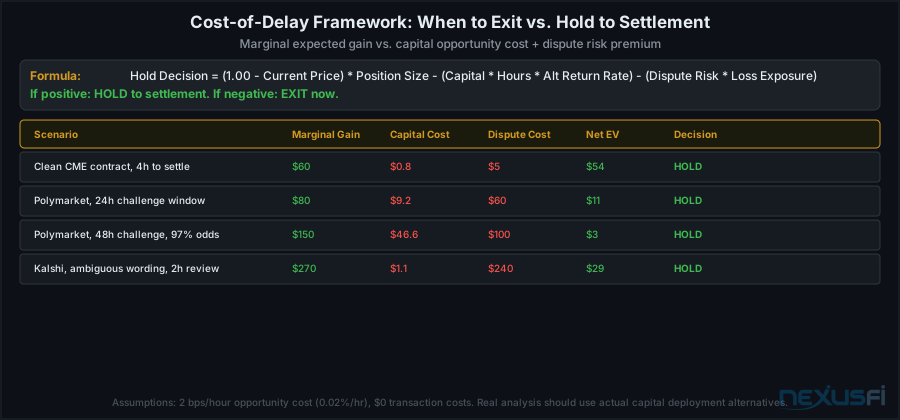
- Contract language ambiguity -- "official count" versus "first report" is the most common culprit. A contract that resolves on the "certified election result" will not settle when networks call the race.
- Late data publication -- the official source sometimes publishes later than traders expect, extending the review period.
- Edge-case definitions -- ties, disqualifications, entity renames, or measurement methodology changes that the contract didn't explicitly address.
Polymarket: UMA Oracle + Public Challenge Window
Polymarket's settlement infrastructure is at the core different from Kalshi's. After the event occurs, a UMA (Universal Market Access) oracle posts a provisional outcome. This begins a public challenge window — typically 24 to 48 hours — during which any participant can dispute the provisional resolution by staking collateral. For a deep dive on how UMA's oracle system specifically works, see Polymarket UMA Oracle Deep Dive.
If a challenge is filed, the dispute escalates through a governance arbitration process. A committee (or token-weighted governance, depending on the market type) reviews the evidence and determines the final outcome. Only after this entire process completes — with no outstanding disputes — are funds released to the winning side.
This architecture has critical implications for high-certainty trading:
- Capital lock-up -- funds are not accessible during the challenge window, regardless of how "obvious" the outcome appears. You cannot redeploy capital until finality.
- Outcome reversal is possible -- rare but documented. A successful challenge can flip a market that initially resolved in favor of one side. Sports markets where games were suspended or declared no-contest have experienced this.
- Oracle selection risk -- the oracle may reference a different source within the contract's source hierarchy than traders assumed.
The good news: Polymarket's challenge history is largely public. Researching whether a specific contract type has experienced disputes in the past gives you calibration data for how much to discount the face probability.
Use Polymarket's forum and resolution notes. Many markets have linked discussion threads where the oracle's reasoning is documented. Before entering a high-certainty Polymarket position, search for the market's resolution history. Contracts where similar wording previously triggered a dispute are higher-risk — price that in.
CME Event Contracts: Exchange-Regulated Settlement
CME event contracts sit at the other end of the regulatory spectrum from Polymarket. As exchange-listed instruments, they settle via formally designated official statistics — BLS CPI releases, election certification by designated authorities, exchange pricing benchmarks. For a full overview of CME event contract specifications, see CME Group Event Contracts.
The dispute mechanism is not user-driven. There is no public challenge window. CME's internal processes handle any administrative questions, and the exchange rulebook is the final word. This makes CME event contracts generally more predictable in their settlement timeline — but they carry their own risk layer:
- Preliminary versus final data -- many macro releases have preliminary and revised versions. A contract that references the "final" CPI figure may settle differently than one using the "as originally reported" figure.
- Administrative adjustment windows -- for some contract types, CME allows a brief window after the official release for administrative corrections. This can delay final settlement.
- Precise cutoff definitions -- CME contracts are written with exact legal language about what constitutes the triggering event. Traders who skim the contract spec often miss these distinctions.
Settlement Risk When a Contract Reaches 90%+ #
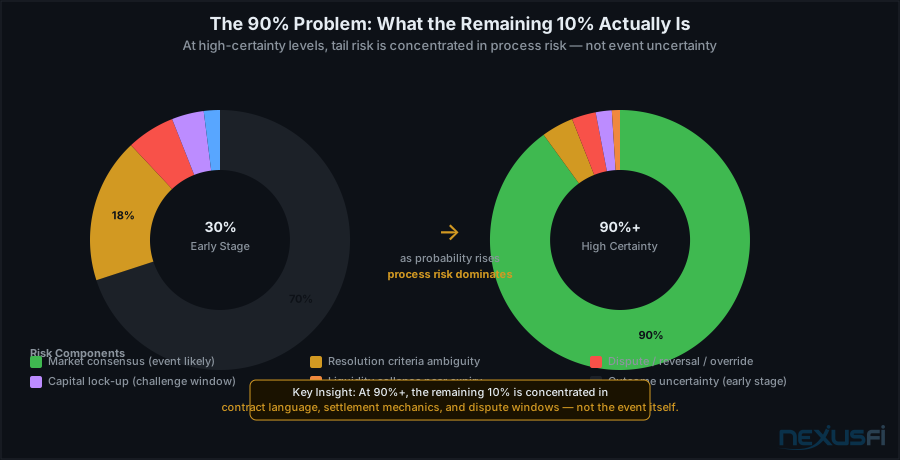
At 90%+ probability, the composition of risk in a binary contract changes completely. Early in the contract's life, when probability sits at 30-40%, the dominant risk is outcome uncertainty — the event might not happen, or might happen differently than expected. At 90%+, that uncertainty has largely resolved. The market is saying the event is very likely to happen as expected.
But the remaining 10% is not distributed evenly across "the event still might not happen" scenarios. At high-certainty levels, the tail is concentrated in specific, identifiable process risks. The Risk Management for Prediction Market Traders article covers overall position-level risk, but settlement risk at high probability levels requires its own framework.
Resolution Criteria Ambiguity
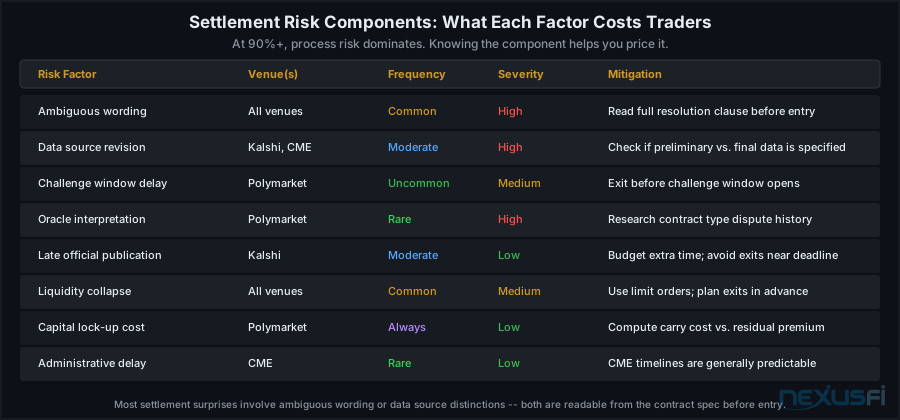
The most common source of settlement surprises is definitional. The contract says one thing; the market prices another. In the Iran deal example, @Fi's prediction markets thread specifically flagged that "an MoU extension, a ceasefire continuation, or a framework announcement that isn't formally signed does not resolve YES." That was a reasonable reading of "permanent peace deal." The market at 21.9% was partly pricing the risk that a formalized MoU wouldn't qualify.
But the contract resolved YES when the MoU was signed. The specific wording of the Polymarket resolution criteria — how it defined "permanent peace deal" — determined the outcome, not the geopolitical narrative. Traders who had read the exact contract language and understood how Polymarket's oracle would apply it to an MoU had material informational edge over traders relying on the headline probability.
@Fi (NexusFi, Prediction Markets forum, June 2026)
-- Then: the contract resolved YES on an MoU. The edge was in reading the oracle's criteria more carefully than the market did.”
This plays out across every contract type: "certified election result" versus "network call," "final CPI" versus "preliminary CPI," "won the game" versus "awarded the victory after an appeal." The contract spec is the trading instrument. The event is just the mechanism that determines its settlement.
Data Revision Risk
Many official data releases come in preliminary form and are subsequently revised. Labor Department employment figures, GDP estimates, and certain other economic releases have revision processes that can materially change the numbers. A contract that resolves on the "as originally reported" figure will settle at a different price than one using the final revised figure — and that difference can flip the binary from YES to NO or vice versa.
Check whether the contract explicitly addresses revision handling. If it doesn't — if it's silent on the issue — that ambiguity itself is a settlement risk, because the venue will apply its own interpretation when a revision occurs.
Dispute and Reversal Risk
On Polymarket specifically, the challenge window creates a period during which an outcome that initially resolves in one direction can be overturned. Sports markets are the most common venue for this: a game suspended midway through, a result later changed upon appeal, a player ruling that affected the official outcome. In several documented cases, a market that provisionally resolved YES spent the 48-hour challenge period in dispute before ultimately settling differently.
The practical risk for high-certainty traders isn't that you'll be dramatically wrong on the event. It's that you'll be right on the event and still face a delayed or contested settlement — with your capital locked during the process.
Liquidity Collapse Near Expiry
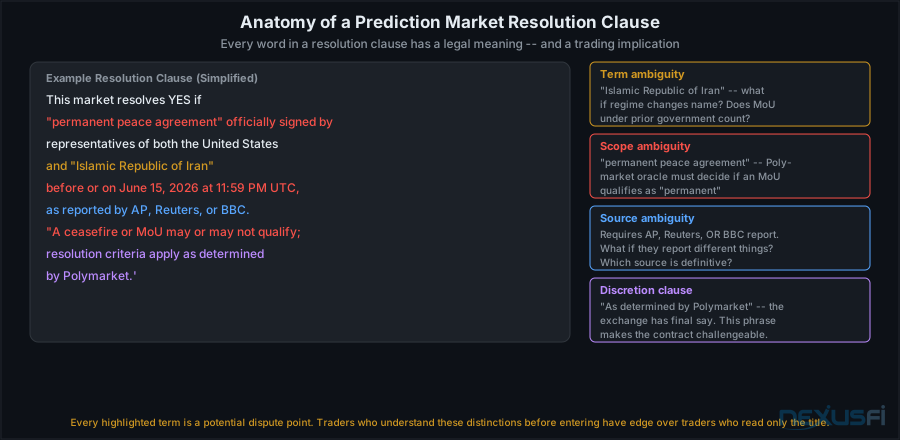
As contracts approach resolution, order book dynamics change. Market makers withdraw quotes because the directional bet is increasingly one-sided and the carry cost of providing liquidity outweighs the spread capture. This means spreads widen sharply in the final hours. A contract that traded with a 1-cent spread through most of its life might have a 5-10 cent spread in the last two hours before resolution.
The relationship between settlement mechanics and liquidity is well understood from traditional futures markets.
[NexusFi, 2013] The same principle applies to prediction market binaries — the settlement mechanics determine both your exit timing and the depth you'll face.
Capital Lock-Up Cost
Even when the resolution is straightforward and fast, there's an opportunity cost to capital locked in a nearly-resolved position. If the marginal return from holding through a Polymarket challenge window is 0.03 (moving from 0.97 to 1.00) and your capital can earn a higher risk-adjusted return elsewhere during that 48-hour period, the expected value of staying in is negative — even with 97% certainty of resolution in your favor.
This is especially relevant for traders who run multiple positions simultaneously. Capital tied up in a high-certainty binary that hasn't yet released is capital that can't be deployed to new opportunities emerging in real time. The Position Sizing for Binary Event Contracts article covers how to account for capital efficiency in sizing decisions.
Trading Strategies for the Final Hours #
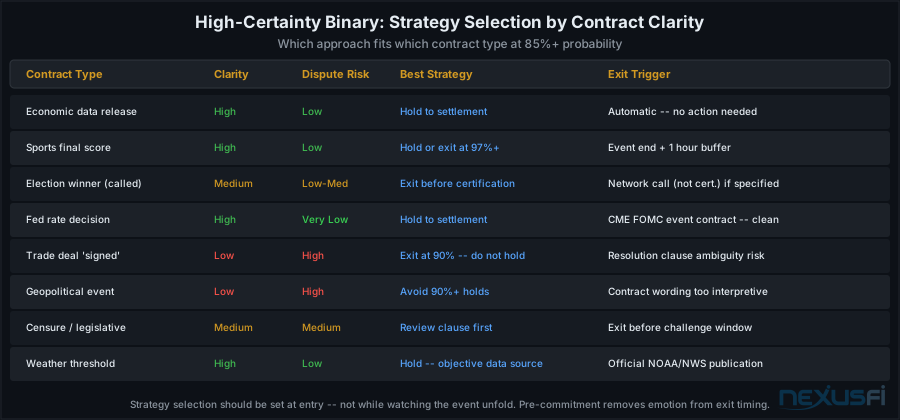
Once a prediction market contract trades above 85-90%, the tactical framework changes. Here are five approaches that professional prediction market traders use, along with when each makes sense:
Exit Before the Challenge Window Opens
The cleanest risk-management approach for high-certainty positions: identify when the venue's challenge window begins and plan exits before it opens. On Polymarket, this is when the UMA oracle posts the provisional outcome. On Kalshi, watch for the "resolution imminent" flag or announcement. Exiting before these triggers means you collect your winnings (or cut losses) while the order book still has reasonable depth — and you free capital for immediate redeployment.
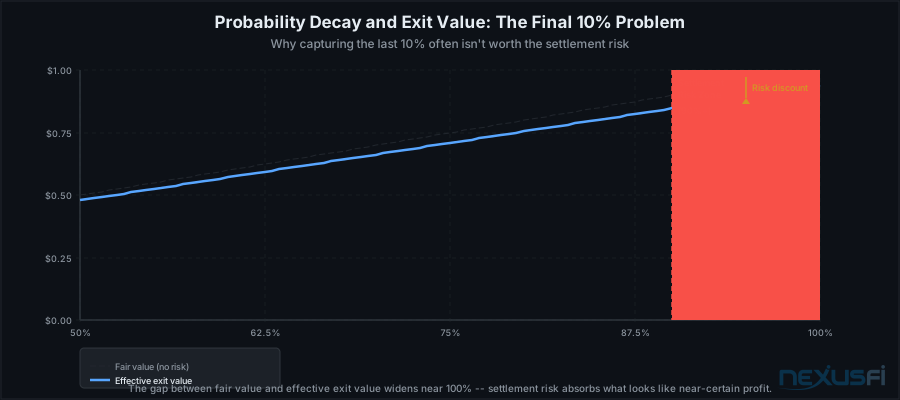
The cost: you leave the last 2-5% of potential gain on the table. For a contract moving from 95% to 100%, that's typically $0.02-0.05 per share. Against the alternative of having capital locked for 48 hours and facing a non-zero dispute reversal risk, many experienced traders take this trade-off consistently.
Hold to Settlement on Clean Contracts
When the resolution criteria is genuinely unambiguous — a single authoritative source, a non-revisable data point, exact cutoff timestamps, no edge-case provisions that could create uncertainty — holding through settlement captures the full expected value. The key word is "genuinely." Most contracts have some degree of ambiguity. The contracts that truly don't are worth identifying and treating differently.
Characteristics of a "clean" contract: references a single, final, non-revisable data source; has a clearly specified timestamp; addresses ties and edge cases explicitly in the resolution clause; has no history of disputes for this type of market on this venue. If all four conditions are met, the expected value of holding through settlement exceeds the cost of the carry risk.
Spread Capture via Market-Making
When book depth thins near expiry, bid-ask spreads widen to levels where market-making becomes profitable. If you understand the settlement mechanics well enough to know the outcome is highly certain, quoting both sides — bidding at 0.95 and offering at 0.97 on a contract heading to YES at 1.00 — captures the spread while the directional risk is minimal.
The constraint: one dispute or reversal can wipe out many spread-capture wins. This strategy requires confidence in settlement quality and a clear exit rule if dispute activity begins. Never use market orders when executing this strategy; limit orders only, with cancel-if-touched triggers tied to dispute signals. For deeper coverage of market microstructure, see Prediction Market Microstructure.
Probability Compression Trade
In the 94-97% range, the remaining probability premium often represents something other than genuine outcome uncertainty — it's partly settlement risk compensation, partly liquidity risk premium, partly the risk aversion of remaining short-side holders. Traders who can accurately assess what fraction of that residual is "real" versus "process overhead" can find edge in the probability compression.
This works like a short-dated binary options trade: you're effectively selling tail risk on a contract approaching certainty. The mechanics favor the trader when the contract's settlement path is clean. They destroy the trader when the unexpected happens — so position sizing matters more here than in any other prediction market strategy.
Cost-of-Delay Analysis
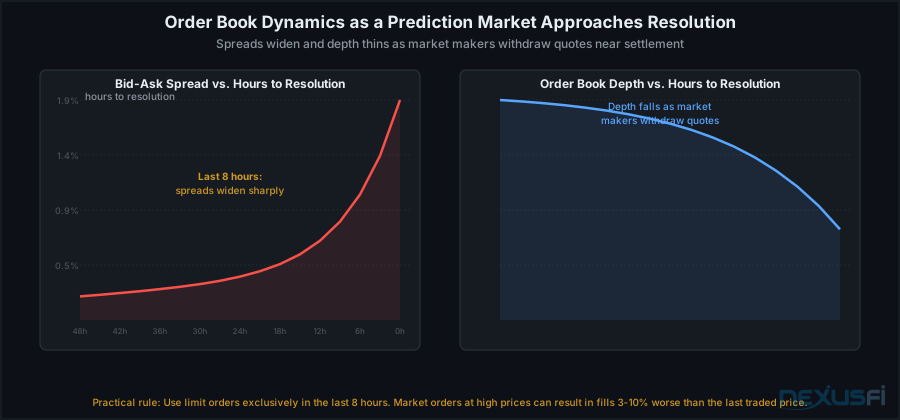
Before deciding whether to hold a high-certainty position through settlement, compute an explicit carry analysis:
- Expected gain from holding: (1.00 - current price) x position size
- Challenge window duration: hours of capital lock-up
- Alternative return available: what else could that capital earn?
- Dispute probability: estimated reversal or delay risk
If (expected gain) - (opportunity cost of locked capital) - (dispute risk premium) is positive, hold. If negative, exit. This framework makes explicit what most traders leave implicit — and often reveals that exiting at 0.94 is better expected value than holding to 1.00, especially when challenge windows run 24-48 hours on capital that could otherwise be actively deployed.
Capital lock-up is a hidden cost. Most traders calculate their expected profit on a high-certainty binary as (1.00 - current price). They forget that capital is locked until settlement — sometimes 48+ hours. A 3% gain over 48 locked hours on capital that could earn 5% annualized elsewhere is a breakeven trade, not a free win. Run the cost-of-delay analysis before every hold-to-settlement decision.
Execution Mechanics Near Resolution #
Beyond strategy, the mechanics of order execution change in the final hours before resolution. Experienced traders adapt their execution approach as the clock runs down. For the foundational execution framework, see Prediction Market Order Types — this section addresses specifically how to adapt those mechanics near resolution.
Use limit orders exclusively. Market orders in thin prediction market books in the final minutes can result in fills far from the last traded price. If you need to exit, enter a limit order at a price you're willing to accept and let the book come to you.
Monitor order book depth, not just last price. A contract showing 0.94 last traded might have zero depth at 0.93-0.95, meaning any meaningful size move will gap through levels. Check depth before size.
Be aware of withdrawal patterns. Market makers often pull their quotes in the last 5-10 minutes before resolution, creating sudden price gaps and spread widening. If you see depth disappear rapidly, that's a signal the book is clearing before settlement — not a signal the outcome is in doubt.
Don't chase final prints. A contract moving from 0.95 to 0.98 in the last hour before resolution is not offering new information about the event — it's reflecting liquidity dynamics. Chasing it means paying an increasing slippage penalty for the same position.
Plan exits before the event, not after. The decision framework for when and how to exit should be determined in advance, when you're not emotionally invested in the real-world event unfolding. Traders who plan "I'll exit at 0.95 if it hits that level before the challenge window" make better decisions than traders who improvise in real time.
The Pre-Trade Resolution Audit #
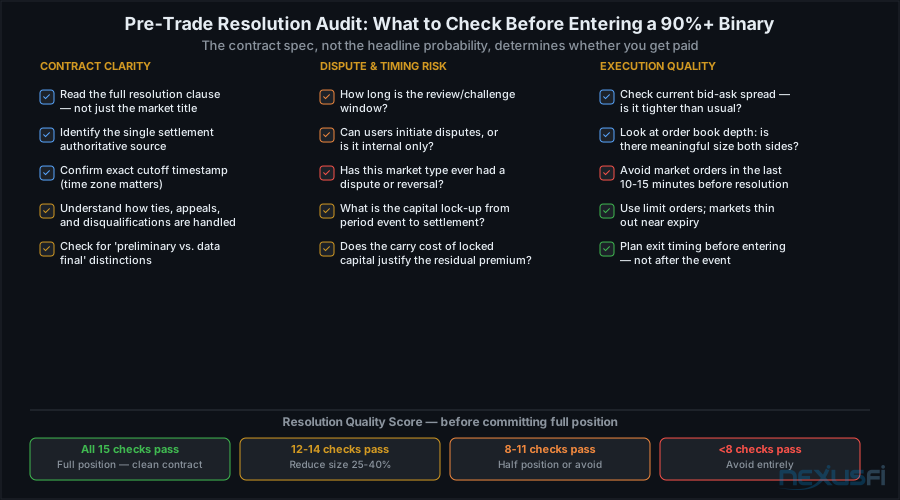
Before entering any position that will be carried into the high-certainty range (above 85-90%), experienced prediction market traders run a pre-trade audit against the contract specification. This is not optional — it's the foundation of the entire trade thesis.
The audit covers three areas:
Contract Clarity
Read the full resolution clause. Not the market title, not the description summary — the actual legal language governing settlement. Ask:
- What is the single authoritative settlement source?
- What is the exact cutoff timestamp, in which timezone?
- How does the contract handle ties, appeals, and disqualifications?
- Does it use "preliminary" or "final" data for macro releases?
- Is there any language that allows for "reasonable discretion" in interpretation?
Any answer that requires judgment or interpretation is a risk factor. The more subjective the resolution language, the wider the process tail on high-certainty positions.
Dispute and Timing Risk
Understand the mechanics of what happens after the event:
- How long is the review/challenge window on this specific venue?
- Can participants initiate disputes, or is the process internal only?
- Has this contract type experienced disputes or reversals historically?
- If a dispute is filed, what is the realistic timeline to resolution?
- Does the expected carry cost of locked capital justify the residual probability premium?
Execution Quality
Before sizing into a high-certainty position:
- What is the current bid-ask spread? How does it compare to the spread at lower probabilities?
- Is there meaningful order book depth on both sides?
- At what size does your position meaningfully move the market?
- What are the realistic execution costs for the exit you're planning?
@SMCJB (NexusFi, Commodities forum, 2021)
The parallel in prediction markets: know exactly when capital is released, because that's when you can redeploy it. It's not automatic at the event — it's at final settlement, which may be hours or days later.”
What This Means for Futures Traders Using Prediction Markets as an Edge #
Many futures traders have started using prediction market probabilities as an overlay on their directional trading — tracking FOMC rate probability on Kalshi, geopolitical risk on Polymarket, or specific data-release contracts on CME. Understanding resolution mechanics matters for this use case too, but in a different way. For the complete framework on using prediction markets as a futures signal, see Prediction Markets as a Futures Trading Edge.
When you're using prediction market prices as an information signal rather than as a primary trading vehicle, the relevant risk isn't settlement — it's the price divergence that can occur during the settlement risk zone. In the Iran deal example, the prediction market price at 21.9% was genuinely pricing event uncertainty the morning before resolution. By the afternoon, the resolution criteria discussion had become the dominant factor. A futures trader watching Brent crude alongside the prediction market needed to understand why the prediction market was at 21.9% versus 50% — was it outcome uncertainty, or resolution uncertainty? Those two scenarios have different implications for oil price behavior.
As prediction markets become more integrated into the broader trading information ecosystem, the ability to distinguish between "the market thinks the event is uncertain" and "the market thinks the settlement mechanics are uncertain" becomes a genuine analytical edge.
Resolution Surprises: What Actually Goes Wrong #
Across all three venues, documented resolution surprises cluster into the same patterns. Understanding these patterns helps calibrate the discount you should apply to face probability on different contract types:
Ambiguous wording is the most common culprit. Election contracts where "winner" was interpreted as network call versus certified result. Trade deal contracts where "signed" meant different things to the market and the contract spec. Contracts where the difference between "announced" and "implemented" determined the outcome. In nearly every case, the event itself was not in dispute — only what the contract required as the qualifying event.
Late data publication creates timeline surprises. When the official source publishes later than the market expects — a delayed certification, a report held until after-hours, a regulatory ruling that takes longer than typical — positions are locked for longer than planned, and the carry cost grows.
Oracle/governance reversal is rare but has occurred on Polymarket, especially for sports markets involving suspended games, rule changes, and situations where the "common sense" outcome conflicted with what the oracle determined the contract language required. The reversal rate is low, but the impact is binary — a 97% position can go to zero.
Cross-platform interpretation differences affect traders who run arbitrage or hedging strategies across Kalshi and Polymarket for the same underlying event. For the cross-platform comparison, see Kalshi vs Polymarket: Choosing the Right Prediction Market Platform. When the two venues interpret resolution criteria differently, positions designed to hedge can end up doubling the loss.
Building a Resolution-Aware Trading Process #
The traders who consistently make money in high-certainty binaries aren't necessarily better at forecasting events. They're better at reading contracts. Their edge comes from:
- Contract selection discipline -- they build a preference for contracts with clean resolution clauses, single authoritative sources, and no precedent of dispute. All else equal, the cleaner contract at slightly lower probability is often the better bet.
- Venue specialization -- they know which contract types tend to resolve cleanly on each venue and which tend to generate edge-case disputes. That historical knowledge is calibration data for discounting face probability.
- Capital efficiency -- they treat challenge windows and review periods as opportunity costs and size positions to account for them. They're not trying to capture the last 2% of probability if it means tying capital up for 48 hours.
- Systematic exit planning -- their exit decision is made when they enter, not when the event is happening. "Exit at X probability, exit before challenge window opens" -- specific, pre-determined, not improvised under the stress of a live event.
@kevinkdog (NexusFi, Emini forum, 2018)
This principle applies directly to prediction markets: the settlement rules are your responsibility to know. The venue won't remind you that your capital is locked or that a challenge window just opened.”
The contract at 21.9% that resolved YES — the Iran deal — was a legitimate trading opportunity for people who understood the resolution criteria. It was also a potential trap for people who assumed "21.9% means roughly 1-in-5 odds of a peace deal." Both were true in different senses. The distinction was the contract spec.
In prediction markets, as in futures trading, reading the fine print is not administrative overhead. It's the trade.
Knowledge Map
Prerequisites
Understand these firstGo Deeper
Build on this knowledgeCitations
- — June 15 Binary RESOLVES YES: Deal Complete, Hormuz Opens June 19 -- Brent -4.7% (2026) 👍 1“The resolution criteria matters here: 'permanent peace deal by June 15' is specific. An MoU extension, a ceasefire continuation, or a framework announcement that isn't formally signed does not resolve YES. The market at 21.9% is pricing in roughly a 1-in-5 shot that a formal signature lands by tomorrow midnight.”
- — June 15 Binary RESOLVES YES: Deal Complete, Hormuz Opens June 19 -- Brent -4.7% (2026)“The June 15 permanent peace deal contract that was trading at 21.9% when this thread was posted has resolved YES. Trump announced Sunday evening: 'The Deal with the Islamic Republic of Iran is now complete.' Brent crude is down $4.09 (4.7%) to $83.24 this morning.”
- — Futures Expirations Question (2013) 👍 7“Cash settled futures -- there is no first notice day. If you hold your position into contract expiry (last trading date), then there will be a cash settlement of the difference, similar to the cash settlement that your futures contract undergoes every day.”
- — What happens if your contract expires (2021) 👍 8“Regarding margin release -- It differs by contract. HH which is a financial version of NG financially settles against the last day closing price of NG. That day the margin is released -- meaning there is no margin requirement the evening of expiration.”
- — Made a total newb mistake. Held position open while contract expired... (2018) 👍 10“It is a bit crazy, because some markets are cash settled (and you can hold to expiration), and others are deliverable and you have to be out before First Notice Day. Ultimately it is your responsibility to adhere to the exchange rules.”
- — Kalshi Event Contract Rules and Resolution (2026)
- — UMA Optimistic Oracle: Dispute Resolution Process (2026)
- — CME Group Event Contracts: Product Overview and Settlement (2026)
- — Event Contracts - New Way to trade the CME Futures markets (2022) 👍 6“it's 100% win or lose: you lose everything if you're wrong, or you profit if you're right”
- — NFA Raises Concerns About Direct Clearing for Retail Derivatives Traders (2026) 👍 1“Event contracts settle when the event resolves, not at execution. That could be days, weeks, or months. Your money sits with the DCO for the entire duration.”