



Trading Economic Event Contracts: Fed Decisions, CPI, and Jobs Data on Kalshi
The practical guide to trading prediction market contracts on economic data releases — building probability estimates, reading the release calendar, and executing around high-volatility events.
Overview #
Economic event contracts are among the highest-quality prediction markets available on Kalshi. Why? Because:
- Clear data sources: BLS, Federal Reserve, Census Bureau provide official, authoritative numbers
- Precise resolution: Economic thresholds are binary and unambiguous once the data publishes
- Deep history: Decades of economic data provide strong base rates for probability estimation
- Active markets: Fed decisions and CPI prints attract institutional participation and tight spreads
This article covers the major economic event categories, how to build probability estimates for each, and execution strategies around data releases.
Fi covered the scale of institutional participation that validates these markets in CME Group Event Contracts Blast Past 100 Million Traded — In Just 8 Weeks — CME's event contracts compete directly with Kalshi's economic markets, which means institutional arbitrageurs ensure prices are well-calibrated.
Federal Reserve Rate Decision Contracts #
Every six weeks, a handful of people in Washington move the entire yield curve — and Kalshi lets you bet on what they'll do next.
Fed rate contracts are the most liquid and actively traded economic contracts on Kalshi. They attract attention from futures traders (who trade Fed Funds futures), options traders (who trade SOFR options), and prediction market participants who bring different analytical frameworks.
What These Contracts Cover #
Typical Fed contracts ask:
- "Will the Fed cut rates at the [month] FOMC meeting?"
- "Will the Fed hike rates by 25+ basis points?"
- "Will the federal funds rate be above X% by year-end?"
Building Your Probability Model #
Step 1: Fed funds futures as baseline
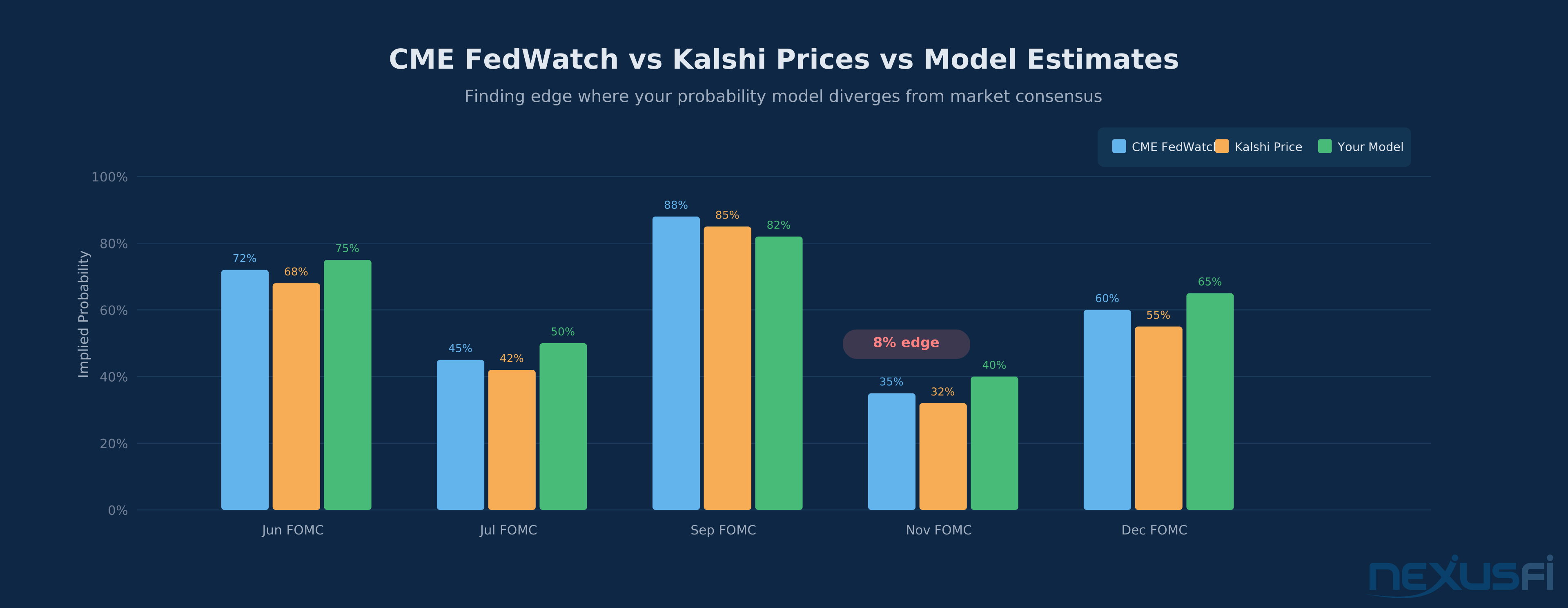
The CME FedWatch tool calculates market-implied probabilities from Fed funds futures prices. This is your primary anchor. If FedWatch says 72% probability of a cut, a Kalshi contract priced at 68¢ suggests 4% of potential edge — but friction is ~$0.033, so you need to verify your model genuinely differs from the futures market before trading.
Step 2: FOMC communication signals
Fed Chair press conferences, meeting minutes, and member speeches provide forward guidance. Key language to monitor:
- "Data dependent" = uncertainty; market should price real probability
- "Patient" = leaning toward no action
- "Transitory" vs. "persistent" inflation characterizations
- "Appropriate to [do X]" = near-certain signal of that action
@Oysteryx demonstrated this kind of scenario mapping in NexusFi's Spoo-nalysis thread, systematically breaking down how each possible FOMC statement change — removing "considerable time," mentioning USD strength, acknowledging oil's deflationary impact — would translate to specific directional moves in ES and USD. That's the framework: map every plausible outcome to a market reaction before the event, not after.
Step 3: Economic data updates
Between FOMC meetings, each major data release shifts the probability:
- Strong jobs report: Reduces cut probability, increases hold/hike probability
- Weak CPI: Increases cut probability
- GDP surprise: Depends on direction and magnitude
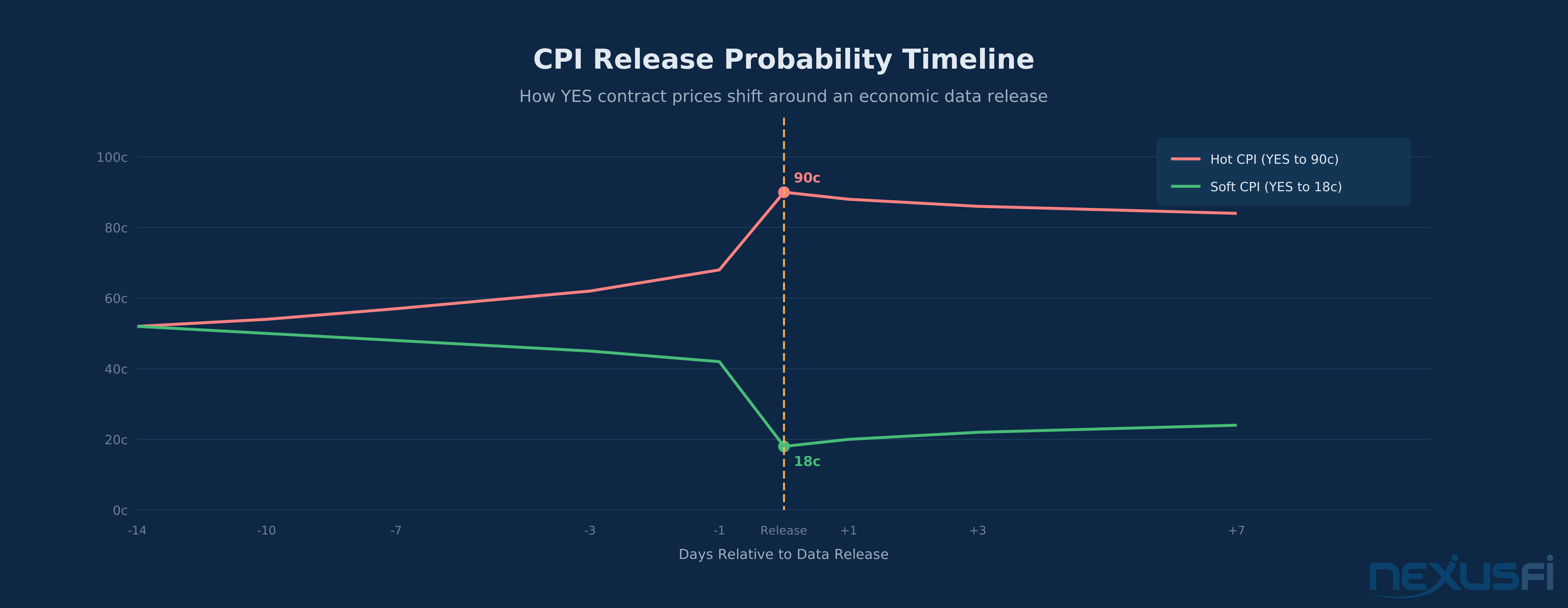
Track how prediction market prices respond to each release. When the price movement seems disproportionate to the actual change in probability, that's a potential opportunity.
Trade Walkthrough: Fed Rate Decision Contract #
Here's how the framework translates into a concrete trade decision.
Scenario: The June FOMC meeting is 12 days away. CME FedWatch shows 78% probability of a 25bp cut. Kalshi offers a "Will the Fed cut rates at the June meeting?" YES contract priced at 72¢.
Step 1 — Identify apparent edge: FedWatch 78% vs. Kalshi 72% = 6¢ apparent difference. But this isn't all edge.
Step 2 — Calculate friction: Kalshi charges $0.033 per contract round-trip (entry fee + exit/settlement). If you buy YES at 72¢ and it settles YES at $1.00, your profit is $1.00 - $0.72 - $0.033 = $0.247 per contract. If it settles NO, you lose $0.72 + the entry fee portion.
Step 3 — Calculate expected value:
- Using your 78% estimate: EV = (0.78 × $0.247) - (0.22 × $0.753) = $0.193 - $0.166 = +$0.027 per contract
- That's a 3.8% expected return on the 72¢ outlay — positive but modest
Step 4 — Validate your edge: Is the 6¢ discount genuine? Check whether it reflects Kalshi's fee friction (market makers widen spreads to compensate) or actual mispricing. If FedWatch moved to 78% only in the last hour and Kalshi hasn't caught up, the edge may be real but temporary. If FedWatch has been at 78% for days and Kalshi is still at 72¢, the fee friction explanation is more likely — and the trade is marginal.
Step 5 — Size the position: With ~4% expected return and binary outcome, this isn't a max-size trade. Risk 1-2% of your prediction market bankroll maximum.
Decision: This trade has positive expected value, but the edge is thin after friction. A stronger signal would be FedWatch at 85%+ with Kalshi still at 72¢ — that's 13¢ of apparent edge where friction can only explain 3-4¢.
When Fed Contracts Offer the Best Value #
Post-FOMC statement, pre-press conference: The statement releases first; the Chair's press conference follows ~30 minutes later. If the statement contains ambiguous language, prices may be mispriced until the press conference clarifies intent.
Between data releases: If all near-term data is in and the next scheduled release is 2 weeks away, prices often settle to reflect consensus accurately. This is harder to find edge in.
Surprise releases: Emergency FOMC meetings are rare but do occur (COVID-era cuts). Contracts tied to scheduled meetings may not cover unscheduled actions — verify the resolution criteria.
Resolution Checklist for Fed Contracts #
- [ ] Which FOMC meeting? (Scheduled vs. any meeting)
- [ ] What action? (Cut, hike, any change, specific amount)
- [ ] Rate measure? (Target range upper bound, lower bound, or midpoint)
- [ ] Source? (FOMC statement, FOMC minutes, or Fed press release)
- [ ] Intraday timing? (On announcement day or end of day)
CPI and Inflation Contracts #
Inflation contracts rank among the most analytically tractable economic prediction markets. Why? Because:
- Extensive historical data provides strong base rates
- Multiple public models (Cleveland Fed Inflation Nowcast, private models) forecast CPI before release
- Market consensus forecasts are published and trackable
- Resolution data (BLS report) is publicly available and unambiguous
The Inflation Data Hierarchy #
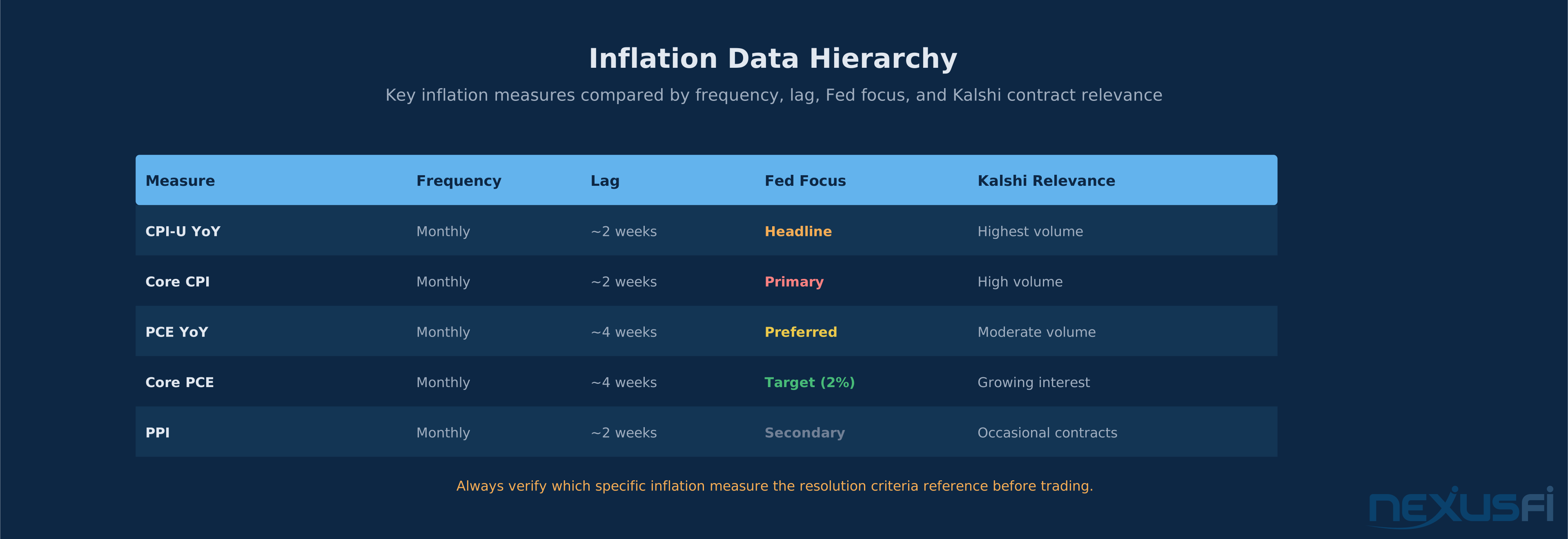
| Measure | Release Frequency | Lag | Primary Use |
|---|---|---|---|
| CPI-U YoY | Monthly | ~2 weeks | Headline inflation |
| Core CPI | Monthly | ~2 weeks | Fed focus metric |
| PCE YoY | Monthly | ~4 weeks | Fed's preferred measure |
| Core PCE | Monthly | ~4 weeks | Fed target measure |
| PPI | Monthly | ~2 weeks | Producer-side signal |
Most Kalshi contracts specify CPI-U. Always verify the specific measure in the resolution criteria before trading. A contract for "Core CPI above 3.2%" and one for "CPI above 3.2%" can have different outcomes on the same release date.
Probability Estimation Framework #
1. Gather pre-release forecasts
- Bloomberg consensus: Average of ~75 economist estimates
- Cleveland Fed Nowcast: Model-based estimate using alternative data
- Your own model: Track which components are running hot (shelter, energy, services)
2. Calculate standard deviation of forecasts
- If 75 economists all cluster around 3.2% (±0.1%), the distribution is tight
- If estimates range 2.8%-3.6%, significant uncertainty exists
- The distribution width determines the probability of exceeding any threshold
3. Apply normal distribution to threshold
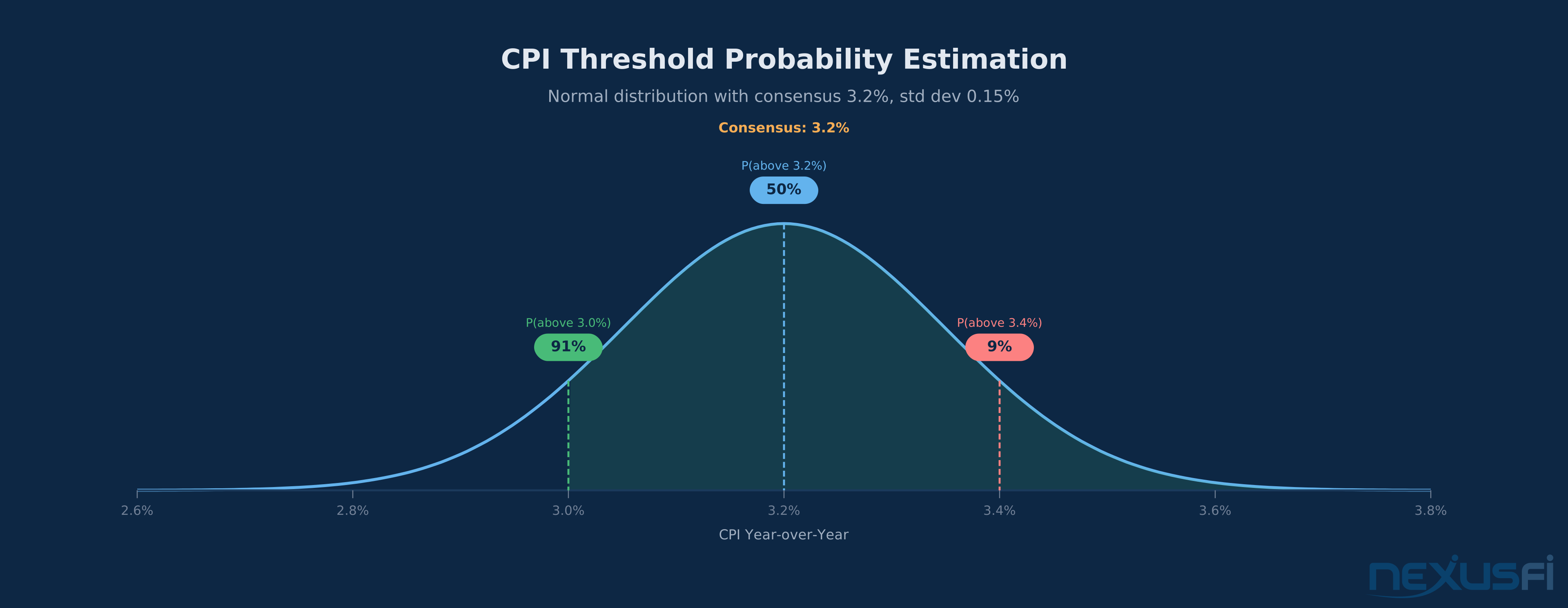
If consensus is 3.2% with a standard deviation of 0.15%:
- Probability above 3.0%: ~91%
- Probability above 3.2%: ~50%
- Probability above 3.4%: ~9%
This is the core technique for CPI contracts: convert the forecast consensus and standard deviation into a probability distribution, then compare each threshold probability to the corresponding Kalshi contract price. Where your distributional estimate diverges from the market price by more than friction costs (~$0.033), you have a potential trade.
Compare these to Kalshi contract prices. Where do the market prices deviate from your distributional estimate?
4. Check for systematic bias
Does the market systematically over- or under-price CPI surprise direction? Track this over time. If the market consistently prices CPI surprises in one direction (e.g., forecasters consistently underestimate shelter inflation), this represents exploitable systematic bias.
Employment Contracts: Jobs Report and Unemployment Rate #
The monthly US employment situation (the "jobs report") releases the first Friday of each month at 8:30 AM ET. It produces two key headline numbers:
- Nonfarm payrolls (NFP): Net job additions across the non-farm economy
- Unemployment rate: The U-3 unemployment rate
Kalshi offers contracts on both. The jobs report is especially volatile: the market-implied 1-sigma move in front-month S&P futures around jobs report releases is typically 30-50 bps.
NFP Probability Estimation Framework #
NFP is notoriously hard to forecast, but a structured approach gives you a distributional estimate to compare against contract prices. Here's the framework, modeled on the same approach used for CPI.
Step 1: Gather consensus and estimate distribution
FactSet and Bloomberg collect 13-80+ economist estimates before each release. The key inputs:
- Consensus (median): The central estimate — e.g., 65K for a typical recent month
- Range of estimates: Low to high — e.g., 0 to 150K
- Clustering: Where the bulk of estimates cluster (often a tighter band like 50K-85K within the full range)
The clustering matters more than the full range. If consensus is 65K and 77% of estimates fall between 50K and 85K, a reading of 30K is a genuine surprise even though it's technically within the range.
Step 2: Calculate standard deviation from historical forecast errors
NFP forecast errors are much larger than CPI errors. The standard deviation of the difference between initial NFP release and consensus typically runs 60K-80K jobs. This is your critical parameter.
With consensus at 150K and historical SD of 70K:
- P(NFP > 100K): ~76% (the threshold is only 0.71 SDs below consensus)
- P(NFP > 200K): ~24% (the threshold is 0.71 SDs above consensus)
- P(NFP > 250K): ~8% (1.43 SDs above consensus)
Compare these to Kalshi contract prices at each threshold. A "NFP above 200K" contract priced at 30¢ when your model says 24% may look like a sell — but verify that the 6¢ difference exceeds friction before trading.
Step 3: Incorporate leading indicators
Before blindly using consensus, check whether leading indicators suggest the consensus is too high or too low:
- ADP Private Payrolls: Released 2 days before NFP. Correlation with NFP is modest (r ≈ 0.5), but large directional misses often shift the NFP distribution. If ADP surprises 80K above expectations, shift your NFP distribution upward by ~30-40K.
- ISM Employment Index: Both manufacturing and services ISM reports include employment subcomponents. Below 50 = contraction signal; above 50 = expansion. Sustained readings below 48 on both indices historically correlate with NFP prints under 100K.
- Initial Jobless Claims: The 4-week moving average leading into NFP week. Claims below 220K signal a tight labor market; claims above 280K signal softening. The trend direction matters more than the level.
- Challenger Job Cuts: Monthly layoff announcements. Spikes above 80K typically precede weak NFP prints within 1-2 months.
If three out of four leading indicators point in the same direction, shift your model's central estimate 20-40K in that direction. This is where edge is created — the consensus lags behind the latest data signals.
Step 4: Address the initial-vs-revised distinction
This is the single most important wrinkle in NFP contracts. Resolution is based on the initial release, not the revised figure. NFP revisions regularly exceed 100K jobs. The March 2026 initial release was 178K versus a consensus of 60K — a massive upside surprise. But historical analysis shows that large initial surprises are often partially reversed in revisions.
NFP contracts resolve on the initial release, not the revised figure. Revisions regularly exceed 100K jobs. Your probability model must target the initial print — do NOT adjust for what you think the "true" number will eventually be. If tracking your model's accuracy, compare to initial releases only. FactSet data shows actuals surpassed median estimates only 43% of the time (using revised numbers), meaning consensus carries a slight upward bias relative to revised outcomes.
For prediction market purposes, this means:
- Your probability model should target the initial release
- Do NOT adjust your model based on what you think the "true" number will eventually be
- If tracking your model's accuracy over time, compare to the initial release number, not the revised final
Unemployment Rate Contracts #
Unemployment rate tends to be more stable (less volatile month-to-month) and easier to forecast with narrow probability bounds. The standard deviation of forecast errors for the unemployment rate is only about 0.1 percentage points.
Contracts for "unemployment above 4.5%" with current unemployment at 4.1% are high-probability NO contracts — but verify whether the probability is priced correctly given the distribution of possible outcomes.
The Fed has been placing increasing emphasis on the unemployment rate over raw payroll numbers because the "breakeven rate" — the number of new jobs needed to keep unemployment stable — has become a moving target. Recent estimates suggest the US may only need near-zero job growth to keep unemployment stable, because labor force growth has slowed to fewer than 10,000 people per month.
This has a concrete implication for contract traders: even a weak payrolls print (say, 30K new jobs) may not move the unemployment rate upward if labor force growth has stalled. Monitor both numbers independently rather than assuming one drives the other.
As NexusFi member @Silvester17 noted in a discussion on NFP trading approaches, the key inputs for trading the report are knowing the consensus range, understanding positioning, and being realistic about execution speed.
GDP Contracts #
Quarterly GDP contracts require understanding one key fact: the advance estimate is the only number that matters for contract resolution, and it is systematically different from the final revised figure.
The GDP Release Sequence #
| Release | Timing | Data Completeness | Revision Risk |
|---|---|---|---|
| Advance estimate | ~4 weeks after quarter ends | ~55% complete source data | High (avg revision: 1.2pp) |
| Second estimate | ~8 weeks after quarter ends | ~75% complete | Moderate |
| Third (final) estimate | ~12 weeks after quarter ends | ~95% complete | Low |
| Annual benchmark revision | July each year | 100% + methodology updates | Can revise years of data |
The advance estimate lacks complete data on three key components: inventories, trade, and consumer spending on services. The BEA fills these gaps using assumptions based on partial surveys and historical trends. When the complete data arrives weeks later, the revision can be significant.
Why the Advance Estimate Is the Only One That Matters #
Most Kalshi GDP contracts resolve on the advance estimate. This creates a specific modeling challenge: you need to predict what the BEA will publish based on incomplete data, not what GDP actually was.
Two factors make the advance estimate systematically different:
- Inventory swings: Inventories are the largest source of advance-to-final revision. A large inventory build that gets revised down can turn a 3.0% advance print into a 2.0% final. But your contract already settled on the 3.0%.
- Trade data: The BEA recently began incorporating the Census Bureau's "advance" trade report, giving it actual trade data for all three months of the quarter. This reduced — but did not eliminate — revision risk from the trade component.
How to Model GDP for Contracts #
Step 1: Use GDP Nowcast models as your anchor
The Atlanta Fed GDPNow and NY Fed Nowcast models provide real-time GDP estimates that update as new data arrives. These are your primary tools:
- Atlanta Fed GDPNow: Updates frequently, tracks individual GDP components, has shown strong accuracy for the advance estimate specifically
- NY Fed Nowcast: Uses a factor model with broad economic indicators
Historical analysis by the Economist Writing Every Day blog found that GDPNow was the best or tied-for-best predictor in 5 of 9 quarters tested, and Kalshi prediction markets performed comparably — both outperforming the WSJ economist survey. The Brier score for prediction market GDP forecasts has been 0.18 (2023-2025), outperforming economist consensus at 0.25.
Step 2: Estimate the distribution
GDP forecast standard deviations are larger than most traders expect. The typical SD of advance estimate forecast errors is 0.8-1.2 percentage points (annualized). With GDPNow pointing to 2.1% growth:
- P(GDP > 1.0%): ~83% (with SD of 1.0pp)
- P(GDP > 2.0%): ~54%
- P(GDP > 3.0%): ~18%
- P(GDP negative): ~2%
Step 3: Watch for inventory signals
If wholesale and manufacturing inventory data releases ahead of GDP show unexpected builds, the advance estimate will be biased upward versus "true" GDP. This doesn't matter for your contract payout, but it matters if you're using final GDP figures to calibrate your model. Always calibrate against initial advance estimates, not revised figures.
Execution Around Data Releases #
Pre-Release Positioning #
If you have conviction before a release:
- Build your position days in advance when volatility is lower
- Spreads widen much in the hour before a major release as market makers reduce risk
- Avoid trading in the final hour before the release window
Post-Release Speed #
Major economic data releases move prediction market prices within seconds of the release. Algorithmic traders with direct data feeds execute faster than human traders clicking through a web interface.
For retail traders, the post-release opportunity isn't in the first few seconds — it's in the minutes and hours afterward, when:
- The initial knee-jerk move overshoots
- Market commentary clarifies the nuances of the number
- Related contracts haven't fully updated to reflect the primary data release implications
The real edge for manual traders isn't speed — it's synthesis. Algos reprice the primary contract in seconds, but the cross-market implications (how a CPI print reshapes Fed cut probability, for example) take minutes to propagate. Your advantage is understanding the second- and third-order effects faster than the market prices them.
Correlated Contract Opportunities #
A strong CPI print affects multiple contracts:
- Directly: CPI contracts
- Indirectly: Fed rate decision contracts, 10-year yield contracts, economic growth contracts
The primary market (CPI contracts) updates in seconds. The secondary markets (Fed decision contracts) may take minutes to fully incorporate the inflation implications. This creates a brief opportunity for traders who quickly understand the cross-market implications.
Risk Management for Economic Contracts #
Announcement Timing Risk #
Sometimes data releases are delayed (government shutdowns, technical issues). If a release is delayed beyond your contract's resolution window, verify how the contract handles the delay.
Political Interference Risk #
In rare cases, data release methodology changes or political controversies affect market perception of the data. A CPI methodology change that shifts the reported number by 0.3% could affect contracts despite the "real" inflation rate being unchanged. Monitor for methodology announcements.
Revisions vs. Initial Release #
For data with high revision risk (NFP, GDP), large positions based on the initial release create risk that the revision would have changed the contract outcome. This doesn't affect your payout (you get paid based on the initial), but it does affect your analytical model's accuracy tracking if you're comparing your estimates to final revised numbers.
Building an Economic Release Calendar #
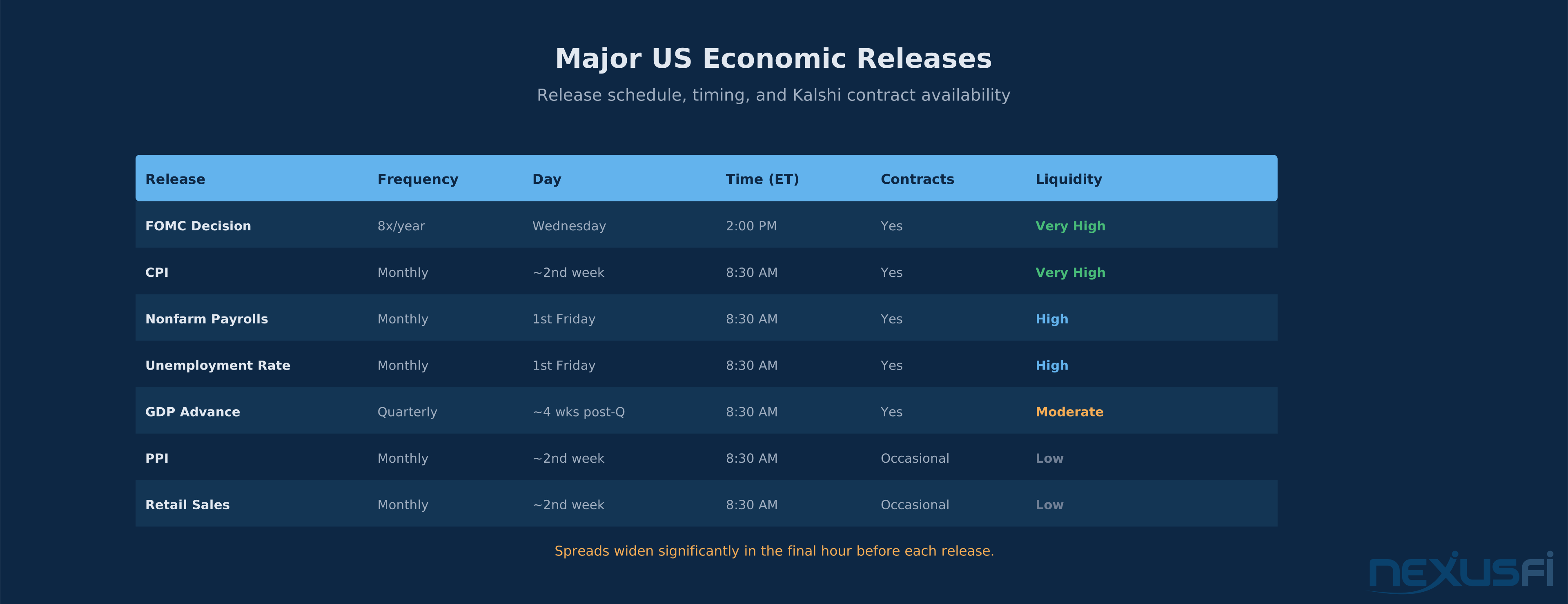
Professional economic traders maintain a detailed calendar:
| Release | Frequency | Day | Time (ET) | Kalshi Contracts |
|---|---|---|---|---|
| CPI | Monthly | ~2nd week | 8:30 AM | Yes |
| PPI | Monthly | ~2nd week | 8:30 AM | Occasionally |
| Nonfarm Payrolls | Monthly | 1st Friday | 8:30 AM | Yes |
| Unemployment Rate | Monthly | 1st Friday | 8:30 AM | Yes |
| FOMC Decision | 8x/year | Wednesday | 2:00 PM | Yes |
| GDP Advance | Quarterly | ~4 weeks post-quarter | 8:30 AM | Yes |
| Retail Sales | Monthly | ~2nd week | 8:30 AM | Occasionally |
Kalshi adds contracts for upcoming releases typically 2-4 weeks in advance. Monitor the platform for new contracts on events you track analytically.
Citations #
- @Fi: CME Group Event Contracts Blast Past 100 Million Traded — In Just 8 Weeks — Scale of institutional participation in economic event contracts
- @Oysteryx: FOMC Scenario Prep in Spoo-nalysis — Systematic mapping of FOMC statement outcomes to ES and USD directional moves
- @Salao: CPI vs. Fed Decision Significance — Gold trader's perspective on relative importance of CPI data versus Fed decisions
- @josh: ADP vs. Official NFP Divergence — January 2022 ADP-BLS discrepancy highlighting survey methodology risk
- @Silvester17: NFP Dual-Direction Market Impact — How the same jobs number can push markets in opposite directions depending on economic context
- @mastadee: Real-Time NFP Reaction Analysis — February 2016 NFP release-day dynamics showing algo selloff reversal
- CME FedWatch Tool — Fed funds futures-based probability model
- Cleveland Fed Inflation Nowcast — Model-based CPI forecasts
- BLS CPI Release Calendar — Official release schedule
Knowledge Map
Go Deeper
Build on this knowledgeReferences This Article
Articles that build on this topicCitations
- — CME Group Event Contracts Blast Past 100 Million Traded -- In Just 8 Weeks (2025)“Scale of institutional participation in economic event contracts”
- — Spoo-nalysis ES e-mini futures S&P 500 (2014) 👍 4“Systematic mapping of FOMC statement outcomes to ES and USD directional moves”
- — Salao's Journal (2023) 👍 8“Gold trader's perspective on relative importance of CPI data versus Fed decisions”
- — Spoo-nalysis ES e-mini futures S&P 500 (2022) 👍 8“January 2022 ADP-BLS discrepancy highlighting survey methodology risk”
- — ES News Releases (2019) 👍 4“How the same jobs number can push markets in opposite directions depending on economic context”
- — Spoo-nalysis ES e-mini futures S&P 500 (2016) 👍 7“February 2016 NFP release-day dynamics showing algo selloff reversal”
- — CME FedWatch Tool
- — Cleveland Fed Inflation Nowcast
- — BLS CPI Release Calendar