



Expected Value in Prop Firm Evaluations: The Mathematics of Deciding Which Challenges Are Actually Worth Taking
Overview #
Most traders approach prop firm evaluations the same way gamblers approach slot machines — they feel out the odds, notice a few big winners, and pull the handle. That's the wrong framework entirely. A prop firm evaluation is a financial decision with quantifiable expected value, and if you're not running the math before you click "buy," you're trading blind.
Expected value (EV) analysis doesn't tell you whether you can pass an evaluation. It tells you something more important: whether you should try, how many times, at which account size, and whether the current fee is worth paying. The difference between a +EV evaluation program and a -EV one isn't always obvious from the marketing page. Firms with identical-looking setups can have wildly different EVs depending on how their drawdown rules interact with your trading style.
Here's the brutal reality check, worth reading before anything else: roughly 95% of traders fail evaluations. Of those who pass, about 80% blow their funded accounts within the first 90 days. That means sustained prop firm income is a 1-in-20 proposition at minimum — and EV analysis is how you know whether the math makes chasing that outcome sensible, or whether you're subsidizing the firm's real revenue model.
This article breaks down the complete EV framework for prop firm evaluations: the formula, the fee structure, the path-dependent survival math, the reset economics, and the worked examples that put real numbers on the decision. By the end, you'll have a calculator framework you can apply to any evaluation before you hand over cash.
Key Concepts #
Expected Value (EV): The average outcome of a decision if repeated many times. EV = (probability of outcome × value of outcome), summed across all possible outcomes. A +EV decision generates profit on average. A -EV decision loses money on average. Single outcomes don't determine EV — the long-run distribution does.
Evaluation Fee: The total cost to attempt a prop firm evaluation. Includes entry fee, any required platform or data subscription fees, and reset fees. The true all-in cost is almost always higher than the advertised headline number.
Profit Target: The minimum profit required to pass the evaluation. Ranges from 4-10% of account size depending on the firm. This is the bar you must clear before hitting the drawdown limit.
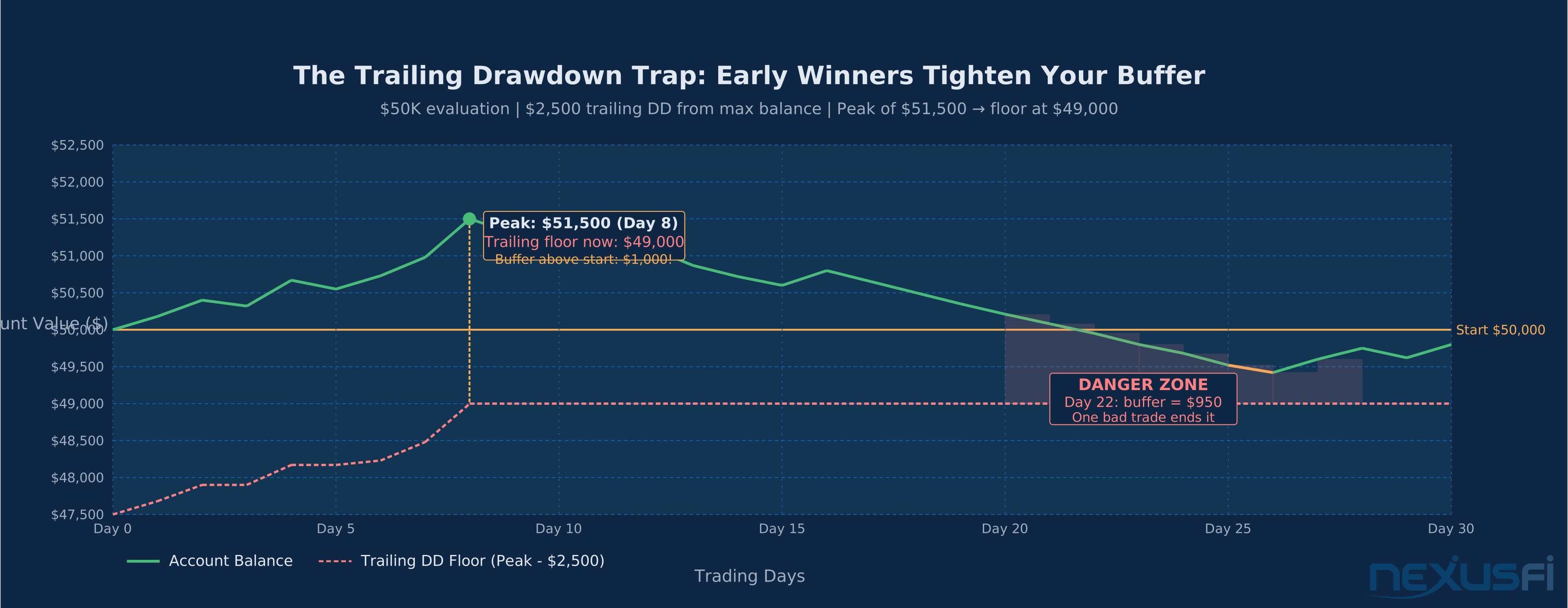
Trailing Drawdown: A drawdown limit that follows your account balance upward but never down. The mechanics are covered in depth at /a/prop-firms/trailing-drawdown-prop-firm-rules. The most common drawdown type in current evaluation programs. Critically, it typically trails from the maximum account value, not current balance — which means an early profitable spike makes your effective buffer smaller, not larger.
Static (End-of-Day) Drawdown: A fixed dollar drawdown limit from the starting balance. Less punishing than trailing drawdown because it doesn't shrink your buffer after a good trade.
Break-Even Pass Probability (p\*): The minimum probability of passing an evaluation at which EV = 0. At your break-even threshold, you'd expect to recover exactly what you paid over many attempts. Above it, you're EV positive. Below it, you're losing money on average.
Reset Fee: The cost to restart a failed evaluation. Some firms charge the same as the original entry fee. Others offer discounted resets. How resets are priced completely changes the multi-attempt EV analysis.
Payout Split: The percentage of profits the trader keeps after passing. Standard splits range from 70/30 to 90/10 (trader/firm). Higher splits mean μ (expected profit if you pass) goes up — which shifts the break-even probability lower, making the evaluation more attractive.
Counterparty Risk: In a live futures trade, your counterparty is CME — zero default risk. With a prop firm, the firm is your counterparty for profit payouts. If they fail to pay or go under, you lose your funded account earnings. This risk is unquantifiable from the outside and doesn't appear in the EV formula, but it's real.
The EV Formula for a Single Evaluation #
Start simple. For a single evaluation attempt:
EV = (p × μ) - F
Where:
- p = probability of passing the evaluation
- μ = expected net profit you receive if you pass (after payout split)
- F = total all-in fee to attempt the evaluation
If EV > 0, you expect to make money over many attempts. If EV < 0, you expect to lose money. It's not more complicated than that at the single-evaluation level.
The complete version includes discounting for time and opportunity cost:
EV = (p × μ) / (1 + r)^T - F
Where r is a discount rate (the return you could get deploying that capital elsewhere) and T is the expected time to pass in years. For most evaluations lasting 30-60 days, this discount is small enough to ignore in practical analysis, but it matters when comparing monthly-fee programs versus upfront-fee programs at different time scales.
The formula looks simple, but every variable in it has hidden complexity. p isn't just your win rate — it's the probability of hitting the profit target before the drawdown limit, which is a path-dependent survival problem. μ isn't the full profit target — it's the profit target minus the payout split and minus any maximum payout caps. F isn't just the entry fee — it's the entry fee plus monthly data fees plus platform subscriptions plus any fees charged after the evaluation phase.
Those three variables — properly calculated — determine whether you're playing a +EV game.
The Fee Side: What You're Actually Paying #
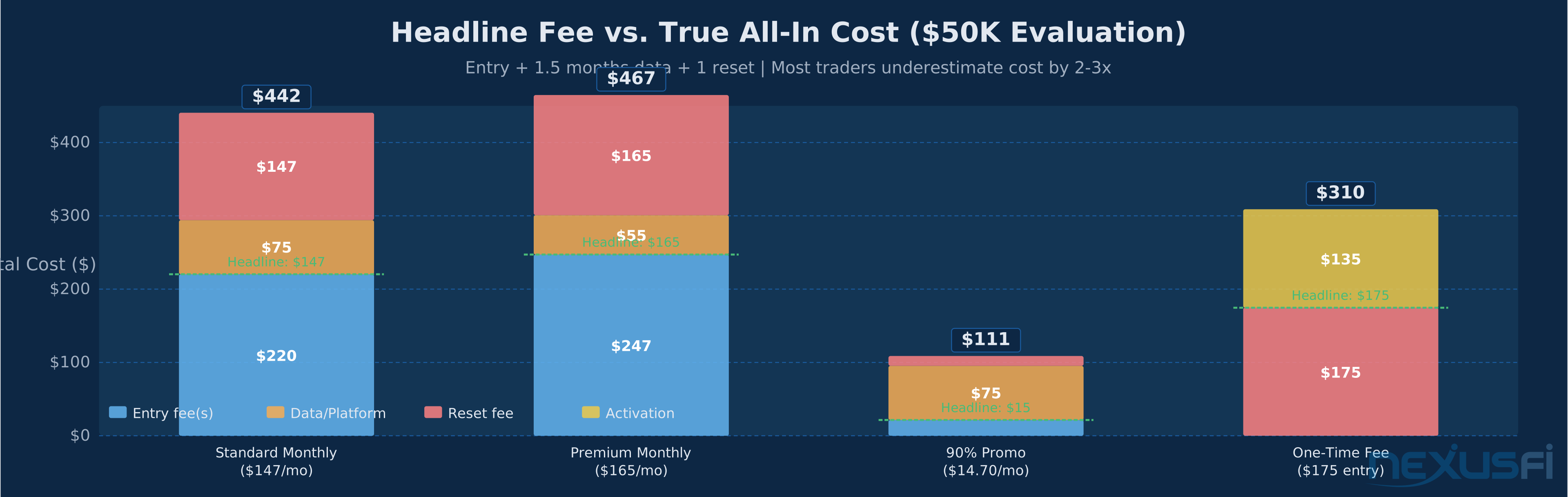
Prop firm fee structures are designed to look smaller than they are. The typical presentation is a headline evaluation fee of $99-$199 for a "100K account." What that number omits:
Entry fee: The advertised number. For a $50K account at a typical firm, this ranges from $25 to $150 for a monthly subscription, or $150-$500 for a one-time evaluation fee.
Monthly data and platform fees: Some firms bundle data fees; others don't. If your firm requires a Rithmic or CQG subscription, add $50-$110/month. NinjaTrader, Sierra Chart, and Tradovate have separate fee structures depending on whether you're in evaluation or funded status.
Reset fees: The cost to restart after failing. At firms charging full reset fees (same as the entry fee), each failed attempt adds the full entry cost. At firms offering 30-50% off resets, the marginal cost of additional attempts is lower. This is one of the biggest EV levers in the analysis.
Funded account activation fees: Some firms charge a separate fee to activate your funded account after passing the evaluation. This is a one-time cost that comes out of your first payout, effectively reducing μ.
That framing is correct. The advertised account size is largely cosmetic. Your effective trading buffer is the drawdown limit, not the nominal account balance.
The true all-in cost calculation:
F_true = Entry Fee + (Expected Months to Pass × Monthly Fees) + (Expected Resets × Reset Fee)
For a trader who expects to take 45 days (1.5 months) and needs 1.5 average resets before passing:
- Entry fee: $99
- 1.5 months data/platform: $75
- 1.5 resets at $99 each: $149
- Total F_true: $323
That's 3.3x the headline fee. Run this calculation before any evaluation — it's rarely the number on the homepage.
The Payout Side: What You're Actually Collecting #
If you pass, what do you actually earn? μ has its own hidden reductions:
The payout split: At an 80/20 split, you keep 80% of profits. On a $3,000 profit target evaluation (Apex $50K example), you'd receive $2,400 on the minimum payout. At a 70/30 split, you receive $2,100.
Profit caps: Many firms cap first payouts. A common structure: first payout capped at $1,000-$2,500 regardless of account profits. This dramatically reduces μ for traders who run up large balances quickly.
Minimum profitable days requirements: Some programs require minimum trading days (5-10 days minimum). This doesn't reduce the dollar amount but extends time-to-payout, affecting the discounted EV.
Consistency rules: Some firms require no single day to represent more than 40-50% of total profits. A trader who has one excellent day early in the evaluation and smaller days thereafter may need to keep trading to "earn" that big day into the payout structure.
The realistic μ for most retail traders passing a $50K evaluation:
- Profit target: $3,000
- Payout split (80%): $2,400
- Minus activation fee (-$135): $2,265
- Effective μ: $2,265
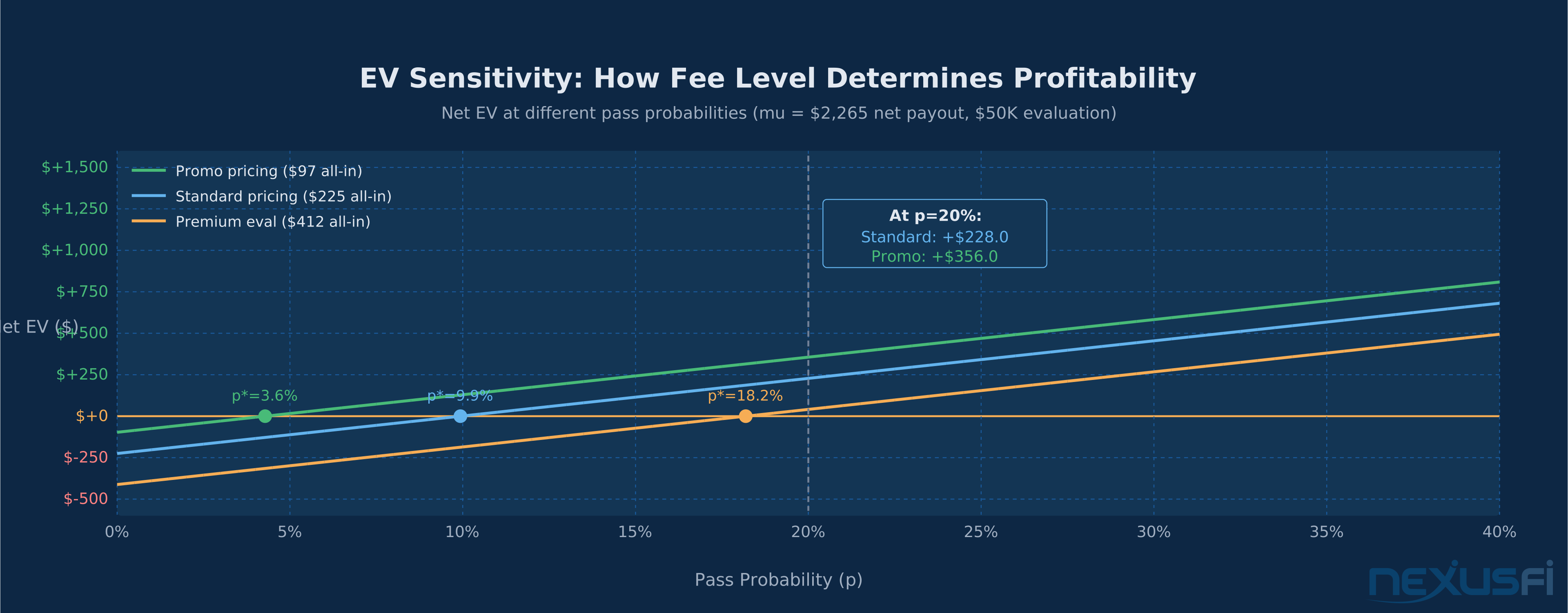
Now plug those numbers in: EV = (p × $2,265) - $323
For EV > 0, you need p > 0.143, or about a 14.3% chance of passing to break even.
That sounds achievable. But p is where the real complexity lives.
Break-Even Pass Probability: The Number That Actually Matters #
Rearranging the EV formula: p\* = F / μ
This is the break-even pass probability — the minimum pass rate at which your EV equals zero. If your realistic pass probability exceeds p\*, the evaluation is +EV. If it falls short, you're losing money in expectation.
For different scenarios using realistic numbers:
| Scenario | F (all-in) | μ (net payout) | p\* (break-even) |
|---|---|---|---|
| Discount evaluation ($34 promo) | $34 | $2,265 | 1.5% |
| Entry-level evaluation ($99/mo) | $323 (full cost) | $2,265 | 14.3% |
| Premium evaluation ($499 one-time) | $499 | $2,265 | 22.1% |
| Large account ($300K, $499 fee) | $499 | $14,400 (80% of $18K) | 3.5% |
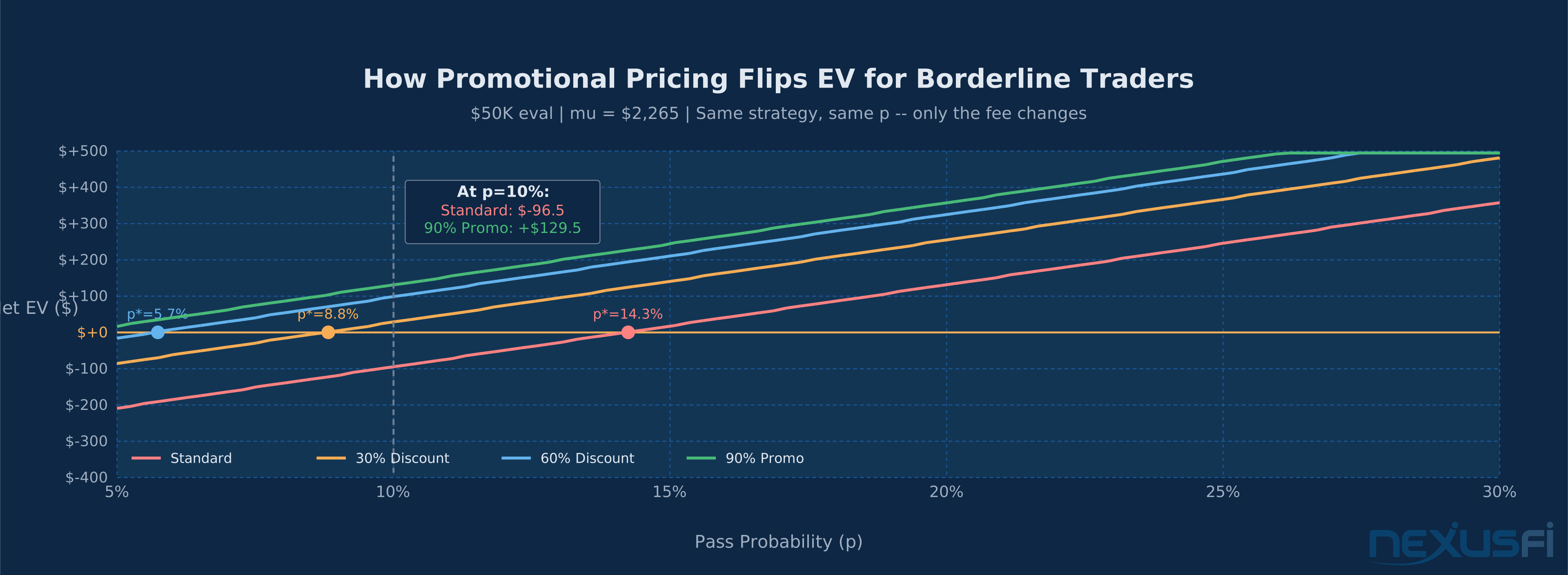
The promo pricing math is the most important insight in this table. When Apex, TopStep, or Earn2Trade runs a "90% off" sale, p\* drops from 14% to 1.5%. That's not marketing — it's a fundamental EV shift. A trader with a 10% pass probability is burning money at full price and printing it at promo price.
That calculation shows a 40% win-rate trader with a positive edge running roughly 14% monthly fees relative to expected profit — a borderline but potentially +EV proposition if their actual pass probability matches the strategy EV.
The key is computing YOUR p, not a generic number. That requires understanding path dependence.
Path Dependence: Why Your Win Rate Isn't Your Pass Rate #
This is where most traders' EV analysis fails completely. They take their historical win rate, assume that's their probability of passing, and conclude the evaluation is +EV. It's not that simple.
Passing a prop firm evaluation isn't a win-rate problem. It's a first-passage problem: what's the probability that your equity curve reaches the profit target before it hits the drawdown limit?
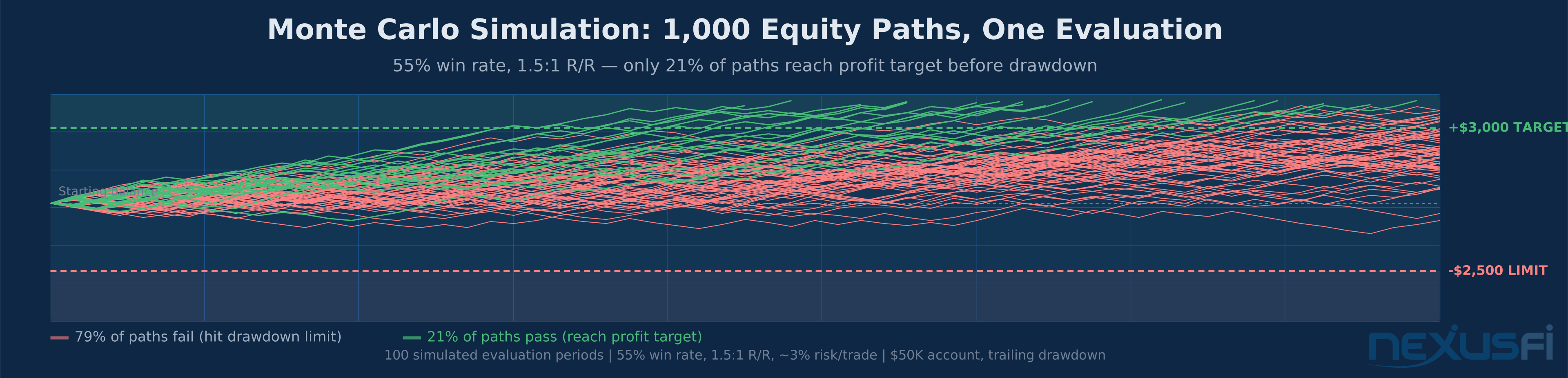
Consider a trader with 55% win rate, 1.5:1 average R/R, and $75 average risk per trade on a $50K evaluation ($3,000 target, $2,500 trailing drawdown):
- Their per-trade EV is positive: (0.55 × $112.50) - (0.45 × $75) = $28.50/trade
- If they trade indefinitely, they'll reach $3,000 eventually
- But the evaluation isn't infinite — they have a $2,500 buffer before getting stopped out
The question becomes: given this distribution of trade outcomes, what's the probability of walking $3,000 uphill before walking $2,500 downhill?
This depends on:
- Distribution shape: A trader with 55% win rate and large variance (some trades +$500, some -$300) is more likely to spike the drawdown limit than a trader with 55% win rate and tight variance (trades cluster at ±$75-$150).
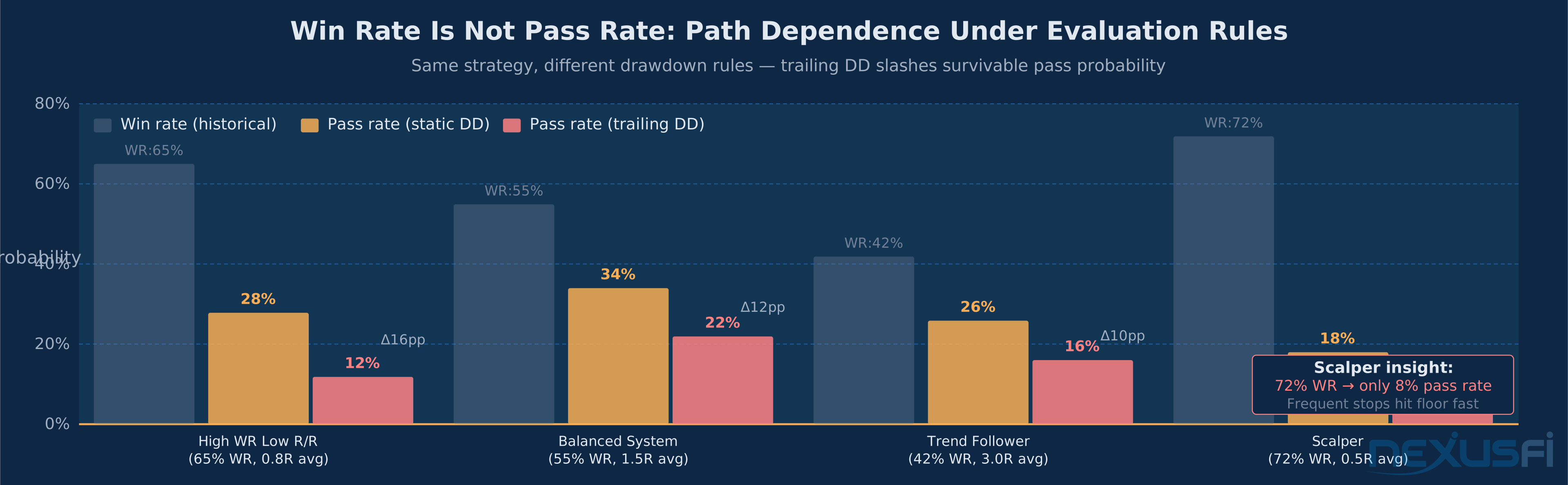
- Trailing vs. static drawdown: With trailing drawdown, early wins actually tighten your buffer because the drawdown floor rises with your balance. A trader who runs up $1,500 in week one now has a $2,500 drawdown limit from $51,500 — their effective floor is at $49,000, only $1,000 above their starting balance.
- Account size: Smaller accounts have tighter absolute buffers relative to position size, making it harder to survive normal variance.
The practical result: traders with positive trading expectancy often have much lower evaluation pass rates than their win percentage suggests. A trader with 60% win rate and reasonable expectancy might have a 20-30% pass rate on a well-structured evaluation — or as low as 8-12% on an evaluation with tight trailing drawdown.
The precise calculation requires Monte Carlo simulation: model your actual trade distribution (including your specific distribution of winners and losers, not just averages), run 10,000 simulated evaluation periods, and count the percentage that hit the profit target first. That's your true p.
Rough approximation for practical use:
- If your profit factor (gross profit / gross loss) > 1.5 and your average win > 2× average loss: p ≈ 15-25%
- Profit factor 1.2-1.5, average win ≈ 1.5× average loss: p ≈ 8-15%
- Profit factor < 1.2 or win rate < 45%: p ≈ 3-8%
These estimates assume normal evaluation structures. Tighter trailing drawdown shifts all estimates down 20-30%.
Account Size and the EV Curve #
The relationship between account size and EV isn't linear. Larger accounts change multiple variables simultaneously:
Fee-to-profit ratio (bps cost): At Apex, the $25K evaluation targets $1,500 profit with a trailing threshold of $1,500. The $300K evaluation targets $20,000 profit with a $7,500 trailing threshold. The profit target scales 13.3× from small to large; the drawdown only scales 5×. Larger accounts give you more favorable risk-to-reward geometry in absolute dollar terms.
But p shifts with account size too:
The contract limits per account (4 for $25K vs. 35 for $300K) mean larger accounts require proportional sizing — and proportional sizing produces proportional drawdown risk per trade. The survival geometry doesn't actually improve at larger sizes.
The contract limit constraint: This is the sleeper issue in account size EV analysis. A $25K account gets 4 contracts maximum. If your edge comes from scalping multiple contracts for small targets, the $25K limit may force you to reduce position size below your optimal risk allocation. Undersizing reduces both your profit accumulation rate AND your drawdown survival probability in awkward ways.
Practical EV comparison by account size (using Apex rough fee estimates):
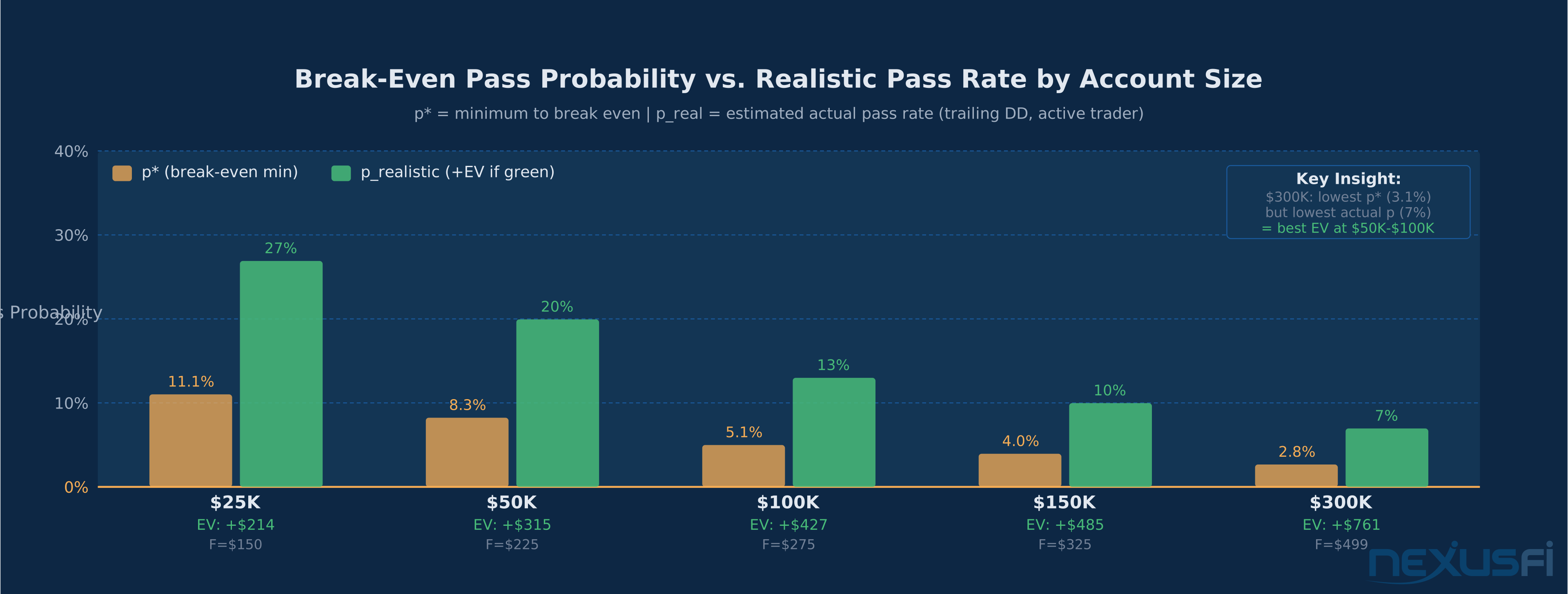
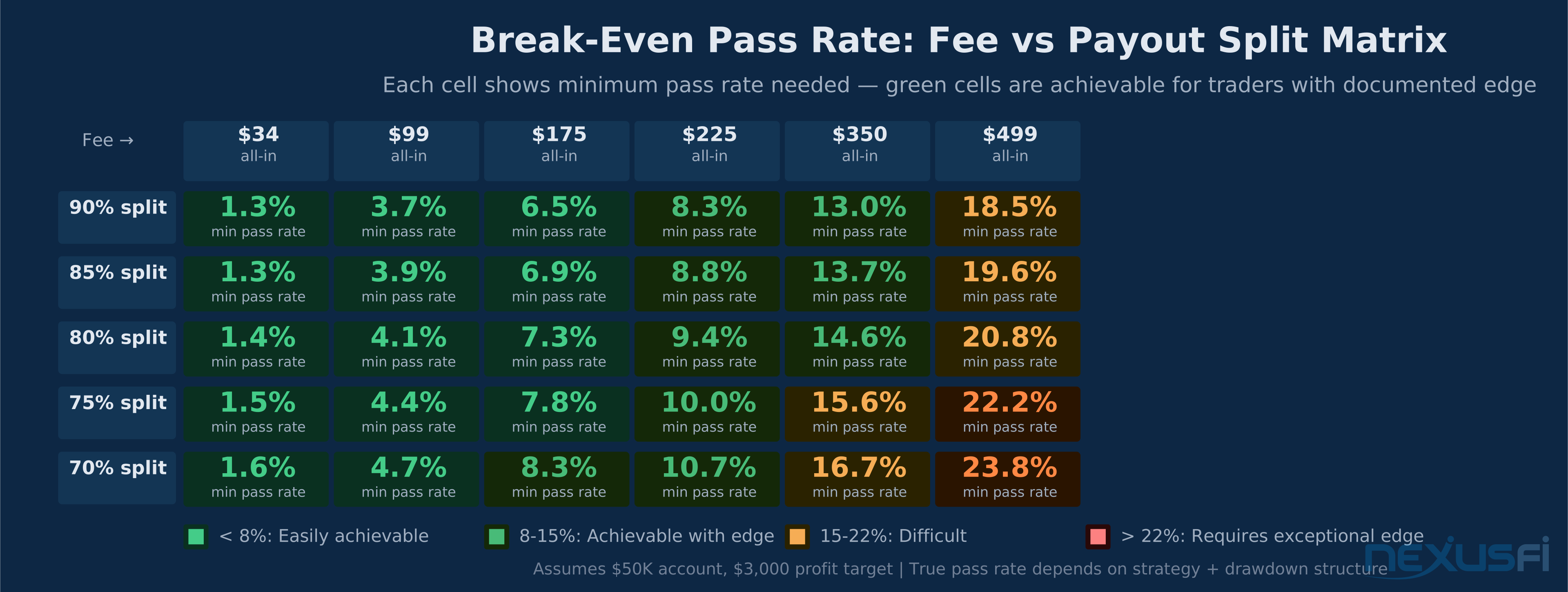
| Account | Profit Target | Trailing DD | Typical All-in Fee | p\* at 80% split |
|---|---|---|---|---|
| $25K | $1,500 | $1,500 | $150 | 12.5% |
| $50K | $3,000 | $2,500 | $225 | 9.4% |
| $150K | $9,000 | $5,000 | $325 | 4.5% |
| $300K | $20,000 | $7,500 | $499 | 3.1% |
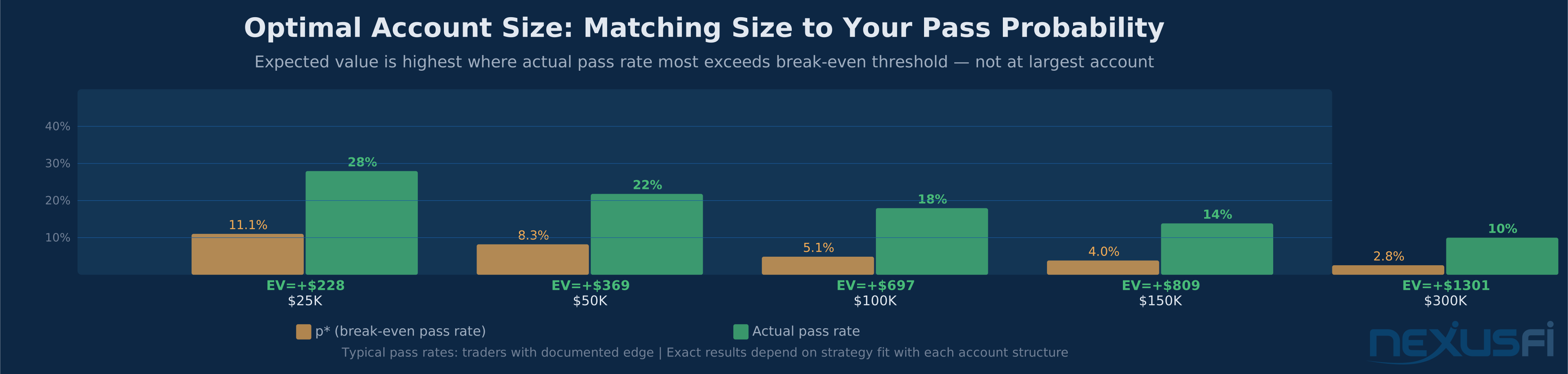
On paper, the $300K account looks most attractive — lowest break-even probability. But if p at $300K is 8-10% and p at $50K is 20%, the $50K evaluation has higher absolute EV.
The right account size is the one where your actual pass probability most exceeds the break-even threshold. For most retail traders with developing edges (p = 15-25%), the $50K-$100K range offers the best EV.
Reset Economics and the Retry Decision #
Most traders will fail their first evaluation. The question isn't whether to retry — it's when to stop.
The multi-attempt EV:
Total EV = Σ (probability of passing on attempt k) × (μ - cumulative fees through attempt k)
For a trader with p = 20% per attempt and full reset fees (F_reset = F_entry):
- Attempt 1: 20% chance of passing
- Attempt 2: 20% × 80% = 16% chance of being in this scenario
- Attempt 3: 20% × 64% = 12.8% chance
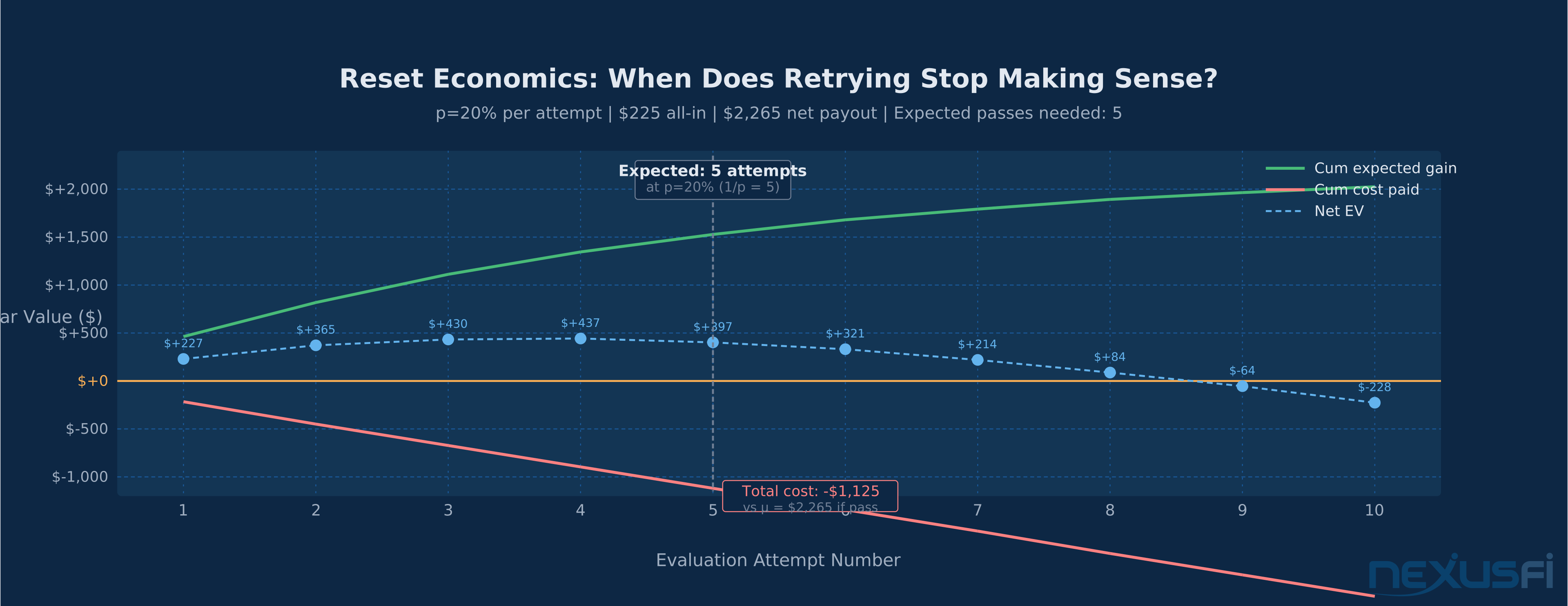
Expected number of attempts to pass: 1/p = 1/0.20 = 5 attempts on average.
If each attempt costs $225 in total fees, the expected total cost to pass is 5 × $225 = $1,125. Against a μ of $2,265, the total multi-attempt EV is roughly +$1,140.
That's positive. But three important caveats:
1. p is not stable across attempts. If you're blowing evaluations repeatedly due to the same behavioral pattern — revenge trading, holding overnight, chasing losses — p doesn't improve with repetition. The geometric distribution assumes independent attempts. If each failure is teaching you something, p increases over time. If you're making the same mistakes, p is constant or declining.
2. The reset decision should be probabilistic. After N failures, ask: has my trading changed? If you've identified a specific flaw and fixed it, keep going. If you can't identify why you failed, the next attempt is identical to the last — same p, same result distribution. The expected cost of continuing falls if you've improved; it's unchanged if you haven't.
3. Opportunity cost compounds. A trader spending 6 months on evaluations is a trader not building a real trading account, not improving their edge through live trading with real feedback, not compounding gains from actual market participation. The EV of the evaluation program must exceed the EV of the alternative use of that capital and time.
As @binarylonewolf documented in their Quest to Funding journal on NexusFi, repeated evaluations become a psychological and financial trap: the sunk cost of previous fees creates pressure to "get the pass" rather than rationally evaluating whether to continue.
The optimal stopping rule: if the expected cost to pass exceeds the expected payout minus your alternative-use opportunity cost, stop. Calculate it before each reset, not after the emotional heat of a failed attempt.
Discount Pricing: The Biggest EV Lever You Can Actually Control #
The most impactful single variable in evaluation EV isn't your win rate. It's the fee.
At full price, a $99/month evaluation has p\ ≈ 14%. At 90% off ($9.90/month), p\ drops to 1.4%. A trader with a 10% pass probability is slightly -EV at full price and massively +EV at promo pricing.
Every major prop firm runs promotional pricing. Apex, TopStep, and Earn2Trade have all run sales reducing entry fees by 50-90%. As @biotic noted in the ApexTraderFunding thread on NexusFi: the income model for most prop firms is "97-99% from fees and resets" — which means when they run sales, they're accepting lower revenue per evaluation in exchange for higher volume.
For traders with borderline pass probabilities (10-18%), the strategic approach is:
- Never pay full price. Monitor for promotional pricing. Major prop firms run sales regularly, often tied to market events, holidays, or quarterly revenue pushes.
- Batch multiple discounted evaluations. At $34/month, running three simultaneous $50K evaluations costs $102/month. If p = 15% per evaluation, the probability that none of three passes in 90 days is (0.85)³ = 61%. That means 39% chance of at least one pass for $306 all-in — far better EV than a single evaluation at $225.
- Reset at promo price only. If your first evaluation was at full price and you fail, wait for a promo before resetting. The reset fee at 90% off is often cheaper than the original entry fee at full price.
The discount strategy isn't exploiting the system — it's correctly applying EV analysis to a variable you can actually control.
The Business Model View: Three Stages of EV #
Single-evaluation EV is incomplete. The full picture has three stages:
Stage 1 — Evaluation EV: The entry cost and pass probability. Discussed above.
Stage 2 — Funded Account EV: The expected value of the funded phase after passing. Managing a funded account effectively is covered in Funded Trader Operations Manual. This stage depends on:
- Expected monthly profit (μ_monthly): trader's edge × account size × payout split
- Expected funded tenure: how long before hitting the drawdown limit
- Scaling opportunities: some firms allow account increases after consistent profits
- Termination risk: firms can close funded accounts unilaterally
Stage 2 EV is where the real business case is or isn't. A trader earning $2,000/month net from funded accounts, with 70% probability of maintaining the account for 6+ months, generates significant positive EV even if Stage 1 entry is expensive.
TopStep CEO Michael Patak shared publicly in 2015 that 71% of funded accounts at TopStep were maintaining or growing their balance. Of funded traders, fewer than 4.3% violated their daily loss limit in that year. That's the data from the firm that had the most structural incentive to maintain funded traders — they earn from payouts only if traders are profitable.
Note that 2015 data came before the expansion of trailing drawdown structures and consistency rules that now dominate the industry. Modern funded account retention rates are likely lower. Use this data as an upper bound, not a baseline.
Stage 3 — Failure and Unfunding EV: The probability-weighted cost of having your funded account closed (either by your drawdown being hit, or by the firm itself). This adds a negative tail to Stage 2. Counterparty risk fits here — if the firm closes operations, Stage 2 EV goes to zero.
Total Business Model EV:
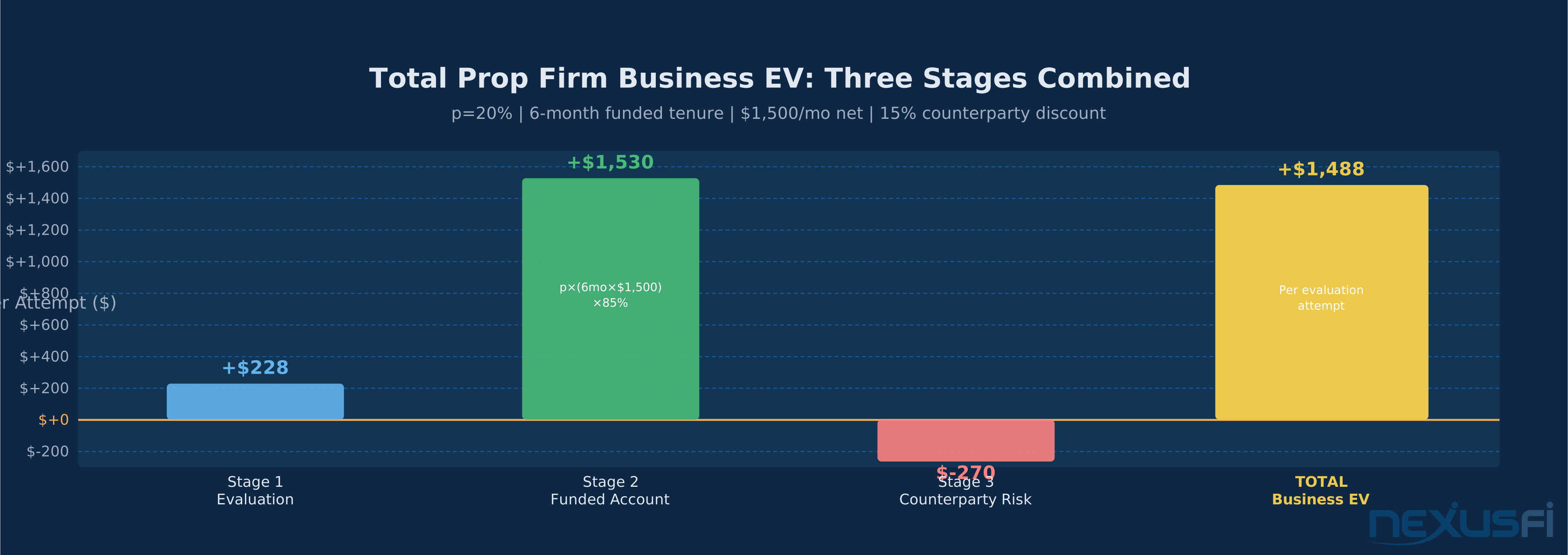
EV_total = EV_evaluation + P(funded) × EV_funded + P(termination) × EV_termination
For a trader with:
- 20% pass rate, $225 all-in evaluation fee, $2,265 net payout
- Expected funded tenure: 6 months at $1,500/month net
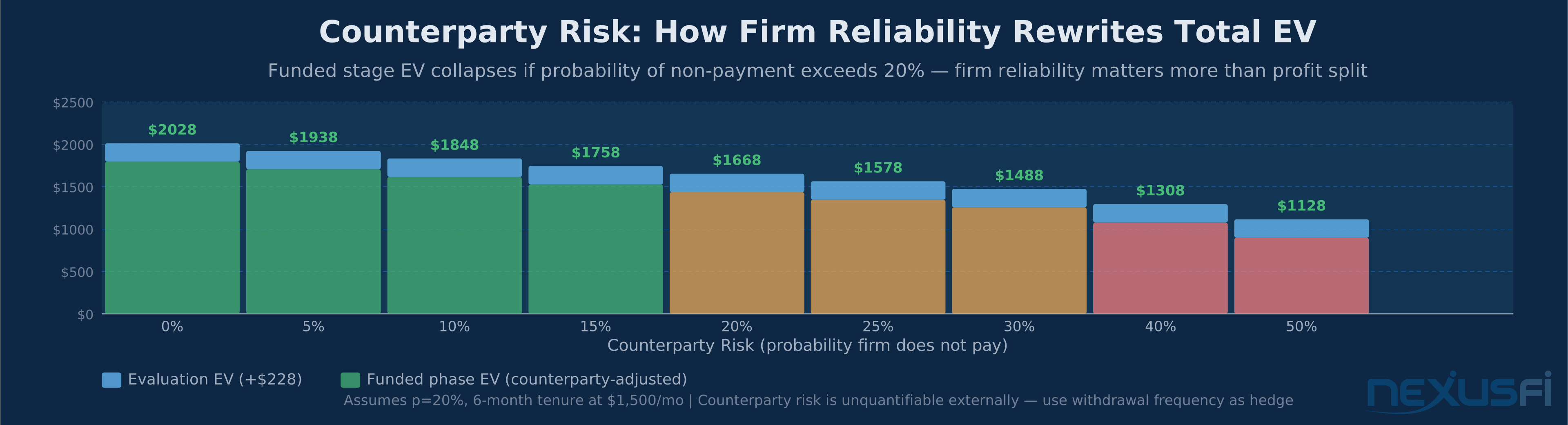
- 15% chance of firm not paying (counterparty risk)
EV_evaluation = (0.20 × $2,265) - $225 = +$228 EV_funded = 0.20 × (6 × $1,500) × (1 - 0.15) = 0.20 × $9,000 × 0.85 = +$1,530 EV_total ≈ +$1,758 per evaluation attempt
That's meaningful positive EV — if the pass probability and funded tenure estimates hold.
Worked Examples: The Math on Real Evaluation Programs #
These calculations use approximate fee structures and real drawdown parameters. Prop firm rules change; use this as a framework, not current pricing.
Apex Trader Funding ($50K) #
- Account: $50K nominal
- Profit target: $3,000
- Trailing drawdown: $2,500 from max account value
- Contract limit: 10 (ES/MES equivalent)
- Monthly fee (regular): ~$147/month
- Promo fee: ~$34-49/month
- Payout split: 90/10 (90% to trader after first milestone)
At regular pricing, 1.5 months average time to pass:
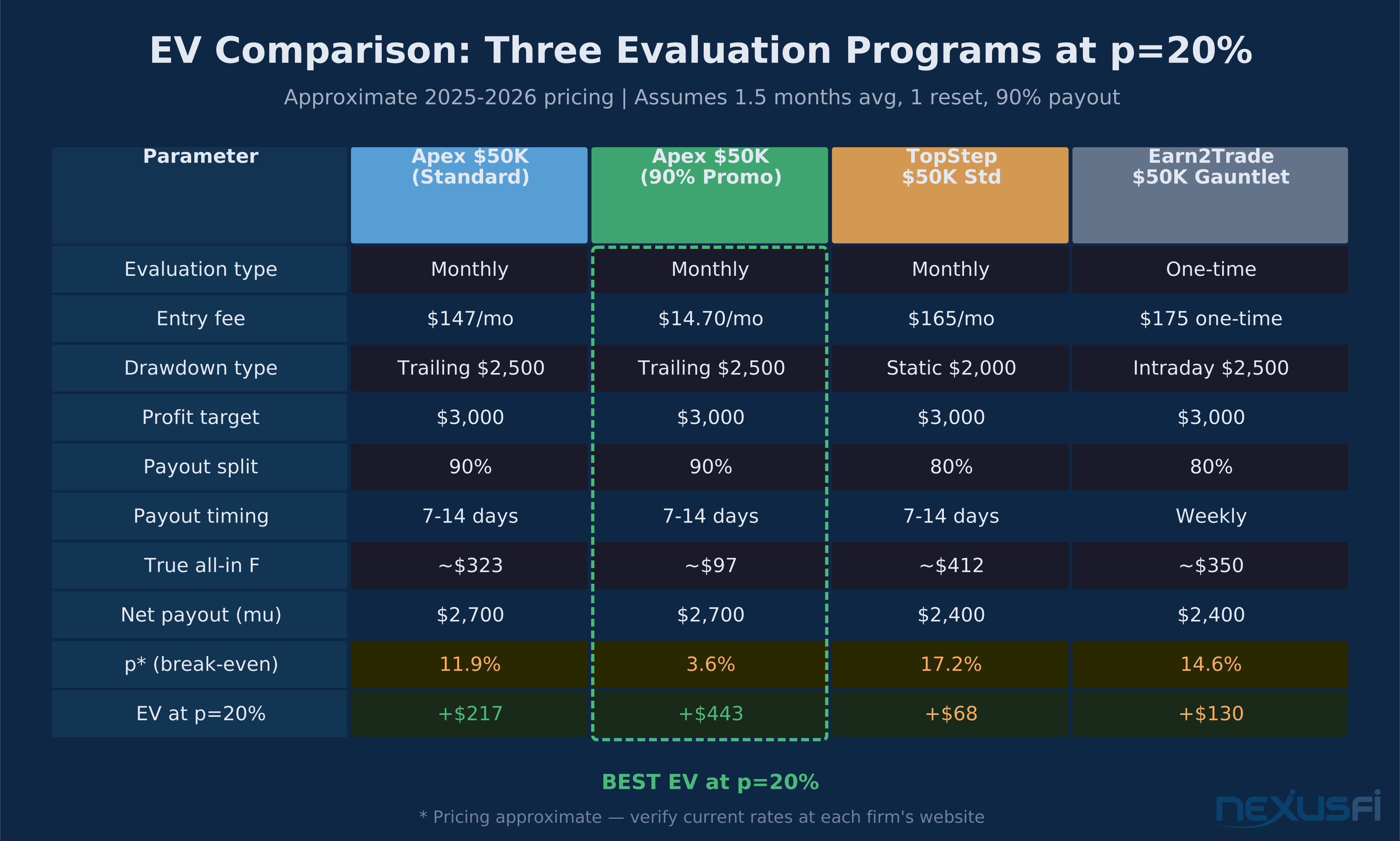
- F_true: $147 × 1.5 + $147 × 1.0 (reset) = $368
- μ: $3,000 × 90% = $2,700
- p\*: $368 / $2,700 = 13.6%
At promo pricing ($39/month):
- F_true: $39 × 1.5 + $39 = $97.50
- μ: $2,700
- p\*: $97.50 / $2,700 = 3.6%
A trader with 20% pass probability is marginally +EV at regular pricing and strongly +EV at promo. The same trader has EV of (0.20 × $2,700) - $368 = +$172 at regular and (0.20 × $2,700) - $97.50 = +$442 at promo.
TopStep ($50K Combine) #
- Account: $50K nominal
- Profit target: $3,000
- Static max drawdown: $2,000 from starting balance (fixed)
- Monthly fee: ~$165/month
- Payout split: 80/20
Key difference from Apex: Static drawdown rather than trailing. This is more forgiving in practical terms — you can't accidentally tighten your buffer with an early winning trade. The $2,000 static limit means your evaluation floor is fixed at $48,000 throughout.
- F_true (1.5 months, 1 reset): $165 × 1.5 + $165 = $412
- μ: $3,000 × 80% = $2,400
- p\*: $412 / $2,400 = 17.2%
Higher break-even probability than Apex due to higher fees and lower payout split. A trader with 20% pass probability has: EV = (0.20 × $2,400) - $412 = +$68 — barely positive. At promo pricing (common with TST), the math improves much.
Earn2Trade ($50K Gauntlet) #
- Account: $50K
- Profit target: $3,000
- Maximum intraday drawdown: $2,500
- One-time entry fee: ~$150-200
- No monthly subscription
- Payout split: 80/20
The one-time fee structure eliminates time pressure. A trader taking 3 months to pass pays the same as one taking 3 weeks.
- F_true: $175 (entry) + $175 (reset) = $350 (one-time structure favors slow, methodical traders)
- μ: $3,000 × 80% = $2,400
- p\*: $350 / $2,400 = 14.6%
For a methodical trader who'd otherwise spend months on monthly subscription fees, E2T's structure is more EV-efficient. The tradeoff: no ability to trade different firm structures or negotiate promo pricing mid-subscription.
The Decision Framework: When Prop Evaluations Are Actually +EV #
Four criteria determine whether an evaluation is worth attempting:
1. Your p exceeds p\ by at least 50%. If p\ = 14% and your realistic pass probability is 21%, you're 50% above break-even — a reasonable margin for uncertainty in p estimation. If your estimated p is 15% and p\* is 14%, that's too close to the margin of error in your own estimate to be confident.
2. You have verifiable pass probability. Simulate your exact strategy under the evaluation's rules for at least 30 days before paying. The complete simulation framework is in Prop Firm Evaluation Strategy. If you can't pass the rules in simulation consistently, your p estimate based on live trading history is not valid — live trading has different rules than evaluations.
3. The evaluation structure matches your trading style. Trailing drawdown evaluations favor traders with consistent small-gain strategies. Static drawdown evaluations favor traders with higher variance but sustained positive expectancy. Run your actual trade distribution against each evaluation type before choosing.
4. You're paying at or below the inflection point. Calculate your break-even fee — the maximum F_true where EV remains positive at your estimated p. Never pay above it. Watch for promos. Use batch evaluation strategies when promo pricing is available.
As @bobwest put it in the ApexTraderFunding review thread, "people who are already pretty decent traders but who lack capital may be the best ones to see if they can get funded by a prop firm. If they already know the ropes and just need backing, this can perhaps be helpful for them."
That's the right selection criterion from a trader's perspective, mapped almost exactly onto the EV framework: if you have documented edge (high p) and only lack capital (low μ from personal account size), prop evaluations offer significant positive value. If you don't have documented edge (low p), evaluations are mostly a way to slowly pay for simulation trading.
That's the right selection criterion from a trader's perspective, mapped almost exactly onto the EV framework: if you have documented edge (high p) and only lack capital (low μ from personal account size), prop evaluations offer significant value. If you don't have documented edge (low p), evaluations are mostly a way to slowly pay for simulation trading.
Where This Analysis Breaks Down #
EV analysis assumes rational, consistent trading across attempts. In practice:
Evaluation-induced behavioral changes. Many traders trade differently under evaluation conditions than in normal markets — taking smaller profits, avoiding positions near drawdown limits, timing trades around daily reset windows. If evaluation behavior differs from baseline trading behavior, your estimated p from historical data is wrong.
Non-stationary markets. Your historical p was estimated from a specific market regime. If market character changes much during your evaluation (volatility regime shift, correlation breakdown), p can drop sharply with no advance warning.
Counterparty risk is unquantifiable. Multiple funded trading firms have closed operations without paying outstanding balances, including some prominent names. This risk doesn't appear in EV formulas because there's no reliable probability estimate. The practical hedge: never maintain more than 2-3 months' expected earnings in any single firm's account. Withdraw frequently.
The psychological cost of repeated failures. The EV framework treats each attempt as independent. Human traders aren't. Three consecutive failed evaluations produce real psychological costs — loss aversion, revenge trading impulses, erosion of confidence — that can lower p on subsequent attempts even if the theoretical edge remains.
The learning value is real but unquantifiable. Conversely, some traders genuinely improve their pass probability with each attempt by learning what not to do. The framework doesn't capture this upside.
EV analysis is the right starting point, not the final word. Use it to screen evaluations before committing, not as a guarantee of outcome.
Practical Application: Building Your EV Calculator #
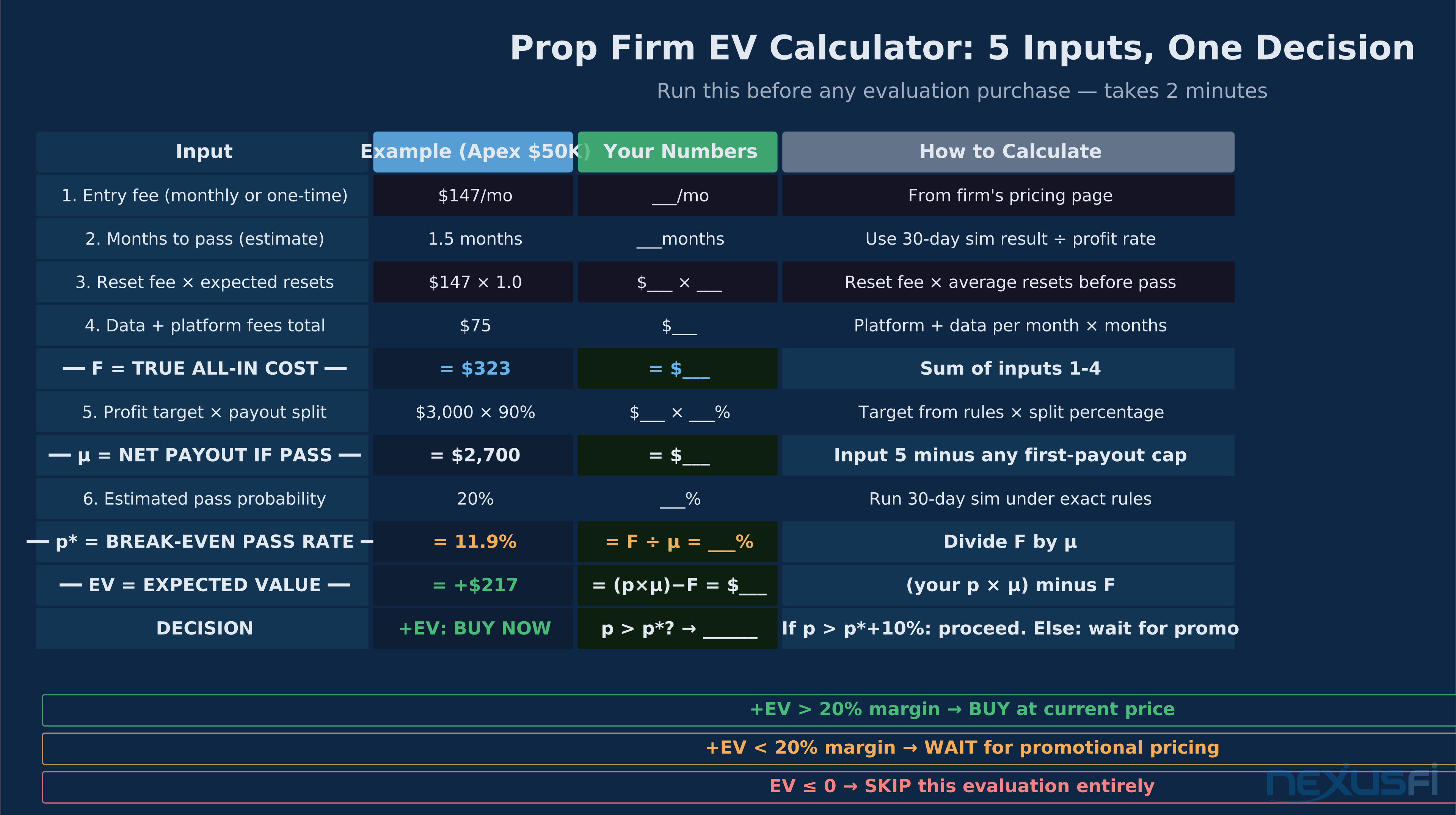
Before any evaluation purchase, build a simple spreadsheet with these inputs:
| Input | Your Value |
|---|---|
| Entry fee | |
| Monthly data/platform fee | |
| Expected time to pass (months) | |
| Expected number of resets | |
| Reset fee | |
| F_true (auto-calc) | |
| Profit target | |
| Payout split (%) | |
| Any first-payout cap | |
| μ (auto-calc) | |
| Your estimated pass probability | |
| p\* = F / μ (auto-calc) | |
| EV = (p × μ) - F (auto-calc) |
If EV < 0, don't buy. If EV is marginally positive (EV / F < 20%), wait for promotional pricing before committing. If EV is strongly positive (EV / F > 50%), the evaluation is worth attempting at current pricing.
Run the same calculator for different account sizes within the same firm. Often the largest accounts have the lowest p\* (best break-even threshold) but also have the lowest realistic p (hardest to pass in practice). The optimal account size is the one where your actual pass probability creates the highest absolute EV, not the one with the most favorable break-even formula.
One last piece of math worth running: the probability of total loss across N attempts. If you allocate a fixed budget of $1,000 to prop evaluations, with each attempt costing $225 and p = 20%, you get approximately 4.4 funded attempts. The probability of not passing in 4 attempts is (0.80)^4 = 40.96%. That means you have a roughly 41% chance of spending your entire $1,000 budget without a single pass — not because you're a bad trader, but because that's the nature of 20% probability over a finite number of trials.
Plan for that scenario before you fund the first attempt, not after the third consecutive failure.
Knowledge Map
Prerequisites
Understand these firstGo Deeper
Build on this knowledgeReferences This Article
Articles that build on this topicCitations
- — Any long term success stories from funded traders in these get-funded programs? (2021) 👍 5“When they offer a '$150k account!!!' in all caps, for $400/month, with a daily max loss of $3k, most traders don't realize that in reality they are purchasing a $3k SIM account, and will almost certainly need to pay 2 or even 3 months worth of subscription fees before they pass.”
- — Funded Trader platforms (2024) 👍 17“Consider a strategy with only a 40% win rate, 2:1 R/R, and a whopping 4% risk per trade... your expected value on any given trade you take is $22.50. If you get 2 trade opportunities per day on average, then you can expect to make $3000 in 67 trading days, which is just over 3 months. The cost would be $133.”
- — Funded Trader platforms (2024) 👍 4“Their trailing drawdown works from the MAX ACCOUNT VALUE and is a meager $2500 on a $50k account. This means, you get into an awesome 10 contract trade and seconds later you're up $3000! yay right? Well, you've hit the wall by now, and the market reverses and your trade slides back $2501. YOU'RE OUT.”
- — ApexTraderFunding.com experience and review (2023) 👍 4“Yes, without doubt fees and resets are what funds payouts. Likely the income of most of the prop companies is 97-99% from fees and resets.”
- — Quest to Funding (2022) 👍 3“Hold out for discounts! Don't just jump blindly into an evaluation without first checking for discounts. The best time is around a major holiday. Just hold tight, and use the time to continue sim trading or practicing to become better.”
- — APEX 300K+: The Journey (2023) 👍 7“The easiest APEX eval account to pass is probably the $25K account and the hardest to pass is probably the $300K. A trader would be better suited to use a trade copier and trade 6-$50K accounts to get 6-$2500 trailing thresholds -- or effectively, a $15000 trailing threshold.”
- — Anybody heard of topsteptrader (review) (2016) 👍 7“Over 370 traders succeeded in achieving a Funded Account. Those funded maintained discipline, with less than 4.3% violating their Daily Loss Limit. 71% of funded accounts are maintaining or growing.”
- — ApexTraderFunding.com experience and review (2022) 👍 8“people who are already pretty decent traders but who lack capital may be the best ones to see if they can get funded by a prop firm. If they already know the ropes and just need backing, this can perhaps be helpful for them.”
- — CFTC: Prop Trading Fraud Advisory (2024)
- — Best Futures Prop Firms in 2026: Ranked After 12 Evaluations (2026)
- — Earn2Trade vs TopStep vs Apex: 2026 Comparison (2026)