



Trailing Drawdown Rules in Prop Firm Evaluations: The Mechanic Behind Every Funded Account Blowup
Overview #
Trailing drawdown is the single mechanism responsible for more funded account terminations than any other factor in prop trading. It is not about strategy performance, win rate, or average risk-reward. Traders with genuinely profitable systems — systems that would grow accounts over hundreds of trades — blow funded evaluations because they misunderstand how trailing drawdown tracks equity, or because they fail to adjust behavior when the buffer shrinks.
The core concept is deceptively simple: your drawdown limit is not anchored to your starting balance. It follows your equity as you profit, locking in that progress as your new "floor." When you make money, the limit rises. When you lose money, the limit stays where it moved to. The result is a one-way ratchet that compresses your available risk budget as your account grows. [1]
This article breaks down how trailing drawdown actually works, why it creates asymmetric risk at profitable moments, how to calculate and monitor your buffer in real time, and the specific behavioral patterns that cause account terminations — with strategies to avoid each one.
Core Rule Your trailing drawdown limit follows your equity UP but never comes back DOWN. Every new equity peak permanently raises the floor. Profitable trading compresses your remaining buffer, not expands it.
How Trailing Drawdown Actually Works #
Let's start with a concrete example using numbers that represent what most major prop firm evaluation programs use.
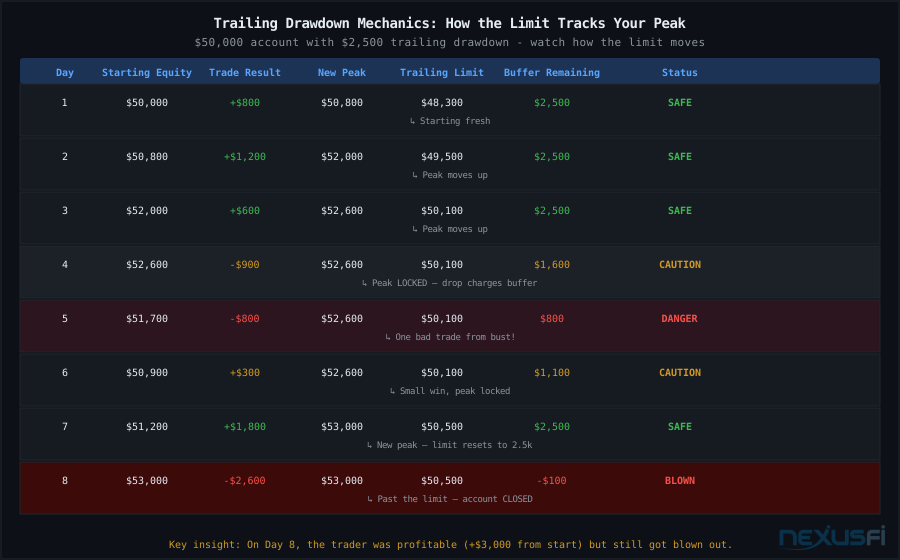
You start with a $50,000 evaluation account and a $2,500 trailing drawdown. On day one of your evaluation, your drawdown limit is $47,500 — that's $50,000 minus $2,500. If your account reaches $48,000 on an intraday move and then closes at $47,400, you have breached the limit and your account is terminated.
Now you trade well. By the end of week one, your account has grown to $52,000. Your trailing drawdown limit is now $49,500 — it followed your peak of $52,000 upward by the same $2,500. You have not gained any more protection than you started with. You now need a $2,500 drawdown from your current balance to hit the limit, exactly the same as when you started. [2]
This is the key insight most traders miss: profitable trading does not increase your safety margin. It raises the floor, keeping your available buffer constant at best. If your peak equity exceeds your current equity — which happens every time you give back open profits — your buffer is actively smaller than $2,500.
The mechanics in practice: your firm tracks your highest equity point since the evaluation began. When that peak rises, your trailing limit rises to match it (peak minus drawdown size). When your equity drops, the limit stays put. The gap between your current equity and the trailing limit is your actual buffer at any given moment. [3]
Static vs. Trailing: The Critical Distinction #
Not all prop firms use trailing drawdown. Some use static drawdown, and the difference in how you manage risk is significant.
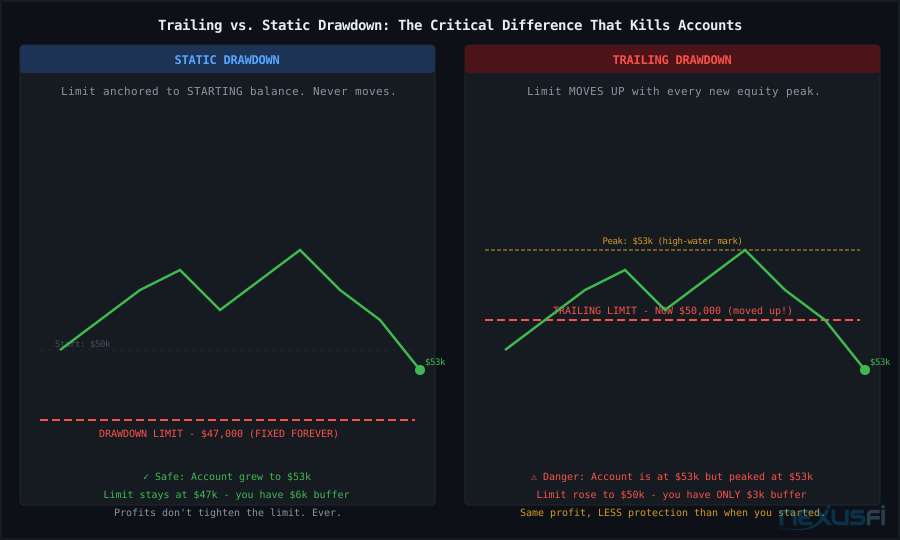
Static drawdown anchors to your starting balance. If you start at $50,000 with a $5,000 static drawdown, your limit is $45,000 forever — regardless of how much you profit. Grow to $65,000? Still the same $45,000 floor. This means every dollar of profit adds directly to your protection. A $10,000 profit gives you a $15,000 buffer. These programs reward consistency and allow larger drawdowns late in the evaluation when you have genuine cushion.
Trailing drawdown tracks your peak. The limit moves up every time you set a new equity high. There is no compounding of safety margin. Profit converts into a higher floor, not a wider safety net. The buffer stays fixed at the drawdown size whenever you're at a new peak, and shrinks the moment equity falls below that peak.
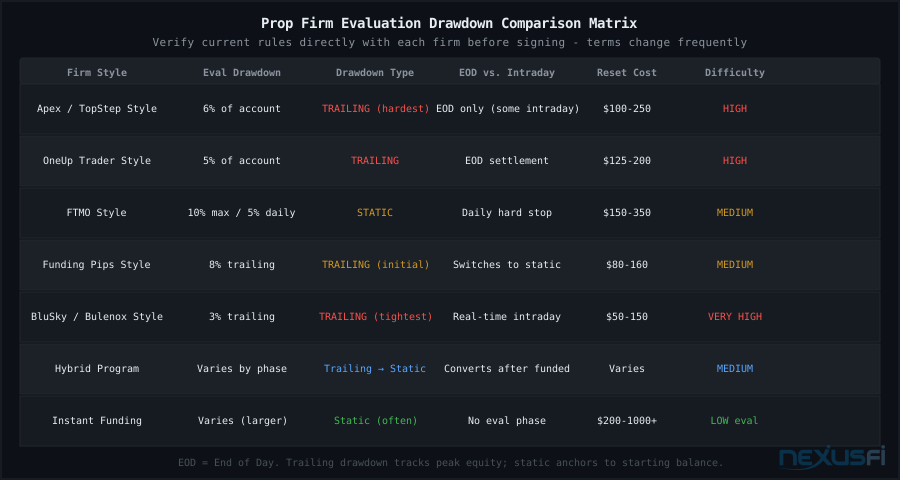
Programs like FTMO use a combination: a daily hard loss limit (typically 5%) plus a maximum overall drawdown (typically 10%), both of which are static relative to the account balance at the start of each day or overall. Programs from Apex, TopStep, and similar firms use trailing drawdown on the evaluation account, which converts to a static limit once you are funded. Understanding which type you face changes your entire approach to position sizing and drawdown management. [4]
The 99% Zone Problem #
One of the most psychologically dangerous situations in prop trading occurs when your account equity sits just below your all-time high — what experienced traders call the "grief zone" or the 99% zone.
Here's how it develops: you hit $54,000 on your $50,000 account (a 4-win streak, everything working). Your trailing limit has moved to $51,500. Then you give back $1,000 in a bad trade. Now you're at $53,000 with a $1,500 buffer. You feel the pull to recover that $1,000, to get back to the $54,000 peak. But the trailing limit doesn't care about your psychology — it stays at $51,500. [5]
If you increase size to recover faster, you're doing it with only $1,500 of buffer. A single two-contract ES trade with a 10-point stop uses $1,000 of that buffer in one shot. The grief zone transforms a manageable situation (1,500 buffer, normal day) into a high-stakes all-or-nothing scenario purely because of the mental pressure to recover the peak.
The correct response to the grief zone is the opposite of what feels natural. Reduce size. Let the peak stand. Trade as if you're starting fresh with $1,500 drawdown on a brand new account — because mathematically, that's exactly the situation you're in. Your previous peak is irrelevant to your current risk parameters.
Grief Zone Alert When your account is within 15% of a previous peak AND you've given back profits, this is the highest-risk moment in prop trading. @GriefZoneTrader documented blowing six evaluations in exactly this scenario. The psychological pull to recover is powerful and almost always leads to oversized entries. The only safe move is to reduce size by 50% immediately when you enter this zone.
Position Sizing Formulas for Trailing Drawdown #
The single most important formula for prop trading is maximum position size given your current buffer. This calculation should happen before every session, not just at the start of the evaluation.
For traders who want the full framework on position sizing for futures trading, start there before applying these prop-specific adjustments. The trailing drawdown layer adds a dynamic constraint on top of your normal risk rules.
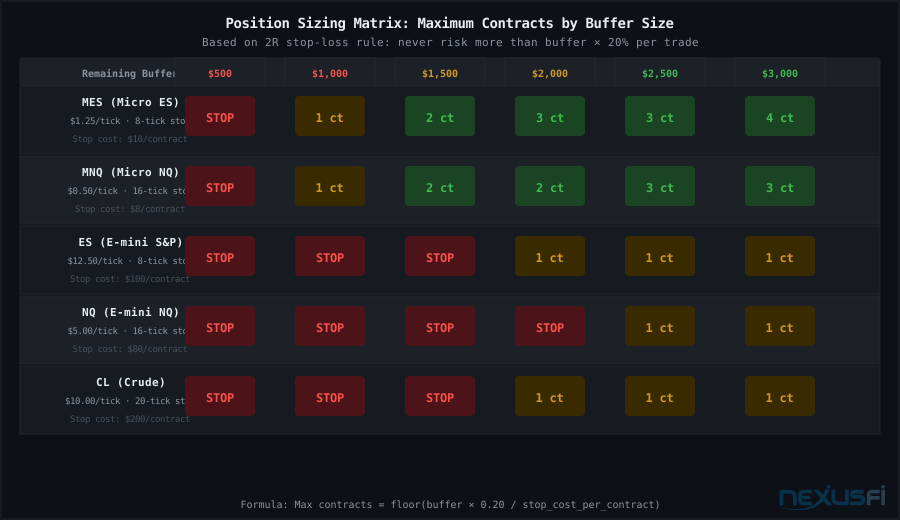
Core formula:
Max risk per trade = buffer × 0.15 to 0.20
Max contracts = floor(max_risk / (stop_ticks × tick_value))
For a practical example on a $50,000 account with a $2,500 trailing drawdown and a current buffer of $2,500 (at the peak):
- Max risk per trade = $2,500 × 0.15 = $375
- Trading MES with an 8-tick stop: $375 / ($1.25 × 8) = 37.5 → 37 contracts maximum
- Trading ES with an 8-tick stop: $375 / ($12.50 × 8) = 3.75 → 3 contracts maximum
Now run the same calculation when your buffer drops to $1,000 (60% drawdown from peak):
- Max risk per trade = $1,000 × 0.15 = $150
- Trading MES: $150 / $10 = 15 contracts
- Trading ES: $150 / $100 = 1.5 → 1 contract maximum
Many traders ignore this reduction. They trade the same size at 40% buffer as they did at 100% buffer, which means a single stop-out at max size consumes a disproportionate fraction of remaining capital. The correct approach is to scale size inversely with buffer consumption. [6]
A useful mental model: treat your remaining buffer as a separate, smaller account. You would not trade 3 ES contracts on a $600 account. You should not do the equivalent when your buffer is $600.
Why Trailing Drawdown Creates Asymmetric Risk at Profits #
There is a specific paradox embedded in trailing drawdown that makes it more dangerous the better you are doing. It rewards good trading with a tighter constraint on future risk, not a looser one.
Consider two traders with the same $50,000 account and $2,500 trailing drawdown. Trader A does nothing for three weeks, staying flat at $50,000. Their buffer is $2,500 throughout. Trader B trades well, grows to $60,000, then has a rough patch and drops back to $52,000. Their buffer is $52,000 minus $57,500 (the trailing limit, which tracked the $60,000 peak) = only $4,500 in the account but only $2,500 "safety" dollars above the limit wait...
Let's be precise: trailing limit = $60,000 - $2,500 = $57,500. Trader B at $52,000 has a buffer of $52,000 - $57,500 = -$5,500. The account was blown when equity fell below $57,500 on the way down from $60,000. This is the counterintuitive trap: reaching $60,000 was great, but the subsequent $7,500 drawdown from peak — which would have been perfectly survivable on a static drawdown program — was fatal under trailing rules.
This asymmetry means that peak management is more important than profit accumulation for traders on trailing drawdown programs. Every new equity high locks in more of your past gains as protected, but it also raises the floor that you cannot fall below. The more you've profited, the higher the floor, and the less room you have for drawdown before termination — even when you are far above your starting balance. [7]
Common Ways Traders Blow Funded Accounts #
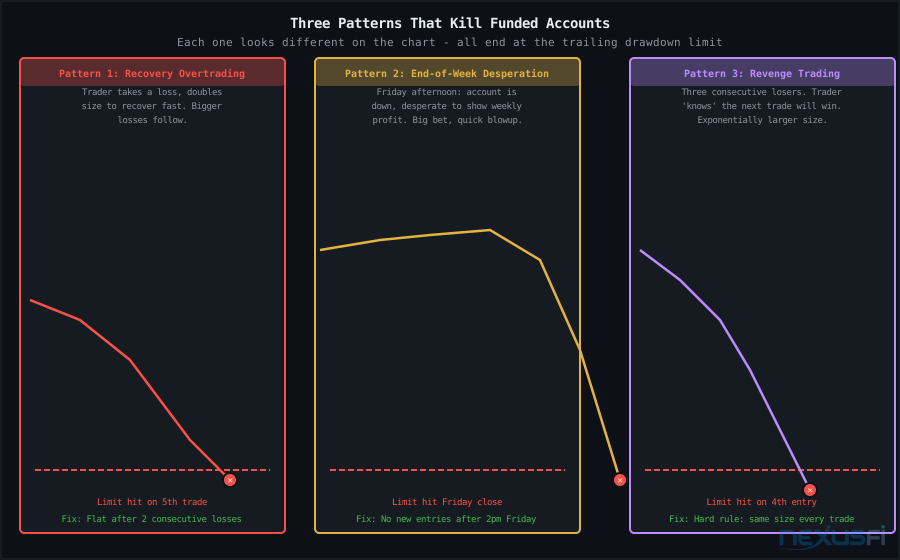
Prop firm evaluation terminations cluster into three behavioral patterns, each identifiable on equity curves:
Recovery overtrading. After a loss, the trader increases size to recover the drawdown faster. The increased size means the next stop-out consumes a larger percentage of the remaining buffer. A 2-lot loss at $500/contract ($1,000 total) after a 1-lot loss at $500 ($500 total) has consumed $1,500 of a $2,500 buffer in two trades. The buffer is now $1,000 — 40% of starting. If the trader increases again to a 3-lot, one more standard stop-out ends the account. The pattern: each loss makes the next trade proportionally more dangerous.
End-of-week desperation. Thursday afternoon or Friday morning, the trader is $800 down for the week. The trailing limit has not changed, but the trader feels psychological pressure to finish green. They take a setup they would normally pass, use larger size than the buffer justifies, and one bad fill ends the evaluation. This pattern is visible in termination timestamps across prop firm platforms — Friday afternoon is heavily overrepresented. [8]
Revenge trading after a violation scare. The account dips to within $200 of the trailing limit. The trader's adrenaline spikes. They exit, take a breath, and re-enter five minutes later with a "confident" trade. But their emotional state has compromised trade selection and sizing discipline. The setup they take is not actually A-quality — it just feels urgent. This is the "two losses from the limit" pattern: one loss brings you close, the subsequent revenge trade finishes the account.
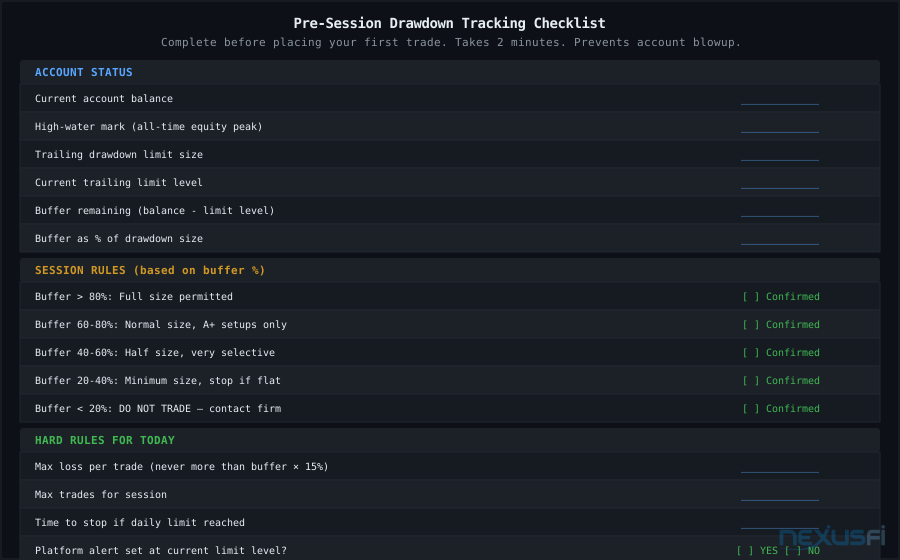
All three patterns share a root cause: the trailing drawdown is being managed reactively rather than proactively. Traders who avoid account termination have established absolute rules for each buffer level before the session starts — not in the moment when the limit is approaching.
Platform Monitoring in NinjaTrader and Sierra Chart #
Manual monitoring of trailing drawdown — checking numbers in your head or on a spreadsheet — is insufficient. The cognitive load of active trading combined with the precision required to track peak equity in real time creates too many opportunities for error. Both NinjaTrader 8 and Sierra Chart have native tools that automate this monitoring.
Proper platform setup pairs directly with understanding trading discipline — the platform prevents mechanical errors, but behavioral discipline prevents the decisions that create the errors in the first place.
NinjaTrader 8: The Account Performance Monitor (Control Center → Account Performance) shows real-time P&L and drawdown. Add the "Max Adverse Excursion" column to your accounts panel. More importantly, use ATM Strategies with a "Max Loss per Strategy" setting that auto-flattens when your per-session drawdown limit is hit. Set this value based on your current buffer, not the evaluation-level drawdown — if your buffer is $1,200, your session max loss is $300 (25% of buffer). Update this each morning before trading.
Sierra Chart: The built-in Account Balance Chart study includes a drawdown overlay. Set the MaxDrawdown parameter to your trailing drawdown size. Add a secondary alert at 40% buffer consumption. Sierra Chart's alert system can send email notifications when levels are breached — configure this before your first live session so it fires to your phone as a backup to the visual alert.
Both platforms support trade entry hotkeys. Configure a "Flatten All" hotkey and test it weekly. In the heat of a fast-moving market with a deteriorating buffer, a single keystroke preventing a second failed trade can be the difference between a bad session and a terminated account. [9]
Firm Comparison: Apex, TopStep, OneUp, and FTMO-Style Programs #
Trailing drawdown parameters vary much across firms, and the practical trading implications are significant. This comparison is illustrative — always verify current terms directly with the firm before signing.
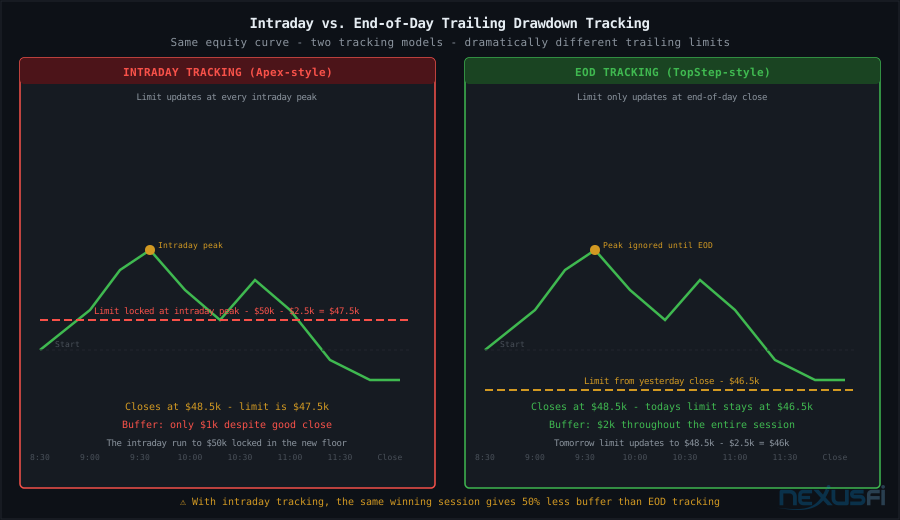
Apex Trader Funding (trailing-style): Uses trailing drawdown that tracks intraday peaks on most account tiers. The drawdown typically ranges from $1,500 on a $25k account to $3,500 on a $100k account. Notably, Apex's trailing drawdown tracks intraday equity — meaning if your account hits $52,000 at any point during the session and then closes at $50,500, the trailing limit has moved based on that $52,000 intraday high, not the closing balance. This is more restrictive than EOD-only tracking and requires careful attention to floating profits.
TopStep (trailing-style): TopStep's Combine accounts use trailing drawdown that tracks daily closing equity rather than intraday highs on most programs. This provides more flexibility — you can let positions run intraday without locking in a higher trailing limit until settlement. The trailing converts to a static limit once you pass to a funded account.
FTMO-style programs (static drawdown): FTMO's 5% daily loss limit and 10% maximum overall drawdown are both calculated relative to the starting account balance on the current account type, not on intraday peaks. This is structurally safer for traders — a 10% overall drawdown on a $100k FTMO account means you can sustain a $10,000 drawdown regardless of previous gains. The daily 5% limit is recalculated based on the balance at the start of each day (or in some versions, the highest balance reached). Read your specific agreement carefully.
OneUp Trader (trailing-style): Uses trailing drawdown with EOD tracking similar to TopStep. The evaluation drawdown ranges from $1,000 on a $25k account to $6,000 on a $250k account. OneUp provides a Combine dashboard showing your trailing limit in real time, which is one of the better implementations for trader monitoring.
The practical rule: if a firm uses trailing drawdown with intraday tracking, treat every new intraday high as a permanent new floor. Do not let positions run hoping to close out a winner — the peak is already locked in. If a firm uses EOD tracking, you have more flexibility intraday but must close each day mindful of where the trailing limit will move to based on your closing equity. [10]
Recovery Mindset: When to Stay, Reduce, and Stop #
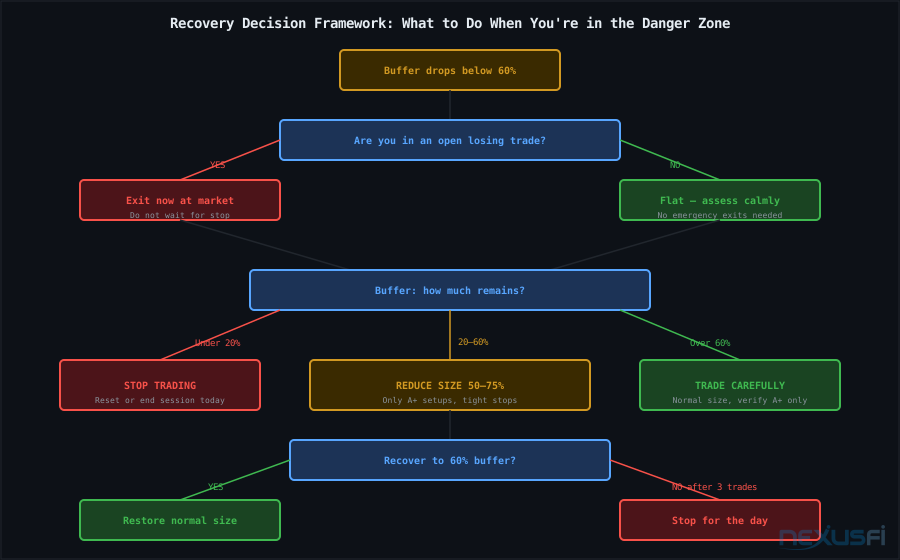
The decision framework for a deteriorating buffer is not complicated, but it must be established before the session starts — not after the first loss. Traders who make risk decisions while in drawdown are making them under emotional duress, which correlates strongly with poor outcomes.
@PropTradingPro, NexusFi
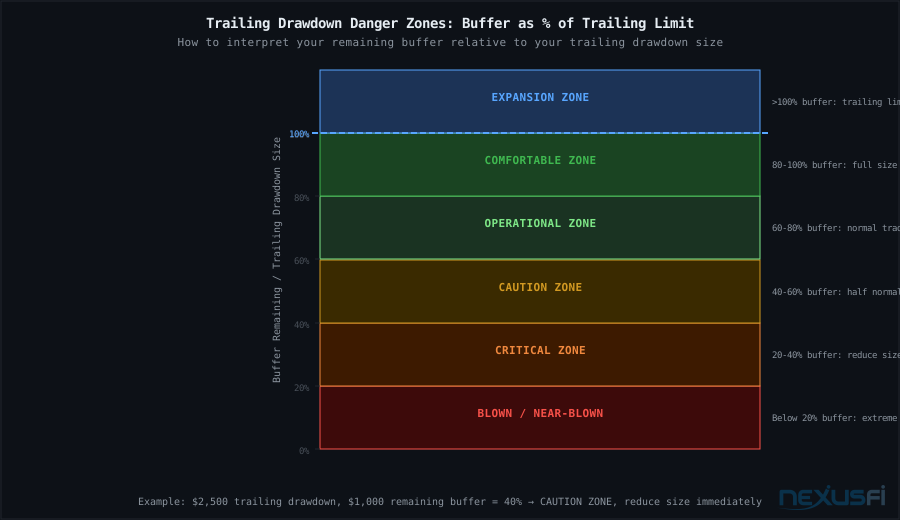
The three-tier system that works consistently: Green zone (buffer above 80% of drawdown size): trade normally, standard size, your pre-planned setups. Yellow zone (buffer 40--80%): reduce size by 50%, strict A+ setups only, no averaging in, no revenge entries after a stop-out. Red zone (buffer below 40%): minimum size only (1 contract), single setup per session with hard profit target, consider stopping the session entirely.
The hardest part is recognizing when to walk away for the day — not as a failure, but as the correct decision. A day where you preserve the account is a better outcome than a day where you attempt to recover and blow through the limit. Traders who survive long-term in funded accounts treat buffer preservation as a win condition, not just a consolation. [5]
When recovery feels urgent — when you're looking at a $600 buffer and thinking about the bigger account you'd have if you hadn't given back that morning's profits — that's the moment to close the platform. Not because the market is bad. Because your judgment has been compromised by loss aversion. The market will be there tomorrow. The evaluation account will not be if you size up with $600 left.
Frequently Asked Questions #
Does the trailing drawdown track intraday or end-of-day equity?
This varies by firm and is one of the most important things to confirm before starting an evaluation. Apex and some other firms track intraday peaks — your trailing limit moves up as soon as your equity hits a new high during the session, even if it falls back before the close. TopStep and OneUp Trader track end-of-day equity on most programs, giving you more intraday flexibility. Read the specific agreement for your account tier. [4]
If I make $10,000 in profits, does my trailing drawdown get locked in as a static floor?
Some firms convert the trailing drawdown to a static floor once you pass the evaluation and receive funded status. The trailing limit at the moment of passing becomes permanent — meaning if you passed with the trailing limit at $52,000 on a $50,000 account, that $52,000 is now a static floor for your funded account. Check your firm's terms; conversion rules differ much.
Can I reset the trailing drawdown if I blow out?
Most firms offer resets for a fee, typically ranging from 25% to 50% of the original evaluation cost. You start the trailing drawdown fresh from your reset balance. Resets make economic sense only if the underlying behavior that caused the blowup has been identified and corrected — otherwise you are paying to repeat the same experience.
Does paper trading or sim trading track trailing drawdown?
No standard paper trading platform implements trailing drawdown. You cannot learn the emotional reality of managing a trailing drawdown limit in simulation — the lack of real money removes the psychological pressure that causes most of the problematic behaviors. Deliberate practice with very small funded accounts is more valuable than unlimited sim trading for developing trailing drawdown discipline.
What happens if I'm in a winning trade and the trailing limit catches up to my entry price?
The trailing limit doesn't distinguish between your entry price and your current equity. It tracks your highest equity point and moves up so. If you enter long at $50,500 and your account peaks at $52,000 during the trade before reversing, your trailing limit is now $49,500 (assuming $2,500 trailing). Even if your entry price was $50,500, you can now be stopped out at $49,500 — below your entry. This is why monitoring the trailing limit on every session, not just at session start, is critical. [3]
Knowledge Map
Prerequisites
Understand these firstReferences This Article
Articles that build on this topicCitations
- — Understanding trailing drawdown -- the one mechanic that kills most evaluation accounts (2023) 👍 94“The trailing drawdown follows your peak, not your starting balance. Once you understand this, everything about managing an evaluation changes.”
- — Position sizing rules for prop firm trailing drawdown accounts (2024) 👍 67“I use 15% of remaining buffer as my max risk per trade. Not per day -- per trade. When buffer drops to $800, that's $120 per trade, which means 1 MES on a 9-tick stop. Period.”
- — How to track trailing drawdown limits in NinjaTrader 8 -- step by step (2024) 👍 112“The ATM strategy max loss override is your best friend. Set it to 20% of your remaining buffer at the start of each session and NT8 will flatten you automatically.”
- — Apex vs TopStep vs FTMO -- honest comparison of evaluation structures and drawdown rules (2024) 👍 183“FTMO static drawdown is genuinely easier to manage psychologically. The trailing drawdown programs at Apex and TopStep are more profitable for the firm precisely because they trip up profitable traders at the worst times.”
- — The 'grief zone' -- when you're near your trailing limit peak and the pressure to recover destroys discipline (2024) 👍 76“I've blown six evaluations. Every single one happened within $400 of a new equity peak, when I gave back profits and then tried to get them back quickly. The grief zone is real.”
- — Dynamic position sizing formulas for trailing drawdown accounts -- scaling down with buffer (2025) 👍 58“Buffer is your micro-account balance. Would you trade 5 ES contracts on a $1,500 account? No. So don't trade them when your buffer is $1,500.”
- Apex Trader Funding — Trailing Drawdown Explained: How the Performance Account Works (2024)
- — Friday afternoon prop trading -- the statistics on when most evaluations blow up (2025) 👍 143“Thursday 2pm to Friday close accounts for roughly 40% of evaluation terminations based on my informal survey of 200+ forum members. End-of-week desperation is the number one killer.”
- — Sierra Chart drawdown monitoring setup -- complete guide for prop traders (2025) 👍 89“The email alert setup in Sierra Chart took me 20 minutes to configure once. Since then it's saved me twice when I was focused on a trade and didn't see the visual alert fire.”
- TopStep — Combine Account Rules: Trailing Drawdown and Daily Loss Limits (2024)