



Sunk Cost Fallacy in Futures Trading: Why Past Losses Destroy Future Decisions
Overview #
Every trader has done it: held a losing ES position an hour past where they should have exited, added contracts to a failing NQ short to "average a better entry," kept paying $200/month for a platform they barely open, or signed up for a fourth prop firm evaluation because they've already spent $600 on previous attempts. The reasoning always sounds logical in the moment. It never is.
That reasoning has a name: the sunk cost fallacy. And in futures trading, where leverage multiplies mistakes by 20x, where losses settle in your account in cash each night regardless, and where margin calls can force exits at the worst possible moment, this cognitive bias is more destructive than in almost any other financial context.
The sunk cost fallacy is one of the most studied biases in behavioral economics. Arkes and Blumer defined it in 1985: the tendency to continue investing in something — money, time, energy — because of prior investment rather than future expected value. The past expenditure is "sunk" — it cannot be recovered regardless of what you do next. And yet the brain treats it as if it can be, and as if continuing the commitment is the only way to justify the prior cost.
In futures trading, this distortion doesn't just affect individual positions. It corrupts strategy evaluation, tool selection, educational investment, and prop firm decisions. The market doesn't care what you paid for your entry, how many months you spent building your system, or how many evaluations you've failed. But your brain does — and it will override your stops, double your size, and drain your capital to protect an ego cost that was already gone before you even asked the question.
Understanding how this works — and how to interrupt it — is one of the highest-leverage psychological improvements a futures trader can make.
What Is a Sunk Cost in Trading? #
A sunk cost is any expenditure that cannot be recovered: money already spent, time already invested, emotional energy already consumed. None of these can be returned by future decisions. The rational approach to decision-making ignores sunk costs entirely and focuses exclusively on expected future value: what is the best course of action from this point forward, independent of what was spent to get here?
In trading, sunk costs take several forms that traders frequently confuse with relevant data:
Monetary sunk costs are the most obvious — the entry price paid for a futures contract, the fees paid for platform subscriptions, the cost of failed prop firm evaluations. Once spent, these dollars are gone. The ES contract you bought at 5100 doesn't know you paid 5100. It will trade at 5088 regardless of your basis.
Time sunk costs are less visible but equally dangerous. Six months building an algorithmic system represents time you will never get back. If the system doesn't have edge in live trading, those six months aren't a reason to keep trading it. They're history — relevant to your learning, irrelevant to whether this specific system should continue receiving capital.
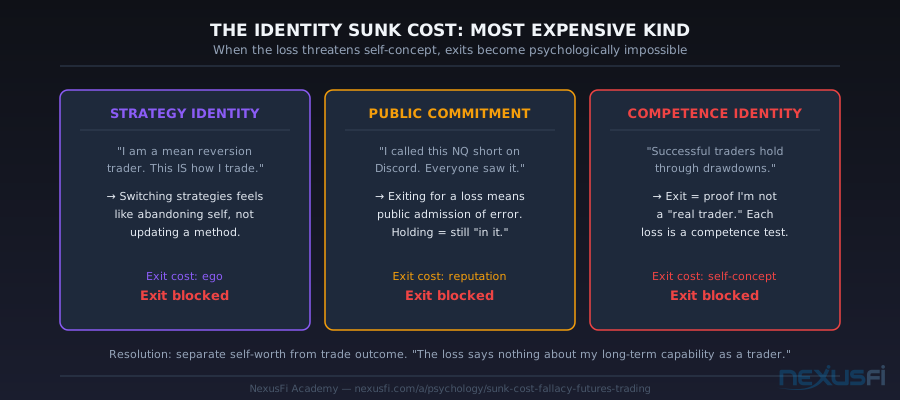
Emotional and identity sunk costs are the most insidious. When a trader has publicly posted their conviction in a thesis, described the setup to their Discord group, or built their identity around being "a volatility fade trader" — exiting that trade means more than just booking a loss. It means admitting the thesis was wrong. The reputational cost, the identity cost, becomes part of the sunk cost calculation, and it drives decisions in ways that are completely invisible to the trader experiencing them.
Effort sunk costs combine time and emotional investment in a especially painful way. A trader who has spent three weeks back-testing a strategy, writing rules, and optimizing parameters has invested effort that feels meaningful. That effort is gone the moment they deploy the strategy — and its past existence is not evidence of its future performance.
“You improve as a trader by repetition, so the cost of this trade has excluded you from many others that could have been taken while you were tangled up in this one. There is an indeterminate cost there.”Source: Stuck in a short position. What to do? (31 thanks)
This framing — that the invisible cost of not acting elsewhere is as real as the visible cost of the bad trade — is the foundation of opportunity cost thinking, the most powerful antidote to sunk cost reasoning.
Why Futures Markets Amplify the Bias #
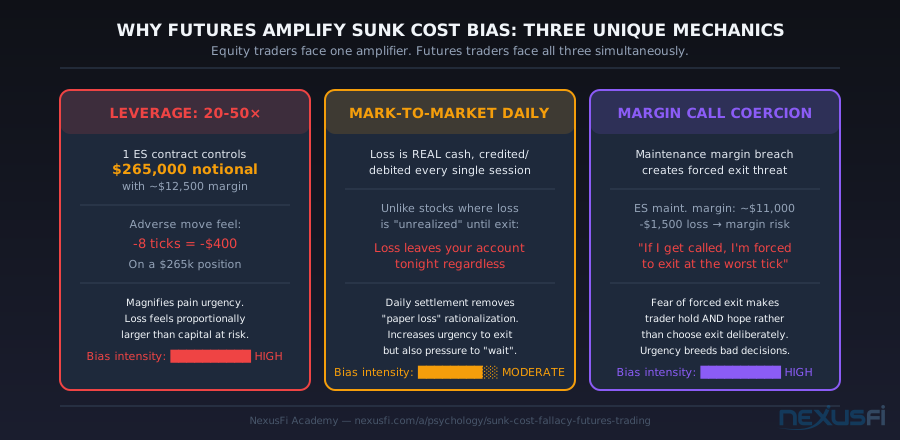
The sunk cost fallacy exists in all investment contexts. But three structural features of futures markets make it dramatically worse than what equity traders face:
Leverage: Making Losses Feel Urgent #
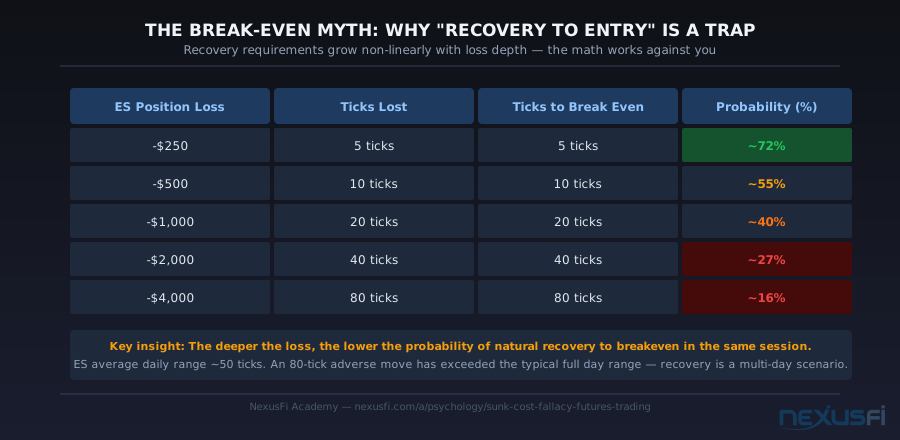
A standard ES contract controls approximately $265,000 in notional S&P 500 exposure on roughly $12,500--$15,000 in margin. That's 17--20x leverage on initial margin, and the losses feel every bit of it. When a trade moves 8 ticks against you — $400 — the psychological impact isn't proportional to the $400. It's proportional to the position size, which at 20x leverage, amplifies the emotional response to loss by the same factor it amplifies the financial exposure.
This urgency is exactly the wrong environment for clear thinking. Sunk cost reasoning thrives on emotional urgency — on the desire to do something about a loss rather than think clearly about what the loss means. Leverage provides that urgency automatically, with every adverse tick.
Mark-to-Market: No "Unrealized Loss" Safety Net #
Equity traders have a cognitive escape hatch that futures traders lack: the ability to classify losses as "unrealized" — meaning they're only a number on a screen until you exit. This allows equity investors to rationalize holding through drawdowns by noting they "haven't actually lost yet." It's incorrect economically, but it's a comfort mechanism.
Futures traders have no such comfort. Mark-to-market settlement means that losses are real cash that leaves your account at the close of each trading session, regardless of whether you've exited. A 15-tick loss on an ES position at session close is $750 gone from your account — real, settled, cleared. There is no "unrealized" frame to hide behind.
This mechanism cuts both ways. It removes the equity trader's rationalization but replaces it with a different pressure: the daily cash reality of an adverse position creates urgency to wait for recovery before another settlement date takes more. The sunk cost trap has a calendar attached to it.
Margin Maintenance: The Coercion Mechanism #
When a position moves against a futures trader deeply enough, maintenance margin becomes a genuine constraint. The broker's margin call doesn't care about your thesis. It cares about your equity balance. If the ES position moves far enough adverse, the choice is no longer "hold versus exit" — it becomes "deposit more capital or be forced out at the worst moment."
The threat of forced liquidation — of having the decision taken away by a margin call — creates a perverse incentive to keep hoping rather than choosing. "If I get called out at this price, I'll be exiting at the absolute worst tick." The fear of that outcome drives irrational holding even as the position continues to deteriorate. The sunk cost bias gets reinforced by margin mechanics.

Five Ways It Shows Up in Futures Trading #
1. Holding Positions Past Defined Stops #
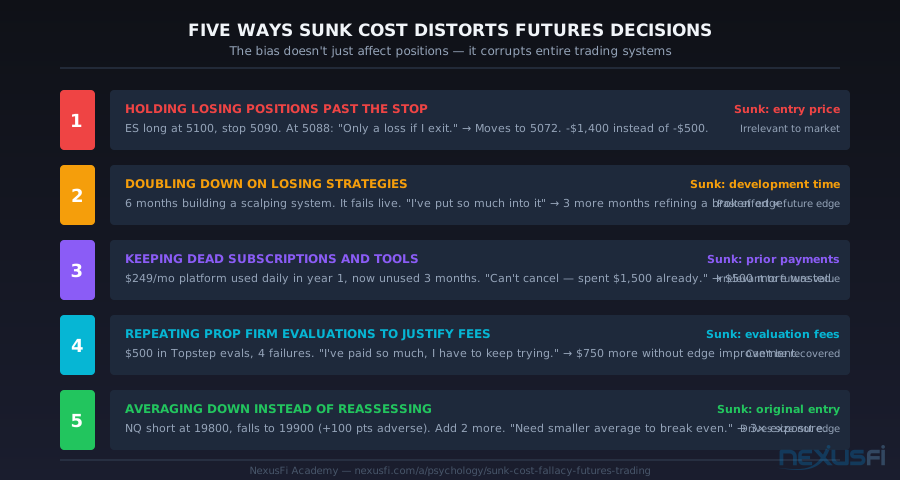
This is the most recognizable manifestation — and the most expensive. A trader defines a stop before entry (let's say 10 ticks below entry on an ES long at 5100, so stop at 5090), watches price breach that level, and then... doesn't exit. The internal monologue takes over:
"It's only a loss if I exit." This statement is factually incorrect — the mark-to-market loss is real whether you exit or hold. But it feels true, because closing the trade "locks in" the loss while staying open preserves the possibility of recovery.
"It'll come back." This might be true. It might not be. The question is whether there's a current-day reason to hold, not whether recovery is possible. The entry price at 5100 doesn't create any additional probability of the position returning to 5100.
"My stop was too tight." This may also be true — but if so, it should have been assessed before entry, not after price hits the stop level. Moving stops after the fact is not position management; it's sunk cost logic applied to stop placement.
“I know that I should be proud of every stop that I honour, because this will save my account in the longer run.”Source: STOPS are Frustrating (SL) ...to take or not to take (33 thanks)
The structural problem is that the entry price — the sunk cost — has no predictive value for future price movement. But the brain treats it as a magnet, an anchor point that price "should" return to. It never should. It will go where the market takes it, indifferent to your basis.
2. Doubling Down on Losing Strategies #
A trader spends six months developing a mean reversion system for the NQ. They do thorough backtesting, parameter optimization, walk-forward testing. They deploy it live, and it fails — the edge doesn't hold in execution, or the regime shifted, or the transaction costs were underestimated in backtesting.
The rational response is to stop trading the system and either discard it or return to development. The sunk cost response is to continue trading it because of the six months invested. "I can't walk away from six months of work." The six months are gone. They cannot be recovered by trading the system one more month. The system's future performance is independent of the past effort invested in building it.
“When I was taking heat on the trade, instead of re-evaluating what I was seeing in front of my eyes, I'd look for validation that the original plan was correct.”Source: Dear Ruby (20 thanks)
The same bias applies to trading styles and approaches more broadly. A trader who has spent years developing as a scalper faces enormous sunk cost pressure to remain a scalper, even when the evidence suggests a longer time frame would better fit their psychology or market conditions. The years invested in scalping are not arguments for scalping; they're history.
3. Keeping Dead Subscriptions and Tools #
This manifestation is low drama but high cost. A trader subscribes to a $299/month platform in year one of their trading, uses it daily, genuinely benefits from it. In year two, they've migrated workflows elsewhere and open the platform twice a week. Year three, they barely open it. They continue paying $299/month because "I've already spent $6,000 on it — I can't cancel now."
The $6,000 is gone. The question is only whether the marginal value of the platform in the next month exceeds $299. If the platform is opened twice a week for routine tasks, the answer is almost certainly no. But the prior $6,000 feels like a sunk cost that would be "wasted" if the subscription is cancelled.
This exact pattern applies to educational courses, mentorship programs, data subscriptions, broker platforms with monthly minimums, and trading room memberships. Each prior payment becomes a reason to continue, regardless of current marginal value.
4. Repeating Prop Firm Evaluations #
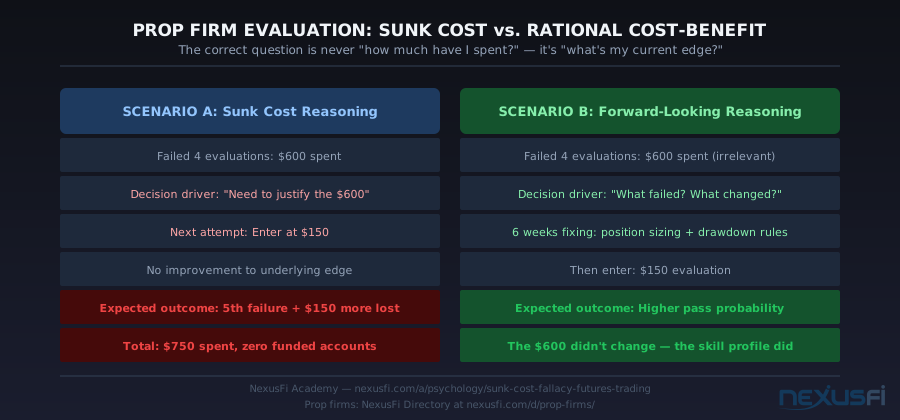
The prop firm evaluation model creates a especially concentrated sunk cost trap. Evaluation fees typically range from $100 to $500+, and failure rates are high. Traders who have failed multiple evaluations face strong sunk cost pressure to continue attempting: "I've spent $600 on these already. I need to pass one to justify what I've spent."
The prior evaluation fees have no bearing on whether the next evaluation will be passed. That outcome depends on whether the trader currently has the skill and psychology to pass. If they failed four evaluations at a $125k challenge, the fifth evaluation will fail for the same reasons the first four did — unless those reasons have been specifically addressed.
An NexusFi member described this loop directly: "I did a LOT of resets on the evaluation. I spent way too much money because of my impatience."
Source: List of FIO traders who have passed the ONEUP Trader Evaluation or funded (9 thanks)
The rational evaluation criterion is simple: "Do I currently have the skill to pass this evaluation, independent of how much I've spent on previous attempts?" If yes, entering is justified by expected future value. If no, additional attempts will compound the loss.
5. Averaging Down Instead of Reassessing #
Averaging down — buying more of a losing long position, or shorting more of a losing short — can be a legitimate trading strategy under specific, pre-defined conditions. When done reactively, to "improve the average entry" because the loss has grown uncomfortable, it's sunk cost logic in its most dangerous form.
Consider a trader short NQ at 19,800 based on a thesis about supply at that level. NQ rallies to 19,900, -100 points adverse, $2,000 loss on 1 contract. The trader adds a second contract: "Now my average entry is 19,850. I only need a 50-point pullback to be at breakeven instead of 100."
The problem is that the position hasn't been analyzed fresh — it's been re-engineered to protect the original entry. The question "Is NQ currently a short at 19,900?" has been answered by the prior short at 19,800, not by current market structure. If the original thesis is valid at 19,900 (meaning the supply level has extended), adding is defensible. If the thesis was invalidated by the move to 19,900, adding is pure sunk cost behavior: doubling a bad decision to justify the original one.
@Silvester17 was direct about this: "Averaging down is a famous reason for professional traders to lose their job. I've seen it many times."
Source: Pro's and Con's: Adding to losers / Dollar Cost Averaging (8 thanks)

The Justification Loop: How Escalation Compounds #

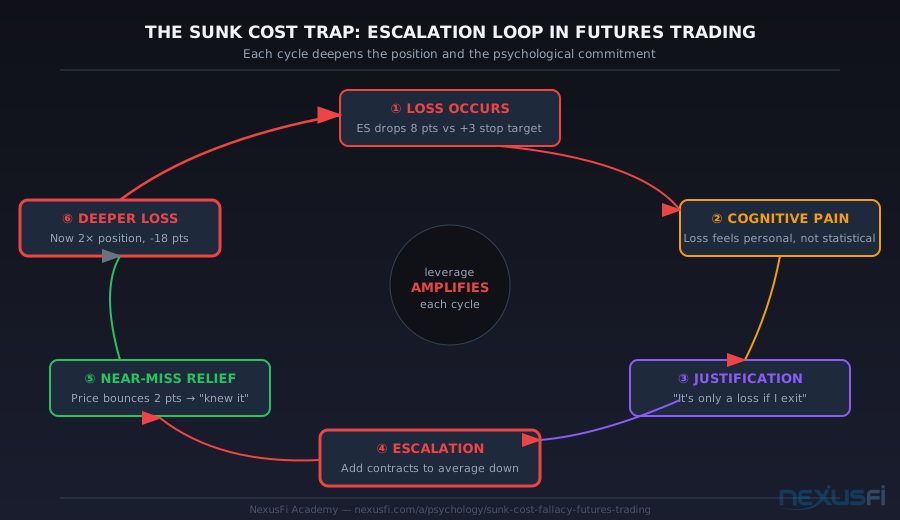
The most damaging version of sunk cost thinking is escalation of commitment — where each prior investment becomes a justification for further investment. The initial loss drives the first bad hold decision. The bigger loss from not exiting drives an even stronger hold decision. The position grows into a life-defining trade.
The psychological sequence:
Loss occurs → The brain registers the loss as a painful discrepancy. The entry price and current price diverge. The discrepancy creates immediate cognitive discomfort — not just financial pain, but ego pain.
Cognitive discomfort → The brain works to resolve the discomfort. The obvious resolution — exit the trade — would mean acknowledging that the thesis was wrong. This triggers a search for reasons to hold instead of exit.
Justification → The trader finds reasons to hold: "it's only a loss if I exit," "the original analysis was correct," "the market is wrong short-term," "institutional traders are accumulating here." These justifications often have surface plausibility. They share one trait: they all point toward holding.
Escalation → Having justified the hold, the trader often escalates: adding size to "improve the average," moving the stop further away to "give it room," extending the intended hold duration from "this session" to "this week." Each escalation is justified by the prior sunk cost.
Near-miss relief → Price occasionally bounces in the desired direction, providing intermittent reinforcement. The brain logs this as evidence that holding was correct. The near-miss relief is more motivating than the average loss level — it's the casino slot machine mechanic applied to your futures account.
Deeper loss → The eventual outcome is almost always a larger loss than the original stop would have produced. Sometimes the trade recovers and the reinforcement of the near-miss creates an even stronger sunk cost trap in future trades.
This is the neuroscience behind it: the anterior cingulate cortex generates the signal that the actual outcome differs from the expected outcome (the "prediction error"). This signal is aversive — literally uncomfortable. And the brain is motivated to reduce it by any means available, including motivated reasoning about why the adverse position will reverse.
Rational Persistence vs. Sunk Cost Escalation #
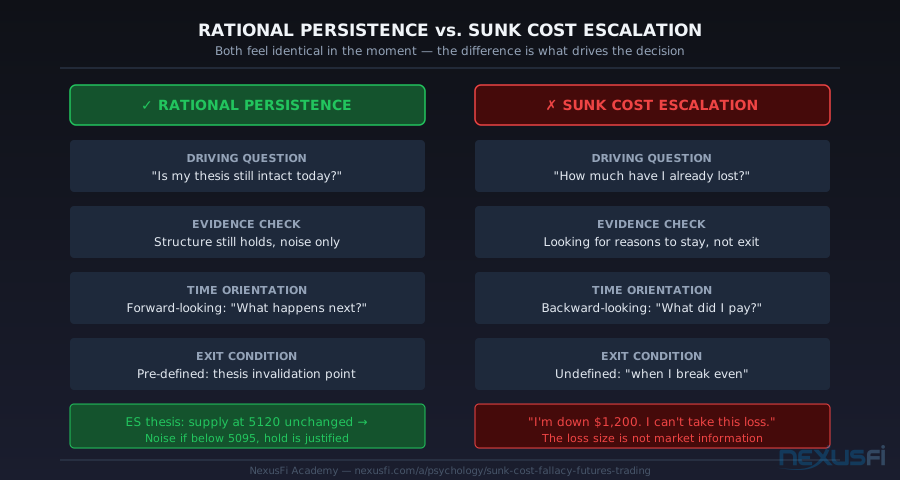
One of the most difficult aspects of sunk cost bias is that its surface presentation is identical to rational, disciplined holding. A trader who holds through a 30-tick drawdown because their thesis remains intact looks exactly the same from the outside as a trader who holds through a 30-tick drawdown because they can't accept the loss.
The diagnostic question is: what is driving the decision?
Rational persistence is forward-looking. The trader holds because:
- The thesis is still intact (the specific price level or structural condition that justified entry hasn't changed)
- The stop hasn't been hit (the pre-defined invalidation point is still ahead)
- The current price action is consistent with noise within the trade's expected range
- If the position were reopened from scratch today, the entry would still be valid
Sunk cost escalation is backward-looking. The trader holds because:
- The loss is too large to accept
- They've "come too far" to exit now
- Breaking even feels necessary to "justify" the trade
- The entry price acts as an anchor that "should" be revisited
The test: close your eyes and imagine you have no position. You have fresh capital, no existing trades, no prior investment. Looking at the current market structure, current price, and the thesis as it exists today — would you enter this trade? If yes, holding may be rational. If no, holding is sunk cost reasoning.
@tigertrader made the practical distinction: "If I believe that I am correct about the direction of the market, I add to my position, whether it is against me or whether I have money in the market."
Source: Big Mike's day trading method and advice (23 thanks)
The key phrase is "I believe the direction is correct" — not "I've already lost money." The belief must be based on current evidence, not past investment.

The Opportunity Cost You're Not Counting #
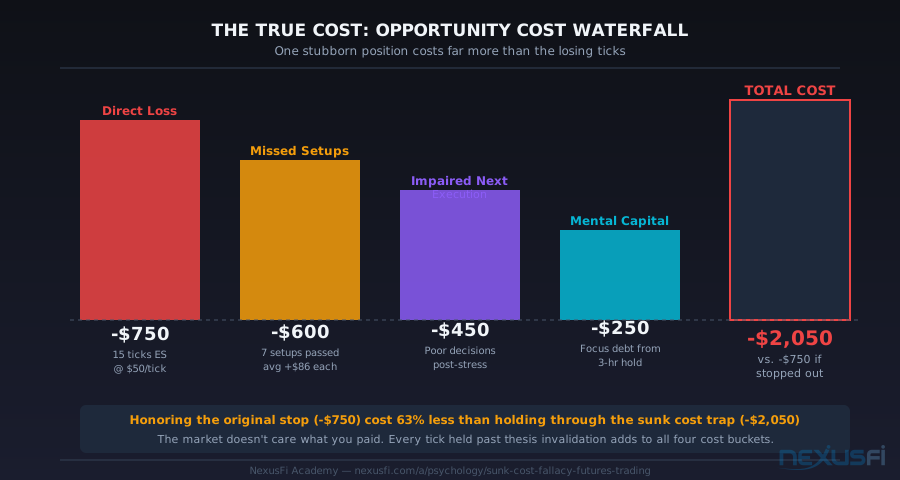
When traders calculate the cost of a sunk cost trap, they typically count only the direct loss: the difference between where the stop should have been honored and where the trade was eventually exited. This underestimates the true cost by a factor of 2--3×.
FuturesTrader71 identified the component that most traders miss: while you're locked in a losing position, you're not taking other trades. That mental and capital lockup has a cost — the setups you didn't take because your capital was deployed in the losing trade, and because your mental bandwidth was consumed by monitoring and hoping.
On an active trading day, a trader managing a stuck position might miss 6--10 setups across instruments. If each of those setups had a positive expected value — say +$100 average across the win/loss distribution — the opportunity cost is $600--$1,000 per day of mental lockup.
Then there's the impairment cost: even after the losing position is finally exited, the trader carries elevated emotional reactivity into subsequent decisions. Trades made in the emotional aftermath of a large loss tend to be worse than the trader's baseline — either overly cautious (missing the next legitimate setup) or revenge-driven (oversizing the next entry to "get it back").
The full cost waterfall for a typical sunk cost trap on ES:
- Direct loss (from missed stop to eventual exit): $750--$2,000
- Opportunity cost (missed setups during lockup): $600--$1,200
- Impaired subsequent execution (2--4 trades): $450--$900
- Mental capital debt (degraded decision quality remainder of day): $200--$500
Total true cost: $2,000--$4,600 on an event where the original stop loss would have cost $375--$750.

The Pre-Hold Decision Audit #
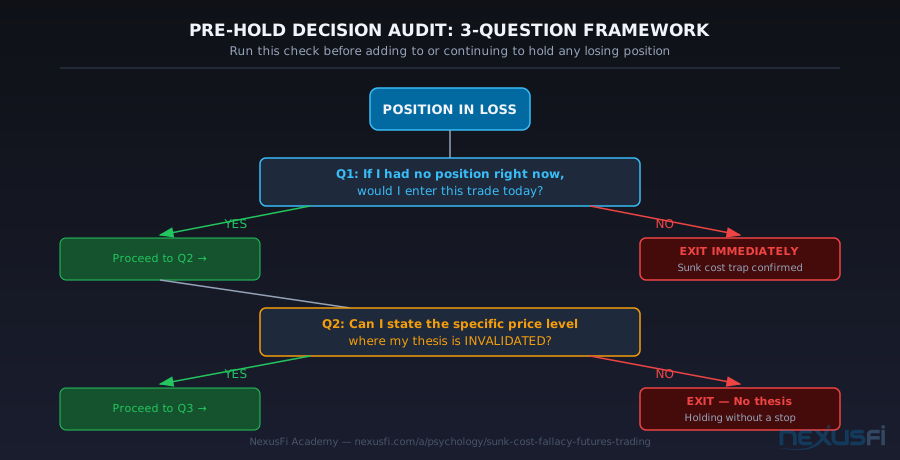
The most effective behavioral intervention is a structured, rapid decision check executed at the moment the sunk cost impulse arises — when the position has moved against you and the impulse to hold "just a little longer" appears.
Three questions, completed in under 60 seconds:
Q1: If I had no position right now, would I enter this trade today?
This question forces the reframe from "should I continue holding?" to "is this a trade I'd take fresh?" If the answer is yes — meaning you would open the position right now at the current price — then continuing to hold has genuine forward-looking justification. Proceed to Q2.
If the answer is no — meaning you wouldn't enter this trade at the current price if you had no position — then the only reason you're holding is because you already have it. That's the sunk cost trap. Exit.
Q2: Can I state the specific price level where my thesis is invalidated?
A trader who cannot answer this with a specific level has no stop. If you can state it — "my thesis is invalidated if ES closes below 5085 on a 30-minute bar" — you have a rule. Proceed to Q3.
If you cannot state it, you're holding without a basis for exit. That means you're holding based on hope, which means you're in the sunk cost trap. Exit.
Q3: Has price already broken that level on a closing basis?
If yes: your thesis is already invalidated. You already know to exit — you just haven't done it. The question is what's stopping you. The answer is sunk cost logic. Exit.
If no: your thesis remains intact, your stop is defined, and holding may be rational. Continue monitoring with the stop still active.
This framework doesn't eliminate all bad holds. It does force the question from "should I continue holding given what I've lost?" to "is there a forward-looking reason to hold?" That reframe alone reduces sunk cost-driven extensions much.

Procedural Fixes That Actually Work #
Identifying the bias intellectually is insufficient. The bias operates faster than conscious reasoning — by the time the trader formulates a rational argument, the emotional decision has already been made. Effective interventions work at the system level, not the in-the-moment reasoning level.
Pre-defined stops that can't be moved. The single most effective protection against position-level sunk cost bias is a hard stop entered at order submission. Not a mental stop — a working stop order in the market. When the stop is already live in the market, moving it requires an active step (canceling and re-entering). That friction is enough to create a pause for the audit framework.
Rules for adding to positions. If your trading plan includes averaging down or scaling in, the conditions must be defined before entry: "I will add to this position only if price pulls back to [specific level] AND the following structural condition is present." The conditions cannot be "if my loss gets large enough." Adding must be thesis-driven, not loss-driven.
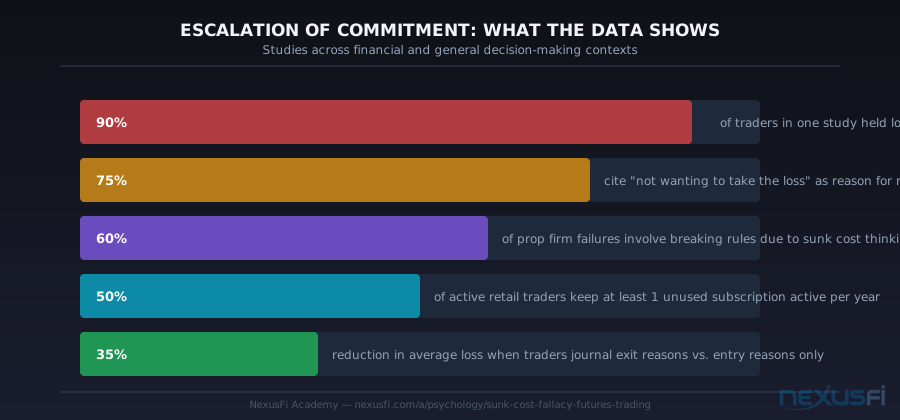
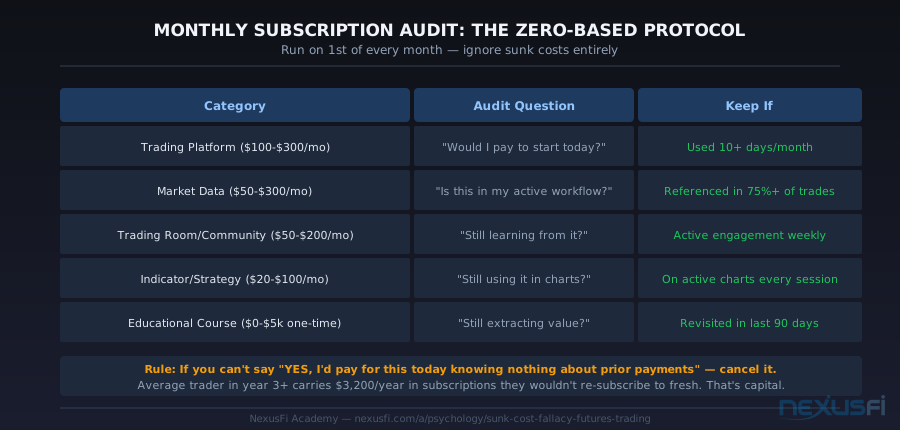
Journal the exit reason, not just the entry reason. Research suggests that traders who explicitly record why they exited a trade — and compare exit reasoning to entry reasoning — show much better decision quality over time. The discipline of articulating "I'm exiting because [forward-looking reason]" versus "I'm exiting because I can't take more loss" makes the bias visible.
Platform and tool audit: a scheduled calendar event. On the first of each month, review every subscription, platform, and service for which you pay. For each item, answer: "Would I subscribe to this today if I had never signed up before?" If no, cancel. The past payments are not part of this analysis.
Prop firm evaluation criteria. Before each evaluation attempt, write down specifically what has changed since the last attempt. If you cannot name a specific skill or psychological improvement that was addressed since the prior failure, you are repeating the attempt because of sunk costs, not because of improved probability.
“All the time and made money. So did tigertrader and Big Mike, back when he was trading. It's not the same as being unwilling to take a loss out of an emotional reaction, but is a thought-out, planned action.”Source: Pro's and Con's: Adding to losers / Dollar Cost Averaging (10 thanks)
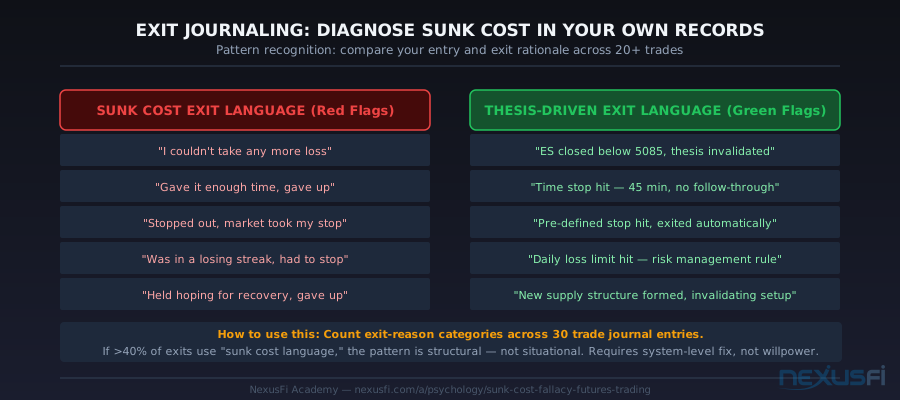
Platform and Tool Audit Protocol #
The monthly audit approach deserves its own framework because the sunk cost trap on tools and subscriptions compounds invisibly. Unlike a losing position — which creates immediate visible pain — a dead subscription bleeds slowly.
The zero-based audit: Treat every subscription as if you're evaluating it for the first time. Ignore what you've already paid. Ask only: "Given my current workflow and trading approach, is this tool worth its monthly cost starting today?"
The replacement test: Would you switch to a free or cheaper alternative if you hadn't already invested in the current tool? If yes, the only reason you're staying is the prior investment.
The usage test: Pull up usage data if available. How often did you actually use this tool in the past 30 days? If the answer is "occasionally" or "I could reconstruct this workflow without it," the tool has passed its utility threshold.
For education and courses, the framework is similar: "If this course were assigned reading for a class I was taking, would I find it valuable?" Past purchase cost shouldn't factor in.
The total cost of dead subscriptions and unused tools often surprises traders who run this audit honestly for the first time. $3,000--$5,000 per year in tools and services that no longer serve the current trading workflow is common among active retail futures traders who have been at it for several years.
Key Takeaways #
The sunk cost fallacy is not a character flaw — it's a feature of human cognition that evolved for a world where persistence often paid off. In futures trading, that feature becomes a liability. The market has no memory of what you paid, and it won't return to your entry because you need it to.
The three-part protection:
1. Structural: Enter hard stops with every position. Not mental stops — working orders. Remove the ability to hold without an active decision.
2. Process: Run the three-question pre-hold audit whenever the impulse to hold past a breach arises. "If I had no position, would I enter here today?"
3. Periodic: Monthly subscription audit using zero-based evaluation. Prop firm evaluation criteria that require demonstrated skill improvement, not fee justification.
The goal isn't to never hold through adverse moves — rational persistence through noise is a legitimate part of active futures trading, as @tigertrader and others have demonstrated over long careers. The goal is to ensure that the hold decision is driven by forward evidence, not backward investment.
Your entry price is gone. The only question is what happens next.
For related reading on position management psychology, see /a/psychology/trading-belief-systems, /a/risk-management/position-sizing, and /a/strategies/stop-loss-placement. For prop firm evaluation frameworks, see /a/prop-firms/prop-firm-evaluation-guide.
Knowledge Map
Go Deeper
Build on this knowledgeCitations
- — Stuck in a short position. What to do? (2020) 👍 31“You improve as a trader (or as anyone) by repetition, so the cost of this trade has excluded you from many others that could have been taken while you were tangled up in this one. There is an indeterminate cost there.”
- — STOPS are Frustrating (SL) ...to take or not to take (2010) 👍 33“I know that I should be proud of every stop that I honour, because this will save my account in the longer run.”
- — Pro's and Con's: Adding to losers / Dollar Cost Averaging (2018) 👍 10“It's not the same as being unwilling to take a loss out of an emotional reaction, but is a thought-out, planned action.”
- — Dear Ruby (2013) 👍 20“Fear of missing out, jumping the gun, hesitating and chasing, moving stops, averaging down -- all these trading no-nos are most often the result of trading what we think rather than what we see.”
- — Spoo-nalysis ES e-mini futures S&P 500 (2015) 👍 17“My guess is you got tired of taking a certain size loss and tightened up your stops and are now getting stopped out of trades.”
- — Pro's and Con's: Adding to losers / Dollar Cost Averaging (2018) 👍 8“Averaging down is a famous reason for professional traders to lose their job. I've seen it many times.”
- — 3 min video - Julia Galef: The Sunk Cost Fallacy (2013) 👍 6“Understanding our biases helps change them.”
- — (1985)
- — (2018)