



Stop Loss Strategies for Futures Trading
Overview #
A stop loss isn't a safety net. It's the structural answer to one question: where is this trade wrong?
Every stop placement decision in futures flows from contract mechanics
This article covers how to design, place, and manage stops specifically for futures positions
Key Concepts #
Invalidation Level: The price at which your trade thesis is structurally wrong
Stop Distance: The number of ticks or points between your entry and your stop. This number directly determines your per-contract risk: Stop Distance x Point Value = Dollar Risk Per Contract.
Maximum Adverse Excursion (MAE): The largest drawdown a trade experiences before reaching its final outcome. MAE data tells you whether your stops are too tight (cutting winners) or too wide (absorbing unnecessary heat).
Noise Stop: A stop placed inside the normal volatility range of the instrument. Gets triggered by random price fluctuation, not by a change in market structure. The single most common stop placement error in futures.
Liquidity Sweep: Price pushing through a cluster of stop orders to access the liquidity those stops provide. Not a conspiracy
Why Stops in Futures Are Different #
Futures aren't stocks. Three mechanics change everything about stop design.
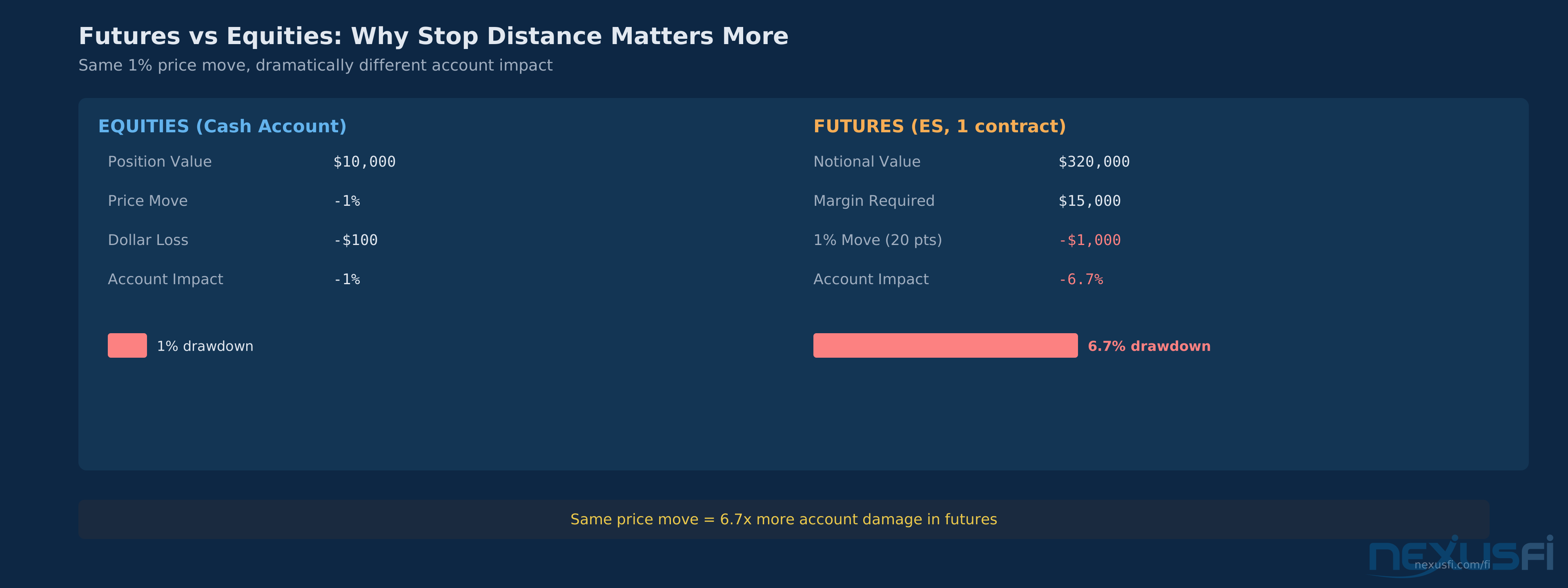
Leverage amplification. A 1% move in ES represents roughly $50 per point per contract. With initial margin around $15,000 for a full ES contract, a 20-point adverse move is a $1,000 loss
Session gaps. Futures trade nearly 24 hours, but liquidity drops dramatically outside RTH (Regular Trading Hours). Globex sessions can gap 10-30 points on ES at the open. Your stop-market order sitting at 6550 might fill at 6538 if the market gaps through it overnight. This isn't slippage in the normal sense
Tick economics vary wildly. ES ticks at 0.25 points ($12.50/tick). CL ticks at 0.01 ($10/tick). ZB ticks at 1/32nd ($31.25/tick). A "2 ATR stop" means completely different dollar risk across contracts. You can't transplant a stop methodology from one instrument to another without recalculating everything.
Stop Order Types: Execution Reality #
Stop-market orders become market orders when triggered. You get filled, guaranteed
Stop-limit orders become limit orders when triggered. You control the fill price, but you might not get filled at all. In a fast market, the price can blow through your limit and keep going, leaving you in a losing trade with no protection. For risk management stops, stop-market is almost always the correct choice. The certainty of exit beats the precision of price.
Native exchange stops vs. synthetic stops. Exchange-native stops sit on the matching engine and trigger at microsecond speed. Synthetic stops run on your platform and depend on your internet connection, platform latency, and data feed speed. For any position you can't monitor continuously, exchange-native stops are mandatory.
Placement Frameworks #
Volatility-Based Placement #
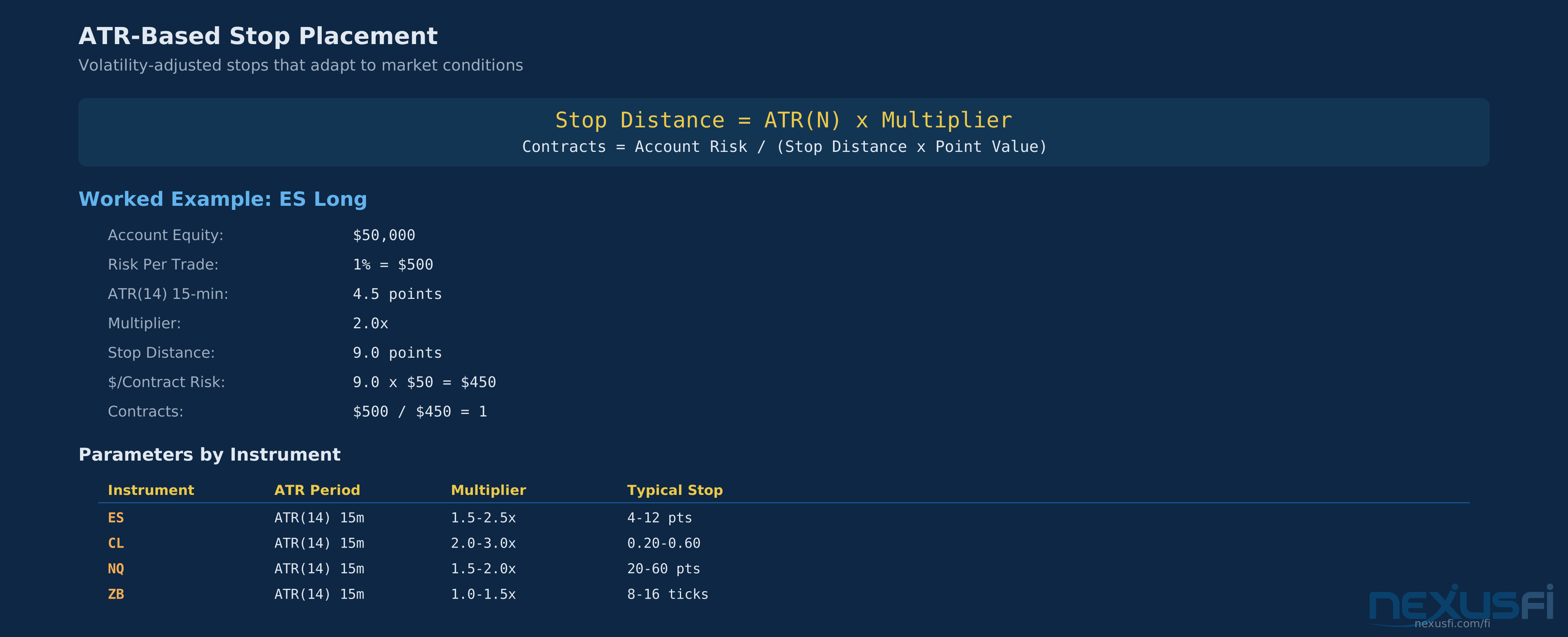
ATR (Average True Range) is the foundation. The logic is simple: your stop distance should reflect how much the instrument normally moves, so you don't get stopped out by routine noise.
@Fat Tails [developed this approach extensively on NexusFi] [4], using "ATR(36) plus Spread" on the 5-minute chart as the money management stop-loss. The key insight: ATR adapts automatically. During low-volatility sessions, stops tighten and position size increases. During high-volatility sessions, stops widen and size decreases.
The formula:
Stop Distance = ATR(N) × Multiplier
Dollar Risk Per Contract = Stop Distance × Point Value
Contracts = Account Risk / Dollar Risk Per Contract
Practical parameters by instrument:
- ES: ATR(14) on 15-min chart, 1.5-2.5x multiplier
- CL: ATR(14) on 15-min chart, 2-3x multiplier (crude is noisier)
- NQ: ATR(14) on 15-min chart, 1.5-2x multiplier
- ZB: ATR(14) on 15-min chart, 1-1.5x multiplier
As @grausch [noted] [6]: "The reason you would use a multiple of ATR to determine a stop-loss is so that your stops automatically adjust to current volatility levels."
A common mistake: using ATR from the wrong timeframe. ATR(14) on a daily chart gives you the average daily range
Structure-Based Placement #
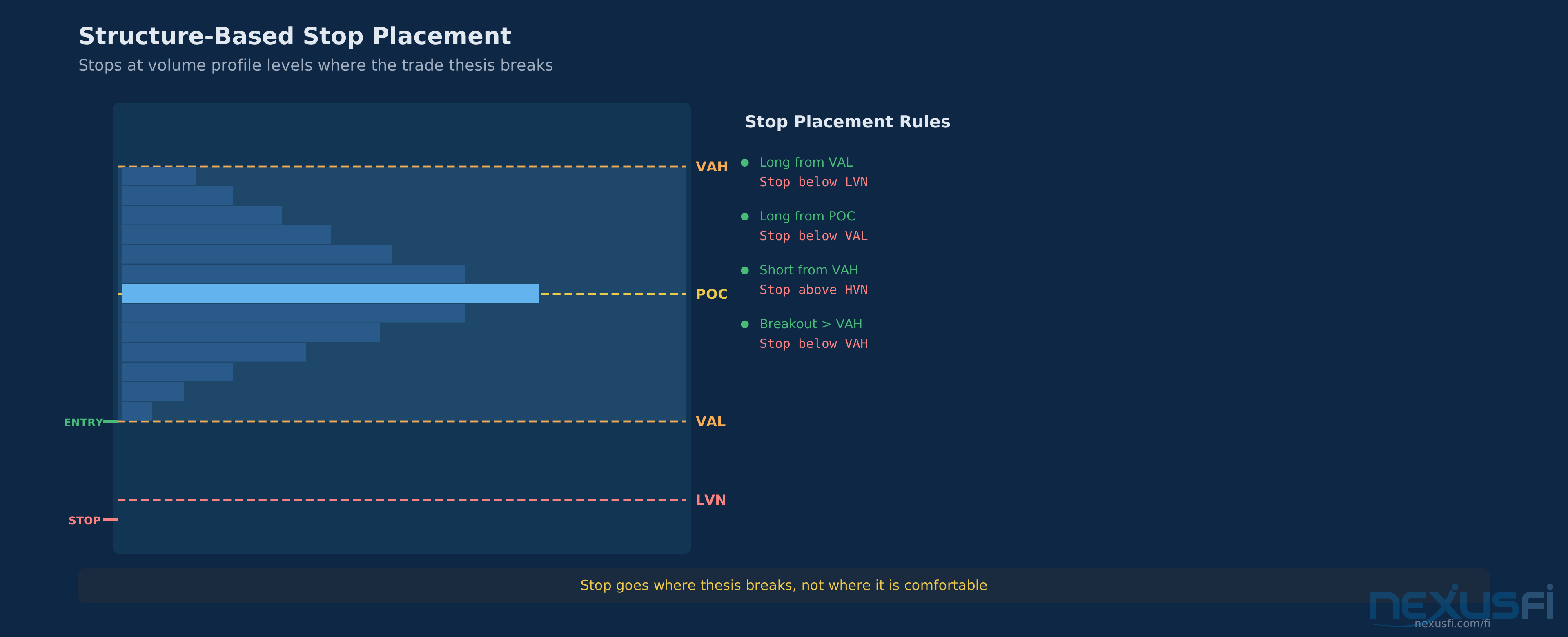
Structure-based stops use price levels where the market has established clear reference points. The stop goes where the trade thesis breaks
Using Volume Profile levels:
- Long from VAL → Stop below the LVN beneath the value area
- Long from POC → Stop below VAL
- Short from VAH → Stop above the HVN above the value area
- Breakout above VAH → Stop just below VAH
Using swing points:
- Long trade → Stop below the most recent swing low
- Short trade → Stop above the most recent swing high
As @mfbreakout [wrote in his trading journal] [8]: "I place stop loss where it getting picked up really means change in market structure." That's the principle. The stop isn't about comfort
The catch: structure-based stops can produce wide stop distances during volatile conditions, which means fewer contracts. That's not a bug
Time-Based Placement #
If your thesis was "price breaks above resistance within the first 30 minutes of RTH," and it hasn't broken out after 45 minutes, the thesis is invalidated
Time stops work best for:
- Opening range breakout strategies
- News event trades
- Mean reversion setups
The Hybrid Approach #
The most strong stop placement combines volatility and structure: place the stop at a structural level, then verify it's at least 1× ATR away from entry. If the structural level is inside 1× ATR, the stop is too tight for the current volatility
This hybrid approach solves two problems simultaneously: your stop has structural logic (it's at a meaningful price), and it has statistical protection (it's outside the noise range).
Matching Stop Logic to Trade Type #
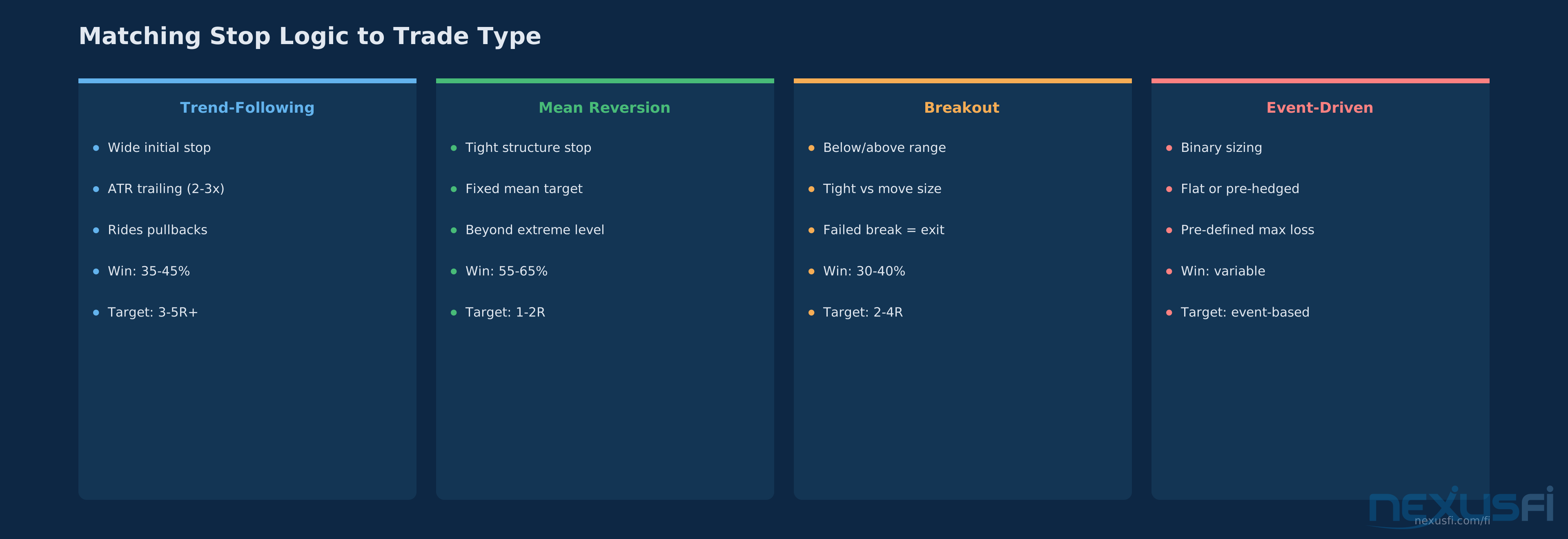
Different strategies demand different stop architectures.
Trend-following: Wide initial stops with aggressive trailing. The goal is to survive the pullbacks while capturing the large directional move. ATR-based trailing stops (like SuperTrend) excel here. @Fat Tails [explained the SuperTrend logic] [5]: "You use a trailing stop based on the ATR such that there will be a wide stop when volatility is high, but a narrower stop when the market calms down."
Mean reversion: Tight structural stops with fixed targets. You're betting price returns to a level (POC, VWAP, mean). The invalidation is clear: if price pushes further away from the mean instead of reverting, you're wrong. Stops belong just beyond the extreme that triggered the reversion signal.
Breakout: Stop goes at the opposite side of the breakout structure. Long above a resistance level → stop below that level. The thesis is "price has accepted higher value." If it comes back inside the prior range, the breakout failed. Keep stops here tight relative to the expected move
Event-driven: Binary outcomes need binary risk management. Either define your max loss before the event and size so, or get flat before the release. There's no "good stop" for FOMC if you're positioned for a specific outcome. The move will either go your way or it won't, and stops in the middle of the expected range accomplish nothing.
Managing Stops After Entry #
Trailing Stops #
ATR trailing: Continuously adjust the stop to entry price minus N × ATR (for longs). As @grausch [explained] [7]: "Whenever you use ATR as a stop, your stop will be closer during periods of low volatility and wider during periods of high volatility. If you size your positions so, the dollar risk remains constant."
Swing-structure trailing: Move the stop behind each new swing low (for longs) or swing high (for shorts) as the trade develops. This keeps the stop at structurally meaningful levels rather than arbitrary distances.
Chandelier trailing: Trail the stop N × ATR below the highest high since entry. Combines the best of ATR and structure
The Break-Even Trap #
Moving to break-even feels safe. The data says otherwise. Break-even stops:
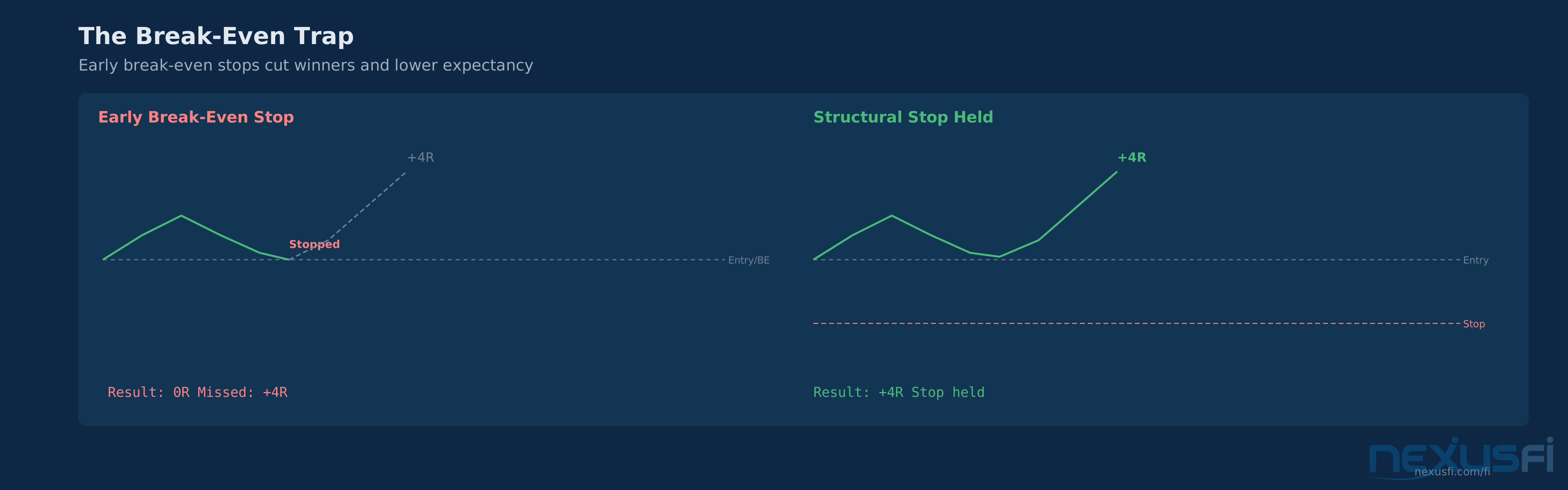
- Cut winners before they develop, reducing average win size
- Get triggered by normal retracements, lowering win rate
- Create false confidence ("at least I can't lose")
As @Big Mike [shared] [9]: "I set my stop at the right level but it was hit to the tick before reversing for like a 50 point win. No big deal. In my view, I didn't make a mistake. The stop was right."
When to move to break-even: only when the trade has moved enough that the original thesis level is no longer structurally relevant. If you're long from the VAL and price has reached the VAH, moving the stop to entry makes structural sense
Partial Exit Integration #
When you scale out of a position, the remaining position needs its own stop logic. Common approach: take half off at the first target, move the stop on the remainder to the original entry (break-even on the remainder, locked profit on the first half). This only works if the first target is far enough from entry to justify the reduced position
Common Failure Modes #
Stops inside the noise. The #1 account killer for new futures traders. If ES has a 4-point ATR on your trading timeframe and your stop is 2 points, you're guaranteeing a high stop-out rate. Noise stops turn a potentially profitable strategy into a consistent loser through transaction costs and frequent small losses.
Obvious placement. @bobwest [nailed this] [10]: "A whole bunch of small traders will place their stops at just about the same places, just like they have been instructed to do by their books and trade instructors and internet gurus. It's like putting up a sign that says, 'Come and get it.'" The solution isn't to skip stops
Widening stops after entry. Once you're in a trade and it's going against you, the temptation to "give it more room" is enormous. This is almost always a discipline failure. If your stop was placed at a structural invalidation level, widening it means you're now in a trade past the point where your thesis was wrong. The exception: if new structural information emerges (a higher low forms, a new support level develops) that changes the invalidation logic. But this should be rare.
Ignoring gap risk. Holding overnight in futures means accepting that your stop might not fill at your price. If you can't stomach a gap through your stop, don't hold overnight. Factor realistic slippage into your risk calculations for swing positions.
Over-optimizing in backtests. A stop at exactly 3.7 ATR outperformed 3.5 and 4.0 in your backtest? That's noise, not signal. Strong stop parameters work across a range of values. If the performance cliff is steep between 3.5 and 4.0 ATR, the strategy is fragile.
Measuring Stop Effectiveness #
Maximum Adverse Excursion (MAE) #
MAE measures the worst drawdown each trade experienced before reaching its outcome. Plot MAE for all your trades
If your winners regularly have MAE of 6-8 ticks but your stop is at 4 ticks, you're cutting winners before they develop. If your losers cluster at MAE of 12-15 ticks but your stop is at 20, you're absorbing unnecessary heat. MAE data tells you the natural stop distance for your strategy.
R-Multiple Distribution #
Track every trade's outcome as a multiple of the initial risk. A 2R winner means you made twice what you risked. A -1R loser means you lost exactly what you planned. The distribution of R-multiples reveals whether your stop strategy supports positive expectancy.
The formula: Expectancy = (Win% × Avg Win in R) - (Loss% × Avg Loss in R)
A 50% win rate system with 2R average wins and 1R average losses has an expectancy of 0.5R per trade. Change the stop to reduce losses to 0.8R but drop the win rate to 40% (tighter stops = more stop-outs), and expectancy drops to 0.32R. The math makes the tradeoff explicit.
Regime Sensitivity #
Test your stop parameters across different volatility regimes. A stop that works during a VIX-15 environment may be catastrophically tight during VIX-30 conditions. The hallmark of a strong stop strategy: performance degrades gracefully across regimes rather than collapsing entirely.
Pre-Trade Stop Checklist #
Before every trade, answer these questions:
- Where is the invalidation level?
- What is the stop distance in ticks?
- Is the stop outside 1× ATR?
- What is the dollar risk per contract?
- Does this fit my risk percentage?
- What order type carries the stop?
- Am I holding through any events?
- What is my trailing rule?
The checklist takes 30 seconds. It prevents the behavioral cascade that turns a manageable loss into an account-threatening one.

Sources & Citations #
This article draws on extensive research and community discussion from NexusFi's trading forums, including contributions from @Fat Tails (ATR-based stops, SuperTrend trailing logic, position sizing integration), @bobwest (stop placement and liquidity dynamics), @Keab (liquidity sweep mechanics), @mfbreakout (structural invalidation stops), @josh (invalidation level discipline), @Big Mike (break-even stop realities), @grausch (volatility-adjusted stop placement), @Cutloss (trailing stop implementation), @xplorer (extreme market slippage documentation), and @runner (failed setup analysis).
Knowledge Map
Prerequisites
Understand these firstGo Deeper
Build on this knowledgeReferences This Article
Articles that build on this topicCitations
- — Crossing the Abyss: An Adventure Guide by Snax (2021) 👍 10“You really, really need to have an "I'm wrong" price. Even if you get out before that. Ideally it won't be arbitrary, but even if it's arbitrary ("a 3 point stop"), it's better than nothing.”
- — Stop Hunts - Are they really what the name entails? Or is there more to them? (2019) 👍 7“I find the best way to think about a stop hunt is to call them liquidity sweeps. Large traders, who are loaded with profitable longs or shorts opened a while back, need large areas of liquidity (stops) to close these positions at a profit without cau...”
- — The CL Crude-analysis Thread (2019) 👍 3“I thought I'd post this for anyone else who might have been caught in that anomalous event mentioned by Daytona in the chat last week.”
- — PositionSizer for ninjatrader (2010) 👍 12“This is too easy. I use NinjaTrader to run ATM strategies, and the question arises indeed, how to adapt the stop loss size to volatility, exchange rate and risk allowance.”
- — Logic that creates the SuperTrend Indicator (2019) 👍 8“There are several volatility based trailing stops that you may use. All of them use the ATR such that there will be a wide stop when volatility is high, but a narrower stop when the market calms down. Here are some example for a long stop.”
- — ATR for Stop Loss (2016) 👍 1“The reason you would use a multiple of ATR to determine a stop-loss is so that your stops automatically adjust to current volatility levels. You can adjust your multiplier 1 which will have you at a 10-tick stoploss at current volatility levels.”
- — Dynamic Trailing Stop and Profit using ATR (2015) 👍 4“The magic of ATR is that it allows us to normalise volatility across a wide range of instruments, for instance, I can position my ZN and my ES position so that the volatility of both instruments is the same in a portfolio.”
- — COMMON SENSE (2014) 👍 8“I will keep harping about using stop loss wide enough to give trade breathing room and allowing trader enough time to think while in the trade.”
- — Runner Breakeven re entry (2010) 👍 6“Hmm, I usually don't get caught up in chop. This has been the case for many months now, I can see past that pretty easily, or maybe a better way to try to define it is that now that I've really focused on pure price action, I tend to set my stops in...”
- — Stop Hunts - Are they really what the name entails? Or is there more to them? (2019) 👍 7“I think this is a really good dose of reality about the "dark forces" that supposedly are after our stops.”