



Futures Trading Taxes in Germany: Abgeltungssteuer, §20 Abs. 6, and the 2024 Loss Cap Abolishment
Overview #
Trading futures as a German private investor puts you in a surprisingly clean tax environment — once you understand the rules. Gains from exchange-traded derivatives land in the Abgeltungssteuer regime at a flat 26.375% (including Solidaritätszuschlag). No fussing over holding periods. No wash sale rules. No complex cost basis tracking that turns every trade into a headache.
The major exception that every German futures trader needs to know: from 2021 through 2023, German tax law imposed a punitive €20,000 annual cap on derivative loss offsetting under §20 Abs. 6 EStG. That cap is now gone. The 2024 Jahressteuergesetz abolished it retroactively — which means traders who filed during those years overpaid, and amended returns may be appropriate.
This article covers what German futures traders actually need to know: how Abgeltungssteuer applies to your trades, the §20 Abs. 6 saga and its aftermath, how Anlage KAP works for German versus foreign brokers, entity structures, and the difference between trading Eurex products (FDAX, FESX, FGBL) versus US CME products (ES, NQ, CL).
Disclaimer: This article is for educational purposes only. German tax law is complex and changes frequently. Consult a qualified Steuerberater (German tax advisor) for guidance specific to your situation before making filing or structuring decisions.
One more thing upfront: if you've been reading US-focused trading content — which is most of what's on the internet — you've probably absorbed a lot about "Section 1256" and the "60/40 rule." None of that applies in Germany. Those are US-only concepts. More on that later.
The Tax Regime Framework: Termingeschäfte Under §20 EStG #
Under German income tax law, futures and derivatives are classified as Termingeschäfte — financial term transactions. This classification matters because it determines which part of the tax code governs your gains and losses.
The relevant provision: §20 Abs. 2 Nr. 3 EStG. Under this rule, profits from Termingeschäfte — including exchange-traded futures on Eurex and CME — are treated as capital income (Einkünfte aus Kapitalvermögen) for private investors. This puts them in the Abgeltungssteuer regime rather than the progressive income tax scale that applies to employment or business income.
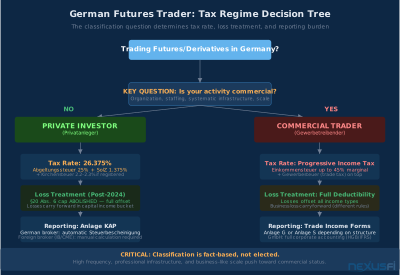
The core classification question every German trader faces: are you a private investor (Privatanleger) or a commercial trader (Gewerbetreibender)?
Private investor status means your futures gains are taxed at the flat 26.375% Abgeltungssteuer rate. Commercial trader status means your trading income is taxed as business income (Gewerbebetrieb) under the progressive Einkommensteuer scale — potentially up to 45% at the marginal rate — plus Gewerbesteuer (trade tax) on top.
Classification isn't a checkbox you fill out on a form. It's a facts-based determination. The tax office (Finanzamt) looks at how you actually operate. Key signals that push toward commercial classification:
- Professional infrastructure: co-location setups, multiple employees or contractors, dedicated office space beyond a home trading desk
- Systematic organization: formal trading system documentation, professional-grade risk management structure, business-like operations
- Scale: extremely high contract volume that resembles institutional activity rather than personal investment
- External funding or management: trading other people's money, managing a fund, operating as a CTA
Most individual futures traders — even active day traders running six or seven figures — remain private investors. The commercial trader classification is for people operating like a proprietary trading firm, not for someone trading from a home office on their own capital. The vast majority of NexusFi community members trading futures individually fall into private investor territory.
The practical implication: most of this article applies to the private investor path. Entity structures (GmbH, Einzelunternehmer) are covered in a later section for those who may be approaching commercial territory or are exploring tax optimization strategies.
Abgeltungssteuer: The 26.375% You're Working With #
Abgeltungssteuer is Germany's flat capital gains tax. It applies to income from capital investments, including futures trading gains for private investors.
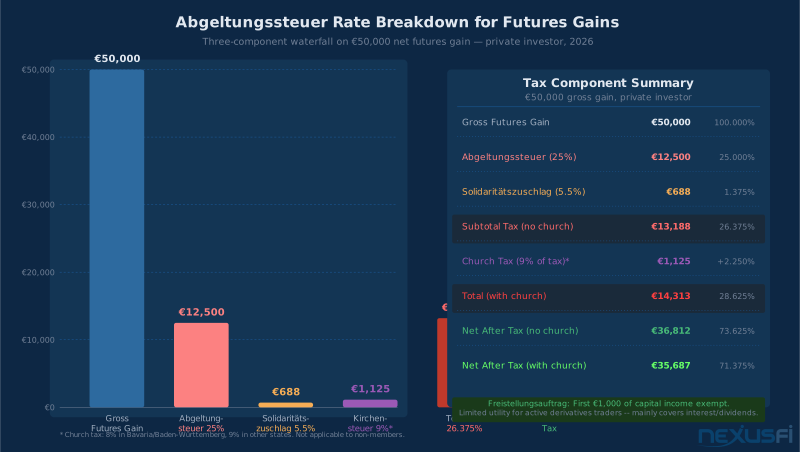
The rate breaks down into three components:
- Kapitalertragsteuer (KapESt): 25% on the taxable gain
- Solidaritätszuschlag (SolZ): 5.5% of the KapESt -- that's 5.5% of 25%, not of the total gain. Effective addition: 1.375%
- Combined effective rate: 26.375%
Church tax (Kirchensteuer) applies only to members of recognized religious communities. In Bavaria and Baden-Württemberg it's 8% of the KapESt, in all other German states it's 9%. On a €50,000 futures gain, church tax adds €1,000-€1,125 to the bill, pushing the effective rate to roughly 28.5-28.6%.
Run the math on a €50,000 net futures gain:
- KapESt: €50,000 × 25% = €12,500
- SolZ: €12,500 × 5.5% = €688
- Total without church tax: €13,188 (26.375%)
- Church tax (9%): €12,500 × 9% = €1,125
- Total with church tax: €14,313 (28.625%)
- Net after tax (no church): €36,812
An important nuance: not all German high earners pay the SolZ anymore. Since 2021, the solidarity surcharge was abolished for approximately 90% of income tax payers. However, the SolZ on capital income (Abgeltungssteuer) is treated differently — it continues to apply to capital income above a certain threshold. For active futures traders with significant annual gains, the SolZ remains in effect. Your tax advisor can confirm your specific situation.
The Freistellungsauftrag
The Freistellungsauftrag is an annual exemption order that instructs your bank or broker not to withhold KapESt on the first €1,000 of capital income (€2,000 for married couples filing jointly, prior to recent changes).
For futures traders, this has limited practical impact. The exemption covers capital income broadly — interest, dividends, ETF distributions, and trading gains alike — but for any active trader generating meaningful futures profits, €1,000 is noise. Where it matters is if you also hold interest-bearing accounts or ETFs with dividends: set up your Freistellungsauftrag to cover those first, reducing the withholding drag on cash.
You can split a Freistellungsauftrag across multiple institutions, but the total across all institutions cannot exceed €1,000 (or €2,000 joint). If you're trading at a foreign broker with no German withholding, the Freistellungsauftrag is irrelevant for those accounts — you'll handle everything manually on your Anlage KAP.
The §20 Abs. 6 Story: Three Years of Asymmetric Taxation #
This is the section that matters most to any German futures trader who has been active since 2021.
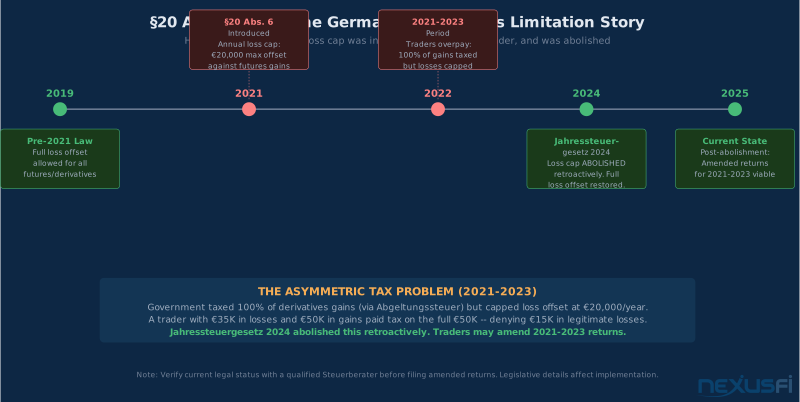
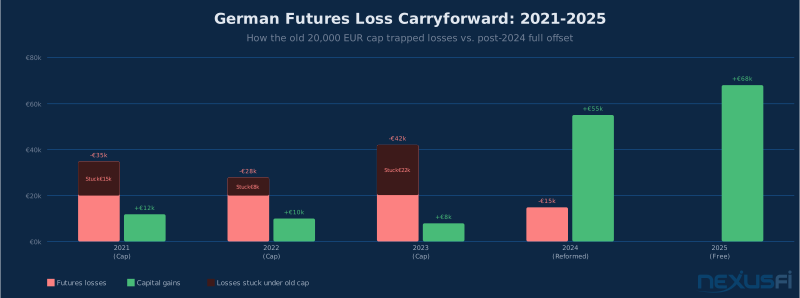
Starting January 1, 2021, the German government introduced §20 Abs. 6 EStG — a rule that capped how much you could deduct from losses on Termingeschäfte and certain other capital instruments. The cap: €20,000 per year.
The asymmetry was brutal. If you had €50,000 in futures gains, you paid tax on the full €50,000 at 26.375%. But if you had €35,000 in futures losses, you could only offset €20,000 of them against other capital income in that year — the remaining €15,000 was stuck.
Germany's §20 Abs. 6 created a functionally similar asymmetry: governments taxing gains fully while limiting loss deductions.
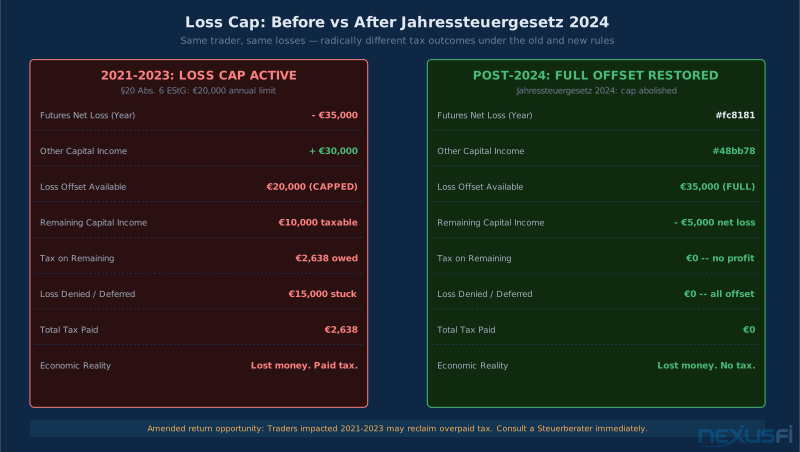
The practical scenario from 2021 through 2023:
- You had €35,000 in net futures losses
- You had €30,000 in other capital income (dividends, interest, ETF gains)
- Under the cap: only €20,000 of your futures losses offset the other capital income
- Result: €10,000 in remaining taxable capital income
- Tax owed: approximately €2,638
- €15,000 in losses remained undeducted ("stuck")
- You lost money on net and still paid tax
The losses that exceeded the cap didn't disappear entirely — they could be carried forward to future years. But "future years" doesn't help the trader who just had a bad year and needed to recover.
Member @grausch, discussing European tax frameworks, noted the general principle: "Losses are usually carried over and can be offset from profits in future years (ring-fenced). Of course countries can ignore this principle, but in general this is usually how taxes worked in the countries I lived in." (https://nexusfi.com/showthread.php?t=37373&p=529026#post529026). Germany's §20 Abs. 6 violated this principle by not just ring-fencing losses but actively limiting how much could be used annually.
The 2024 Jahressteuergesetz: Cap Abolished
The 2024 Annual Tax Act (Jahressteuergesetz 2024) abolished the §20 Abs. 6 loss limitation retroactively. As of the current law, losses from Termingeschäfte are again fully deductible against capital income — no annual cap.
This has two implications:
Going forward: You can offset all your futures losses against other capital gains in the same year without a cap. If you lose €60,000 in futures but earn €80,000 in other capital income, you pay tax on the net €20,000 — not on the full €80,000 minus a capped €20,000.
Retroactively: Traders who filed under the cap during 2021, 2022, or 2023 may be eligible to amend those returns and claim the full loss offset. This is a situation where a qualified Steuerberater is not optional — the mechanics of amended returns, the interaction with loss carryforwards already claimed, and the exact scope of the retroactive abolishment require professional analysis specific to your filing history.
Verify the current legal status of this abolishment before taking action. Tax law changes between legislative passage and the time you're reading this. The Jahressteuergesetz 2024 provisions are the starting point, but implementation details, BFH court interpretations, and your individual circumstances all matter.
Reporting: Anlage KAP and Broker Obligations #
How your futures gains and losses get reported to the Finanzamt depends heavily on where your brokerage is located: German broker or foreign broker.
German Brokers: The Easy Path
If you're trading at a German broker — flatex, DKB, ING, comdirect, Sparkasse — your broker handles most of the heavy lifting. At year-end, they issue a Steuerbescheinigung (tax certificate) that summarizes your taxable capital income, losses, any withholding already applied, and the breakdown by loss bucket. You (or your tax advisor) transfer the relevant figures to Anlage KAP in your Steuererklärung.
For Eurex products specifically, the reporting chain is clean. The broker sees your EUR-denominated P&L, applies the relevant withholding, and the Steuerbescheinigung reflects exactly what goes on your return. Most German brokers offer Eurex products — FDAX (DAX futures), FESX (Euro Stoxx 50), FGBL (Euro-Bund), FBTP (Italian BTP futures), FOAT (French OAT futures).
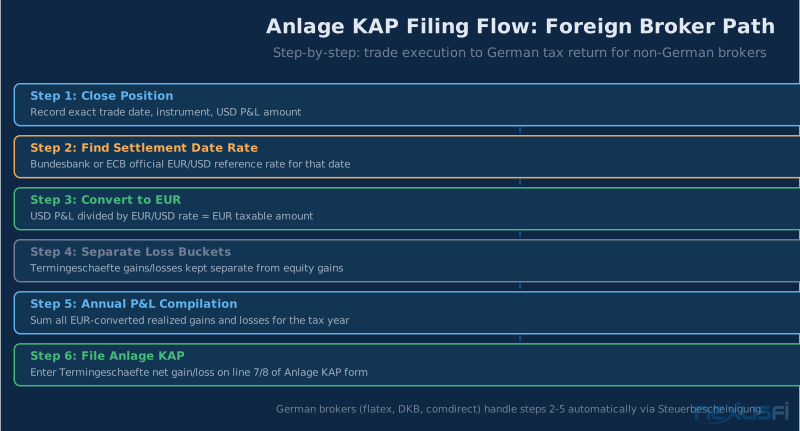
Foreign Brokers: The Manual Path
If you're trading at Interactive Brokers, Optimus Futures, Rithmic, or any other non-German broker, you're responsible for everything. Understanding broker dispute resolution channels is also useful when non-German brokers misreport tax documentation.
The foreign broker does not issue a Steuerbescheinigung. They don't withhold German KapESt. They don't know your German tax status. What you get is a trade confirmation, monthly activity statements, and annual P&L summaries — none formatted for German tax purposes.
Your obligations when using a foreign broker:
- Calculate realized P&L: Identify every trade closed during the tax year and its net P&L in the settlement currency
- Convert to EUR: For USD-denominated instruments (ES, NQ, CL, GC), convert each realized gain or loss to EUR at the rate on the settlement date. The Bundesbank publishes official daily EUR/USD reference rates
- Separate by instrument type: Exchange-traded futures (Termingeschäfte) go in a different KAP line than dividends or interest
- Apply loss limitation rules: For 2021-2023 returns filed under the old law, apply the §20 Abs. 6 cap. For current-year returns, offset fully
- File Anlage KAP: Enter the EUR figures on the appropriate lines of Anlage KAP in your annual Steuererklärung
- Submit with supporting documentation: Keep broker statements, conversion rate sources, and calculations in case the Finanzamt asks
The W-8BEN form is frequently mentioned in international trading contexts. As member @mattz (Optimus Futures) explained: "In the United States you sign a form called W-8BEN which is 'Certificate of Foreign Status of Beneficial Owner for United States Tax Withholding and Reporting (Individuals)' — this means that you are not paying taxes in the USA, rather it is your own individual obligation to pay it in your own country." (https://nexusfi.com/showthread.php?t=4832&p=654533#post654533). For German traders at US brokers, W-8BEN means you're not subject to US withholding on futures gains. Your reporting obligation is entirely in Germany via Anlage KAP.
Anlage KAP: The Key Lines
Anlage KAP is the supplementary form for capital income. The key areas for futures traders:
- Line 7/8 (Gains from Termingeschäfte): Your net futures gains land here. Net means after applying loss offsets within the futures/derivatives bucket
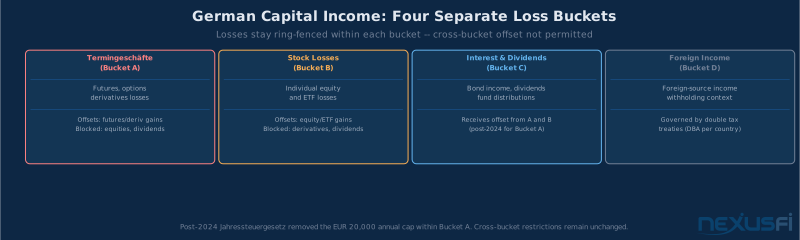
- Loss carryforward application: If you have carryforward losses from prior years (including losses denied under the old §20 Abs. 6 cap), these offset against current-year gains
- Foreign tax credits: If your foreign broker withheld taxes in another country (rare for futures gains, but possible for interest income), you can claim foreign tax credits
The exact Anlage KAP layout changes slightly each year as the form is updated. Your Steuerberater or tax software (ELSTER, WISO, Tax, Taxfix) will guide you to the right lines for the current year.
Entity Structures: Private vs Einzelunternehmer vs GmbH #
Most German futures traders don't need to think about entity structure — private investor status is the default, the simplest, and usually the most tax-efficient path for individual traders.
But for traders approaching institutional scale, traders the Finanzamt has already flagged as commercial, or traders exploring optimization at very high income levels, entity structure becomes relevant.
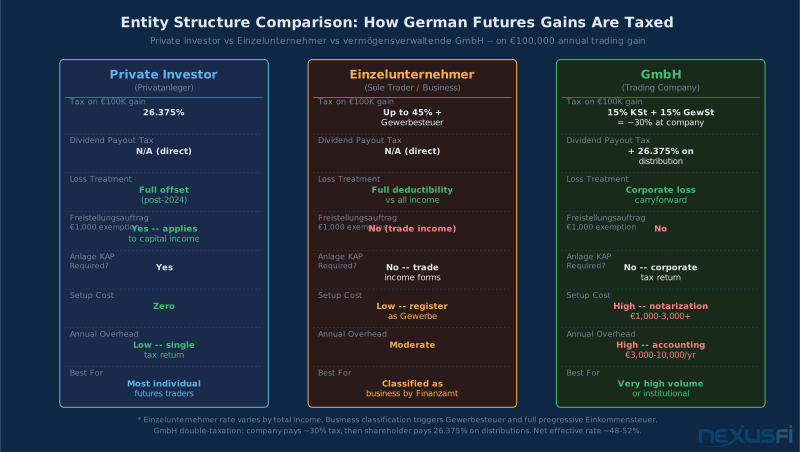
Private Investor (Privatanleger)
Tax rate: 26.375% flat (Abgeltungssteuer + SolZ)
Loss treatment: Full offset against other capital income (post-2024)
Reporting: Anlage KAP
Overhead: Minimal — standard annual tax return
Best for: The overwhelming majority of individual futures traders
For context on how tax efficiency fits into long-term trading objectives, see Trading Financial Freedom Number.
Einzelunternehmer (Sole Trader)
If the Finanzamt classifies your trading activity as commercial (gewerblich), you're an Einzelunternehmer by default — no choice required. Your trading income shifts from capital income to business income.
Tax rate: Progressive Einkommensteuer up to 45% marginal + Gewerbesteuer (varies by municipality, typically 3-4 × Hebesatz, effective 7-18% depending on location)
Loss treatment: Full deductibility against all income types — this is the upside
Reporting: Anlage G or Anlage S
Overhead: More complex than private investor, requires proper business bookkeeping
As member
(https://nexusfi.com/showthread.php?t=39769&p=582819#post582819). The same principle applies in Germany: commercial classification unlocks deductibility of trading costs (data feeds, platforms, co-location, professional fees) against all income, but comes at the cost of a much higher marginal rate.
GmbH (Limited Liability Company)
The GmbH is sometimes discussed as a tax optimization vehicle for traders. The theory: GmbH corporate tax rate (~15% KSt) beats the 45% personal income tax rate.
The reality is messier. A gewerbliche GmbH pays approximately 30% at the company level (15% KSt + 5.5% SolZ on that + Gewerbesteuer). When you distribute profits as a dividend, you pay Abgeltungssteuer (26.375%) on the distribution. Total effective rate on distributed profits: roughly 48-52%.
A vermögensverwaltende GmbH (asset-managing company) aims for different treatment, but derivatives trading can trigger commercial classification at the company level anyway — making the actual tax outcome uncertain without professional analysis.
The GmbH makes economic sense mainly when accumulating profits inside the company rather than distributing them, using tax deferral to compound at the lower corporate rate. For most active traders who live off their trading income, the double-taxation layer on distributions erases the corporate tax advantage. Understanding your full futures trading costs — including tax friction — is essential before committing to any entity structure.
(https://nexusfi.com/showthread.php?t=12309&p=858139#post858139). The German GmbH requires similar careful modeling — and the break-even point versus private investor treatment is higher than most traders expect.
Loss Treatment Comparison
The one area where commercial status (Einzelunternehmer or GmbH) clearly beats private investor status is loss treatment. Business losses can offset all income types — employment income, rental income, other business income. Private investor losses stay in the capital income bucket — they can only offset capital gains, not salary or rental income.
For a trader who expects to have a significant loss year (getting established, going through a drawdown, experimenting with a new approach), commercial status with full income offset can be genuinely valuable. For a consistently profitable trader, private investor at 26.375% wins.
Eurex vs CME: Product-Specific Reporting and FX Conversion #
The instruments you trade create a meaningful practical difference in tax reporting complexity.
Eurex Products (EUR-denominated)
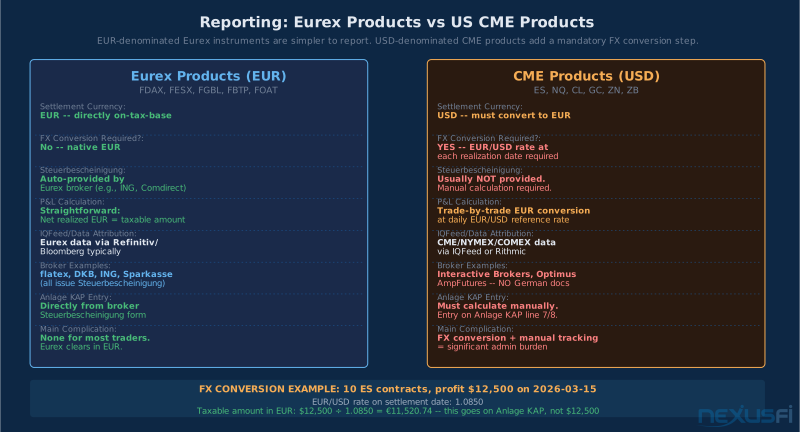
Trading FDAX (DAX Index Futures), FESX (Euro Stoxx 50 Index Futures), FGBL (Euro-Bund), FBTP (Italian BTP Bond Futures), or FOAT (French OAT Bond Futures) keeps everything in euros. Your P&L, your margin, and your broker's reporting are all EUR-denominated.
German brokers who offer Eurex access — flatex, Consorsbank, comdirect — generate a Steuerbescheinigung with the EUR figures already computed. There's no FX conversion step. The amount you made or lost in euros is the amount that goes on Anlage KAP.
CME Products (USD-denominated)
Trading ES (E-mini S&P 500), NQ (E-mini Nasdaq), CL (WTI Crude Oil), GC (Gold), ZN (10-Year Treasury), or ZB (30-Year Treasury) means your P&L is in US dollars. To report this on a German tax return, you must convert each realized gain or loss to EUR at the exchange rate on the settlement date.
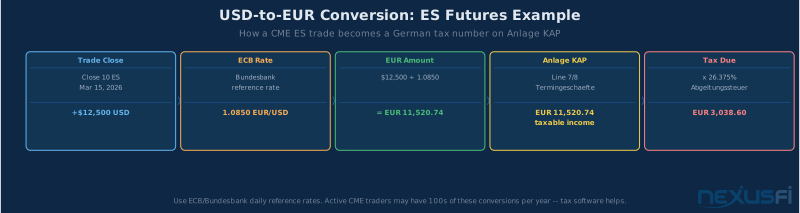
The mechanics: Each time you close a position, note the date of settlement and the official EUR/USD reference rate for that date (published by the Deutsche Bundesbank or the European Central Bank). Multiply your USD P&L by (1 / EUR/USD rate) to get the EUR equivalent.
Practical example: You close 10 ES contracts on March 15, 2026, realizing $12,500 profit. The EUR/USD rate that day is 1.0850. Your taxable EUR income: $12,500 ÷ 1.0850 = €11,520.74. That's what goes on Anlage KAP, not $12,500.
This FX conversion requirement adds meaningful admin overhead to every USD-denominated futures trade. Over a year of active trading, you might have hundreds of closing transactions, each requiring its own FX conversion. Tax software can automate some of this, but you need clean trade data from your broker to feed it.
Foreign brokers like Interactive Brokers don't provide a Steuerbescheinigung for German tax purposes. They provide detailed trade reports in their native format. You (or your Steuerberater) must map those reports into German tax requirements.
Mixed Portfolio Approach
Some German traders split: Eurex for their main trading activity (simpler reporting), CME for specific instruments or strategies where no Eurex equivalent exists (ES when you want full CME liquidity versus FESX, for example). The tax reporting burden of the two legs is very different. Know the overhead cost before committing to US instruments as your primary vehicle.
BaFin's Narrow Role in Your Tax Life #
BaFin regulates whether your broker is authorized to operate in Germany — that's it for tax purposes. A BaFin-regulated broker (German bank or EU-passported foreign institution) generally provides proper German tax documentation (Steuerbescheinigung). An unauthorized foreign broker doesn't generate German-format tax documents, shifting the burden entirely to you.
For your tax filing, the distinction matters only for documentation: regulated broker means automatic Steuerbescheinigung and easier Anlage KAP filing; foreign broker means you calculate and document everything yourself. The tax obligation and rates are identical either way. BaFin doesn't affect your tax rate, your classification, or the §20 Abs. 6 rules. The regulatory status of your broker and the tax classification of your trading activity are completely separate questions.
Year-End Tax Planning Strategies #
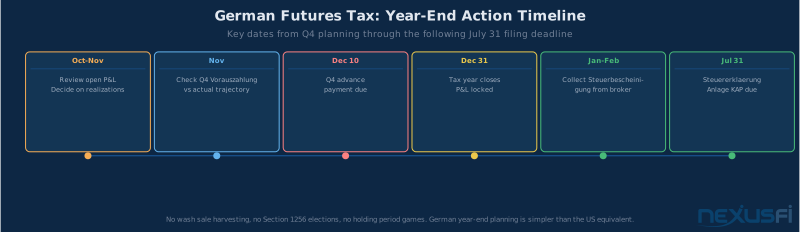
Tax planning for German futures traders operates on a different calendar than what US-focused trading content describes. There's no Section 1256 mark-to-market election, no wash sale rule to avoid, no complex "loss harvesting" strategy requiring specific holding periods. But there are German-specific angles worth managing.
Loss Realization Timing
With the §20 Abs. 6 cap now abolished, the artificial urgency to realize losses before year-end (or spread them across years to stay under the cap) is gone. Loss offset is no longer limited by timing within the year.
That said, if you have open losing positions, deciding whether to realize them in the current year versus rolling them into the next year still has implications for which year's tax return they affect. This is a normal consideration — not one specific to German law — but worth discussing with your Steuerberater if the amounts are material.
Loss Carryforward Tracking
If you accumulated loss carryforwards during 2021-2023 under the old cap regime — losses that exceeded the €20,000 annual limit and were "stuck" — those carryforward amounts may have changed under the retroactive abolishment. The exact treatment depends on how your returns were filed and how the retroactive provisions interact with prior-year carryforward elections.
Don't assume your existing loss carryforward is still accurate. Review prior returns with a Steuerberater to understand what's actually available to you under the updated rules.
Amended Returns for 2021-2023
If you were impacted by the §20 Abs. 6 cap — you had more than €20,000 in annual derivative losses during 2021, 2022, or 2023 and your tax return reflected the cap — you may have an opportunity to amend those returns and recover overpaid tax.
The amended return process (Berichtigungsantrag or Änderungsantrag) requires demonstrating the original return applied a rule that has since been removed retroactively. Given that the Jahressteuergesetz 2024 is a significant legislative change, expect the Finanzamt to scrutinize amended returns on this basis. Professional representation is advisable.
Estimated Tax Payments
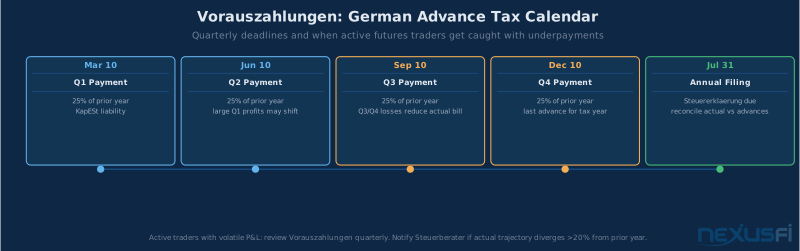
Germany's system of Vorauszahlungen (advance tax payments) can catch active traders off guard. If your capital income is significant enough that it wasn't fully covered by broker withholding, the Finanzamt may assess quarterly advance payments for the following year based on your prior year's liability.
Member @booneyall, discussing US estimated tax strategy, made a point that applies equally in Germany: "Losses in Q3 or Q4 may offset gains in Q1/Q2. Since section 1256 contracts aren't subject to self employment tax, the pressure to send [estimated payments] in is greatly reduced." (https://nexusfi.com/showthread.php?t=57486&p=850357#post850357). In Germany, this translates to: late-year losses can dramatically change your actual year-end liability versus what you've advanced. Monitor your realized P&L through the year and communicate with your Steuerberater if the advance payment seems misaligned with your actual trajectory.
Germany vs. US: Why Section 1256 Doesn't Apply Here #
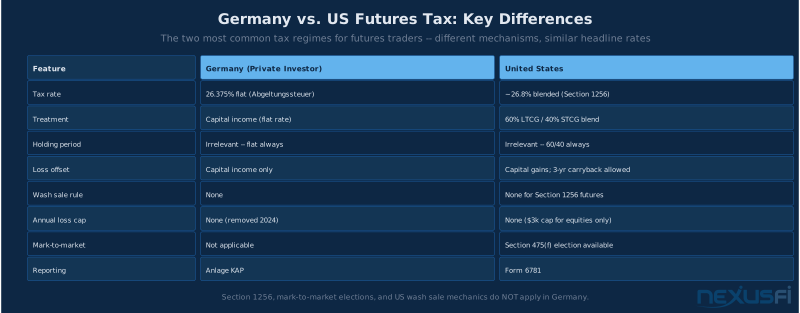
If you've spent any time reading English-language futures trading content, you've absorbed US-centric tax concepts. Section 1256. The 60/40 rule. Mark-to-market elections. None of these apply in Germany.
Section 1256 is a US Internal Revenue Code provision that gives a specific tax treatment to "regulated futures contracts" — a category defined under US law. The regulatory framework that enables this is the CFTC oversight regime that governs US futures markets. US traders pay tax on futures gains blended as 60% long-term capital gains and 40% short-term gains, regardless of actual holding period. This produces a maximum effective federal rate of roughly 26.8% for top-bracket US traders.
@Big Mike in the NexusFi Tax Thread: "For gains, futures are taxed as 60/40, meaning 60% long term gains, and 40% short term gains." Germany has no equivalent. German futures gains are taxed at the flat 26.375% Abgeltungssteuer rate, period.
The practical difference: a US trader in the 37% marginal bracket pays roughly 26.8% effective federal rate via the 60/40 blend. A German trader pays 26.375% via Abgeltungssteuer. Similar headline rates by coincidence — but the mechanism, classification framework, loss treatment, and reporting requirements are entirely different systems.
Don't apply wash sale rules, mark-to-market elections, or Section 475(f) trader tax status elections to your German return. They have no German equivalent. The $3,000 capital loss cap @Big Mike mentioned in the Tax Thread is a US-specific rule — German private investor losses stay ring-fenced within the capital income bucket, but without that specific numerical annual cap (beyond the now-abolished §20 Abs. 6).
Practical Compliance Checklist #
For German futures traders, these are the action items that matter:
During the Year
- Keep a trade blotter: For foreign broker accounts (IB, etc.), maintain your own record of realized P&L with settlement dates -- don't rely solely on the broker's annual summary
- Track EUR/USD conversions: For USD-denominated futures, note the ECB or Bundesbank reference rate on each settlement date
- Separate loss buckets: Futures/derivatives losses (Termingeschäfte) and other capital losses (stocks, ETFs) have different treatment rules -- don't mix them in your tracking
- Monitor Vorauszahlungen: If you're making significant year-over-year P&L changes, your advance payment obligations may shift
At Year-End
- Request your Steuerbescheinigung: German broker accounts issue this by end of January / early February for the prior year. Review it for accuracy before using it on Anlage KAP
- Reconcile foreign broker statements: Cross-check your own trade blotter against the broker's annual report. Foreign broker reports are not designed for German tax purposes -- discrepancies are common
- Review loss carryforwards: Confirm your carryforward position, especially if you had losses under the old §20 Abs. 6 cap regime (2021-2023)
- Assess amended return opportunity: If you were impacted by the old loss cap, discuss with your Steuerberater whether an amendment makes sense for prior years
With Your Steuerberater
- Confirm your classification: Private investor or commercial? Get an explicit professional opinion -- not an assumption
- Verify 2024 Jahressteuergesetz application: The retroactive abolishment of §20 Abs. 6 has implementation nuances specific to your prior filing history
- Plan entity structure (if needed): If your trading volume is approaching commercial territory, have the structure conversation before the Finanzamt raises it
- Document deductible expenses: Under commercial classification, data feeds, platform subscriptions, co-location, and professional fees are deductible. Under private investor status, they generally aren't
Records to Retain (5-Year Minimum)
- All trade confirmations and broker statements
- EUR conversion rate records for USD-denominated trades (ECB/Bundesbank daily rates)
- Steuerbescheinigungen from German brokers
- All filed Steuererklärungen including Anlage KAP
- Any Finanzamt correspondence on trading income or loss carryforwards
The Finanzamt can request documentation for up to 10 years (suspected evasion) or 5 years (standard). For loss claims or amended returns related to §20 Abs. 6, complete records back to 2021 are essential.
Knowledge Map
Go Deeper
Build on this knowledgeCitations
- — End of futures for retail investors in Belgium ? (2015) 👍 8“You need 60% profit / 40% loss to be break even -- if loser and winners are equal.”
- — End of futures for retail investors in Belgium ? (2015) 👍 1“Losses are usually carried over and can be offset from profits in future years (ring-fenced).”
- — The Tax Thread (2017) 👍 5“In the United States you sign a form called W-8BEN -- this means that you are not paying taxes in the USA.”
- — canadian trader and IRS / US taxes (2016) 👍 4“This is actually an advantage as it gets taxed at a lower rate if you have a high income and commissions and data feeds become business related costs.”
- — Senate Bill to revoke Futures 60/40 tax treatment (2021) 👍 5“Losses in Q3 or Q4 may offset gains in Q1/Q2. Since section 1256 contracts are not subject to self employment tax, the pressure to send estimated payments in is greatly reduced.”
- — Selling Options on Futures? (2021) 👍 6“the combination of the medical and pension and the fact that the management fee is offset against the short term capital gains means this is still tax effective.”
- — The Tax Thread (2015) 👍 1“Most Futures and Futures Option contracts are taxed as Section 1256 Contracts which means that they are taxed 60% at your long term capital gains rates and 40% at your short term capital gains rate no matter what the holding period.”
- — The Tax Thread (2012) 👍 3“For gains, futures are taxed as 60/40, meaning 60% long term gains, and 40% short term gains.”
- — The Tax Thread (2023) 👍 4“Equities are only taxed upon closing the position while futures are taxed on mark-to-market gains.”
- — Verlustverrechnung Termingeschaefte: Gesetzgeber hebt Verlustbegrenzung auf (2025)
- — Futures Trading Steuern in Deutschland einfach erklaert (2025)