



Futures Trading Costs: The Complete Breakdown
Overview #
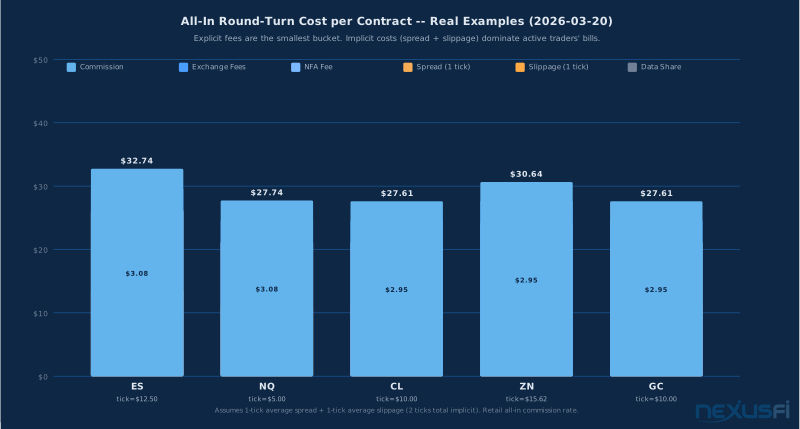
Every futures trade costs more than the commission. That's the thing most traders figure out too late — after months of watching profitable strategies underperform expectations, after running the numbers on paper only to find the real account doesn't match. The broker shows you a $0.75 commission. What they don't show you is the $12.50 you paid crossing the spread, the $25 you gave up to slippage, the $30 monthly data subscription, and the $200 sitting in margin that could be earning 5% somewhere else. Add it all up and a "cheap" trade suddenly looks expensive.
This article breaks down every layer of futures trading cost — the explicit fees that show up on your statement, the recurring overhead that silently grinds your P&L, and the hidden execution costs that for most active traders are bigger than everything else combined. By the time you finish reading, you'll be able to calculate a true all-in round-turn cost for any contract you trade, express it in ticks (the native metric that actually matters), and know exactly which lever to pull to reduce it.
The goal isn't to find the cheapest broker. The goal is to understand where your money actually goes.
The real cost hierarchy: For most active futures traders, execution costs (spread + slippage) represent 60-80% of all-in trading cost. Broker commission is typically 5-15%. Fixed costs (data + platform) are the remainder. If you're spending energy optimizing commission rates before you've measured your actual slippage, you're optimizing the wrong bucket.
The Four-Bucket Cost Taxonomy #
Every dollar you spend trading futures falls into one of four buckets. Most traders only think about the first one.
Bucket 1: Explicit fees. These are the line items on your statement — commission, exchange fees, clearing fees, NFA regulatory fees. They're visible, predictable, and the easiest to compare across brokers. They're also, for active traders, often the smallest part of the bill.
Bucket 2: Recurring access costs. Market data subscriptions and platform fees. Fixed monthly charges that exist regardless of how many trades you take. For a scalper doing 300 round-turns per month, a $30 data subscription is only $0.10 per trade. For a swing trader doing 10 round-turns per month, that same $30 is $3.00 per trade — suddenly a material cost.
Bucket 3: Implicit execution costs. The spread, slippage, and market impact. These never appear on your statement. Nobody sends you a bill. But every time you cross the spread or your order moves the market against you, money leaves your account just as surely as if you'd paid a fee. For most retail futures traders, this bucket is bigger than the other three combined.
Bucket 4: Capital costs. The opportunity cost of margin capital sitting idle. Not a fee in the traditional sense, but money you're not making while it's posted as margin. For position traders holding large positions overnight, this adds up.
The critical point as @SMCJB laid out clearly in the NexusFi forums: "The cost to trade futures is made up of three major components — Exchange Fees, NFA Fees, and Broker / FCM / Software / Data Fees." That's the explicit side. But the implicit side is where the real cost lives for active traders.
Explicit Fees: Commissions, Exchange, Clearing, NFA #
Commissions: Per Side vs Round-Turn
Here's the confusion that catches traders constantly: most brokers quote commissions per side. A round-turn trade — entering and exiting — costs two sides. When a broker says "$0.75 per contract," they mean $0.75 to open and $0.75 to close. The round-turn commission is $1.50. This sounds obvious, but it's easy to forget when you're reading marketing material that screams "as low as $0.25!"
Broker commission models break into three categories:
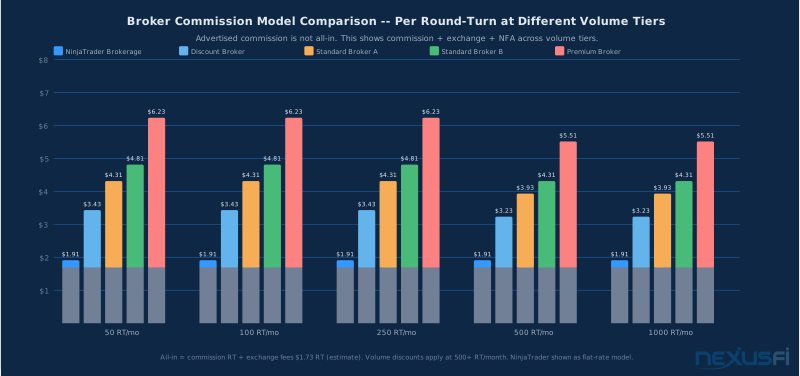
Discount brokers (AMP Futures, Ironbeam, NinjaTrader Brokerage, see commission comparison) target volume-conscious traders with per-side rates. Typical ranges: micro contracts (MES, MNQ, MCL, MGC) run $0.25--$0.75 per side. Standard contracts (ES, NQ, CL, GC, ZN) run $0.75--$1.50 per side. Volume tiers can push standard contract rates below $0.50 per side at high monthly volumes.
Full-service brokers charge $3--$5+ per side on standard contracts. The rate difference versus discount is $2--$4 per side, or $4--$8 per round-turn. That's $1,200--$2,400 per month on 100 round-turns per day. For a retail trader, full-service pricing is hard to justify unless the broker provides genuinely differentiated execution, research, or risk management services.
Exchange membership / direct access is a separate category entirely. CME clearing members can access exchange fees at near-zero commission levels ($0.10--$0.30 per side), but this requires membership, compliance infrastructure, and technology overhead that only makes sense for firms clearing hundreds of thousands of contracts monthly. The retail comparison to membership pricing is mostly irrelevant.
Exchange Fees: The Fixed Floor
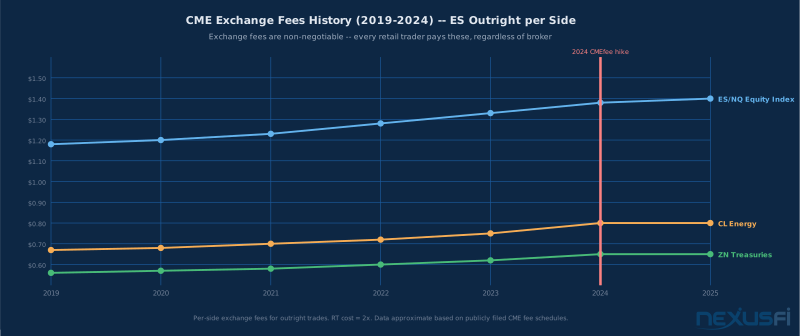
Exchange transaction fees are set by the exchanges — CME, ICE, CBOT, NYMEX — and are the same for all non-member accounts regardless of which broker you use. This is the answer to the common question about why "exchange fees vary by website": the underlying fee is fixed, but brokers may bundle it, markup it, or pass through a discount from their clearing arrangements differently.
Exchange Fees: The Fixed Floor
Exchange transaction fees are set by the exchanges — CME, ICE, CBOT, NYMEX — and are the same for all non-member accounts regardless of which broker you use. This is the answer to the common question about why "exchange fees vary by website": the underlying fee is fixed, but brokers may bundle it, markup it, or pass through a discount from their clearing arrangements differently.
.18 toExchange Fees: The Fixed Floor
Exchange transaction fees are set by the exchanges — CME, ICE, CBOT, NYMEX — and are the same for all non-member accounts regardless of which broker you use. This is the answer to the common question about why "exchange fees vary by website": the underlying fee is fixed, but brokers may bundle it, markup it, or pass through a discount from their clearing arrangements differently.
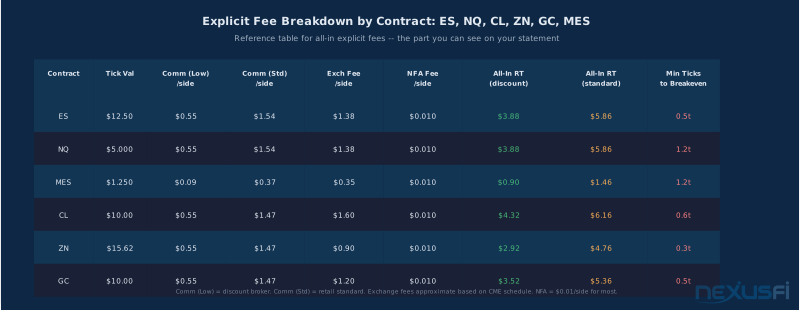
.40/side from 2019-2025. These fees are non-negotiable: every trader pays the same regardless of volume or broker. Round-turn cost = 2x per-side fee, on top of broker commission.Current CME non-member transaction fees for major contracts:
| Contract | Exchange Fee (per side) | Per Round-Turn |
|---|---|---|
| ES (E-mini S&P 500) | $1.28 | $2.56 |
| MES (Micro E-mini S&P 500) | $0.64 | $1.28 |
| NQ (E-mini Nasdaq-100) | $1.28 | $2.56 |
| MNQ (Micro E-mini Nasdaq-100) | $0.64 | $1.28 |
| CL (Crude Oil) | $1.44 | $2.88 |
| GC (Gold) | $1.44 | $2.88 |
| ZN (10-Year Treasury Note) | $1.28 | $2.56 |
These fees change periodically. Verify current rates directly at cmegroup.com/company/clearing-fees.html. Member accounts receive roughly a 20--30% discount on transaction fees, which is why you sometimes see "institutional" all-in quotes that seem impossibly cheap for non-members.
Clearing and NFA Fees
Clearing fees are charged by the FCM (see how clearing works) (futures commission merchant) that clears your trades and vary by broker, volume tier, and clearing arrangement. Typical ranges: $0.10--$0.30 per side for standard contracts, $0.02--$0.15 per side for micros. These are often bundled into what brokers call their "all-in" rate, which is why comparing quotes requires explicit decomposition.
 Clearing and NFA Fees
Clearing fees are charged by the FCM (see how clearing works) (futures commission merchant) that clears your trades and vary by broker, volume tier, and clearing arrangement. Typical ranges: $0.10--$0.30 per side for standard contracts, $0.02--$0.15 per side for micros. These are often bundled into what brokers call their "all-in" rate, which is why comparing quotes requires explicit decomposition.
.02 per round-turn, constant, non-negotiable for US futures traders" loading="lazy" width="800" height="450" style="max-width:100%;height:auto;" class="academy-lightbox-trigger">Clearing and NFA Fees
Clearing fees are charged by the FCM (see how clearing works) (futures commission merchant) that clears your trades and vary by broker, volume tier, and clearing arrangement. Typical ranges: $0.10--$0.30 per side for standard contracts, $0.02--$0.15 per side for micros. These are often bundled into what brokers call their "all-in" rate, which is why comparing quotes requires explicit decomposition.
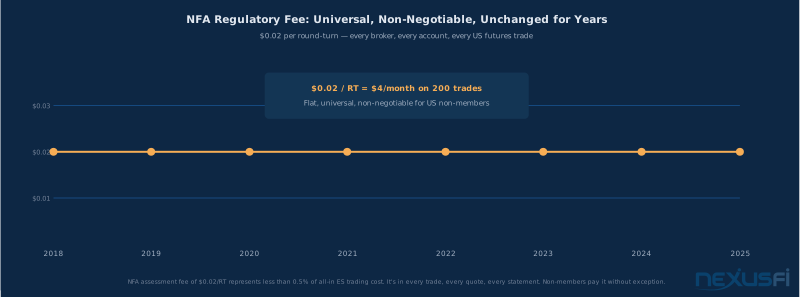
.02 per round-turn for years. At 200 trades/month, that's .00/month -- essentially a rounding error in your cost model. But it appears on every statement, every trade confirmation, and every broker quote. Factor it in your all-in model even if it rounds to noise.The NFA (National Futures Association) fee is simple: $0.02 per round-turn, flat, universal for U.S. non-member accounts.
It's a small number but it's in every quote, every trade, every statement. Include it in your cost model even though it rounds to noise.
Explicit Cost Summary by Contract
Combining commission (discount broker at $0.75/side), exchange fees, clearing (mid-range at $0.20/side), and NFA:
| Contract | Tick Value | Explicit Cost (RT) | Cost in Ticks |
|---|---|---|---|
| ES | $12.50 | $4.48 | 0.36 ticks |
| MES | $1.25 | $2.10 | 1.68 ticks |
| NQ | $5.00 | $4.48 | 0.90 ticks |
| CL | $10.00 | $4.76 | 0.48 ticks |
| GC | $10.00 | $4.76 | 0.48 ticks |
| ZN | $15.625 | $4.48 | 0.29 ticks |
Notice MES. The explicit cost in ticks — 1.68 ticks — is nearly 5x higher than ES on the same metric. That's not because micros are "more expensive" in dollar terms, but because each tick is worth so much less. A trader using MES to reduce risk-per-contract is paying proportionally more in fees relative to each tick of market movement. That's not a reason to avoid MES, but it's something to understand when sizing targets and stops.
Recurring Access Costs: Data and Platform #
Market Data Fees
Market data is one of those costs traders forget to include until their P&L starts not making sense. CME charges traders directly for real-time data access. The structure:
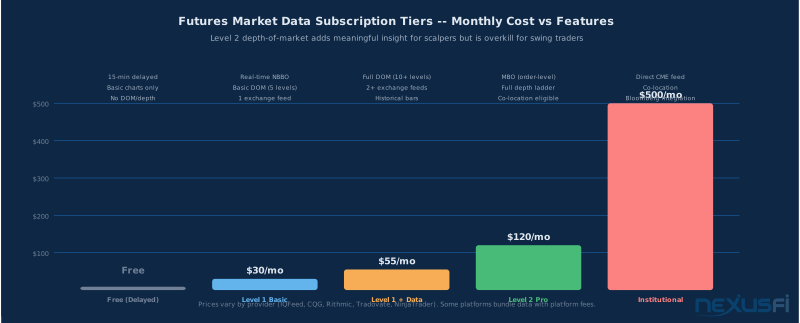
Level 1 (top of book): Best bid/ask price and last trade. Sufficient for straightforward execution if you're not relying on depth. CME charges $10/month per exchange for non-professional accounts. "Non-professional" means you're trading your own money and not affiliated with a financial institution. If you trade ES and nothing else, that's $10/month. If you also trade CL (NYMEX), that's another $10.
CME bundle: Covers CME, CBOT, NYMEX, and COMEX together for $30/month for non-professionals. If you trade across equity indexes (ES, NQ on CME) and commodities (CL, GC on NYMEX/COMEX) and bonds (ZN on CBOT), the bundle saves you versus paying each exchange separately.
Level 2 (depth of market): Order book depth showing 5--10 price levels on each side. Runs $50--$100+/month depending on the package and vendor. DOM data matters for scalpers who read order flow and need to see the bid/ask stack, not just the top of book.
Professional data: If you trade professionally or on behalf of others, you pay professional rates — typically $25--$100+/month per exchange. The non-professional classification requires signing a data entitlement agreement with your broker confirming you're trading personal funds. Don't falsify this — it's a regulatory document.
Many brokers waive data fees for accounts with sufficient monthly trading volume — check your broker's threshold. Some waive the $30 CME bundle entirely for accounts generating more than 50 or 100 round-turns per month.
Platform Fees
Platform costs range from zero to several hundred dollars per month depending on what you need:
Free tier: Broker-provided platforms (Tradovate's web interface, NinjaTrader's broker-connected free license, Interactive Brokers TWS) include order entry, basic charting, and execution at no additional cost. Trade-off: limited DOM customization, no API, basic automation.
Retail tier ($0--$100/month): NinjaTrader 8 lifetime license (~$1,100 one-time or ~$60/month lease), Sierra Chart ($30/month with data), TradingView Pro ($15/month). These provide professional charting, indicator libraries, and DOM tools adequate for most discretionary traders.
Professional tier ($100--$300/month): Rithmic data + execution platform ($75--$150/month), Trading Technologies ($150--$300/month for full DOM/automation), CQG Desktop ($75+/month). These are optimized for low latency, advanced order types, and automated execution. For scalpers executing hundreds of trades daily, the routing and execution quality difference versus free platforms can justify the cost — but only if you can actually measure the improvement in fill quality.
How to Amortize Fixed Costs
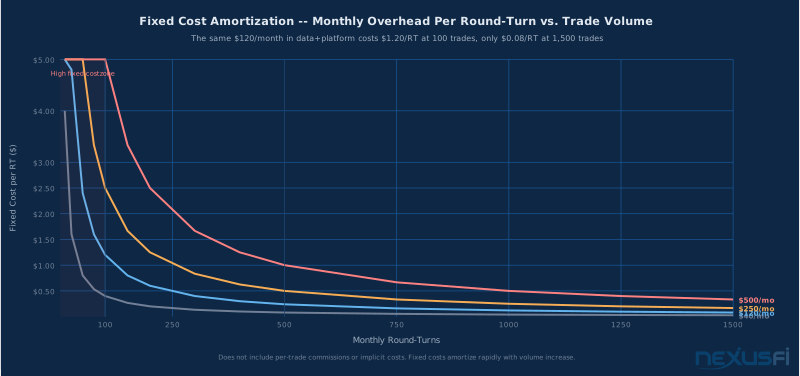
The right way to think about data and platform costs is per-trade, not per-month. Divide your total monthly fixed costs by your expected monthly round-turns:
How to Amortize Fixed Costs
The right way to think about data and platform costs is per-trade, not per-month. Divide your total monthly fixed costs by your expected monthly round-turns:
.24/RT.Fixed cost per trade = (data fees + platform fees) / monthly round-turns
For a trader doing 200 round-turns per month with a $30 CME bundle and a $60 platform: ($30 + $60) / 200 = $0.45 per trade. That's about 0.04 ticks on ES — negligible. For a trader doing 10 round-turns per month with the same setup, it's $9.00 per trade, or 0.72 ticks on ES. Suddenly it's a cost worth managing.
Implicit Execution Costs: Spread, Slippage, Impact #
This is where the real money goes. For most retail futures traders, the combined cost of bid/ask spread and slippage dwarfs every explicit fee combined. Yet these costs never appear on your statement. They're invisible, which is exactly why they're dangerous.
The Bid/Ask Spread: The Cost of Immediacy
Every time you want to buy immediately, you pay the ask price. Every time you want to sell immediately, you receive the bid price. The gap between those two prices is the bid/ask spread — and every market order or aggressive limit order you send crosses it. You give up half a spread on entry, half on exit. In a round-turn, you pay the full spread.
Tick values and typical 1-tick spread costs for major contracts:
| Contract | Tick Size | $/Tick | 1-Tick Spread RT Cost |
|---|---|---|---|
| ES (E-mini S&P 500) | 0.25 pts | $12.50 | $25.00 |
| MES (Micro E-mini S&P 500) | 0.25 pts | $1.25 | $2.50 |
| NQ (E-mini Nasdaq-100) | 0.25 pts | $5.00 | $10.00 |
| MNQ (Micro E-mini Nasdaq) | 0.25 pts | $0.50 | $1.00 |
| CL (Crude Oil) | $0.01/bbl | $10.00 | $20.00 |
| GC (Gold) | $0.10/oz | $10.00 | $20.00 |
| ZN (10-Year T-Note) | 1/64 pts | $15.625 | $31.25 |
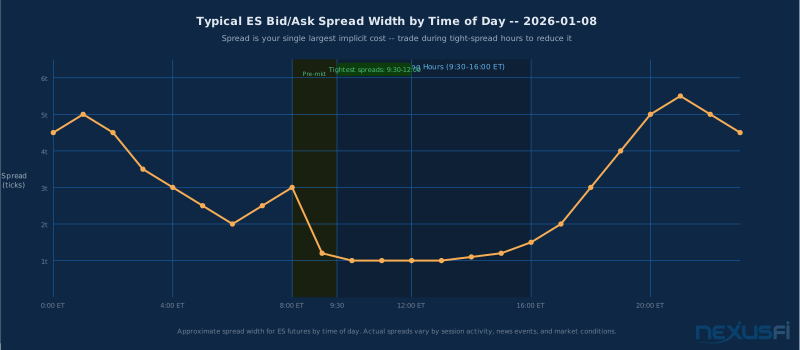
During normal RTH sessions for the most liquid contracts — ES, NQ, CL, GC — the spread is typically 1 tick. That's not "typically" in the sense of sometimes more, sometimes less. It's almost always exactly 1 tick during liquid hours. The spread on ES costs $12.50 per side, $25.00 per round-turn, every single time you use a market order. Compare that to the explicit cost of about $4.48 per round-turn with a discount broker. The spread is 5.6x bigger than your commission, exchange fees, clearing fees, and NFA fee combined.
During pre-market and overnight sessions, spreads widen. During news events — CPI, FOMC, NFP — they can widen dramatically. A market order for ES during an FOMC announcement isn't crossing a 1-tick spread. You might be crossing 3--5 ticks before the order even processes.
Slippage: Beyond the Spread
Slippage is the difference between the price you expected to get and the price you actually received. It's distinct from the spread cost (though related) and it's almost always negative for retail market orders in fast-moving conditions.
The NexusFi community has consistently documented that retail ES scalpers should assume a minimum of roughly 2 ticks round-turn slippage when using market orders in typical conditions.
@wldman was direct: "Say conservatively I give up 2.5 ticks to the spread and trade related costs. It is fair to expect at least 1 tick in slippage on either side unless you are resting orders."
Where slippage comes from:
Queue position. When you send a limit order, you go to the back of the queue at that price level. When the market moves to your price level, you only get filled if the queue ahead of you doesn't consume all available liquidity. When you do get filled, the market often then moves against you — what @iantg documented as "toxic fills" in his deep analysis of ES microstructure: "A toxic fill is when your order is filled only as a result of the entire price level breaking. All participants left were filled and the price moved 1 tick against this position." His data showed that on the ES with medium volatility, multi-price-level sweeps occur roughly 20--25% of the time.
Latency. From the moment you decide to trade to the moment your order hits the exchange, milliseconds pass. In that time, the market may have moved. The longer your latency, the worse your average fill relative to the price you saw when you made the decision.
Speed of price movement. When a news event drops, the order book thins instantly as market makers pull their quotes. The first aggressive orders fill at the NBBO. The next orders fill a tick deeper. The next ones two ticks deeper. If you're sending a market order during a volatility spike, you're filling wherever the book happens to be when your order arrives.
Realistic slippage estimates by scenario:
| Scenario | Typical Slippage (RT) | Reason |
|---|---|---|
| Calm session, 1-lot market order, liquid hour | 1--2 ticks | Queue effects, minor adverse selection |
| Fast-moving session, aggressive market order | 2--4 ticks | Wider effective spread, partial book sweeps |
| FOMC/CPI/NFP release, any size | 5--15 ticks | Book thins, market impact spikes dramatically |
| 5+ contract order, thin micro contract | 2--5 ticks/side | Market impact: you're consuming multiple price levels |
| Resting limit order, non-news conditions | 0--1 tick | No spread crossing, limited adverse selection |
Market Impact: When Your Order Moves the Market
Market impact is a cost most retail traders ignore because for 1-lot orders in ES it's negligible. But once you're trading 5--10 contracts, or in thinner instruments (ZN during off-hours, GC overnight), impact starts mattering.
The empirical rule: market impact scales roughly with the square root of your order size relative to the contract's average daily volume. ES trades roughly 1--2 million contracts per day. A 10-contract order is 0.0007% of that volume — effectively zero impact. CL trades 400,000--600,000 contracts daily. A 50-contract CL order starts to be noticed. GC trades 150,000--250,000 contracts daily. A 20-contract block during quiet overnight hours can visibly move the book.
The practical implication: if you're scaling from single-lot retail to multi-lot trading, measure your fill quality before and after the size increase. Market impact costs can grow faster than profits from the additional size.
The All-In Cost Formula #
Here's the complete calculation for a round-turn on 1 contract:
All-In Cost (RT) = Explicit Fees + Execution Costs + Amortized Fixed Costs + Capital Cost
Where:
- Explicit fees = 2 × (commission + exchange fee + clearing fee) + NFA fee
- Execution costs = spread ticks × $/tick + slippage ticks × $/tick
- Amortized fixed costs = (data fees + platform fees) / monthly round-turns
- Capital cost = margin required × opportunity rate × holding period
Worked example for 1 ES round-turn, discount broker ($0.75/side commission), market orders, normal session:
| Component | Discount Broker | Full-Service ($4/side) |
|---|---|---|
| Commission (RT) | $1.50 | $8.00 |
| Exchange fees (RT) | $2.56 | $2.56 |
| Clearing fees (RT) | $0.40 | $0.40 |
| NFA fee (RT) | $0.02 | $0.02 |
| Explicit subtotal | $4.48 | $10.98 |
| Spread (1 tick RT) | $25.00 | $25.00 |
| Slippage (2 ticks RT) | $25.00 | $25.00 |
| Amortized data/platform | $0.45 | $0.45 |
| All-in estimate | ~$55 | ~$61 |
| All-in in ticks (ES) | ~4.4 ticks | ~4.9 ticks |
The $6.50 per-trade commission difference between a discount and full-service broker represents about 12% of total all-in cost. Meanwhile, the spread and slippage — identical regardless of broker — represent about 73% of total cost. This is the number that should reshape how you think about broker selection. Discount brokers matter, but they're not the leverage point.
Thinking in Ticks: The Futures Trader's Native Metric #
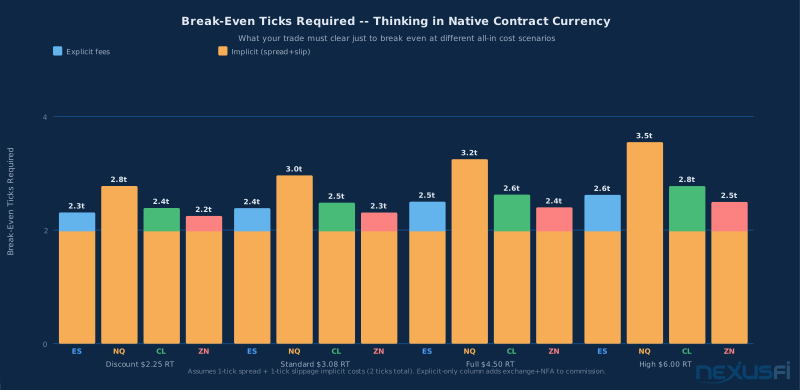
Everything above translates into a simple lens: what does this trade cost in ticks? Your edge is measured in ticks. Your stops are in ticks. Your targets are in ticks. Your cost should be in ticks too — that's the only way to honestly compare strategy profitability across different cost environments.
Convert explicit fees to ticks by dividing by tick value:
| Contract | $/Tick | Explicit Cost (RT) | Explicit in Ticks | Full All-In (ticks) |
|---|---|---|---|---|
| ES | $12.50 | $4.48 | 0.36 | ~4.4 |
| MES | $1.25 | $2.10 | 1.68 | ~5.7 |
| NQ | $5.00 | $4.48 | 0.90 | ~3.9 |
| CL | $10.00 | $4.76 | 0.48 | ~3.5 |
| GC | $10.00 | $4.76 | 0.48 | ~3.5 |
| ZN | $15.625 | $4.48 | 0.29 | ~3.2 |
These "full all-in" numbers assume 1-tick spread and 2-tick slippage for market orders. Limit order execution can bring them down to 1.5--2.0 ticks all-in for ES. High-impact events can push them to 10+ ticks.
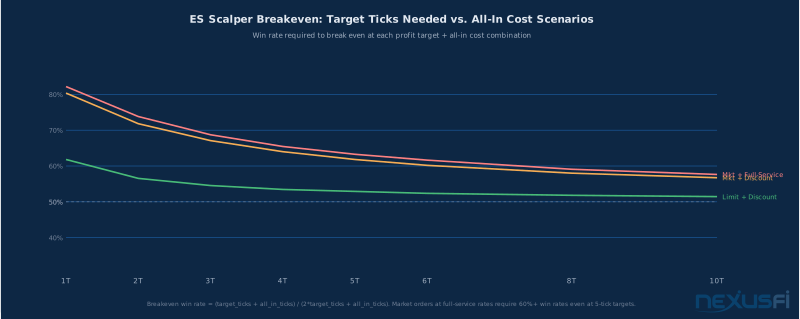
The practical implication: if your scalping strategy has a target of 4 ticks and a stop of 2 ticks on ES, the math doesn't work before you even discuss your win rate. You need a minimum 4.4 ticks of favorable price movement just to break even on an all-in cost basis. Your 4-tick target leaves you short. This is why @erwinbeckers was direct in the forum: "If you are scalping just 1 tick then you only win $12.50 and then those $4 fees become a big part, 1/3rd of your profit. It's time to reconsider if scalping 1-tick is an intelligent thing to do."
The Scalper's Dilemma: When Implicit Costs Dwarf Explicit Fees #
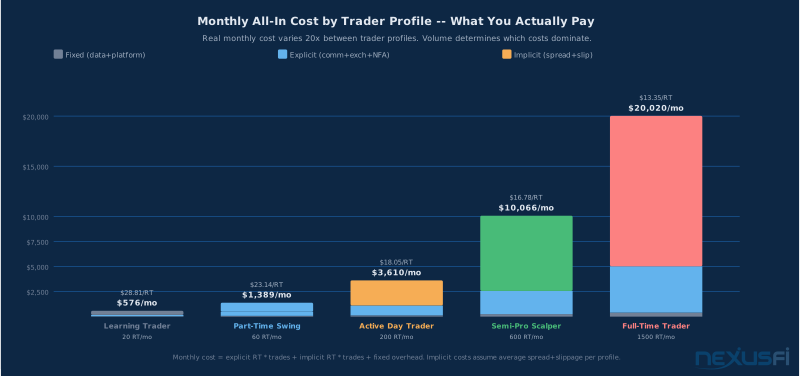
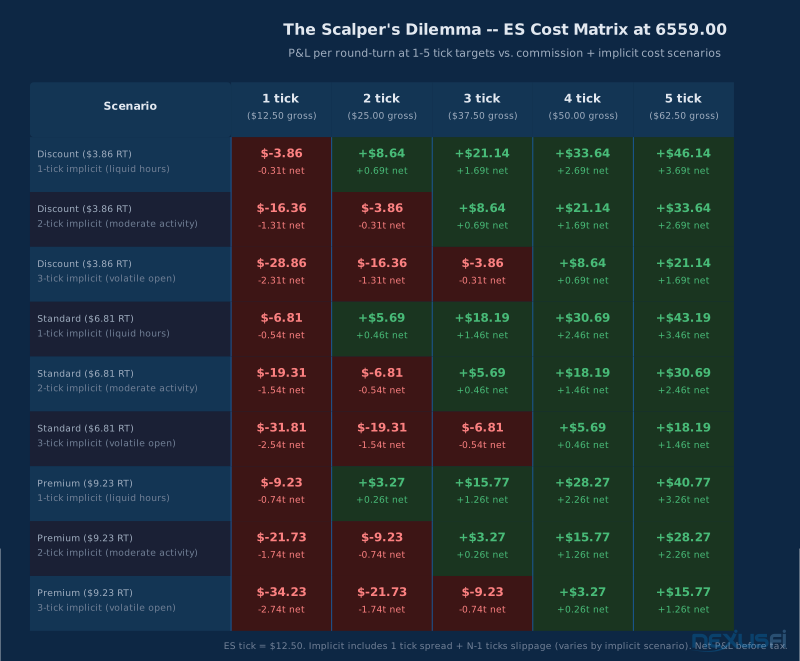
Run the numbers on a retail ES scalper doing 100 round-turns per day with a $30,000 account and a 1-lot position:
| Cost Component | Per Trade | Monthly (2,000 RT) |
|---|---|---|
| Spread (1 tick) | $25.00 | $50,000 |
| Slippage (2 ticks) | $25.00 | $50,000 |
| Commission (discount) | $1.50 | $3,000 |
| Exchange + clearing + NFA | $2.98 | $5,960 |
| Data + platform | $0.45 | $900 |
| Total | $54.93 | $109,860 |
The implicit costs — spread and slippage — represent 91% of total monthly cost. The broker commission represents 3%. Switching from a full-service broker ($8/RT) to a discount broker ($1.50/RT) saves $13,000/month on this volume. But reducing average slippage from 2 ticks to 1 tick saves $50,000/month. The optimization priorities are clear: execution quality first, commission second.
This is @iantg's "Red Pill" analysis in quantitative form. His data showed that for ES scalpers targeting 1-tick profits: "Every winner is worth 1 tick - retail commissions and every loser is worth 1 tick + retail commissions. So for ES this is typically $8.50 for winners and $16.50 for losers." Once you account for non-toxic vs toxic fill rates and the queue dynamics of limit order execution, many 1-tick scalping strategies are structurally negative even before considering market direction.
The break-even requirement for an ES scalper: your average gain per winner must exceed your all-in cost. At 4.4 ticks all-in with market orders and 2-tick slippage, you need strategies targeting 5+ ticks minimum just to have a fighting chance. The traders who consistently scalp profitably in ES are either: (1) using limit orders that avoid crossing the spread, accepting fill uncertainty as the price; (2) reducing slippage through co-location and optimized execution infrastructure; or (3) trading larger targets than the term "scalping" implies — 4--8 ticks or more.
Capital Costs: The Margin Opportunity Cost #
Futures trading uses performance bond margin rather than the full contract value, but that margin capital still has an opportunity cost. At 5% annualized, one ES contract at $13,000 overnight margin costs approximately $650/year in foregone returns — roughly $2.50 per trading day. For scalpers doing 100 round-turns per day, this amounts to $0.025 per trade, basically noise. For position traders holding 10+ contracts overnight for extended periods, capital costs become material. Day traders using intraday margin ($500--$1,000 at most discount brokers) keep this bucket negligible. CME overnight margins: ES ~$12,000--$15,000, NQ ~$17,000--$22,000, CL ~$7,000--$10,000, ZN ~$2,000--$3,500 per contract. Verify current rates with your broker before sizing up.
Cost Minimization: Ranked by Impact #
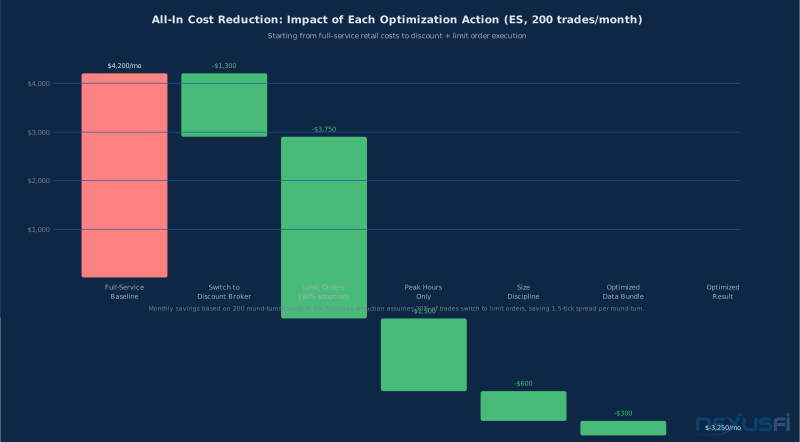
Given the analysis above, here's where to focus your cost-reduction efforts, ranked by actual impact on total cost:
1. Limit Orders Over Market Orders (HIGH IMPACT)
Using limit orders at the inside bid/ask eliminates the spread crossing. Instead of paying the ask when buying, you sit at the bid and wait to be filled. When you succeed, you save the entire spread — $12.50 per side on ES, $25.00 per round-turn. Even a partial reduction in market order usage has a massive impact given the spread's dominance in total cost.
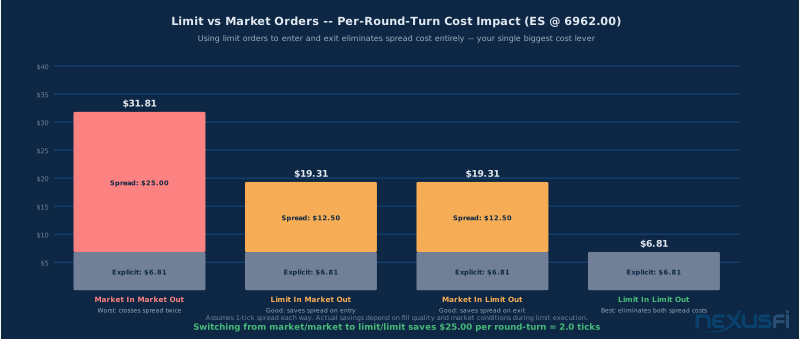
The trade-off: fill uncertainty. Your limit order may not get filled if the market moves away. For strategies where execution certainty is important (stops, breakouts, event-driven), market orders are necessary. For mean-reversion approaches where you're comfortable not getting filled if price doesn't reach your level, limit orders can dramatically reduce cost.
2. Trade During Peak Liquidity (HIGH IMPACT)
Timing execution to deep liquidity windows directly reduces slippage. For ES: deep liquidity runs 9:30--11:30 AM ET and 2:00--4:00 PM ET where 1-tick spreads are consistent. Pre-market, overnight, and the first 1--2 minutes of the RTH open are high-risk for slippage. Avoid scheduled macro data releases and unexpected breaking news for market orders. Moving from thin-market execution to peak-liquidity execution can reduce slippage by 1--2 ticks per round-turn.
3. Size Discipline (MEDIUM IMPACT)
Keep individual order sizes below visible book depth at your price level. For ES in normal conditions, the first 10--20 contracts at the best bid/ask will fill instantly without impact. Beyond 20--30 contracts, you start consuming deeper levels. Check the DOM before sending large orders and split them if needed.
4. Discount Broker Selection (MEDIUM IMPACT)
Broker commission differences represent roughly 10--15% of all-in cost for active traders. Switching from a $4/side broker to a $0.75/side broker saves $6.50 per ES round-turn — $1,300/month on 200 trades/month. It's meaningful but it ranks fourth, behind execution quality improvements that can save $25--$50 per round-turn on the same volume.
5. Data and Platform Optimization (LOW IMPACT)
The CME $30 bundle covers all major CME/CBOT/NYMEX/COMEX contracts. A trader watching ES, NQ, CL, GC, and ZN pays $10/month per exchange if purchased separately. The bundle saves $20--$30/month. Don't cut platform costs if it degrades order routing or DOM responsiveness.
6. Margin Efficiency (LOW IMPACT for Most Traders)
Multi-contract portfolios can reduce total margin via cross-margining correlated positions. CME allows margin offsets for highly correlated products — ES and NQ share credit, Treasury futures (ZN, ZB) have portfolio margin credits. For single-instrument retail traders, margin optimization is last on the priority list.
Broker Model Deep Dive #
The real difference between discount and full-service brokers isn't just commission rates — it's a bundle of services. Choosing a futures broker requires comparing execution quality, direct-to-exchange routing, platform inclusion, and margin rates alongside headline commission. Discount brokers (AMP, Interactive Brokers, NinjaTrader Brokerage, Tradovate) target volume-conscious traders with per-side rates as low as $0.25 per side. Full-service FCMs charge $3--$5+ per side but may offer dedicated account management and better margin rates.
At the discount end of the market, per-side rates below $1.00 for standard contracts are achievable and should be the baseline expectation for active retail traders.
Quick Reference: Tick Values and Cost Summary #
| Contract | $/Tick | Explicit Cost (RT) | 3-Tick Execution Cost | Approx All-In |
|---|---|---|---|---|
| ES | $12.50 | $4.48 | $37.50 | ~$42--$55 |
| MES | $1.25 | $2.10 | $3.75 | ~$6--$8 |
| NQ | $5.00 | $4.48 | $15.00 | ~$20--$25 |
| CL | $10.00 | $4.76 | $30.00 | ~$35--$45 |
| GC | $10.00 | $4.76 | $30.00 | ~$35--$45 |
| ZN | $15.625 | $4.48 | $46.88 | ~$52--$65 |
The all-in ranges reflect the variability in slippage (calm vs. active markets) and don't include capital costs. ZN's high tick value means both sides: a 1-tick move represents $15.625, and each tick of slippage costs correspondingly more. But ZN also has different microstructure than equity indexes — spreads and slippage characteristics differ from ES.
Practical Considerations and What Traders Get Wrong #
Confusing per-side and round-turn quotes. This is probably the single most common error when comparing broker costs. "We charge $0.25" needs a follow-up question: is that per side or per contract round-turn? The difference is 2x. Always confirm and convert to round-turn for meaningful comparisons.
Using commission alone to evaluate brokers. A broker with $0.25/side commission but slow execution technology may be more expensive than a broker with $0.50/side commission and direct-to-exchange routing that saves 0.5 ticks on average. Compare all-in cost, not just headline rates.
Ignoring data costs. The $30 CME bundle doesn't sound like much, but if you're trading light volume it's $3.00 per trade. Factor it into your viability calculations, especially when starting out.
Backtesting without realistic slippage. If your backtest assumes zero slippage or fills at mid-price, the strategy's simulated performance is unrealistic. Run backtests with at least 1-tick slippage assumption for limit orders and 2-tick for market orders. Strategies that look profitable at zero slippage often break even or worse in live trading.
Knowledge Map
Go Deeper
Build on this knowledgeReferences This Article
Articles that build on this topicCitations
- — Lowest commissions futures brokers (2023) 👍 5“Exchange fees are set by the exchange and are standard across the industry. Brokerage/Clearing fees are set by brokers and are 100% negotiable.”
- — 2024 CME Exchange Fee Increases (2023) 👍 8“CME eMini Equity Futures OUTRIGHTS increase from $1.33 to $1.38. CME eMini Equity Futures SPREADS increase from $1.00 to $1.15. NYMEX Natural Gas, Crude & Products increase from $1.50 to $1.60.”
- — COMPLETELY NEWBIE QUESTION = COMMISSION COST PER TRADE QUESTION (2024) 👍 6“In E-MINI ES and NQ it is ULTRA EASY to know what the cost per trade is -- pure and simple it is the ALL-IN commissions from your broker+exchange_fees. That is very simple and very clean.”
- — 2024 CME Exchange Fee Increases (2023) 👍 4“In futures, the term 'commission' usually just means the relatively small piece that goes to the broker, while 'commission and fees' includes the data/trade network and exchange per-trade fees. This is why you always need to compare total or 'all in' charges, not 'commission' alone.”
- — High Frequency Trading Adventures with Rithmic's R API (2025) 👍 7“Retail applications I tested were around 250 milliseconds behind the exchange timestamps. Most algorithms place orders WAY ahead of time at every price level, and use the MBO data feed to see their exact position in the queue.”
- — Cmegroup.com (2024)
- — Nfa.futures.org (2024)
- — Who makes more money. Scalpers or Point Traders (2014) 👍 20“My golden rule is I will never put on a trade where the cost of doing business (slippage and commission) is greater than the house odds of an American style roulette wheel. Once you understand your all-in cost, you can determine if your edge is real or illusory.”
- — Comparing Index Futures (2012) 👍 132“Each futures contract has different character in terms of slippage. FDAX has bigger spreads but less competition. ES has tighter spreads but incredible liquidity competition. Understanding the microstructure of each instrument is essential before trading it.”
- — Floored, But Back On My Feet (2013) 👍 154“In the pit era, exchange members had structural cost advantages that retail traders could never match. Today those advantages have largely been competed away at the infrastructure level, but the implicit cost gap between retail and professional execution remains real.”
- — The Scalper's Journey (2018) 👍 33“The math on scalping ES is brutal when you run the real numbers. You need wins that substantially exceed your losses in tick terms just to cover the all-in cost of the round-turn. Most new scalpers underestimate this by at least 2x.”