



Hedging with Futures: Transferring Price Risk Without Exiting Your Position
Overview #
Futures were invented to hedge. Before anyone was day trading ES for $50 ticks, grain farmers were selling forward contracts to lock in harvest prices and flour mills were buying those same contracts to lock in input costs. The speculator who took the other side of those trades made the market function. That's the original deal — hedgers transfer risk to speculators who want it.
Today, hedging with futures is a toolkit used by portfolio managers protecting equity exposure, commodity producers locking in revenue, and active traders managing concentrated risk they can't or won't close. The mechanics haven't changed much since 1848. The instruments have.
This article covers the practical side: how to calculate how many contracts you need, what basis risk means for your hedge's actual effectiveness, and where hedging will fail you if you're not careful.
What Hedging Actually Is #
A hedge is a position that offsets the risk of another position. Not eliminates it — offsets it. The goal is to reduce variance in your P&L, not to make money on both sides of the trade.
If you own 100 shares of a stock trading at $200 and you short one ES futures contract, you've created a hedge. If the stock falls 10%, you lose $2,000 on your equity. If ES falls 10% too (and the correlation is tight enough), your short ES position gains roughly $2,000. Net P&L: close to zero. You haven't made money. You've transferred the price risk out of your position.
The hedge is not a profit center. A hedge that "works" means you broke even while the market moved against you. Expecting to profit from both the hedge and the underlying is the wrong mental model — you're paying for stability, not returns.
The futures market exists because of hedgers. Speculators provide the liquidity.
A decision not to hedge is a decision to speculate.
For traders holding concentrated positions, that applies just as directly.

The Two Directions: Long Hedge and Short Hedge #
Every hedge falls into one of two categories based on what risk you're managing.
Short Hedge (Protecting Long Exposure)
You hold an asset and you're worried prices will fall. You short futures to offset the downside risk.
Examples:
- Equity investor short ES to protect a stock portfolio from a market correction
- Corn farmer short ZC to lock in current prices before harvest
- Gold producer short GC to lock in revenue before delivery
Long Hedge (Locking in a Purchase Price)
You need to buy an asset in the future and you're worried prices will rise before you get there. You go long futures to lock in the current price.
Examples:
- Airline buying CL futures to lock in jet fuel costs six months out
- Chocolate manufacturer buying cocoa futures to secure input costs
- Fund manager planning to deploy cash buys ES to get market exposure before allocating to individual stocks
The mechanics are the same in both cases — you're using a futures position to transfer price risk from the period you don't want exposure to.

Key Concepts #
Hedge Ratio #
The hedge ratio is how many futures contracts you need relative to the size of your underlying exposure. Getting this wrong is the most common mistake in hedging — too few contracts leaves you underhedged with significant residual risk, too many contracts and you've reversed your exposure rather than neutralized it.
Simple Hedge Ratio (Direct Correlation)
For positions with direct correlation — physical WTI crude hedged with CL futures, for example:
Number of Contracts = Position Size / Contract Notional ValueIf you hold 10,000 barrels of crude oil and each CL contract covers 1,000 barrels:
Contracts = 10,000 / 1,000 = 10 CL contracts shortBeta-Adjusted Hedge Ratio (Equity Portfolios)
For equity portfolios, you need to adjust for the portfolio's beta relative to the hedge instrument. A high-beta tech portfolio moves more than ES point-for-point; a low-beta defensive portfolio moves less.

Example: You hold a $750,000 equity portfolio with a beta of 1.2 against the S&P 500. ES is trading at 5,200, and each contract has a multiplier of $50.
Contracts = ($750,000 x 1.2) / (5,200 x $50)
Contracts = $900,000 / $260,000
Contracts = 3.46 -> round to 3 contracts
Three short ES contracts. This isn't perfect — you'll have residual unhedged exposure because of the rounding and because your portfolio's actual beta in a stressed market may differ from its historical beta. But it gets you to roughly 87% hedged, which is materially better than nothing.
Minimum Variance Hedge Ratio
For cross-hedges or imperfect correlations, the statistically optimal hedge ratio comes from regression analysis:

A natural gas distributor hedging jet fuel costs with CL futures (since no jet fuel futures exist with sufficient liquidity) would use this calculation to determine the CL contract quantity that minimizes portfolio variance. The result is often less than 1:1 and sometimes quite different from a simple notional hedge.

Basis Risk #
Basis is the difference between the spot price of an asset and the futures price:
Basis = Spot Price - Futures PriceBasis risk is the risk that this difference changes in unexpected ways during the life of the hedge. It's the risk that remains after all hedging is done.
You've eliminated outright price risk but kept basis risk — and sometimes basis moves can be substantial.
Basis risk is the hidden cost of imperfect hedges. In normal markets, basis changes are small and predictable. During dislocations — delivery squeezes, supply shocks, liquidity crises — basis can blow out dramatically. Your hedge that looked clean on paper can produce unexpected losses even when your underlying position behaves as predicted.
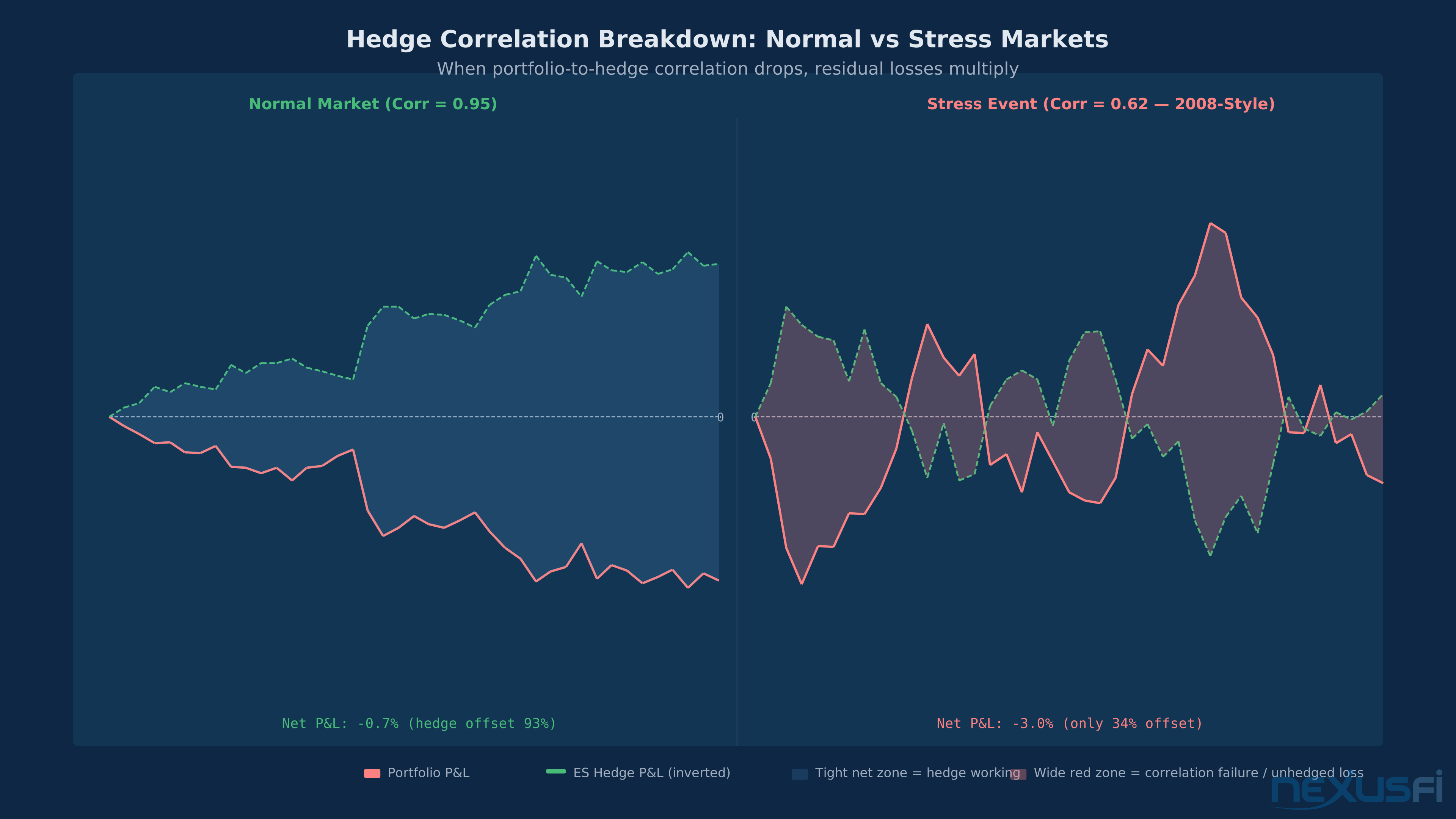
For equity portfolio hedgers, basis risk shows up as tracking error. Your portfolio doesn't move identically with ES — it has its own sector weights, individual names, and beta instabilities. A portfolio that's historically correlated 0.95 with the S&P may track only 0.75 during a sector-specific stress event. Your ES short doesn't help when energy names crater while tech holds.
For commodity hedgers, basis risk includes:
- Geographic basis: Henry Hub NG vs. Appalachian NG — different delivery points trade at different spreads
- Quality basis: WTI crude vs. heavy sour crude differentials that widen and narrow independently
- Calendar basis: spot vs. nearby futures during delivery periods when physical tightness hits
@SodyTexas makes this concrete on natural gas basis: the Henry Hub futures price is completely different from your regional citygate price. A $2.22 Henry Hub price with a $0.12 regional basis means your actual cost is $2.342. An NG futures hedge protects the Henry Hub component but leaves the basis risk fully exposed.

Cash Flow Risk of Futures Hedges #
This is the part that kills hedgers who aren't capitalized properly. @SMCJB explains the mechanics clearly in the crude oil hedging thread:
Imagine you produce oil at $30/barrel and hedge by selling futures at $50. Prices spike to $100. Your hedge loses $50/barrel in mark-to-market, and the exchange demands cash margin daily. Your physical oil is worth $100/barrel — great on paper — but you need $50/barrel in cash now to maintain the hedge.
For a commodity producer hedged for one year at scale, that's hundreds of millions in potential cash calls. The physical production is worth it eventually, but you need the cash to stay in the hedge until delivery.
Futures hedges require liquid cash for variation margin as the hedge moves against you. The underlying asset you're protecting may be illiquid, long-dated, or physically held — it won't help you cover margin calls. Size your hedge based on your cash capacity to sustain it, not just the notional you want to protect.
This is why many commercial hedgers transact OTC rather than exchange-traded futures — OTC hedges can be structured without daily margin calls, counting the exposure against credit lines instead. The trade-off is price — you're at the bank's mercy on execution.
For retail equity hedgers, the same risk applies at smaller scale. Short ES in a falling market generates variation margin gains; but if you're using the hedge to protect a stock portfolio during a rally, the ES short will be generating daily losses requiring margin. If your account doesn't have enough cushion, you'll be forced to close the hedge at the worst time — which is exactly when you need it most.

Roll Cost #
Most hedges need to survive longer than a single futures contract month. When your hedge position expires, you close it and reopen in the next contract month — this is called rolling the hedge.
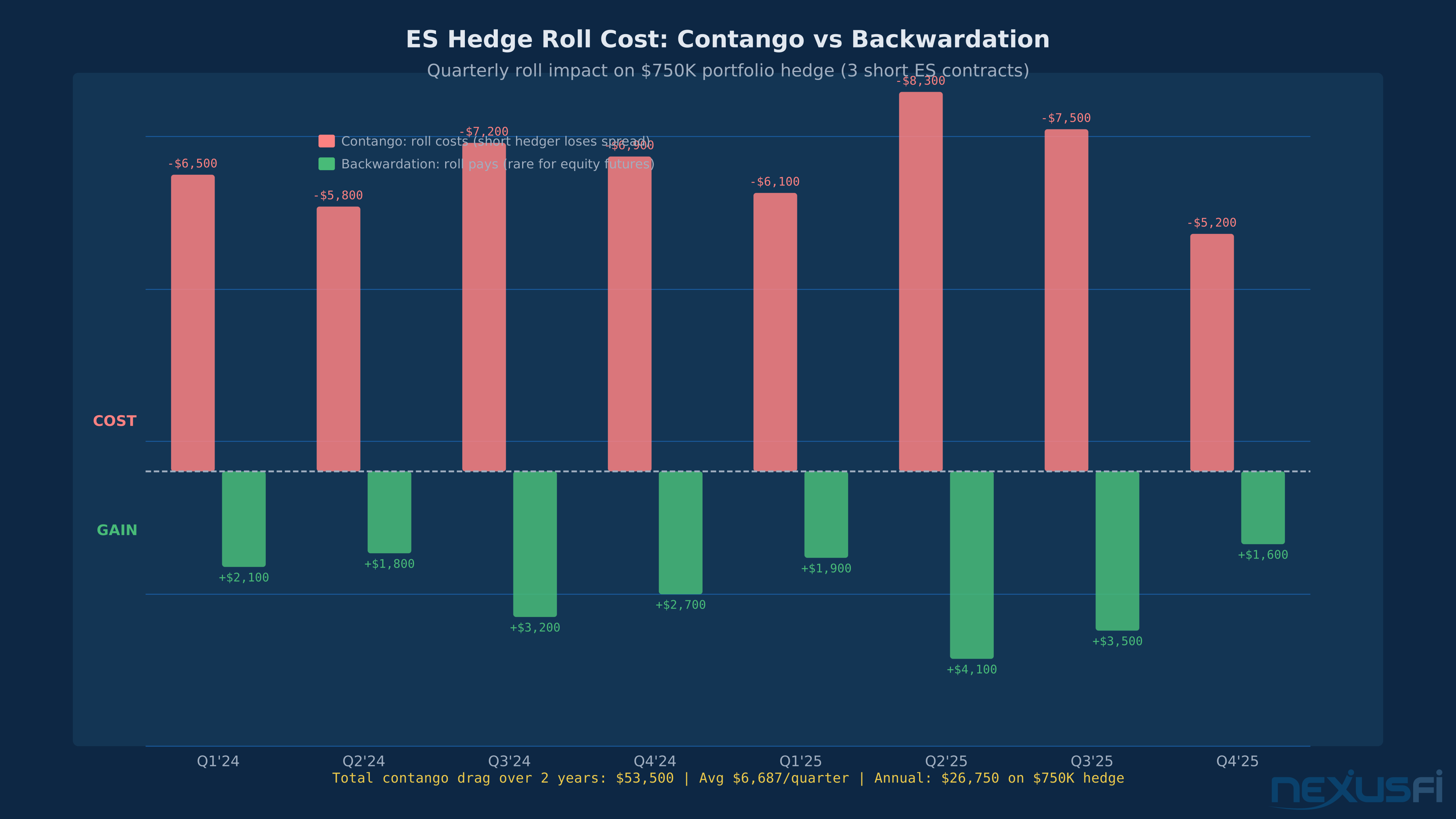
Rolling has a cost. In contango markets (future prices above spot), rolling forward a short futures position means buying back the lower nearby contract and selling the higher deferred contract. You lose the spread every roll. In backwardation (future prices below spot), you gain on the roll.
For equity index hedgers using ES, the roll cost is typically tied to interest rates minus dividends:

With a 5% risk-free rate and 1.5% dividend yield on the S&P, a quarterly ES roll costs approximately 0.875% of notional. On a $750,000 hedge, that's about $6,500 per quarter, or $26,000 per year — just to keep the hedge open. That's the "insurance premium" expressed in roll costs.
When evaluating whether to hedge, calculate the full roll cost over the hedge horizon. A hedge intended to run 12 months costs more than four quarterly rolls suggest if the contango steepens. Price the insurance before buying it.
How Equity Portfolio Hedging Works in Practice #
This is the most common use case for retail and semi-institutional traders: you have a stock portfolio you don't want to sell (tax reasons, conviction, restricted holdings), but you expect near-term volatility or a market correction. Short ES protects the portfolio.
Step 1: Calculate Your Hedge Size
Portfolio: $750,000, beta 1.2 vs. S&P 500. ES at 5,200, multiplier $50.
Contracts = ($750,000 x 1.2) / (5,200 x $50) = $900,000 / $260,000 = 3.46 -> 3 contracts shortNotional hedge coverage: 3 x $260,000 = $780,000. Beta-adjusted exposure was $900,000. You're covering about 87% — acceptable, not perfect.
Step 2: Margin Requirements
Short ES has initial margin requirements of approximately $12,000-$14,000 per contract at current SPAN rates. Three contracts: roughly $39,000-$42,000 in initial margin. On a $750,000 portfolio, that's about 5.2-5.6% cash committed to the hedge — manageable.
@SMCJB points out that when you hold offsetting positions (e.g., long equity + short ES in a portfolio margin account), the broker can recognize the offset and margin requirements are substantially reduced from the sum of the two positions independently.
Step 3: Managing the Hedge
The hedge isn't "set and forget." As the market moves, your portfolio's value changes and its beta changes. A 10% market drop may shift your portfolio beta from 1.2 to 0.9 if high-beta names sold off more aggressively. Recheck the hedge ratio at major market moves (more than 5-7%) and rebalance if the calculation is materially off.
Step 4: Closing or Rolling
When the hedge period ends — the event you were worried about passes, the volatility subsides — you close the short ES position. If the hedge needs to extend past contract expiration, roll it: buy back the expiring contract and sell the next month out. Price the roll cost and include it in your total hedge cost evaluation.
For equity portfolio hedges: calculate beta-adjusted contracts, confirm margin availability before entering, track mark-to-market daily, rebalance at major moves, and price the roll cost upfront. An unmanaged hedge is almost as dangerous as no hedge.
How Commodity Exposure Hedging Works #
Commodity hedges follow the same structure but with more complex basis considerations.
Producer Short Hedge Example: Crude Oil
A small E&P company produces 5,000 barrels per month and wants to lock in the current $75/barrel price for the next six months:
Contracts = 5,000 barrels/month x 6 months / 1,000 barrels per CL contract
Contracts = 30,000 / 1,000 = 30 CL contracts short
Entered at $75. If crude falls to $60, the hedge gains $15/barrel x 30,000 barrels = $450,000. The physical oil sells for $60 in the spot market. Net revenue: $75/barrel — goal achieved, locked in.
If crude rallies to $90, the hedge loses $15/barrel x 30,000 barrels = $450,000 in mark-to-market. The physical oil now sells for $90. Net revenue still: $75/barrel. The hedge capped the upside — that's the cost of certainty.
Cross-Hedge Example: Jet Fuel with CL
No standard NYMEX contract exists for jet fuel with meaningful retail liquidity. Airlines hedge with crude oil futures despite the imperfect correlation (jet fuel and crude have a strong historical correlation of approximately 0.88-0.92, but spreads widen during refinery disruptions).
Using the minimum variance hedge ratio approach:
- Historical correlation between jet fuel and CL price changes: 0.88
- sigma_S (jet fuel daily price change volatility): 1.8%
- sigma_F (CL daily price change volatility): 2.1%
h* = 0.88 x (1.8% / 2.1%) = 0.754For every $1 of jet fuel exposure, hedge $0.754 of notional with CL. The hedge isn't perfect — you'll have residual basis exposure — but it eliminates approximately 75% of outright price risk, which is substantially better than no hedge.
Hedging with Micro Contracts #
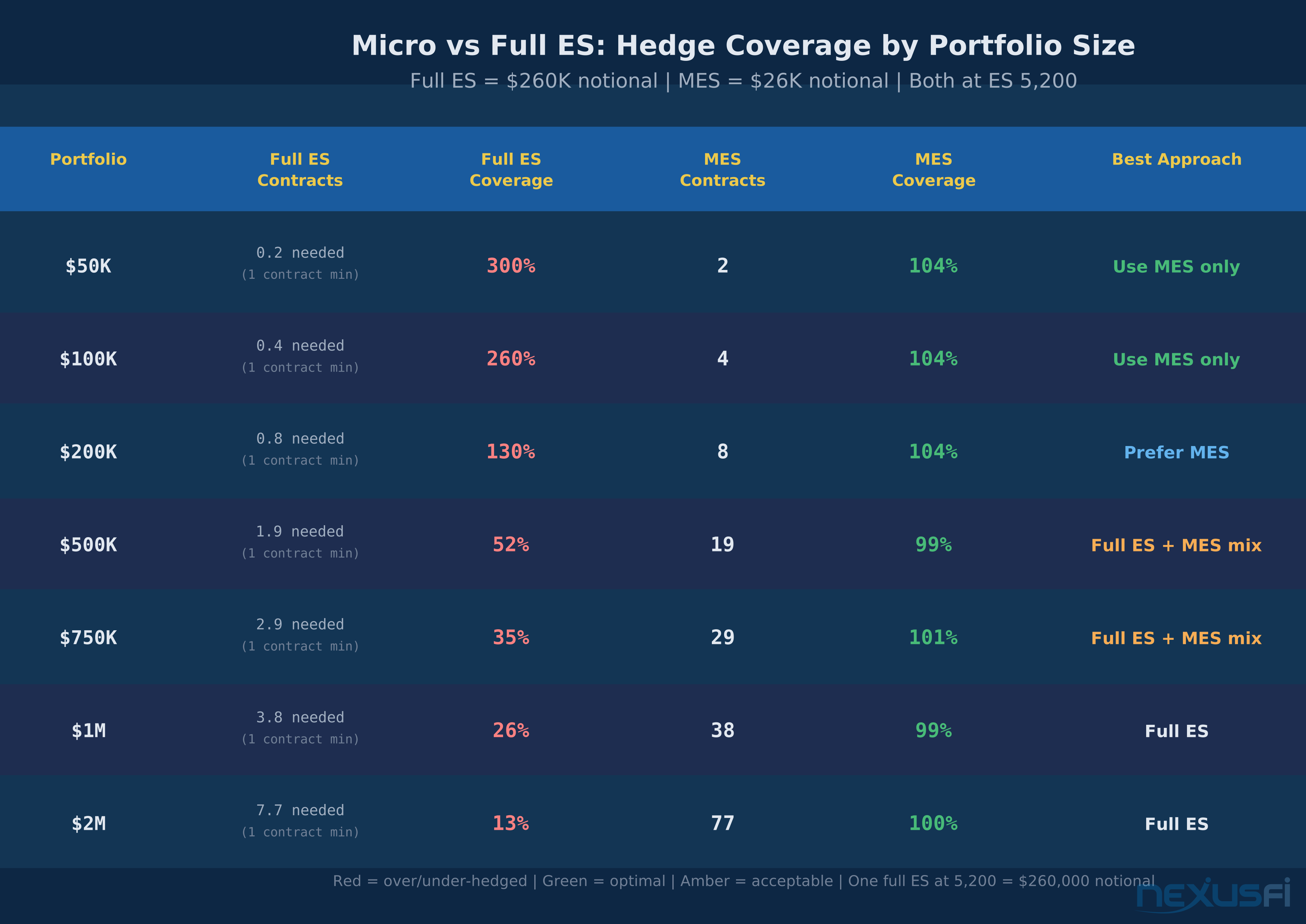
One underused hedging tool is micro futures. The micro ES (MES) has a $5 multiplier versus $50 for full ES. For smaller portfolios, this enables precision hedging that wouldn't be possible with full contracts.
For a $100,000 portfolio with a beta of 1.0, one full ES contract at 5,200 would be a $260,000 notional position — 2.6x the portfolio value. Running a $260K short against a $100K account flips you net short the market. One MES is $26,000 notional — roughly 25% coverage. Two MES = 50% hedge. Five MES = 100% hedge. The micro granularity matters enormously for smaller accounts.
And for roll management: "When it comes to roll, if I have say 20 MES, I will actually roll 2 ES not MES, saves on commissions and slippage."
For portfolios under $200,000, use Micro ES (MES) or Micro NQ (MNQ) rather than full contracts. Full ES notional at current prices exceeds $260,000 — one contract for a $200K portfolio isn't a hedge, it's a net short position. MES gives you 10x the precision.
Integration with Other Risk Tools #
Hedging doesn't operate in isolation. Professional hedgers layer it with complementary tools:
Options for Asymmetric Protection
Short futures hedges cap gains on the underlying. Options hedges (long puts) let you keep the upside while protecting against downside. As @Fat Tails explains: a long futures put alongside a long futures position lets you "trade in and out of your index futures position and have additional protection." The put gives protection without forfeiting the rally.
The cost: options premiums vs. no premium for futures. Put options have time value that erodes — a futures hedge has no time value erosion. For long-dated, static protection, futures are more cost-effective. For hedges where you want to retain upside exposure, options make more sense despite the premium.
For delta hedging, ES futures are the tool — the high liquidity makes them preferred for rapid hedge adjustments.
Collars for Budget-Neutral Protection
A collar combines selling a call and buying a put against a long underlying position. The call premium funds the put premium, making the hedge approximately cost-neutral. The trade-off: both upside and downside are capped.
Position Sizing as a First Line of Defense
@Fat Tails makes the key point: "The best protection is offered by put options, which are not far out of the money, and those are the most expensive ones, as everybody wants to use them." Before adding hedge cost, consider whether better position sizing at entry would accomplish the same risk reduction more efficiently. Hedging an overleveraged position is more expensive than sizing correctly from the start.
When Hedging Fails #
Hedging isn't risk elimination. Several scenarios produce hedges that fail or underperform:
Correlation Breakdown
The most common failure mode. A hedge that has worked historically can disconnect during stress events. In 2008-2009, correlations across equity sectors collapsed toward 1.0 simultaneously — everything sold off together regardless of sector. A portfolio hedged against "normal" volatility found its sector diversification worthless and its ES hedge undersized for the magnitude of the move.
Hedge Too Small (Under-Hedging)
If you round down on contracts or forget to rebalance as market moves change the effective beta, your hedge covers less exposure than you think. This is especially common for portfolios with concentrated high-beta names — the hedge ratio needs more frequent recalibration.
Hedge Too Large (Over-Hedging)
If you're short more ES notional than the value of your portfolio, you've inverted your position. A $750,000 portfolio with 6 short ES contracts (notional: $1.56M) has actually gone net short the market. Know exactly what size you're running.
Liquidity and Execution Risk During Crises
ES bid/ask spreads widen during the most violent market sessions. The 2020 COVID crash saw spreads expanding during the acute phase. The hedge design was sound, but execution cost multiplied because of timing. Hedges entered or exited during stress events cost more than hedges put in place before the stress.
Operational Uncertainty for Commercial Hedgers
Production hedges require volume estimates that may prove wrong. Over-hedging future production that never materializes creates an orphaned short position with no offsetting physical exposure.
Practical Application: Pre-Hedge Checklist #
Before entering any hedge, answer these questions:
1. What specific risk am I hedging? Be precise. "Market risk" isn't precise. "50% of my portfolio's beta-weighted equity exposure for the next 60 days" is.
2. What's the hedge instrument's correlation to my underlying? For direct hedges (ES for S&P exposure), correlation is typically 0.98+. For cross-hedges (CL for jet fuel), calculate historically and stress-test the number.
3. How many contracts? Run the calculation. Don't estimate. Rounding one contract up or down on a 3-contract hedge is a 33% difference in coverage.
4. Do I have enough cash for variation margin? Calculate the worst-case scenario: what if the hedge moves 15% against me before the underlying recovers? Make sure the cash is there. Rule of thumb: reserve 20% of hedge notional in liquid cash for variation margin.
5. What's the roll cost over the hedge horizon? If the hedge spans multiple contract months, price each roll. Total that cost into your evaluation.
6. What's my exit condition? The hedge has a purpose. When that purpose ends — the event passes, the risk resolves — what triggers closing? Define it before you enter. Hedges left open past their useful life are just speculative shorts.
A hedge without an exit condition is a position. Know why you're in it and what "done" looks like before you put the trade on.
Knowledge Map
Go Deeper
Build on this knowledgeReferences This Article
Articles that build on this topicCitations
- — why do large institutions invest in the ES (2024) 👍 1“This is the general reason that there is a futures market, to offload market risk from those who don't want to take it (hedged positions) to those who do (unhedged.)”
- — Crude oil, Hedging (2015) 👍 7“A decision not to hedge is a decision to speculate.”
- — Crude oil, Hedging (2015) 👍 7“A long physical position holder may hedge his futures price risk by selling an equivalent number of futures contracts on the exchange thereby leaving him exposed only to basis risk.”
- — UNG as a hedge? (2015) 👍 3“In order for you to properly hedge your physical Natural Gas you would need to purchase/sell the HH futures market and at the same time your nearest CityGate future via the ICE exchange.”
- — Spoo-nalysis ES e-mini futures S&P 500 (2022) 👍 9“SPX options are the global, go-to product for hedging equity exposure.”
- — Trading Futures with options as protection (2011) 👍 9“The best protection is offered by put options, which are not far out of the money, and those are the most expensive ones.”
- — Hedging NQ and MNQ 1-10 (2022) 👍 4“When it comes to roll, if I have say 20 MES, I will actually roll 2 ES not MES, saves on commissions and slippage.”
- — Hedging NQ and MNQ 1-10 (2022) 👍 3“Per exchange margining the margin requirement for MES is 1/10th of ES.”