



Optimal F Position Sizing: Ralph Vince's Framework for Maximum Geometric Growth (and Why You Should Use a Fraction of It)
Overview #
Ralph Vince published The Mathematics of Money Management in 1990 and introduced a concept that has haunted futures traders ever since: Optimal f. The idea is deceptively simple — there exists a specific fraction of your trading capital that, if risked on every trade, maximizes the long-run growth rate of your account. Risk more than that fraction and you grow slower. Risk less and you leave growth on the table. Risk exactly that fraction and you're theoretically on the optimal geometric growth path.
The problem? At full strength, optimal f typically tells you to risk 20% to 40% of your account per trade. Which means 50% to 70% drawdowns are not edge cases — they're the expected, normal, by-design outcome of following the math. Most futures traders discover this lesson the hard way, usually somewhere around trade 30 in a 40-contract ES account that's down to $14,000.
This article covers what optimal f actually is, how it's calculated, why it's related to (but not identical to) the Kelly Criterion, what the drawdown implications are in concrete dollars, and — most importantly — how to use the framework in a way that doesn't end your trading career. The short answer: use 10% to 25% of your calculated optimal f. The long answer is everything below.
Optimal f belongs in your analytical toolkit whether or not you ever deploy it directly. Understanding geometric growth optimization changes how you think about position sizing across every method you use.
What Optimal f Actually Measures #
Optimal f isn't a money management rule — it's the solution to an optimization problem. The question it answers: given my historical trading results, what fraction of my capital should I risk on each trade to maximize the long-term compound growth rate of my account?
The "f" stands for fraction. An f of 0.10 means risk 10% of current equity per trade. An f of 0.33 means risk 33% per trade. The "optimal" part means this specific value maximizes a quantity called the Terminal Wealth Relative, or TWR.
Terminal Wealth Relative #
TWR is the product of (1 + f × HPR) across all trades, where HPR is the Holding Period Return expressed in normalized units. If you start with $1 and end with $4, your TWR is 4.0. Optimal f is the value of f that maximizes this product.
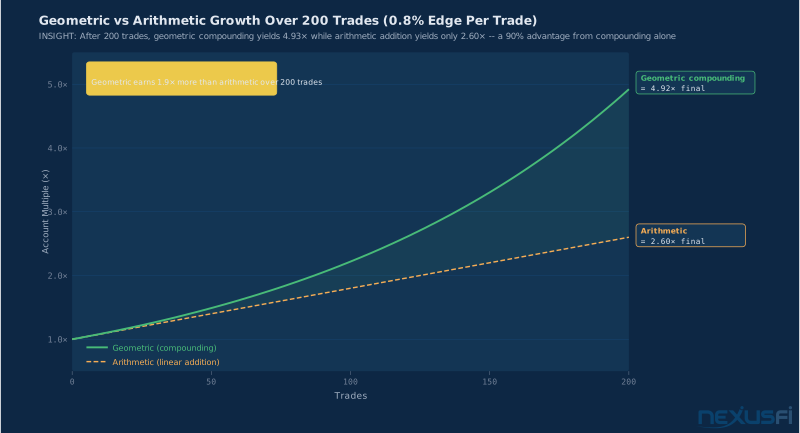
The geometric mean return — your compound growth rate per trade — is TWR raised to the power of (1/n), where n is number of trades. This is what counts for long-run wealth. Arithmetic returns can be misleading: a strategy that returns +50% then -33% has an arithmetic average of +8.5% but a geometric mean of exactly 0% (you're back to your starting capital).
Optimal f maximizes the geometric mean. That's genuinely useful. The problem is what "maximizing it" requires.
The Analytical Formula #
For strategies that can be approximated as binary (win or lose, with consistent payoffs), optimal f has a clean analytical solution:
*f = (p × (R + 1) - 1) / R
[1] The same mathematics underlies optimal f — the difference is optimal f extends the framework to multi-outcome distributions.**
Where:
- p = win probability
- R = reward/risk ratio (average win divided by average loss)
- q = 1 - p (loss probability)
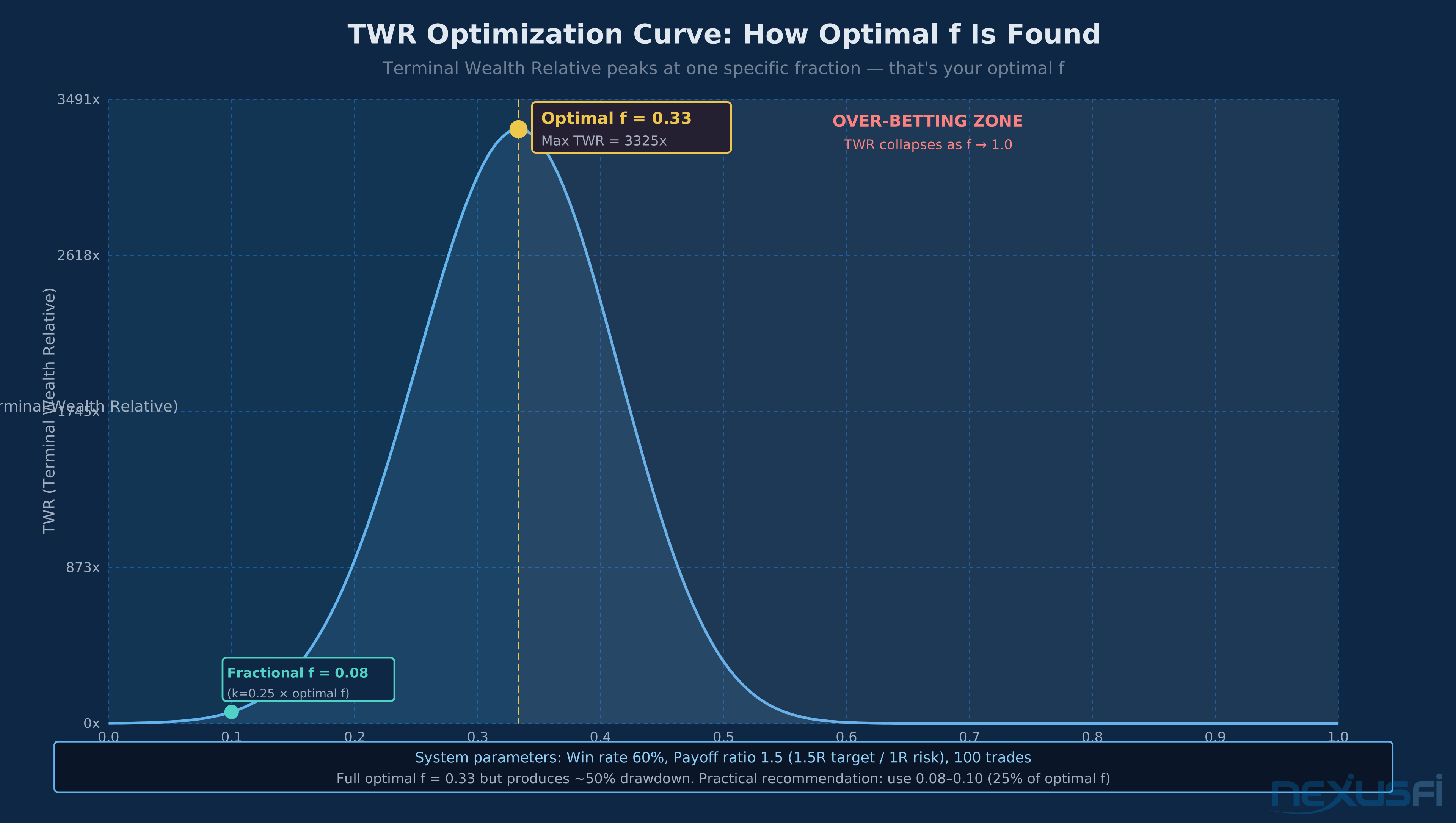
For a system with a 60% win rate and a 1.5:1 reward/risk ratio: f* = (0.60 × 2.5 - 1) / 1.5 = 0.50/1.5 ≈ 0.333. This formula tells you to risk 33.3% of your account on every trade.
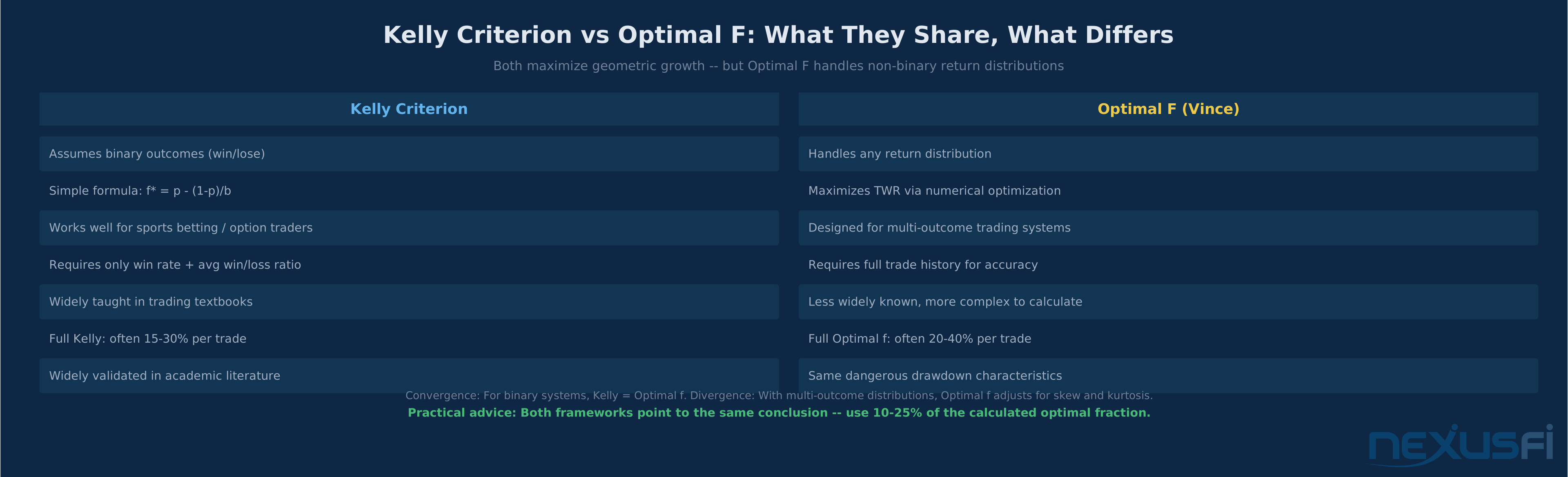
This is the same formula as the Kelly Criterion, and that's not a coincidence — both improve for the same objective (maximizing expected log growth), and they produce identical results given equivalent assumptions. Vince's contribution was extending the framework to handle real trading distributions, which are rarely clean binary outcomes.
Empirical Optimization for Real Trading #
Most trading systems have irregular P&L distributions: some trades win 2R, some win 0.5R, some lose 1.2R due to slippage. The clean formula breaks down. The empirical approach tests hundreds of f values from 0 to 1, computes the TWR for each using your actual trade sequence, and selects the f that produces the maximum TWR.
The TWR optimization curve has a characteristic shape: starts at 1.0 (no growth at f=0), rises to a peak at f*, then crashes back to zero as f approaches 1.0. That crash is a mathematical certainty — as f nears 1.0, any single losing trade eliminates most of your capital.
This curve matters because it shows you how aggressively the TWR function punishes over-betting. Sizing slightly below optimal f still produces near-maximum TWR. Sizing much above it produces catastrophic losses. The asymmetry is severe, and it's the reason every serious practitioner recommends using a fraction of optimal f rather than the full value.
The Relationship to Kelly Criterion #
@Fat Tails' detailed analysis in the NexusFi Risk of Ruin thread established the connection clearly: "Optimal F assumes that you follow a fixed fractional betting strategy to achieve optimal geometric growth."[2] This is the unifying insight — both frameworks are solutions to the same optimization problem, differing mainly in their assumptions about the distribution of outcomes.
Traders often ask whether optimal f and the Kelly Criterion are the same thing. The short answer: they're the same optimization, packaged differently.
The Kelly Criterion comes from information theory and gambling. John Kelly Jr. derived it in 1956 at Bell Labs, asking what fraction of capital a gambler should bet to maximize the expected log growth of their wealth. For a binary bet with win probability p and payoff odds R:
f_kelly = (p × (R + 1) - 1) / R
This is identical to the optimal f formula above. What Vince added was:
- Empirical implementation: Using actual trade sequences rather than assumed probabilities, allowing the framework to handle non-binary, asymmetric outcomes
- The HPR framework: Normalizing trade outcomes to Holding Period Returns, making cross-strategy comparison possible
- Explicit connection to futures trading: Translating from gambling theory to contract-based position sizing
Where they diverge in practice: Kelly is typically used with win rate and payoff estimates (which may be wrong); optimal f is computed from actual historical trade distributions (which may be unrepresentative of future conditions). Both share the same fundamental flaw — they're optimal only when your input parameters accurately describe future trading conditions. If your win rate estimate is 60% but your real forward win rate is 52%, you're overbetting much.
Kelly and optimal f answer the same question using different inputs. Kelly uses estimated probabilities; optimal f uses empirical distributions. Neither is strong to regime changes in your strategy's edge. Both recommend dangerous position sizes at full deployment.
Fat Tails, one of NexusFi's most respected quantitative contributors, spent considerable time in the forum thread Risk of Ruin working through the mathematics of optimal f alongside Kelly, noting the framework's theoretical elegance while demonstrating through spreadsheet models why most practical implementations required significant fractional scaling. His work showed that "tolerated risk" — the amount of drawdown a trader can psychologically endure — is often the binding constraint, not the mathematical optimum. See the full @Fat_Tails analysis in the Risk of Ruin thread[1]
Nicolas11 extended this analysis with explicit capital simulations in Optimal position sizing strategy (including considerations on Kelly criterion), showing that for a $1,000 account, the difference between 50% of optimal f and 100% of optimal f was the difference between sustainable trading and catastrophic drawdown. The full thread: https://nexusfi.com/showthread.php?t=30750&p=391796#post391796
Why Full Optimal f Is Dangerous #
@Fat Tails calculated the drawdown implications precisely: "I will definitely stop trading after a drawdown of 50% (ruin)."[3] At full optimal f, that ruin threshold is the expected outcome, not an edge case. The mathematics guarantee it.
The mathematical case for optimal f is airtight. The practical case against using it at full strength is equally airtight. Here's why:
Expected Drawdowns Are Catastrophic #
At full optimal f, expected maximum drawdown is 50% to 70%. Not the worst case — the expected outcome given a profitable system. For a $50,000 ES futures account, this means routine drawdowns of $25,000 to $35,000. This is not a risk you can manage around — it's a structural feature of maximizing geometric growth at the aggressive level the formula prescribes.
The practical problem: most futures brokers require minimum margin maintenance. At 50% drawdown from $50,000, you're at $25,000. That's uncomfortably close to the minimum for trading ES (around $12,800 per contract at typical margins). If you're running 3 contracts, you're forced to cut positions precisely when the system is performing normally.
Estimation Error Amplifies Risk #
[10]
Optimal f is calculated from historical data. But your forward trading conditions may not match your history. If your estimated win rate is 60% and your forward win rate is 52%, you're overbetting by roughly 15-20%. The punishment for overbetting is asymmetric: being above the optimal means far larger drawdowns for only slightly higher upside.
In a fixed-probability game, you can trust your parameters. In futures trading, edge erodes, correlations shift, and market microstructure changes. The calculation you run today may be irrelevant by the time you've traded 50 more contracts.
Sample Size Requirements Are Rarely Met #
[7]
The reliability of your optimal f calculation scales with the number of trades in your sample. With 30 trades, your win rate estimate has a standard error large enough to make the calculation nearly meaningless. With 100 trades, it's more reliable but still subject to survivorship bias (you're measuring a period when the system worked). Most retail traders haven't generated 100 comparable trades from a consistent system — they've changed their approach multiple times.
Calculating optimal f from fewer than 50 executed trades with accurate slippage data is not position sizing — it's false precision on top of a small sample. The formula will give you a number. That number is not reliable.
Psychological Breaking Points Arrive First #
The mathematics of optimal f assumes you can tolerate any drawdown and continue trading identically. Real traders cannot. Most experienced futures traders have a psychological threshold around 20-25% drawdown where their decision-making degrades, their trading journal entries get shorter, and their rule adherence falls. Full optimal f produces drawdowns of 50-70%. The math says you'll recover. Your nervous system says otherwise.
Fat Tails addressed this directly in the NexusFi Risk of Ruin thread, framing the real constraint not as mathematical ruin but as the "pain threshold where you stop trading." This psychological ruin is more common and more predictable than mathematical ruin, and it arrives at drawdown levels well below what optimal f routinely produces.
The Fractional f Solution #
@Fat Tails proposed the practical framework: "Replace 'risk aversion' with 'Tolerated risk' — replace Full/Half/Quarter Kelly with Actual risk."[4] The actual risk you can tolerate psychologically and financially determines your fractional f multiplier — not some theoretical optimization target.
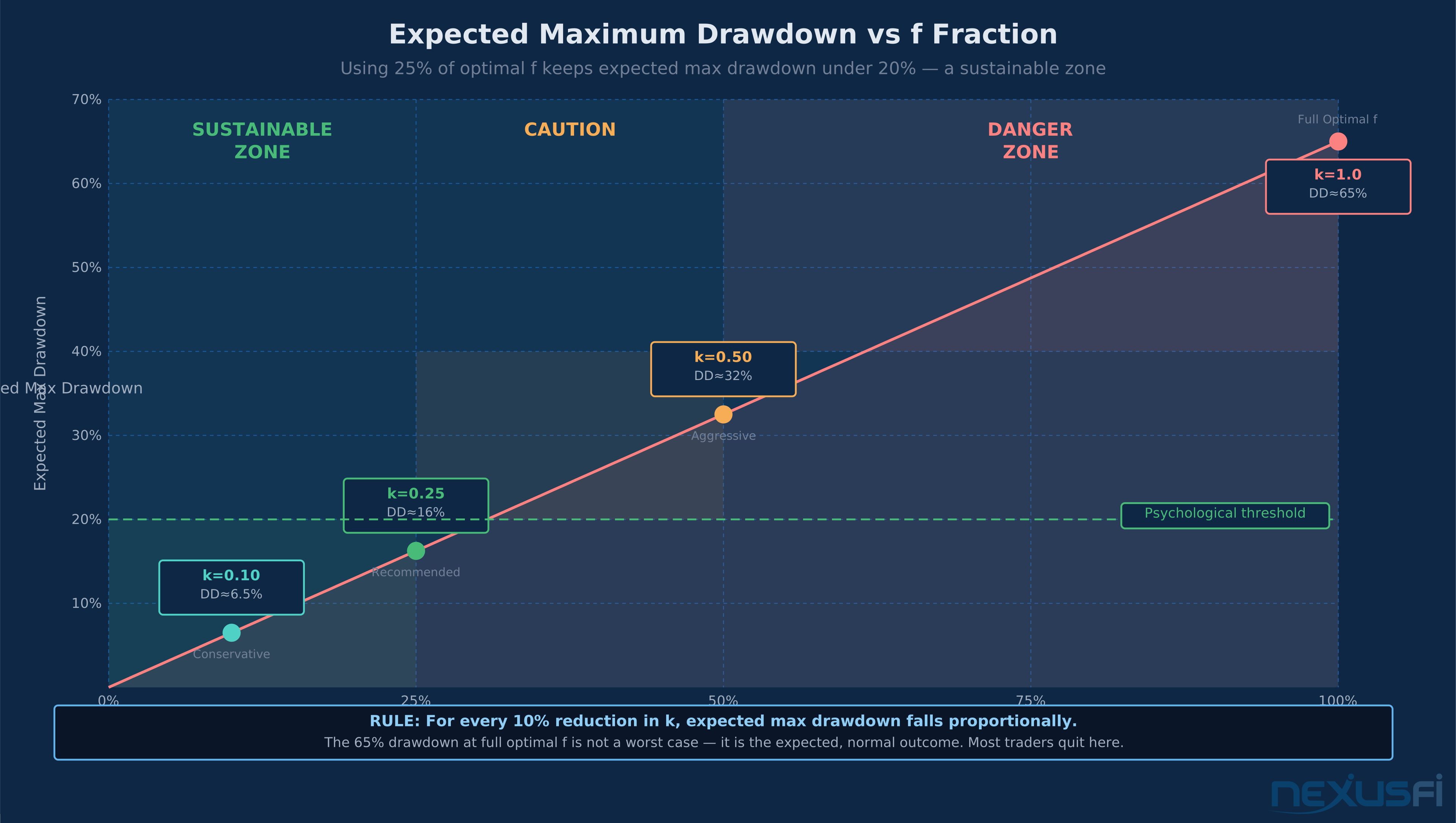
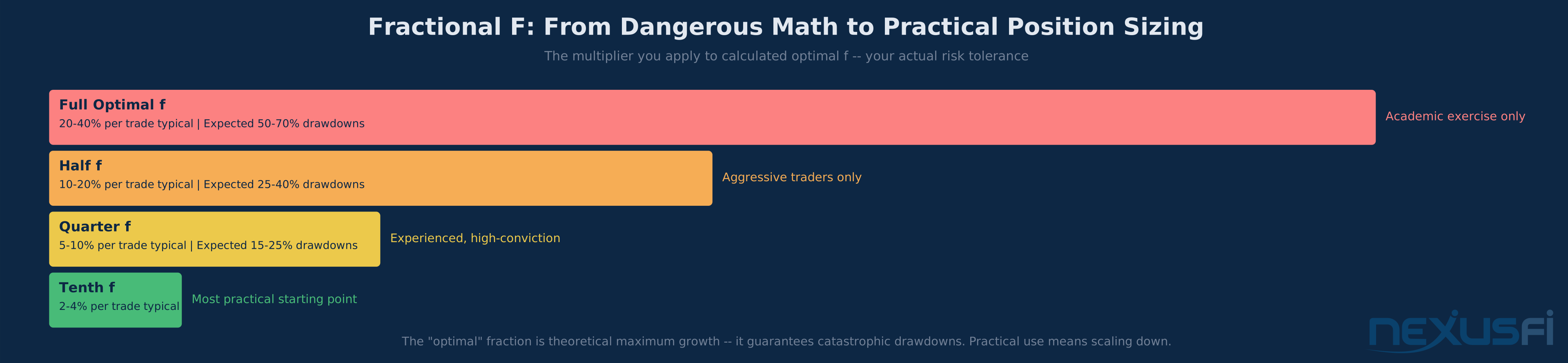
The practitioner consensus — and it is a genuine consensus — is that optimal f belongs in your analysis but fractional optimal f belongs in your trading. Specifically, using 10% to 25% of your calculated optimal f produces growth that beats simple fixed-fractional sizing while keeping drawdowns in the 7-16% range.
The k Scaling Factor #
The standard notation: f_practical = k × f*
Where k is the scaling factor, typically 0.10 to 0.25. The choice of k should be driven by:
- Account size: Smaller accounts need more conservative k values because rounding to whole contracts amplifies proportional bet sizing
- Strategy reliability: More trades, longer track record, and more consistent edge → can tolerate higher k
- Psychological tolerance: What's your actual maximum drawdown tolerance? Set k so expected max drawdown stays well below that threshold
- Market conditions: High volatility environments call for lower k; clear trending regimes with good system performance support slightly higher k
The relationship between k and expected max drawdown is roughly linear:
| k Value | Expected Max Drawdown | Characterization |
|---|---|---|
| k = 0.10 | ~6.5% | Conservative — modest growth, minimal psychological stress |
| k = 0.15 | ~10% | Moderate — good growth, manageable drawdowns |
| k = 0.25 | ~16% | Recommended — near-optimal growth-to-drawdown balance |
| k = 0.50 | ~32% | Aggressive — most experienced traders find this difficult |
| k = 1.00 | ~65% | Full optimal f — mathematically optimal, practically unsustainable |
These are expected maximum drawdowns, not worst-case scenarios. With k = 0.25, planning for 20% drawdown keeps you comfortably covered.
The k = 0.25 recommendation is not arbitrary. It produces expected drawdowns in the 15-20% range while capturing a significant fraction of the theoretical growth potential. Most traders can trade through a 20% drawdown without significant psychological degradation. Most cannot trade through 40% without fundamental changes to their behavior.
Fractional f vs Fixed Fractional vs Full Optimal f #
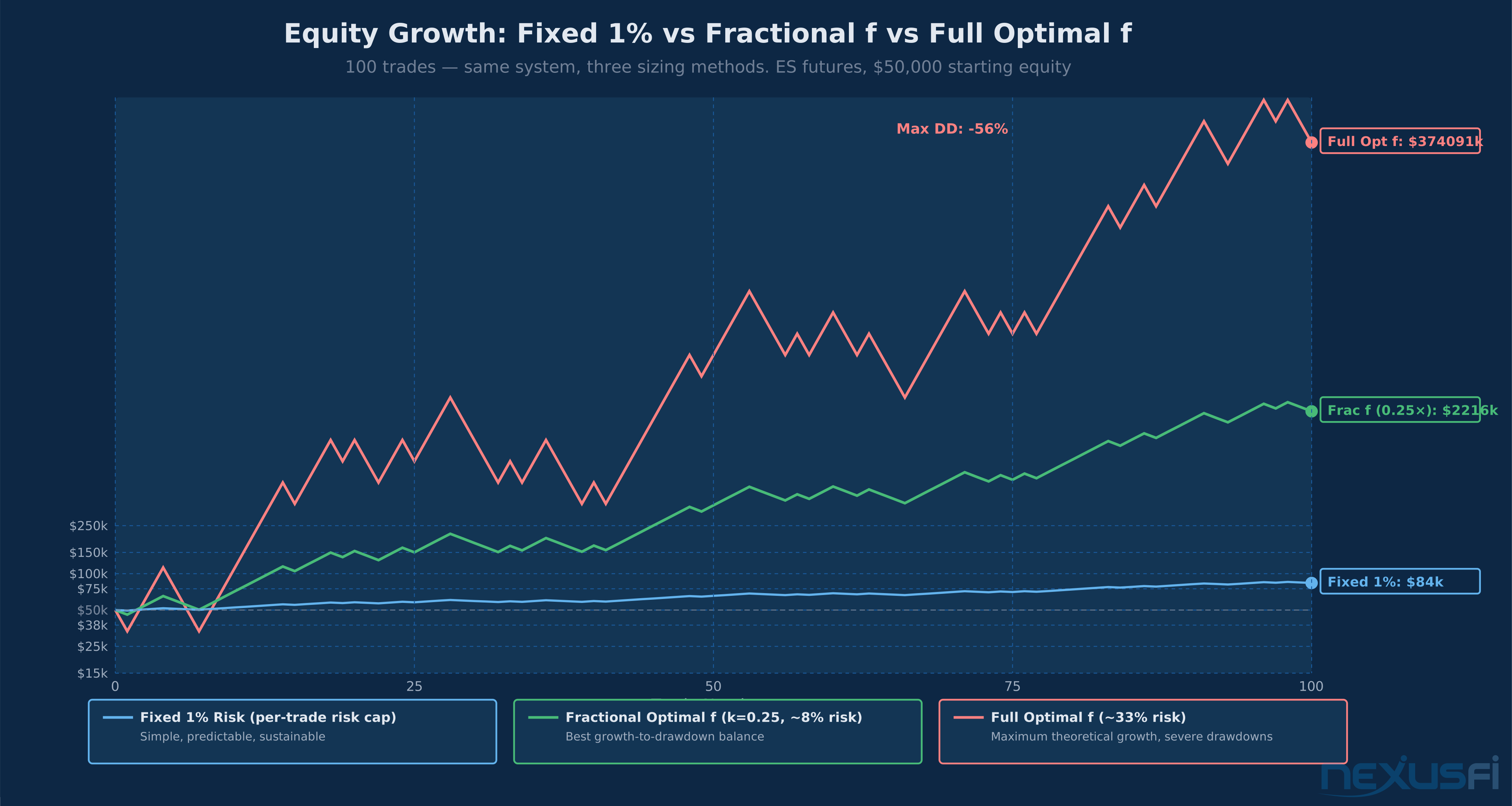
The equity growth comparison between three approaches tells the real story. Running a 60% win rate, 1.5R system for 100 trades on a $50,000 ES account:
- Fixed 1% risk: Ends near $85,000. Smooth, predictable, low volatility of equity curve
- Fractional optimal f (k=0.25, ~8% risk): Ends near $140,000. Higher volatility but manageable drawdowns
- Full optimal f (~33% risk): Theoretically ends highest but with a 60%+ drawdown in the middle that would have triggered forced liquidation or psychological capitulation
The practical winner isn't the theoretical winner. A trader who blows out at trade 60 ends with nothing, regardless of what the 100-trade equity curve shows.
How to Calculate Your Optimal f #
@Nicolas11 worked through the calculation framework in detail: "Let's suppose we have a capital C = $1000 and a profitable trading system described by two parameters: p = %win..."[5] The calculation requires a statistically meaningful trade history — at minimum 30-50 trades, ideally 100+ across different market conditions.
Step 1: Build an Execution-Realistic Database #
Before calculating anything, you need trade data that reflects what you actually would have captured, not what a clean backtest shows. This means:
- At least 50 completed trades (100+ preferred)
- Entry and exit prices at realistic fill levels (not mid-point)
- Slippage included for each side
- Commissions deducted
- Based on a consistent methodology (don't mix discretionary and systematic trades)
If you're running NinjaScript strategies in NinjaTrader, you can export trade history with slippage modeling. If you're discretionary, your trade journal is the only source — and it must be honest.
Step 2: Normalize to P&L Units #
Convert all trades to a consistent unit: dollars of risk per trade. For futures this means expressing each trade P&L relative to the dollar risk you took (your stop distance in dollars).
Example: You trade 2 ES contracts with a 4-point stop ($400 risk). The trade wins 6 points ($600 profit). In risk units: +1.5. You then trade 1 NQ contract with an 8-point stop ($160 risk) and lose. In risk units: -1.0.
By normalizing to risk units, you create a distribution that's independent of position size, allowing you to calculate f* accurately.
Step 3: Apply the Formula or Run the Optimization #
For a simple system approximating binary outcomes:
For a simple binary approximation, the formula is: f* = (p × (R + 1) - 1) / R (see The Analytical Formula section above).
Where p is your win rate and R is your average win / average loss (in risk units).
For a realistic distribution with varying outcomes, the empirical approach tests f values from 0.01 to 0.99 in increments of 0.01 and computes TWR for each. The f that produces the highest TWR is your optimal f. This is straightforward in a spreadsheet or Python:
def find_optimal_f(trades):
    """
    trades: list of P&L in risk units (positive = win, negative = loss)
    Returns: optimal f fraction
    """
    best_f = 0.01
    best_twr = 0
    for f_test in [i/100 for i in range(1, 100)]:
        twr = 1.0
        for trade in trades:
            hpr = 1 + f_test * trade
            if hpr <= 0:
                twr = 0; break
            twr *= hpr
        if twr > best_twr:
            best_twr = twr
            best_f = f_test
return best_fThe Python function above is the core calculation. Note the if hpr <= 0: break — if f is so large that a single trade would eliminate all capital, the entire sequence produces zero TWR. This is the mathematical structure that makes the curve plummet to zero above f*.
Step 4: Apply Fractional Scaling #
@Geomean arrived at the same conclusion after computing optimal f from a 35+ year trading history: "Even @ optimum f, I still didn't like the drawdowns... I now use Optimum f % x total equity bet size/largest loss % = bet size/1% of equity."[8]
Multiply your f* by k = 0.10 to 0.25. This is your working position sizing fraction.
f_working = k × f*
Step 5: Convert to Contract Count #
For futures, where you can only trade whole contracts:
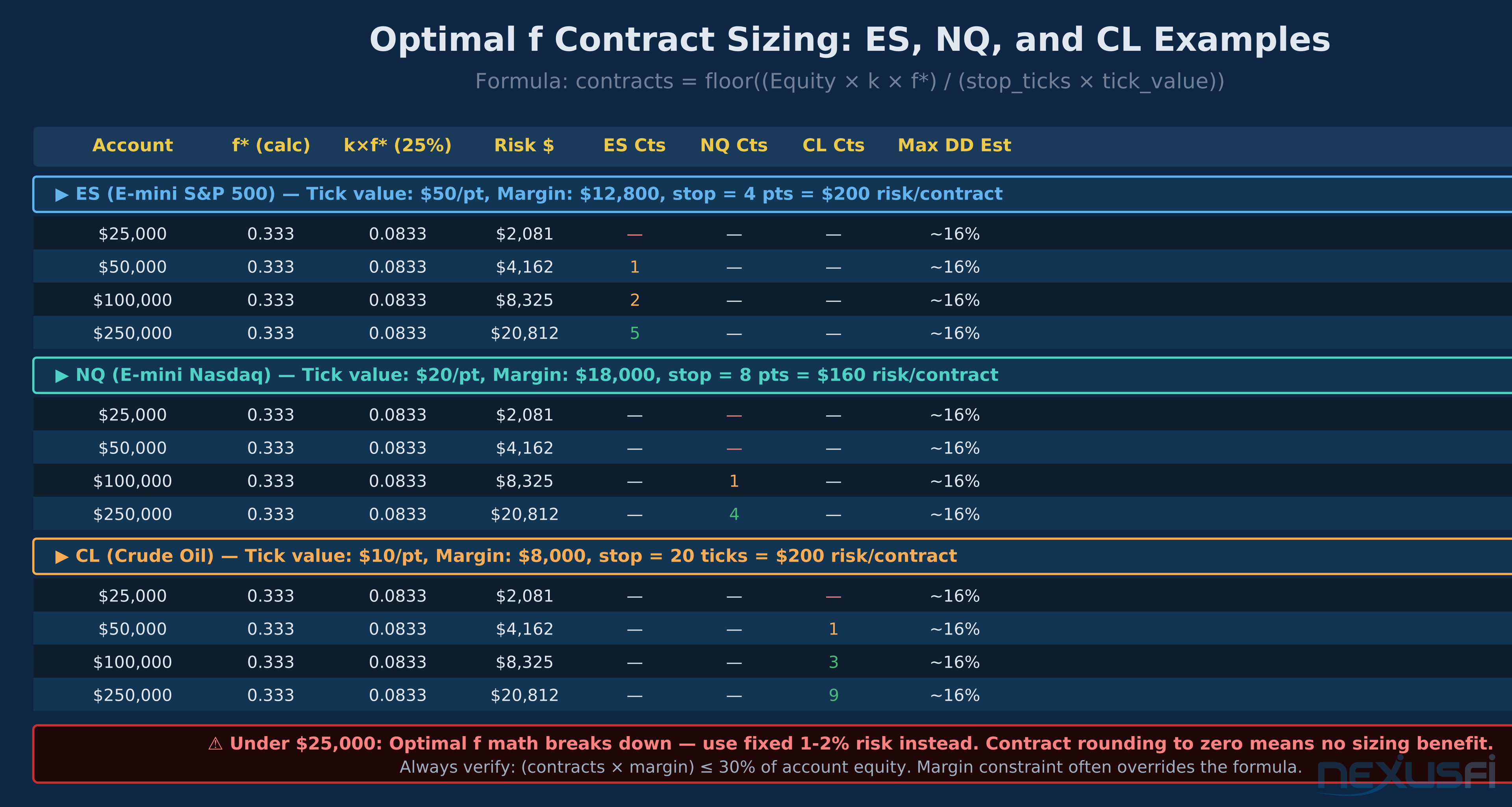
contracts = floor((Equity × f_working) / (stop_distance_ticks × tick_value))
Always round down. Always verify that:
- (contracts × margin requirement) ≤ 30% of account equity
- (contracts × dollar risk per contract) ≤ hard risk cap (1.5-2% of equity)
The margin constraint frequently overrides the formula, especially on accounts under $50,000.
Step 6: Recalibrate Quarterly #
Your optimal f changes as your strategy evolves. Recalculate using a rolling window of your most recent 50-100 trades quarterly, or after any significant change in your approach. If your measured edge weakens (win rate drops, average win/loss ratio deteriorates), reduce k before adjusting strategy.
Minimum Account Requirements #
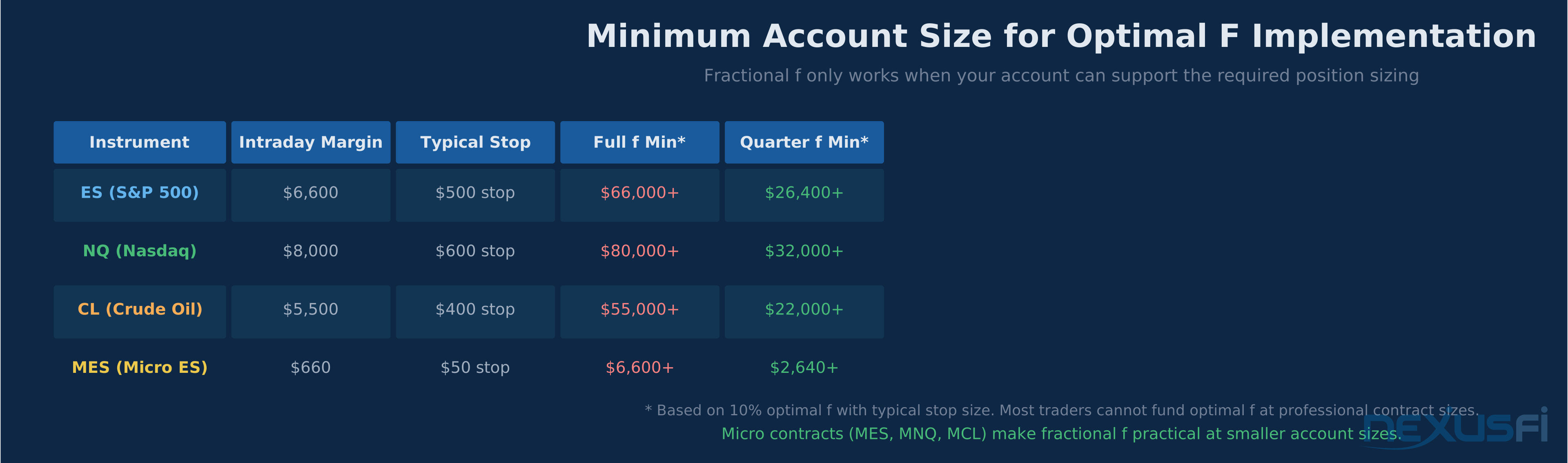
The dirty secret of optimal f is that it requires scale to be meaningful. The math breaks down on small accounts because:
Rounding to whole contracts eliminates fractional sizing. If optimal f says risk 8% of a $15,000 account per trade ($1,200), but the minimum ES risk per contract is $200 (4-point stop), you'd trade 6 contracts — which is 40% of your account in margin. The formula produces a dangerous answer not because the math is wrong, but because the account is too small for the contract size.
| Instrument | Minimum Account | Notes |
|---|---|---|
| ES (E-mini S&P 500) | $25,000+ | Below this, use MES (micro) or fixed 1-2% risk |
| NQ (E-mini Nasdaq) | $30,000+ | Higher tick value makes undercapitalization severe |
| CL (Crude Oil) | $20,000+ | Higher volatility; intraday sizing especially sensitive |
| MES (Micro E-mini S&P) | $5,000+ | Allows meaningful fractional sizing at smaller accounts |
| MNQ (Micro E-mini Nasdaq) | $7,000+ | Viable entry point for fractional f experimentation |
[9]
Traders under the minimum account threshold should use fixed fractional sizing (risk 1-2% per trade, absolute) and build the account before attempting optimal f calculation. The framework isn't useful below these thresholds — you simply don't have enough room between contract size and account size to implement it meaningfully.
Practical Overlays: Hard Caps and Circuit Breakers #
Optimal f should never operate without a set of hard constraints that override the formula when conditions deteriorate. These are not optional refinements — they're the difference between a growth tool and an account destroyer.
Hard Risk Caps (Non-Negotiable) #
Regardless of what optimal f produces:
- Per-trade risk cap: Never exceed 1.5% of account equity on a single trade
- Per-day risk cap: If you've lost 3-4% of account equity in a day, stop trading
- Margin utilization cap: Keep total open margin below 30% of account equity
- Correlation cap: If running correlated positions (e.g., long ES and long NQ), treat them as a single position for sizing purposes
These caps protect against the failure mode where your optimal f calculation is wrong. Which it probably is to some degree.
Drawdown Circuit Breakers #
When the drawdown circuit breaker triggers, act immediately:
15% drawdown from peak: Reduce all position sizes by 50%. Do not wait for mathematical recovery before reducing size. Investigate whether the edge change is structural.
25% drawdown from peak: Stop trading the current strategy. Either wait 30 days and reassess, or switch to paper trading to re-validate the edge before risking real capital.
The circuit breaker isn't admitting defeat — it's preventing a 15% drawdown from becoming a 40% drawdown. The most important position sizing decision is often the size reduction, not the initial sizing.
The psychological pressure to "trade through" a drawdown and recover losses is one of the most dangerous states in futures trading. Optimal f does not have a mechanism to distinguish between a normal drawdown within expected parameters and a strategy that has lost its edge. The human trader must supply this judgment.
Volatility-Regime Scaling #
As market volatility expands (VIX spikes, ATR increases), the dollar risk per point increases even when your nominal stop distance stays the same. Practical response: when the 20-day ATR of your primary instrument is more than 50% above its 6-month average, reduce k by 30-50%.
This isn't a signal that your edge has disappeared — it's recognition that the market is in a different regime and your historical distribution may not apply in the short term. Reduce size, preserve capital, let the regime clarify.
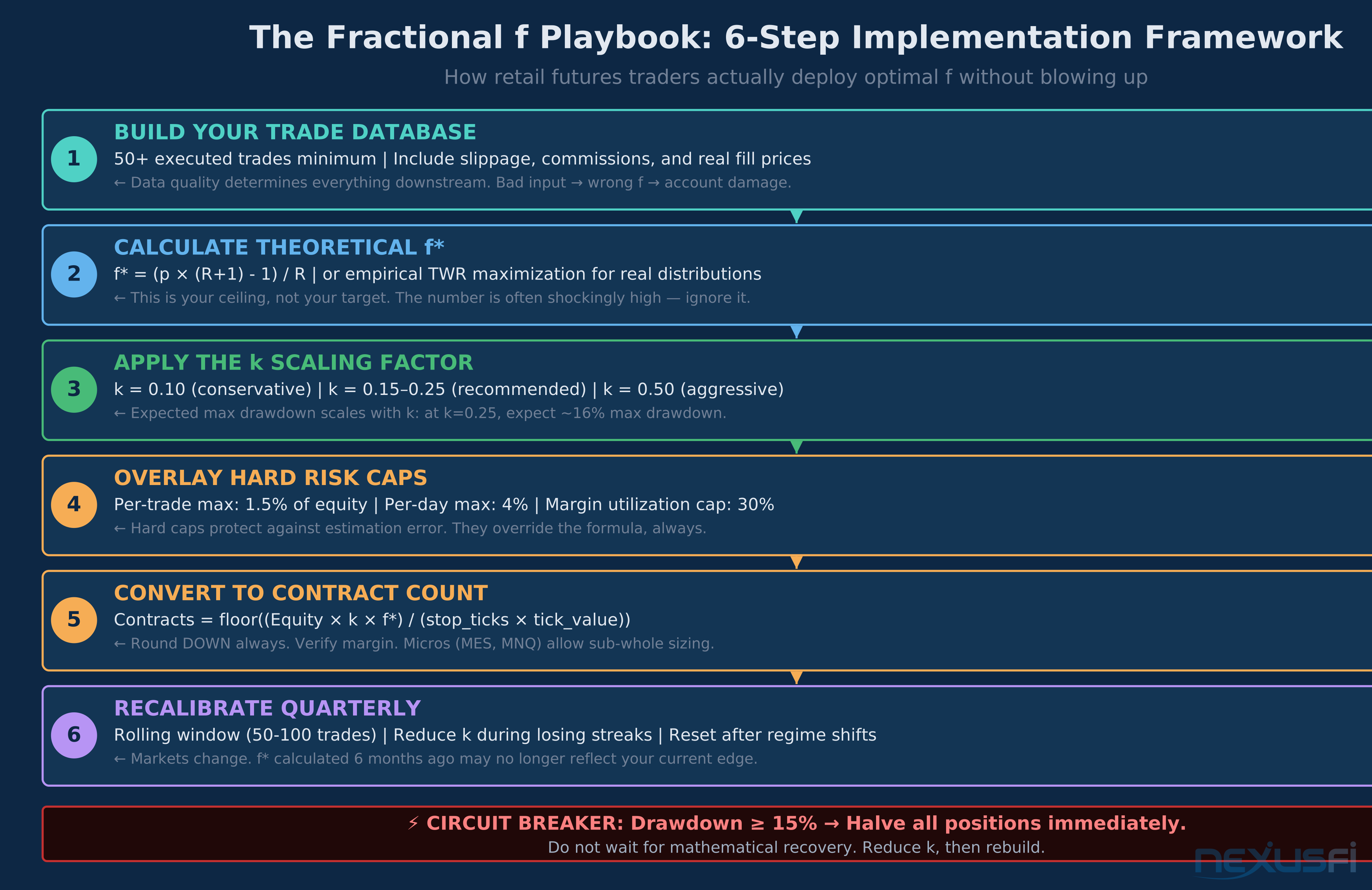
When Optimal f Is Worth Calculating (And When It Isn't) #
Worth calculating when:
- You have 50+ executed trades from a consistent methodology
- You're trading a systematic strategy with measurable edge
- You want to understand the theoretical growth potential of your current system
- You're deciding between two strategies and want to compare their geometric growth efficiency
Not worth calculating when:
- You're discretionary and your trade sizing has varied much
- You've changed your approach in the last 3-6 months
- You have fewer than 50 comparable trades
- Your account is under $20,000
A better alternative for most retail traders: Combine fixed fractional sizing (1-2% risk per trade) with volatility-based scaling:
contracts = floor((Equity × 0.015) / (current_ATR × tick_value × 2))
This approaches the intuition behind optimal f — size based on realized market conditions — without requiring a reliable historical distribution. For traders who haven't yet built a systematic track record, this is more strong than a poorly-estimated optimal f.
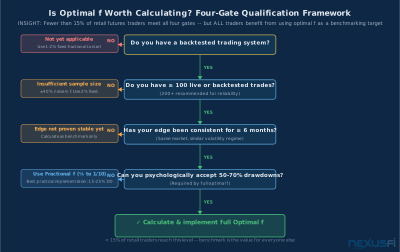
Optimal f as a Benchmarking Tool #
Perhaps the most valuable application of optimal f for retail futures traders isn't as a position sizing directive — it's as a strategy evaluation metric.
Two strategies with different win rates and payoff ratios can be compared by their optimal f values:
- Higher optimal f indicates greater theoretical growth potential at equivalent risk tolerance
- A strategy with higher optimal f but similar historical characteristics (drawdown, trade frequency) is mathematically superior for compounding
This comparison works even when you don't intend to trade at the calculated fraction. It gives you a growth-adjusted way to rank strategies that pure Sharpe ratio or profit factor comparisons miss.
Optimal f tells you how good your edge actually is in geometric terms. A win rate of 55% with 2:1 payoff has a higher optimal f than a 65% win rate with 0.8:1 payoff. The number doesn't tell you what to trade — it tells you which edge compounds faster.
For deeper context on related strategy metrics, see the Academy articles on Kelly Criterion, System Quality Number (SQN), and Volatility-Based Position Sizing.
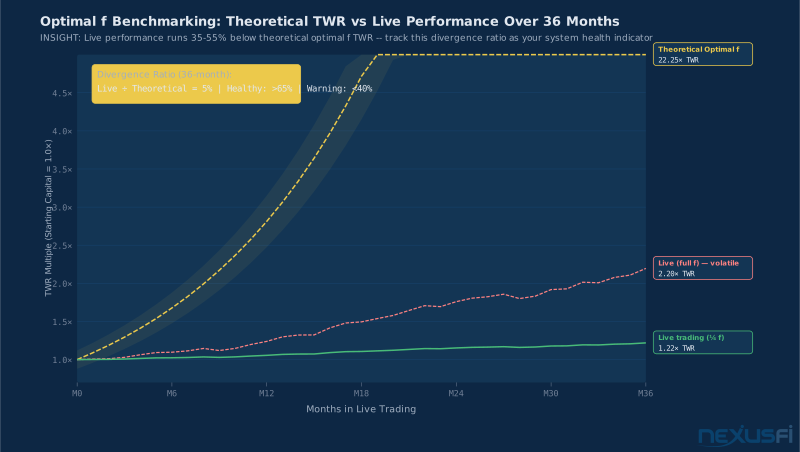
Integration with Broader Position Sizing Framework #
Optimal f doesn't operate in isolation. It's one layer in a complete position sizing framework:
Layer 1: Account-level risk budgeting Determine maximum acceptable drawdown (20-25% for most futures traders). Set k so that expected max drawdown stays well inside that threshold. This is where optimal f calculations live.
Layer 2: Per-trade risk caps Absolute dollar limits per trade (1.5% of equity) and per day (3-4% of equity). These override Layer 1 when the formula suggests excess risk.
Layer 3: Volatility adjustment Scale position size inversely with current ATR relative to 6-month average. See Volatility-Based Position Sizing for implementation details.
Layer 4: Correlation management Reduce aggregate exposure when holding correlated positions. See Correlation and Portfolio Risk for the mechanics.
Layer 5: Drawdown circuit breakers The emergency override that activates at 15% and 25% drawdown thresholds. Reduces size before losses compound further.
Position Sizing Methods for Futures Trading covers the broader environment of approaches and helps contextualize where optimal f fits relative to fixed fractional, percent volatility, and fixed dollar sizing methods.
What Actually Breaks Optimal f in Practice #
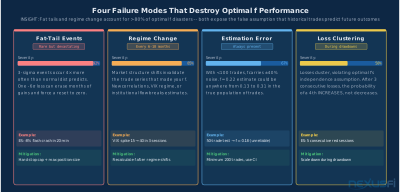
[6] Traders who calculate optimal f and then apply a fractional multiplier without accounting for their actual risk tolerance are not using the framework correctly — they're just using a different number without the psychological foundation.
Mistake 1: Using simulated backtest data Optimal f calculated from a backtest will overstate your f* because backtests systematically understate slippage, miss data errors, and benefit from look-ahead bias. Always use executed trades.
Mistake 2: Treating different market regimes as one distribution If you have 80 trades, 40 from a trending environment and 40 from choppy conditions, your distribution mixes two different statistical profiles. Either separate them or acknowledge the instability in your estimates.
Mistake 3: Recalculating too frequently Some traders recalculate optimal f after every 10-20 trades, updating k after each run. This over-fits to noise. Monthly recalculation with a 50+ trade rolling window is the minimum credible interval.
Mistake 4: Ignoring the margin constraint The formula produces a number of contracts. Before trading that number, verify that (contracts × margin per contract) is less than 30% of your account. This is frequently the binding constraint, not optimal f itself.
Mistake 5: Using optimal f to justify large positions after a run of losses The formula will suggest maintaining consistent sizing even during drawdowns. Your circuit breaker rules should override this. A losing streak is information about whether your edge has degraded — the formula can't tell you that.
The Vince Legacy: What the Framework Gets Right #
Despite the practical limitations, Ralph Vince's contribution to position sizing theory is significant. Before optimal f, most retail sizing advice was either arbitrary (trade 2 contracts because you feel comfortable with that) or rule-of-thumb (never risk more than 2% per trade). Optimal f introduced the idea that position sizing has a mathematically optimal solution given known edge parameters, and that this solution involves compounding through reinvestment.
The deeper insight: arithmetic returns are the wrong objective. A strategy that averages +5% per month arithmetically but has high variance can be outcompeted by a strategy that averages +3% with lower variance, depending on the reinvestment path. Optimal f makes this explicit.
For serious students of trading, The Mathematics of Money Management and its successor The New Money Management are worth reading not because you'll implement full optimal f, but because the framework clarifies what you're actually trying to improve. Most traders are unknowingly trying to maximize arithmetic returns when geometric returns — the ones that actually compound — should be the objective.
The NexusFi Risk of Ruin thread[2] contains some of the best accessible treatment of this framework in a trading context
Fat Tails' 7% threshold analysis[3] provides complementary context on why the gap between mathematical and practical optimal sizing matters
Conclusion #
Optimal f answers the right question — what fraction of equity maximizes geometric growth? — but gives an answer that most traders cannot operationally sustain. The resolution is fractional scaling: use 10-25% of your calculated optimal f, maintain hard caps that override the formula, and treat the full optimal f number as a ceiling rather than a target.
The practical takeaway for futures traders:
- Build a real trade database (50+ executed trades, full slippage, consistent methodology)
- Calculate f* using empirical optimization or the analytical formula
- Deploy at k = 0.15 to 0.25 — not full optimal f
- Keep per-trade risk below 1.5% of equity as an absolute cap
- Use 15% and 25% drawdown as circuit breaker thresholds that immediately reduce size
- Recalibrate quarterly using a rolling window
The traders who find optimal f most useful aren't usually deploying it directly. They're using it to compare strategies, set benchmarks, and understand what their edge is theoretically worth in geometric growth terms. That's valuable even if you trade at 1% risk per trade for the rest of your career.
Ralph Vince got the math right. The market reality is that the math's assumptions — stable parameters, infinite trading horizon, infinite psychological tolerance — don't hold in practice. Fractional f is the bridge between the elegant theory and the survivable trade.
Knowledge Map
Go Deeper
Build on this knowledgeReferences This Article
Articles that build on this topicCitations
- — Risk of Ruin (2012) 👍 30“The Kelly formula therefore suggests to bet 9.3% of my account with every single bet”
- — Risk of Ruin (2012) 👍 39“Optimal F assumes that you follow a fixed fractional betting strategy to achieve optimal geometric growth”
- — Why 7% is the Difference between Failure and Success in Trading (2012) 👍 32“I will definitely stop trading after a drawdown of 50% (ruin)”
- — Risk of Ruin (2012) 👍 10“Replace risk aversion with Tolerated risk -- Replace Full/Half/Quarter Kelly with Actual risk”
- — Optimal position sizing strategy (2014) 👍 6“Lets suppose we have a capital C = $1000 and a profitable trading system”
- — Risk of Ruin (2012) 👍 24“The best system is that one which allows us to trade size for the same risk appetite”
- — Kevin's TST Combine Journal (2013) 👍 10“Ralph Vince (creator of optimal f) said that most (90%?) of system performance is due to position sizing”
- — How advanced mathematics and gaming theory can help you as a trader (2011) 👍 3“I spent weeks studying Vince 8 years ago and setting up excel files of a 35+ year trading history to calculate optimum f”
- — Why 7% is the Difference between Failure and Success in Trading (2012) 👍 5“the risk adjusted Optimal F is slightly higher for the 40/40 system (4.22% versus 3.14%)”
- — Risk of Ruin (2012) 👍 17“Be aware that not all risk is accounted for. There is more risk involved than can be calculated via a model.”