



The Kelly Criterion: Growth-Optimal Position Sizing for Futures Traders
Overview #
Overview #
Every futures trader eventually faces the same question: "I have an edge
Developed by John L. Kelly Jr. at Bell Labs in 1956 for information theory (not trading), the Kelly formula calculates the growth-optimal fraction of capital to risk on each bet. It maximizes the long-run geometric growth rate of your account. That's the good news. The bad news? Full Kelly sizing produces drawdowns so severe that virtually no human can stomach them. The real value of Kelly isn't the exact number it spits out
For futures traders specifically, Kelly matters because leverage amplifies everything. A 2% Kelly fraction on a $100,000 ES account doesn't behave like 2% on an unleveraged stock portfolio. The notional exposure, margin mechanics, and mark-to-market volatility create an environment where oversizing kills accounts faster than in any other market. Kelly provides the ceiling. Smart traders stay well below it.
This article covers the formula, how to estimate its inputs from real trade data, why fractional Kelly is the only practical implementation, and where the entire framework breaks down. For prerequisite concepts, see Position Sizing Methods, Expectancy, and R-Multiples.
The Kelly Formula #
The classic Kelly formula for a binary outcome (you either win a fixed amount or lose a fixed amount) is:
f* = (bp - q) / b
Where:
- f* = the optimal fraction of capital to risk
- b = the profit-to-loss ratio (average winner / average loser)
- p = the probability of winning (win rate)
- q = the probability of losing (1 - p)
This can also be written as: f = p - q/b or equivalently f = ((b+1) × p - 1) / b
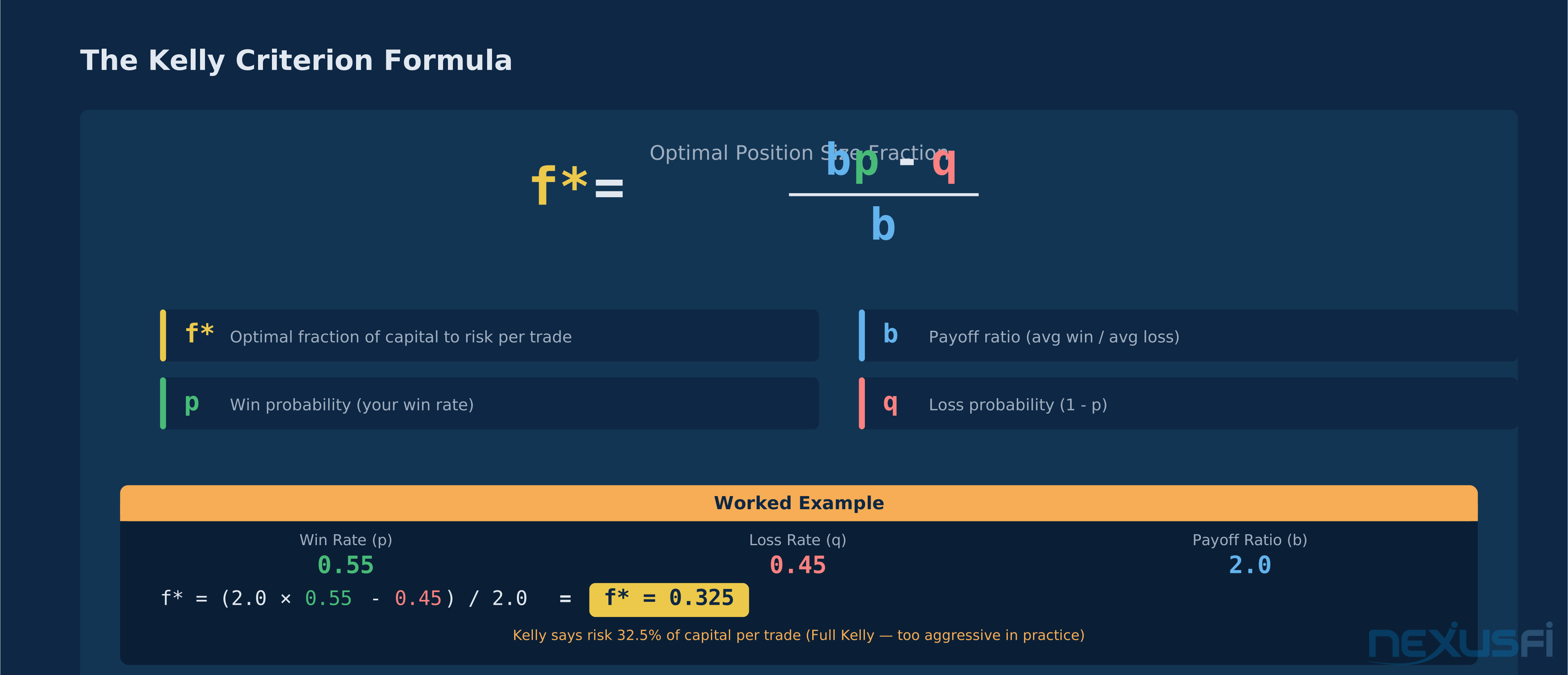
Run a concrete example. You trade ES with a system that wins 55% of the time. Your average winner is $500 and your average loser is $250, giving you a profit-to-loss ratio (b) of 2.0. Kelly says:
f* = (2.0 × 0.55 - 0.45) / 2.0 = (1.10 - 0.45) / 2.0 = 0.65 / 2.0 = 0.325
Kelly recommends risking 32.5% of your account on each trade. Stop and think about that for a moment. On a $100,000 account, you'd be risking $32,500 per trade. Three consecutive losers
What Kelly Actually Optimizes
Kelly maximizes the geometric growth rate of your account
Here's the math that makes this concrete. If you gain 50% then lose 50%, you don't break even
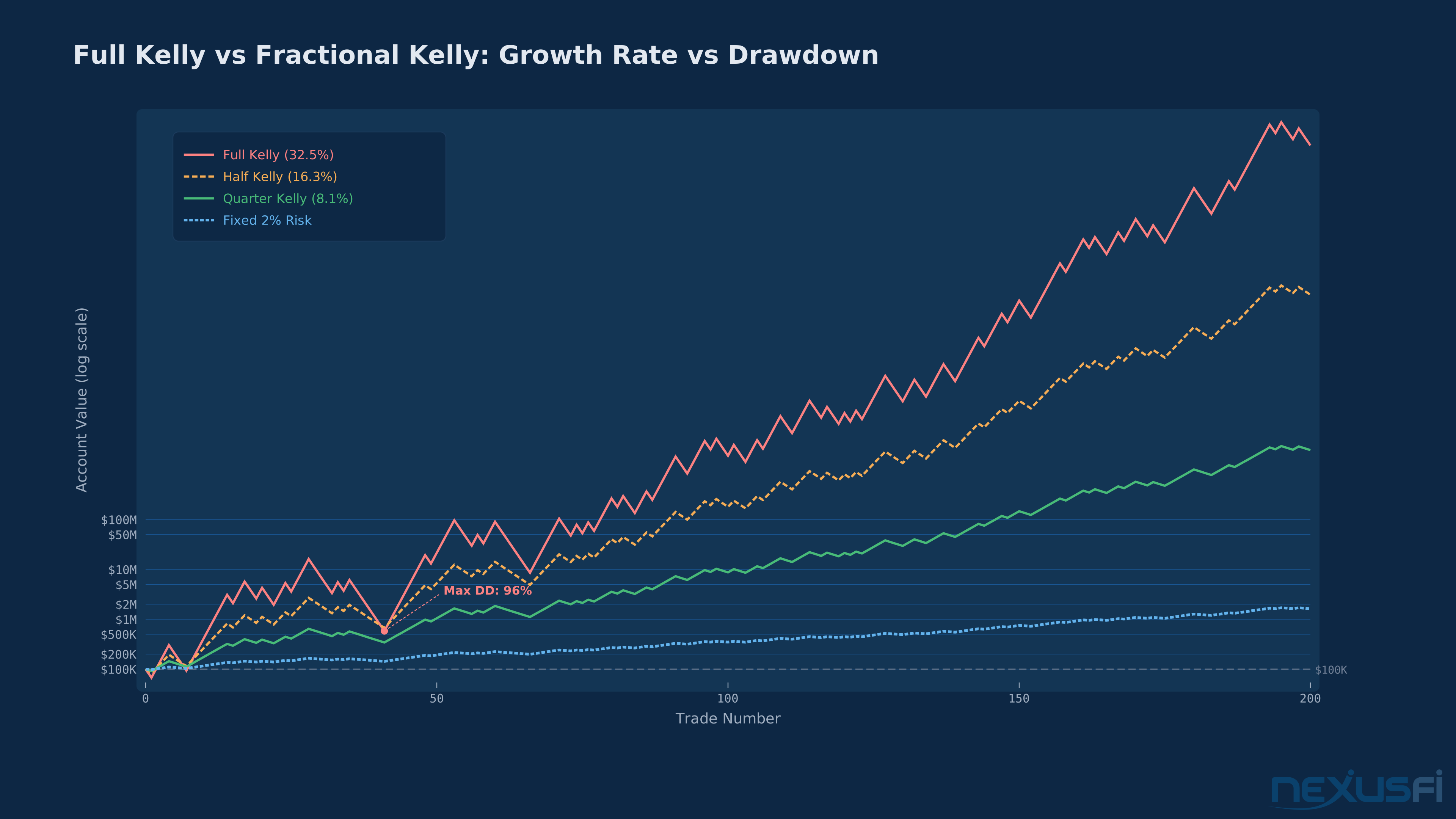
Full Kelly vs Fractional Kelly #
No professional futures trader uses full Kelly. The theoretical growth rate is maximized, but the ride is brutal. As @Fat Tails demonstrated in detailed analysis on NexusFi, the risk of ruin at full Kelly is catastrophic. [1]
Using a concrete example with a $100,000 account targeting $400,000 (ruin defined as dropping to $25,000):
- Full Kelly (k=1.0): Risk of ruin = ~20-43%. You have roughly a 1-in-3 chance of blowing up before reaching your target. Maximum theoretical growth rate, but the drawdowns are devastating.
- Half Kelly (k=0.5): Risk of ruin drops to ~1.5-12%. You sacrifice approximately 25% of the growth rate but reduce volatility by roughly 75%. This is the sweet spot most quantitative traders reference. [2]
- Quarter Kelly (k=0.25): Risk of ruin falls below 1%. The growth rate is slower but the equity curve is dramatically smoother. For most retail futures traders, this is the practical maximum.
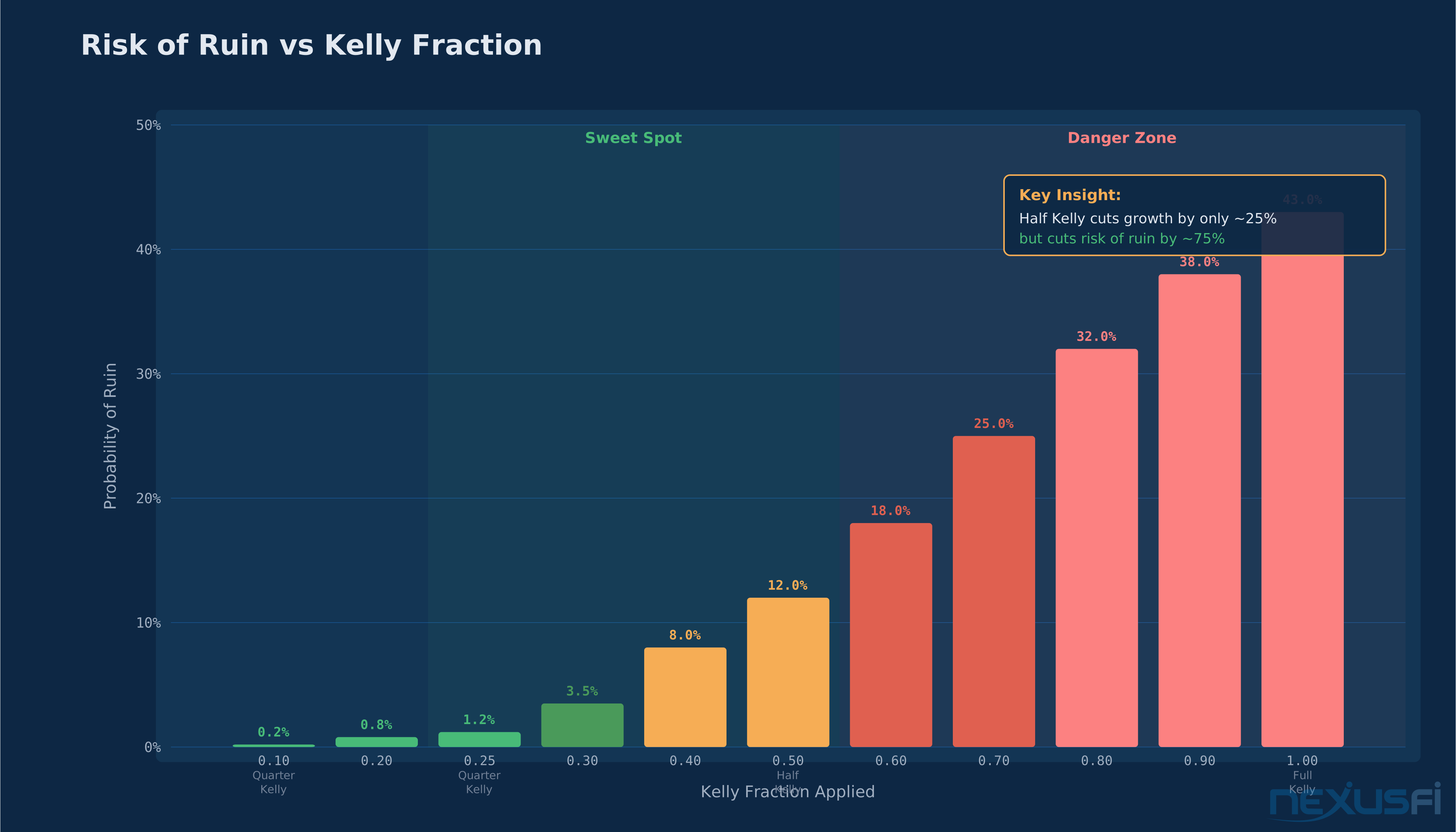
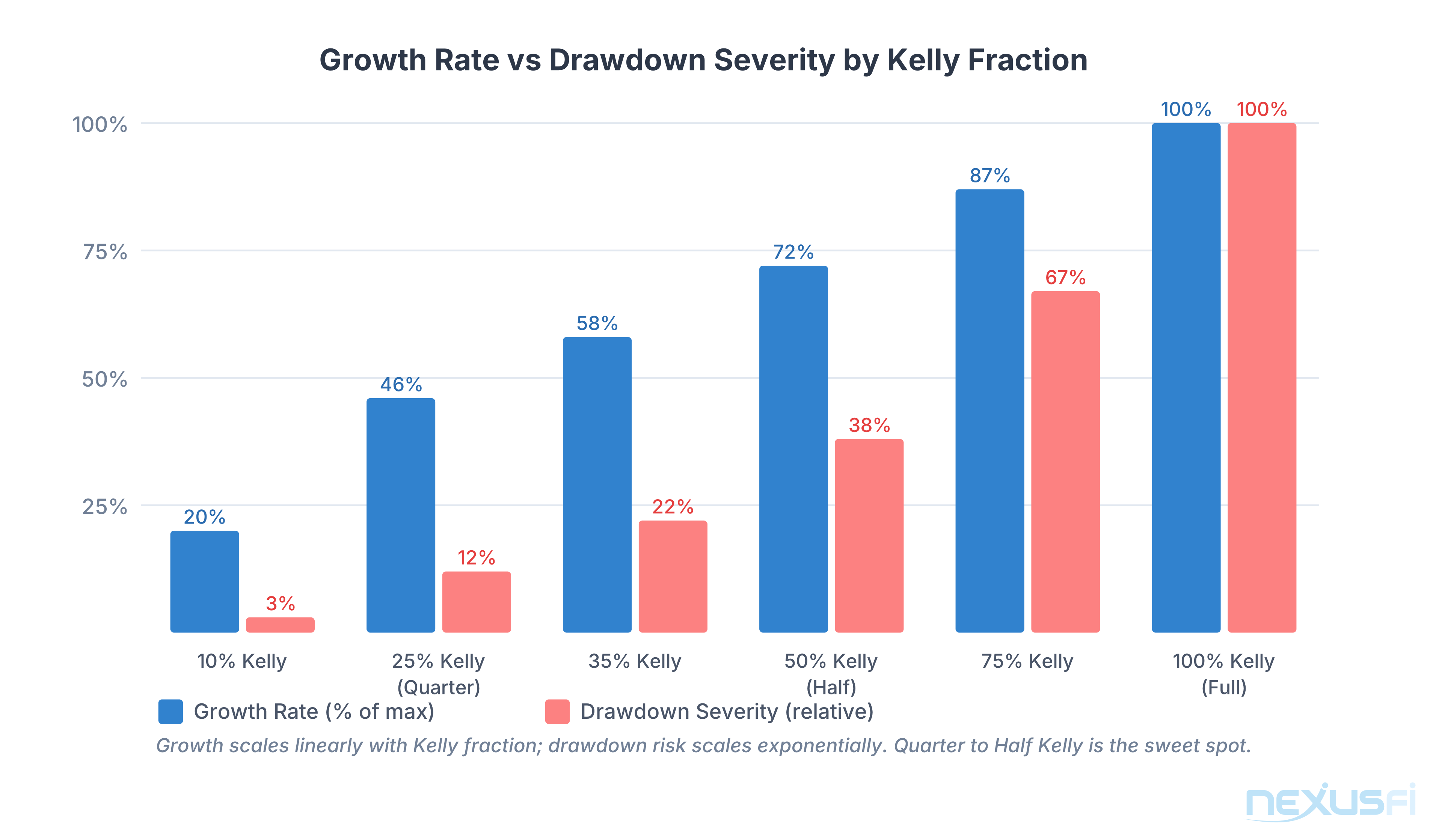
The math behind this tradeoff is elegant. Growth rate scales roughly linearly with the Kelly fraction, but drawdown risk scales exponentially. Going from quarter Kelly to half Kelly doubles your growth rate but increases your ruin probability by roughly 10x. Going from half Kelly to full Kelly doubles growth again but increases ruin probability by another 10-20x. The risk-reward of fractional Kelly is overwhelmingly favorable.
Estimating Kelly Inputs from Real Trading Data #
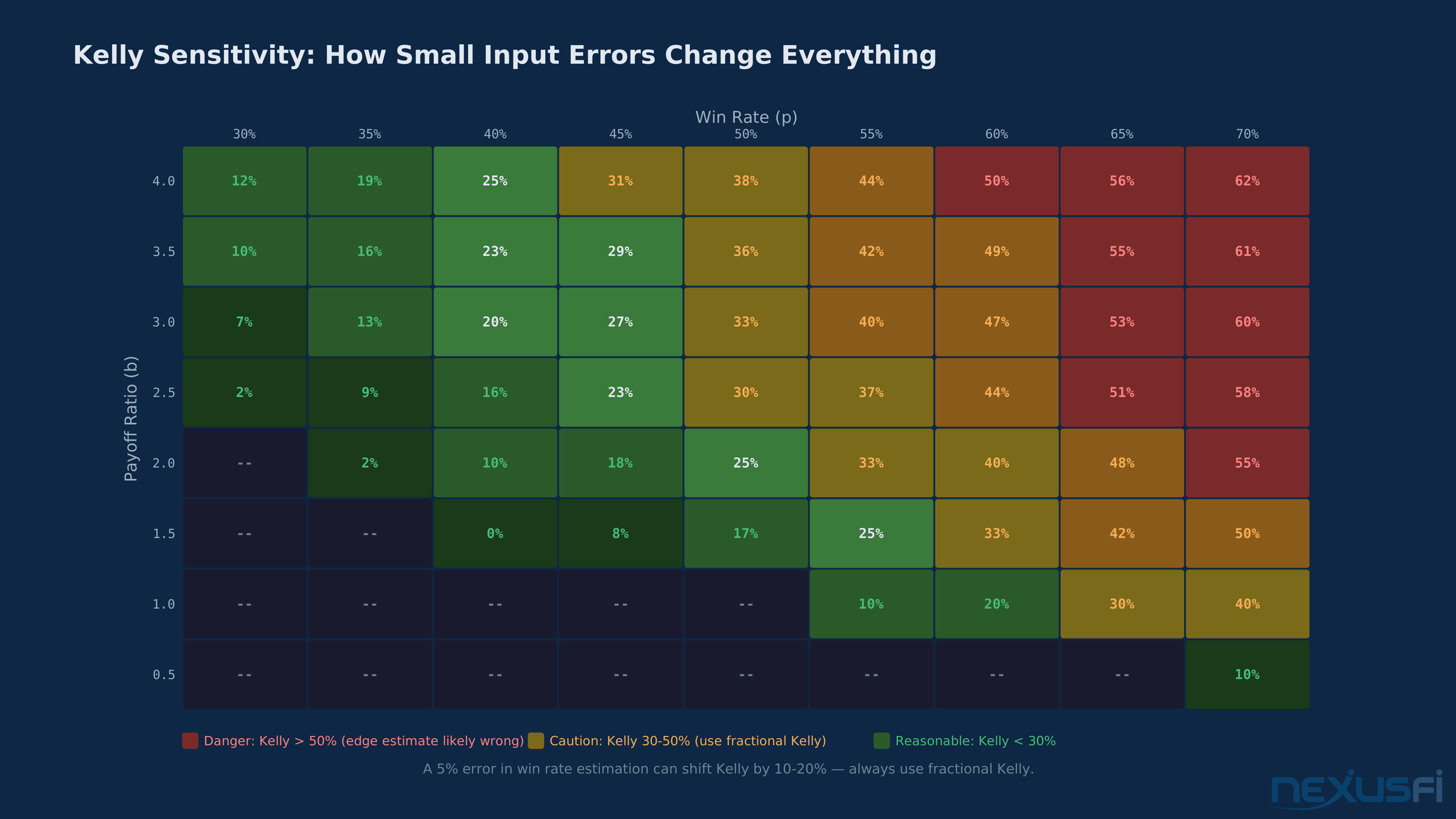
The Kelly formula is only as good as its inputs. Get the win rate or payoff ratio wrong by a few percentage points and the recommended position size can change by 50% or more. This estimation problem is the single biggest practical challenge with Kelly
Step 1: Gather Your Trade Data
You need a minimum of 100 completed trades to estimate Kelly inputs with any reliability. 200+ is better. Fewer than 100 and your win rate estimate has a confidence interval so wide that the Kelly output is basically noise.
From your trade log, extract:
- Win rate (p): Number of winning trades / total trades. Use actual results, not backtested results. If you've been trading live for 6 months with 150 trades and a 52% win rate, that's your p
- Average winner: Total profits from winning trades / number of winning trades. Include commissions and slippage.
- Average loser: Total losses from losing trades / number of losing trades. Include commissions and slippage.
- Payoff ratio (b): Average winner / average loser (in absolute terms).
Step 2: Adjust for Costs
This is where many traders get Kelly wrong. As @Fat Tails demonstrated in a YM position sizing example: when your system produces 20-point winners and 10-point losers, after accounting for $4 round-turn commission (0.8 YM points) and 1 point average slippage, the actual profit-to-loss ratio drops from 2.0 to 1.542. That's a 23% reduction in your payoff ratio from costs alone, which much changes the Kelly output. [4]
For futures specifically, include:
- Round-turn commissions (per contract)
- Exchange fees
- Average slippage (measure this
- Data feed costs (amortized per trade if significant)
- Roll costs for strategies that hold through expiration
Step 3: Calculate and Apply the Kelly Fraction
Once you have cost-adjusted p and b, run the formula. Then immediately multiply by your chosen Kelly fraction (0.25 to 0.50 for most traders).
Converting Kelly output to contract count: Contracts = (Account × f* × k) / (Dollar Risk Per Contract)
Where dollar risk per contract = stop distance in points × point value. On ES with a 10-point stop, that's 10 × $50 = $500 per contract risk.
Example: $100,000 account, full Kelly = 9.3%, using quarter Kelly (k=0.25), dollar risk per contract = $59 (YM example). Usable fraction = 9.3% × 0.25 = 2.33%. Position size = ($100,000 × 0.0233) / $59 = ~39 contracts. [4]
Step 4: Validate with Out-of-Sample Data
Run the Kelly calculation on different time periods of your trading history. If your Kelly fraction varies wildly between the first half and second half of your trade log, your edge isn't stable enough for Kelly to be meaningful. In that case, default to a fixed fractional approach (1-2% per trade) until you have more consistent data.
The Sensitivity Problem #
Kelly's biggest practical weakness is its extreme sensitivity to input accuracy. Small estimation errors produce large sizing errors
Consider two systems with identical expectancy but different win rate / payoff structures. As @Fat Tails showed: a system with a lower R-multiple but higher win rate can dramatically outperform a trend-following system with a high R-multiple and lower win rate
Specifically, in Fat Tails' example, a model with a 60% win rate and 1:1 payoff had an Optimal F of 12.09%, while a 40% win rate / 2:1 payoff model (same expectancy) had an Optimal F of only 5.76%. For equal drawdown risk, the first model trades twice as many contracts and reaches the $400,000 target in 218 trades versus 450 trades for the second model.
This illustrates a key insight: Kelly cares about the distribution of outcomes, not just the average. Two strategies with the same expectancy can have radically different optimal position sizes because their return distributions are different. Wider distributions (high-R-multiple trend following) require more conservative sizing than tighter distributions (high-win-rate scalping) for the same expected growth.
Practical Sensitivity Ranges
To demonstrate how sensitive Kelly is, take a baseline system: 55% win rate, 1.5:1 payoff ratio. Kelly recommends f* = 0.183 (18.3% of capital).
Now imagine your true win rate is actually 50% instead of 55%
- At p=0.55, b=1.5: f* = 0.183 (18.3%)
- At p=0.50, b=1.5: f* = 0.167 (16.7%)
- At p=0.45, b=1.5: f* = 0.083 (8.3%)
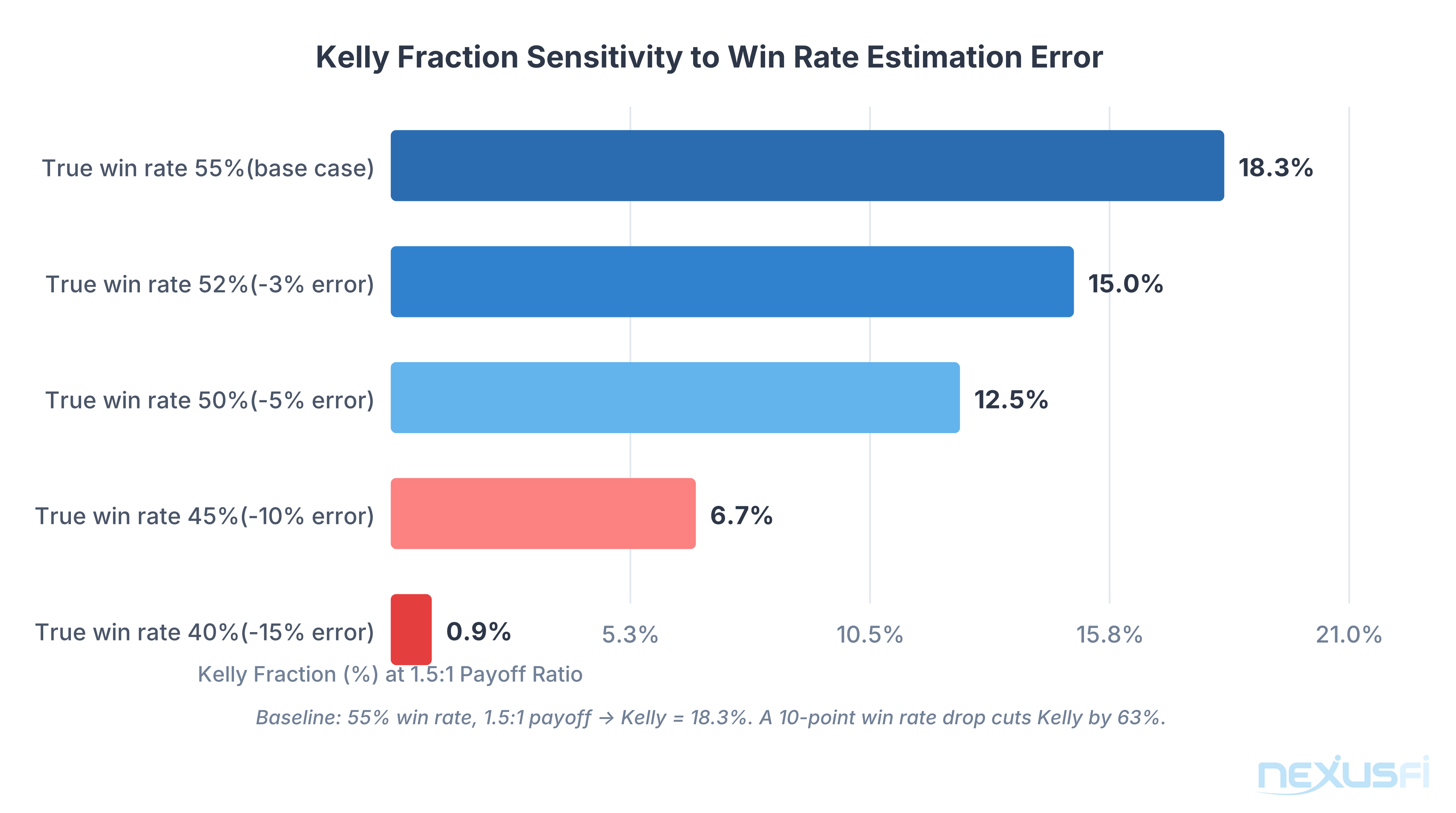
The Kelly fraction drops by more than half when your win rate drops 10 percentage points. And those 10 points could easily be the difference between your in-sample backtest and your out-of-sample live results. This is why conservative fractional Kelly (quarter or third Kelly) provides a buffer against estimation error
When Kelly Fails #
Kelly makes several assumptions that don't fully hold in futures trading. Understanding where the model breaks down is more valuable than knowing the formula itself.
1. Independent Outcomes
Kelly assumes each trade is independent
2. Known and Stable Edge
Kelly assumes you know your true win rate and payoff ratio. You don't. You have estimates from a finite sample of trades, and those estimates may not be stationary. Market regimes shift. A strategy that won 58% of trades in 2024 may win 47% in 2025 because volatility structure changed, participation changed, or you changed.
3. Continuous Capital and Infinite Divisibility
Kelly assumes you can bet any fraction of your capital with perfect precision. Futures contracts are discrete
4. Binary Outcomes
The basic Kelly formula assumes you either win b units or lose 1 unit. Real trading has a distribution of outcomes
5. No Leverage Constraints
Kelly doesn't know about margin requirements, position limits, or the mechanics of mark-to-market. It may recommend a position size that's operationally impossible given your broker's margin requirements, or that would trigger intraday margin calls during normal market volatility even if the trade ultimately wins.
6. Psychological Reality
Even half Kelly produces drawdowns that most traders can't tolerate. A 30-40% drawdown is psychologically devastating
7. Model Risk -- The Risk Kelly Can't Measure
This is the most underappreciated failure mode. @Fat Tails was clear on this distinction: the Kelly risk-of-ruin calculation measures the probability of losing money even when all your assumptions are correct. But there's an entirely separate risk class that Kelly doesn't touch: [9]
- False edge evaluation -- your backtested win rate doesn't reflect live trading reality (curve fitting, selection bias, look-ahead errors)
- Edge evaporation -- markets change, participants change, your strategy's edge diminishes over time
- Operational risk -- power failure, data feed interruption, exchange outage, broker issues produce outcomes outside the Bernoulli distribution Kelly assumes
- Tail events -- gap openings, flash crashes, extreme moves -- produce outcomes no Kelly fraction prepares you for
[12] Quarter Kelly doesn't just protect your growth rate — it protects against being wrong about your edge.
Kelly vs Other Position Sizing Methods #
Kelly doesn't exist in isolation. Here's how it compares to the other sizing frameworks covered in Position Sizing Methods.
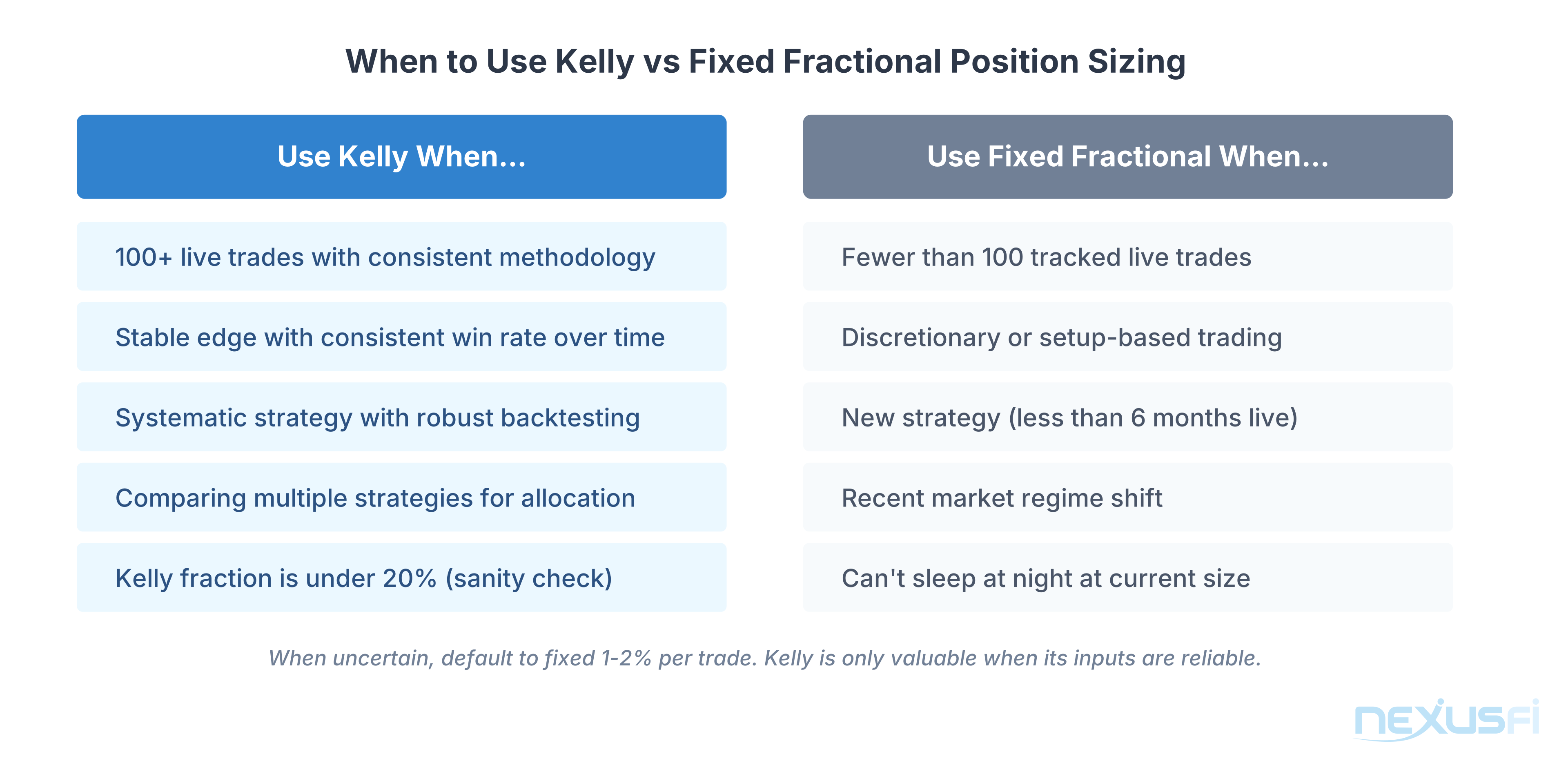
alt="Decision guide showing when to use Kelly vs fixed fractional position sizing" loading="lazy" width="800" height="360">
Fixed Fractional (Percent Risk)
The most common approach: risk a fixed percentage of capital (typically 1-2%) on every trade. This is actually a simplified version of Kelly
When to use fixed fractional over Kelly: When you have fewer than 100 tracked trades, when your edge is uncertain or regime-dependent, when you're trading discretionary setups that don't produce consistent statistics, or when psychological stability matters more than growth optimization.
Volatility-Based Sizing
Common in systematic trend-following: size positions based on current market volatility (often using ATR). The logic is that position size should adapt to how much the market moves, not just to a fixed dollar risk. This approach doesn't consider your edge at all
Kelly + vol-sizing hybrid: Use fractional Kelly to determine the maximum fraction of capital to allocate, then use ATR-based sizing within that allocation to adapt to current volatility. This captures both edge-based sizing and volatility adaptation.
R-Multiple Sizing
As described in R-Multiples, this framework normalizes all trades to units of risk (1R = the amount risked on entry). Kelly maps naturally to R-multiples: your payoff ratio (b) is simply your average R-multiple for winners, and your risk per trade is the R amount scaled by the Kelly fraction. Using R-multiples makes Kelly inputs easier to estimate and compare across different instruments.
Where Kelly Adds Unique Value
Kelly's differentiated contribution is that it explicitly ties position size to edge magnitude. Fixed fractional says "risk 1% regardless of edge." Kelly says "risk more when your edge is larger, less when it's smaller." For traders running multiple strategies with different edges, Kelly provides a rational framework for allocating capital across strategies
Same Expectancy, Different Kelly Fraction #
Here's where most traders get Kelly completely wrong: two systems with identical expectancy require radically different position sizes. This isn't a quirk — it's fundamental to how Kelly works, and ignoring it leads to either leaving serious money on the table or gambling your account away.
@Fat Tails ran a definitive analysis comparing three trading systems, all with identical net expectancy of $21 per trade after commissions and slippage. The results are striking: [8]
| System | Win Rate | Payoff | Net Expectancy | Optimal f | Starting Contracts* | Trades to 4x Target |
|---|---|---|---|---|---|---|
| Trend Follower (30pt win, 10pt loss) | 40% | 3:1 | $21 | 3.72% | 32 | 104 |
| Scalper (12pt win, 12pt loss) | 75% | 1:1 | $21 | 10.29% | 75 | 45 |
| Retracement (20pt win, 20pt loss) | 65% | 1:1 | $21 | 5.77% | 26 | 128 |
| *Starting contracts at quarter-Kelly, $50,000 account, targeting $200,000. All systems maintain identical risk of ruin (~0.78%). | ||||||
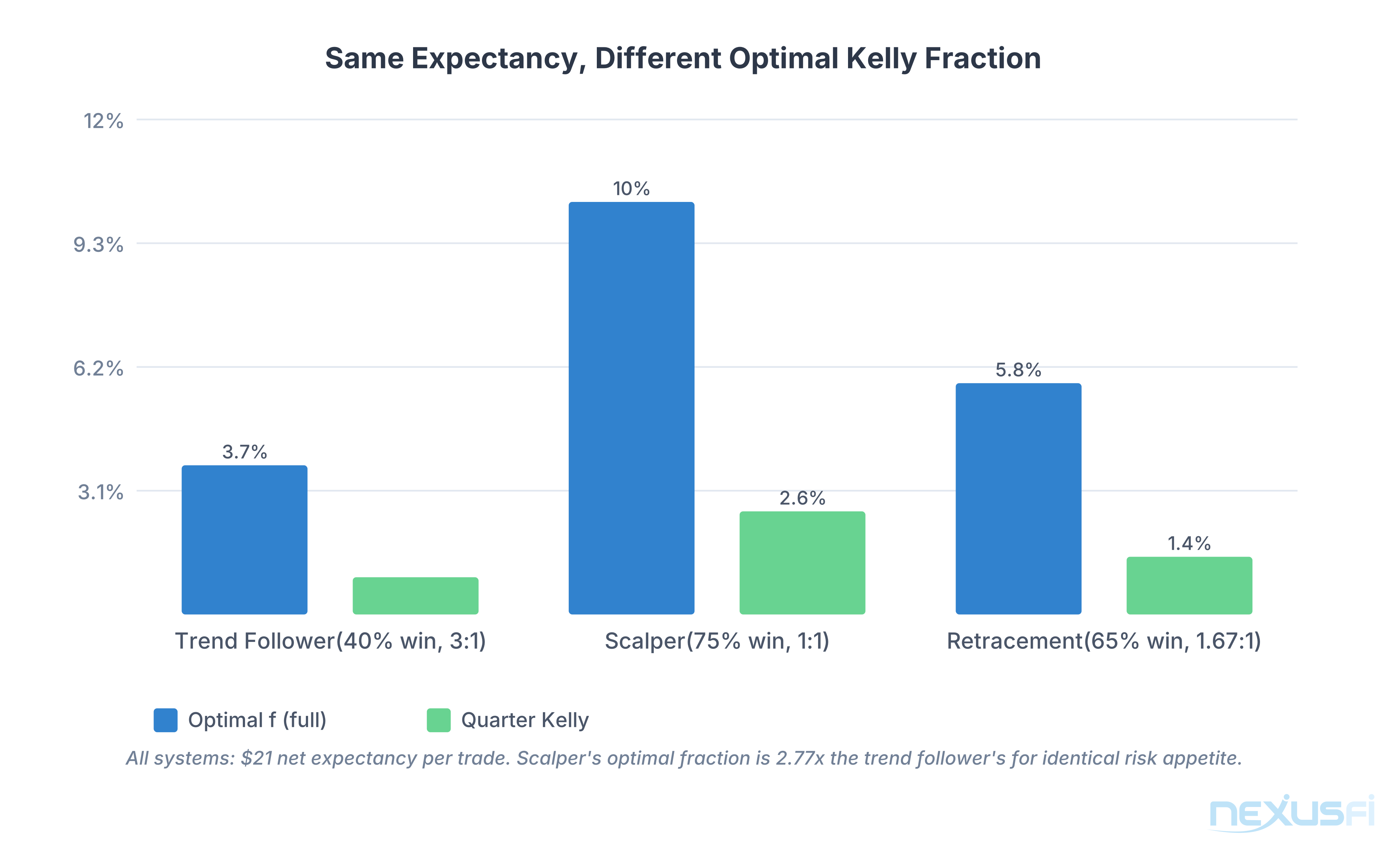
The scalper's optimal fraction is nearly 3x the trend follower's — for the same expected edge and the same risk of ruin. The scalper reaches target in 45 trades. The trend follower needs 104 — the difference between a year and three years of grinding.
Why? Variance, not expectancy, drives the Kelly fraction. The trend follower's wide return distribution (big wins, but lots of small losses) forces conservative sizing. The scalper's tight distribution (small wins, small losses, high frequency) allows aggressive sizing. Kelly is at the core a variance-aware formula masquerading as an expectancy formula.
The practical takeaway: if you're choosing between two strategies with similar expectancy, the one with higher win rate and tighter return distribution can be sized more aggressively for the same risk level. This is why many systematic traders prefer scalping or mean-reversion strategies to trend-following despite similar backtested returns — Kelly lets them trade bigger.
Account Size Is Not Just a Number #
The same system, the same Kelly fraction, the same stops — and yet wildly different odds of survival. Account size doesn't just affect how many contracts you can trade. It at the core changes your probability of success.
@Fat Tails walked through this in stark terms using an ES scalping system: average 20-point winners, 10-point stops, 43% win rate. Positive expectancy of $250 per trade after commissions. [10]
With a $10,000 account: Kelly fraction near full (dangerously high), risk of ruin before reaching $100,000 target = 58%, odds barely 2-to-1 against you.
With a $25,000 account trading identically: Kelly fraction 0.31, risk of ruin = 2.4%, odds 40-to-1 in your favor.
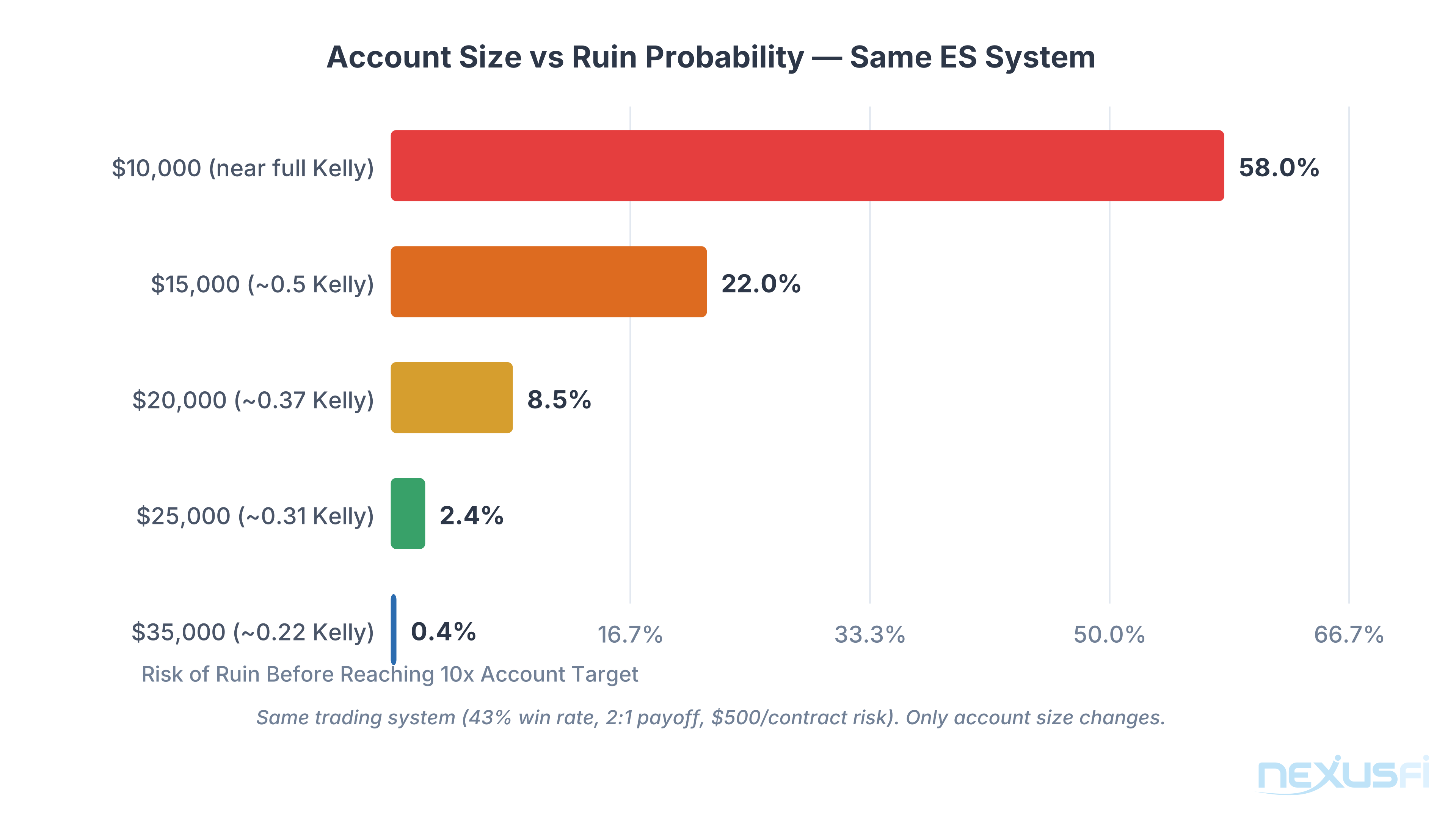
Same system. Same stops. Same win rate. The only difference is starting capital. And the difference in survival odds is 24x. Fat Tails' conclusion: "Your winning system with a positive expectancy is not worth anymore than a coin toss" when you're undersized.
The "minimum account to trade futures" question isn't really about margin — it's about Kelly. Margin requirements tell you the floor for trading. Kelly tells you the floor for reasonable survival odds. Those numbers are very different.
Start with enough capital that your natural position size lands at quarter Kelly or below. If quarter Kelly requires $25,000 and you have $10,000, trade MES instead of ES or MNQ instead of NQ until you're properly capitalized. Undercapitalization isn't courage — it's gambling.
Practical Application: The Kelly Framework for Futures Traders #
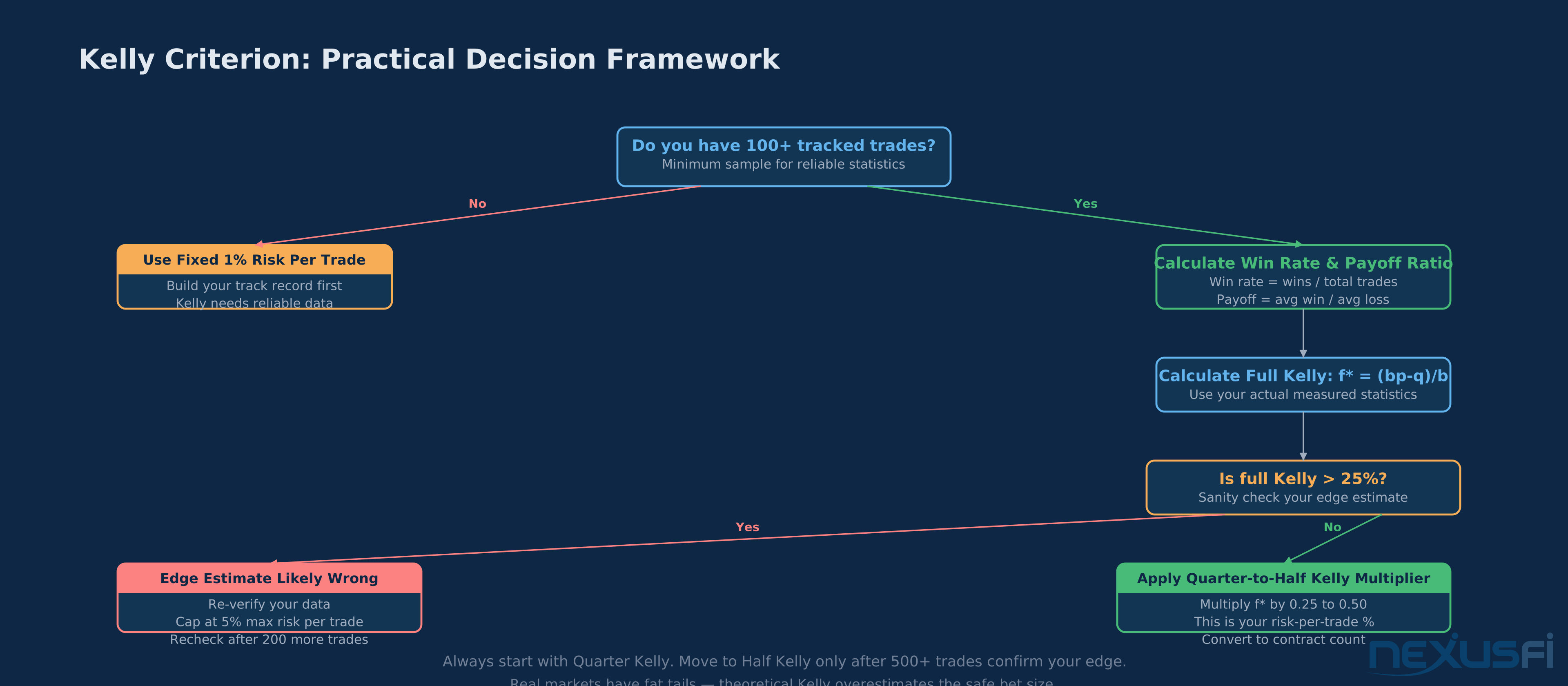
Here's how to actually use Kelly in practice
The Decision Process
- Do you have 100+ tracked trades with consistent methodology? If not, use fixed 1% risk per trade. Period. Kelly without reliable inputs is worse than useless
- Calculate your cost-adjusted win rate and payoff ratio. Include commissions, slippage, and any other friction. Use out-of-sample data whenever possible.
- Run the Kelly formula. If f* comes out above 25%, your edge estimate is almost certainly too optimistic. No sustainable futures strategy consistently supports Kelly fractions that high. Double-check your data.
- Apply quarter-to-half Kelly. For discretionary traders: quarter Kelly. For systematic traders with strong backtesting: half Kelly maximum. This builds in a buffer against estimation error, regime change, and fat tails.
- Convert to contracts. Contracts = (Account × f* × k) / (Dollar Risk Per Contract). Round down, never up. If the math says 3.7 contracts, trade 3.
- Re-estimate quarterly. Recalculate your Kelly inputs every 50-100 trades or every quarter, whichever comes first. If your Kelly fraction changes by more than 30% between periods, your edge isn't stable enough for Kelly-based sizing
A Worked Example
Trader with a $75,000 account trading NQ. Over the last 180 trades (9 months):
- Win rate: 48%
- Average winner (net of costs): $680
- Average loser (net of costs): $380
- Payoff ratio (b): 1.789
- Standard stop: 30 NQ points ($600 per contract risk)
Kelly calculation: f* = ((1.789 + 1) × 0.48 - 1) / 1.789 = (2.789 × 0.48 - 1) / 1.789 = (1.339 - 1) / 1.789 = 0.339 / 1.789 = 0.190 (19.0%)
Apply quarter Kelly: 0.190 × 0.25 = 0.0475 (4.75%)
Dollar risk budget: $75,000 × 0.0475 = $3,562
Contracts: $3,562 / $600 = 5.9 → 5 contracts
This is a reasonable, survivable position size. Compare to a naive 2% risk approach: $75,000 × 0.02 / $600 = 2.5 → 2 contracts. Kelly-based sizing with quarter Kelly suggests the trader can afford slightly more risk than the standard 2% rule, because the payoff ratio supports it. But it's still conservative enough to survive a sustained losing streak.
When to Abandon Kelly
Drop back to fixed fractional sizing when:
- Your win rate drops below 40% (edge may have evaporated)
- Kelly fraction changes by more than 50% between quarterly reviews
- You're trading a new strategy with fewer than 100 live trades
- Market regime has clearly shifted (volatility doubled, correlation structure changed)
- You can't sleep at night
Knowledge Map
Prerequisites
Understand these firstGo Deeper
Build on this knowledgeReferences This Article
Articles that build on this topicCitations
- — Risk of Ruin (2012) 👍 16“Betting full Kelly is quite risky. P(0.25,4,1) = 80%. The risk of ruin is 20%. This shows that betting full Kelly is quite risky.”
- — Risk of Ruin (2012) 👍 17“Can you live with a risk of ruin of 20%? Then you are a full-Kelly trader. Do you tolerate something like a risk of ruin of 2%? Then you are a half-Kelly trader.”
- — Optimal position sizing strategy (including considerations on Kelly criterion) (2014) 👍 6“Kelly's model is less risk-averse than the typical trader. A workaround consists in using Kelly's f multiplied by a fractional coefficient.”
- — Risk of Ruin (2012) 👍 30“Following the formula from Ralph Vince (The Mathematics of Money Management) the optimal fixed fraction can be determined. After slippage and commissions, B = 1.542 and optimal f = 0.0933.”
- — Why 7% is the Difference between Failure and Success in Trading (2012) 👍 32“The second model has a higher Optimal F - 12.09% compared to 5.76%. For equal drawdown risk the second model trades twice as many contracts and it comes out the clear winner.”
- — Risk of Ruin (2012) 👍 17“There is more risk involved than can be calculated via a Kelly formula. Your edge may prove to be a temporary edge at best.”
- — Optimal position sizing strategy (including considerations on Kelly criterion) (2014) 👍 9“What is the best strategy in terms of position sizing? There is no unique answer. It depends on what we want to optimize.”
- — Risk of Ruin (2012) 👍 24“Three systems with identical $21 net expectancy: System 1 (trend follower, 40% win, 3:1 payoff) optimal size = 3.72%; System 2 (scalper, 75% win, 1:1 payoff) optimal size = 10.29%. The scalper can trade 75 contracts vs 32 for the trend follower -- for the same risk of ruin.”
- — Risk of Ruin (2012) 👍 14“The risk of ruin as defined per the Kelly criterion is the risk that you will lose money although your assumptions have been correct. The risk that you have made a false evaluation of your edge, the risk that markets have changed -- these are NOT covered by the Kelly approach.”
- — ES - mini- alternative instrument to trade before market opens (2014) 👍 12“Trading 2 ES contracts with $10,000 account: risk of ruin is 58% before reaching $100,000 target -- odds barely 2:1. Same system with $25,000 account: risk of ruin drops to 2.4% -- odds 40:1 in your favor. A winning system becomes a coin toss when undersized.”
- — Risk of Ruin (2012) 👍 8“The Kelly formula is all about compounding returns. It calculates the optimal fraction -- called optimal f -- leading to maximum growth of your account. It is just mathematics. The Kelly formula should only be applied if there is an edge or positive expectancy.”
- — Optimal position sizing strategy (including considerations on Kelly criterion) (2023) 👍 1“Lack of accounting for utility is one of the big drawbacks of Kelly and Optimal F. Will you risk the same percentage on a trade if your account is $10,000 or $10,000,000? Blowing 10k is dramatic enough, but blowing 10M is life changing for most of us.”
- — SBtrader82's Trading Journal (2023) 👍 6“The big misunderstanding about risk management is that it is a 'mysterious' unsolved problem. It is not. Assuming you know all the parameters, there is a formula for the exact risk to take for every trade -- the Kelly Criterion. With any other approach the equity will grow slower and you will reach a drawdown faster, on average.”
- — Risk of Ruin (2022) 👍 5“The Kelly Criterion is a bet sizing system that allows a trader with an edge to maximize their edge, and at the same time it allows them to weather most conceivable drawdown situations. A trading system with an edge can still go bust if the system is traded 'too large'.”
- — Why 7% is the Difference between Failure and Success in Trading (2012) 👍 11“If the win rate drops by 10% (from 80% to 72%), your expectancy drops to zero. No model covers the model risk, and here the model risk is huge, as it includes the assumption of a known and stable edge. Models simplify, so they should not be applied to reality without care.”