



Execution Algorithms for Futures Trading: TWAP, VWAP, Iceberg Orders, and Smart Order Routing
Overview #
Execution algorithms are the machinery that turns your trading decision into a filled order — and how that machinery works determines whether you keep your edge or give it back in slippage.
Every trader has felt it: you want to buy 50 ES contracts, you hit market, and by the time the fill report comes back you've paid 2 ticks more than the price you saw. That's not bad luck. That's market impact, and it's the exact problem execution algorithms exist to solve.
The core idea is simple. Instead of dumping your entire order into the book at once, you slice it into smaller pieces and feed them to the market over time, following rules designed to minimize the price you pay (or maximize the price you receive). The rules differ — some algorithms track time, some track volume, some track your decision price — but the goal is always the same: get filled without moving the market against yourself.
For retail traders working 1-10 contracts on liquid products like ES or NQ, execution algorithms might seem like overkill. Fair enough — at 5 lots, you're rarely moving anything. But the moment you start scaling (20+ contracts, less liquid products like ZB or HO, or fast-moving conditions where depth evaporates), these tools become the difference between a profitable strategy and one that bleeds out through execution costs.
For institutional traders, execution algorithms are table stakes. A fund running 500 lots of CL through a trending session without algorithmic slicing is lighting money on fire. Implementation shortfall — the gap between your decision price and your average fill — is measured, attributed, and reported. Every tick matters.
This article covers the six execution algorithm families you'll encounter in futures: TWAP, VWAP, iceberg orders, smart order routing, participation rate, and arrival price algorithms. For each one, you'll learn what it does, when to use it, and what the practical gotchas are. No textbook theory — just how these tools work in real markets with real liquidity constraints.
Key Concepts #
TWAP (Time-Weighted Average Price) — An algorithm that distributes order execution evenly across a specified time window, regardless of market volume. Child orders fire at regular intervals (every 30 seconds, every minute, every 5 minutes) until the parent order is complete.
VWAP (Volume-Weighted Average Price) — An algorithm that distributes order execution proportionally to observed market volume. It aims to achieve an average fill price equal to the session's volume-weighted average. Heavier execution during high-volume periods, lighter during lulls.
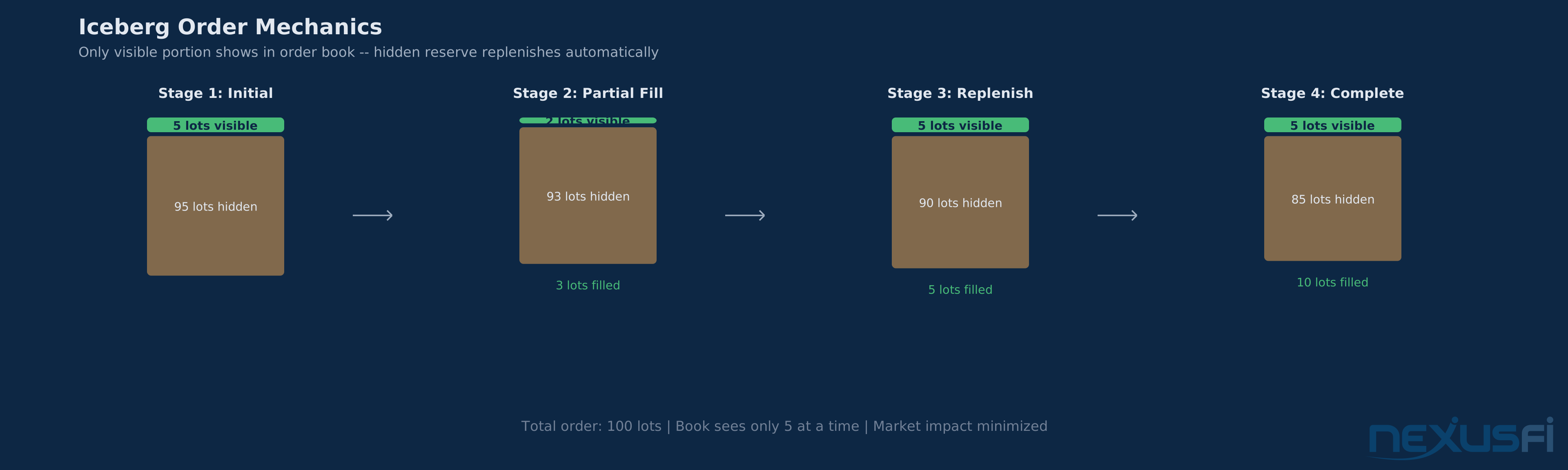
Iceberg Order — An order type that displays only a fraction of total size in the visible order book. When the displayed portion fills, it automatically replenishes from the hidden reserve. Designed to conceal true order size from other market participants.
Smart Order Routing (SOR) — Logic that determines where and how to route each child order for optimal execution. In futures, this primarily means choosing between order types, aggressiveness levels, and (where applicable) execution venues.
Participation Rate Algorithm — An algorithm that limits execution to a fixed percentage of market volume (e.g., "participate at 10% of volume"). Self-limiting by design — it naturally slows in thin markets and speeds up when liquidity flows.
Arrival Price Algorithm (Implementation Shortfall) — An algorithm that minimizes slippage relative to the price at the moment the order was initiated. Balances urgency (get it done before price moves further) against market impact (don't push price by executing too aggressively).
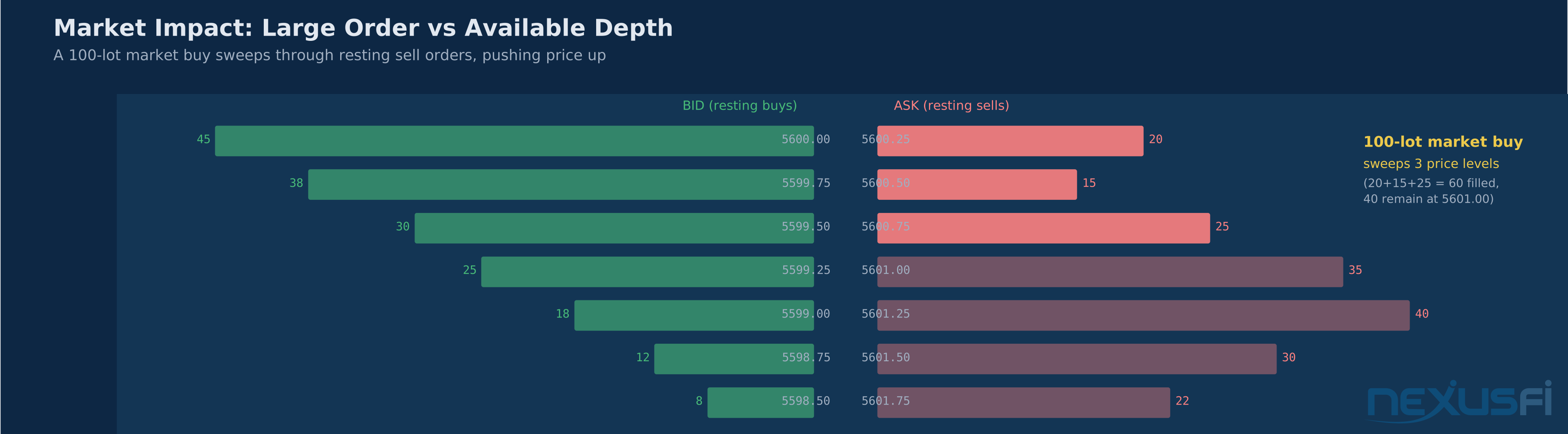
Market Impact — The price movement caused by your own order's execution. Large market orders consume available depth and push price against you. The primary cost that execution algorithms are designed to minimize.
Implementation Shortfall — The difference between your decision price (when you decided to trade) and your actual average execution price. The gold-standard metric for measuring execution quality in institutional settings.
How It Works #
TWAP: The Clock-Based Slicer #
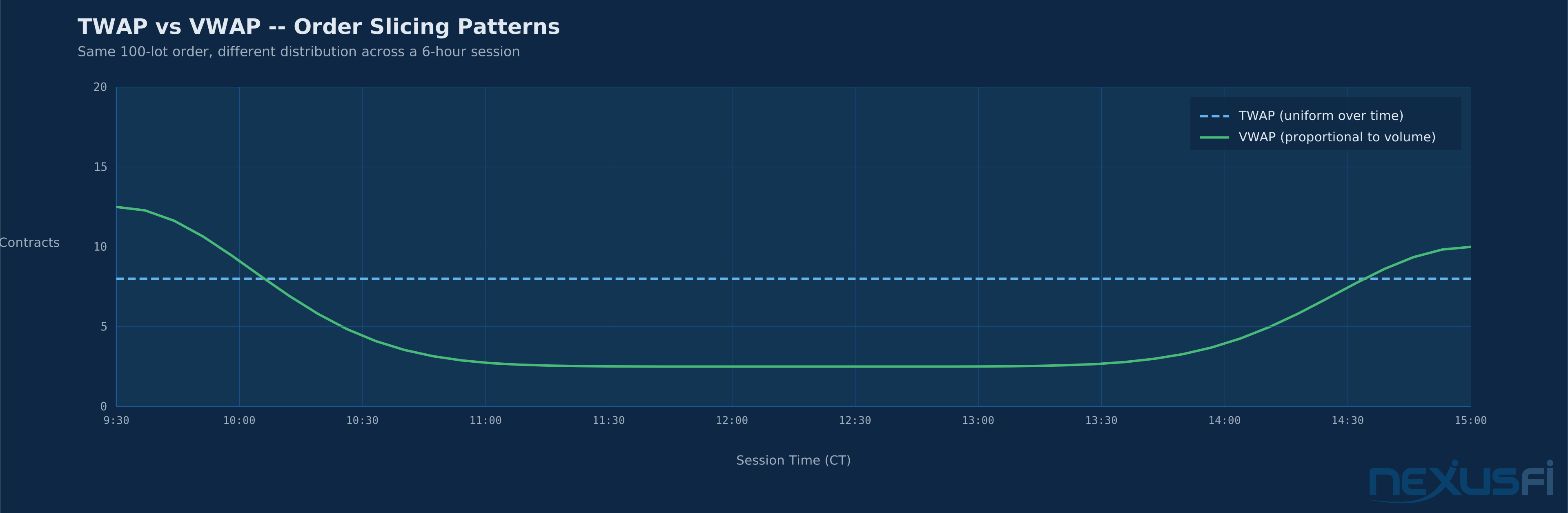
TWAP is the simplest execution algorithm and the easiest to understand. You specify a start time, an end time, and a total quantity. The algorithm divides the quantity into equal slices and executes one slice per interval.
Example: You need to sell 100 ES contracts between 9:30 AM and 12:00 PM CT. That's 150 minutes. TWAP might fire a 1-lot every 90 seconds, or a 5-lot every 7.5 minutes — the pacing depends on configuration. Each slice is typically sent as a limit order at or near the current best price, with rules about how aggressive to be if the limit doesn't fill within the interval.
The strength of TWAP is predictability. You know exactly when and how much will execute. The weakness is that TWAP is volume-blind — it executes the same amount during the 11:30 AM lull as it does during the 9:30 AM open, even though the open has 5x the liquidity. That means your TWAP slices during thin periods carry disproportionate market impact.
Professional traders almost never run vanilla TWAP. They use adaptive variants that adjust pacing based on volatility and spread conditions. If the bid-ask spread suddenly widens from 1 tick to 3 ticks, a smart TWAP pauses rather than paying the wide spread. If volatility spikes, it may slow down to avoid adverse selection.
As @Fat Tails noted in analysis of [intraday seasonality patterns][1], the TWAP and its time-weighted alternatives provide meaningful benchmarks for execution quality when paired with intraday volume analysis.
VWAP: The Volume Tracker #
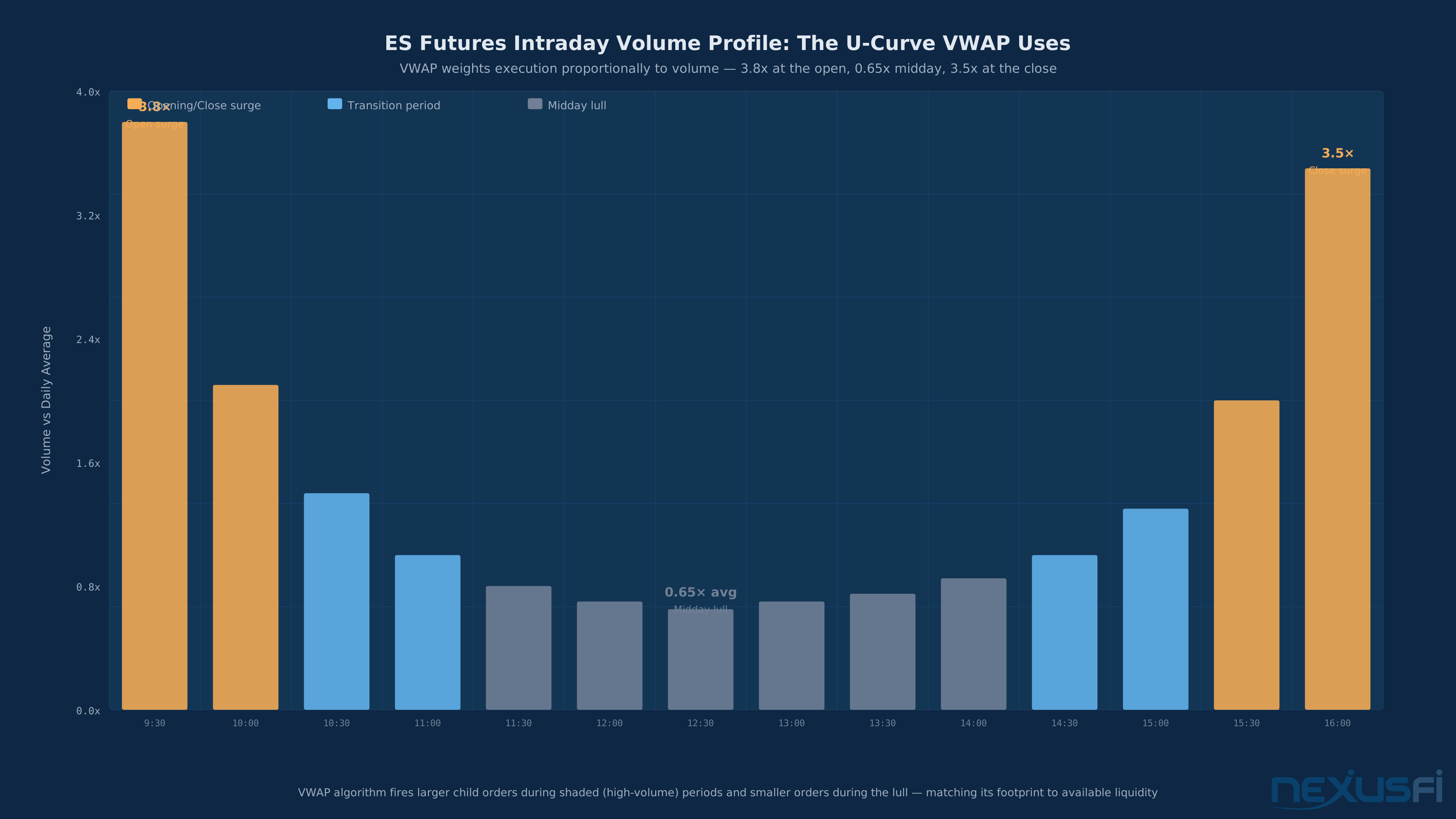
VWAP takes a different approach. Instead of distributing evenly over time, it distributes proportionally to market volume. During the opening 30 minutes when ES trades 200,000 contracts, VWAP pushes harder. During the midday doldrums when volume drops 70%, it backs off.
The logic is straightforward: liquidity follows volume. By executing proportionally to volume, you minimize the chance of being a disproportionate share of the market at any given moment.
The practical implementation requires a volume prediction model. The algorithm needs to know: "What percentage of today's total volume will occur in the next 5 minutes?" Most implementations use historical volume curves — the well-documented U-shaped intraday pattern for equity index futures, where volume concentrates at the open and close. Dynamic VWAP updates these predictions in real-time as the session unfolds.
@Fat Tails provides extensive analysis of VWAP properties in the [Session Toolbox thread][2], including how VWAP acts as the session's true average price and its relationship to institutional execution benchmarks. The [VWAP indicator thread][3] covers both VWAP and TWAP indicator implementations with standard deviation bands.
The critical weakness of VWAP: in trending markets, volume concentrates where price is moving. If price is ripping higher and you're trying to buy, VWAP tells you to buy aggressively during exactly the periods where you'll pay the most. VWAP assumes volume is a good proxy for available liquidity — and in momentum-driven moves, that assumption breaks.
Professional desks address this with variants like "B-VWAP" that exclude the opening 30 minutes (avoiding the volatility spike) or VWAP with price corridor limits that pause execution when price deviates more than N ticks from the initial reference.
Iceberg Orders: Hiding in Plain Sight #
Iceberg orders attack a different problem: information leakage. When you place a 200-lot limit order on ES, every participant with a DOM can see it. HFT firms, institutional desks, and sophisticated retail traders all monitor large resting orders — and they trade against them.
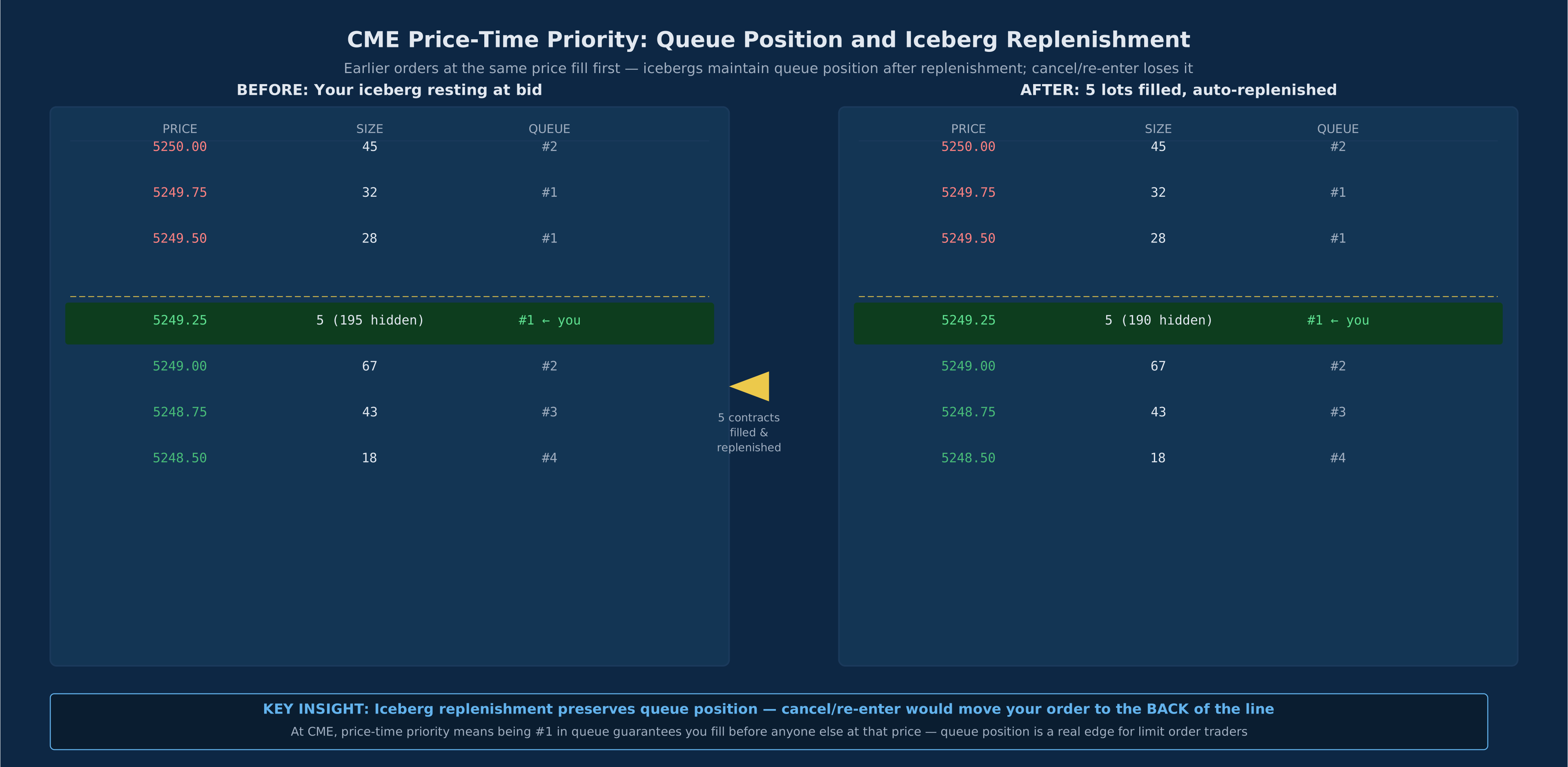
An iceberg shows only a fraction of your true size. You might display 5 contracts while 195 sit hidden. Each time your displayed 5-lot fills, the exchange automatically replenishes it from the hidden reserve.
As discussed in the NexusFi community regarding [iceberg order dynamics][4], even larger traders use iceberg orders to inject limit orders into the order book carefully, making their activity appear statistically normal within the visible depth. Smart observation of both limit (iceberg) and market (delta) orders, as noted in the [VWAP trading thread][5], can reveal when bigger orders are being parceled through the book.
The key configuration decisions:
- Visible size: Too large and you're still signaling. Too small and you're obviously an iceberg (a 1-lot that keeps refilling at the same price is a giveaway). The visible portion should look "normal" relative to the typical resting order at that depth level.
- Refresh behavior: Immediate refill or delayed? Immediate refill maintains queue position but is more detectable. A brief random delay between refills makes the pattern less obvious.
- Price behavior: Does the iceberg stay at one price level, or does it follow price? A "pegged iceberg" that tracks the best bid/offer is more aggressive but harder to detect.
CME and ICE both support native iceberg orders, though there are exchange-specific nuances. CME charges a small fee for the hidden portion. Some exchanges impose maximum lifetimes on hidden orders.
Smart Order Routing: Choosing How to Execute #
In equities, smart order routing means scanning 15 different exchanges and dark pools. In futures, the environment is simpler — most major contracts trade on a single primary exchange (ES/NQ/CL on CME Globex, Brent on ICE). So what does SOR mean in futures?
It means optimizing across order types, aggressiveness levels, and execution tactics within a venue. The routing decision includes:
- Limit vs. marketable limit vs. market: A limit order gets queue position but risks not filling. A marketable limit crosses the spread but has a price cap. A market order fills immediately but takes whatever price is available.
- Displayed vs. hidden: Use the full order book or an iceberg?
- Passive vs. aggressive timing: Join the bid and wait, or cross the spread and take?
For the few futures products that trade across multiple venues (crude oil trades on both CME and ICE, for instance), SOR also routes between exchanges based on real-time depth, spread, and latency comparisons. As discussed in NexusFi's [order routing thread][6], the physical location of your broker's routing infrastructure matters — orders routed from a co-located server at CME's data center in Aurora, IL fill differently than orders routed from Virginia.
Retail traders often don't have direct control over routing — their broker handles it. The practical concern is whether your broker's routing logic is any good. Check whether they offer transparent reporting on execution quality, what order types they support, and whether they co-locate with the exchange.
Participation Rate: The Impact Limiter #
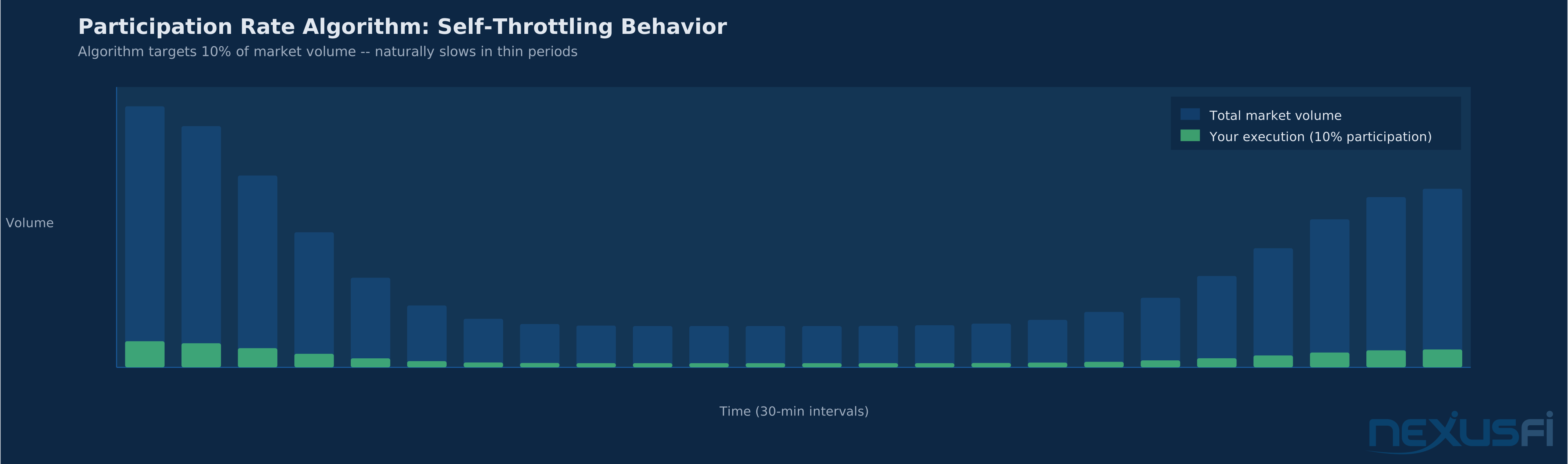
Participation rate algorithms set a simple constraint: "Never be more than X% of the volume at any given time." If you're targeting 10% participation and the market trades 100 contracts in a minute, you execute 10. If volume drops to 20 contracts per minute, you execute 2.
This is the most intuitive approach to market impact control. You're capping your footprint relative to the market's activity. In liquid contracts like ES (which trades 1.5+ million contracts daily), 10% participation is enormous — you'd be executing 150,000 contracts. In a contract like lean hogs or platinum that trades 20,000 per day, 10% participation means you're still only 2,000 contracts — but you're a significant presence.
The advantage over TWAP: participation naturally throttles in thin markets. Where TWAP blindly fires slices regardless of available liquidity, participation rate waits for volume.
The advantage over VWAP: participation is mechanically simpler and doesn't require a volume prediction model. It responds to actual observed volume rather than predicted volume.
The weakness: participation doesn't account for adverse selection. If volume spikes because aggressive sellers are hitting the bid (and you're trying to buy), participation rate tells you to buy more — right into the selling pressure. Smart participation algorithms add volatility filters and spread-widening triggers to pause during adverse conditions.
As @Fat Tails demonstrated in analysis of [expected slippage vs order size][7], slippage mechanics in futures are at the core about the relationship between your order size and available depth — the exact relationship that participation rate algorithms explicitly manage.
Arrival Price: Minimizing Decision Cost #
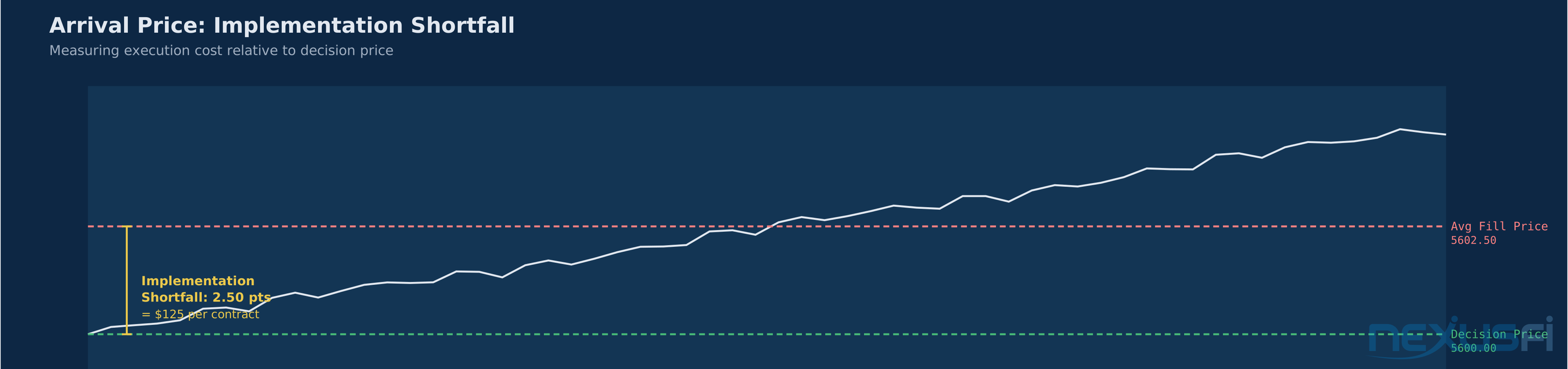
Arrival price algorithms answer a specific question: "How much did execution cost me relative to where the market was when I decided to trade?"
The reference price is set at order arrival — typically the mid-price when the algorithm starts. The algorithm then balances two competing forces:
- Urgency: The longer you wait, the more the market can move away from your reference price (timing risk).
- Impact: The faster you execute, the more you push the market against yourself (market impact).
The optimal strategy depends on where you are on this spectrum. For a time-sensitive hedge that must be done in 5 minutes, the algorithm runs aggressively — accepting impact to avoid timing risk. For a large position build over a full session, it runs passively — accepting timing risk to minimize impact.
Arrival price is the preferred benchmark in institutional settings because it directly measures the cost of the execution decision. Implementation shortfall reporting shows exactly how many ticks (and dollars) the execution cost relative to the price at which the trade was initiated.
The practical challenge: arrival price algorithms are highly sensitive to their aggressiveness calibration. Too aggressive and they cause unnecessary impact. Too passive and the reference price drifts away. Most professional implementations use dynamic aggressiveness that ramps up as time remaining decreases or as price moves further from the reference.
Practical Application #
Choosing the Right Algorithm #
The decision framework is straightforward:
| Your Situation | Best Algorithm | Why |
|---|---|---|
| Building a position over hours, no urgency | TWAP (adaptive) or VWAP | Spread impact evenly, minimize footprint |
| Hedging by end of day, moderate urgency | VWAP with price corridor | Track market activity, cap adverse drift |
| Large order in thin contract | Iceberg + low participation rate | Conceal size, cap market share |
| Urgent execution (stop hit, hedge deadline) | Arrival price (aggressive) | Minimize slippage from decision point |
| Rebalancing across session | Participation rate at 5-10% | Explicit impact control, self-throttling |
| Multi-venue product (e.g., crude oil) | SOR + VWAP overlay | Capture best price across venues |
Guardrails Matter More Than Algorithm Choice #
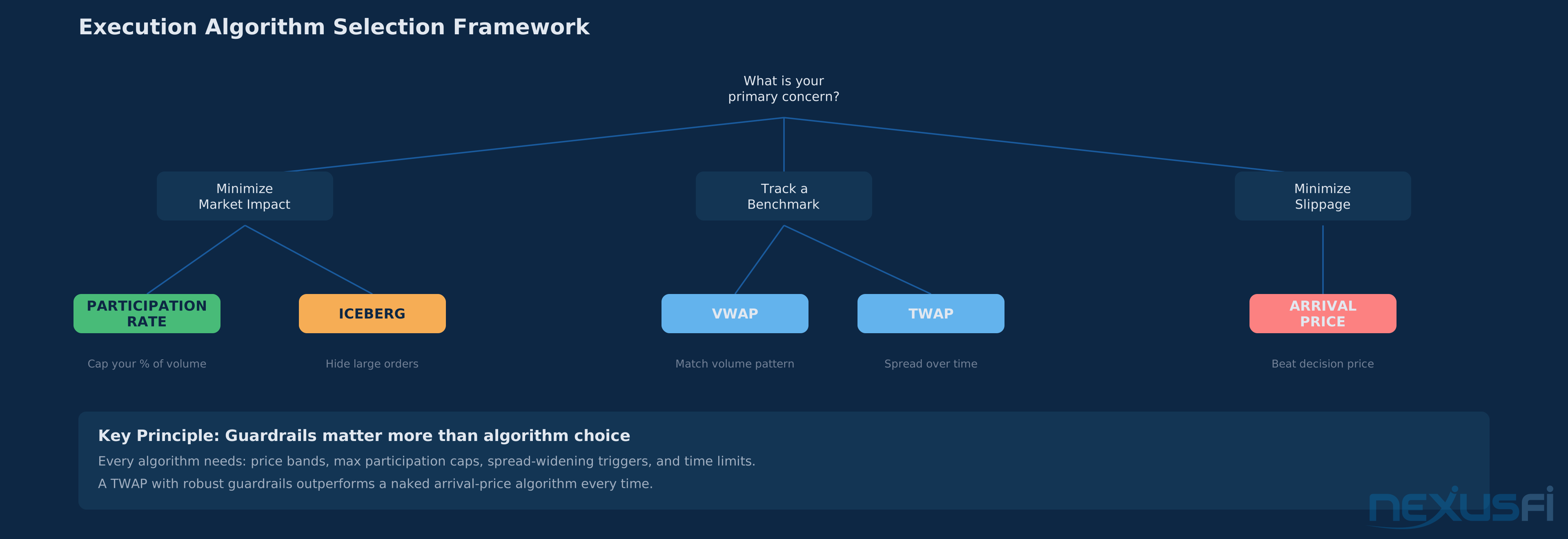
Every expert I consulted for this article said the same thing: the risk controls wrapped around the algorithm determine outcomes more than the algorithm itself. A TWAP with strong guardrails outperforms a naked arrival-price algorithm every time.
Mandatory guardrails for any execution algorithm:
- Price bands: Maximum deviation from a reference price (e.g., don't buy more than 3 ticks above VWAP). Prevents the algorithm from chasing runaway moves.
- Maximum participation: Cap at 5-15% of volume depending on contract liquidity. Prevents you from becoming a dominant share of the market.
- Spread triggers: Pause execution when the bid-ask spread widens beyond normal (usually 2x average spread). Wide spreads signal thin liquidity.
- Time limits: Don't chase forever. If the order isn't filled within the time window, cancel the remainder and reassess.
- Cancel/replace limits: Restrict how often the algorithm can cancel and replace orders. Excessive churn signals intent to other participants.
The Retail Reality #
Community discussions on [execution quality][8] consistently emphasize a practical point: for retail traders, the single biggest execution improvement is getting your orders in the queue early rather than waiting for a signal and then scrambling to enter. Queue position in a limit order book determines fill quality more than any algorithm.
For retail traders working 1-20 contracts on liquid products:
- TWAP and VWAP add value primarily during fast markets or when you're scaling beyond 10 contracts on mid-liquidity products.
- Iceberg orders are useful starting around 20+ lots on ES or 10+ lots on lower-volume contracts.
- Smart order routing is largely handled by your broker — focus on choosing a broker with transparent execution quality reporting.
- The most impactful "algorithm" for retail is manual slicing: split your 20-lot into 4x 5-lots spaced 30 seconds apart. Simple, effective, no special tools required.
For institutional traders and larger retail accounts:
- VWAP with dynamic volume weighting is the default for position building.
- Arrival price for time-sensitive execution (hedges, risk reduction).
- Participation rate for impact-sensitive execution in less liquid contracts.
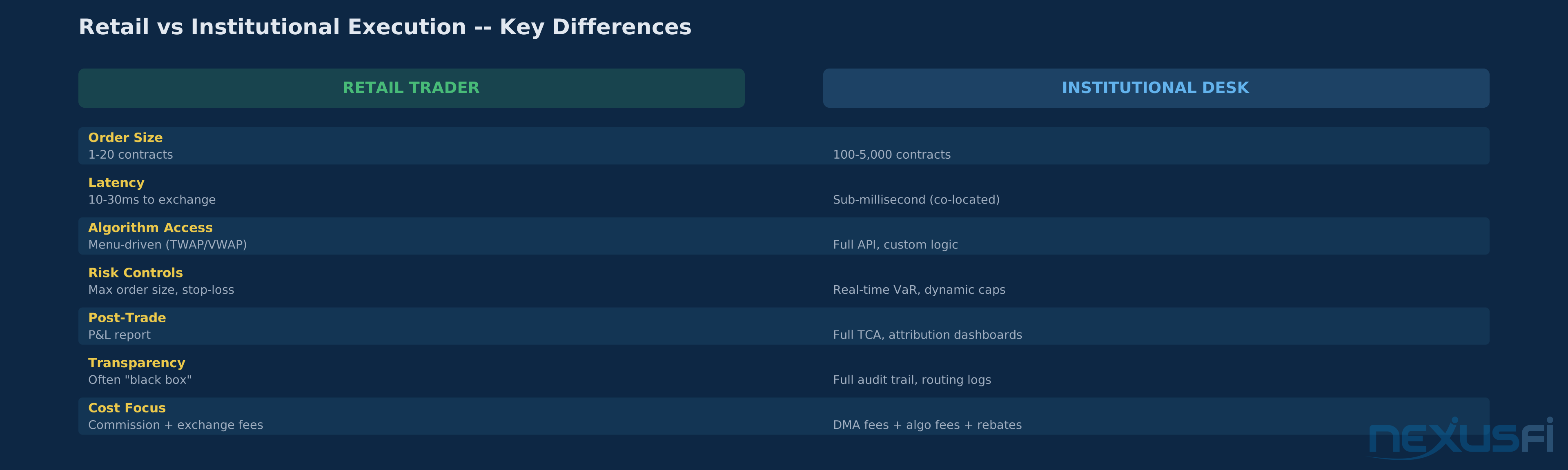
- Post-trade TCA is mandatory — measure implementation shortfall, not just P&L.
Futures-Specific Execution Challenges #
Futures have execution characteristics that differ from equities:
- Contract rolls: Liquidity shifts from the front month to the next contract quarterly (ES/NQ) or monthly (CL). During roll periods, execution in the back month is thin. Algorithms need roll-aware logic.
- Session boundaries: The RTH open (9:30 ET for ES) sees massive volume and volatility. VWAP algorithms that include the opening rotation behave very differently from those that start at 9:45 or 10:00.
- Tick size constraints: ES trades in 0.25 increments ($12.50 per tick). CL trades in 0.01 ($10 per tick). Slicing granularity is bounded by tick size — you can't improve price in fractions of a tick.
- Queue position dynamics: CME uses price-time priority. Your queue position at a price level determines your fill order. Canceling and re-entering to adjust size loses your position. Iceberg replenishment maintains position at the filled price level.
- Exchange-specific behavior: CME Globex handles hidden orders differently than ICE. Stop orders have exchange-specific triggering logic. Algorithms must account for these mechanics.
As the NexusFi community explored in discussions about [market impact and large orders][9], whether your buying actually moves the market depends on order type, size relative to available depth, and the current state of the book. Market orders eat through resting depth. Limit orders add depth. The interplay between the two is what execution algorithms manage.
Knowledge Map
Prerequisites
Understand these firstGo Deeper
Build on this knowledgeReferences This Article
Articles that build on this topicCitations
- — Intraday Seasonality Volatility - When to Trade and When Not to Trade (2010) 👍 108“Specific Trading Times Each instrument has its specific times, when it can be traded, and also has its times, when trading does not pay off. The question is. how to determine the optimal trading times? The main criterion is volatility.”
- — Session Toolbox - Trading the Session (Fat Tails) (2013) 👍 239“This thread is about session indicators and how to trade them. I have coded quite a few indicators for NinjaTrader, which I would like to explain, and for which I do regular updates.”
- — Using VWAP in your trading (2010) 👍 14“Lately, I've been considering taking off the only moving average on my charts -- an ema 20 -- and replacing it with a VWAP.”
- — If an transaction occurs BELOW the bid vrs AT the bid a bullish or bearish move (2014)“If a transaction occurs BELOW the bid vrs AT the bid is it a bullish or bearish move ? and vice versa transacting ABOVE the ask vrs AT the ask or am i missing something?”
- — VWAP for stock index futures trading? (2019) 👍 6“Hello, in the stock world, vwap is an indicator widely used in particular with big professional money managers that use it to asses the performance of traders.”
- — TradeStation Terrible Order Execution Yet Worse Customer Service! (2022)“TradeStation sucks- I've had issues in the past but yesterday was the worse experience ever. Obviously during days of increased volatility you really need a broker you can trust- TradeStation is NOT that broker.”
- — Expected slippage vs order size (2010)“I would like to solicit experience based opinions about expected slippage vs order size during regular session hours, especially for the ES, TF, CL, and 6E. I currently do optimizing with 1 contract and 1 tick slippage.”
- — how to get better fills, especially on NQ (2020)“i use funded account (leeloo) using rithmic with ninjatrader i use semi-automation tool from markers plus i occasionally get slippage during scalping (4 ticks off) on NQ i was told getting better datafeed like iqfeed would help because it is unfilter...”
- — Does my buying ever move the market? (2021) 👍 2“Hi guys I've been quite successful scalping the E-Micros in the last year thanks to the heightened volatility. While doing so i realized that i seem to know less about the product that i'm trading than i thought.”