



Automated Order Execution: Getting Filled Without Giving Away the Trade
Overview #
You've done the hard work. The signal fires. Your system says buy — now. What happens in the next 50 milliseconds determines whether that edge you spent months building actually shows up in your account, or whether it evaporates in the gap between signal and fill.
Automated order execution is the machinery that converts trading decisions into actual positions. It sounds mechanical because it is — but "mechanical" doesn't mean simple. Between your signal and your fill sits a matching engine running FIFO price-time priority, a queue of thousands of competing orders, and a set of tradeoffs that can add or subtract hundreds of basis points from your realized returns annually.
Most retail futures traders treat order execution as an afterthought. You build the strategy, you automate the entries, you set a market order and move on. That's leaving money in the matching engine. Execution quality is a skill, and it compounds.
This article covers how automated execution actually works — from the matching engine mechanics to the algorithms professional desks use, to what's practically available to you on NinjaTrader or Sierra Chart right now. The goal isn't to make you sound like a quant. The goal is to get you better fills.
What Automated Order Execution Actually Is #
Automated order execution refers to any system that submits, routes, modifies, or cancels orders without human intervention at the moment of trade. At the simplest end, that's a stop-loss that triggers automatically when price hits a level. At the complex end, it's a multi-legged execution algorithm that slices a large order across time and venues to minimize market impact while tracking a benchmark.
The common thread is that a set of rules — coded in advance — determines order behavior. The human makes the strategic decision (what to trade, when, roughly how much). The execution system handles the tactical details (what order type, what price, how to manage the queue).
For retail futures traders, automated execution typically means:
- Bracket orders — automated stop and target placement after entry
- OCO (One Cancels Other) — linked orders where filling one cancels the other
- Conditional orders — execution triggered by price, time, or indicator conditions
- Algorithmic scaling — splitting entries or exits across multiple prices
- Fully automated strategies — signal-to-order pipelines with no manual touch
The mechanics governing all of these are the same. Understanding them lets you make better decisions about which order types to use and when.
Key Concepts Every Automated Trader Needs #
Execution Benchmarks
A benchmark is the reference price against which you measure fill quality. Without a benchmark, you can't know if your execution was good or bad — you're just looking at a fill price in isolation.
The main benchmarks used in futures execution:
Arrival Price — the mid-price of the bid-ask spread at the moment your order decision is made. This is the "fair" price before you've done anything. The difference between your arrival price and your average fill is pure execution cost.
VWAP (Volume-Weighted Average Price) — the average price weighted by volume over a defined period, typically the session.
It represents where the average dollar of volume traded that day. Executing at or better than VWAP means you didn't pay more than the market average — which is the institutional standard for acceptable execution.
TWAP (Time-Weighted Average Price) — simple average price over a defined time window, unweighted by volume. Easier to compute, more useful for low-liquidity periods.
Close — the settlement or closing price. Used for mark-to-market and some benchmark funds that need to track index closing levels.
For retail futures traders, arrival price is the most practical benchmark. It tells you how much your execution cost relative to the price when you decided to trade. Every tick of slippage from arrival is money out of your strategy's alpha.
Market Impact
Market impact is what your own order does to the price. When you buy, you consume the offer — and if you buy enough, you push the price up before you're even fully filled. You're paying more for later fills than earlier ones, and you've moved the market against yourself.
Market impact has two components:
Temporary impact — price moves while you're filling, then reverts partially after you stop. This is the liquidity friction of absorbing the order book.
Permanent impact — price doesn't fully revert because your order conveyed information. The market learned you were buying and repriced so.
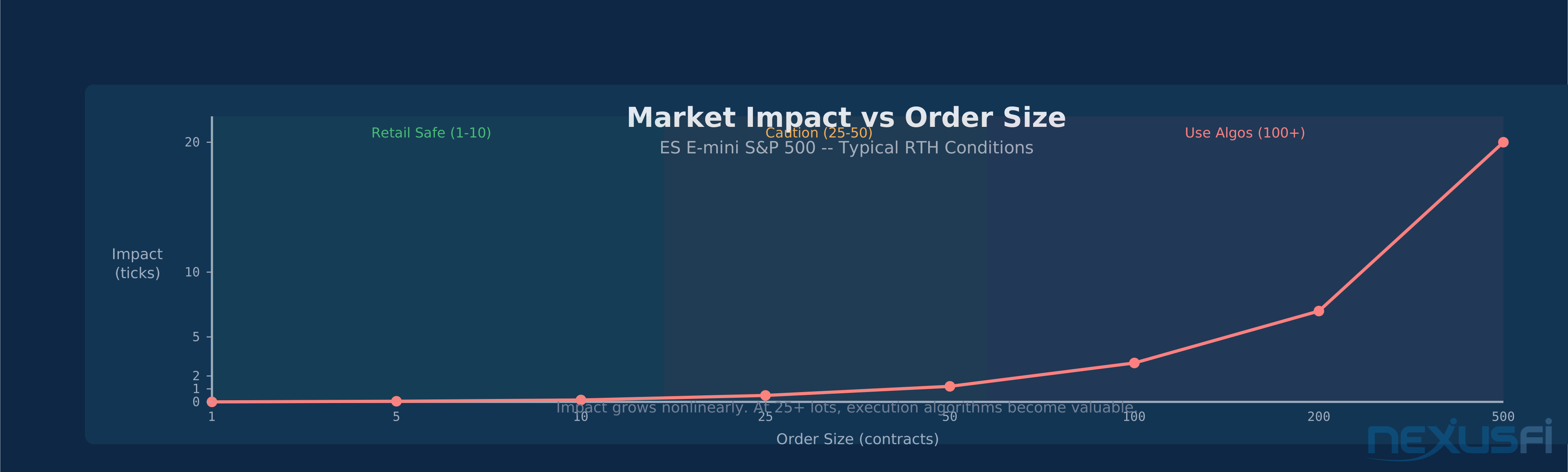
NexusFi member @artemiso, in their systematic trading AMA, is direct about the scale of this effect: at 25-40 lots on ES, you're looking at significant market impact. That's a size most retail traders don't approach, but the principle applies at any scale — it just starts smaller on thinner instruments like smaller equity futures or micro contracts with tighter queues.
The math on market impact is approximately linear for small orders, then grows nonlinearly as order size approaches the typical bid-ask depth. For ES futures with typical bid depth of 300-600 contracts on each level, a 10-lot market order has minimal impact. A 100-lot market order at a single price level starts consuming multiple queue positions and drives measurable price movement.
Information Leakage
Information leakage is when the market figures out you're building a position before you're done. It's related to permanent impact but distinct — leakage happens even when you're trading with limit orders, if your order pattern is predictable enough for algorithms to front-run.
Signs of information leakage in automated execution:
- Price consistently moves away after partial fills on large orders
- Best offer disappears the moment your bid appears
- Queue depth collapses as you approach your target size
The solution is randomization — varying order timing, size, and price placement so your pattern isn't decodable by HFT pattern recognition. For retail traders, the practical version of this is not stacking obvious resting orders at round numbers where they'll get front-run, and not always hitting the market in the same size at the same time of day.
Queue Mechanics
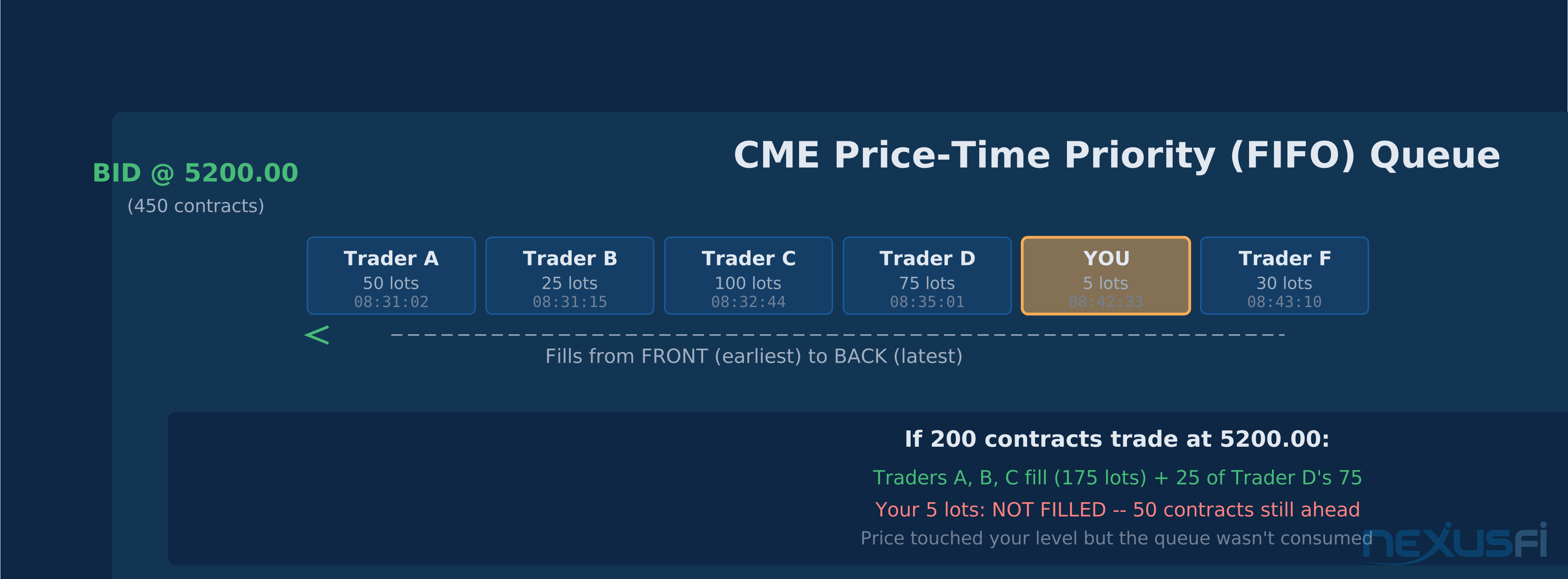
NexusFi member @bobwest breaks down the mechanics of limit order queues in detail: queue priority is everything. Price-time priority means that at a given price level, orders that arrived earlier fill first. When you place a limit order, you join the back of the queue at your price. If price touches your limit but the queue ahead of you doesn't fully fill, you don't get filled.
This is the core reason limit orders at touch don't always fill. @keymoo documents this specifically for ES fills: being at the back of a 500-contract queue at a price that trades 200 contracts means you don't fill even though your price traded. You needed the market to trade through your level, not just at it.
Queue position is capital. Getting in line early, at the right price, with the right size, is as important as the signal itself.
Core Execution Algorithms #
TWAP -- Time-Weighted Average Price Algorithm
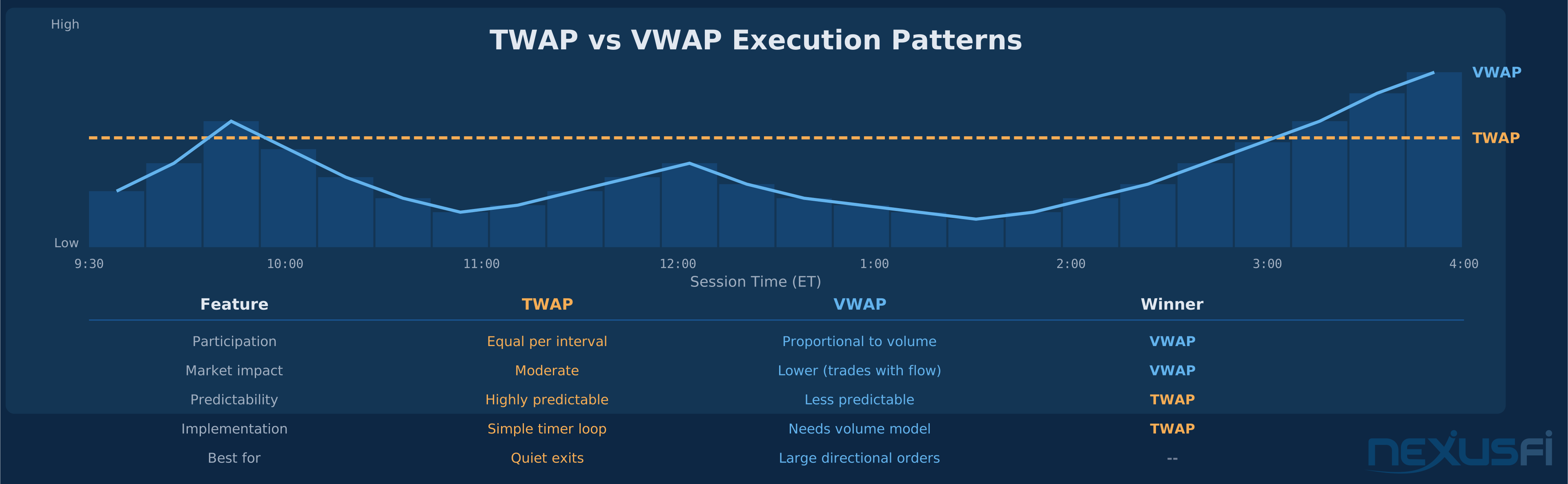
TWAP divides an order into equal-sized slices and executes them at regular time intervals. If you want to buy 20 ES contracts over 20 minutes, a TWAP algo sends 1 contract per minute.
What it does well: Simple to implement, predictable, minimizes market impact by spreading the order over time. Works well when you have no strong view on intraday price direction and just want to get done without moving the market.
What it does poorly: It's completely volume-agnostic. If you're executing into a thin period, you're paying wide spreads. If volume spikes, you're under-participating when liquidity is cheapest. TWAP also doesn't adapt to price movement — you keep buying even if the market is ripping against you.
When to use it: Routine rebalancing, exiting large positions over a quiet period, situations where time is the dominant constraint and you have no directional view.
For retail futures traders, TWAP is achievable manually or via simple scripting — set a timer, send 1-lot every N seconds. The discipline of spreading out entries rather than hitting all at once is the core insight worth taking.
VWAP -- Volume-Weighted Average Price Algorithm
VWAP execution participates proportionally to volume. If 15% of the day's volume typically trades in the first 30 minutes, a VWAP algo tries to execute 15% of your order in that window. It constantly compares your actual fills to the running VWAP benchmark and adjusts pace so.
What it does well: Trades when liquidity is deepest, which minimizes market impact. Hitting the session VWAP is the institutional standard for "adequate execution" — you traded with the market, not against it.
What it does poorly: VWAP execution is backward-looking. The algo is chasing historical volume patterns, which may not match today's session. Also, everyone knows VWAP — algos on both sides are targeting it, creating predictable clustering of orders around the benchmark that sophisticated players exploit.
When to use it: Large directional positions where minimizing impact is the primary goal, institutional-style rebalancing, situations where beating VWAP is the explicit mandate.
The deeper concept, as @Fat Tails emphasizes, is that VWAP represents where the session's business got done. If you're consistently filling above VWAP on longs, that's a measurable drag on performance.
Iceberg (Reserve) Orders
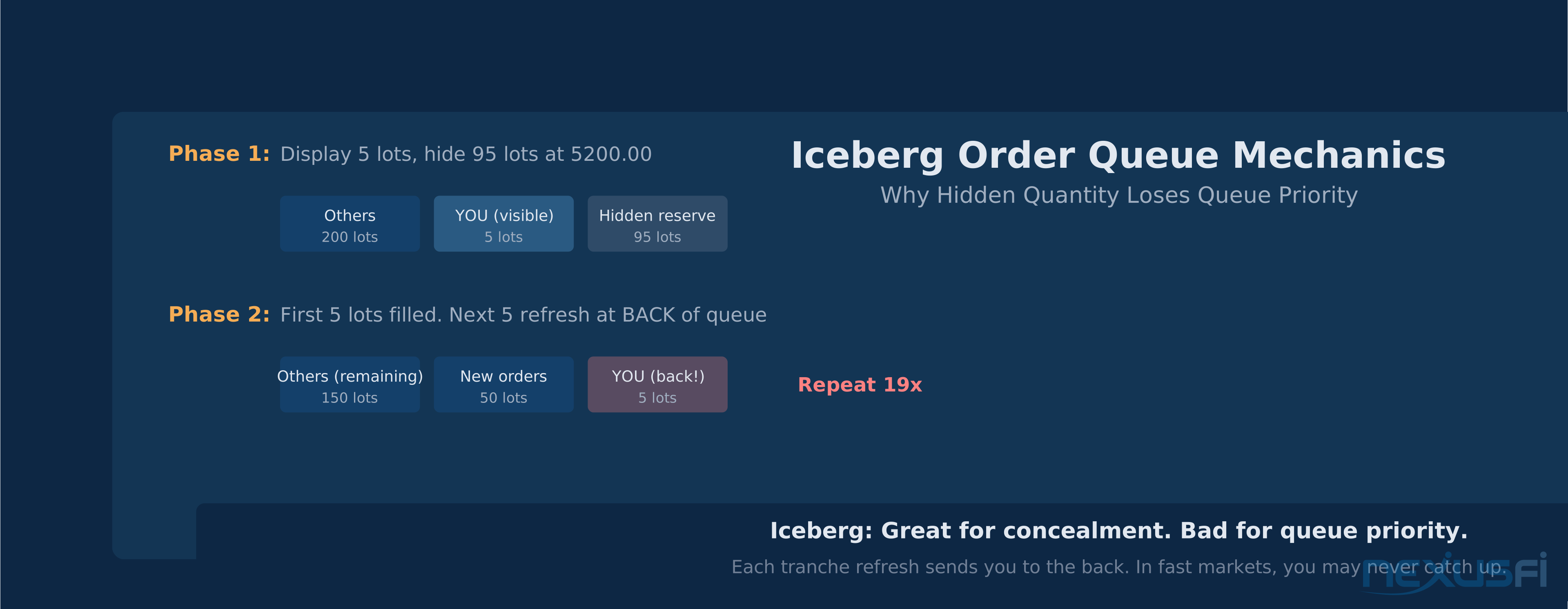
An iceberg order shows only a portion of the total order size to the market. The exchange matches the visible portion against the book, and when it fills, the next tranche automatically refreshes from the hidden reserve until the total is complete.
A 100-lot iceberg with a 5-lot display quantity shows 5 contracts to the market. After those 5 fill, 5 more appear. The market sees continuous small orders, not one large order.
What it does well: Reduces information leakage dramatically. Algorithms that front-run large orders see 5 lots instead of 100 — they have no reason to move against you aggressively.
What it does poorly: On CME, @artemiso points out that hidden orders are predominantly from market makers, and they're typically small size. More importantly, @Jigsaw Trading notes in their thread on MBO icebergs that icebergs are at the back of the queue — the hidden portion refreshes at the back, not the front. So your iceberg loses queue priority on every tranche. In a fast-moving market, an iceberg can end up perpetually at the back, constantly missing fills.
The queue priority math: If 400 contracts are ahead of you at the offer, and you display 5 lots with 95 hidden, after your first 5 fill your next 5 go to the back of a (now smaller) queue. You're not preserving queue position — you're re-entering the queue repeatedly.
When to use it: Situations where size concealment matters more than queue priority. Useful for building positions over time when you don't need immediate fills and want to avoid signaling large interest.
Arrival Price / Implementation Shortfall Algorithm
Arrival price algorithms target the mid-price at the moment the order decision is made. The goal is to minimize slippage from that arrival price, which means being aggressive when price is near arrival and passive when it's moved away.
The core logic: if you're trying to buy and price drops toward your arrival price, be passive (don't chase). If price rises above arrival, the algo gets more aggressive — it accepts more impact to get done before costs compound further.
This is a risk-adjusted approach. It explicitly trades off impact cost against opportunity cost. The parameters control how aggressive the algo is relative to how far price has moved from arrival.
What it does well: Optimal for traders who have a signal with a specific entry point in mind. Minimizes slippage measured against the decision price. Adapts to adverse price movement rather than executing mechanically regardless of conditions.
What it does poorly: Requires real-time price tracking and sophisticated parameter calibration. The "right" aggressiveness depends on your signal's decay rate — how quickly does your edge disappear if you wait? A high-frequency signal decays in seconds, while a mean-reversion signal might be valid for hours.
When to use it: Systematic strategies where signal timing matters and you want to minimize the cost of getting from decision to position.
Adaptive (Smart) Execution Algorithms
Adaptive algorithms combine elements of the above with real-time market microstructure inputs. They monitor bid-ask spread, queue depth, trade rate, and volatility to adjust participation dynamically.
A basic adaptive algo might:
- Increase participation rate when spread narrows (cheaper to execute)
- Pause when spread widens (wait for better conditions)
- Accelerate when queue depth at your price is thin (less competition)
- Slow down when volatility spikes (risk of adverse selection increases)
Research indicates that adaptive algorithms consistently outperform static TWAP by 15-40% in implementation shortfall, depending on market conditions and order size. The gains are largest in volatile, liquid markets where conditions change rapidly within an execution window.
For retail traders, a simplified adaptive approach is available: monitor the spread before executing, wait for high-spread periods to pass, and use limit orders aggressively when conditions are favorable.
The Matching Engine and Queue Priority #
CME FIFO and Price-Time Priority
CME Globex uses a strict price-time priority (FIFO) matching algorithm for most futures contracts including ES, NQ, CL, and GC. The rules are:
1. Price priority first. The best bid gets matched before all worse bids. The best offer gets matched before all worse offers.
2. Time priority at the same price. Among all orders at the same price, the one that arrived first gets filled first. The exchange timestamp is to the microsecond.
3. Full quantity matching. The matching engine fills the entire quantity of a matched order if possible, or the available quantity on the other side.
This system means your position in the queue at a given price level is determined entirely by when you submitted the order. Not your size. Not your broker. Not your account type. Time.
The practical implication: if you want queue priority at a limit price, you need to be there before the signal fires. NexusFi member @iantg makes this explicit for NQ execution — get in line early, have orders in the queue before signals trigger. In NQ, where the order book is much thinner than ES (typical bid depth of 50-150 contracts per level vs. 300-600 on ES), queue position is the difference between filling and missing.
The Queue Math
Let's make this concrete. ES is trading at 5200.00 bid / 5200.25 offer. You want to buy. The queue at 5200.00 bid (where you'd be passive) has 450 contracts ahead of you.
For price to come to you, the market needs to sell 450+ contracts at 5200.00 before your order. At average ES trade rates during the session (roughly 800-2000 contracts per minute), that 450-contract queue might take 15-30 seconds to clear — if sellers are willing to hit 5200.00 at all. Meanwhile, price might be moving.
Alternatively, you can lift the offer at 5200.25 and fill immediately with zero queue exposure — but you've paid 1 tick of spread ($12.50 per contract on ES).
The decision framework: how much is 1 tick of spread worth relative to the risk of price moving away while you wait in queue? That depends on your signal's time sensitivity and expected price move.
Market-If-Touched Orders
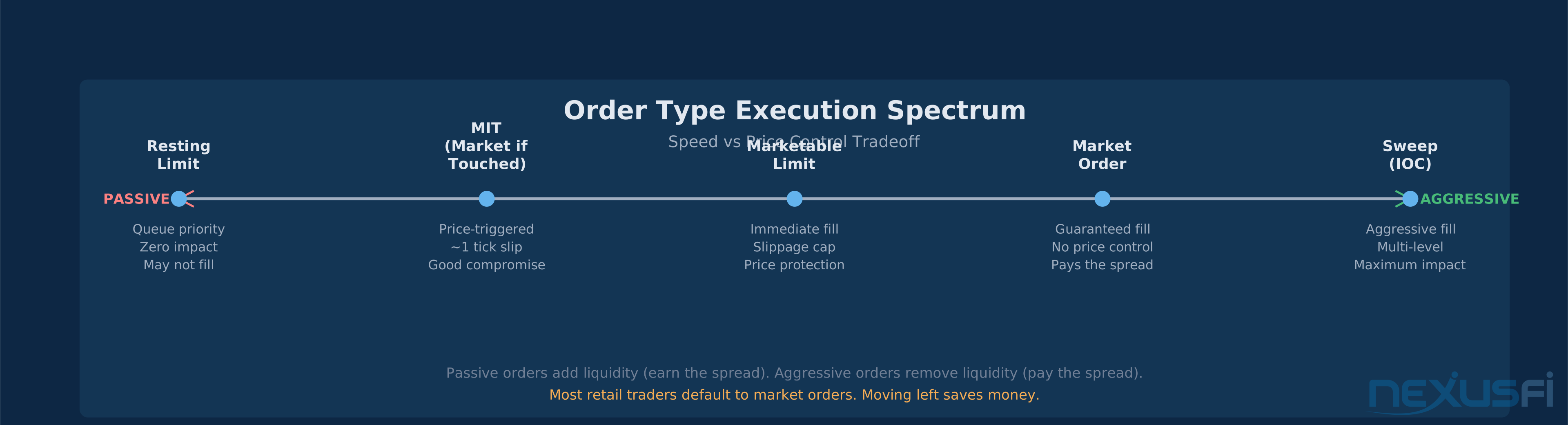
@Fat Tails describes a practical middle ground in their thread on MIT orders: Market-if-Touched (MIT) orders rest at a price and convert to market orders when that price trades. The typical result is 1 tick of slippage from the touch price — better than submitting a market order cold, worse than getting a passive fill at the touch price.
The mechanism: you place MIT to buy at 5200.00. When the market trades at 5200.00 (even one contract), your order converts to a market order and sweeps the available offer. If the offer is at 5200.25, you fill at 5200.25 — 1 tick of slippage. If the market is moving fast and the offer jumps to 5200.50, you fill at 5200.50.
MIT gives you price-triggered execution with market order immediacy. The 1-tick typical slippage is the cost of conversion speed. It's a reasonable compromise for traders who want automated entry at specific price levels without waiting in passive queue.
Marketable Limit Orders and Slippage Control
@Fat Tails addresses this directly in their analysis of marketable limit orders: buying at the ask or selling at the bid with a defined limit price sets your maximum slippage. If you place a buy limit at 5200.50 when the offer is at 5200.25, you'll fill at 5200.25 (the offer) but you won't pay more than 5200.50 no matter what.
This is the professional approach to "aggressive passive" execution. You're not just sending a market order — you're setting a ceiling on your worst fill. In fast markets, this prevents catastrophic slippage from sweeping multiple price levels.
The cost: if the offer gaps above your limit during high volatility, you don't fill. You get price protection at the cost of fill certainty. For strategies where getting the trade is essential (momentum entries), this is too restrictive. For strategies where the entry price is critical (mean reversion setups where edge disappears above a threshold), this is exactly right.
Measuring Execution Quality #
Implementation Shortfall
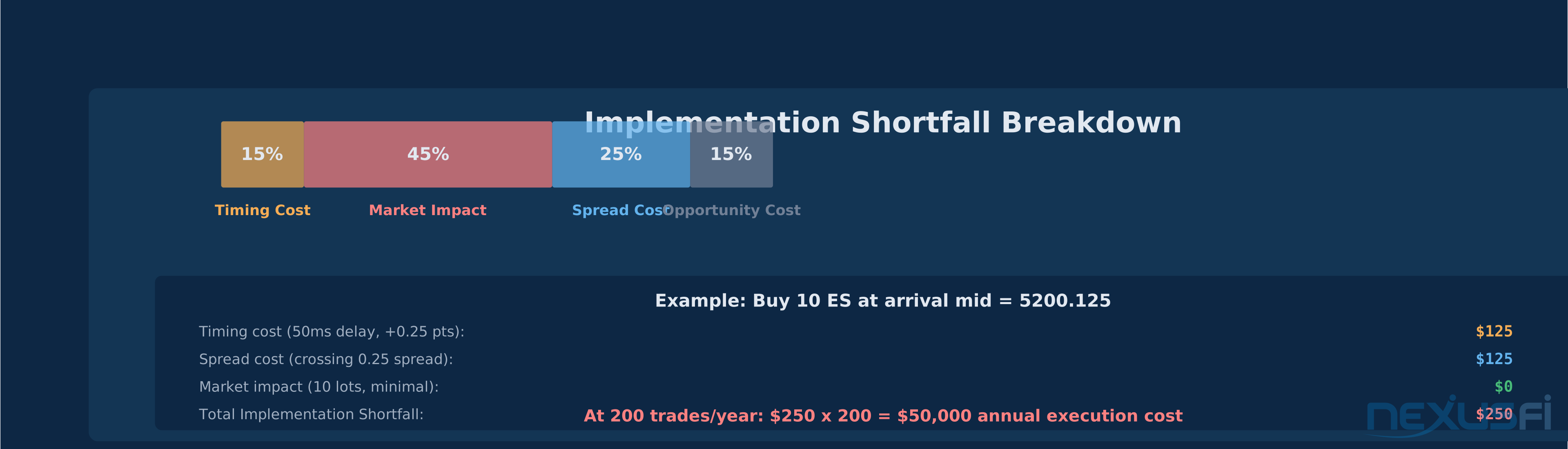
Implementation shortfall (IS) is the gold standard metric for execution quality. It measures the total cost of execution relative to the paper portfolio — what you would have made if you could trade at the decision price with no friction.
IS = (Average Fill Price - Arrival Price) x Contracts x Multiplier x Direction
For a buy order where arrival price was 5200.00 and average fill was 5200.50:
10 contracts x 0.50 points x $50 = $250
That $250 is the implementation shortfall on that single trade. If your strategy averages 200 trades per year, IS of 0.50 points per trade costs $50,000 annually — before commissions.
IS breaks into three components:
Timing cost — price movement from decision to order submission (technology latency, signal processing delay)
Market impact — price movement caused by your order consuming liquidity
Opportunity cost — cost of orders that didn't fill (the trade you missed)
Reducing IS is the explicit goal of execution algorithm design. Different algorithms make different tradeoffs between these components.
Slippage Measurement
Slippage is the simpler operational metric: the difference between your expected entry/exit and your actual fill. Every platform reports this differently, but the concept is consistent.
@Fat Tails explains the key factors affecting slippage in their thread on expected slippage: slippage occurs primarily with market orders, and the magnitude depends on order size relative to available liquidity, speed of price movement at execution, and time of day (spread widens much at open and close).
@kevinkdog documents an important practical reality: slippage in live trading vs. hypothetical backtesting has gotten worse in some respects. Research from their 2023 analysis shows a meaningful gap between simulator fills and live fills, especially in fast-moving conditions. The implication is that any backtest using "1 tick slippage" assumptions is likely optimistic for strategies that require fast execution.
@djkiwi's systematic approach to measuring execution quality on autotrading vs. replay is the right framework: log every order's expected fill price (the signal price or bid/ask at signal time), record actual fills, compute the difference, and aggregate over hundreds of trades. Patterns in slippage data reveal whether you have a systemic execution problem or just statistical noise.
A proper slippage log captures:
- Signal timestamp
- Signal price (bid, ask, or mid at signal time)
- Order submission timestamp
- Order type submitted
- Fill price
- Fill timestamp
- Slippage in ticks
- Market conditions at fill (spread, volume, volatility)
After 100+ trades, you'll see whether your slippage is random or systematic. Systematic slippage (consistently worse in certain conditions) is fixable. Random slippage that averages near zero means your execution is reasonable.
VWAP Benchmark Analysis
For traders executing larger orders or strategies where entry spreads across time, comparing fills to session VWAP provides the institutional context. A simple analysis:
- Record fill prices and quantities for each order
- Compute weighted average fill price
- Compare to session VWAP for that instrument that day
- Track the distribution over time
Consistently executing above VWAP on longs or below VWAP on shorts means you're systematically trading when liquidity is thinner than average — paying a premium for execution. Consistently beating VWAP means either good timing or that you're front-running volume patterns.
Fill Rate Analysis
For passive limit order strategies, fill rate is the critical metric — what percentage of your placed orders actually fill?
A fill rate below 70% on a limit strategy means you're frequently chasing markets or your limit prices are too passive. A fill rate above 95% on a limit strategy that targets specific prices means you're placing limits that are actually marketable — you're not getting the passive benefit you think you are.
The optimal fill rate depends on your strategy. A mean reversion strategy that only works when price reverses from your level might want a 60% fill rate — the 40% misses are times the market didn't reverse, so not filling was correct. An entry strategy that needs confirmation might target 85%+.
Practical Execution for Retail Futures Traders #
What's Actually Available on Your Platform
NinjaTrader 8
NinjaTrader's native order management covers the essentials:
- ATM Strategies — pre-configured bracket orders with stops and targets. Fully automated post-entry management.
- OCO Orders — native support for linked stop/target pairs
- MIT (Market-if-Touched) — available as a native order type
- Simulated Stop Orders — client-side orders that convert to market or limit when price triggers
- NinjaScript Strategies — full algorithmic execution via C# API with access to all order types and real-time tick data
NinjaTrader's strategy framework lets you implement TWAP by submitting one-lot orders on a timer, or arrival-price logic by tracking the bid/ask at signal time and adjusting aggressiveness based on price movement.
Sierra Chart
Sierra Chart is more powerful for execution customization:
- Advanced Custom Studies — C++ or ACSIL scripting for full order control
- Trade Activity Log — detailed fill tracking for slippage analysis
- Multi-Account Trading — scale to multiple accounts simultaneously
- Simulated vs. Native Orders — explicit control over whether orders live at exchange or on client
Sierra Chart's fill reporting is excellent for slippage analysis. The trade log exports cleanly to CSV, making it straightforward to build the slippage tracking spreadsheet described earlier.
Interactive Brokers (TWS)
IBKR has the most institutional execution toolkit accessible to retail:
- TWAP orders — native TWAP execution built into TWS
- VWAP orders — native VWAP execution with configurable participation rate
- Adaptive Algo — adjusts between passive and aggressive based on conditions
- Iceberg orders — native display quantity control
- Accumulate/Distribute — configurable order splitting with randomization
For futures traders with larger size (10+ lots per trade), IBKR's native algos are worth serious consideration.
What to Actually Use
For most retail futures traders executing 1-10 lots per trade:
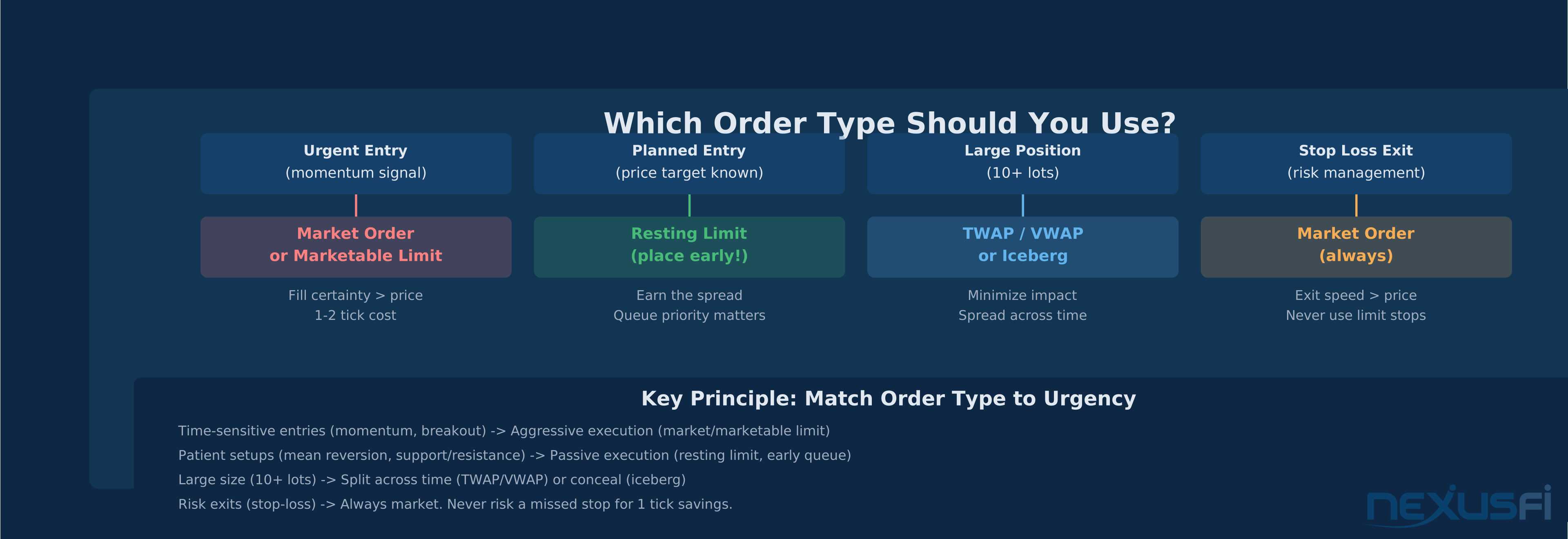
Single entries/exits: Marketable limit orders with a 1-2 tick buffer over the current offer (buys) or below the current bid (sells). You get the certainty of immediate execution with slippage protection.
Scale-ins over multiple prices: Manual or scripted TWAP on a 30-60 second window. Send 1-lot every 30 seconds until full. Minimal market impact, spreads the execution risk.
Stop-loss exits in fast markets: Market orders, not limits. In a fast falling market, a sell-limit stop will miss. Take the 1-2 tick slippage — it's far cheaper than a missed stop.
Profit targets in stable markets: Passive limit orders at your target price. Get in the queue early — place the limit when you enter the position, not when price approaches the target.
The @iantg insight applies here directly: for NQ specifically, where book depth is 200-400 contracts thinner than ES per level, getting in queue early is essential. If your strategy has a defined target, place the limit immediately on entry.
Common Execution Mistakes (and How to Avoid Them) #
Using Market Orders for Everything
Market orders guarantee fills but not prices. In liquid markets like ES during RTH, this costs you 1 tick (the spread) plus whatever impact your size has. Over 500 trades per year at 5 lots per trade, that's:
500 trades x 5 lots x 1 tick x $12.50 = $31,250 annually
Just from unnecessary market orders on entries where limit orders would have worked fine.
The fix: default to marketable limit orders for entry. Use market orders only for exits where immediacy is critical.
Placing Limits at Round Numbers
Round numbers attract order clustering. A buy limit at exactly 5200.00 puts you in a queue with hundreds of other traders who set the same round number. You're at the back of a deep, visible queue.
Place limits 1-2 ticks away from obvious round numbers. The fill probability drops marginally, but you avoid the front-running dynamic and often get better queue position because fewer traders pick odd ticks.
Ignoring Time of Day
ES spreads during RTH (9:30 AM to 4:00 PM ET) are typically 0.25 points (1 tick). During the open (first 10 minutes) and close (last 10 minutes), effective spreads widen 2-5x as algorithms adjust to volatility.
If your strategy allows execution timing flexibility, avoid the open and close for limit-order strategies. Execution quality is measurably better from 10:00 AM to 3:30 PM ET for most futures contracts.
Backtesting with Best-Case Fill Assumptions
This is the most expensive mistake in systematic trading. Assuming you fill at the signal bar's close, or at the bid on buys and ask on sells, builds in fills you'll never see in live trading.
Conservative backtesting assumptions for futures:
- Market orders: Fill at ask + 1 tick for buys, bid - 1 tick for sells
- Limit orders: Only fill if price trades through your limit by at least 1 tick (not just touches)
- Fast market conditions: Add 2-3 ticks additional slippage for entries during high-volatility periods
- Large size (10+ lots): Add 0.5-1 tick per 10 lots for market impact
A strategy that shows 2 ticks of average slippage in backtesting with conservative assumptions and still has positive expectancy is real. A strategy that needs best-case fills to show profitability will lose money live.
Not Measuring Actual Slippage
The traders who get better at execution are the ones who track it systematically. @djkiwi's approach — logging expected vs. actual fills on every trade — is the operational discipline that turns execution from a guess into a process.
The setup is simple:
- Log the bid/ask at signal time
- Log the actual fill price
- Compute the difference
- Review weekly for patterns
After 100 trades, you'll know whether you have a 0.5-tick average slippage problem or a 2-tick problem. You'll know whether slippage is worse at the open, in volatile conditions, or with market orders. And you'll have a baseline to measure against if you change your execution approach.
Bringing It Together #
Automated order execution is the translation layer between your trading decisions and your actual P&L. The decision can be brilliant and the execution can still destroy the edge.
The key principles to carry forward:
- Queue position is capital. Get in the queue early for passive orders. The first trader at a price level has maximum priority.
- Measure everything. You can't improve what you don't track. Build the slippage log, review it weekly, find the patterns.
- Match order type to urgency. Time-sensitive entries warrant aggressive execution. Patient setups deserve patient execution. Using market orders for mean reversion entries is burning money.
- Backtest conservatively. Assume you fill through your limit, not at it. Assume market orders cost 1-2 ticks more than mid. If the strategy is profitable under conservative assumptions, it has a real chance live.
- Size controls impact. At retail sizes (1-10 lots on ES/NQ), market impact is minimal in liquid conditions. At 25+ lots, it becomes a real cost to manage.
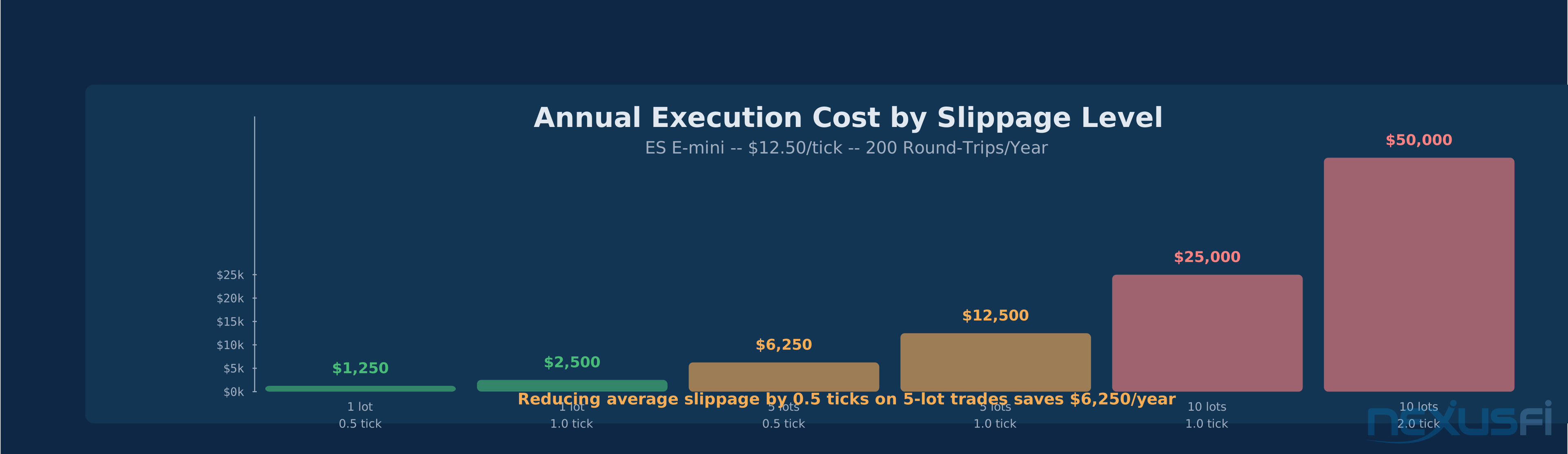
The goal isn't perfect execution — that's theoretically impossible. The goal is measured, systematic, improving execution. Every tick of improvement in average slippage is pure profit added to whatever your strategy generates. At 200 trades per year on 5 lots, a half-tick improvement is:
200 x 5 x 0.25 points x $50 = $12,500 annually
That's real money — earned not by finding a better signal, but by executing the same signal more skillfully.
Knowledge Map
Go Deeper
Build on this knowledgeReferences This Article
Articles that build on this topicCitations
- — Session Toolbox - Trading the Session (Fat Tails) (2013) 👍 54“In this post I just want to summarize some of the properties of the VWAP 1.The VWAP is the price of the session. The VWAP can be considered as the price of the day.”
- — Expected slippage vs order size (2010) 👍 8“Slippage occurs with market orders only. If you use limit orders there will be positive slippage. In case you enter a market order, there are different cases to consider: What causes slippage? (a) Your order size exceeds the number of contracts avail...”
- — MIT (Market if touched) - Reduce Slippage (2013) 👍 15“Hi Erfan, Welcome to the forum. You asked a few interesting questions, will be fun to answer. A market if touched order is a conditional order, which is not shown on the order book. It will be activated when price touches the trigger price.”
- — Buying the Ask; Selling the Bid - better than placing Market orders? (2011) 👍 14“If you buy the ask, this is a limit order at the best ask price. The price is guaranteed, but there is a risk of not getting filled. This is true for all limit orders.”
- — how to get better fills, especially on NQ (2020) 👍 4“If you are interested in speed and better fills then here are the biggest items that could help you. 1. Get in line early for all your orders (entries + exits).”
- — How does my buy limit order not get filled on touch? (2022) 👍 6“The issue is not the speed of the computers. A limit order is not guaranteed to be filled. If it is filled, it will be at its stated price, but for it to be filled there must be orders on the other side that can be matched to it, at that price.”
- — Ask me anything: systematic trading (AMA) (2016) 👍 2“25-40 lot definitely falls into the realm of having significant market impact. The formal way to look at it is: If you want to reduce market impact, you need to have a trading schedule algorithm.”
- — Webinar: Real-world Order Flow Strategies & Setups w/Scott Pulcini & Bookmap (2020) 👍 13“If it helps calm everyone down, I'll weigh in and assert that almost everyone here in this thread is using "icebergs" incorrectly. I'm happy to be proved wrong, the world is a happier place when everyone learns of their own lack of knowledge.”
- — Webinar: Real-world Order Flow Strategies & Setups w/Scott Pulcini & Bookmap (2020) 👍 8“I know not aimed at me but I think some important points.... Actually - this is what's being taught out there. Right now - traders are being taught that you should buy ahead of icebergs. That MBO detected icebergs represent 'secret sauce'.”
- — Slippage Now 2023 vs Past (2023) 👍 6“I see people routinely UNDERstating slippage (especially sim trading scammers on YT and Twitter). Maybe I define slippage differently, but I compare the hypothetical fill from my strategy backtest engine, and compare it to my actual fill.”
- — Autotrading Slippage compared to Replay (2012) 👍 23“Gary, unfortunately if you continue with this approach the odds are so mathematically stacked against you, you will lose all or nearly all of your money. I would seriously consider a temporary halt to this approach.”
- — Filling Limit Orders on the ES (2012) 👍 5“I would recommend you fully understand the workings of a futures exchange. There is a rather dry but extremely detailed and thorough explanation of how exchanges work in Larry Harris's excellent book, Trading and Exchanges.”