



Market Data Handling for Automated Trading Systems: Building the Foundation Your Algo Can't Trade Without
Overview #
Market Data Handling for Automated Trading Systems: Building the Foundation Your Algo Can't Trade Without
Your algorithm is only as good as the data feeding it. A brilliant strategy running on garbage data will produce garbage results — and in futures, garbage results mean real losses measured in ticks, not theory. Market data handling is the unglamorous plumbing that separates production-grade trading systems from backtesting toys.
This article covers the full lifecycle of market data in automated futures trading — from the moment a packet leaves the exchange matching engine to the point where your strategy consumes a clean, validated, sequenced event stream. Get this wrong and nothing downstream matters. Get it right and you've built the foundation everything else depends on.
The Data Pipeline Mental Model #
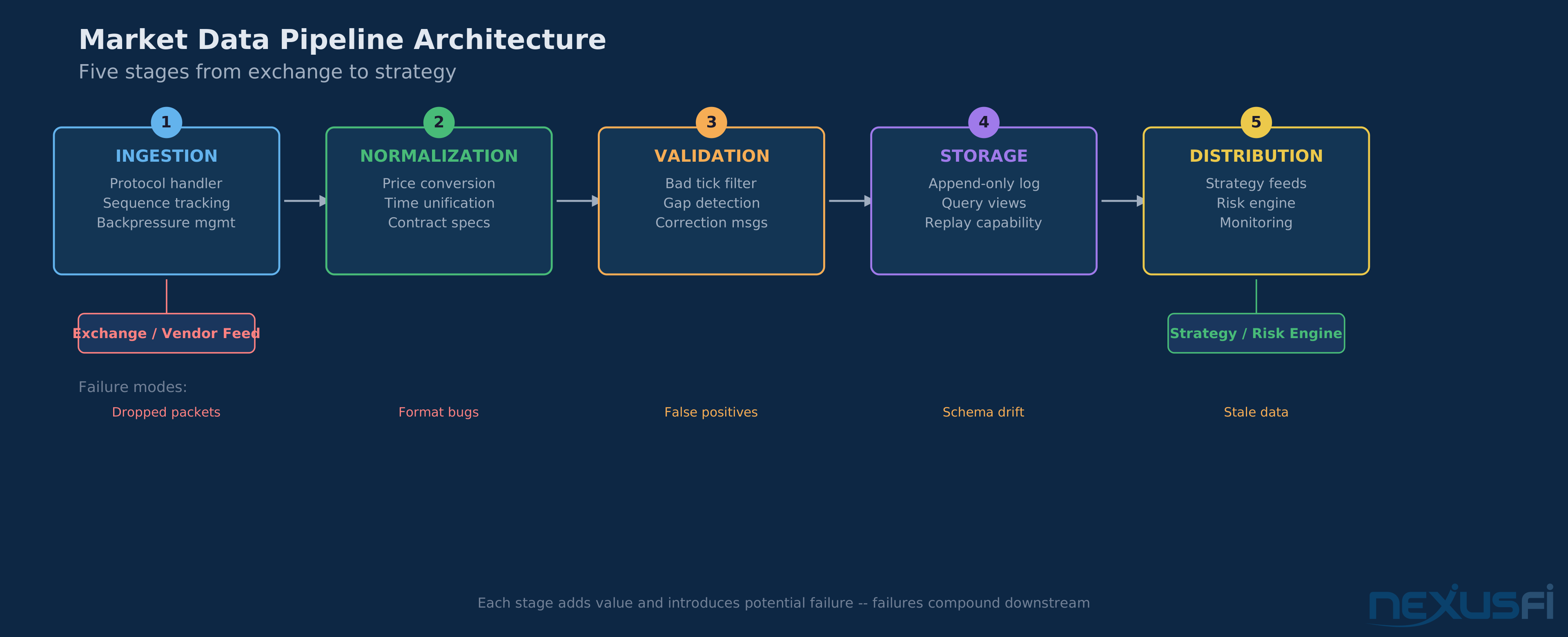
Think of your market data infrastructure as a pipeline with five stages, each adding value and each capable of introducing errors:
Ingestion — Raw data arrives from the exchange or vendor feed. Packets come in fast, sometimes out of order, sometimes with gaps. Your job is to capture everything without dropping messages.
Normalization — Raw protocol-specific data gets converted into your internal canonical format. Prices become tick-aligned values, timestamps get unified, contract-specific quirks get resolved.
Validation — Every tick gets checked against sanity rules. Bad ticks get flagged or filtered. Gaps get detected and recovery procedures trigger.
Storage — Clean data gets persisted for replay, debugging, and historical analysis. Schema versioning ensures your research doesn't silently change when you update the pipeline.
Distribution — Validated data reaches your strategy, risk engine, and monitoring systems through well-defined interfaces with freshness guarantees.
Each stage has its own failure modes, and failures compound downstream. A normalization bug that shifts prices by one tick will produce a perfectly functional-looking but at the core wrong data stream that your validation layer might never catch because the data "looks" clean.
Real-Time Feed Management #
The Packet Lifecycle #
When a trade happens at the CME, the matching engine assigns a sequence number and broadcasts the event. That message travels through the exchange's network infrastructure, reaches your data vendor's gateway (or your direct feed handler if you're colocated), gets processed, and eventually arrives at your application layer.
— and every hop in that chain adds latency and introduces potential failure points. [1]
For context on the raw throughput involved,
That's over 2,700 depth updates per second across just two instruments — and that's a normal trading session, not a volatility spike. [2]
Event-Driven Architecture #
Production data pipelines are event-driven, not polling-based. Your system subscribes to instruments and processes events as they arrive. The critical design decisions:
Single-threaded vs multi-threaded ingestion. Single-threaded processing on a pinned CPU core gives you deterministic latency — every event processes in the same order, every time. Multi-threaded processing can handle higher throughput but introduces sequencing complexity. For most retail and mid-frequency strategies, single-threaded with a lock-free ring buffer handles the load with microsecond consistency.
Backpressure handling. When your processing can't keep up with incoming data — during a flash crash or a Fed announcement — you need explicit backpressure policies. Options include: dropping oldest events (acceptable for quote data, catastrophic for trade data), buffering with bounded queues (predictable memory usage, known worst-case latency), or degrading gracefully by widening your strategy's spread requirements when the system detects falling behind.
Staleness detection. Your system needs to know when data is old. A quote that's 500 milliseconds stale during a volatile ES session might as well be from yesterday. Implement per-symbol heartbeat monitoring: if no update arrives within an expected interval (calibrated to the instrument's typical update frequency), flag the data as potentially stale and alert your strategy.
Subscription Management #
Futures have session boundaries that equities don't. ES trades nearly 23 hours per day on Globex, but the RTH session (9:30 AM - 4:00 PM ET) is where the real volume lives. Your subscription logic needs to handle:
- Session open/close transitions cleanly
- Pre-market vs RTH vs post-market state changes
- Holiday schedules and early closes (these will bite you if they're hardcoded)
- Exchange-level trading halts and circuit breakers
Tick Data Normalization #
Normalization converts raw feed data into a canonical format your strategy can consume without caring which vendor or protocol delivered it. This is where futures-specific details matter enormously.
Price Representation #
Every futures contract has a minimum tick size, and your internal price representation must respect it. ES ticks in 0.25-point increments. CL ticks in $0.01 increments. ZB ticks in 1/32nds of a point. Getting this wrong produces prices that look reasonable but don't correspond to any tradeable level.
Store prices as integers internally — multiply by the inverse of the tick size. ES at 5500.25 becomes 22001 (5500.25 / 0.25). This eliminates floating-point comparison bugs that will otherwise haunt your strategy logic. "Is this price equal to that price?" is a question that IEEE 754 floating point cannot reliably answer, but integer comparison handles trivially.
Time Normalization #
Timestamps are deceptively complex. Exchange timestamps, vendor timestamps, and your local arrival timestamps will all differ — sometimes by milliseconds, sometimes by seconds during high-load periods.
@iantg measured this directly using Rithmic's API from a colocated server: "The bid and ask feed has a timestamp down to the microsecond from the exchange. You can test the delta between this timestamp and when your application receives the update... other retail applications I tested were around 250 milliseconds behind the exchange timestamps." [3]
Your normalization layer should:
- Preserve the original exchange timestamp (this is ground truth)
- Record your local arrival timestamp (this is what your strategy actually experienced)
- Convert all timestamps to a single timezone representation (UTC is standard)
- Handle DST transitions — the US switches twice a year, Europe switches on different dates, and some futures trade across the boundary
Contract-Specific Conventions #
Futures are not equities. Each contract has a multiplier, a tick size, specific trading hours, and expiration dates. Your normalization layer needs a contract specification database that maps every instrument to its canonical properties:
| Property | ES | CL | ZB | NQ |
|---|---|---|---|---|
| Tick size | 0.25 | 0.01 | 1/32 | 0.25 |
| Multiplier | $50 | $1,000 | $1,000 | $20 |
| RTH hours | 9:30-16:00 ET | 9:00-14:30 ET | 8:20-15:00 ET | 9:30-16:00 ET |
This database needs to be versioned and updated — exchanges change specs, margins shift, and new micro contracts appear. A hardcoded spec table is a ticking time bomb.
Handling Bad Data and Gaps #
Bad Tick Detection #
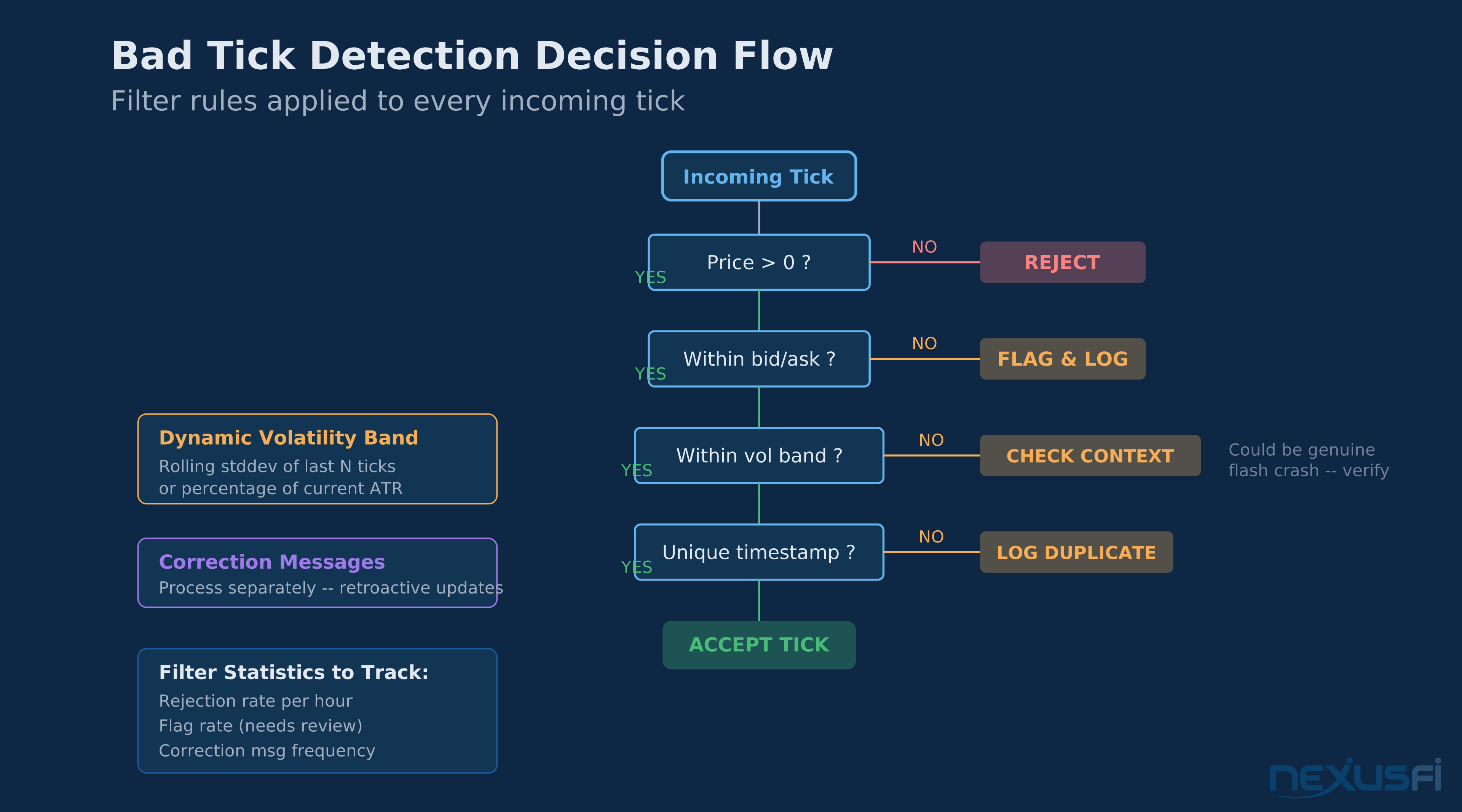
Bad ticks happen. IQFeed, one of the most popular retail data feeds, is explicitly unfiltered — they provide "TRUE, tick-by-tick" data including erroneous prints.
Common bad tick patterns in futures:
Zero or negative prices. Self-explanatory — no futures contract trades at zero. Filter immediately.
Price jumps exceeding reasonable thresholds. A single tick that jumps 50 points on ES when the previous tick was normal is almost certainly bad data. But be careful with static thresholds — during genuine flash crashes, prices can move 20+ points in seconds. Use dynamic thresholds based on recent volatility (rolling standard deviation over the last N ticks or a percentage of the ATR).
Crossed markets. When the bid exceeds the ask in the feed, something is wrong. This can indicate bad data, but it can also indicate latency in the quote updates. Don't immediately filter — log and investigate.
Duplicate timestamps with different prices. This can indicate feed fragmentation or delayed corrections.
The Correction Message Problem #
This is a futures-specific pitfall that catches developers coming from crypto or equities. Futures exchanges routinely issue correction messages — trade busts, price corrections, and volume adjustments — sometimes minutes or hours after the original event.
An automated system that doesn't respect Update and Delete flags in the protocol feed will calculate erroneous P&L, incorrect positions, and wrong indicator values. Your data pipeline must support retroactive corrections: when a correction arrives, propagate the change through your entire downstream state.
Gap Detection and Recovery #
Sequence gaps in the data feed indicate missed messages. Your recovery strategy depends on the gap type:
Sequence number gaps. Most exchange feeds include sequence numbers. If you receive message 1000 followed by message 1003, you've missed two messages. Request retransmission from the feed handler or snapshot server.
Heartbeat timeouts. If no data arrives for a configurable period, assume a connection problem. Reconnect, request a snapshot of current market state, and rebuild your local order book from that snapshot plus subsequent incremental updates.
Session boundary gaps. The period around session transitions (like 4:00 PM to 6:00 PM ET for ES, or the daily maintenance window) naturally has no data. Your system needs to distinguish "no data because the market is closed" from "no data because something broke."
The recovery strategy matters for your trading logic.
Choose your failure mode deliberately: fail-fast (stop trading immediately when data quality degrades) is appropriate for latency-sensitive strategies. Degrade-gracefully (widen spreads, reduce position size, switch to limit-only orders) suits longer-horizon strategies where a few seconds of imperfect data won't kill you.
Data Feed Redundancy and Failover #
Running a single data feed is running without a safety net. Professional automated traders use at least two independent feed sources.
Multi-Feed Architecture #
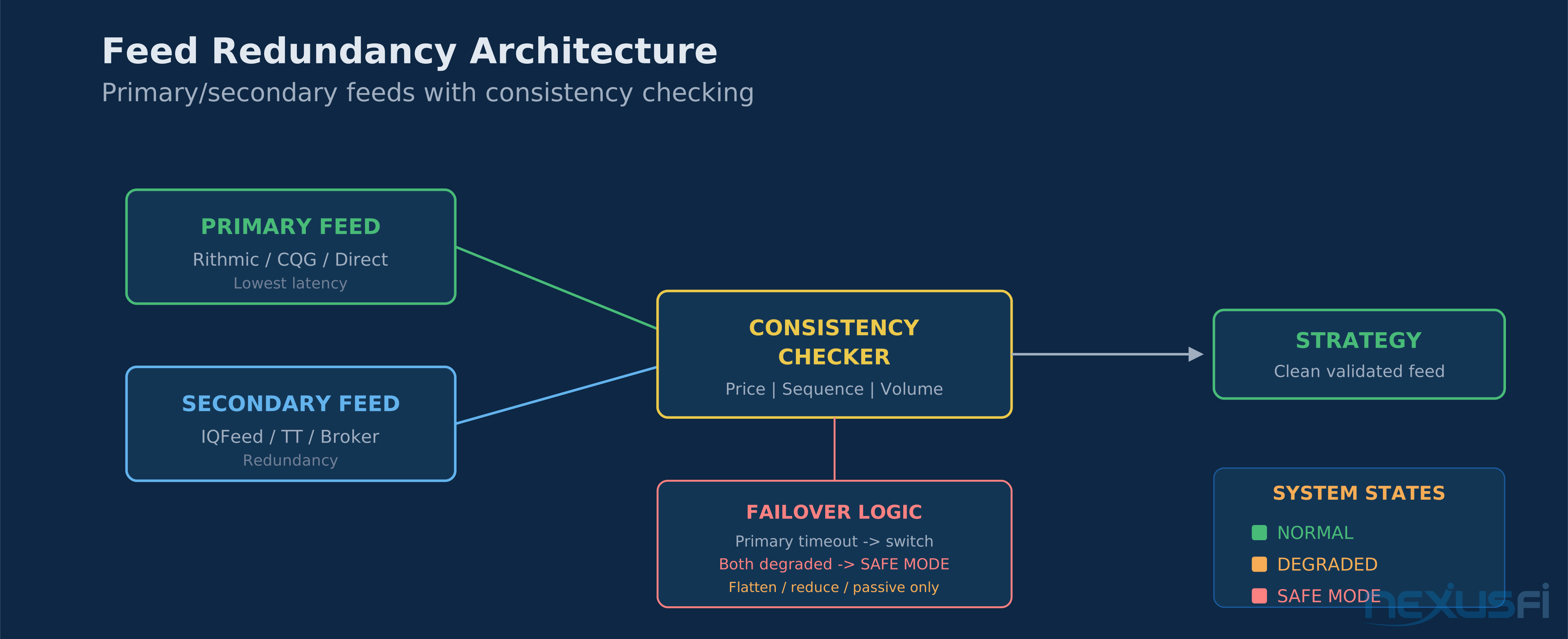
The standard setup uses a primary feed (your lowest-latency, highest-fidelity source) and one or more secondary feeds for redundancy. In the futures world, this often means:
- Primary: Rithmic, CQG, or a direct exchange feed
- Secondary: A different vendor (IQFeed, TT, or a broker's feed)
But differences do exist in how vendors process and deliver data — different feeds bundle ticks differently, apply different filtering, and route through different infrastructure. [6]
Consistency Checks #
When running multiple feeds, you need to continuously validate that they agree. Compare:
- Last trade price (should match within tick size)
- Best bid/ask (should match within normal spread)
- Sequence integrity (both feeds showing the same number of trades over time)
When feeds diverge beyond configured thresholds, your system should:
- Log the divergence with full context
- Attempt to determine which feed is correct (the one with higher sequence fidelity usually wins)
- If no determination is possible, enter "safe mode" — flatten or reduce positions, switch to passive-only orders, alert the operator
Failover Logic #
Automatic failover needs explicit rules. Don't just "switch to the backup" — define:
- Trigger conditions: How many missed heartbeats? What staleness threshold?
- Transition behavior: Do you pause trading during switchover? Accept potential duplicate events?
- Recovery: When the primary comes back, do you switch back immediately or wait for confirmation of stability?
Historical Data Storage and Retrieval #
Your data pipeline doesn't end at real-time consumption. Historical data serves three critical functions: backtesting strategy logic, replaying production incidents, and training machine learning models.
Storage Architecture #
For futures tick data, append-only time-series storage is the right pattern. Each event gets written once and never modified (corrections get written as new events referencing the original). This gives you:
- Immutable audit trail: You can always see exactly what your system saw at any point in time
- Replay fidelity: Reproduce the exact event stream your strategy processed during a specific session
- Schema versioning: When you change your canonical format, old data stays in its original schema with a version tag
@artemiso emphasizes the importance of data fidelity for futures: his historical MBO data samples include "nanosecond precision in the timestamps and one-to-one correspondence with exchange message sequence numbers" — the kind of precision needed to reconstruct exact market state at any point. [7]
Query Patterns #
Design your storage around how you'll actually query it:
- Session-based slices: "Give me all ES data from the RTH session on March 15"
- Rolling windows: "Give me the last 20 days of NQ tick data"
- Contract roll windows: "Give me the 5 days around the March-to-June ES roll"
- Event-type filters: "Give me only trades (not quotes) for CL during the OPEC announcement"
Replay vs Live #
Your historical replay engine should produce the same event stream format as your live data pipeline. If your strategy sees different data structures in backtest vs production, you will have bugs that only appear in one mode. This is a non-negotiable architectural constraint — a single canonical event type that both live and replay systems emit.
Symbology and Contract Rollover #
The Roll Problem #
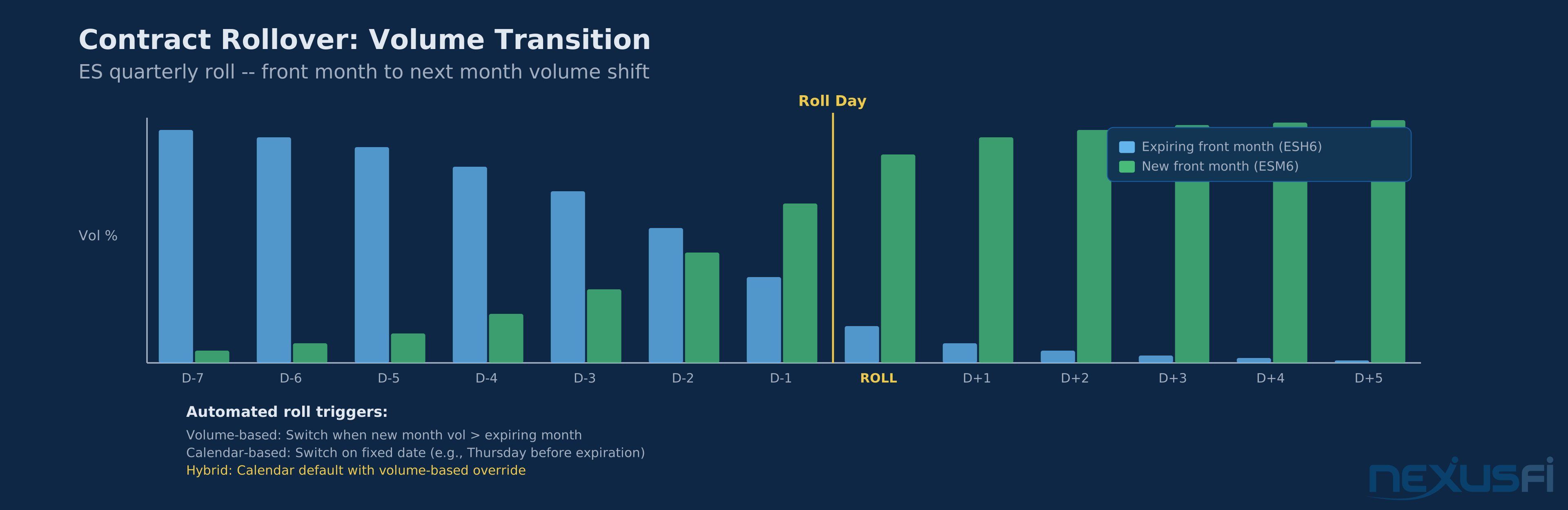
Futures contracts expire. Every quarter (or every month for some products), your system needs to transition from the expiring front-month contract to the next one. Getting this wrong means your algo trades an illiquid back month at terrible fills, or worse, tries to trade an expired contract.
He details three approaches — gap-adjusted, back-adjusted, and continuous — each with distinct implications for backtesting validity. [8]
Automated Roll Logic #
For live trading, your system needs explicit roll rules:
Volume-based roll: Switch to the new front month when its daily volume exceeds the current front month's. This is the most common and most reliable approach for liquid futures. For ES, the roll typically happens on the Thursday before expiration. For CL, it can vary much.
Calendar-based roll: Switch on a fixed date relative to expiration. Simpler to implement but less adaptive to actual liquidity transitions.
Hybrid approach: Use calendar rules as the default with volume-based override. If volume transitions earlier or later than expected, the system adapts.
Your roll logic must propagate through the entire pipeline:
- Update the symbol mapping (ES now means ESM6 instead of ESH6)
- Reset accumulated session state (VWAP, volume profiles, etc.)
- Adjust any continuous-contract calculations
- Notify downstream strategies of the roll event
Symbology Management #
Every exchange and vendor uses slightly different symbol formats. CME uses one format, your broker uses another, your charting platform uses a third. Your pipeline needs a symbology translation layer that maps between all of them. Keep this mapping in a database, not in code — contract months change quarterly and new products launch regularly.
Latency Considerations #
What Latency Actually Means #
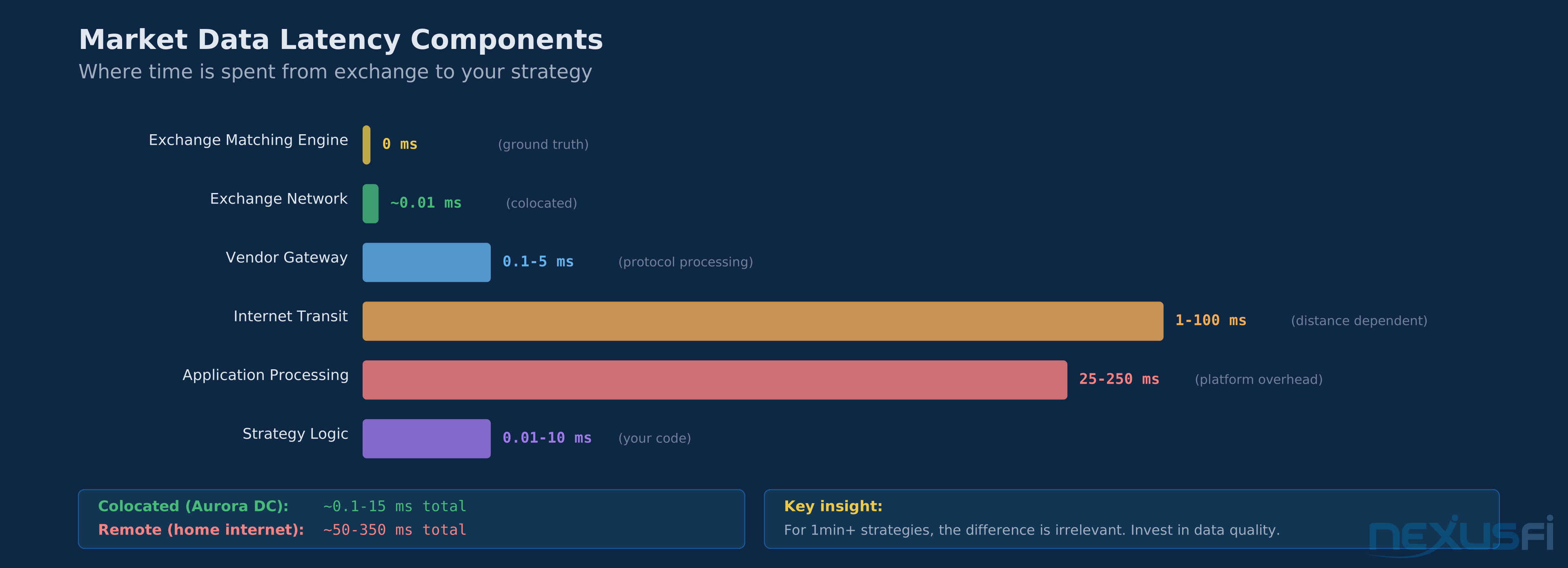
Latency in market data has multiple components, and they're not all equal:
@SMCJB breaks down the order routing path clearly: trading from home in Chicago, "your order is actually travelling (routed) all the way to Florida and back" if your broker's gateway is in Florida. Even colocated, you're looking at different latency profiles: "Your software at the Cermak data center — your order had to travel about 50 miles. Your software at your broker's colocated space in Aurora — your order had to travel 106 feet." [9]
The same principle applies to market data. Your data feed travels a physical path, and every hop adds latency.
When Latency Matters (And When It Doesn't) #
For most automated futures strategies — trend following, mean reversion on 1-minute+ bars, swing trading, portfolio allocation — the difference between 10ms and 100ms of data latency is completely irrelevant. Your edge comes from signal quality, not speed.
Where latency genuinely matters:
- Market making at the top of the book where queue position is everything
- Statistical arbitrage between correlated instruments where the window of opportunity is milliseconds
- News-driven strategies racing to react to economic releases
If your strategy doesn't require sub-millisecond data, spending money on colocation and exotic feed infrastructure is waste. Invest in data quality instead.
Freshness Gating #
Regardless of your strategy's latency sensitivity, you need freshness gates — configurable thresholds that tell your strategy "this data is too old to act on." If your market data is 2 seconds stale during a fast market, your limit order placement will be wrong and your market orders will slip more than expected.
Implement per-symbol freshness tracking: compare the most recent exchange timestamp to your local clock (accounting for known clock offset). If the delta exceeds your threshold, signal your strategy to stop or reduce activity until the data catches up.
Practical Pipeline Engineering #
Reference Architecture #
A production-grade futures data pipeline looks like this:
Exchange/Vendor Feed
      ↓
[1. Ingestion Layer]
    - Protocol handler (FIX/FAST, binary, proprietary)
    - Sequence tracking
    - Backpressure management
      ↓
[2. Normalization Layer]
    - Price → integer conversion
    - Timestamp unification
    - Contract spec application
      ↓
[3. Validation Layer]
    - Bad tick filter
    - Gap detection
    - Correction message processing
      ↓
[4. Persistence Layer]
    - Append-only event log
    - Query-optimized views
    - Replay capability
      ↓
[5. Distribution Layer]
    - Strategy feeds (low-latency)
    - Risk engine feeds
    - Monitoring/alerting feeds
Observability #
You can't fix what you can't see. Instrument every stage of your pipeline:
- Gap rate: How many sequence gaps per hour? A rising gap rate indicates network or vendor issues.
- Invalid tick rate: How many ticks get filtered? A spike means either bad data from the vendor or your filter thresholds are wrong.
- Queue depth: How deep are your internal buffers? Rising depths mean you're falling behind.
- Event drop count: Are you dropping events? This should be zero in production.
- Feed divergence: If running multiple feeds, how often do they disagree?
Set alerting thresholds calibrated to your instrument's typical behavior. ES during lunch hour generates far fewer events than ES during the 9:30 open. Your alerting needs to account for these natural variations.
Operational Checklist #
Before going live with an automated strategy, verify:
- [ ] Bad tick filter handles real historical bad ticks correctly (test against known bad tick events)
- [ ] Gap recovery produces correct state after simulated network disconnection
- [ ] Failover to secondary feed works within acceptable latency
- [ ] Historical replay produces identical results to live processing on the same data
- [ ] Roll logic correctly transitions between contract months
- [ ] Freshness gates trigger at configured thresholds
- [ ] All monitoring metrics are reporting and alerting correctly
- [ ] Pipeline handles exchange maintenance windows without false alerts
- [ ] Correction message processing produces correct adjusted state
When Data Handling Fails #
No data pipeline is perfect. Understanding the failure modes helps you design appropriate safeguards:
Silent data degradation. The most dangerous failure. Data looks normal but is subtly wrong — prices shifted by one tick due to a normalization bug, or timestamps drifting because of clock sync issues. The only defense is regular validation against an independent data source.
Vendor outages. Every data vendor has outages. Without redundancy, you're blind. With redundancy, you switch to your backup feed — but now you need to handle the potential for duplicate or out-of-order events during the transition.
Exchange corrections that arrive late. A trade gets busted 30 minutes after execution. If your strategy already acted on that trade's signal, you may have positions based on data that no longer exists. Your correction handler needs to propagate the change and flag any affected positions for review.
Protocol changes. Vendors and exchanges update their protocols. A field that was a 32-bit integer becomes a 64-bit integer. A new message type gets added. These changes break brittle parsers. Build your ingestion layer to handle unknown fields gracefully and log warnings for unrecognized message types.
Volume regime shifts. During high-volatility events (Fed announcements, elections, geopolitical shocks), data rates can spike 10x or more. If your pipeline is sized for normal conditions, it will fall behind exactly when you need it most. Size your buffers and processing for peak load, not average load.
Knowledge Map
Go Deeper
Build on this knowledgeReferences This Article
Articles that build on this topicCitations
- — Getting a co location dedicated server, but need some help! (2013) 👍 8“Elite: Trying to answer your questions. False: Automated trading does not always use stop and limit orders, but an automated trading strategy can also use market orders.”
- — Design a DayTrader Scalping Trend Pivot Indicator (2022) 👍 2“COMMENTS ON DEPTH OF MARKET UPDATE RATES with the Rithmic Market Data feed. My system counts incoming Market Depth Update events for EACH minute.”
- — Rithmic Latency Calculations (Plus trading remotely) (2022) 👍 5“The latency you are seeing from Rithmic is the latency between them and the exchange. As long as you are co-located well, this part should be the least of your concerns. The bigger impacts to your latency are: 1.”
- — IQFeed: Suggestions to filter bad ticks (2020)“I've also had this issue previously using IQFeed service as it is as you say, unfiltered and not cleaned.”
- — Ninja8 DXFeed (2025) 👍 1“Hi, what experiences do users have with the NT8 DXFeed integration? Is it worth to give it a shot? It would run colocated sub 1MS to CME to provide tick data for volume chart based bots in NT8 executed over CQG and maybe IB looking longer ahead.”
- — Futures Data Question (2021) 👍 3“Rithmic has a very good reputation too and is the full data so there should in effect be very little to no difference between that and DTN IQFeed.”
- — Historical market depth and MBO data: Assess your latency, data and execution quality (2019) 👍 16“I decided to start a thread to provide some samples of historical market depth and MBO data to consolidate a solution for different questions on execution quality, data integrity and latency.”
- — continuous contract in NT7 /merge policy / rollover (2011) 👍 31“First of all there are several ways of creating continuous or merged futures. This document gives an overview of the options. https://nexusfi.com/free_downloads/educational_manuals_ebooks_videos/628-download.”
- — Which the best faster VPS to retail (2022) 👍 8“Your software (or you) creates an order, that order has to get to the exchange matching engine. How it gets there is called 'order routing'. Example A. You live in Chicago and trade from home using Software ABC.”
- — Rithmic Latency Calculations (Plus trading remotely) (2022) 👍 5“The latency you are seeing from Rithmic is the latency between them and the exchange. As long as you are co-located well, this part should be the least of your concerns. The bigger impacts to your latency are: 1.”