



Machine Learning for Futures Trading: Pattern Recognition, Prediction Models, and the Realities of Algo Intelligence
Subtitle: What ML can actually do in futures markets, what it can't, and the validation framework that separates real edge from expensive curve-fitting.
Overview #
Machine learning in futures trading sits at a strange intersection
This isn't an ML primer. If you need to learn what a random forest is, start there first. This article is for futures traders who want to understand where ML actually creates edge, where it reliably destroys capital, and what the critical validation requirements look like when you're applying statistical learning to financial time series. The gap between a model that backtests well and a model that makes money live is wider in futures than almost any other ML application domain
The core problem is simple to state and difficult to solve: financial time series are non-stationary, noisy, and adversarial. The patterns that existed last quarter might not exist this quarter. The features that predicted crude oil direction in 2022 might be worthless in 2024. And unlike image classification or natural language processing
None of this means ML is useless for futures trading. It means the bar is higher than most retail traders expect, and the value often shows up in places they're not looking.
The ML Problem: Why Futures Are Different #
Before touching any algorithm, understand what makes futures data at the core different from the datasets where ML typically excels.
Contract mechanics contaminate your data. Futures contracts expire. When you roll from one contract to the next, the price jumps by the calendar spread
Non-stationarity is the default, not the exception. In image recognition, a cat in 2020 looks like a cat in 2025. In futures markets, the statistical properties of ES price changes shift with Fed policy, volatility regimes, and market structure evolution. A model trained on the low-volatility grind of 2017 is worse than useless during the VIX explosion of early 2018. This isn't a bug to be patched
Leverage amplifies everything. A 1% misclassification rate sounds great in academic ML. In futures, with 10:1 or 20:1 leverage, that 1% error hits your account like a freight train. ML models for futures must be evaluated not just on accuracy but on the tail behavior of their wrong predictions
The signal-to-noise ratio is terrible. In most ML applications, the signal is strong relative to noise. In futures markets, daily returns are dominated by noise. Even the best systematic strategies capture only a thin statistical edge buried under enormous randomness. This means you need either a lot of data (which introduces non-stationarity) or very clean features (which requires deep domain expertise). There is no free lunch.
Core ML Tasks Mapped to Futures Trading #
ML earns its keep in futures trading when it's solving the right problem. The most common mistake is asking ML to predict direction
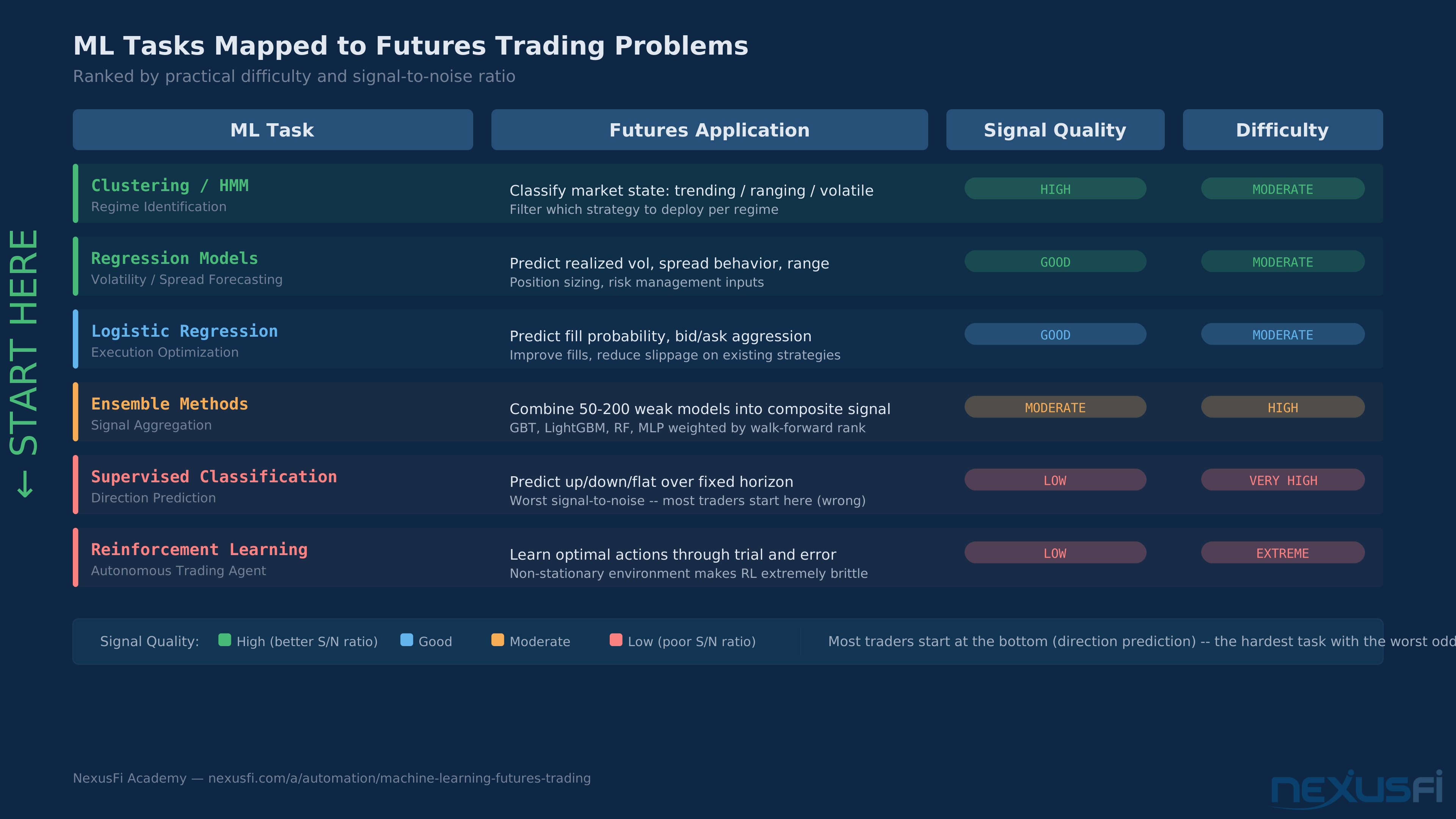
Classification: regime identification. Is the market trending, ranging, or in a volatility expansion? Clustering algorithms (k-means, Gaussian mixture models) and hidden Markov models can identify regime states from multi-dimensional feature sets
Regression: volatility and spread forecasting. Predicting the magnitude of moves (realized volatility) or the behavior of spreads (calendar spreads, inter-commodity spreads) is more tractable than direction prediction. The signal-to-noise ratio is better, the targets are more persistent, and the outputs map directly to position sizing and risk management decisions. Gradient boosted trees and neural networks both outperform simple historical averages here
Classification: execution optimization. As @SMCJB documented in a 2016 discussion on NexusFi, a logistic regression model trained on order book data predicted whether the next trade in crude oil would hit the bid or ask with over 75% accuracy. Applied to a simple Bollinger Band strategy, this execution filter turned a small loser into a consistent winner
Ranking and scoring: signal aggregation. When you have multiple trading signals or models, ML can learn the optimal weighting across them. This is the ensemble approach
Reinforcement learning: position management. RL sounds seductive
Feature Engineering: The Make-or-Break Step #
The algorithm you choose matters far less than the features you feed it. Feature engineering for futures trading is about encoding market structure knowledge into numerical representations that ML can work with.
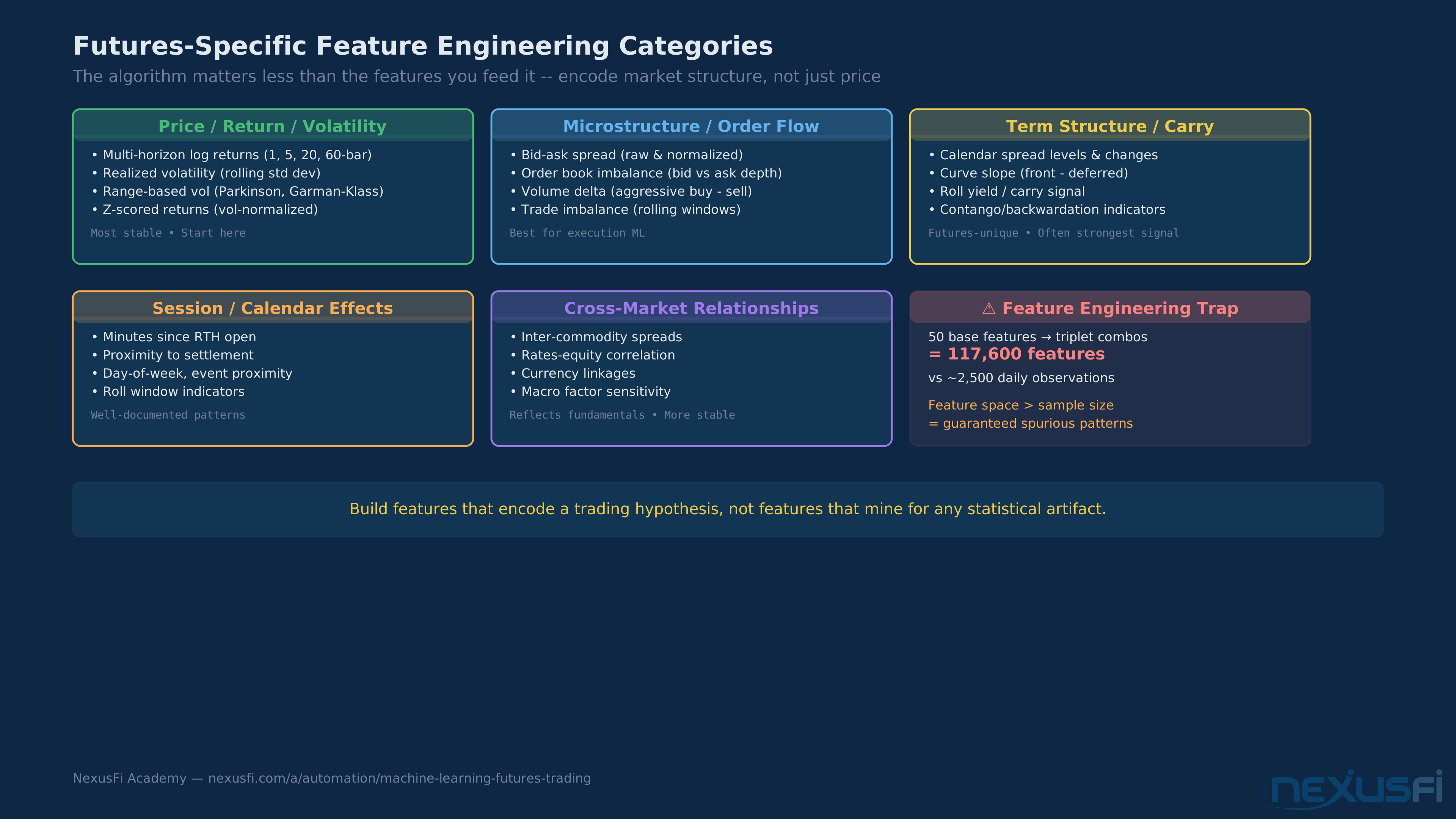
Price and Return Features #
The basics: log returns at multiple horizons (1-bar, 5-bar, 20-bar, 60-bar), realized volatility (standard deviation of returns over rolling windows), range-based volatility measures (Parkinson, Garman-Klass), and momentum indicators (rate of change, z-scores of returns). These capture the surface-level price dynamics.
The subtlety: how you normalize matters enormously. Raw returns are non-stationary. Z-scored returns (returns divided by recent volatility) are more stable. Features that adapt to the current volatility regime
Microstructure Features #
For intraday models: bid-ask spread (both raw and as a multiple of tick size), order book imbalance (bid size minus ask size at best levels), trade imbalance (aggressive buying volume minus aggressive selling volume over rolling windows), and volume delta. These features capture the short-term supply/demand dynamics that drive price on tick-to-tick and minute-to-minute timeframes.
Term Structure and Carry #
Futures-specific and often overlooked: calendar spread levels and changes, curve slope (front month minus deferred), roll yield (the return from rolling positions forward), and basis relationships. In commodity futures, the term structure often contains more tradeable information than outright price movement. A model that ignores carry in crude oil or natural gas is leaving the strongest signal on the table.
Session and Calendar Effects #
Time-of-day features (minutes since RTH open, proximity to settlement), day-of-week, proximity to major data releases (FOMC, NFP, inventory reports), and roll window indicators. These capture the well-documented intraday and calendar patterns in futures volatility and liquidity.
Cross-Market Features #
Inter-commodity spreads, equity-commodity correlations, rates-equity relationships, and currency linkages. Professional futures traders rarely look at a single instrument in isolation
The Feature Engineering Trap #
@SMCJB's experience with feature engineering on NexusFi captures the core danger: starting with 50 base features and creating triplet combinations produces 117,600 features from approximately 2,500 daily records. Your feature space explodes past your sample size, and you're guaranteed to find spurious patterns. The antidote is domain knowledge
As @whitmark noted in the Elite Quantitative forum, dimensionality reduction techniques like autoencoders can help compress high-dimensional feature sets while preserving non-linear relationships. But compression without domain knowledge just produces well-organized noise.
Validation: Where Most ML Trading Models Die #
This is the single most important section of this article. If you get validation wrong, nothing else matters
Why Standard ML Validation Fails in Trading #
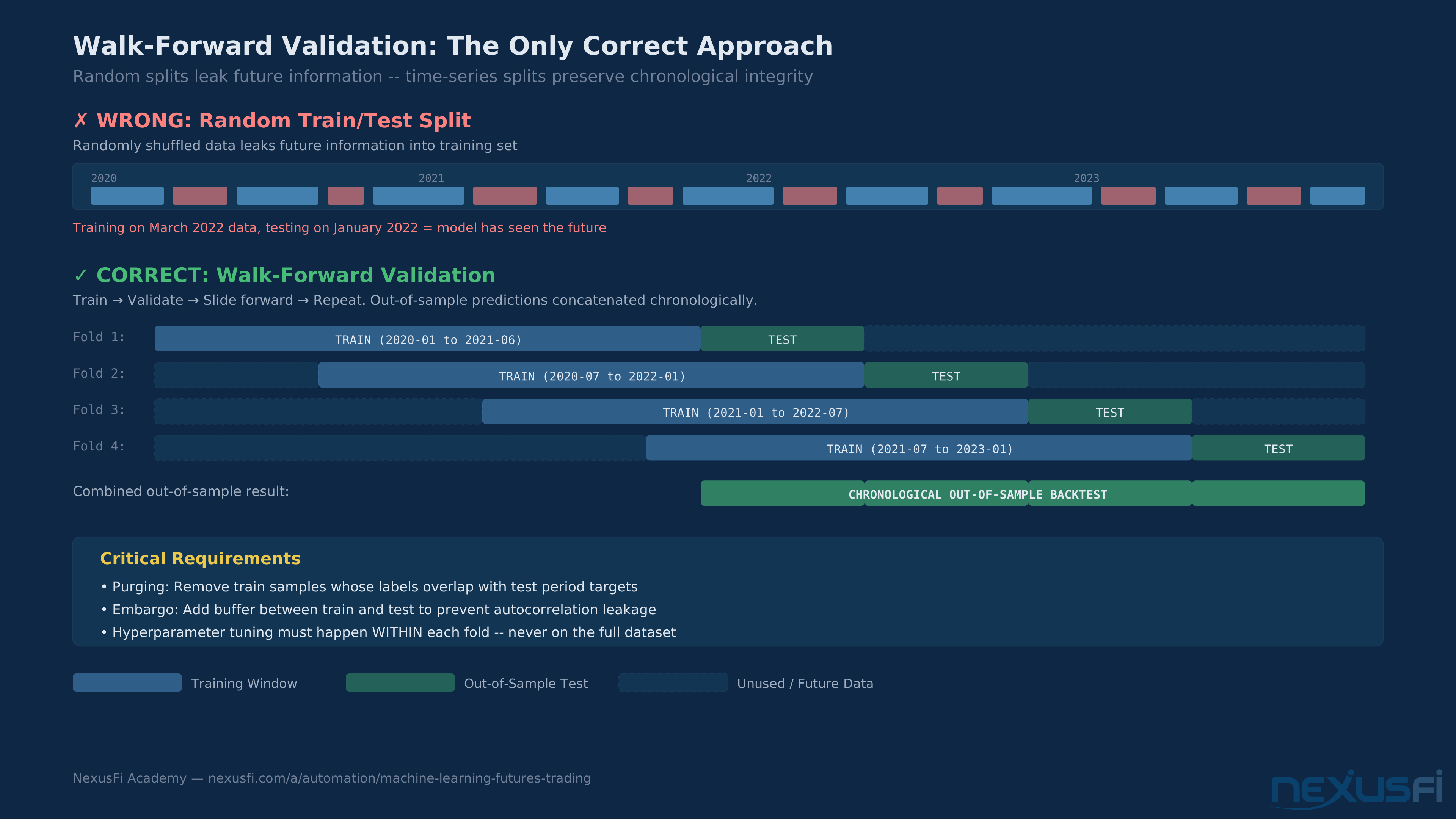
In standard ML, you randomly split data into train/validation/test sets. In financial time series, this is catastrophically wrong. Random splitting leaks future information into your training set
Walk-Forward Validation: The Only Correct Approach #
Walk-forward validation is non-negotiable. Train on a historical window, validate on the immediately following period, slide the window forward, repeat. The out-of-sample predictions from each fold are concatenated to produce a single, chronologically correct backtest. This is the only validation method that produces performance estimates you can trust.
@Hulk's experience confirms this: "It is not easy for data scientists to understand walk-forward testing in the context of trading. Most data scientists work on data that is static
@kbellare's extensive work with walk-forward optimization across 100+ strategies highlights the pitfalls: choosing "highest" metrics (highest Profit Factor, highest Net Profit) as the objective function "sets you up for failure
Purging and Embargo #
When your labels overlap in time (e.g., predicting the 5-day return from every daily observation), adjacent train and test samples share information. Purging removes training samples that overlap with test labels. Embargo adds a buffer zone between train and test periods to prevent leakage from autocorrelated features. Skip these steps and your walk-forward results will be systematically overoptimistic.
The Multiple Testing Problem #
If you test 1,000 feature combinations and pick the best one, you haven't found a signal
Overfitting: Why Financial ML Fails Faster Than Other Domains #
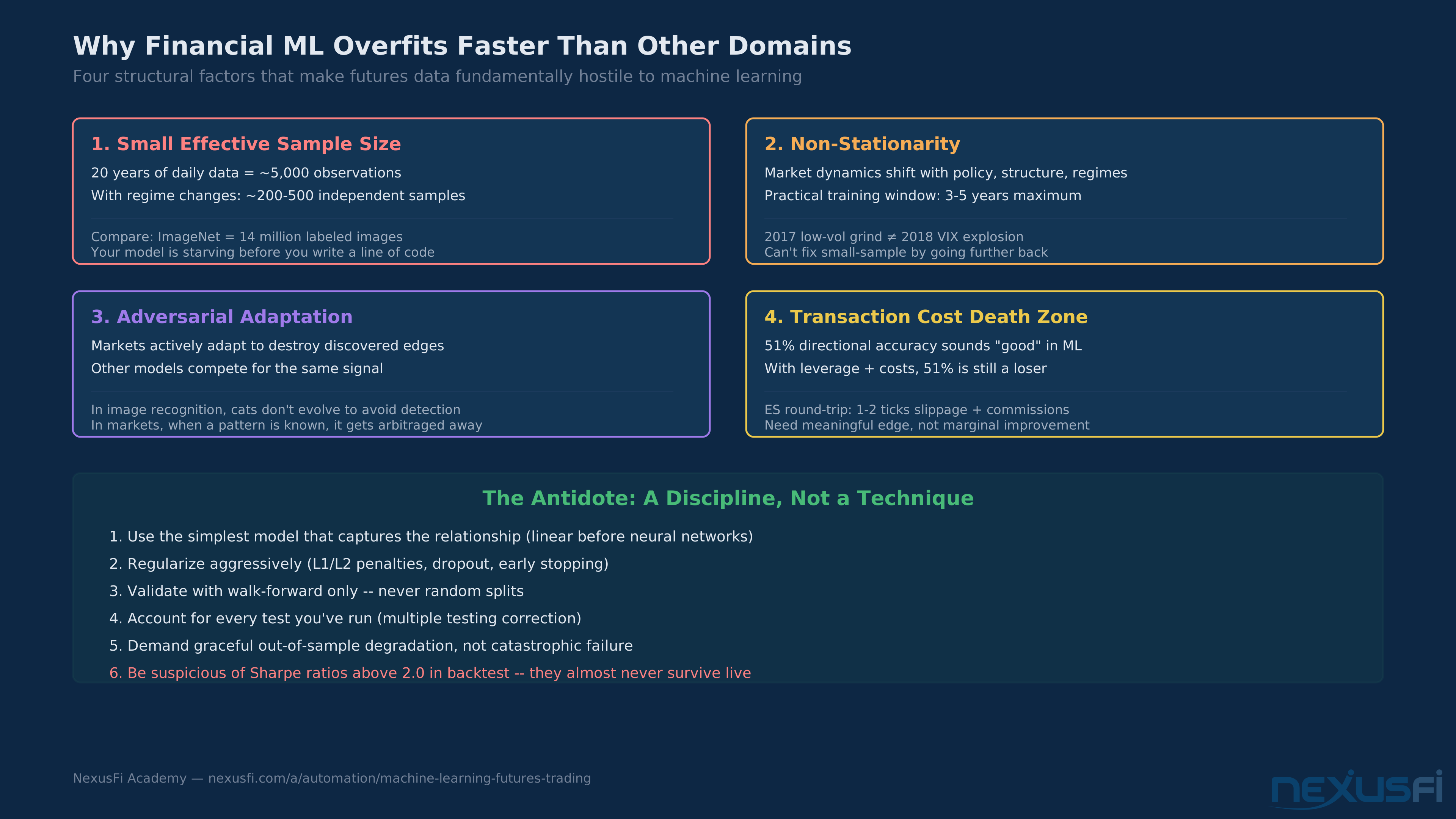
Financial ML overfits faster and more severely than ML in most other domains. Understanding why is essential to avoiding it.
Small effective sample size. Even 20 years of daily futures data is only ~5,000 observations. With regime changes, the effectively independent samples might be a few hundred. Compare this to image classification datasets with millions of labeled examples. Your model is starving for data before you write a single line of code.
Non-stationarity reduces useful history. You can't solve the small-sample problem by going further back in time because market dynamics from 2005 aren't the same as 2025. The useful training window is at the core limited by how quickly the market's statistical properties change. For most futures markets, 3-5 years of data is the practical ceiling for a single model configuration.
Adversarial adaptation. In image recognition, cats don't evolve to avoid being classified. In markets, when a pattern becomes known, other participants trade against it, reducing or eliminating the edge. Your model isn't just fitting a static function
Transaction costs create a death zone. In academic ML, a model that's 51% accurate is "working." In futures trading, a model that's 51% accurate on direction might still be a loser after commissions, slippage, and the bid-ask spread. The hurdle rate for profitability varies by instrument and timeframe, but for most retail futures traders, you need meaningful edge
As @NJAMC observed after years of ML research on NexusFi: "Many of these systems had difficulty representing the 'model' of the active marketplace. They would usually be good at fitting the training data, but not forecasting future performance. There was no real MODEL
The antidote to overfitting isn't a single technique. It's a discipline:
- Use the simplest model that captures the relationship (linear models before neural networks)
- Regularize aggressively (L1/L2 penalties, dropout, early stopping)
- Validate with walk-forward, never random splits
- Account for every test you've run (multiple testing correction)
- Demand that out-of-sample performance degrades gracefully, not catastrophically
- Be suspicious of Sharpe ratios above 2.0 in backtest
Backtesting ML Strategies: Trading Metrics Over Classification Metrics #
A model with 90% accuracy and terrible risk-adjusted returns is worthless. A model with 55% accuracy and excellent risk-adjusted returns might be a goldmine. The metrics that matter for ML trading models are trading metrics, not ML metrics.
Net PnL after all costs. Not gross returns
Maximum drawdown and drawdown duration. These determine whether a strategy is psychologically and financially survivable. An ML model with a 30% peak-to-trough drawdown will get shut off by any rational trader
Stability across time periods. Examine the equity curve by year and by quarter. If 80% of the profit comes from one regime (like the COVID volatility of 2020), the model has no real edge
Turnover and capacity. High-frequency ML models may look spectacular on paper but generate so many trades that slippage and market impact erode the edge. Always ask: what is the dollar capacity of this strategy before it starts moving the market?
Deployment: The Last Mile That Kills Most Models #
Getting a model from backtest to live trading introduces a whole category of failure modes that don't exist in research.
Data pipeline reliability. Your model needs clean, timely data to generate signals. In production, data feeds drop ticks, exchanges halt trading, and timestamps drift. A model trained on clean historical data that encounters a 30-second data gap during a volatile move can generate catastrophic signals. Build data quality checks into the pipeline
Contract mapping and roll logic. Your production system must handle contract expiration, roll timing, and position transfer between contracts. If the model is trained on back-adjusted data but trades front-month contracts, the price levels don't match. This sounds trivial until a roll window coincides with a major position and your model's signals are based on phantom prices.
Model drift and retraining. Every ML model decays in financial markets. The question is how fast and how to detect it. Monitor feature distributions (are inputs still within the range the model was trained on?), prediction distributions (has the model stopped making confident predictions?), and realized performance (rolling Sharpe, hit rate, average PnL per trade). When drift is detected, retrain on recent data
Risk controls and kill switches. No ML model should trade without hard position limits, maximum daily loss limits, and a kill switch that flattens everything if something goes wrong. These aren't optional safety features
@Trembling Hand's blunt assessment on NexusFi captures the deployment reality: "The promise of ML and the application is a million miles away if you're hoping to get a superior signal in the form of buy/sell/hold using just price data and a few squiggly lines. It's a problem using these tools to try and shoehorn them into applications that humans cannot even describe what the rules are."
When ML Works and When It Fails #
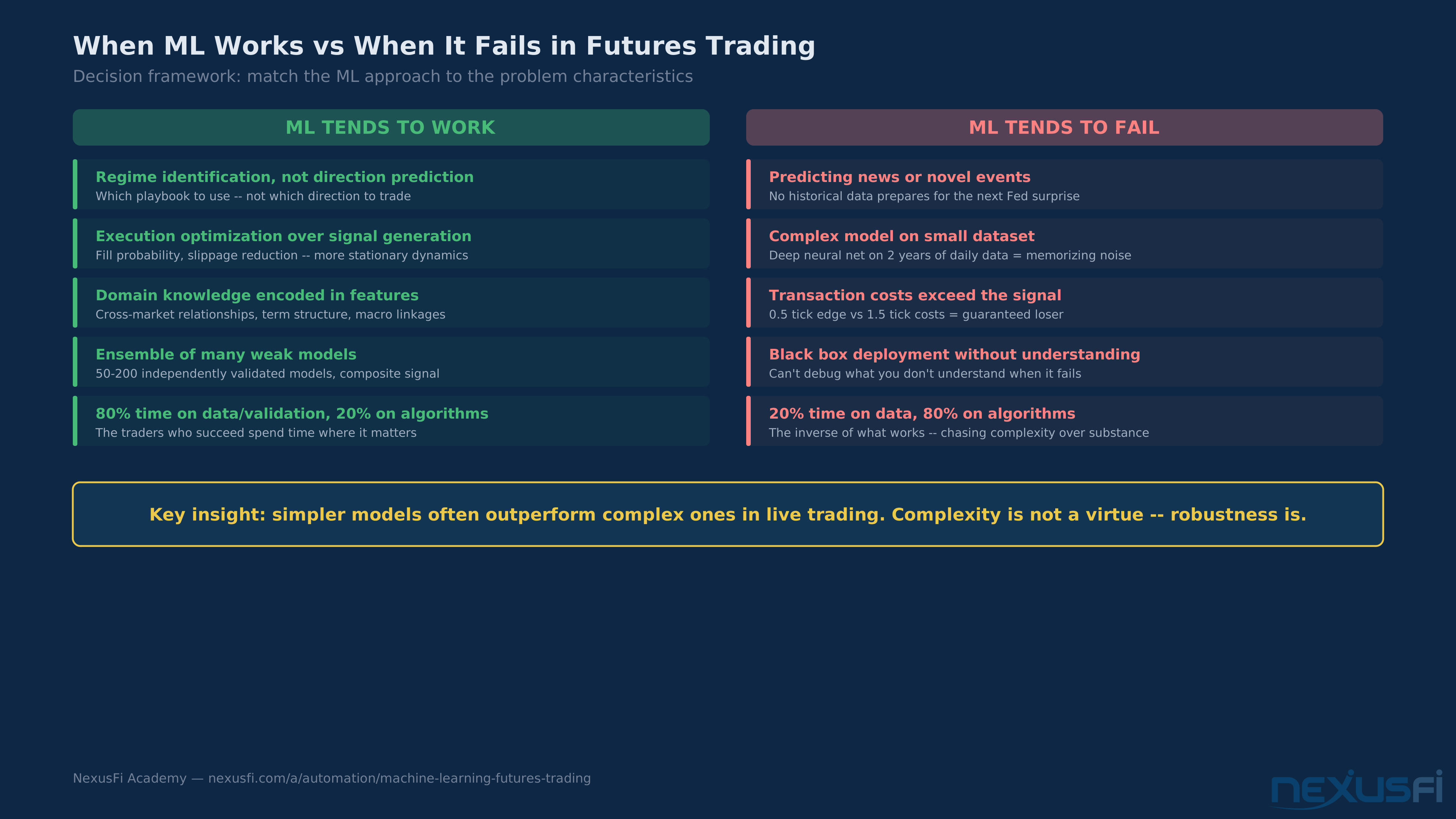
ML Works Better When: #
The task is regime identification, not direction prediction. Using clustering or HMMs to classify market states (trending/ranging/volatile) and then running different rule-based strategies per regime is the highest-value ML application for most futures traders. The model doesn't predict price
The edge comes from execution, not signal. ML for optimizing order placement, fill probability estimation, and slippage reduction has a better signal-to-noise ratio than directional prediction because the underlying dynamics (order book behavior, queue mechanics) are more stationary than price direction.
You have genuine informational advantage in feature construction. Cross-market features that encode domain knowledge (like the relationship between crude oil inventory data timing and WTI price moves) give ML something to work with. Raw OHLCV data alone is not enough.
The ensemble approach aggregates weak signals. No single ML model reliably predicts futures direction. But an ensemble of 50-200 models, each capturing a slightly different pattern, can produce a composite signal with meaningful edge
You're patient and disciplined about validation. The traders who succeed with ML are the ones who spend 80% of their time on data cleaning, feature engineering, and validation
ML Fails When: #
You're trying to predict news. No amount of historical data will predict the next Fed surprise, geopolitical shock, or flash crash. ML trained on historical patterns is structurally blind to novel events. If your strategy has no plan for when the model encounters something it's never seen before, you have no strategy.
The sample is too small for the complexity. A deep neural network trained on 2 years of daily ES data is memorizing noise, period. Match model complexity to available data
Transaction costs dominate the signal. If your model's edge is 0.5 ticks per trade and round-trip costs are 1.5 ticks, no amount of algorithmic sophistication will make it profitable. Always compute the breakeven accuracy given realistic costs before investing months in model development.
You treat ML as a black box. Deploying a model you don't understand is deploying a model you can't debug when it fails. And it will fail. Understanding why the model makes its predictions (feature importance, partial dependence plots, SHAP values) isn't just academic
Practical Checklist: Before You Build #
Before investing time in an ML trading system for futures, work through this decision framework:
- Define the problem precisely. "Predict ES direction" is too vague. "Classify the next 30-minute regime as trending or mean-reverting based on the first 15 minutes of RTH data" is actionable.
- Estimate the available signal. How many independent observations do you have? What's the realistic signal-to-noise ratio? If you can't articulate why ML should outperform a simple rules-based approach for your specific problem, it probably won't.
- Design your validation before your model. Write the walk-forward testing code before you train anything. If you can't validate correctly, the model results are meaningless regardless of how sophisticated the algorithm is.
- Budget for transaction costs. Calculate the minimum edge required to break even after commissions, slippage, and data costs for your target instrument and timeframe. If the required edge is larger than any realistic ML model is likely to deliver, stop here.
- Plan for model failure. Every ML model will eventually encounter a market regime it wasn't trained for. What are your drawdown limits? What triggers a model shutdown? What's your plan for the period between shutdown and retraining? These answers matter more than your model architecture.
- Start simple. Linear regression and logistic regression before gradient boosting. Gradient boosting before neural networks. The simplest model that captures the relationship is the model most likely to survive live trading. Complexity is not a virtue
Knowledge Map
Go Deeper
Build on this knowledgeReferences This Article
Articles that build on this topicCitations
- — Machine Learning/AI discussion (Generic) (2016) 👍 7“A logistic regression model trained on order book data predicted whether the next trade in crude oil would hit the bid or ask just over 75% of the time.”
- — Machine Learning Journal (2025) 👍 6“The main problem was the data science approach. It was too academic.”
- — Machine Learning Journal (2022) 👍 3“Starting with 50 features and creating triplet combinations produces 117,600 features from approximately 2,500 daily records.”
- — Machine learning and feature extraction (2017) 👍 4“Using an autoencoder to reduce dimensionality, more adept at teasing out non-linear relationships.”
- — Walk Forward Testing and Optimization Experiences and Best Practices (2013) 👍 6“Choosing Highest/Lowest metrics set you up for failure -- they pick the outliers in-sample which invariably fail out-of-sample.”
- — Machine Learning/AI discussion (Generic) (2016) 👍 7“Many of these systems had difficulty representing the model of the active marketplace. They would be good at fitting training data, but not forecasting future performance.”
- — Train an AI to trade like a discretionary trader (2020) 👍 4“The promise of ML and the application is a million miles away if you are hoping to get a superior signal in the form of buy/sell/hold.”