There are two kinds of traders who've tried AI tools for trading. The first kind asked ChatGPT for a trading strategy, got back something generic and useless, and wrote off the whole thing as hype. The second kind realized AI can't tell you what to trade — but it can compress the time it takes you to research, code, validate, and review your work from hours into minutes.
The second group is winning.
This article is for traders who already know futures — who understand contract specs, have written some code, and have a backtesting process they trust (mostly). You're not here to learn what an LLM is. You're here to figure out where it fits in a real trading workflow without creating new ways to blow up your account.
AI and LLMs are cognitive force multipliers. They accelerate drafting and synthesis. They're not oracles. They don't know today's ES close, they can't access your broker's order flow, and they will confidently tell you the wrong tick size for GC if you don't supply it. The traders who integrate these tools effectively treat every AI output as a draft that requires validation, not an answer that requires execution.
That's the lens for everything that follows.
Academy content is Copyright NexusFi® and may ONLY be used with a discrete citation specifically linking to the original article at https://nexusfi.com/a/automation/ai-llm-futures-trading-workflow
Large Language Model (LLM): A generative AI system (ChatGPT, Claude, Gemini, DeepSeek) trained on text that can generate, summarize, and transform text — including code. They don't access real-time data unless specifically connected to tools that do.
Knowledge cutoff: The date at which the model's training data ends. After that date, the LLM knows nothing about market events, contract changes, or exchange rule updates unless you provide that information in the prompt.
Prompt engineering: The practice of structuring inputs to LLMs to get reliable, actionable outputs. For trading, this means specifying instruments, timeframes, session constraints, and output format requirements explicitly.
Hallucination: When an LLM generates confident, plausible-sounding output that's factually wrong. Dangerous in trading contexts because contract specs, tick values, and roll logic errors can look correct until they explode in a backtest.
Verification gate: A mandatory checkpoint between workflow stages where specific tests must pass before proceeding. Code doesn't enter the backtest engine until it passes lookahead bias checks and unit tests.
Lookahead bias: Using data at time t that wouldn't have been available until time t+1 or later. The most common error in AI-generated trading code, and the hardest to detect by inspection alone.
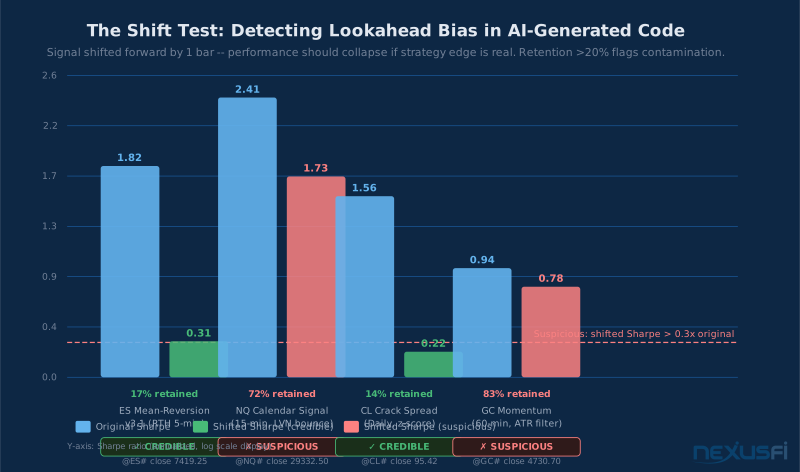
Shift test: A validation method where you shift signals forward by one bar and check whether backtest performance collapses. If performance stays high after the shift, you likely have lookahead bias contaminating the results.
Shift test results for 4 strategies. ES mean-reversion (1.82→0.31 Sharpe) passes: 17% retention. NQ calendar signal (2.41→1.73) fails: 72% retention signals lookahead bias.Academy content is Copyright NexusFi® and may ONLY be used with a discrete citation specifically linking to the original article at https://nexusfi.com/a/automation/ai-llm-futures-trading-workflow
The Workflow Map: Six Stages, Six AI Touchpoints #
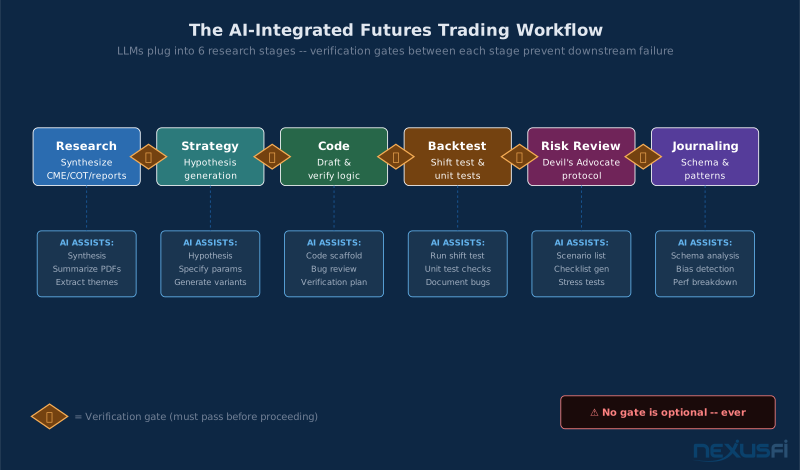
Here's where LLMs actually add value in a futures trading workflow. Map it mentally before diving into each section — it'll clarify what the tool is for at each stage.
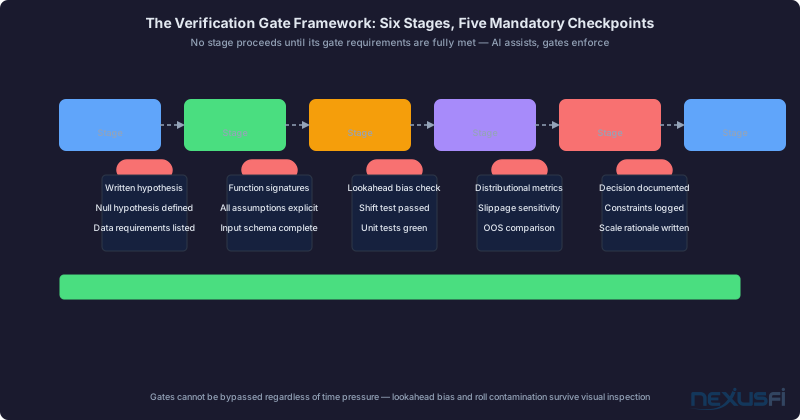
Each stage transition is a gate. You don't proceed until the gate requirements are met.
Gate Research → Strategy: Written hypothesis, explicit null hypothesis, data requirements list, defined time horizon and execution assumption (e.g., "next bar open").
Gate Strategy → Code: Function signatures, input schema, complete list of assumptions (timezone, session filter, roll mapping method). If any assumption is missing or undefined, reject and ask.
Gate Code → Backtest: Lookahead bias checks, roll logic validation, session filter unit tests, tick-to-dollar conversion verification.
The AI assists at every stage. It doesn't bypass any gate.
The AI-Integrated Futures Trading Workflow: 6 stages with mandatory verification gates between each. LLMs assist at every stage but cannot bypass any gate.The five verification gates between six stages. AI assists throughout but cannot bypass any gate -- the gates exist precisely because AI makes confident mistakes.Academy content is Copyright NexusFi® and may ONLY be used with a discrete citation specifically linking to the original article at https://nexusfi.com/a/automation/ai-llm-futures-trading-workflow
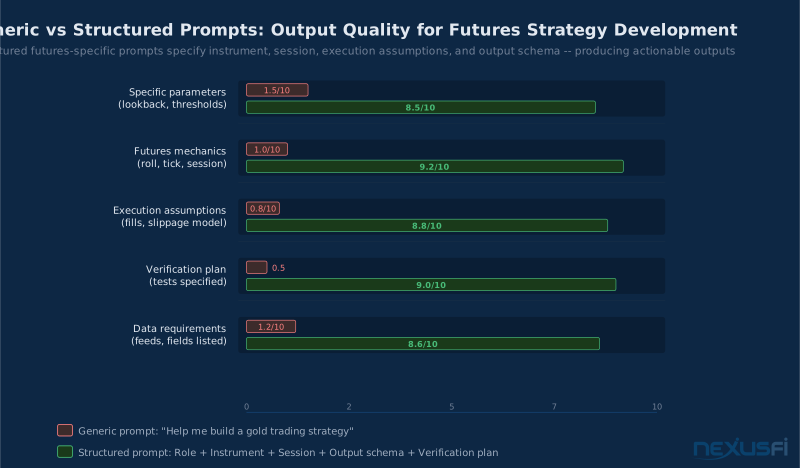
Generic prompts produce generic answers. "Help me build a gold trading strategy" is going to get you something that sounds reasonable but ignores everything that makes GC actually hard to trade — roll dates, multiplier conventions, liquidity around London fix, the relationship between dollar strength and momentum.
Futures-specific prompts work because they force the model to operate within your context. Here are three templates that actually work.
Use this when you want a structured hypothesis with all assumptions explicit.
Prompt format:
You are a quantitative futures strategist.
Instrument: [ES], Timeframe: [5-min], Session: [RTH only 9:30-4:00 ET],
Horizon: [hold 10-20 bars max], Objective: [maximize risk-adjusted return,
assume 0.25-tick slippage per side].

Produce a JSON output with these exact fields:
- hypothesis (1-2 sentences, testable)
- null_hypothesis
- features (list with exact calculation definitions)
- signal_rules (entry trigger, exit trigger, holding limit)
- execution_assumptions (bar open/close, fill model, session handling)
- risk_rules (stop distance in ticks, position size formula)
- data_requirements (fields needed, roll handling method)
- lookahead_risks (list of what you might accidentally leak)
- verification_plan (specific tests to run)

If any field requires information you don't have, ask instead of guessing.
The "ask instead of guessing" instruction matters — without it, the model fills gaps with assumptions that may be wrong for your setup.
After generating code, run this before touching the backtest engine.
Prompt:
Act as a skeptical backtest auditor for futures strategies.
Given this code: [paste code]

List the 10 most likely implementation bugs specific to:
(a) session boundary handling
(b) roll contamination in continuous contract data
(c) timezone conversion errors
(d) bar indexing (bar[0] vs. close[0] lookahead issues)
(e) lookahead bias in feature calculation

For each bug, provide a specific unit test that would detect it.
“Your GPT-4/GPT-5 audit workflow is exactly right - AI reviewing its own code catches logic errors manual review misses.”
This is especially critical for subtle session boundary issues in 1-minute MNQ scalping systems where the gap between RTH close and Globex continuation creates phantom signals.
Turn 1: "Draft a calendar spread strategy for CL using z-score of the front-back spread." Turn 2: "Find contradictions and undefined assumptions in your previous output." Turn 3: "For each undefined assumption, propose the invariant I'd test in code to verify it."
By the third turn, you have a hypothesis with explicit parameters and a verification checklist — both needed before writing a line of code.
A well-crafted prompt like this produces actionable guidance where a generic prompt produces useless noise.
“Here's a rock-solid and highly tailored prompt you can use with an AI (like chatGPT, Gemini, Perplexity) to get actionable guidance on building and validating edges specifically for ES, NQ, and YM futures in a day-trading context, integrating market internals and sentiment... Assign a unique ID or marker to each major concept, idea, or step you present. This allows me to ask follow-up questions about a specific ID without quoting the whole text.”
The key principle: specificity scales. Every vague term in your prompt ("use an appropriate lookback period") becomes ambiguity in the output that either hallucinates or defaults to the most generic answer. Lock down every variable. If you don't care which lookback period, give a range and ask the model to justify its choice.
Generic vs structured prompt quality across 5 dimensions. Structured prompts (8.5-9.2/10) outperform generic prompts (0.5-1.5/10) on every dimension -- specificity is everything.Academy content is Copyright NexusFi® and may ONLY be used with a discrete citation specifically linking to the original article at https://nexusfi.com/a/automation/ai-llm-futures-trading-workflow
LLMs are genuinely useful for three things in strategy development: hypothesis generation, spread relationship exploration, and rule-based specification drafting. They're not useful for anything that requires actual market knowledge about current conditions.
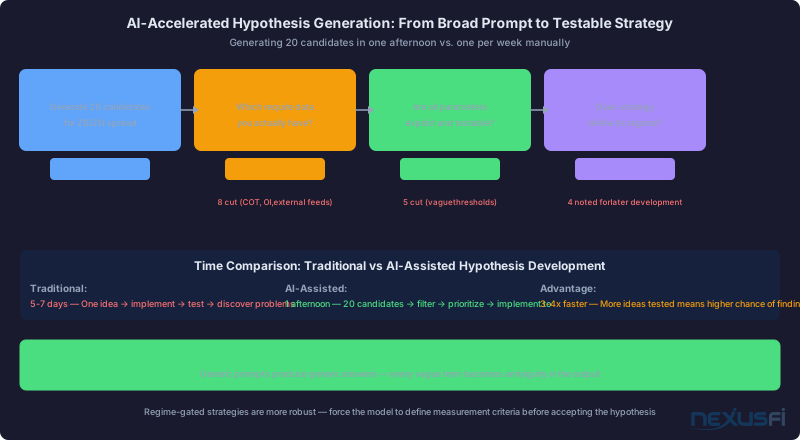
Instead of developing one idea and spending a week implementing it, you can generate 20 candidate hypotheses in an afternoon, filter them by data requirements and testability, and prioritize the strongest two or three for implementation. That's the workflow change.
From 20 candidates to 3 implementable strategies: three filters reduce the field by data requirements, parameter specificity, and regime definition -- the 17 cut are data unavailable or hand-wavy.
Example for the ZB/ZN Treasury spread:
Prompt:
Generate 5 candidate mean-reversion hypotheses for the ZB/ZN inter-contract spread.
For each hypothesis:
- Define the spread construction (formula)
- Specify lookback for mean and standard deviation
- Define entry and exit z-score thresholds
- Define max holding period in trading days
- Define stop-loss in spread ticks
- Specify what regime condition gates the signal (if any)
Do not generate hypotheses that require yield curve data unless you specify exactly
how that data would be computed from ZB and ZN prices.
The requirement to specify regime conditions is important. Regime-gated strategies are more robust — and forcing the model to define the gate explicitly surfaces whether the hypothesis is testable or hand-wavy. Hypotheses that only "work when yield curve is steepening" without specifying how to measure steepness from available data are not testable strategies.
As @aligator shared in the Elite Circle (post 909136, 2026), the speed advantage is real — ChatGPT generated a complete NQ/MNQ order flow absorption reversal system in under 2 seconds, including position sizing rules by stop distance, entry criteria, and daily loss limits. The output quality was high enough to serve as a real strategy framework. Manual verification against actual order book data was still required before backtesting, but the research compression was substantial.
“Claude AI is great for creating code. It is much better and faster than I was expecting. you MUST give specific instructions and know exactly what you need. [After 17 versions and iterations with Grok] After a few minutes, Grok posted without prompting — to open my original indicator and change this ONE LINE of code. I did that and it worked.
:::quote
"Claude AI is great for creating code. It is much better and faster than I was expecting. Claude seems a little robotic but I guess that is expected since it is a machine/robot. LOL... you MUST give specific instructions and know exactly what you need. [After 17 versions and iterations with Grok] I told Grok I was done. It was late and 'we' had worked on this for many hours with no progress... After a few minutes, Grok posted (without prompting). Grok's comment was to open my original indicator and change this ONE LINE of code. I did that and it worked."
-- @DavidHP, NexusFi - Darmok and Jalad at Tanagra (post 908557, 2025)”
This is the verification discipline that separates traders who use AI productively from traders who use AI to generate false confidence.
Academy content is Copyright NexusFi® and may ONLY be used with a discrete citation specifically linking to the original article at https://nexusfi.com/a/automation/ai-llm-futures-trading-workflow
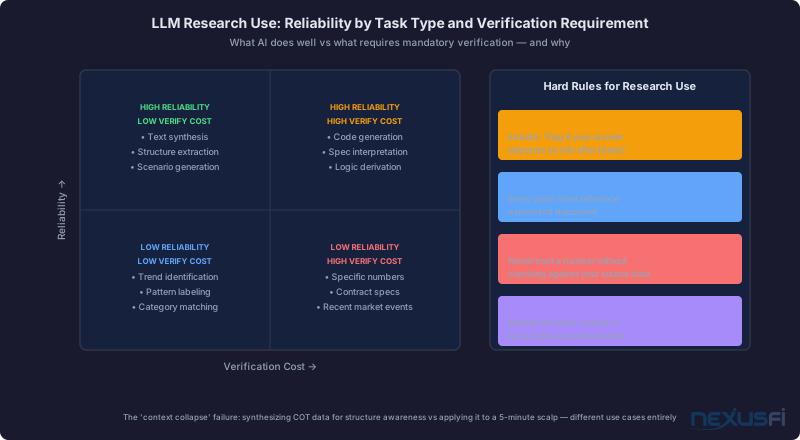
LLMs are genuinely good at processing large volumes of text and extracting structured information. They're not good at knowing what happened in markets last Tuesday.
CME report synthesis: Paste the quarterly equity index review text into the prompt and ask for a structured summary of contract spec changes, volume trends, and margin adjustments. A 60-page CME notice that takes 2 hours to read carefully can be summarized in 15-20 minutes with AI-assisted synthesis — and you spend your reading time on the parts the AI flagged as relevant to your strategies.
COT interpretation: Pull the data, do the math, feed the LLM the formatted table for interpretive categories (hedger positioning trends, disaggregated breakdown). The LLM labels; you verify. Any numeric claim must match your computed numbers or be discarded.
Strategy research synthesis: Running through academic papers, pulling key findings, identifying which empirical results apply to your specific instruments and timeframes. The model can flag relevant passages, suggest follow-up research, and help structure the literature into a coherent hypothesis.
Rule 1: Knowledge cutoff awareness. Include: "Your knowledge cutoff means you may not know about recent contract changes. Flag any part of your response that depends on information after [date]." This gets the model to mark uncertainty rather than hallucinate.
Rule 2: Citation requirement. When providing documents for synthesis, require the model to cite which provided document each claim comes from. Free-floating claims with no document source are usually hallucinations.
Rule 3: Numeric verification. Never trust a number an LLM produces without verifying it against your source data. The LLM will be wrong about specific quantities more often than it's wrong about conceptual relationships.
Reliability vs verification cost by task type. Text synthesis and scenario generation are high-reliability, low-cost. Contract specs and specific numbers are low-reliability, high-cost -- always verify.
As @Hulk explained in NexusFi's Deep Research thread (post 905035, 2025):
“these tools are absolutely fantastic because they can save us a lot of time doing the research, implementing tests, interpreting results but you have to be able to recognize when they start transitioning from fact to fiction... For assistance coding complex pieces with C++ and Python, it has been very helpful — Claude 3.5 in particular.”
Academy content is Copyright NexusFi® and may ONLY be used with a discrete citation specifically linking to the original article at https://nexusfi.com/a/automation/ai-llm-futures-trading-workflow
Risk Management Review: The Devil's Advocate Protocol #
Here's a prompt structure that's become standard for risk review before scaling any position:
I'm considering this position: [instrument, size, strategy rationale].
Act as a risk manager with 20 years of futures experience who is skeptical
of this trade. Generate:

1. A checklist of 10 risk factors specific to this instrument and market environment
2. At least 3 risk factors related to futures-specific mechanics (delivery, roll,
   liquidity around expiration)
3. The top 3 macro scenarios that produce a max-loss outcome
4. A stress test: what happens if volatility triples and I'm wrong on direction?
5. A position sizing check: given my account size [X] and my stop at [Y ticks],
   am I within my maximum R exposure?

State any assumptions you're making explicitly.
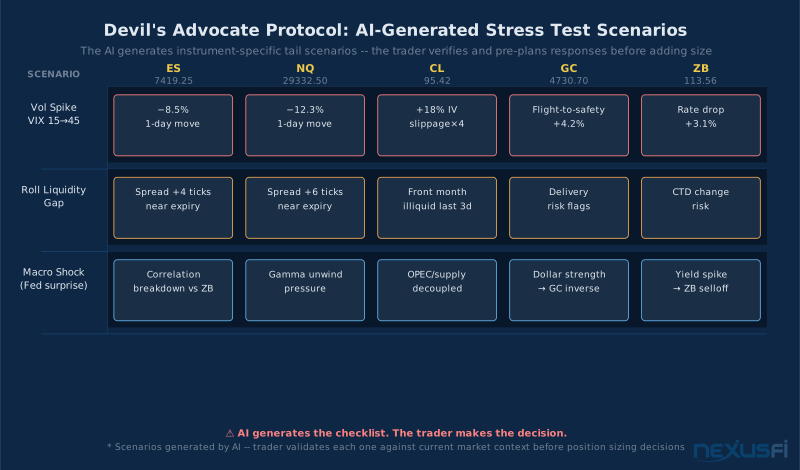
This is the "Devil's Advocate" protocol. The LLM plays adversary to your position. It generates scenarios your confirmation bias would ignore. It does not make the decision — it makes sure you've stress-tested before you do.
For an ES long position ahead of a Fed meeting, the stress test prompt produces: correlation breakdown between equity futures and bonds in a stagflation scenario, liquidity gap risk around the announcement, option gamma unwind pressure if VIX spikes from 15 to 35. Not predictions — checklists of risks you need to have pre-planned responses for.
The critical rule: AI outputs require manual approval before any position change. This is not optional and not up for debate. The model can generate 10 risk scenarios. You decide which ones require position adjustments and make those adjustments yourself. You do not ask the model what to do and then execute its suggestion.
For automated systems specifically, the risk checklist workflow looks like this:
AI generates checklist
You verify each item against current market conditions
You manually decide which conditions would trigger a system pause
Those conditions get coded as explicit kill switches
The kill switch logic doesn't come from the AI. It comes from you, informed by the AI's scenario generation. See the automated risk controls article for implementation specifics.
Devil's Advocate Protocol: AI generates instrument-specific tail scenarios across vol spikes, roll liquidity gaps, and macro shocks. Trader validates and pre-plans before adding size.
Account: $75,000
Strategy: ES mean-reversion, stop at 8 ticks = $100 per contract
Max single-trade risk: 0.5% of equity = $375
Max contracts: floor($375 / $100) = 3 contracts
Ask the LLM: "Given these parameters, what are the three most likely ways I could accidentally exceed my max risk?"
Common catches: slippage on fast markets blowing through stops, overnight gap risk if the strategy holds positions through session close, and correlated positions in NQ that aren't captured in the ES-based risk calculation.
Academy content is Copyright NexusFi® and may ONLY be used with a discrete citation specifically linking to the original article at https://nexusfi.com/a/automation/ai-llm-futures-trading-workflow
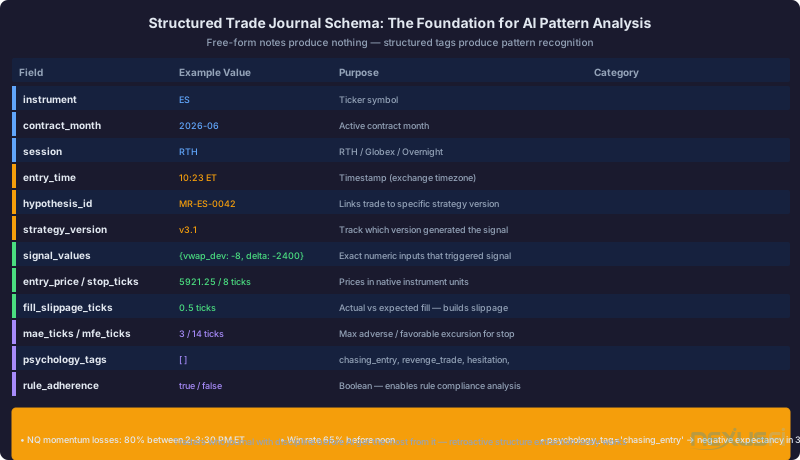
The traders who get the most out of AI-assisted journaling are the ones who journaled with discipline before AI existed. The traders who get nothing from it are the ones who kept free-form notes and are now trying to retroactively extract structure from them.
Here's the schema that makes AI analysis possible:
{
  "instrument": "ES",
  "contract_month": "2026-06",
  "session": "RTH",
  "entry_time": "2026-06-04T10:23:00ET",
  "hypothesis_id": "MR-ES-0042",
  "strategy_version": "v3.1",
  "signal_values": {
    "vwap_deviation_ticks": -8,
    "delta_cumulative_1min": -2400,
    "session_volume_percentile": 67
  },
  "entry_price": 5921.25,
  "stop_ticks": 8,
  "target_ticks": 12,
  "actual_contracts": 2,
  "r_multiple_risked": 1.0,
  "fill_slippage_ticks": 0.5,
  "exit_price": 5929.75,
  "realized_pnl": 850,
  "mae_ticks": 3,
  "mfe_ticks": 14,
  "psychology_tags": [],
  "rule_adherence": true,
  "human_notes": "Hit target, no issues"
}


  The 12-field journal schema that enables AI pattern analysis. Missing any field means missing a dimension of analysis -- psychology tags alone reveal bias patterns invisible in raw P&L.
With this structure, an LLM can compute in seconds: win rate by session time, P&L correlation with psychology tags, performance drift across strategy versions, MAE distribution by setup type.
The output is only as good as the data. Generic notes produce nothing. Structured tags produce pattern recognition.
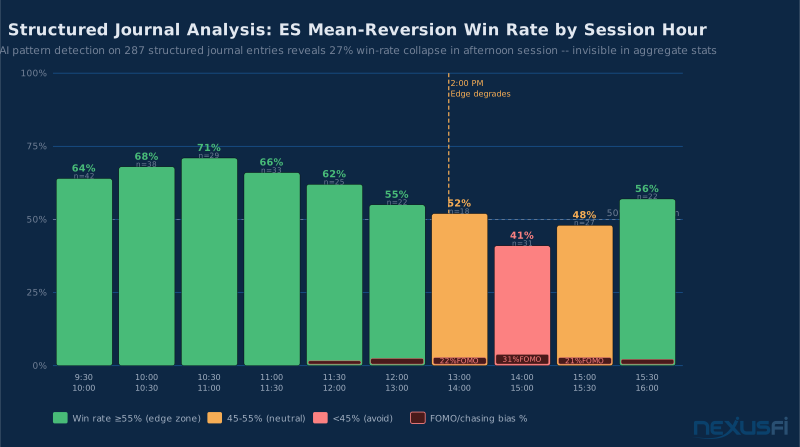
Time-of-day effects: 80% of NQ momentum-following losses between 2:00 PM and 3:30 PM ET but 65% win rate before noon — a pattern that takes 200 trades to notice manually and 3 seconds with structured data.
Psychology tag correlations: Trades tagged "chasing entry" producing negative expectancy across a 30-trade sample triggers a rule review. Without the tag, it's invisible in the P&L.
Structured journal analysis: ES mean-reversion win rate drops from 71% (10:30-11:00 AM) to 41% (2:00-3:00 PM). FOMO bias spikes to 31% in the 2 PM hour -- invisible in aggregate P&L.
Strategy version drift: Comparing expectancy between v2.4 and v3.1 of the same ES system after a parameter adjustment. Did the change improve or degrade performance in specific regimes?
“The real value comes from comparing different AIs. ChatGPT and DeepSeek, for example, often produce very different results. Sometimes I let one AI critique the other's logic, which helps highlight new angles I might not have considered.”
That cross-checking workflow extends naturally to journal analysis — the AI works through your historical trades the same way, except the data is your performance rather than the market.
Academy content is Copyright NexusFi® and may ONLY be used with a discrete citation specifically linking to the original article at https://nexusfi.com/a/automation/ai-llm-futures-trading-workflow
Rule 1: Never paste proprietary data into commercial LLMs. This means: your actual order flow, your broker account details, your live positions, your API keys, your strategy alpha. If you're using GPT-4 via a web interface, assume the prompt is visible. Use anonymized versions ("Asset_A for ES, Asset_B for NQ") when discussing strategy mechanics that could identify your edge.
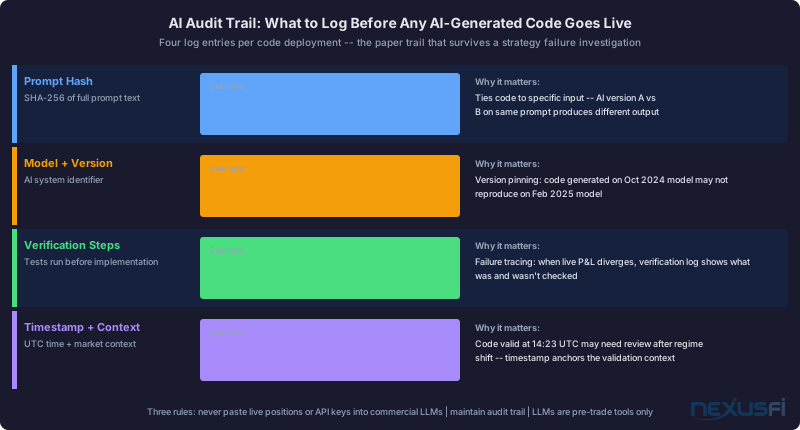
Rule 2: Maintain an audit trail. Every time AI generates code or strategy logic that you implement, log:
The prompt (or a hash of the prompt)
The model and version
The timestamp
The output (or hash of the output)
What you verified before implementation
If a strategy blows up, you need to be able to trace whether the failure was in your prompt, the model's output, your verification, or your implementation.
Four audit trail entries per AI code deployment. When live P&L diverges from backtest, the audit trail shows exactly what prompt generated the code, which model produced it, what tests were run, and under what market conditions -- the paper trail for strategy failure investigation.
Rule 3: LLMs are pre-trade tools. Response latency for LLMs runs from 5 seconds to several minutes for complex queries. They are not in your execution loop. They are not making real-time decisions. They work on the research and review cycle — before you trade, after you trade, not during.
For traders running automated systems, the integration point is offline: AI generates verification checklists, stress test scenarios, and code review before system deployment. The live system runs its own logic without AI involvement.
Academy content is Copyright NexusFi® and may ONLY be used with a discrete citation specifically linking to the original article at https://nexusfi.com/a/automation/ai-llm-futures-trading-workflow
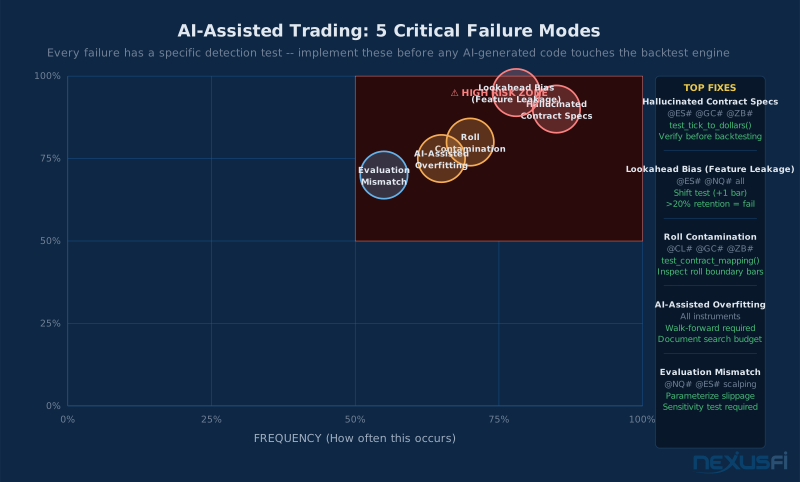
These are the five ways traders blow up their workflow with AI.
5 failure modes by frequency and severity. Hallucinated specs and lookahead bias occupy the high-risk zone -- both caught by unit tests that take under 5 minutes to implement.
An LLM confidently states that ES has a tick value of $25 per tick. Wrong — it's $12.50. GC has a tick of 0.10 points worth $10, not $1. ZB multiplier is $1,000 per point. These are things the model gets wrong at a surprisingly high rate, and they're things that make your backtest P&L calculations look completely different from reality.
The fix: unit test test_tick_to_dollars() for every instrument before running any backtest. The contract spec is not something you verify once — it's something you verify for every new piece of code involving that instrument.
The shift test is the single most important verification step for AI-generated code. It takes 10 minutes to run. Traders consistently skip it because the backtest looks good and they want to move on.
Run the shift test. Always.
Failure 3: Roll Contamination in Spread Strategies #
Any strategy involving multiple contract months is vulnerable to roll contamination. AI-generated code almost never handles roll correctly on the first draft — roll logic is deeply instrument-specific.
Test: inspect the spread value around every roll date — anomalies (jumps, spikes) not in un-rolled raw data signal contamination. Each leg needs its own explicit roll date calendar.
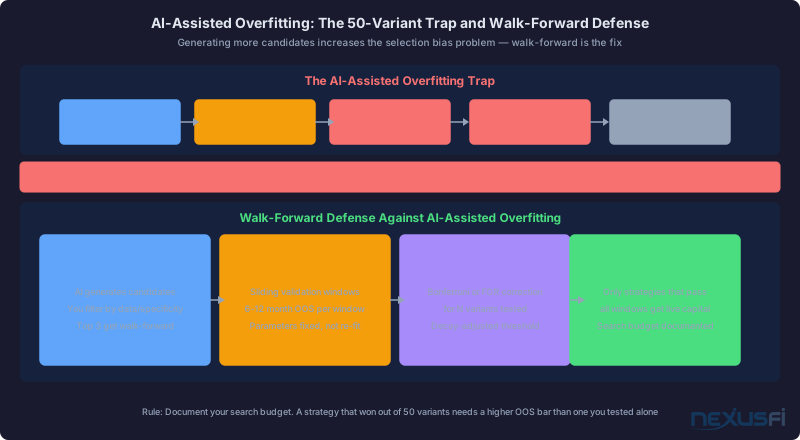
If you ask an LLM to generate 50 strategy variants and then backtest all of them and pick the top performer, you're overfitting. The model will generate variants that differ in lookback windows, threshold values, session filters — exactly the parameters that are easy to overfit to historical data.
The fix: walk-forward validation before any variant selection. Document your search budget and apply a statistical penalty for the comparisons made — a strategy that "won" out of 50 variants needs a much higher out-of-sample bar.
“AI is a huge distraction in the hands of the wrong trader... the novice will invariably introduce data snooping into his backtest or worse curve fit the results.”
That warning applies with compounding force when AI makes it trivially easy to generate 50 variants — the ease of generation makes rigorous walk-forward discipline more important, not less.
The 50-variant trap: AI makes it easy to generate candidates, which makes selection bias worse. Walk-forward validation with statistical penalty for N comparisons is the only valid defense.
Failure 5: Treating Research Synthesis as Trading Advice #
An LLM synthesizes CME crude oil data and tells you "commercial positioning suggests a bullish bias in CL." That's interpretive synthesis from the data you provided. It is not a trade recommendation. It tells you something about current institutional positioning, which may or may not be relevant to a 5-minute mean-reversion system on crude futures.
Context collapse is a real failure mode. The research synthesis that's useful for understanding market structure is being applied to specific trade decisions where it has no edge. Keep those layers separate in your workflow.
Academy content is Copyright NexusFi® and may ONLY be used with a discrete citation specifically linking to the original article at https://nexusfi.com/a/automation/ai-llm-futures-trading-workflow
The traders getting the most out of these tools have made AI integration a deliberate practice, not an occasional experiment. Here's what that looks like in operational terms.
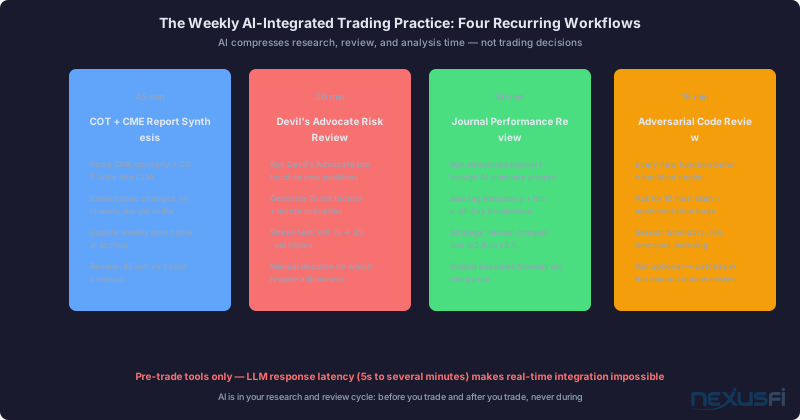
Weekly research cycle: Every Sunday, synthesize the week's COT report, CME notices, and major macro reports. Update your trading plan's context section. This takes 45 minutes instead of 3 hours.
Pre-trade risk review: Before sizing up or adding new instruments, run the Devil's Advocate protocol. Takes 20 minutes. Forces you to think through scenarios that confirmation bias would suppress.
Post-trade journal review: Every Friday, run your structured journal through an AI summary prompt. Ask for bias patterns, time-of-day breakdowns, and version comparisons. The output becomes your Monday morning prep.
Code review process: Every new strategy function gets the adversarial audit prompt before entering the backtest engine. Not optional.
Four recurring AI workflows totaling about 110 minutes per week. Each compresses a task that would otherwise take 3-4x as long -- without replacing any trading decision.
The measurable improvement: strategy development cycle shrinks from 5-7 to 2-3 days by parallelizing ideation and front-loading verification plans.
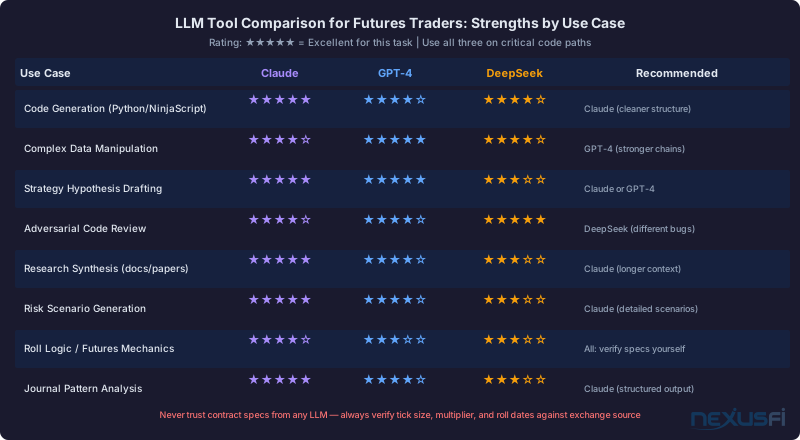
For the tools themselves: Claude, GPT-4, and DeepSeek each bring different strengths to code review — use all three on critical code paths.
LLM strengths by use case: Claude leads on code structure and research synthesis, GPT-4 on complex data chains, DeepSeek on adversarial review -- use all three on critical code paths.
As @SMCJB noted (post 907600, 2025), the approach has been validated at elite levels — Kevin Davey has published AI-inspired strategy frameworks and run live real-money comparisons of AI-generated ES systems against manual approaches. Verification discipline is what separates real edge from backtest illusion.
The integration that produces lasting edge isn't a single clever use case. It's systematic workflow improvement across research, development, verification, risk review, and journal analysis — compressing each stage without replacing the human judgment that makes any of it meaningful.
Key Takeaway
Three rules determine whether AI makes your trading better or worse: specificity (every vague term in your prompt becomes ambiguity in the output), verification (treat every AI output as a draft — lookahead bias and hallucinated contract specs look correct until they explode in a backtest), and scope (AI is a pre-trade and post-trade tool — it does not make real-time decisions and is not in your execution loop). Get these right and AI compresses every stage of your research, development, and review cycle without creating new ways to blow up your account.
Academy content is Copyright NexusFi® and may ONLY be used with a discrete citation specifically linking to the original article at https://nexusfi.com/a/automation/ai-llm-futures-trading-workflow
“Heres a rock-solid and highly tailored prompt you can use with an AI (like chatGPT, Gemini, Perplexity) to get actionable guidance on building and testing strategies”
“The ES futures example you shared highlights a fundamental challenge: most AI tools generate 'textbook' strategies without considering actual market dynamics. When you ask ChatGPT about ES trading, it doesn't account for real market microstructure.”
“Preliminary market analysis in a future market with a pre-compiled list of topics that I find interesting, comparison work where you want to match a current structure against historical context”
“Critical Gap: Execution Realism -- Strategy Analyzer assumes perfect fills. For 1-minute MNQ scalping, you must validate with Market Replay (actual order book conditions), because AI reviewing its own code catches logic errors that manual review misses.”
“I spent a lot of time discussing medium term trading strategies based on MBO data, order flow analysis and microstructure with it. It knows quite a bit about MBO data, aggressive order activity.”
“ChatGPT is unlikely to provide any useful signals by itself. Still, if you provide it access to Model Context Protocols (MCPs), you can combine real-time data with AI reasoning.”
“I have decided after some thought to provide for free the current strategy that I use for my trading firm out of the hundreds that I have developed using AI assistance for initial code generation.”
“AI is a huge distraction in the hands of the wrong trader. The novice will invariably introduce data snooping into his backtest or worse curve fit the results.”
“Kevin Davey just published a new book 11 AI Inspired Algo Trading Strategies. Also ran real-money ES Futures Trading experiments comparing Kevin vs a ChatGPT AI Bot.”
“I decided to first have ChatGPT come up with a simple Order Flow trading system... Fun to see what ChatGPT came up with, a full system in less than 2 seconds”
“Claude AI is great for creating code. It is much better and faster than I was expecting... you MUST give specific instructions and know exactly what you need.”
Help Improve This Article
NexusFi Elite Members can help keep Academy articles accurate and comprehensive.
Your feedback goes directly to Fi for review and action.
Become an Elite Member to suggest improvements and help shape the trading knowledge base.
Unlock the Full NexusFi Academy
833 in-depth articles across 17 categories — written by traders, backed by community research. Includes knowledge maps, citations with community excerpts, and the ability to help improve articles.
Strategies (91)
Order Flow Analysis
Volume Profile Trading
plus 89 more
Market Structure (44)
Initial Balance: The First Hour That Defines Your Entire Trading Day
Volume Profile: Reading the Market's Structural Blueprint at Every Price Level
plus 42 more
Exchanges (44)
Futures Contract Rollover and Expiration: When, How, and What Can Go Wrong
plus 42 more
Concepts (44)
Renko Charts and Range Bars for Futures Trading: The Complete Guide
Point of Control (POC): The Complete Guide to Volume's Gravitational Center
plus 42 more
Indicators (56)
Delta Analysis & Cumulative Volume Delta (CVD)
Market Internals: Reading the Broad Market to Trade Index Futures