



Zytrade All-In Transparent Pricing: Understanding What You Actually Pay to Trade Futures
Overview #
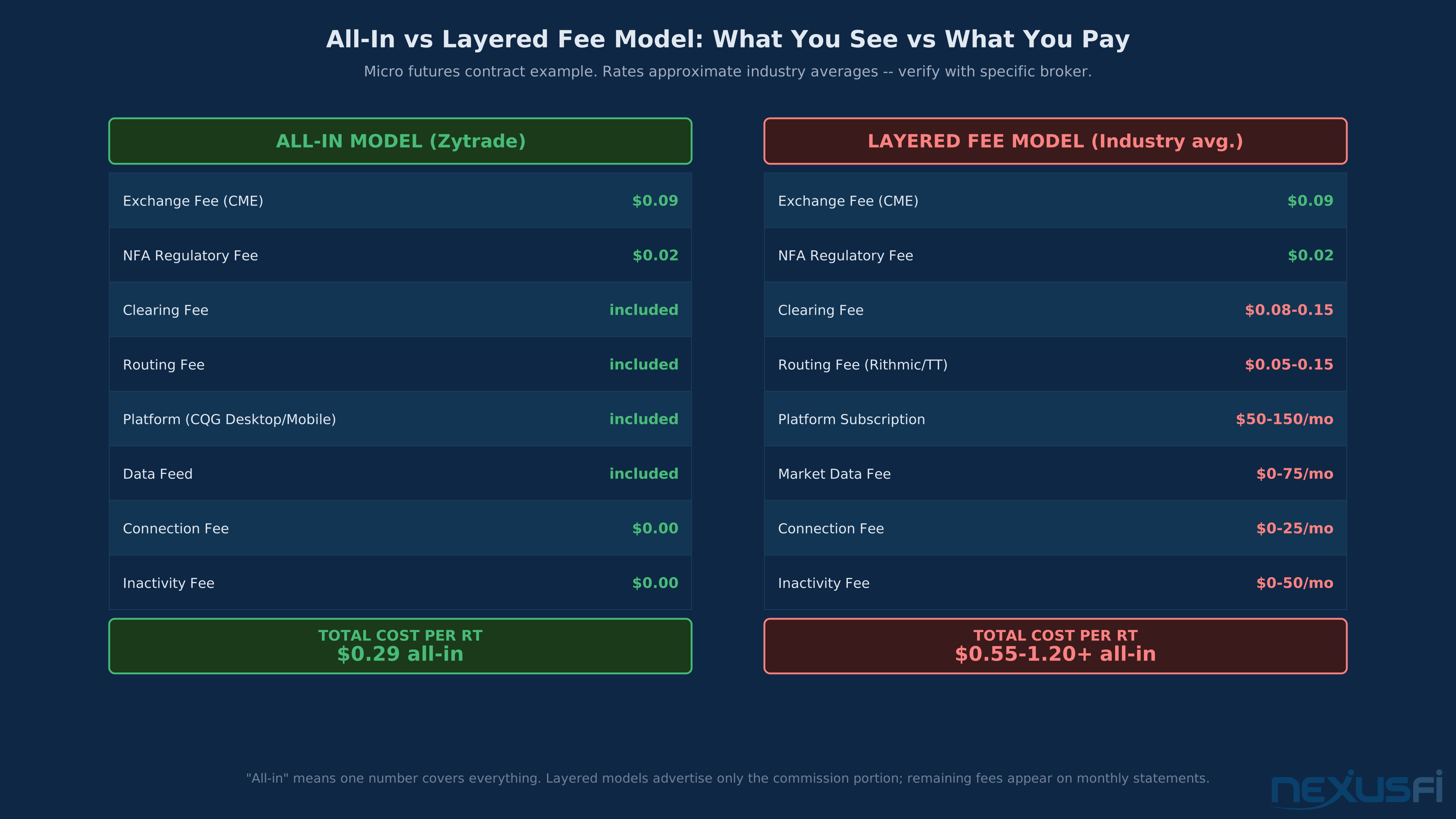
When a broker advertises $0.49 per contract, that number might be the commission portion only. Add $0.09 exchange fee, $0.02 NFA fee, $0.10 clearing fee, $0.10 routing surcharge, and $50/month in platform fees amortized at 100 trades, and you're actually paying over $1.20 per round turn. The number that was advertised bears no resemblance to what hits your account.
This is the hidden fee problem in futures brokerage, and it's been documented extensively on trading forums for years. Zytrade's pricing model is a direct response to it: $0.29 per micro contract round turn, $0.69 per standard contract — and those numbers include everything. Exchange fee, NFA fee, clearing, routing, and platform access. One number, full stop.
Understanding what "all-in" actually means — and why the difference matters at scale — is the subject of this article.
What All-In Actually Means #
A complete round-turn futures trade involves mandatory fees and broker-variable fees. Mandatory fees are set by the exchange and NFA — you pay them regardless of which broker you use. Broker-variable fees are everything else, and this is where the industry has historically been opaque.
The CME Globex exchange fee for micro equity index contracts (MES, MNQ) is approximately $0.09/RT. The NFA regulatory assessment is $0.02/RT. These are non-negotiable — every broker passes them through. Everything above $0.11/RT on a micro contract is broker-variable: clearing fees, routing fees, technology fees, platform subscriptions, and the broker's commission margin.
An "all-in" price means the broker has bundled all of these into a single stated rate. $0.29 all-in on a micro means you pay $0.29 and that's the complete transaction cost. Nothing shows up separately on the statement as a "clearing fee" or "technology surcharge."
The Fee Anatomy of a Futures Trade #
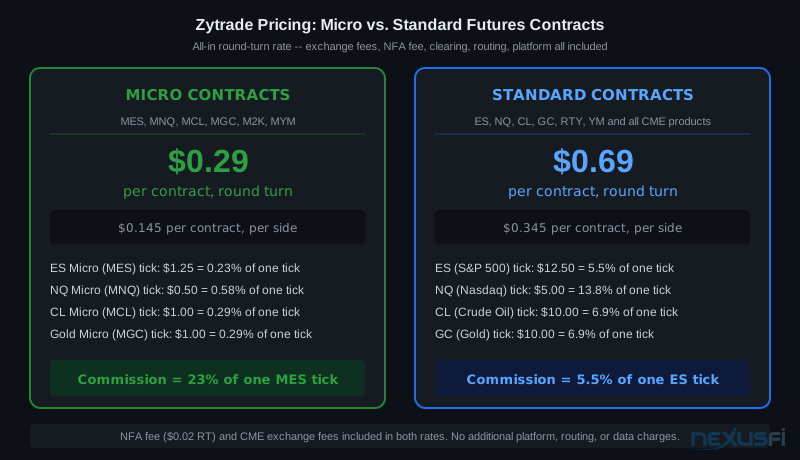
Breaking down the complete cost structure of one round-turn micro futures trade clarifies what's happening when fees are transparent versus layered.
Exchange fee: $0.09 RT — this is the CME's charge for use of Globex infrastructure. Every broker pays this and passes it to you. It's the same at every broker.
NFA regulatory fee: $0.02 RT — the National Futures Association assessment for every futures trade. Also identical everywhere, mandatory by law.
Clearing fee: This is where it gets variable. The FCM (Futures Commission Merchant) charges to clear and settle the trade. In transparent models, this is bundled. In layered models, it appears as a separate line on statements, typically $0.05-0.25/RT.
Routing fee: If the broker routes orders through a third-party technology vendor (Rithmic, TT, or proprietary), that vendor charges a per-order fee. This is typically $0.05-0.15/RT. The NexusFi thread comparing Teton and CQG routing called this out explicitly — brokers that use direct routing rather than third-party vendors eliminate this charge entirely.
Platform subscription: Standalone professional trading platforms (CQG subscriptions, Sierra Chart, NinjaTrader) run $50-150/month. Amortized across monthly trade volume, this adds $0.05-0.50/RT depending on how active you are. At 100 RT/month with a $50/month platform, you're adding $0.50/RT in invisible costs.
Broker commission: The broker's actual revenue margin per trade. This is what varies most between discount and full-service brokers and what discount models compress aggressively.
Zytrade Pricing Structure #
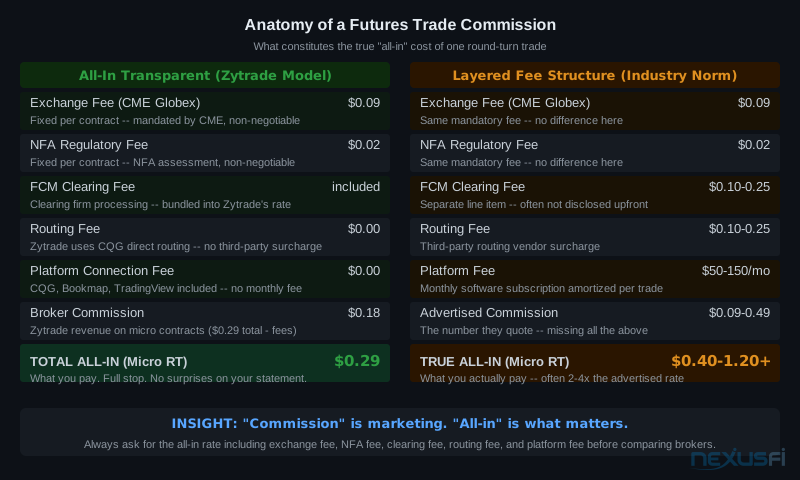
The structure is two numbers: $0.29 for micro contracts, $0.69 for standard contracts. Both are all-in round-turn rates.
Micro contracts at $0.29/RT cover MES (Micro E-Mini S&P 500), MNQ (Micro Nasdaq), MCL (Micro Crude Oil), MGC (Micro Gold), M2K (Micro Russell 2000), MYM (Micro Dow), and the broader range of CME micro products. Standard contracts at $0.69/RT cover ES, NQ, CL, GC, RTY, YM, and the full standard futures complex.
There is no platform fee. CQG Desktop and CQG Mobile are included. Bookmap access is included. TradingView, MultiCharts, OverCharts, and Sierra Chart integration is available at no additional charge. There is no connection fee, no data fee, no routing surcharge, no transaction fee, no technology fee.
The model bundles what others charge separately. CQG data subscriptions for professional users run $500-1,200/month standalone. Routing through CQG's infrastructure eliminates the per-order routing vendor charge. Platform access is zero. The $0.29 and $0.69 rates absorb all of this.
Micro Futures Pricing: $0.29 Per Contract Explained #
Micro contracts trade at 1/10th the notional size of their standard counterparts. One MES contract controls $5 times the S&P 500 index, versus $50 times for a full ES contract. The minimum tick on MES is 0.25 index points, worth $1.25 per contract.
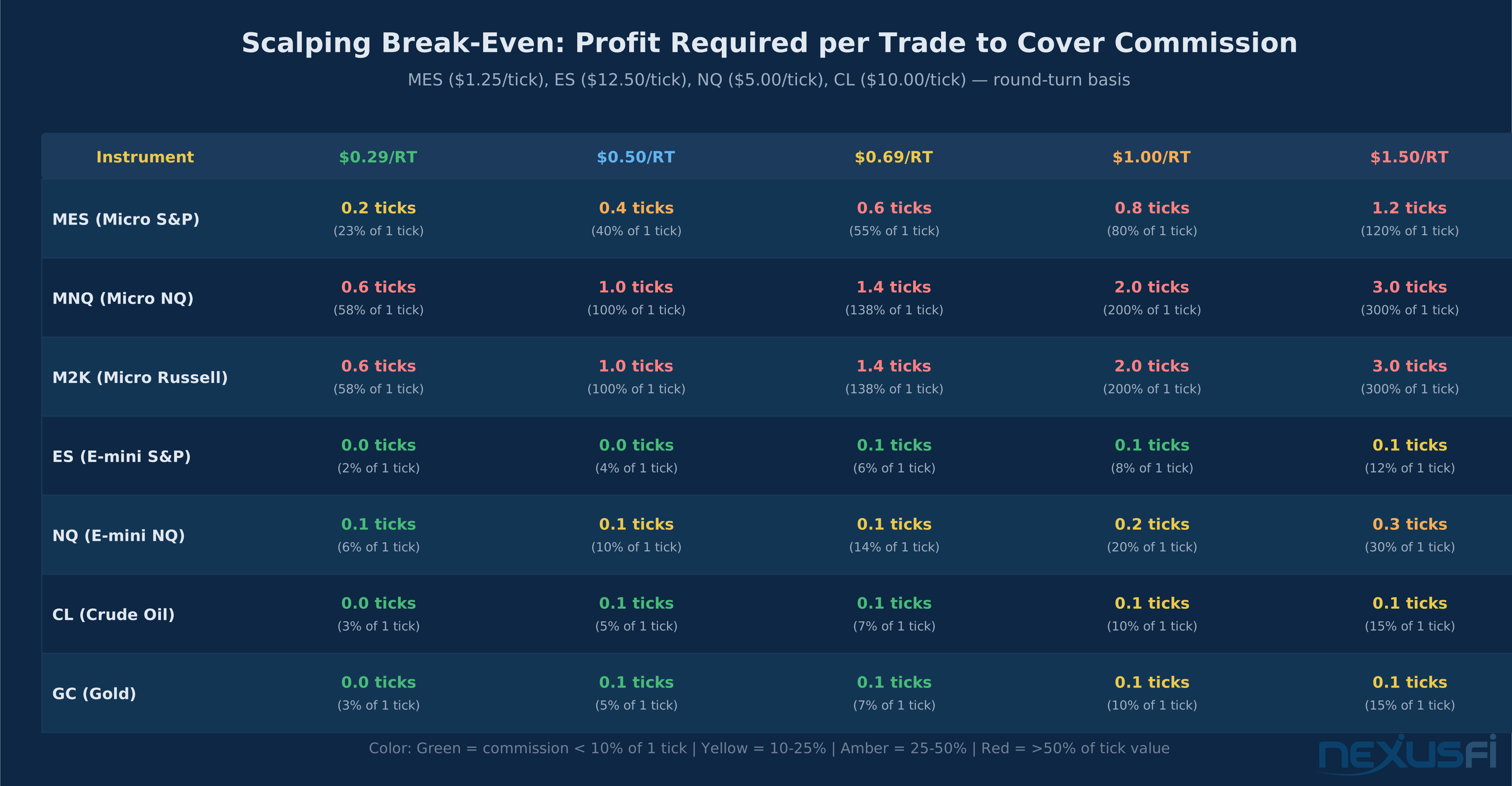
At $0.29/RT, the commission is 23% of one MES tick. A single one-tick winner ($1.25) covers the commission with $0.96 remaining. A two-tick winner ($2.50) covers commission and generates $2.21 in profit after costs. The ratio is workable for discretionary traders who aren't relying on sub-tick edges.
The micro pricing is especially relevant for newer traders building skills with limited capital. [post=719301]@bobwest[/post] explained in a NexusFi thread on intraday margins: "Margin is totally unregulated for intraday trades" — meaning brokers set their own intraday margin requirements. Zytrade offers low day trading margins, making micros accessible at relatively small account sizes while keeping commission costs competitive.
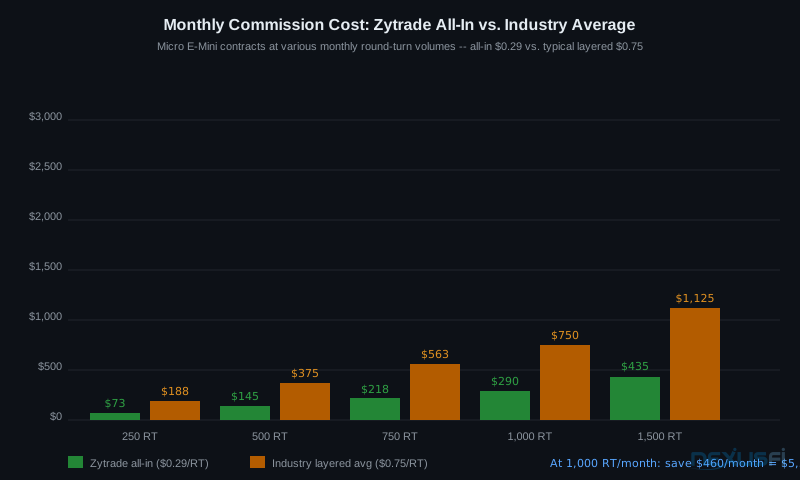
For high-frequency approaches on micros — scalpers doing 20+ RT/day — the $0.29 rate at 500 monthly RT generates $145 in monthly commissions. At an industry layered rate of $0.60, the same volume generates $300 in monthly commissions. The $155 monthly difference is $1,860 annually. Scale to 1,000 RT/month and it's $3,720 annually. These are real dollars that don't appear anywhere in the broker comparison if you're comparing on the advertised headline rate.
Standard Futures: $0.69 Per Contract #
Standard contracts at $0.69/RT all-in cover the full futures complex: equity index (ES, NQ, RTY, YM), energy (CL, NG, HO, RB), metals (GC, SI, HG), agricultural (ZC, ZS, ZW), currencies (6E, 6J, 6B), and interest rates (ZN, ZB, ZT).
The ES tick is $12.50 for a 0.25-point move. At $0.69/RT, commissions represent 5.5% of one ES tick — a standard entry-level ratio for discretionary ES trading. The NQ tick is $5.00 per 0.25-point move — $0.69 is 13.8% of one NQ tick, slightly higher proportionally but still within the range that allows tick-to-tick edge-based strategies to work.
For CL (crude oil), the tick is $10.00 per 0.01 move — $0.69 is 6.9% of one tick, comparable to ES. Gold futures (GC) tick at $10.00 per $0.10 move — same 6.9% ratio.
At 500 standard RT/month, the $0.69 all-in rate generates $345 in monthly commissions. A comparable layered-fee setup at $1.20/RT (which is common when you add routing, platform, and clearing separately) runs $600/month — a $255/month or $3,060/year difference.
Volume Impact: Calculating Your Annual Commission Burden #
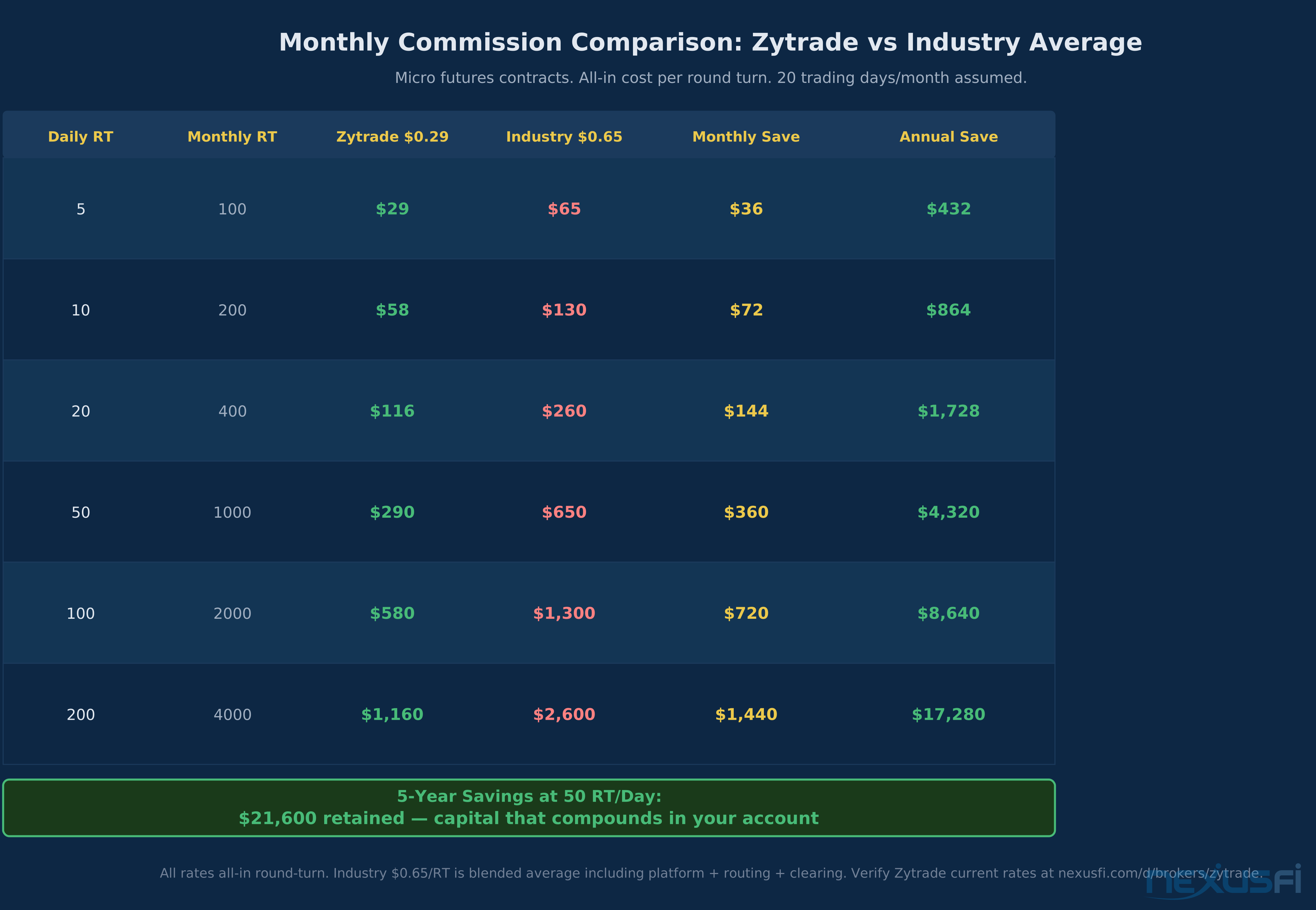
Commission math is straightforward but most traders don't run it. The calculation: daily round turns multiplied by trading days multiplied by all-in rate equals annual commission cost.
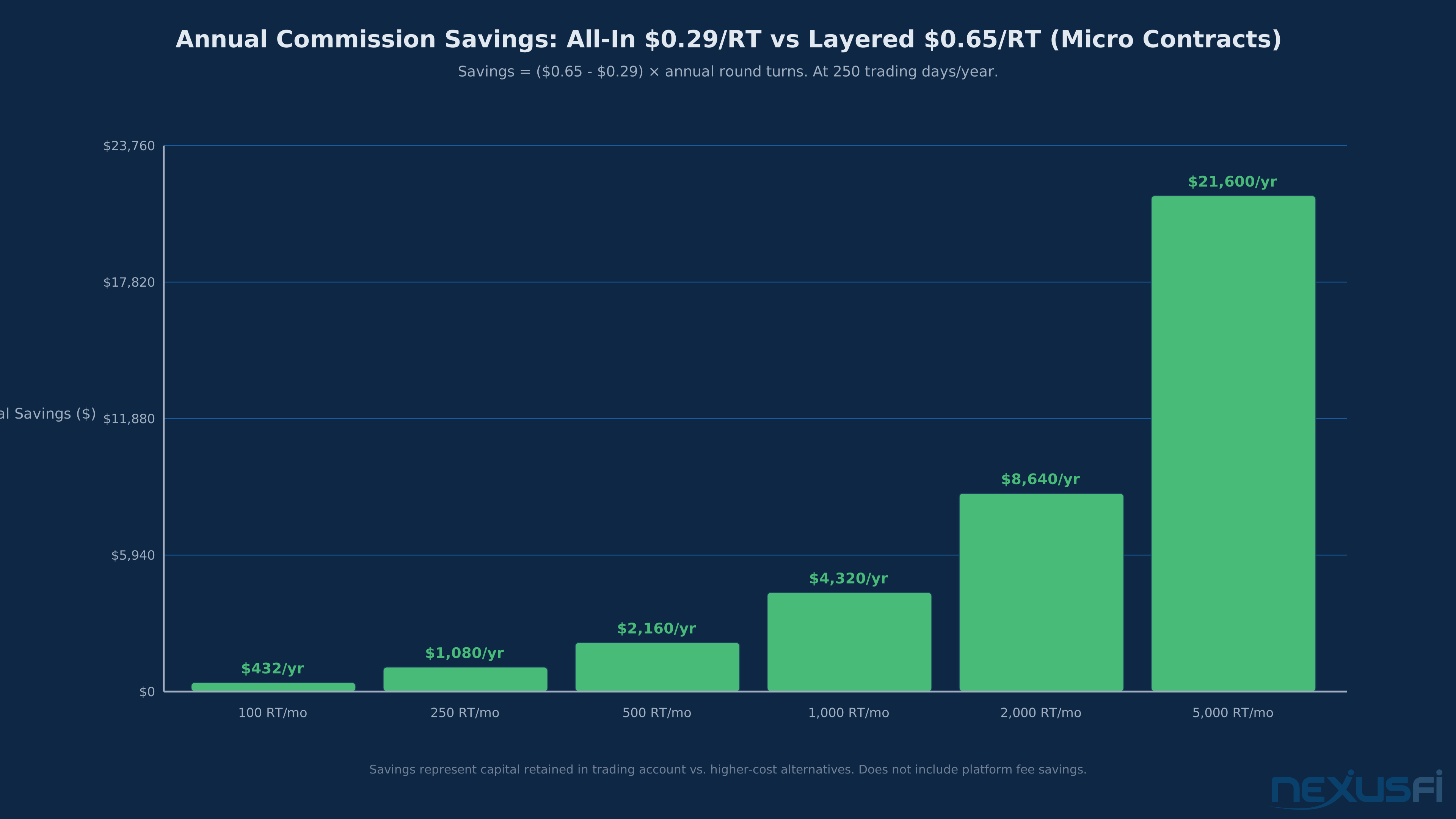
At 10 micro RT/day, 20 trading days/month, 12 months: 2,400 RT/year at $0.29 = $696 annually. At a layered rate of $0.65, the same 2,400 RT = $1,560 annually. Difference: $864/year.
At 50 micro RT/day (active scalper): 12,000 RT/year at $0.29 = $3,480. At $0.65: $7,800. Difference: $4,320/year. That's a meaningful amount of capital that compounds into your trading account instead of disappearing to intermediaries.
For standard contracts, the scale is larger. 20 ES RT/day at $0.69 all-in: 4,800 RT/year = $3,312. At an industry average of $1.50 all-in: $7,200. Difference: $3,888/year.
These differences don't appear in any advertised commission comparison. They only emerge when you model the complete cost structure at realistic trade volumes. That's the exercise Big Mike's commission shopping framework was designed to prompt — and the exercise transparent pricing models eliminate the need to do.
What Zytrade Does Not Charge #
The explicit zero-fee list covers the categories that create the most confusion in broker comparisons:
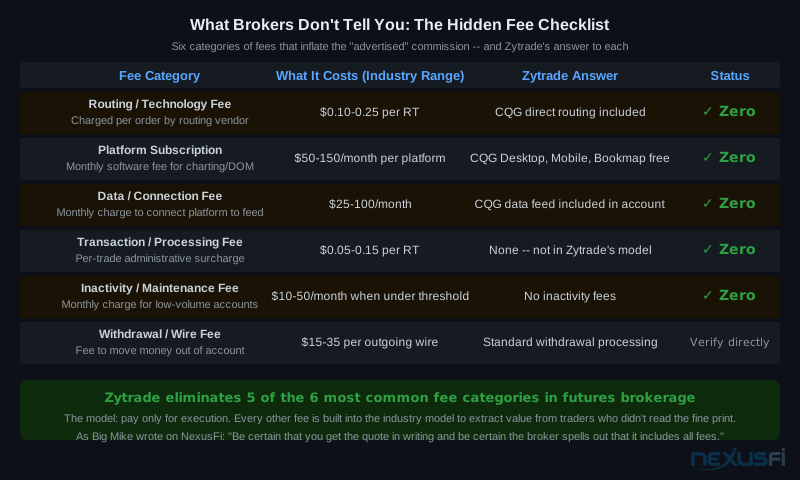
No platform fee — CQG Desktop, CQG Mobile, and Bookmap are included in the account. No monthly software subscription, no per-platform connection charge. TradingView, MultiCharts, OverCharts, and Sierra Chart integration is available without additional fees.
No transaction fee — no per-trade administrative charge layered on top of the commission rate. The rate is the rate.
No routing fee — Zytrade routes through CQG's infrastructure, which eliminates the third-party routing vendor surcharge that adds $0.05-0.25/RT at brokers using separate routing services.
No connection fee — connecting platforms to the account carries no monthly charge. This matters for traders running multiple platforms simultaneously or switching between environments.
No inactivity fee — accounts that go dormant for a period don't get charged for the privilege of existing.
The practical test: look at a brokerage statement after a month of trading and see if there are any line items beyond the per-contract commission and the exchange/NFA fees. With Zytrade's model, the statement should be simple.
Putting It All Together #
Transparent all-in pricing has a compounding benefit that goes beyond the arithmetic. When you know exactly what each trade costs, you can model the break-even requirements of any strategy with precision. A scalping approach that needs a 2-tick edge to break even on MES trades has a different viability calculation at $0.29/RT than at $0.65/RT — the difference isn't trivial when you're looking at the edge requirements across hundreds of trades.
The community guidance on this has been consistent for years. Veteran traders on NexusFi have consistently framed broker cost analysis as a full-relationship question — not just the headline rate. Institutional-grade commissions on standard contracts were discussed in the CQG FCM thread by [post=432030]@artemiso[/post], who noted that direct FCM routing at $0.25/RT commission was achievable for professional volume. The all-in comparison shifts that benchmark to include infrastructure, routing, and platform costs. The hidden fee model transfers wealth from traders to intermediaries through opacity. The transparent all-in model replaces that extraction with a simple contract: pay this rate per execution, and that's the complete relationship.
Zytrade's platform breadth — six trading environments, professional analytics, CQG execution infrastructure — is included in the account at these rates. The comparison isn't just $0.29 vs. $0.65 in isolation. It's $0.29 with full CQG infrastructure vs. $0.65 with a third-party routing vendor and a separate platform subscription.
Confirm current rates and account requirements directly at Zytrade's NexusFi directory listing. Pricing is subject to change — the all-in model is the commitment, not any specific rate. Zytrade is an NFA member and subject to full CFTC regulatory oversight. All customer funds are held in segregated accounts at the clearing firm.
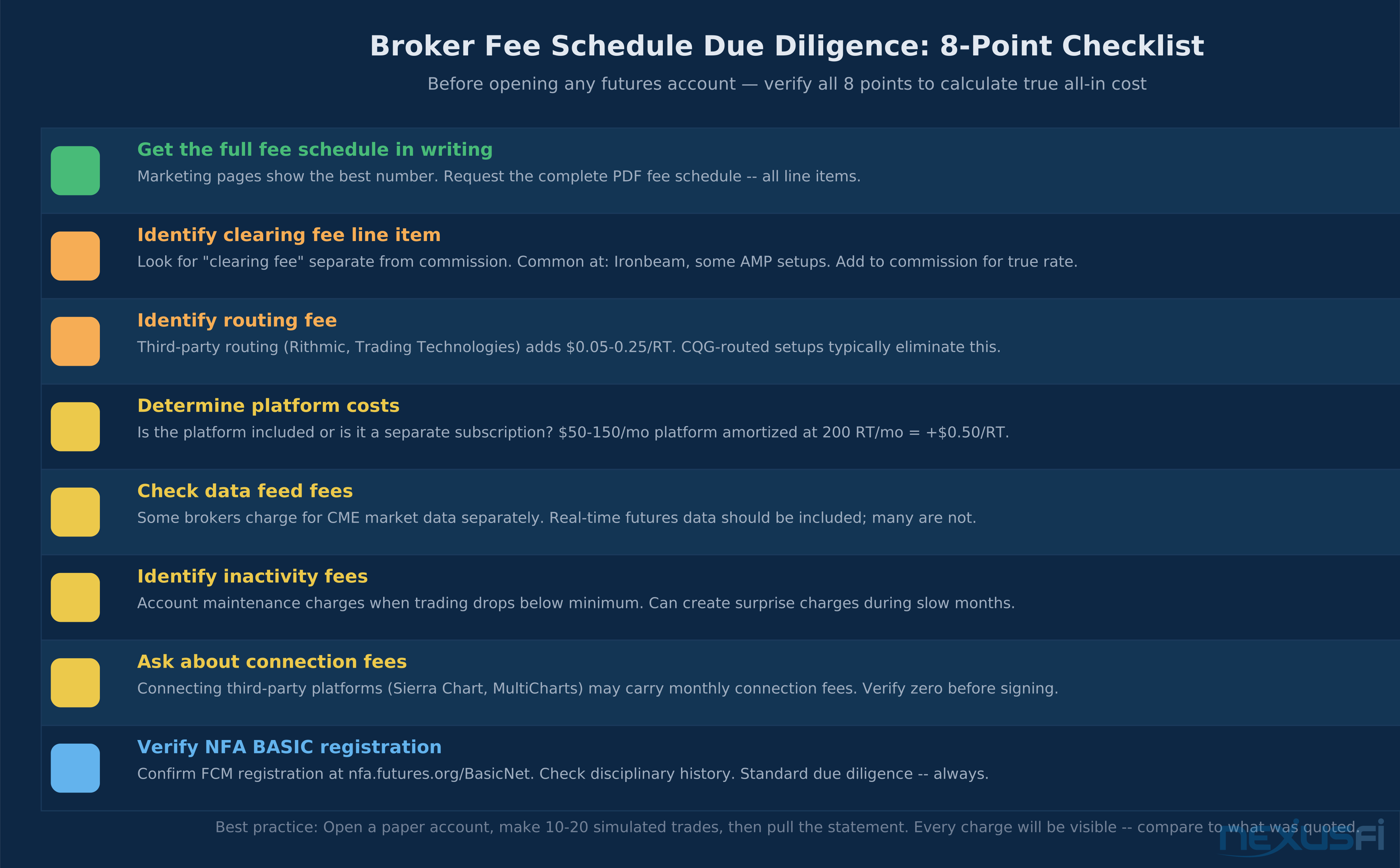
Before comparing any two brokers, get the complete fee schedule in writing — not the marketing page. Request the PDF fee schedule and look specifically for "clearing fee" and "routing fee" as separate line items. These two categories alone account for the majority of the gap between advertised and actual per-trade cost.
Practical Cost Audit: Evaluating Any Broker Fee Schedule #
Commission shopping without a complete audit framework produces bad comparisons. The correct method is to start with your actual monthly trade volume and run the full cost at every rate you're evaluating — not just the headline number. For a complete systematic approach to broker selection beyond just cost, see the Futures Broker Evaluation Framework.
Step one: Pull up the broker's complete fee schedule, not the marketing page. Look for every category of charge: commission per contract, exchange and NFA pass-throughs, clearing fee, routing fee, data fee (especially if there's a minimum monthly data spend), platform fee, and inactivity fee. Many brokers bury clearing fees in the account agreement rather than the fee schedule. Look for both.
Step two: Calculate the true per-RT rate. Take your last 90 days of statements and add up every charge that wasn't a margin deposit or a P&L swing. Divide by the number of round turns executed. That's your actual all-in rate. Compare this to what you thought you were paying. The gap between the two numbers is what you're paying for opacity.
Step three: Model at three volume levels — your current average, 50% higher, and double. Commission costs scale linearly. Infrastructure costs (platform fees, data fees, connection fees) are fixed and dilute as volume increases. The per-RT rate at 2x volume tells you what the brokerage relationship costs if your approach succeeds and your frequency increases.
Step four: Account for the platform bundle. If your current broker charges separately for a trading platform you use daily, that's a cost to include in the comparison. A $100/month platform subscription at 200 RT/month adds $0.50/RT to your effective all-in rate. At 500 RT/month, it adds $0.20/RT. The platform cost is real but doesn't appear anywhere in the per-contract comparison if you don't model it explicitly.
The clean version of this analysis answers one question: what does it cost to execute one round-turn trade, including all charges, amortized across your real monthly volume? That number is your true brokerage cost. Compare it against $0.29/RT on micros or $0.69/RT on standards — including the platform, data, and infrastructure bundle included with both — and the comparison is apples-to-apples.
NexusFi member @Big Mike was among the first to document this framework formally in the community: the key quote, referenced earlier, was "be sure to ask for the 'all-in' price" and look for clearing fees as a separate line item. That advice was specific to the state of the industry in 2014 but applies equally now. The mechanism of hidden fee layering hasn't changed; only the specific fee labels have evolved.
Commission Structure Impact by Trading Approach #
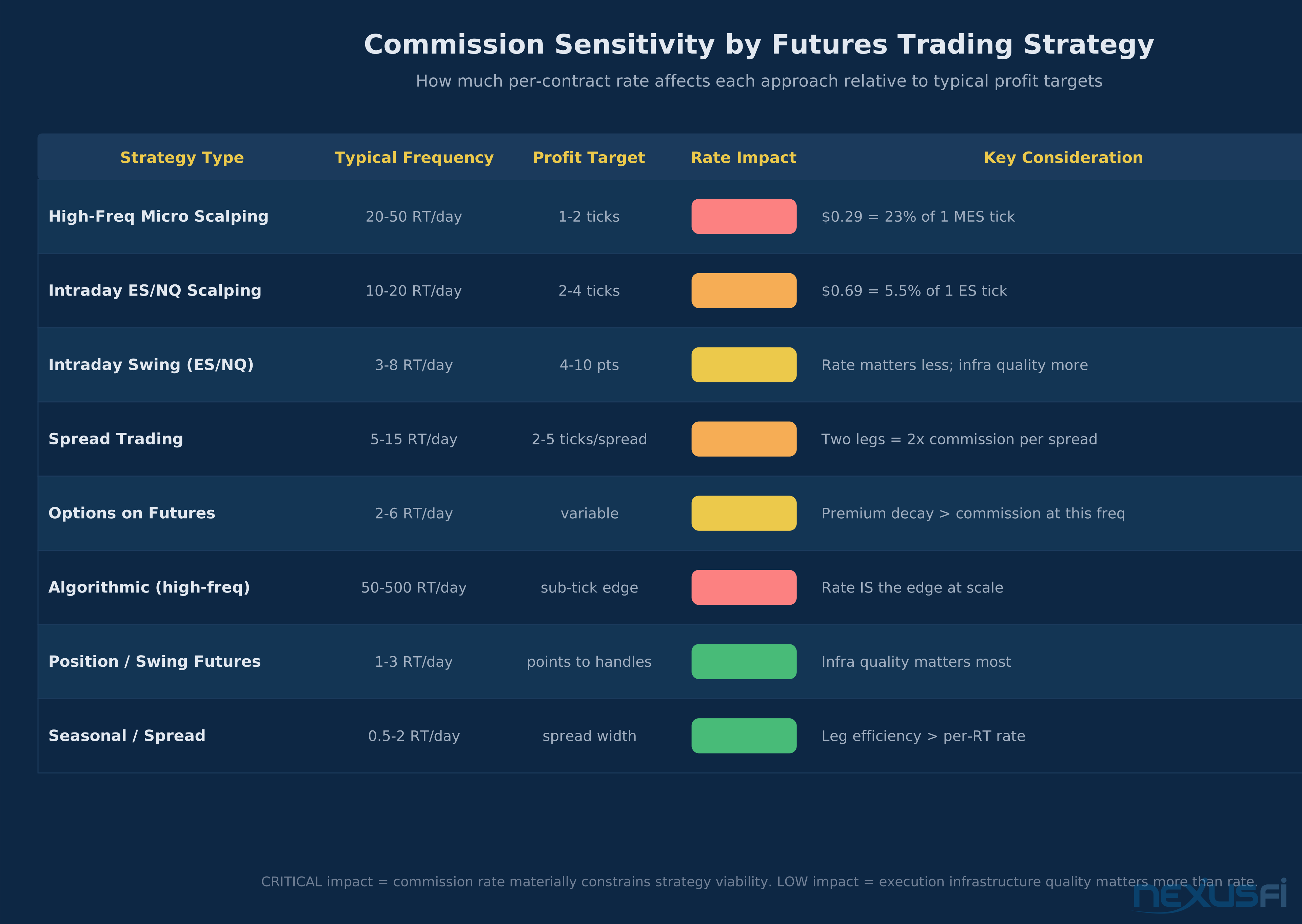
Commission drag affects trading approaches differently depending on profit-per-trade and frequency. Note that commission is only one component of total execution cost in futures trading — slippage, bid/ask spread, and market impact compound with commission at scale. Understanding which category your approach falls into tells you how much the per-RT rate actually matters to your edge.
High-frequency scalping on micros is the most commission-sensitive approach. A trader targeting 1-2 ticks per trade on MES at $0.29/RT needs the fill to be at least 1.25 points just to cover commission. At $0.65/RT, the break-even threshold is the same or better — and the difference in the rate doesn't change strategy viability but does change the account's actual keep rate over time. Run 3,000 micro RT/month at $0.29: $870 annually. At $0.65: $1,950 annually. The difference is $1,080 that compounds back into capital rather than leaving via commissions.
Swing traders and position traders on standard contracts are less commission-sensitive — the profit targets are large relative to the per-RT cost — but the infrastructure quality argument matters more. A position held for days or weeks needs reliable order management, bracket execution, and market data continuity over extended periods. CQG's server-side order management and institutional-grade data feed address exactly this.
Spread traders pay commission on each leg. A two-legged spread in micro contracts at $0.29/RT pays $0.58 total per spread round turn. At $0.65/RT, it's $1.30. For calendar spread strategies that target $2-5 per spread, the commission differential is material — 25% of profit at $0.29 versus 26-65% of profit at $0.65 on a $2 target. Spread trading is naturally commission-amplified because of the leg count.
Automated strategies and algorithmic trading are probably the most impacted category. An algo running 100+ RT/day operates at a forced commission rate regardless of the day's P&L. The commission rate is a fixed drag that the algo's edge must overcome before generating any profit. Lowering the per-RT rate from $0.65 to $0.29 on a micro algo running 100 RT/day is $36/day in commission savings — $9,000 annually at 250 trading days. That's meaningful alpha recovery at zero edge cost.
The general rule: commission drag matters most when profit targets are small, frequency is high, or leg count is high. It matters least when you're trading low-frequency, large-move strategies. The transparency argument matters regardless of approach — you need accurate numbers to model strategy viability, and layered fees make accurate modeling impossible until after the fact.
Regulatory Protections and Account Safety #
Zytrade operates as an FCM (Futures Commission Merchant) registered with the CFTC and a member of the NFA. The regulatory framework that governs futures brokers is substantively different from equities brokers, and understanding it helps traders evaluate account safety correctly.
CFTC Regulation 1.20 requires that customer segregated funds be held separately from the firm's own capital in segregated accounts at approved depositories. An FCM cannot use customer funds for proprietary trading or as operating capital. The rules governing what brokers can do with those segregated funds once deposited are governed by CFTC Regulation 1.25 — a separate protection layer worth understanding. This is the core protection — if Zytrade were to face financial difficulty, customer funds are segregated and protected from creditor claims.
NFA membership subjects the firm to regular audits and financial reporting requirements. NFA-registered FCMs file financial reports quarterly; the NFA conducts on-site audits. This regulatory layer is the baseline compliance check on the firm's financial health and operational practices.
Customer protection is further supported by the fact that clearing happens through established, capitalized clearing firms at the exchange level. The exchange clearinghouse stands between buyer and seller on every futures trade; the FCM is the customer's intermediary to that clearinghouse, not the counterparty itself.
Confirm all NFA registration and compliance information directly through the NFA Background Affiliation Status Information Center (BASIC), which is a public database. Search by firm name or NFA ID to verify current registration status, disciplinary history, and associated persons. For a complete account-opening verification checklist, see Futures Broker Due Diligence. This is standard protocol for any futures account opening.
Knowledge Map
Go Deeper
Build on this knowledgeReferences This Article
Articles that build on this topicCitations
- — Commission shopping w/brokerages (2014) 👍 10“Be certain that you get the quote in writing and be certain the broker spells out that it includes all fees.”
- — NT 8 Futures Micro Contracts and Data feeds (2019) 👍 2“They will often tell you about their low, low commissions, which is technically correct -- it is their part of the total fee, which includes exchange fees and data fees on a per-trade basis.”
- — Futures vs CFD with AMP futures (2020) 👍 3“What is important is to make sure you really understand your complete end-to-end cost per trade.”
- — Ironbeam brokerage / FCM (2025) 👍 1“The lack of transparency on commissions is even worse -- pricing is not clearly listed on the website and is only provided via email in a clunky PDF.”
- — CQG FCM commissions and fees (2014) 👍 5“You would expect no more than $2.82 per ES round trip all-in including exchange, FCM commission and NFA fee.”
- — Teton Order Routing versus CQG (2023) 👍 2“No $0.10 routing fee or monthly connection premium that other vendors charge.”
- — AMP Futures / AMP Global Review (2014) 👍 1“He always said he quotes all-in.”
- — Zytrade - Deep Discount Futures Broker
- — Zytrade + Bookmap Partnership