



Zytrade CQG-Powered Futures Brokerage: Professional Execution and Analytics at Deep Discount Commissions
Overview #
Zytrade built its brokerage on a simple bet: if you give traders institutional-grade technology for free and charge a low, transparent rate per contract, you win on volume. The CQG platform at the center of that bet has a 40+ year track record running execution and data for professional trading desks worldwide. Getting it at zero cost through a discount brokerage account is the kind of infrastructure arbitrage that wasn't available to retail traders a decade ago.
The pitch is concrete: Zytrade provides CQG Desktop and CQG Mobile at no charge, no connection fee, no monthly platform subscription. Micros trade at $0.29 all-in per contract round turn, standards at $0.69. That's it. No routing surcharge, no technology fee buried in the statements, no data fee layered on top. One number, full stop.
What CQG actually delivers is worth understanding in detail — because "free platform" sounds like a marketing line until you look at what the platform does.
CQG: The Backbone of Professional Futures Trading #
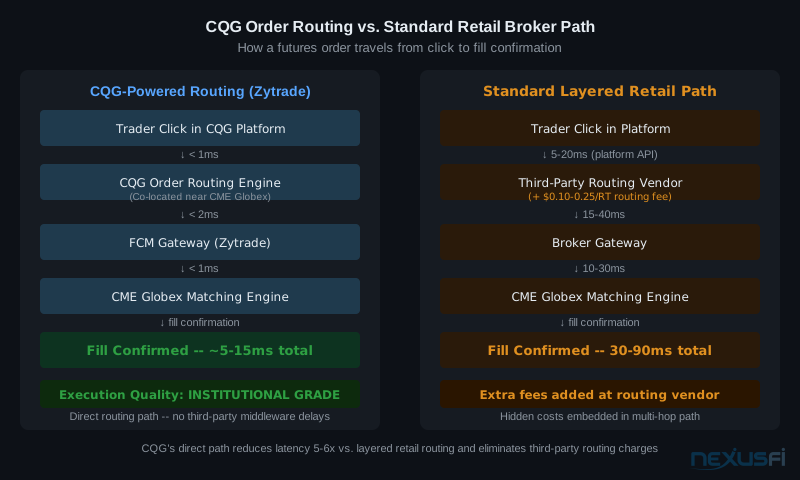
CQG has been powering professional futures execution since 1983. The company runs co-located infrastructure next to CME Globex and the major futures exchanges, which means order routing paths are shorter and more direct than typical retail broker paths.
The technical reality: a retail order through a layered broker path (platform API to routing vendor to FCM gateway to exchange) might add 30-90ms of latency while also adding routing fees at each hop. CQG's infrastructure shortens that path much. In the NexusFi forum, [post=95920]@h4cked[/post] put it directly: "CQG is really needed for the following: Advanced Trading Strategies, Options Trading, Spreading, News Trading. Their routing service is simply the best."
That same thread noted CQG's co-location offering at the exchange level for latency-critical applications. What matters for Zytrade customers is that the underlying routing infrastructure is the same — professional-grade, direct paths to the exchange, no third-party routing vendor extracting margin in the middle.
[post=705808]@HiLatencyTRDR HLT[/post] — a 15-year trading veteran, series 3 licensed broker for a decade, and former branch manager at a futures prop firm — mapped the full routing chain: most retail FCMs route through CQG's API and direct exchange connection rather than maintaining proprietary infrastructure. "ONLY a direct connection goes straight to the trade engine," he noted, explaining that CQG's architecture eliminates the intermediate hops that add latency and opacity to the order path.
[post=858772]@Ironbeam[/post] reinforced this in a NexusFi thread comparing Teton vs. CQG routing: "No $0.10 routing fee or monthly connection premium that other vendors charge." The absence of the per-contract routing surcharge on CQG-based setups was specifically called out as a meaningful cost advantage. For the full picture on how commission structure compares across setups, see Zytrade All-In Transparent Pricing. At 1,000 round turns a month, a $0.10/RT routing fee adds $100/month in invisible costs — $1,200/year that never shows up on the headline commission rate but hits the bottom line just the same.
CQG Desktop -- The Core Trading Interface #
CQG Desktop runs in a browser — no software download, no local installation, no machine-specific license. Switch between a desktop at home and a laptop on the road without configuring anything. That practical advantage matters more than it sounds when your charting setup needs to be available at 5:30 AM on an unfamiliar machine.
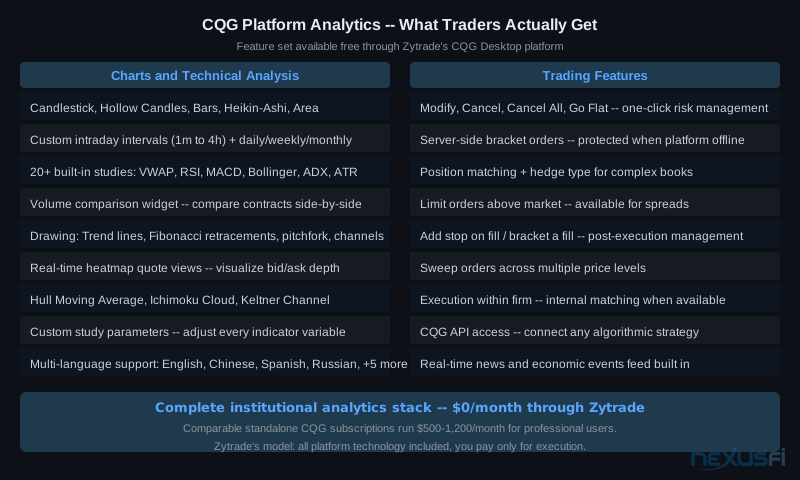
Most brokers offer stripped-down web platforms with basic charting. CQG Desktop is a different animal entirely. The technical study library runs deep enough for professional work: VWAP, volume profile studies, RSI, MACD with histogram, Bollinger Bands, ADX, ATR, Keltner Channels, Ichimoku Cloud, Hull Moving Average — all with adjustable parameters on tick-accurate data. The output quality depends on the feed underneath it. CQG's feed doesn't skip ticks, which means your VWAP calculation is actually tracking every fill, not a sampled approximation.
The depth-of-market heatmap visualization is the feature worth pausing on. Standalone DOM tools that display real-time bid/ask depth with visual heatmapping run $50-150/month as separate subscriptions. CQG Desktop includes this natively. For traders watching order flow — iceberg detection, stop cluster identification, liquidity shifts at key levels — the DOM display is where the edge lives. Getting it bundled into a zero-cost platform through Zytrade changes the cost math much for order flow traders.
Multi-contract quote comparison lets you display correlated instruments side by side. Spread traders watching ES vs NQ, crude vs gasoline, or any inter-market relationship need this workflow. The display updates on the same feed infrastructure, so cross-contract comparisons reflect synchronized data — not two different feeds with drift between them.
CQG Mobile -- Trade From Anywhere #
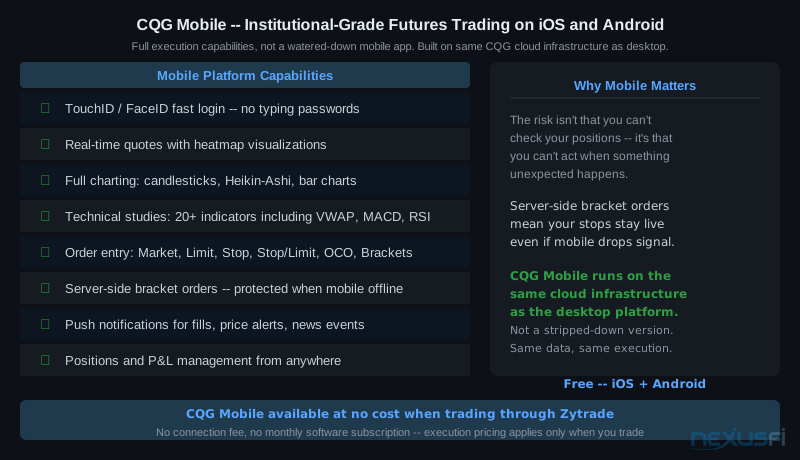
CQG Mobile runs on the same cloud infrastructure as the desktop. That single architectural decision puts it in a different category from every companion app that gives you watered-down charts and a basic order ticket. The data feed, execution path, and order management are identical to what you see on the desktop — same studies, same order types, same server-side execution.
The server-side bracket order capability is the feature that matters most on mobile. When you enter a bracket order, the stop and target levels live on CQG's servers — not on your phone. If you walk into a dead zone, hit the subway, or your carrier drops a signal, those protective orders remain active. Most retail mobile platforms don't solve this problem at all. Your stop lives on the device, the device loses connection, and you're sitting in a live position with no protection. CQG's architecture eliminates that risk entirely.
TouchID and FaceID login is a small detail that matters in real trading moments. When price is moving and you need to check or manage a position, a 15-second password entry can cost you the exit. Biometric login gets you from lock screen to live positions in under two seconds.
Position management from mobile is complete — open positions, unrealized P&L, order modification, one-tap flatten. The full order type suite works here: market, limit, stop, stop/limit, OCO, and bracket. There's no compromised subset where you're missing the stop type you need when you're away from the desk. Trading from mobile isn't a degraded experience — it's the same execution environment on a smaller screen.
Platform Ecosystem: Multiple Choices for Any Style #
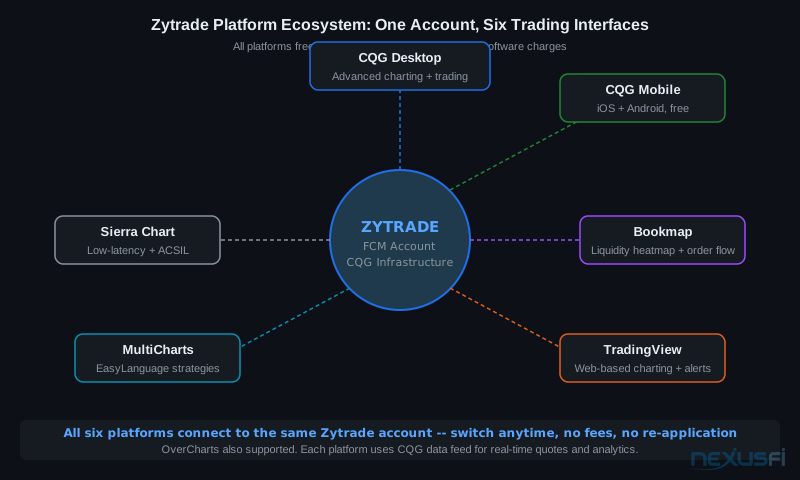
Zytrade connects to seven trading environments: CQG Desktop, CQG Mobile, Bookmap, TradingView, MultiCharts, OverCharts, and Sierra Chart. All connect via CQG's API infrastructure at no additional connection or software fees — you're not locked into one platform because you chose Zytrade as your broker.
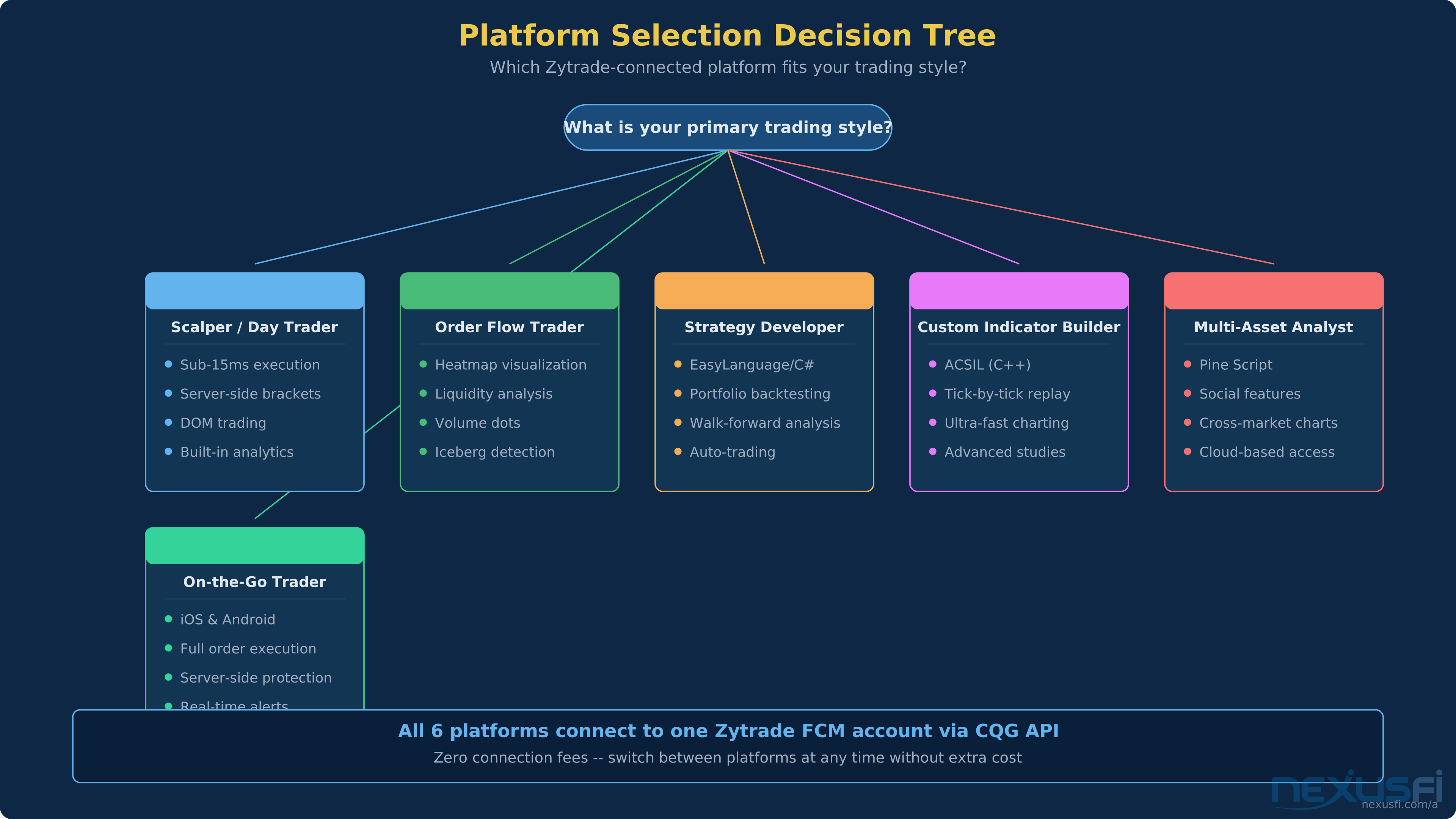
The platform selection decision has a clear answer for each trader type:
- CQG Desktop -- The default for most traders. Sub-15ms order routing, full DOM heatmap, 20+ built-in studies on tick-accurate data, and the complete nine-order-type suite. Start here unless you have a specific reason to use another environment.
- Bookmap -- For order flow traders who need liquidity heatmap visualization. If iceberg detection, stop-cluster identification, and real-time bid/ask depth visualization are part of your read, Bookmap is the right tool. CQG executes behind it -- you get both at zero combined cost.
- MultiCharts -- For EasyLanguage strategy developers. If you have automated or semi-automated strategies written in TradeStation's EasyLanguage, MultiCharts is the direct execution path. Your existing strategy code ports without rewriting.
- TradingView -- For chartists and community-driven traders. If you run setups informed by TradingView alerts or shared community ideas, you can execute directly through your Zytrade account without leaving the TradingView interface.
- Sierra Chart -- For advanced discretionary traders and ACSIL programmers. Lowest-latency DOM display available, deep customizability, and native support for Sierra's own ACSIL automation language. Best for traders who want full platform control and are comfortable with Sierra's technical depth.
- OverCharts -- For depth-of-book analysis focused on European-style ladder execution. Specialized visualization for traders who rely on bid/ask ladder dynamics as a primary read.
The platform choice is reversible — your Zytrade account connects to all six simultaneously, so if your approach evolves from discretionary TradingView charts to systematic MultiCharts execution, you switch the connection without opening a new account or re-funding.
[post=836230]@Sawtooth[/post] mapped the standalone platform cost environment: "MultiCharts is about $100/mo to get fewer features than Sierra's Package 3. NinjaTrader is $60/mo with fewer features than Sierra's Package 3. You could easily spend $150/mo to get comparable to Sierra's Package 3." At Zytrade, none of these subscriptions apply — all six platforms connect at zero additional cost on top of the $0.69/RT all-in rate. (2021)

Order Types and Execution Capabilities #
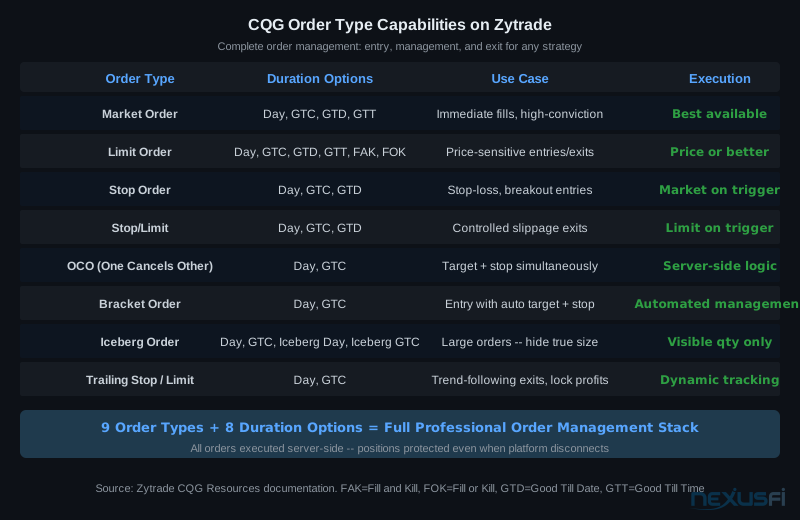
CQG's order management stack covers nine order types across eight duration options. This matters because missing order types force workarounds that introduce execution risk.
The nine order types: Market, Limit, Stop, Stop/Limit, OCO (One Cancels Other), Bracket, Iceberg, Trailing Stop, and Trailing Limit. Each supports multiple duration options: Day, GTC (Good Till Canceled), GTD (Good Till Date), GTT (Good Till Time), FAK (Fill and Kill), and FOK (Fill or Kill). Iceberg orders specifically support Iceberg Day and Iceberg GTC durations for managing large position entries without revealing full size.
Execution features include order modification, sweeps across multiple price levels, limit orders above market (relevant for spread strategies), Cancel All and Go Flat for emergency risk reduction, and position matching and hedge type settings for complex books. Post-execution management includes add-stop-on-fill and bracket-a-fill capabilities — meaning you can automate the stop placement workflow after a fill without manually entering it.
All of this executes server-side. Your orders live on CQG's infrastructure, not on your desktop or mobile device. A platform crash, power outage, or internet disruption doesn't leave open positions unprotected.
Market Data Quality and Analytics #
CQG processes market data directly from CME Globex and the major exchanges. The feed includes real-time quotes, tick data, volume and open interest, and news/economic events. The breadth covers equity index futures, energy, metals, agriculture, currencies, interest rates, and cryptocurrency futures where applicable.
The analytics layer on top of the raw data includes everything covered in the charting section — 20+ built-in studies, multiple chart types, customizable parameters. But the data quality itself is the foundation. A feed that skips ticks or introduces latency in the data path corrupts every calculation that runs on top of it. CQG's data infrastructure is purpose-built for futures execution, which means tick-level accuracy is the default, not an add-on.
For traders running volume-based strategies — VWAP, volume profile, order flow — the data quality is the strategy. CQG is built for the work most futures traders actually do: price action, VWAP, volume-based signals. The data infrastructure behind those studies doesn't drop ticks under load — and when your volume delta calculation skips ticks, your edge disappears. That's the result of 40 years running institutional-grade feed architecture. The feed quality is the edge.
Professional Services and Automation #
CTA and CPO Account Structure
Zytrade explicitly supports CTA (Commodity Trading Advisor), CPO (Commodity Pool Operator), and fund structures. The mechanics of how this works at the account level matters for advisors evaluating the platform: each managed client receives a separate, individually-segregated sub-account number at the FCM. When a CTA executes a trade, the fill is allocated to multiple client sub-accounts simultaneously — either via a block-then-allocate workflow or by submitting individual orders per account using CQG's multi-account management infrastructure.
Allocation methods include pro-rata by account equity, equal allocation by shares, and custom per-account allocation. Each sub-account maintains independent position tracking, P&L reporting, and margin monitoring. CQG's CAST (Customer Account Service Tool) provides the risk control layer — pre-trade validation that a given order doesn't breach any individual client's position or margin limits before routing to the exchange, running simultaneously across the full managed book.
For CPOs operating a commingled fund, the pool is a single legal entity with its own FCM account. Fund administration (NAV calculation, investor allocation) typically runs through a third-party administrator, while the FCM provides daily confirms, monthly statements, and audit-ready transaction records. CTAs need NFA registration and Disclosure Document filing; CPOs have additional quarterly financial reporting requirements under CFTC rules.
The Trade Desk service handles a specific use case: traders who follow investment newsletters or trading signals but want professional execution support rather than placing orders themselves. The desk manages each trade according to the provided recommendation — useful for signal subscribers who want the benefit of the strategy without the execution pressure of trading it live themselves.
CQG API and Automation Paths
CQG exposes two distinct API integration paths for algorithmic traders. Understanding which applies to your situation determines the approach:
As [post=704006]@FreeToChoose[/post] noted in a NexusFi platform API thread: "CQG, their API is in C#/.Net but I can write a server with listener port on their API and have my system send orders via TCP/IP port" — illustrating how the CQG Trading API's COM architecture lets developers build custom order routing layers in any language that supports TCP/IP. (2019)
CQG Trading API — A COM-based automation server running alongside CQG's desktop client. Supported languages are any that handle Windows COM automation: C#, C++, Visual Basic, Excel VBA, and MatLab. CQG provides sample code and API templates for each. This API exposes full access to market data, historical data, analytics, and order routing from a single interface. Traders using platforms like MultiCharts (EasyLanguage) or Sierra Chart (ACSIL) connect through this layer; those platforms handle the API bridge, so your strategy code communicates with the platform's native API, not CQG's API directly.
CQG FIX Connect — Platform-neutral order routing via FIX 4.2 protocol. This path is for traders connecting custom algorithmic systems without any CQG proprietary client — hedge funds, CTAs, and institutional setups running custom C++ or Python order management systems. FIX Connect routes to CQG's unified exchange gateway and supports 40+ exchanges worldwide. The workflow uses standard FIX message types: NewOrderSingle (Tag 35=D) to submit, OrderCancelRequest (Tag 35=F) to cancel, and ExecutionReport (Tag 35=8) to receive fills. Because it's standard FIX 4.2, any FIX-compatible language or OMS connects without CQG-specific modifications.
The end-to-end workflow for a systematic strategy connecting via FIX Connect:
- Strategy generates signal -- price crosses a threshold, a statistical condition fires, an event triggers execution logic
- OMS constructs FIX 4.2 NewOrderSingle message -- populates Symbol (CQG format, e.g., F.US.EP for ES front month), Side (1=Buy, 2=Sell), OrdType (1=Market, 2=Limit), Quantity, Price
- Message routes to CQG Gateway -- via TLS-encrypted FIX session to CQG's production host
- CAST pre-trade risk validation -- CQG's Customer Account Service Tool validates position limits, margin adequacy, and risk parameters before the order leaves CQG's infrastructure
- CQG routes to exchange -- CME Globex receives the order via CQG's co-located gateway with sub-15ms path latency
- ExecutionReport returns -- fill details (price, quantity, execution ID) arrive via the same FIX session within milliseconds of exchange acknowledgment
Before going live, CQG provides a conformance testing environment with real-time market quotes. Testing covers logon/logout, order types (market, limit, stop), smart orders (iceberg, quantity-triggered stops), and account data requests. Submitting session logs to CQG for verification is required — the FIX gateway rejects malformed messages at the session level, and debugging under live conditions is expensive.
Auto-trade futures and options is explicitly supported. For options on futures traders running semi-automated or systematic approaches, having CQG's execution infrastructure behind the automation matters — options fills are sensitive to routing quality and fill-to-fill consistency. The combination of CQG's API with Bookmap's own API (also included via the Zytrade partnership) creates an order-flow-aware automation environment: strategy logic can incorporate live book data alongside price and volume signals. For a complete treatment of building and deploying systematic strategies, see Algorithmic Trading in Futures and Automated Order Execution.
Cost at Scale: What the Numbers Actually Look Like #
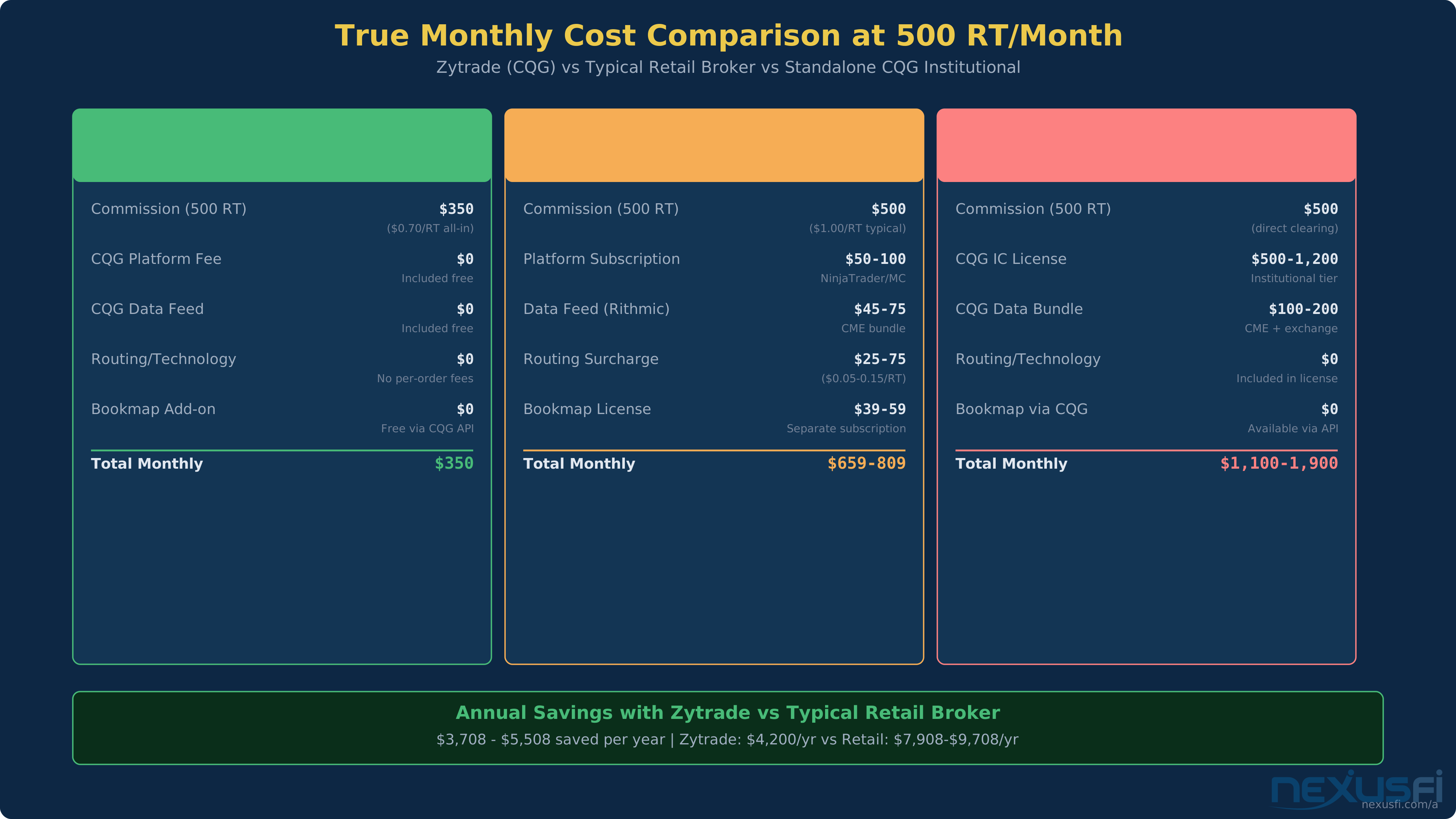
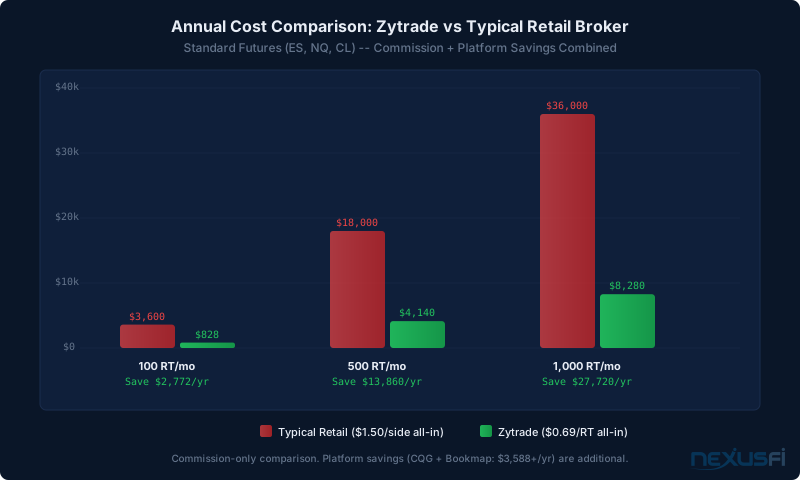
The commission math is concrete. Zytrade charges $0.69/RT all-in for standard futures — no routing surcharge, no platform fee, no data line buried on the statement. A typical retail broker running Rithmic or a proprietary routing layer commonly charges $1.50/side, or $3.00/RT all-in. That $2.31/RT spread compounds quickly at trading volume:
| Monthly Volume | Zytrade ($0.69/RT) | Retail Broker ($3.00/RT) | Monthly Savings | Annual Savings |
|---|---|---|---|---|
| 100 RT/month | $69 | $300 | $231 | $2,772 |
| 500 RT/month | $345 | $1,500 | $1,155 | $13,860 |
| 1,000 RT/month | $690 | $3,000 | $2,310 | $27,720 |
Platform costs stack on top. Bookmap carries a standalone subscription of $60-100/month depending on the tier. CQG institutional access — the same professional infrastructure Zytrade includes at zero cost — runs $500-1,200/month for independent professional licensing. A trader running Bookmap for order flow on a retail broker with Rithmic routing is paying commission overhead plus two separate platform subscriptions before accounting for a single bad fill. Zytrade eliminates all three line items and replaces them with one transparent per-contract rate.
The transparency of the all-in rate matters as much as the number itself. [post=380619]@Big Mike[/post] warned in a NexusFi commission shopping thread: "Be certain you also ask, in writing, if the price is round turn or per side. I've seen some sneaky brokers quote prices on a per side basis. Be certain the broker spells out in writing that it includes all fees and commissions." Zytrade's $0.69/RT is explicitly a round-turn, all-inclusive rate — exchange fees, NFA fee, and clearing are inside that number. No per-side ambiguity, no clearing surcharge discovered on the statement. (2014)
[post=863305]@FuturesTrader71[/post] framed the volume question directly: "How many round trips a month do you do? Let's start there and then let's talk about what is expensive for the service provided." At 500 RT/month, the arithmetic is direct: $1,155/month in commission savings covers a trader's full research, data, and infrastructure budget with room remaining. At 1,000 RT/month, that figure runs $2,310/month — the kind of number that moves the needle on trading account compounding. (2022)
The account minimum question: Zytrade sets competitive day-trading margins on micros and standard contracts. Micro E-mini intraday margins across discount futures brokers commonly run $50-100 per contract. Standard E-mini day margins typically run $500-1,000 per contract at competitive brokers. Exact current minimums are set by Zytrade and adjust periodically — confirm directly through their account opening process. The structural point is that the rate you pay for execution ($0.69/RT) doesn't carry hidden platform costs layered on top, which means the stated margin requirement is the complete cost picture, not a starting point for fee discovery.


Who Should Trade With Zytrade #
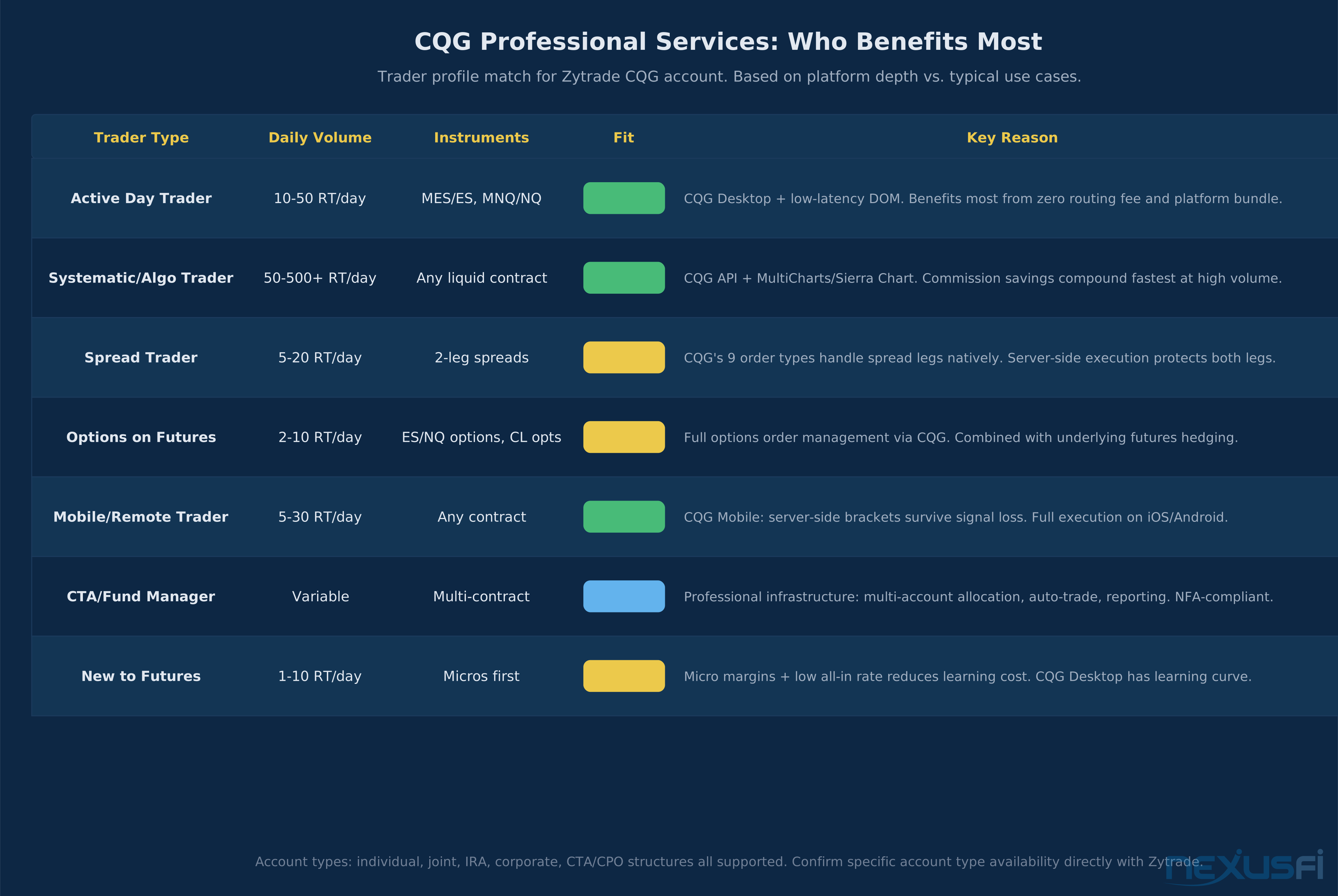
The Zytrade model fits a specific profile well: technically capable traders who want professional execution infrastructure without paying professional subscription costs, traders who value platform flexibility over a single fixed environment, and high-volume traders for whom the per-contract rate compounds into real annual savings.
The discount model works because the technology overhead is borne by CQG's infrastructure — Zytrade passes that cost savings to customers through lower rates. For a complete evaluation framework when comparing brokers, see the Futures Broker Evaluation Framework. As @FuturesTrader71 observed in a NexusFi thread on commission shopping: the hidden cost in cut-rate brokers is "something is being cut somewhere." With Zytrade, the cut is in the broker's margin, not in execution infrastructure quality.
The platform depth — six trading environments, professional order types, server-side risk management, institutional data quality — makes this a setup that scales from discretionary day traders to systematic fund managers. The $0.29 micro rate and $0.69 standard rate apply regardless of account size or volume level.
Verify the current fee schedule and account requirements directly at Zytrade's NexusFi directory listing or through their onboarding process. Zytrade is a member of the NFA and subject to CFTC regulatory oversight.
Before opening any futures account, verify NFA registration at nfa.futures.org/BasicNet. Search by firm name to confirm active registration, review financial filings, and check disciplinary history. This is standard due diligence that takes under 5 minutes and should be done regardless of which broker you choose.
Account Setup and Minimum Requirements #
Opening a Zytrade account follows the standard FCM onboarding workflow: identity verification, funding, and platform connection. The process is comparable to other NFA-registered futures brokers.
Minimum account funding varies by instrument. Micro futures day trading margins are set by the broker, not the exchange — as [post=847625]@bobwest[/post] explained: "Margin is totally unregulated for intraday trades," the CME only sets requirements for overnight positions (past 16:00 Central Time). Confirm current minimum funding requirements directly through Zytrade's account opening process since these change periodically.
Platform setup involves downloading CQG Desktop (browser-based, no install required) or CQG Mobile from the App Store or Google Play. Connecting third-party platforms (TradingView, MultiCharts, OverCharts, Sierra Chart) requires CQG API credentials provided during account setup; Zytrade's onboarding materials cover the configuration steps for each environment.
Bookmap access is provisioned through the Zytrade-Bookmap partnership — account holders activate through Bookmap's portal using their Zytrade account credentials. This is different from a standalone Bookmap subscription; the partnership pricing covers full platform access without the monthly subscription fee.
Regulatory Framework and CFTC Oversight #
Zytrade operates as an NFA-registered FCM (Futures Commission Merchant) under CFTC oversight. The regulatory structure governing futures brokers is substantively different from equity broker-dealers, and understanding the distinctions helps traders evaluate account safety correctly.
The CFTC's customer segregation requirements mandate that all customer funds be held in segregated accounts at approved depositories, separate from the broker's operating capital. An FCM cannot commingle customer funds with proprietary capital. This is the core protection against broker insolvency risk — customer funds are legally protected even if the FCM faces financial difficulty.
NFA membership means Zytrade is subject to regular financial audits, capital adequacy requirements, and ongoing regulatory supervision. The NFA maintains the BASIC database — searchable at nfa.futures.org/BasicNet — providing public access to registration status, financial filings, and disciplinary history. Futures trading is conducted on regulated exchanges (CME, ICE, CBOE) where the clearinghouse stands between every buyer and seller, so the FCM is the trader's intermediary to the clearinghouse, not the counterparty itself.
For a complete pre-account verification checklist covering FCM regulatory status, capitalization, and account protection mechanisms, see Futures Broker Due Diligence. Execution quality beyond routing is covered in Slippage in Futures Trading.
CQG vs Rithmic vs Trading Technologies: The Routing Decision #
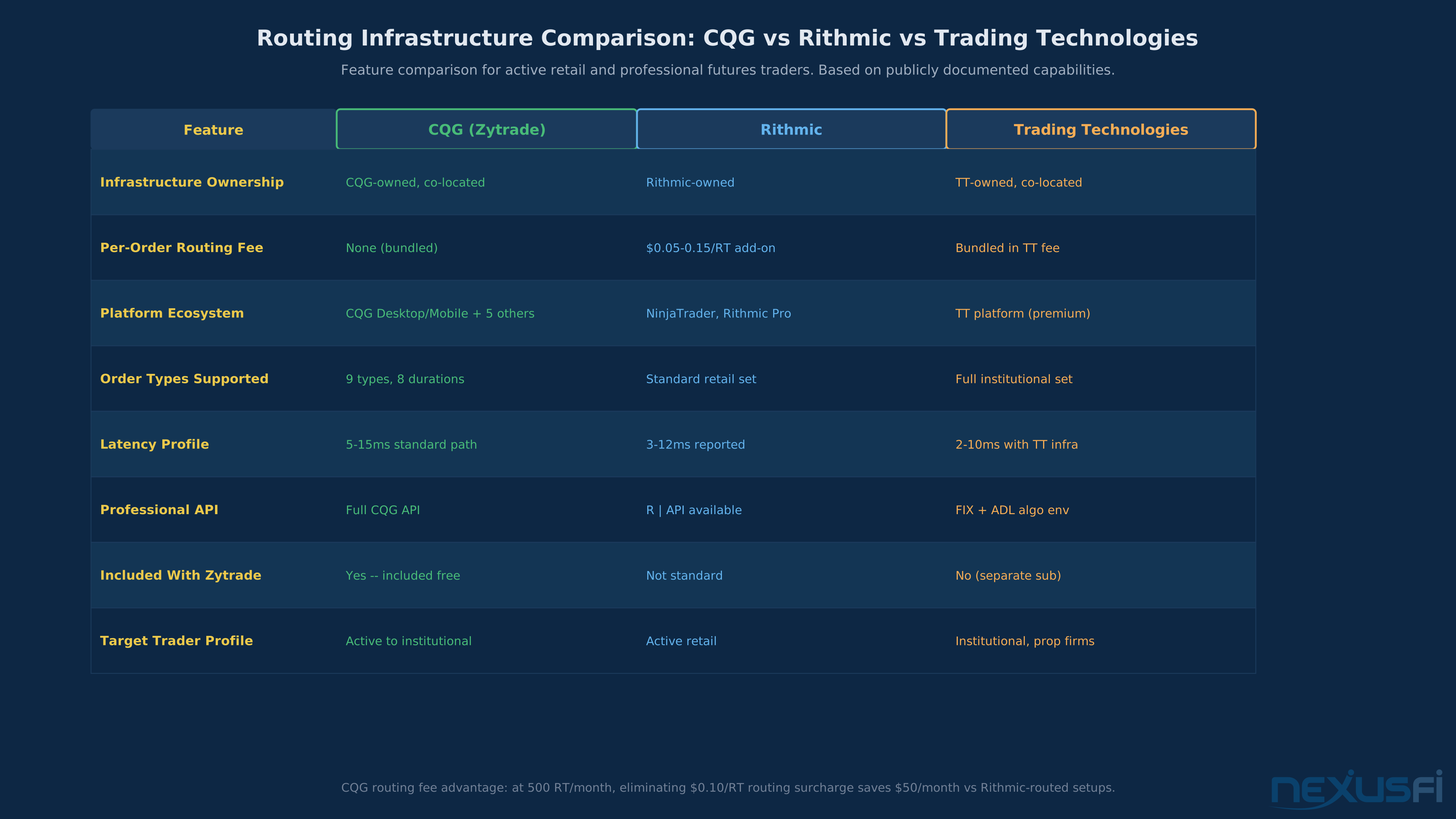
CQG's core differentiator is infrastructure ownership. CQG owns and operates its entire technology stack — co-located at the major exchanges with a direct feed to CME Globex. The latency profile is in the 5-15ms range for standard exchange paths. Because CQG is both the routing layer and the technology provider, there's no third-party vendor as a single point of failure. The cost implications of this architecture — including the elimination of per-contract routing surcharges — were covered in detail in the CQG backbone section above. What matters here is the architectural consequence: fewer moving parts in the execution chain mean fewer points where things break under stress.
The platform ecosystem is another meaningful differentiator. CQG connects natively to seven trading environments (Desktop, Mobile, Bookmap, TradingView, MultiCharts, OverCharts, Sierra Chart), giving traders the flexibility to switch platforms without switching brokers. Rithmic supports a different but overlapping set of platforms, while TT's ecosystem is more narrowly targeted at institutional workflows. For traders whose approach evolves — say, moving from discretionary charting on TradingView to systematic execution on MultiCharts — CQG's breadth means the broker relationship stays constant.
Rithmic is widely used across retail futures brokers and offers competitive latency at lower cost to the broker, which can translate to lower commissions in some setups. The general community consensus is that CQG's owned infrastructure delivers strong reliability, though Rithmic's execution quality is also well-regarded for standard order types. The choice often comes down to which platforms your workflow requires.
Trading Technologies (TT) targets institutional traders with sophisticated spread trading tools and FIX connectivity. TT carries a higher platform cost that makes it less competitive for retail account sizes, though its autospreader tools are best-in-class for spread-heavy strategies.
For most active traders, the routing decision comes down to infrastructure reliability, platform ecosystem fit, and transparent cost structure. CQG scores on all three — owned infrastructure with direct exchange paths, the broadest platform compatibility, and a clean all-in rate with no hidden routing fees.
Knowledge Map
Go Deeper
Build on this knowledgeReferences This Article
Articles that build on this topicCitations
- — CQG platform (CQG Trader/CQG Integrated Client) (2011) 👍 4“CQG is really needed for the following: Advanced Trading Strategies, Options Trading, Spreading, News Trading. Their routing service is simply the best.”
- — Teton Order Routing versus CQG (2023) 👍 2“No $0.10 routing fee or monthly connection premium that other vendors charge.”
- — Best Broker offers the lowest commissions on Micro Futures (2023) 👍 5“Something is being cut somewhere -- the difference in a cut-rate broker and full-service is more than made up for when you need help.”
- — payment for order flow futures (2019) 👍 10“Trading for 15 years, series 3 licensed broker for 10 years, branch manager futures trading prop firm for 2 years before going independent.”
- — Question about intraday margins (2023) 👍 2“Margin is totally unregulated for intraday trades.”
- — Zytrade - Deep Discount Futures Broker
- — Zytrade + Bookmap Partnership
- — Commission shopping w/brokerages (2014) 👍 10“Be certain you also ask, in writing, if the price is round turn or per side. Be certain the broker spells out in writing that it includes all fees and commissions.”
- — Another day, another price increase... (2021) 👍 1“MultiCharts is about $100/mo to get fewer features than Sierra's Package 3. NinjaTrader is $60/mo with fewer features than Sierra's Package 3. You could easily spend $150/mo to get comparable to Sierra's Package 3.”
- — Costs associated with trading futures? (2020) 👍 7“The all-in round-turn cost for ES is listed at $3.70 per trade. This is reasonably consistent with transaction costs in general in the industry.”