



Point and Figure (P&F) Charts: The Noise-Filtering Method ES and NQ Traders Actually Use
Overview #
Point and Figure (P&F) charts are one of the oldest analytical tools in trading — predating candlestick charts by decades — yet they remain actively used by experienced ES and NQ traders because they do something no time-based chart can: they record only meaningful price movement and ignore everything else. No candles printing while price goes nowhere. No wicks from 2 AM that haunt your support lines. No chart that shows "volatility" just because the clock ticked over. P&F charts show you the market's structure, stripped of time noise.
The traders on NexusFi who use P&F don't use it for everything. They use it for one specific job: knowing where they are in the market's structure before they engage. When @Inletcap — whose Spoo-nalysis thread has over 38,000 replies — describes building his 3-box reversal charts from 1-minute bars on ES, he's using P&F to answer a question no 5-minute candle chart answers cleanly: "Is this move meaningful, or is this just noise?"
This article explains how P&F works, how to set it up for ES, NQ, and CL, and how to integrate it with order flow for a practical day-trading framework.
The Mechanics: X, O, Box Size, and Reversal #
P&F charts have three components. That's it. Once you understand all three, the chart reads itself.
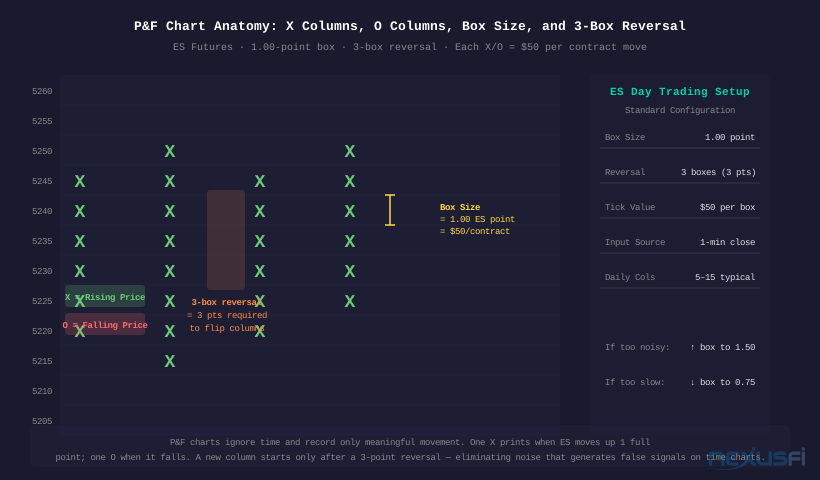
X columns represent rising price. Every time price moves up by one box, a new X is printed in the current column. The column keeps growing as long as price continues rising.
O columns represent falling price. Every time price moves down by one box, a new O is printed. The column extends downward until a reversal occurs.
Box size is the price increment each X or O represents. On ES, a 1-point box means each X or O equals one full ES point ($50 per contract). Price must move by at least one full box to print a new mark.
Reversal is the number of boxes price must move against the current column before a new column of the opposite type begins. With the standard 3-box reversal, an X column will not become an O column until price falls at least 3 full boxes below the highest X in that column.
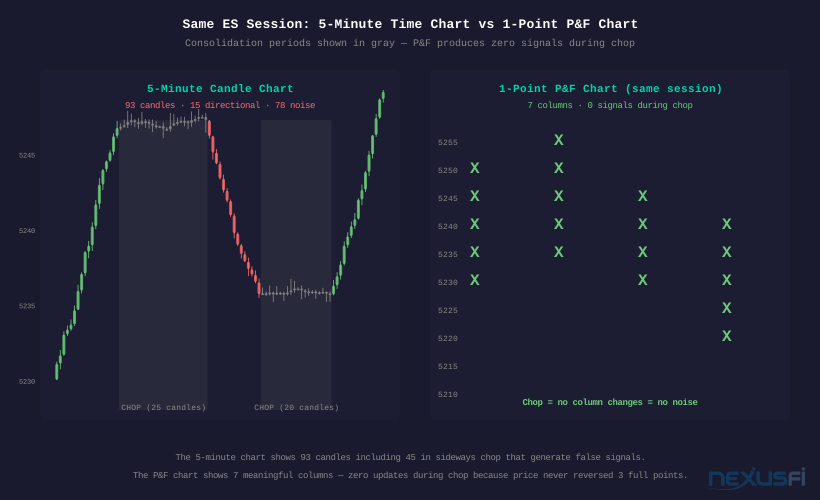
Here's the critical insight: the chart doesn't update unless something happens. If ES grinds sideways for 45 minutes, your P&F chart stays frozen. The time chart shows 45 candles of indecision. The P&F chart shows nothing changed — which is the same information, delivered without the noise.
The reversal number controls how much filtering you get. A 1-box reversal charts every wiggle — you'll get a squiggly, overcrowded chart that looks like an EKG during a cardiac event. A 3-box reversal, the industry standard, only changes columns when price commits to a direction. A 5-box reversal gives you even cleaner structure but misses shorter swing trades.
For day trading futures, 3-box reversal is the right default. That's what @Inletcap uses, that's what the research supports, and that's what you should start with.
Setting Box Size for ES, NQ, and CL #
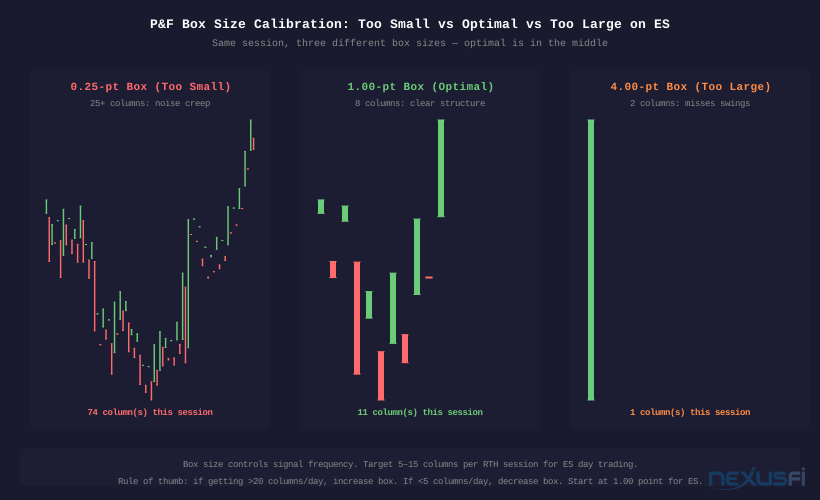
Box size is where traders make the most mistakes. Too small and you're back to watching noise. Too large and the chart barely moves during a session.
The goal is simple: pick a box size where a typical intraday swing leg equals 2-4 boxes. Not every micro-dip — a real directional move that a trend-following trader would take seriously.
ES (E-mini S&P 500)
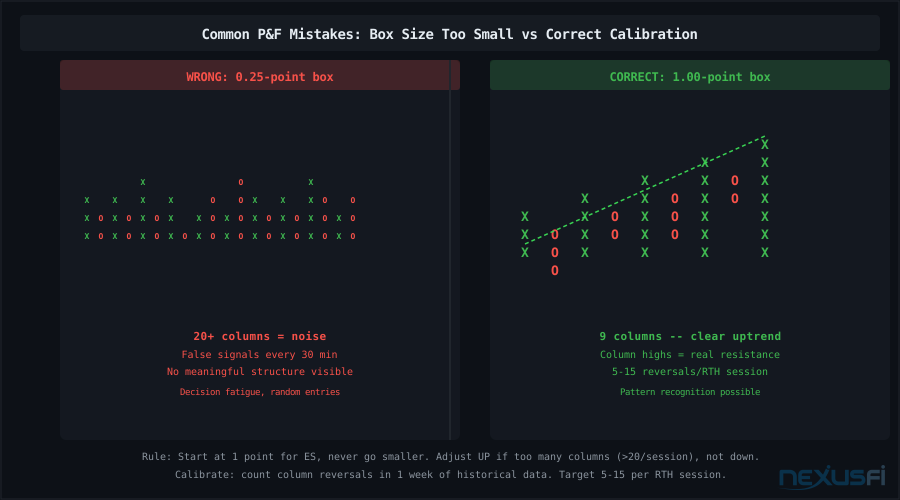
ES trades in 0.25-point ticks. Starting with the 1-point box is the most common choice for intraday day traders, and with good reason: most genuine ES rotations are at least 2-3 points, so a 1-point box captures structure without losing it to noise. A 0.25-point box is too fine — it prints on every tick like a standard time chart. A 2-point box starts missing shorter intraday structures that matter.
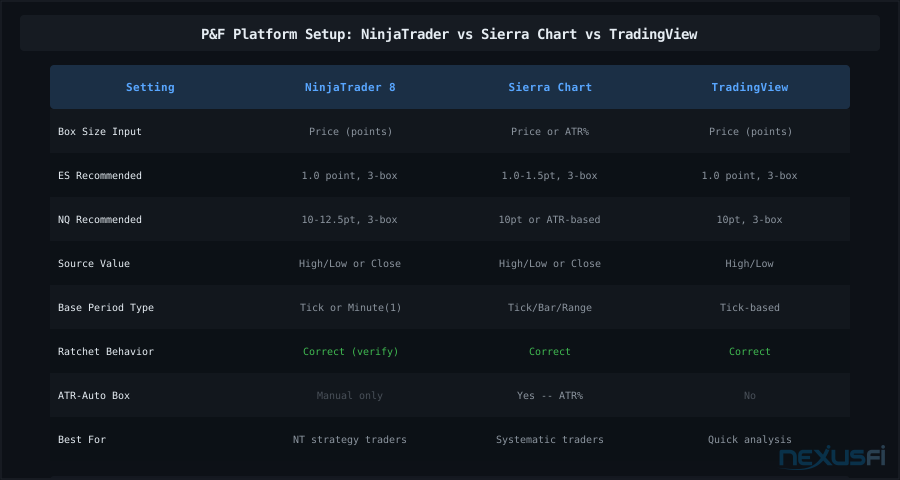
Recommended: 1.00 to 1.50 points, 3-box reversal.
@Inletcap from the Spoo-nalysis thread describes his actual setup:
"Regarding the P&Fs, I use 1 minute (not tick) to build my 3 box reversal charts."
He's using 1-minute close prices as the input, which smooths the data and prevents intraday wick-noise from triggering false column changes. In his Floor Pivots & P&F thread, he specified:
"I use 3 ticks ($0.75) on ES. 1 Tick will print constantly and not represent trend. I only trade P&F Buy signals as continuation signals."
The takeaway: use 1 point (4 ticks) minimum for intraday ES P&F. Don't go smaller.
NQ (E-mini Nasdaq 100)
NQ moves faster than ES — its average daily range is roughly 2-4x ES in points terms. A 1-point box on NQ would be absurdly noisy. You need to scale up.
Most NQ day traders using P&F work with 5-15 point boxes, with 3-box reversal. A 10-point box with 3-box reversal means NQ must move 30 points to flip columns — that's a meaningful commitment in any session.
Recommended: 10 to 12.5 points, 3-box reversal.
CL (Crude Oil)
CL's minimum tick is $0.01/barrel. A 1-cent box would be unusable. The standard approach is using $0.20-$0.40 per box, which filters the noise of CL's frequent $0.10-$0.15 intraday wiggles while capturing the genuine $1-3 swing moves that day traders focus on.
Recommended: $0.20 to $0.40 per box, 3-box reversal.
Calibration method
Take a week of historical sessions and count how many column reversals your settings produce per day. You want 5-15 reversals per RTH session. Under 5 and the chart is too insensitive — you'll enter too late and miss reversals entirely. Over 20 and you're tracking noise. Adjust until you land in that range.
@Binkius shared an insight from his NQ journal worth noting:
"Use 3-box reversal and 1-box reversal charts together. The 3-box reversal gives a rough idea of the pattern and the 1-box reversal gives detail on entries."
This dual-chart approach — structural context from 3-box, entry timing from 1-box — is used by more experienced P&F traders to get the benefits of both resolution levels.
The Noise-Filtering Advantage Over Time Charts #
Here's what happens on a typical ES session on a time chart: you see candles print every minute, regardless of whether price moved. During a genuine high-volume trend move, you might get 15 clean directional candles. But during the three 20-minute consolidation windows that bookend and interrupt that move, you also get 60 indeterminate candles where price grinds, coils, and tests levels repeatedly. Ninety-three candles total. Fifteen meaningful. Seventy-five generating false signals and decision fatigue.
The P&F chart for that same session might show 8-12 columns. The three consolidation windows? They show up as tight, compressed areas where columns are short and reversals are quick. The trend move shows up as a long, clean column with no reversals — visually unmistakable. The ratio of signal to visual noise is completely inverted compared to the time chart.
This matters practically because support and resistance levels defined on P&F charts are more stable. A P&F resistance level is defined by the tops of X columns — the highest price that actually produced a reversal. It's not contaminated by 3 AM wicks or by limit orders on an otherwise dead tape. When a P&F level defines resistance, it means "price reached here and turned around with enough force to register as a column reversal." That's a more meaningful level than a time chart's resistance defined by where a candle wick happened to poke above a previous high during low-volume overnight trading.
@jcdawsey posted extensively in the "Day Trading the ES PATS style — 1 point at a time" thread about his use of P&F charts:
"The trick with the P&F charts is to look for areas where the ledges are forming. I concentrate on where the Xs and Os are forming without overlap."
He's describing the same thing — areas where P&F columns are stacking at similar levels without breakthrough, which indicate genuine accumulation or distribution rather than random noise.
Classical P&F Patterns #
P&F patterns have formal names that sound more complicated than they are. The underlying logic is simple: columns that repeatedly fail at the same level are telling you something.
Double Top (bearish) and Double Bottom (bullish)
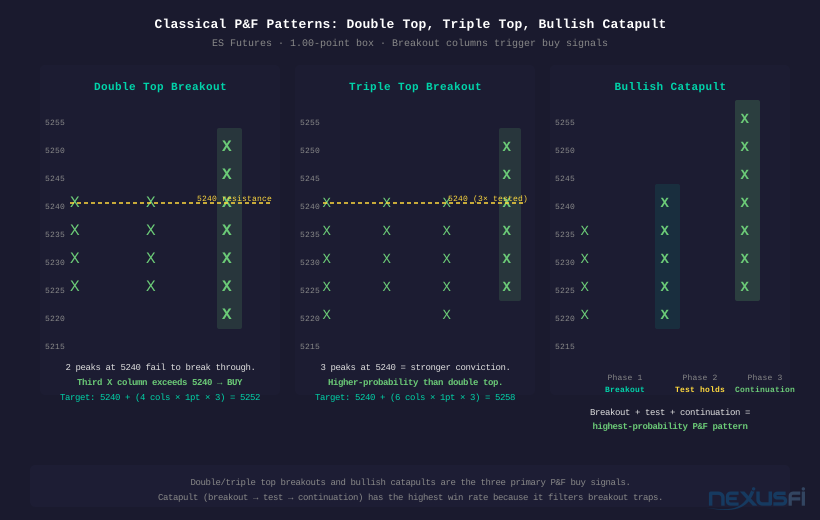
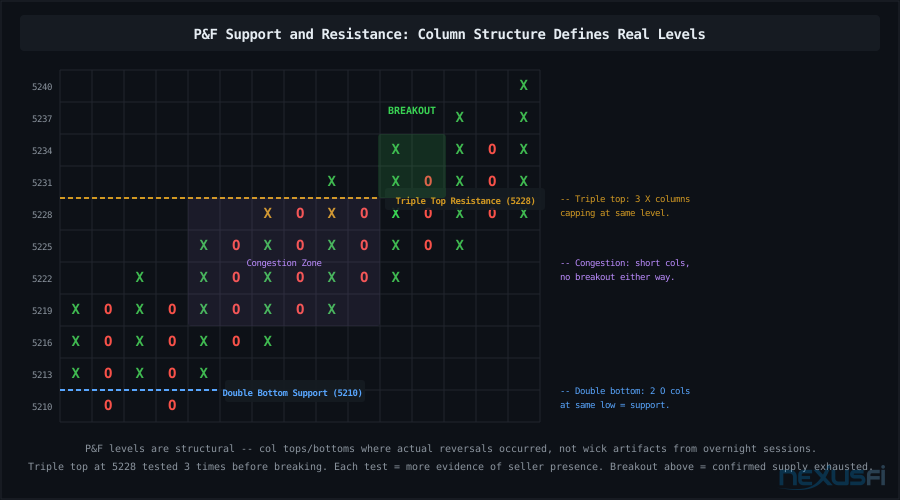
A double top in P&F means two consecutive X columns topped out at the same level. The second column couldn't exceed the first. This is a structure-based signal that sellers are active at that level — they've shown up twice.
A breakout through the double top level — an X column that exceeds both prior peaks — is a buy signal. The prior two peaks become support. The trade is positioned for continuation above the breakout level.
A double bottom has the same logic inverted. Two O columns with matching lows, then a breakdown through both lows is a sell signal.
Triple Top and Triple Bottom
The same as double tops/bottoms but with a third attempt. More tests at the same level mean more evidence of two-sided activity — sellers repeatedly appearing at resistance, or buyers repeatedly defending support. A triple top breakout is generally considered a stronger signal than a double top breakout because more tests have occurred without breakthrough.
The flip side: three tests at a level can also signal that the level is about to be overcome violently. If liquidity providers are repeatedly absorbing order flow at a level, eventually the incoming order flow exhausts their inventory, and the level breaks with significant momentum. This is why triple tops and bottoms are watched carefully for breakouts as well as reversals.
Triple Tops, Triple Bottoms, and the Catapult #
Bullish Catapult and Bearish Catapult
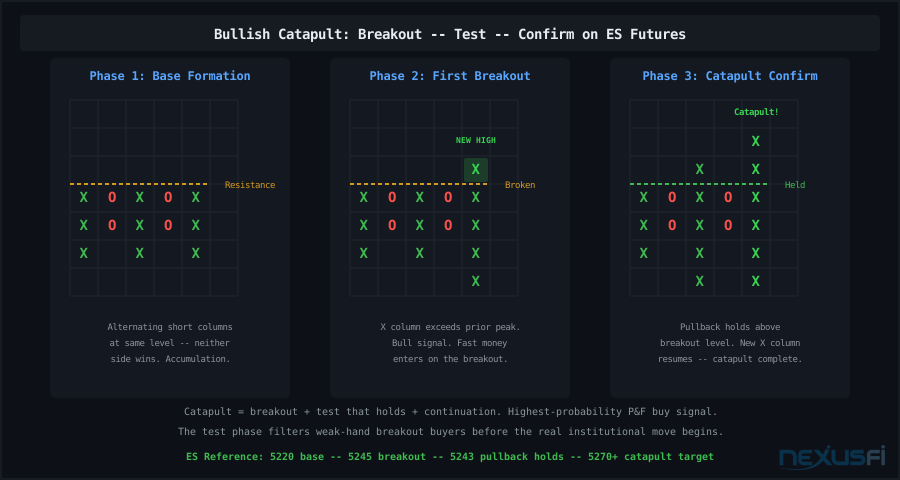
A bullish catapult is one of the highest-probability P&F patterns for trend continuation. The sequence: a base of accumulation forms (identified by short, alternating columns), a breakout occurs (X column exceeds a prior peak), then a brief pullback that doesn't violate the breakout level, then a continuation column that resumes the breakout direction.
The catapult is a "test and confirm" structure. The breakout happens, the market pulls back to test whether buyers are still interested at the breakout level, finds support there, and resumes upward. It's the market's way of cleaning out weak hands from the breakout before the real move begins.
Bearish catapults are the mirror: a breakdown, a brief bounce that fails below the breakdown level, then continuation lower.
For ES day traders, catapult patterns often align with news-driven impulses — a data release creates a breakout, a brief mean-reversion follows as fast money takes profits, then institutional buyers absorb the pullback and the trend resumes. The P&F chart shows this as a catapult. The 5-minute time chart shows it as... a lot of candles.
Spread Triple Top
A variation of the triple top where the three peaks are at slightly different levels rather than exactly the same. The classic triple top has three peaks at identical P&F levels. A spread triple top has peaks within a range — say, three consecutive X column tops at levels 5250, 5252, and 5251 on ES.
The spread triple top defines a resistance zone rather than a precise resistance level. For execution, this is often more practical than a classic triple top because real order books defend price ranges, not individual ticks. The "spread" tells you that sellers are active in a band, and any advance into that band should be treated as encountering distributed resistance.
Support and Resistance in a P&F World #
P&F's structural S/R operates differently from the S/R you draw on time charts. On time charts, you draw lines through obvious high/low pivots. On P&F, S/R emerges from column structure:
Column tops as resistance: The highest X in any column that was followed by a reversal is a resistance point. That's where sellers showed up with enough force to reverse the trend. Multiple column tops at the same level create multi-tested resistance.
Column bottoms as support: The lowest O in any column that was followed by a reversal is a support point. Buyers appeared with enough conviction to stop the decline.
Congestion zones: Areas where columns are short and closely packed represent price areas where neither buyers nor sellers have won decisively. These zones often act as both support and resistance in the future, as they contain trapped positions and remembered levels.
When you're mapping a trading session with P&F, identify:
- The most recent column top (nearest resistance)
- The most recent column bottom (nearest support)
- Any patterns (double/triple tops/bottoms) that create "confirmed" S/R levels
- Congestion areas where multiple short columns are packed together
These become your pre-planned reference levels for the session. Price approaching a P&F resistance with 3 prior tests is a different situation from price approaching fresh air with no prior structure.
Price Targets: Vertical and Horizontal Count Methods #
One of P&F's distinctive features is its mathematical target projection methods. Unlike most technical analysis targets that are somewhat arbitrary (drawn to nearest round numbers, prior highs/lows, or Fibonacci levels), P&F targets come from the structure of the chart itself.
Horizontal Count
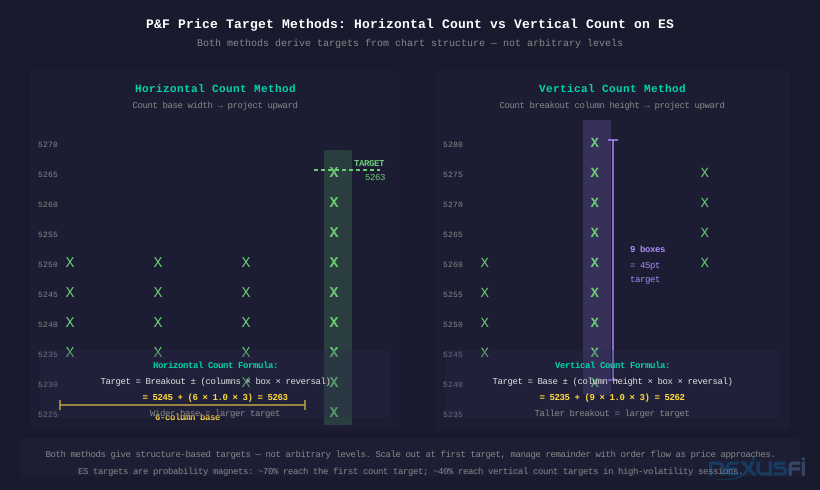
The horizontal count is used when price breaks out from a congestion zone.
Count the number of columns in the base — the consolidation area before the breakout. Multiply that column count by the box size, then multiply by the reversal value (usually 3 for 3-box reversal). Add the result to the lowest level in the base for an upside target, or subtract from the highest level in the base for a downside target.
Example on ES with 1-point box, 3-box reversal:
- Base has 6 columns
- Box size = 1 point, reversal = 3
- Calculation: 6 × 1 × 3 = 18 points
- If base runs from 5220 to 5225, upside target = 5225 + 18 = 5243
This gives you a mathematically derived target based on the amount of "energy" accumulated in the base. Wider bases generate larger targets.
Vertical Count
The vertical count measures the height of a prior strong move — typically the initial breakout column — and projects that same distance forward.
Count the boxes in the breakout column (from the base level to the highest X). Multiply by the box size and reversal value. Add to the base level for upside, subtract from the top for downside.
Example on ES:
- Breakout column has 12 boxes
- Box size = 1 point, reversal = 3
- Calculation: 12 × 1 × 3 = 36 points
- From base at 5220: target = 5220 + 36 = 5256
Using targets practically
P&F targets are probability magnets, not guaranteed stopping points. In liquid futures markets, especially ES and NQ with algorithmic participants, price can overshoot or stop short. The smart approach:
- Scale out half position at the first count target
- Manage the remainder with order flow — watch for absorption and delta divergence at the target
- If the market accepts above the target and builds new P&F structure, the move likely has more room
The target tells you to start paying attention, not automatically exit. The order flow tells you what's actually happening when you get there.
Combining P&F with Order Flow #
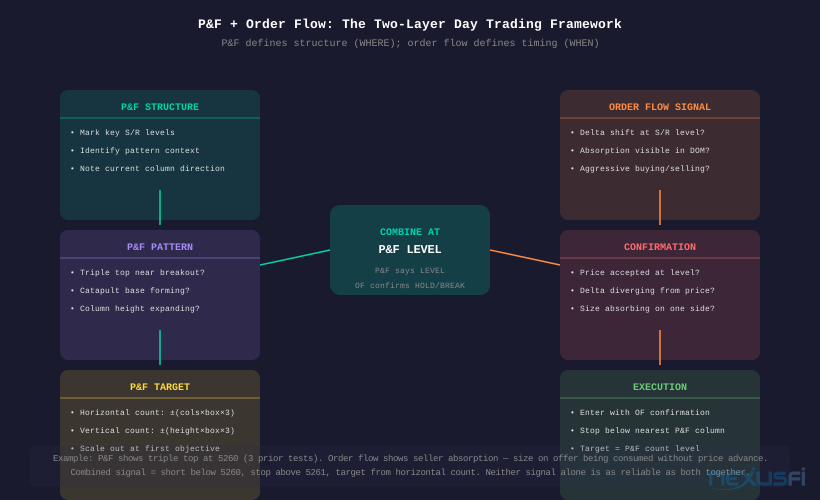
This is where P&F becomes more than a historical curiosity and starts working as a genuine day-trading edge. The combination solves a fundamental problem with using either tool alone.
P&F alone is too slow for entries. By the time a P&F reversal registers, price has already moved by at least the reversal distance (3 points on ES with a 1-point box). You'll be entering after the initial move, which is fine for trend-following but misses precise entries.
Order flow alone is too noisy for context. Watching the DOM and time & sales without knowing where you are in the market's structural picture means you're constantly reacting to microstructure without a framework for when to press and when to stand aside.
Together, they work:
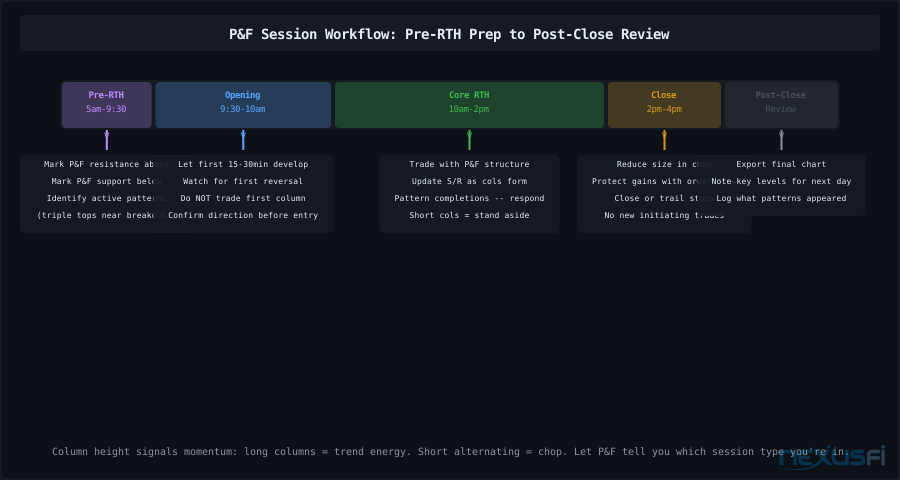
P&F provides the structural map: Before RTH opens, mark the nearest P&F resistance above (last major X column top, or triple top level) and nearest support below (last major O column bottom, or triple bottom level). These are your pre-planned engagement zones for the session.
Order flow provides engagement signals within the map: When price approaches a P&F resistance level, you're not entering because the level is there — you're watching for order flow confirmation. Specifically:
- Aggressive selling that meets buying and produces absorption (sellers can't move price lower despite high volume)
- Negative delta divergence — price is at or near the high but cumulative delta is declining
- DOM: visible size building on the offer, being absorbed by market buys with no uptick
When you see these signals at a P&F resistance level, the probability that the level holds is meaningfully higher than if you engaged on the P&F level alone or the order flow signal alone.
@jcdawsey, active in the "Day Trading the ES PATS style" thread:
"I really use the P&F charts to verify my entries. For me the process is the following. Step 1: verify the context of the market (trending, range...). For me the P&F charts provided an additional layer of confirmation for where price might find support or resistance."
This is exactly the framework: P&F for context, other tools for confirmation and timing.
Practical entry rule: When price is at a P&F resistance/support level AND order flow confirms (absorption visible, delta diverging, or aggressive response in the opposite direction), enter. When price is at a P&F level but order flow is neutral or confirming continuation, do nothing. When order flow signals a reversal but you're in the middle of a P&F column with no structural support, reduce size — you're fighting structure without it.
Practical Implementation: A Session-by-Session Workflow #
Here's how to use P&F day-to-day:
Before the open (pre-RTH preparation)
Run your P&F chart using overnight data (if your platform supports it) or start fresh at RTH open. Identify:
- The dominant column direction from the prior session's close
- The nearest P&F resistance above current price
- The nearest P&F support below
- Any active patterns from yesterday (triple tops near completion, catapult bases forming)
These levels are your initial "lines in the sand."
First 30 minutes of RTH
The opening range typically creates new P&F structure quickly. Let the first 15-30 minutes develop the initial context — you'll see the first few column reversals, which establish the opening directional commitment.
The key: don't trade the first column. Let a reversal happen first. The first column of the day can be a momentum trap. The reversal confirms whether the opening move had follow-through or was being faded.
Intraday updates
As P&F updates throughout the session:
- New column tops and bottoms become new S/R levels
- Pattern completions (triple tops, catapults) trigger pre-planned responses
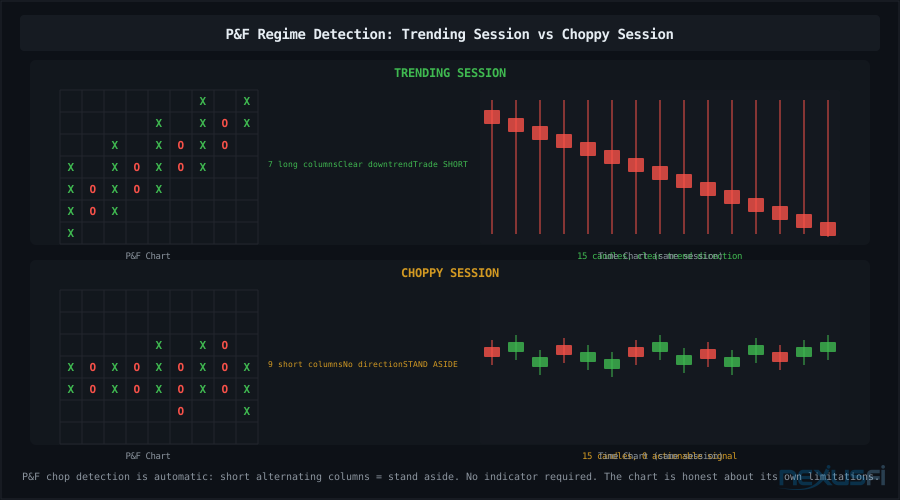
- Column height tells you momentum intensity — a long column in one direction means trend energy; short, alternating columns mean choppy conditions where range-trading is more appropriate
When to stand aside
P&F makes chop visible. If you see 6-10 very short columns alternating back and forth without either side making progress, you're in a range-bound, choppy period. P&F doesn't give you a directional edge during this time — and it will be honest about it by not developing any meaningful pattern.
This is valuable information. When the P&F chart shows nothing developing, nothing is developing. Staying out during genuine chop is as valuable as entering during genuine trend.
Common Mistakes and How to Avoid Them #
Using box size that's too small
The most common mistake, especially for traders coming from tick charts. A 0.25-point box on ES sounds precise but produces a chart that reacts to every wiggle — exactly the noise you were trying to filter. Start at 1 point and adjust up if needed, never down to match your time chart's granularity.
Treating P&F levels as exact price points
P&F support at 5242 doesn't mean buyers will show up precisely at 5242.00. It means buyers were active enough in the 5241-5243 range to produce a column reversal. Trade the zone, not the number. Using P&F levels as if they were algorithmic triggers (placing a limit order exactly at the P&F level) will produce consistent early stops.
Entering solely on P&F pattern completion
A triple top breakout is a high-probability pattern — not a guaranteed one. If you enter every single triple top breakout without order flow confirmation, you'll catch 70% winners and 30% failures that come as whipsaws. Those 30% failures often happen at resistance zones where the market is distributing, precisely where pattern-traders are most vulnerable. Require confirmation.
Using P&F as your only chart
P&F answers structural questions. It cannot tell you what's happening right now at the millisecond level — what size is sitting on the offer, whether the last aggressive move was absorbed or pushed through. Use P&F for context; use footprint charts, time & sales, or DOM for execution.
@Miesto described a specific implementation in his trading diary:
"I used a 4x2 PnF chart with HiLo bars for judging price movement of the June '23 ES futures contract."
The HiLo bar setup captures both the high and low of each base period, giving P&F its full range of movement to work with rather than just closes.
Changing settings mid-session
If you find yourself repeatedly adjusting box size because the chart "doesn't look right," you're chasing confirmation bias. Pick your settings before the session, stick with them, and let the chart show you what actually happened. Changing settings in response to market conditions is the P&F equivalent of redrawing trend lines to make them still look valid.
Platform Implementation Notes #
P&F charts are available in most professional futures platforms, with meaningful differences in how they handle the mechanics.
NinjaTrader 8
NinjaTrader's native P&F chart is available under Chart Type > Point and Figure. The "Base Period Type" setting matters: using "Tick" means every tick updates the P&F, which at ES tick frequency is nearly equivalent to a time chart. Using "Minute" with a base period of 1 (as @Inletcap describes) smooths out sub-minute noise before it reaches the P&F calculation. This is the recommended setup for ES day trading.
NinjaTrader also offers the option to use "High/Low" vs "Close" as the source value. High/Low uses the actual wick extremes of each bar (capturing full price range). Close uses only closes. High/Low will produce more reversals (more sensitive); Close fewer (more filtered). Start with Close for a cleaner chart.
Sierra Chart
Sierra Chart has more granular P&F settings and is often preferred by systematic traders who want precise control over how box sizes are defined. Sierra allows ATR-based automatic box sizing, which adapts as volatility changes throughout the session. This is conceptually similar to the ATR-based calibration discussed in the Chandelier Exit article.
TradingView
Available via Chart Type > Point & Figure. Box size is set in "Price" (absolute points). For ES, this matches directly. For NQ, be aware that TradingView's price basis for NQ may differ from CME settlement price in subtle ways that affect exact column boundaries.
When P&F Works and When It Doesn't #
P&F performs best in trending markets with regular, directional moves. The chart's ability to filter noise is maximized when the market is making progress — consecutive columns in one direction, followed by shallow reversals, followed by continuation. This is when P&F's structural patterns (catapults, breakouts from bases) have the highest probability of playing out.
P&F struggles in two environments:
Low-volatility grinds: When ES is moving 0.5 points per hour in a directional grind, even a 1-point box will struggle to register meaningful column changes. The chart updates rarely and provides little actionable information. In these sessions, market profile or order flow tools are better primary tools.
Post-news volatility spikes: When ES moves 15 points in 30 seconds on a Fed announcement, P&F updates rapidly with many column changes that can look like patterns but reflect the mechanical updating of the chart rather than genuine structural change. Wait for post-spike consolidation before reading P&F structure seriously after major volatility events.
The meta-skill in using P&F for day trading is recognizing which environment you're in. An experienced P&F user looks at the chart and immediately sees: "This is a trending session — the columns are long and directional, and I'm trading with the structure." Or: "This is a choppy session — short, alternating columns with no pattern development, and I'm staying in smaller size."
Knowledge Map
Go Deeper
Build on this knowledgeCitations
- — Spoo-nalysis ES e-mini futures S&P 500 (2017) 👍 12“Regarding the P&Fs, I use 1 minute (not tick) to build my 3 box reversal charts”
- — Floor Pivots, Price Action, Point & Figure, Chart Patterns & Fibs (2015) 👍 8“I use 3 ticks ($0.75) on ES. 1 Tick will print constantly and not represent trend. I only trade P&F Buy signals as continuation signals”
- — Day Trading the ES PATS style - 1 point at a time (2014) 👍 15“The trick with the P&F charts is to look for areas where the ledges are forming. I concentrate on where the Xs and Os are forming without overlap”
- — Day Trading the ES PATS style - 1 point at a time (2014) 👍 10“I really use the P&F charts to verify my entries. For me the process is the following. Step 1: verify the context of the market (trending, range...). For me the P&F charts provided an additional layer of confirmation”
- — Day Trading the ES PATS style - 1 point at a time (2013) 👍 5“trendisyourfriend's post with pnf charts intrigued me to see if I could gain additional clarity using them as a tool”
- — NQ - Slowly figuring things out. Very slowly. (2018) 👍 7“Use 3-box reversal and 1-box reversal charts together. The 3-box reversal gives a rough idea of the pattern and the 1-box reversal gives detail on entries”
- — Diary of a simple price action trader (2023) 👍 4“I used a 4x2 PnF chart with HiLo bars for judging price movement of the June 23 ES futures contract”
- Thomas Dorsey — Point & Figure Charting (4th ed.) - Bloomberg Press
- CME Group — E-mini S&P 500 Futures Contract Specifications