



Chart Types for Futures Trading: Picking the Right Lens for the Market You're Trading
Overview #
Chart Types for Futures Trading: Picking the Right Lens for the Market You're Trading
Every chart type is a filter. It decides what you see, what gets hidden, and how fast the picture updates. Pick the wrong filter and you're trading a distorted version of reality — the setups look clean in hindsight but fall apart in execution. Pick the right one and the market's rhythm becomes legible.
This isn't about which chart type is "best." That question is meaningless without context. A scalper staring at a daily candlestick chart is flying blind. A position trader watching a 200-tick chart is drowning in noise. The question is: what decision are you making, and which chart construction gives you the clearest signal for that decision?
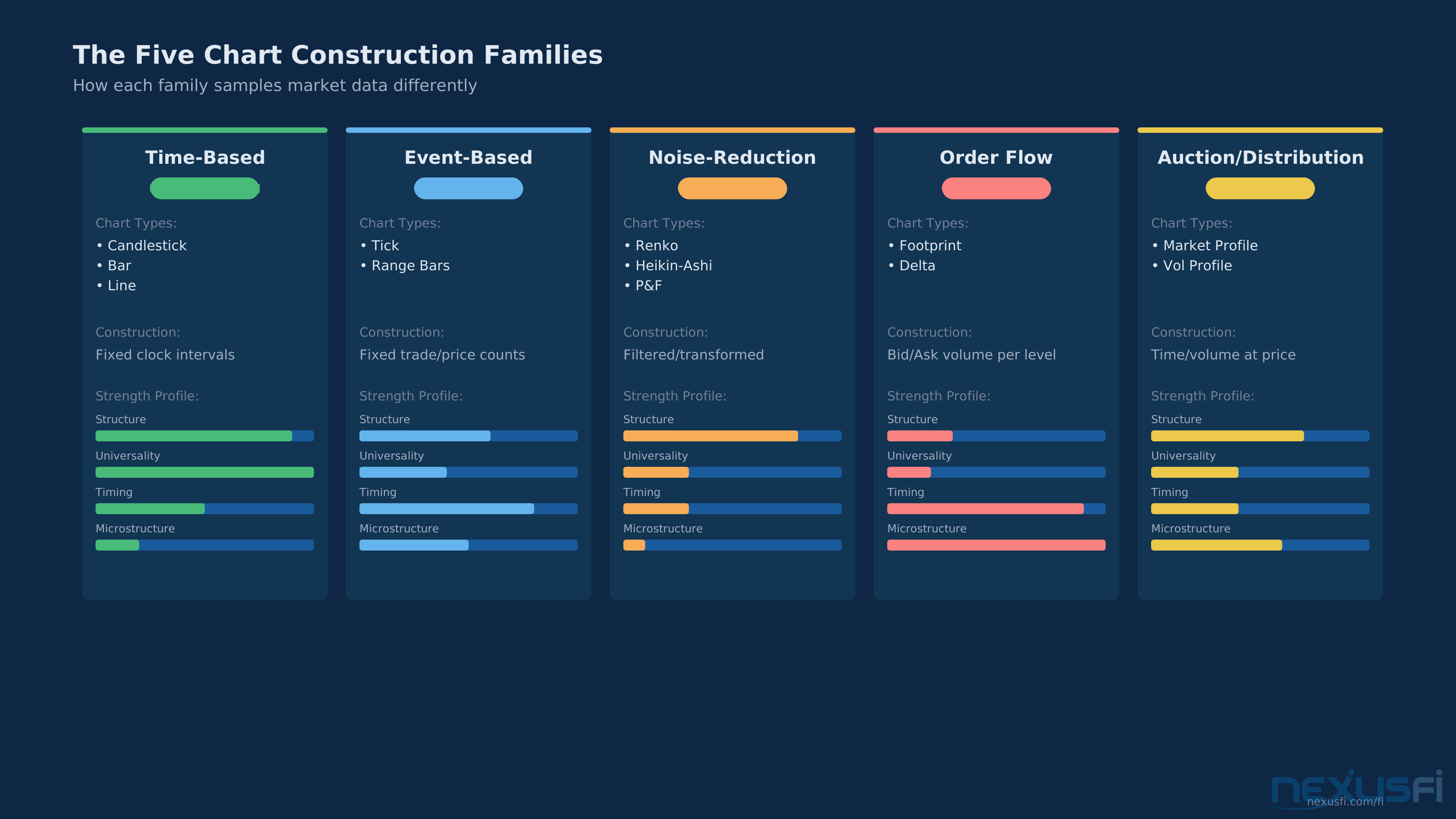
The Five Construction Families #
Chart types aren't just visual preferences — they represent at the core different ways of sampling market data. Understanding the construction method tells you what the chart optimizes for and where it lies to you.
1. Time-Based Charts: The Universal Standard #
Candlestick and bar charts aggregate price into fixed time intervals — every 1-minute, 5-minute, daily bar covers the same clock duration regardless of whether 50,000 contracts traded or 50.
What they show well: Structure. Candlestick patterns, swing highs and lows, support and resistance — the entire vocabulary of classical technical analysis was built on time-based charts. Multi-timeframe analysis works seamlessly because every participant worldwide sees the same bar boundaries.
Where they mislead: During slow periods, a 5-minute candle might represent 12 trades. During a news spike, the same candle might pack 5,000 trades. The chart treats both equally. As @trader000 points out, "every platform has minute based charts. Minute charts are also the only chart setting that you know is on every platform" — and that universality is actually an edge, because "you want as many people as possible seeing the exact same trade idea that you are." [1]
Line charts strip everything to the close (or median) price. Most traders undervalue them. For higher-timeframe regime identification — is this a trending or range-bound week? — a daily line chart removes the noise that candlesticks add. Not useful for execution decisions, but excellent as a context dashboard.
Best for: Day trading structure (5-15 min candles), swing trading (hourly/daily), multi-timeframe confirmation, pattern-based methods. The 5-minute chart remains the workhorse of professional futures day trading for good reason — it balances detail against noise.
2. Event-Based Charts: Trading the Market's Pulse #
Tick charts form a new bar after a fixed number of trades execute. Range bars form after price moves a fixed amount. Both decouple the chart from the clock and couple it to market activity.
The practical difference is significant. During the ES open when 20,000+ contracts trade per minute, a 1,500-tick chart prints bars rapidly — you see the auction unfolding in near real-time. During the 12:30 PM doldrums, bars form slowly because activity has dried up. The chart naturally compresses dead time and expands active time.
Tick charts are the scalper's and short-term day trader's instrument of choice. They reveal momentum bursts that time charts flatten into single bars, and they compress quiet periods that time charts stretch into meaningless noise.
Range bars normalize volatility — every bar has the same high-to-low range. In choppy sideways markets, range bars clean up the mess that time charts display. In trending markets, they paint an orderly staircase that's easy to trade.
The catch with both: There's no universal "correct" setting. A 1,500-tick chart on ES looks completely different from 1,500 ticks on CL. You have to calibrate the setting to your instrument's typical activity level — and recalibrate when volatility regimes shift. Bars can also print in split seconds during fast markets, as
Best for: Scalping (small tick counts — 200-500 on ES), day trading momentum reads (1,000-2,000 ticks on ES), and any strategy where you need the chart to reflect participation intensity rather than clock time.
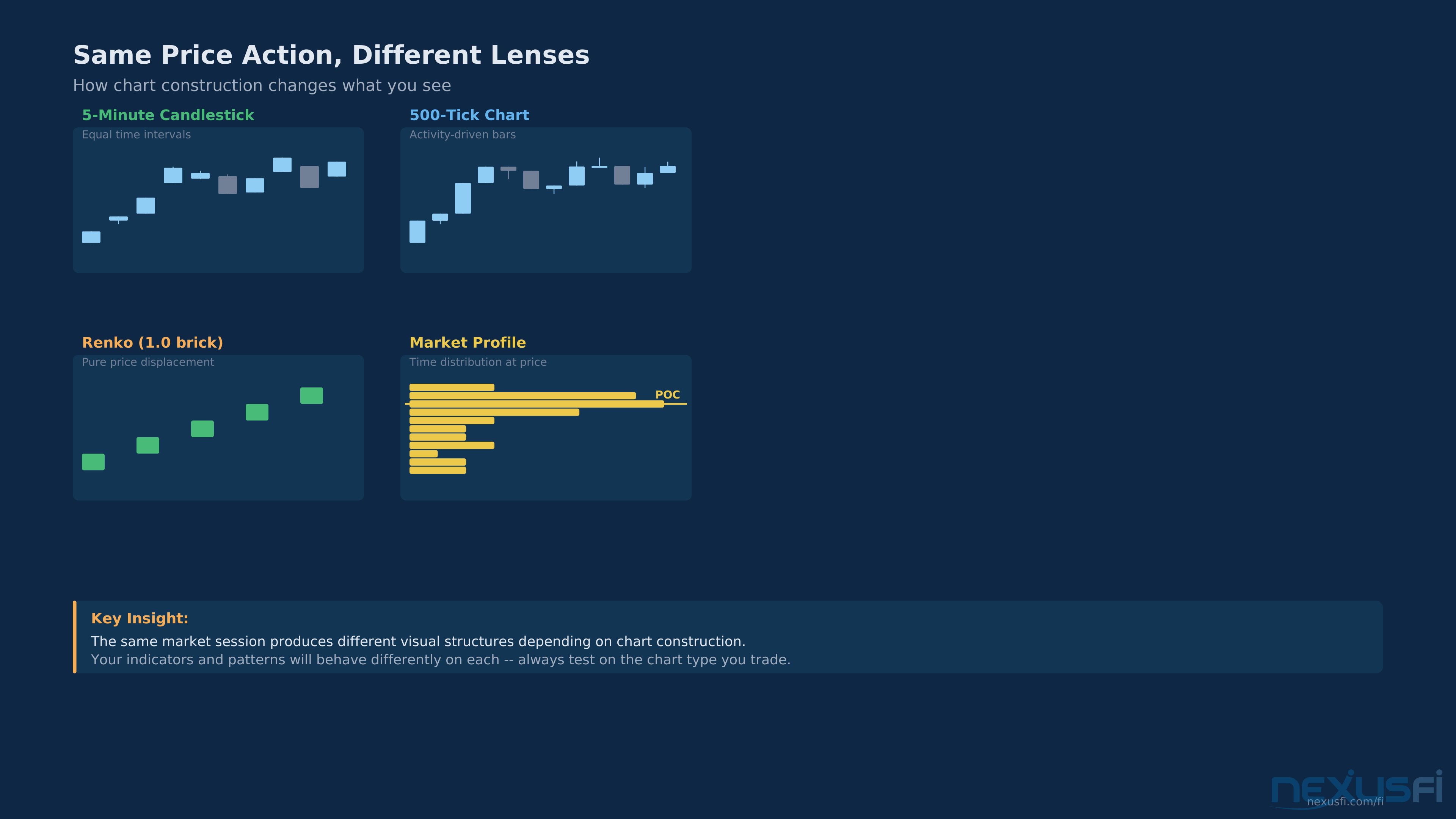
3. Noise-Reduction Charts: Filtering for Trend Clarity #
Renko charts build bricks of fixed price size. A new brick only forms when price moves the full brick distance in one direction. Reversal requires moving the brick size (or more) in the opposite direction. The result strips virtually all noise — what remains is pure directional displacement.
Heikin-Ashi applies a mathematical transformation to standard OHLC data, averaging the open and close with prior values. The smoothed candles make trends visually obvious — solid green runs in uptrends, solid red runs in downtrends, with small-bodied candles at turning points.
Point-and-Figure charts use columns of X's (rises) and O's (falls) based on box size and reversal criteria. Time doesn't exist on these charts. They're the purest expression of "did price move enough to matter?"
The critical warning on all three: These charts change the data. Renko bricks don't reflect actual OHLC prices — a "close" on a Renko brick is the brick boundary, not where the last trade occurred. Heikin-Ashi candles show averaged prices that never actually traded. P&F charts have no time axis at all. If you're placing stops based on Renko levels or HA candle patterns, you're working with derived data, not the actual market.
[3] The emphasis on parameter selection is critical — wrong brick size, wrong range size, wrong box size, and these charts generate worthless signals.
Best for: Swing and position trading where directional persistence matters more than precise timing. Renko works well as a trend filter overlay — not as the sole execution chart. Heikin-Ashi is useful for staying in trades longer during trending sessions. P&F excels at identifying major supply/demand levels and breakout targets.
4. Order Flow Charts: Seeing Inside the Bar #
Footprint charts (also called volume ladder, bid/ask charts, or order flow charts) show the volume traded at each price level within a bar, split by aggressor side. They reveal what candlestick charts hide: who was buying, who was selling, where absorption occurred, and where stops got run.
This is the most futures-specific chart family. Because futures trade on centralized exchanges where every print is reported, footprint data has a level of integrity that OTC markets can't match. You're seeing the actual auction — not a broker's filtered feed.
That distinction matters. The footprint confirms — it doesn't generate. Traders who try to derive entries purely from delta imbalances without a structural framework tend to get chopped up. The most effective approach combines predetermined levels (from Market Profile, volume profile, or prior session references) with footprint confirmation of buyer/seller behavior at those levels.
The cognitive load problem: Footprint charts display an enormous amount of information. Delta, cumulative delta, bid/ask volume, imbalance highlighting, absorption detection — it's easy to develop analysis paralysis. Start simple: learn to read delta (net buying vs selling pressure) at key levels before adding imbalance filters and absorption detection.
Best for: Scalping and short-term day trading around key levels. Confirmation of entries and exits derived from higher-timeframe structure. Identifying absorption (large passive orders absorbing aggressive flow) and stop runs.
5. Auction / Distribution Charts: Where Value Lives #
Market Profile (TPO charts) distribute time across price, showing where the market spent the most time during a session. The Point of Control (POC) marks the price with the most time spent, and the Value Area brackets the 70% zone. This directly visualizes the auction process — where the market accepted price and where it rejected it.
@Big Mike (founder of NexusFi) provides the essential framework: "POC = Point of Control, the price where the most volume of the session traded. VA = Value Area, the area in which 70% of the volume traded... Balance leads to imbalance. Imbalance leads to balance. In other words, the market tends to go back and forth." [5]
Volume Profile takes a similar approach but distributes volume rather than time at each price. High Volume Nodes (HVN) represent prices where heavy participation occurred — they act as magnets. Low Volume Nodes (LVN) represent prices the market moved through quickly — they act as barriers that price either blows through or bounces off.
Both chart types answer the same fundamental question: where is fair value, and is the current price above it, below it, or within it? That context determines everything else. If you're trading within yesterday's value area, mean reversion setups dominate. If you're trading outside value, trend continuation has the edge.
Best for: Day trading context (where is value today relative to yesterday?), swing trading (multi-day composite profiles reveal longer-term acceptance zones), and pre-market preparation (establishing bias before the session opens).
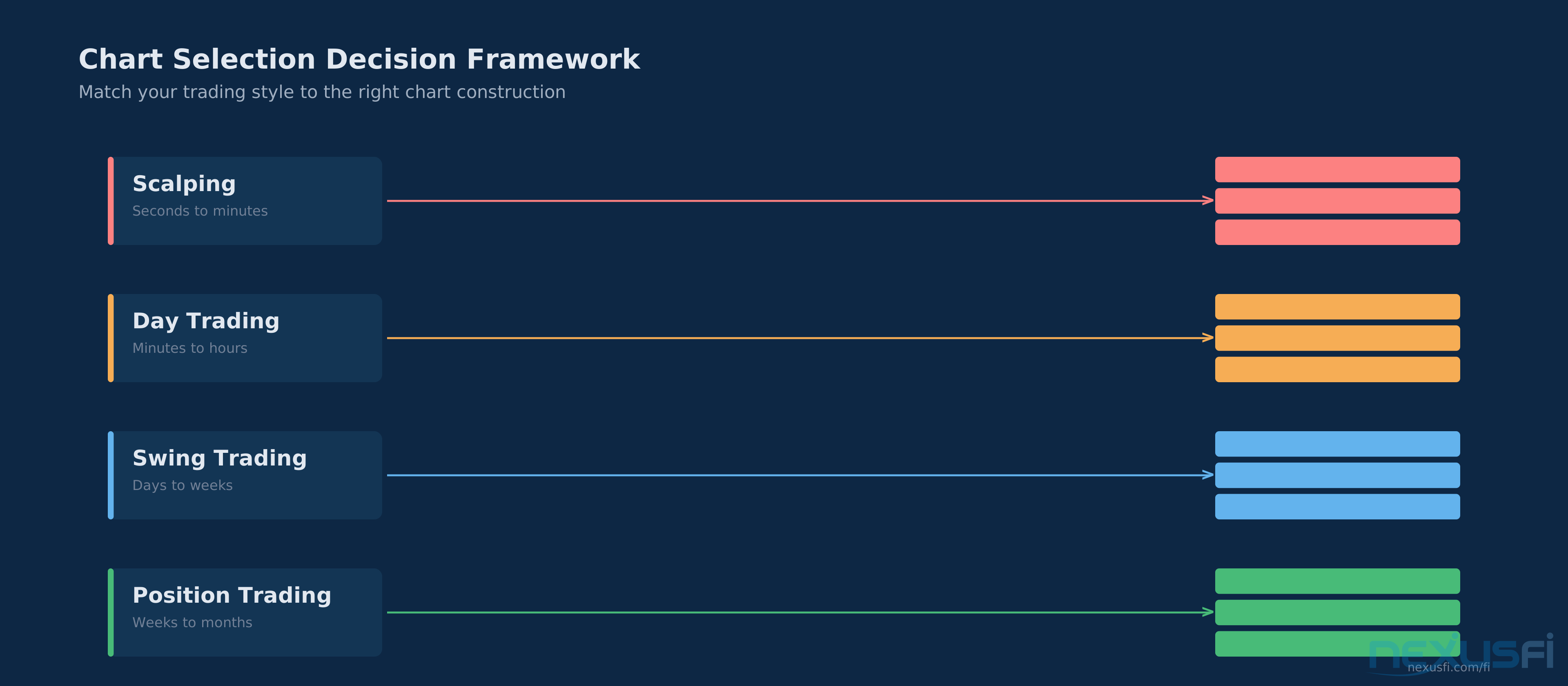
The Decision Framework: Match Chart to Intent #
Don't pick a chart type based on what looks cleanest. Pick it based on what decision you're making.
If You're Scalping (seconds to minutes) #
Primary: Tick charts (200-500 ticks on ES) or range bars for execution timing. Footprint charts for confirmation at key levels.
Context: A higher-timeframe candlestick chart (5-15 min) or Market Profile for session structure. You need to know where value is before you start trading inside it.
Avoid as primary: Daily candles (too slow), Renko (delays turns), Line charts (no intrabar info).
If You're Day Trading (minutes to hours) #
Primary: Candlestick or bar charts (5-15 min) for structure and patterns. Market Profile for session context and value area identification.
Execution enhancement: Tick charts or footprint charts for timing entries at key levels identified on the higher timeframe.
Useful supplement: Volume Profile for identifying HVN/LVN confluence with prior session levels.
@sstheo demonstrates the multi-chart approach for day trading: using 5-minute charts for structure identification while dropping to 15-second charts for precise scalp entries around Tick extremes — "The market is the embodiment of collective human emotion, and the NYSE $Tick directly measures that emotion." [6]
If You're Swing Trading (days to weeks) #
Primary: Daily or 4-hour candlestick/bar charts for structure. Renko or range bars for trend clarity and noise reduction.
Context: Composite Market Profile (multi-day) for major value areas. Point-and-Figure for objective breakout targets.
Useful supplement: Heikin-Ashi as a trend filter to avoid premature exits during normal pullbacks.
If You're Position Trading (weeks to months) #
Primary: Daily/weekly candlestick charts for macro structure. Line charts for clean trend identification.
Context: Long-term composite profiles for major acceptance zones. Point-and-Figure for price objective calculations.
Avoid: Tick charts, footprint charts, fast-timeframe anything — the noise will shake you out of positions before the thesis plays out.
Futures-Specific Considerations #
Session Settings Change Everything #
A 5-minute candlestick chart of ES looks completely different depending on whether you include Electronic Trading Hours (ETH/Globex) or only Regular Trading Hours (RTH). Volume Profile changes dramatically. Market Profile shapes shift. The chart type might be the same, but the session template transforms the output.
Most professional futures day traders use RTH-only profiles for session analysis and ETH charts for overnight context. @Private Banker makes this explicit: "I'm not a fan of using a 24 hr session value area and POC. The volume changes so drastically from the ON session into the RTH session." [7]
Parameter Selection Is Everything for Non-Time Charts #
There's no universal "correct" tick count, range size, or Renko brick. These parameters must be calibrated to:
- The instrument's typical activity level — 1,500 ticks on ES produces roughly the same visual density as 300 ticks on CL
- The current volatility regime — a 2-point Renko brick that works well during normal ES sessions becomes too tight during FOMC days
- Your trading timeframe — smaller tick counts/ranges for scalping, larger for day trading
When volatility regimes shift (and they do, regularly), your non-time chart parameters need recalibration. Most traders don't do this, which is why their "perfect" tick chart stops working every few months.
Switching Chart Types Changes Backtest Results #
This is the warning most chart type articles skip. If you developed a strategy on 5-minute candles and switch to 1,500-tick bars, your indicators will compute differently, your entry/exit signals will trigger at different times, and your backtest results will change — sometimes dramatically. The strategy isn't broken, but the data sampling changed the signal stream.
Test any strategy on the chart type you'll actually trade. Don't improve on one chart type and execute on another.
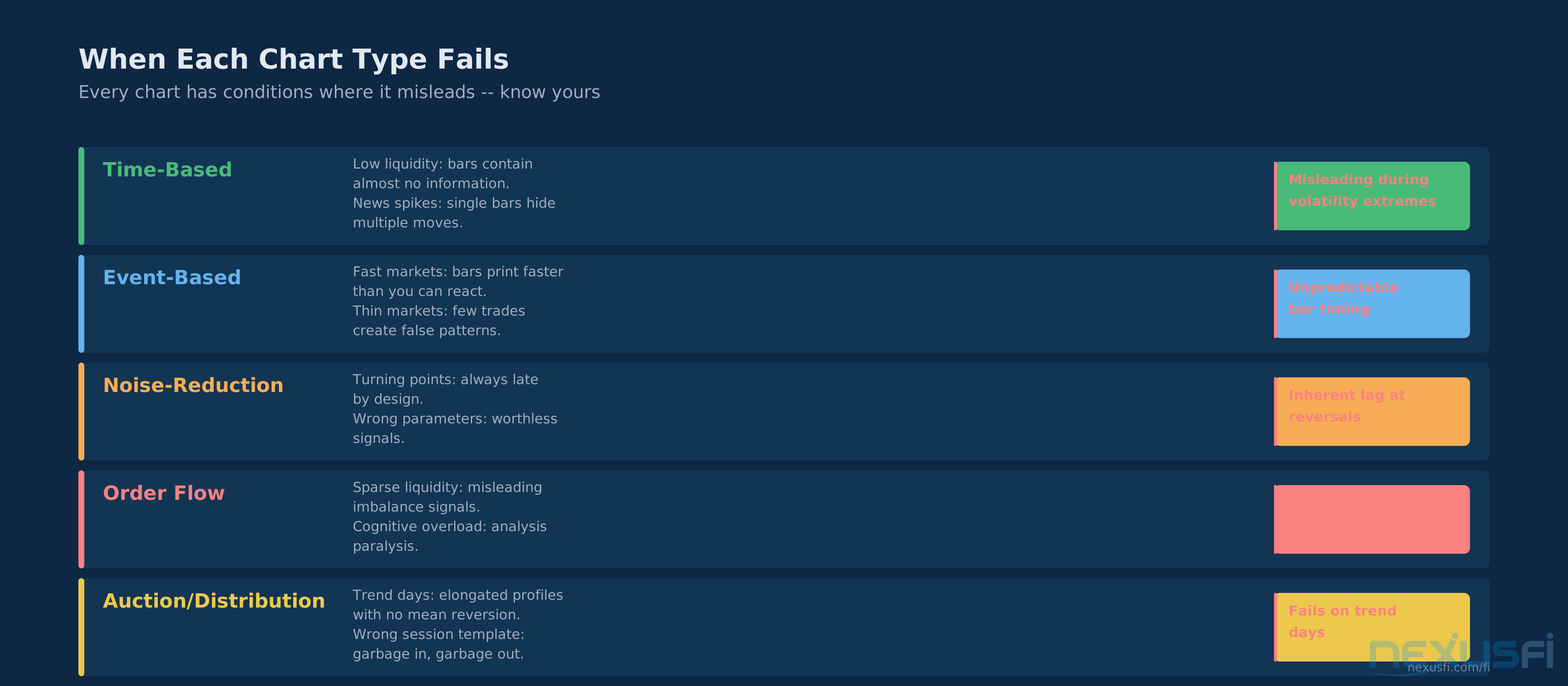
When Chart Types Fail You #
No chart type prevents losses. Here's where each family breaks down:
Time-based charts fail during low-liquidity periods when bars contain almost no information, and during news events when single bars contain multiple moves worth of price action.
Tick and range charts fail when activity bursts produce bars faster than you can react, and during thin markets when a handful of trades produce misleading bar patterns.
Renko and Heikin-Ashi fail at turning points — by design, they lag. The noise reduction that helps during trends hurts when the trend reverses. You'll always be late to the turn.
Footprint charts fail in thin markets where a few large orders can create misleading imbalance signals, and when traders over-interpret noise in the bid/ask split as meaningful aggression.
Market Profile fails on days where the market doesn't establish a normal distribution — trend days produce elongated, directional profiles where the POC has limited predictive value.
The chart type doesn't give you an edge. Your framework for reading the market gives you the edge. The chart type is just the lens you look through.
Getting Started: Practical First Steps #
If you're currently only using time-based candlestick charts and want to expand your toolkit:
- Add tick charts as a secondary view. Keep your time-based chart as the primary. Add a tick chart alongside it and observe how the same price action looks different. Start with a tick setting that produces roughly 20-40 bars per hour during normal RTH activity for your instrument.
- Learn Market Profile. Understanding where value is changes how you read every other chart type. Start with the previous day's value area (VAH, VAL, POC) plotted on today's chart.
- Try Renko or range bars for trend identification only. Don't use them for entry timing initially. Use them to answer one question: is the trend still intact, or has it reversed?
- Save footprint charts for last. They require the most screen time to develop pattern recognition. Most traders aren't ready for footprint analysis until they have a solid structural framework from time-based + profile analysis.
Don't try to watch all chart types simultaneously. Start with two views maximum — one for structure, one for timing. Add complexity only when the current setup stops answering your questions.
Knowledge Map
Go Deeper
Build on this knowledgeReferences This Article
Articles that build on this topicCitations
- — Why Tick Charts instead of Time Based Charts? or other chart types (2013) 👍 7“Every platform has minute based charts. Minute charts are also the only chart setting that you know is on every platform.”
- — Tick chart orientation (2011) 👍 21“A tick chart creates a new bar after a specified number of trades have been executed. The result is a perspective on price action that naturally conforms with the rhythm of the trading session.”
- — renko bars vs range bars? (2009) 👍 6“Be careful when selecting your sampling frequency... I have a futures strategy which uses roonius' implementation of renko bars with great success.”
- — Volume Profile and Footprint discussion (2012) 👍 65“The use of the footprint/volume ladder is an important tool in seeing inside the bar. The entries are NOT derived based upon what is observed within the footprint but upon key predetermined levels.”
- — Volume Profile and Footprint discussion (2012) 👍 118“POC = Point of Control, the price where the most volume of the session traded. VA = Value Area, the area in which 70% of the volume traded. Balance leads to imbalance. Imbalance leads to balance.”
- — Making a Living with the Micros (2021) 👍 15“The market is the embodiment of collective human emotion, and the NYSE $Tick directly measures that emotion.”
- — Volume Profile and Footprint discussion (2012) 👍 9“I'm not a fan of using a 24 hr session value area and POC. The volume changes so drastically from the ON session into the RTH session.”