



Futures Exchange Contract Design: How Products Get Built, Approved, and Why Most Fail
What Makes a Futures Contract #
Every futures contract you trade — the ES, CL, ZB, MES, or any other instrument — is a product. Someone designed it. An exchange decided how big each contract would be, how it would settle, when it would expire, and what it would cost to trade. The CFTC reviewed those decisions and either approved them or sent them back for revision. Then the exchange listed the contract and hoped traders would show up.
Most don't show up. The futures graveyard is full of contracts that made perfect sense on paper — housing futures, hurricane insurance, broadband futures, economic indicator contracts — that never found enough liquidity to function. A handful of contracts, meanwhile, dominate global trading volume so completely that they've become the benchmarks for entire asset classes.
Understanding how contracts get designed, why the winning ones win, and what that means for your trading doesn't just satisfy intellectual curiosity. It tells you why the ES has the tick size it has, why micro contracts exist, why crypto futures settled cash instead of physically when they launched, and why the contracts with the tightest bid-ask spreads are almost always the ones with the most standardized, well-understood specifications.
The Core Insight: Contract design isn't arbitrary. Every specification reflects deliberate choices about who the product is for, what risk it manages, and how the exchange expects it to trade. Understanding those choices makes you a better trader of the contracts you already use.
The Three Core Design Decisions #
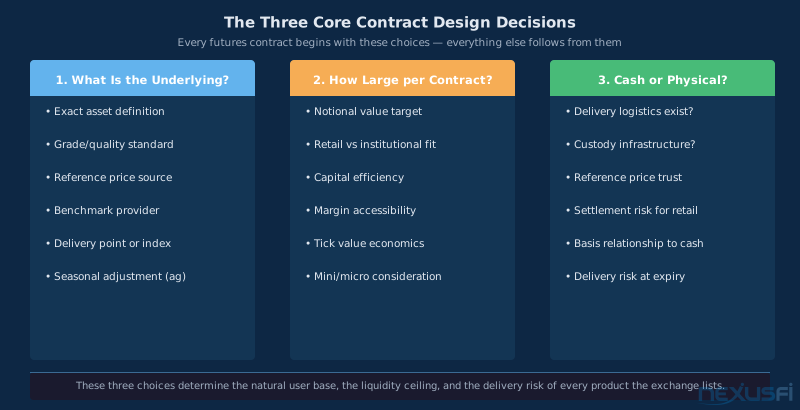
Every futures contract begins with three decisions that shape everything else. Exchanges and their product development teams spend months or years resolving these before a contract ever reaches the CFTC for approval.
1. What Does the Contract Represent?
The underlying asset — and how it's measured — determines who will use the contract and for what purpose. A crude oil contract represents physical barrels at a specific delivery point. An S&P 500 futures contract represents a notional exposure to an index. A Treasury bond futures contract represents an obligation to deliver government debt with specific characteristics.
The underlying specification includes: the exact asset (crude oil = WTI light sweet crude, not Brent), the grade or quality standard for physical commodities, the reference price for cash-settled contracts, and for financial contracts, the index or benchmark provider relationship.
Getting this right matters because basis risk — the divergence between a contract's price behavior and the underlying exposure being hedged — is what determines whether commercial hedgers will use the product. A grain elevator wants a corn futures contract that tracks the price of corn it actually buys. If the contract's delivery specifications don't match the physical market, hedgers won't use it. Without hedgers, speculators don't get natural counterparties. Without counterparties, the contract dies.
2. How Big Is Each Contract?
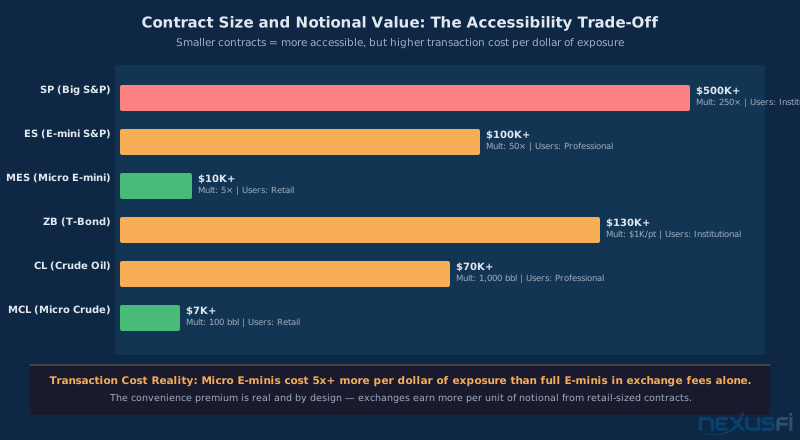
Contract size sets the notional value of each unit traded. The original S&P 500 futures contract (SP) was sized at 250x the index. When the S&P was at 1,500, one contract represented $375,000 of exposure — accessible to institutional traders but too large for most retail participants. The E-mini (ES), introduced in 1997 at 50x the index, was specifically designed to lower the barrier to entry. At the same 1,500 index level, one ES contract represented $75,000 — a fifth of the original.
Contract size involves a direct tradeoff: larger contracts are more capital-efficient for institutions (lower transaction costs per dollar of exposure), but smaller contracts are more accessible for retail traders. Exchanges have increasingly resolved this tension by listing both full-size and mini contracts simultaneously, letting each market segment find its natural instrument.
3. How Does It Settle?
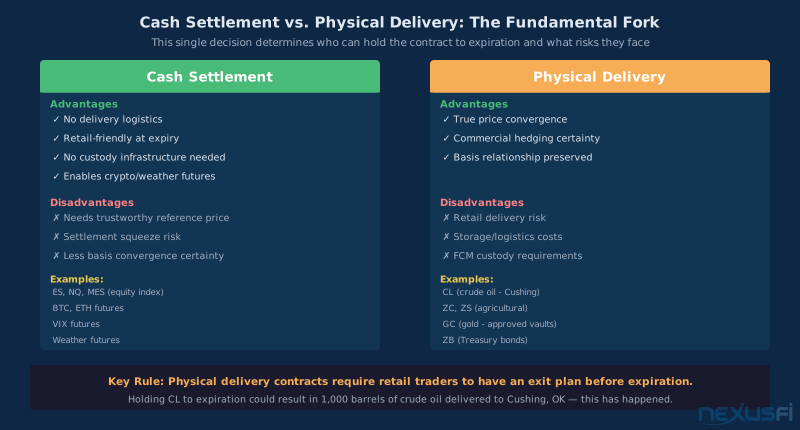
Cash settlement or physical delivery? This single decision determines who can realistically use the contract at expiration. Physical settlement means someone actually delivers the underlying asset to someone else — barrels of oil, bushels of corn, U.S. Treasury bonds. Cash settlement means the contract expires at a reference price and money moves between accounts.
Physical settlement is essential for contracts where the purpose is to actually transfer ownership of the underlying commodity. But physical settlement creates delivery risk: retail traders who hold positions to expiration risk receiving 1,000 barrels of crude oil at Cushing, Oklahoma. This isn't hypothetical — it happens, and it creates enormous operational and compliance problems.
Cash settlement, conversely, eliminates delivery logistics but requires a trustworthy reference price. S&P 500 futures cash-settle to the "Special Opening Quotation" of the index — a specific price computed from the actual opening prints of all 500 component stocks on expiration morning. Bitcoin futures cash-settled to various reference prices when they launched because there was no regulated physical delivery infrastructure for crypto assets.
Tick Size and Contract Multiplier: The Economics of Granularity #
After the fundamental design choices, tick size and the contract multiplier determine the day-to-day economics of trading the product. These specifications interact in ways that directly affect retail traders.
Tick Size
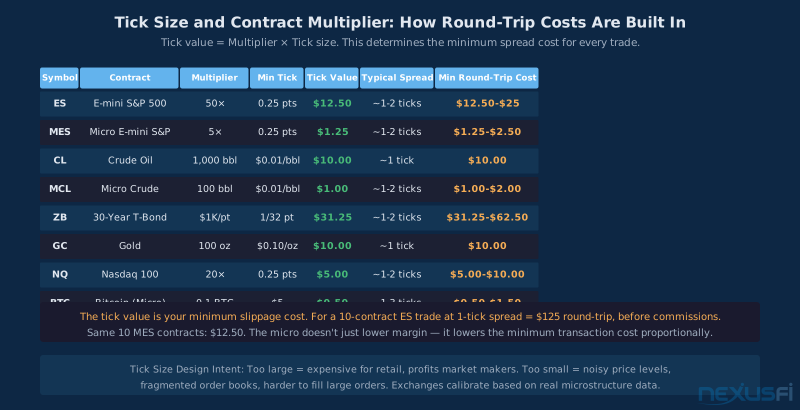
The tick is the minimum price increment — the smallest move a futures price can make. For the ES, the tick is 0.25 index points. For crude oil (CL), it's $0.01 per barrel. For Treasury bonds (ZB), it's 1/32nd of a point per $100 face value.
Tick size matters for market microstructure. Too large, and the bid-ask spread becomes expensive relative to the trading opportunity — market makers earn a spread of at least one tick, so large ticks mean large spreads in absolute terms. Too small, and the contract becomes cluttered with price levels that create noise without improving price discovery.
Exchanges have adjusted tick sizes over time based on trading behavior. When algorithms began trading Treasury futures at high frequency, the bid-ask spread consistently rested at one tick, meaning the minimum round-trip cost was one tick's worth of slippage. Exchanges considered tick size reductions to narrow spreads; the counterargument was that smaller ticks would fragment order flow and potentially reduce quoted depth. These calibration decisions are made based on actual microstructure data, not theoretical models.
Contract Multiplier
The multiplier converts the quoted price into dollar value. For the ES: 50 times the index. For CL: 1,000 barrels times the per-barrel price. For ZB: $1,000 per point of the price quoted per $100 face value.
The tick value — the dollar amount of each minimum price move — is so: (multiplier × tick size). For the ES: 50 × 0.25 = $12.50 per tick. For CL: 1,000 × 0.01 = $10 per tick. For the MES (Micro E-mini): 5 × 0.25 = $1.25 per tick.
These numbers aren't chosen arbitrarily. Exchange product development teams model what the "typical" round-trip trading cost should be relative to the contract's notional value and the expected strategy of its users. A contract designed for institutional hedgers can tolerate larger tick values because hedge efficiency matters more than round-trip cost. A contract designed for retail traders needs small enough tick values that a string of losing trades doesn't devastate the account.
Practical Reality: At SMCJB's analysis of micro contract costs, Micro E-minis cost more than 5x the per-dollar-of-exposure transaction cost of the full-size E-mini. The convenience of smaller contracts has a real price. This is contract design working as intended — the exchange profits more per dollar of exposure from retail contracts.
The Expiration Calendar #
Futures contracts expire. The expiration calendar — which months trade, when they expire, and how far in advance they're listed — is another deliberate design decision that affects trading strategy and market dynamics.
Quarterly vs. Monthly vs. Serial Expirations
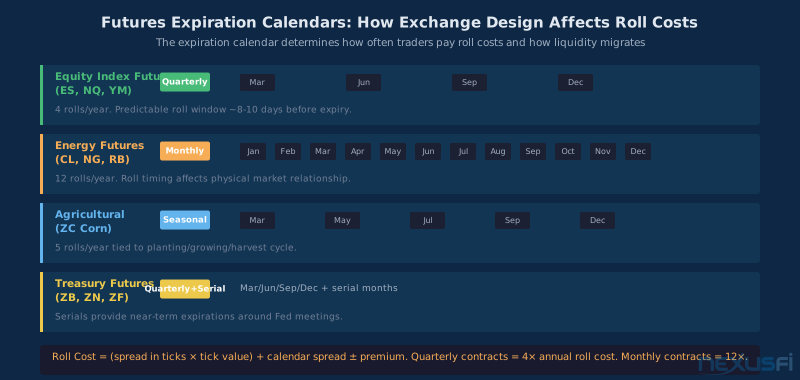
Most major financial futures trade on quarterly cycles: March, June, September, December. This gives each contract a three-month life before expiration, with four contract months active at any given time in the "front" of the curve. Agricultural contracts often have more complex calendars tied to growing seasons: corn trades January, March, May, July, September, December — months that align with planting, growing, and harvesting cycles.
Serial months — intermediate months not in the main cycle — exist for some contracts and provide additional expiration dates for near-term positioning. Treasury options are often listed in serial months to give more flexibility around scheduled Fed meetings and economic releases.
The Roll and Liquidity Migration
Because futures expire, traders with ongoing positions must "roll" from the expiring contract to the next active month. This creates a predictable liquidity migration pattern: volume concentrates in the front-month contract until approximately 8-10 days before expiration (the "roll window"), then shifts to the next quarterly contract.
"Rollover is 8 days before expiration. Volume shifts to the new contract at market open on Rollover day. New day trading or swing trading positions opened on rollover day should use the new contract month irrespective of when you plan to close it."
@max-td | Rollover Days - some Quick Facts about | Traders Hideout
This migration creates the characteristic volume profile that every futures trader learns: front-month dominance, sudden roll activity, then establishment of a new front month. The timing of this migration is itself a product design choice — the exchange decides when the front month transitions, which affects when roll costs are incurred and by whom.
The CFTC Approval Process #
New futures contracts don't just appear. Every product listed on a U.S. futures exchange must go through a regulatory review process administered by the CFTC.
Self-Certification
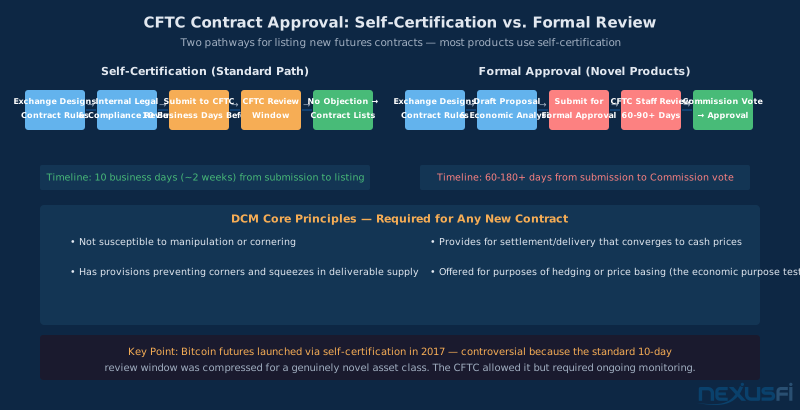
The primary pathway for new contract approval is self-certification. Under this mechanism, an exchange — formally a Designated Contract Market (DCM) — submits the new contract's ruleset to the CFTC 10 business days before the intended listing date. If the CFTC doesn't object within that window, the exchange can list the contract.
Self-certification was a deliberate regulatory design choice to speed innovation. Before self-certification became the standard pathway, new contracts required explicit CFTC approval, which took longer and created a bottleneck that slowed product development. The tradeoff: exchanges bear greater responsibility for ensuring compliance before listing, rather than having the CFTC vet every specification.
Designated Contract Market Rules
For a contract to pass self-certification, it must comply with the DCM Core Principles established in the Commodity Exchange Act. These include requirements that the contract:
- Not be susceptible to manipulation
- Provide for delivery or settlement that converges to cash prices
- Have provisions preventing corners and squeezes
- Be offered for trading for purposes of hedging or price basing (the "economic purpose" test)
The anti-manipulation requirement is the critical design constraint. Every structural decision — delivery point, settlement price methodology, contract size relative to the deliverable supply — is evaluated against the question: could someone corner this market? Agricultural contracts with small deliverable supplies, for instance, face intense scrutiny because physical squeezes (accumulating more futures contracts than the available underlying supply) are a real historical risk.
CFTC Review and Approval for Novel Products
For genuinely novel products — asset classes without precedent, complex settlement mechanisms, or products raising public policy questions — exchanges can pursue formal CFTC approval rather than self-certification. This provides certainty (a CFTC approval is harder to challenge than a self-certification) but takes longer and involves more extensive engagement.
Bitcoin futures launched in 2017 via self-certification by both CME and CBOE. This was controversial — critics argued that a novel, volatile, lightly-regulated underlying asset created manipulation risks that the standard 10-day window couldn't adequately evaluate. The CFTC ultimately allowed the listing but required ongoing monitoring. As forum members discussed at the time, cash settlement was a deliberate design choice precisely because it eliminated the physical delivery logistics for an asset that had no established institutional custody infrastructure.
Why Most New Futures Contracts Fail #
The futures markets have tried to create contracts on housing prices, weather events, GDP growth, broadband bandwidth, shipping rates, and hundreds of other underlying assets. Most of these experiments ended quietly, with contracts being delisted after failing to attract meaningful trading volume.
The Liquidity Trap
Futures contracts need liquidity to function. Liquidity requires market makers willing to post continuous bids and offers. Market makers require either enough trading volume to earn spreads profitably, or payment from the exchange for providing liquidity (market maker incentive programs).
The bootstrap problem: a new contract has no volume, so market makers charge wide spreads. Wide spreads make the contract expensive to use, so traders avoid it. With few traders, market makers earn little. They widen spreads further or leave. The contract dies.
Breaking this cycle requires either an existing user base (commercial hedgers who need the contract to manage real exposure will trade it regardless of spread) or a network effect trigger (the exchange attracts a critical mass of market makers simultaneously through incentives). Most contracts that fail do so because they never found either.
The Substitution Problem
Many failed contracts had a viable underlying concept but faced substitution from existing instruments. Single-stock futures were legally permitted after the Commodity Futures Modernization Act of 2000 but never achieved meaningful volume — equity options already served most of the same positioning purposes, with deeper liquidity and established infrastructure. Launching a new contract into a market with existing substitutes requires demonstrating a specific advantage that justifies migrating liquidity.
Correlation Without Independence
Some contracts fail because traders can replicate their exposure through existing products. If you can construct the same risk profile by trading two liquid contracts, a new product offering that combined exposure has no marginal value. Exchange product development teams spend significant time analyzing whether proposed contracts offer genuine economic differentiation or are basically portfolios of existing instruments dressed up as something new.
The Weather Futures Case
CME launched weather futures and options in 1999, targeting energy companies hedging temperature-sensitive demand. The contracts were structurally sound: heating and cooling degree day contracts with defined settlement methodologies. They attracted some institutional hedging interest but never developed liquid, active markets. The problem: the hedgers who needed weather risk management were few and idiosyncratic; they preferred OTC customization over standardized exchange contracts. The speculative community found the contracts obscure and the research burden high. The contracts persist in limited form today, but they never became major traded instruments.

The Micro Revolution: CME's Most Successful Innovation #
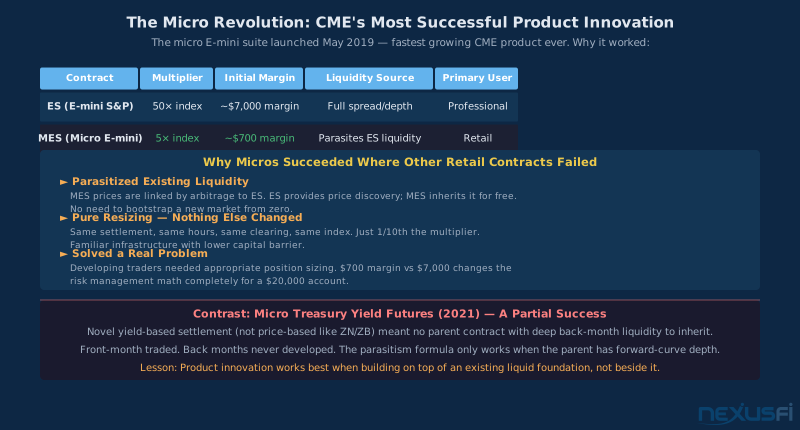
In May 2019, CME launched the Micro E-mini suite — MES (S&P 500), MNQ (Nasdaq 100), MYM (Dow Jones), and M2K (Russell 2000). Each contract was sized at 1/10th of the corresponding E-mini. The initial margin for an MES was approximately $500-700, compared to $5,000-7,000 for an ES.
The micro contracts became CME's fastest-growing product ever. Within months, average daily volume exceeded a million contracts. They succeeded where other retail-focused innovations had failed because they solved a genuine problem — appropriate position sizing for developing traders — while maintaining the institutional infrastructure of their parent contracts: same settlement methodology, same clearing structure, same market hours, same arbitrage relationship to the underlying index.
Community Perspective on Micro Contract Costs: As Big Mike noted when CME launched smaller FX contracts years earlier, smaller contracts let traders manage risk more precisely — though the per-dollar transaction cost is higher. FuturesTrader71's analysis of the micro launches confirmed that exchange fees alone were over 5x higher per dollar of exposure in the micros vs. full E-minis, reflecting the premium for contract accessibility.
Why Micros Worked When Other Retail-Focused Contracts Failed
The critical insight is that the micro contracts parasitized existing liquidity rather than trying to create new liquidity from scratch. The MES trades at 1/10th the size of the ES, but ES and MES markets are linked by arbitrage: any pricing discrepancy is instantly arbitraged away. The micro contracts inherited the ES's price discovery rather than needing to create their own.
This is different from, say, a new single-stock futures contract that would need its own liquidity ecosystem. The micro suite was basically a contract redesign — changing the multiplier while keeping everything else identical — that unlocked retail access without fracturing the existing market.
Subsequent Micro Launches
The success of equity index micros led CME to apply the formula elsewhere. Micro Treasury Yield futures launched in 2021, targeting retail traders who wanted direct exposure to yield levels rather than the price-based ZB/ZN/ZF contracts. As Schnook noted in the NexusFi discussion, these were structurally novel — settled to yield rather than price — and despite initial volume, their deferred months saw little activity. Back-month liquidity in micro yield contracts never developed the way back-month liquidity did in the index micros, illustrating that the parasitism formula only works when the parent contract has deep forward-curve liquidity to share.
Crypto Futures: A Case Study in Contract Innovation #
The 2017 launch of Bitcoin futures by CME and CBOE was the most watched futures product launch in decades. It illustrated nearly every aspect of contract design in a compressed, public timeframe.
Settlement Choice: Cash Over Physical
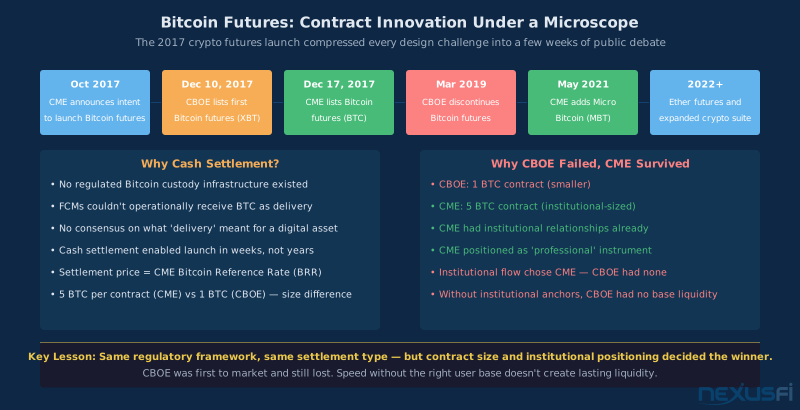
Both CME and CBOE chose cash settlement, despite Bitcoin being physically transferable. The rationale was practical: there was no established institutional custody infrastructure, no defined delivery methodology, and no consensus on what constituted "delivery" for a cryptographic asset. Physical settlement would have required FCMs to develop Bitcoin custody capabilities that didn't exist in regulated form. Cash settlement against reference prices (CME used the Bitcoin Reference Rate; CBOE used the Gemini auction price) allowed launch without those dependencies.
As Devil Man's analysis of the CME contract specifications showed, the original BTC contract included a 1,000-contract spot position limit and 5,000-contract accountability level — conservative numbers reflecting the exchange's uncertainty about how the contract would trade.
The CBOE Contract's Failure
CBOE was first to market with Bitcoin futures (December 10, 2017, versus CME's December 17 launch) but discontinued the product in March 2019 after volume collapsed. CME's contract survived and grew. The difference wasn't settlement methodology — both were cash-settled — but contract size and institutional adoption. CME's contract represented 5 BTC, CBOE's represented 1 BTC. CME's institutional relationships and marketing positioned its product as the "professional" instrument. Institutional traders chose CME. Without institutional flow, CBOE's contract had no natural liquidity foundation.
Later Evolution: Micro Bitcoin and Ether Futures
CME eventually launched Micro Bitcoin futures (1/10th BTC) and Ether futures, applying the same micro-contract formula that worked for equity indexes. These products attracted retail participation while maintaining the institutional infrastructure of the full-size contracts. The pattern is consistent: successful contract innovation often works by resizing an existing successful product rather than creating entirely new market structure.
Contract Modifications: When Exchanges Adjust Existing Products #
Contract specifications aren't permanent. Exchanges periodically modify existing contracts in response to market evolution, regulatory requirements, or user feedback. These changes require CFTC notice even for minor modifications.
Tick Size Changes
Tick size reductions have become more common as electronic market making has compressed bid-ask spreads to minimum tick increments in liquid contracts. When a contract trades consistently at one-tick spreads — indicating that the tick is economically binding — there's an argument for reducing the tick to allow more price granularity. The counterargument is that tighter ticks can fragment order flow, reducing quoted depth at each price level and making large orders harder to fill without impact.
Contract Size Adjustments
Changes to contract multipliers are rarer and more disruptive. Because position limits, margining, and risk management systems are all tied to contract notional value, resizing a contract requires wholesale recalibration. Exchanges generally prefer launching a separate contract (the mini/micro approach) over modifying the existing product.
Settlement Methodology Changes
Changes to settlement prices require CFTC approval and advance notice. These are most common when the reference price methodology becomes contested (for instance, when LIBOR's manipulation came to light, contracts tied to LIBOR rates needed to transition to alternative reference rates like SOFR). These transitions are operationally complex because they affect not just new contracts but all open interest in existing positions.
Delivery Point Changes
Physical delivery point changes in commodity contracts are politically charged. Crude oil's primary delivery point at Cushing, Oklahoma was designed for the pipeline infrastructure of the 1980s. As U.S. shale production growth changed the crude oil logistics environment, arguments arose for additional delivery points. Any such change affects basis relationships between physical and futures prices across the entire market — a change that benefits some hedgers disadvantages others.
Contracts that succeed long-term share one trait — their design specifications align with genuine economic demand. The tick size, contract size, settlement method, and expiration calendar work together to serve the traders who need the product most. When a contract's specs don't match real hedging or speculative demand, no amount of marketing saves it.
What Contract Design Means for Your Trading #
Understanding contract design isn't just historical context. It directly informs decisions about which contracts to trade, how to size positions, and what risks to watch for.
Liquidity Follows Design Quality
The contracts with the deepest liquidity are generally those whose specifications best match the natural demand for risk transfer in that market. The ES is liquid because millions of traders and institutions want exposure to U.S. equity markets, and its specifications (size, settlement, expiration calendar) match that need efficiently. When you trade the ES, you benefit from the accumulated liquidity of every participant who found the contract design appropriate for their purpose.
Contracts with thinner liquidity often have design mismatches — specifications that don't quite fit the natural hedging or speculative demand in that market. Trading them means accepting wider spreads and lower depth, which affects your execution costs.
Contract Size and Position Sizing
For developing traders, the availability of micro contracts changes position sizing math entirely. Trading MES vs. ES isn't just a matter of using less margin — it's a different position sizing and risk management framework. The MES allows 10-contract positions where the ES allows only 1, enabling more precise scaling. The cost is a higher transaction cost per dollar of exposure, which the exchange transparently designed into the product.
Settlement Risk Near Expiration
Physical delivery contracts carry settlement risk that cash-settled contracts don't. Understanding whether you're trading a physically-delivered product (CL, ZC, ZB in some contexts) determines what happens if you're careless about holding positions into the expiration window. The design decision to cash-settle rather than physically settle isn't just abstract — it's a practical boundary on your operational risk.
Expiration Calendar and Roll Costs
The expiration calendar determines when you'll pay roll costs if you maintain ongoing exposure through multiple contract cycles. Quarterly-expiry contracts require rolling four times per year. Monthly contracts require twelve rolls. Each roll has a cost: the bid-ask spread plus any difference between the prices of the expiring and next contract (calendar spread). Contracts with more roll dates generate more roll cost for traders with continuous exposure.
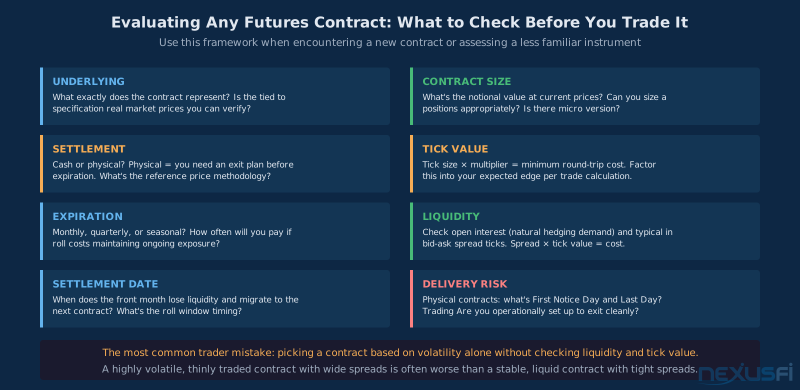
Checklist: Understanding a New Futures Contract
- What's the underlying, and is the specification tied to actual market prices?
- How large is each contract (notional value at current prices)?
- Cash settled or physical delivery?
- What's the tick size and tick value?
- Monthly, quarterly, or seasonal expirations?
- Is there a micro version available?
- What's the open interest -- a proxy for how much natural hedging demand exists?
- How wide is the typical bid-ask spread (spread in ticks × tick value = cost per round-trip)?
Knowledge Map
Go Deeper
Build on this knowledgeCitations
- — Trading the new CME E-Micro's (E micro) MES, MNQ, MYM, M2K and other micros (2013) 👍 24
- — Trading the new CME E-Micro's (E micro) MES, MNQ, MYM, M2K and other micros (2019) 👍 8
- — Trading the new CME E-Micro's (E micro) MES, MNQ, MYM, M2K and other micros (2019) 👍 4
- — Trading the new CME E-Micro's (E micro) MES, MNQ, MYM, M2K and other micros (2019) 👍 4
- — Bitcoin Futures by the CME (2017) 👍 5
- — Bitcoin Futures by the CME (2017) 👍 3
- — CBOE BitCoin futures (2017) 👍 3
- — FOUR more NEW MICRO's - Micro Treasury Yield Futures coming 16 Aug'21 (2021) 👍 7
- — Rollover Days - some Quick Facts about (2009) 👍 22