



Commodity Channel Index (CCI): The Unbounded Momentum Oscillator That Shows What RSI Can't
Overview #
The Commodity Channel Index measures how far price has deviated from its own recent average, scaled by mean absolute deviation. That scaling is why CCI behaves differently from every other oscillator on your chart. RSI caps at 100. Stochastic caps at 100. CCI doesn't cap at all. When crude oil spikes 8% on a geopolitical headline, RSI reads 82. CCI reads +380. One of those numbers tells you something useful about the magnitude of the move. The other just says "overbought."
Donald Lambert introduced CCI in 1980 for identifying cyclical turns in commodity markets. The indicator has since become a staple across all futures classes — equity indices, energy, metals, grains, rates — precisely because its construction adapts to the volatility regime of whatever you're trading. CCI expands when volatility expands. It contracts when volatility contracts. That self-adjusting quality makes it one of the more reliable momentum tools for leveraged markets where price moves can be extreme and sudden.
Here's the core idea: CCI tells you how unusual the current price is relative to its recent history, measured in units of average deviation. A reading of +100 means price is one average deviation above its mean. A reading of +250 means it's 2.5 average deviations above. Zero means price is sitting right at its recent average — no directional bias. That framework gives you a continuous measure of momentum magnitude, not just direction.
Key Concepts #
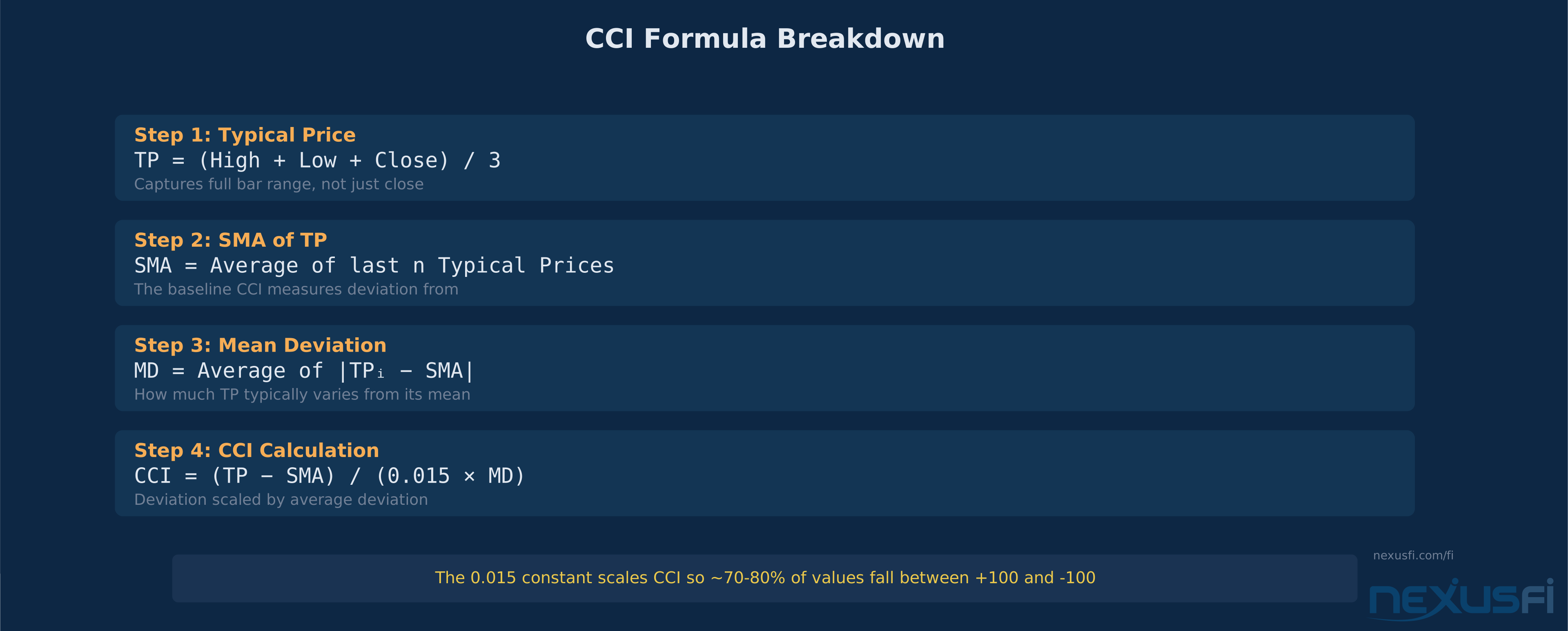
Typical Price (TP): The average of the high, low, and close for each bar: TP = (High + Low + Close) / 3. Using all three prices captures intra-bar extremes — critical in futures where wicks represent real liquidity sweeps, not just noise.
Simple Moving Average of TP (SMA): The arithmetic mean of the last n Typical Prices. This is the baseline CCI measures deviation from. Default period is 14, though experienced traders adjust this much by timeframe and contract.
Mean Deviation (MD): The average absolute deviation of each TP from the SMA over the same n periods: MD = (1/n) × Σ|TPᵢ − SMA(TP)|. This is different from standard deviation. Mean deviation gives equal weight to all deviations rather than squaring them, making CCI more responsive to the fat-tailed returns common in futures markets.
The Formula: CCI = (TP − SMA(TP)) / (0.015 × MD). The 0.015 constant is a historical calibration factor Lambert chose so that roughly 70-80% of CCI values fall between +100 and -100 under normal conditions. It's not a statistical constant — it's a scaling choice that makes the indicator's levels intuitive.
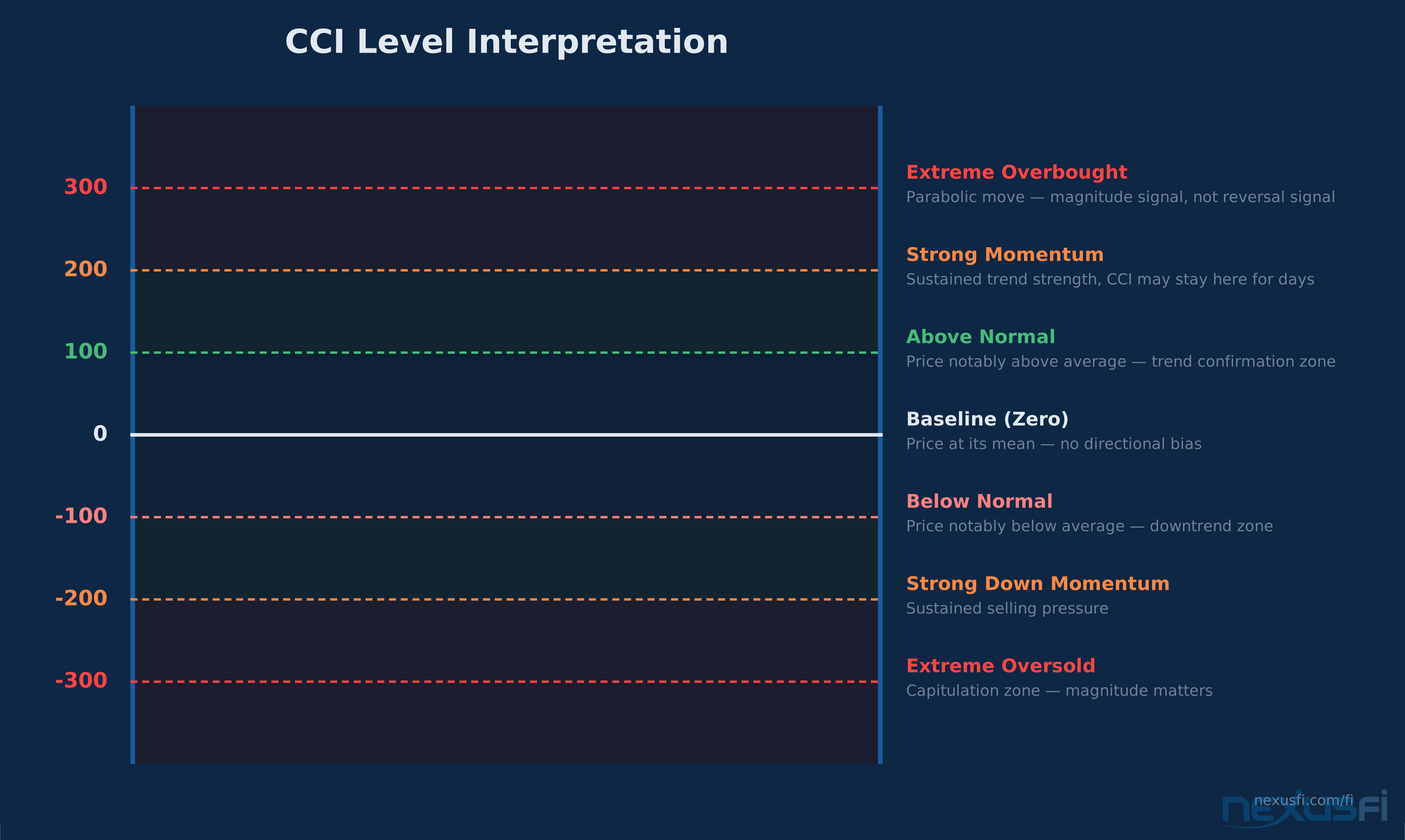
Zero Line: When CCI is above zero, price is above its recent average. Below zero, price is below. This sounds simple, but the zero line is arguably the most useful feature of the indicator — it's a clean trend filter with no equivalent in RSI or Stochastic.
Threshold Levels: +100/-100 marks the boundary between "normal" deviation and "notable" momentum. +200/-200 signals extreme readings. In strong futures trends, CCI can push to +300, +400, or beyond — and that's information, not a guaranteed reversal signal.
The Math Behind CCI #
Walk through a quick calculation on five bars of ES data. Suppose the last five Typical Prices are: 5,420.25, 5,418.50, 5,422.75, 5,425.00, 5,430.50.
SMA(5) = (5,420.25 + 5,418.50 + 5,422.75 + 5,425.00 + 5,430.50) / 5 = 5,423.40
Mean Deviation = (|5,420.25 − 5,423.40| + |5,418.50 − 5,423.40| + |5,422.75 − 5,423.40| + |5,425.00 − 5,423.40| + |5,430.50 − 5,423.40|) / 5 = (3.15 + 4.90 + 0.65 + 1.60 + 7.10) / 5 = 3.48
CCI = (5,430.50 − 5,423.40) / (0.015 × 3.48) = 7.10 / 0.0522 = +136.0
The current bar's CCI of +136 tells you price is notably above its recent mean — past the +100 threshold but not extreme. In a trending market, this might be normal momentum. In a range, it might signal an overshoot worth fading.
How CCI Responds to Volatility #
This is the single most important thing to understand about CCI, and it's what separates it from RSI and Stochastic in practical terms.
The Mean Deviation in the denominator expands when price becomes more volatile and contracts when price calms down. This means CCI's sensitivity automatically adjusts to the current regime. During a quiet session where ES is grinding in a 5-point range, a 3-point deviation from the mean produces a large CCI reading. During a volatile FOMC session where ES is swinging 20+ points, that same 3-point deviation barely registers.
This is a feature, not a bug. It means CCI readings of +150 during a low-volatility grind and +150 during a high-volatility event represent roughly equivalent levels of "unusualness" relative to their respective regimes. RSI and Stochastic don't do this — they measure momentum without adjusting for the current volatility context, which is why they get stuck at extremes during strong trends and oscillate uselessly during range compression.
The practical implication: you don't need to change your CCI threshold levels when volatility shifts. The indicator has already adjusted. A +200 reading always represents a significant deviation from the mean, whether the market is calm or chaotic.
Futures-Specific Data Considerations #
Before trading CCI signals, get your data right. Futures have wrinkles that equities don't.
Continuous Contracts vs. Front-Month: Back-adjusted continuous contracts can create artificial CCI spikes at roll points. The price gap from rolling creates a phantom deviation that inflates the CCI reading for several bars until it washes out of the lookback window. If you're using CCI on daily or weekly charts, use ratio-adjusted or unadjusted front-month data and be aware of expiration effects. On intraday charts within a single session, this rarely matters.
Session Boundaries: CCI computed across the overnight Globex session and the Regular Trading Hours session will behave differently than CCI computed on RTH-only data. Overnight gaps between sessions can create opening CCI spikes that don't reflect actual momentum — they reflect a price adjustment, not a new impulse. Many experienced futures traders compute CCI on RTH-only bars for signal generation and use the full session only for context.
Bar Construction: CCI responds to Typical Price, which includes the high and low. On time-based bars, wide-range bars during volatile periods produce larger TP deviations. On tick or volume bars, the sampling rate changes with activity. Neither is wrong, but they produce different CCI behavior. Pick a bar type, test it, and stick with it.
— the key is consistency once you've chosen.
Signal Families #
CCI generates four distinct categories of tradeable signals. Each works differently depending on market regime.
Zero-Line Crossovers (Trend Filter) #
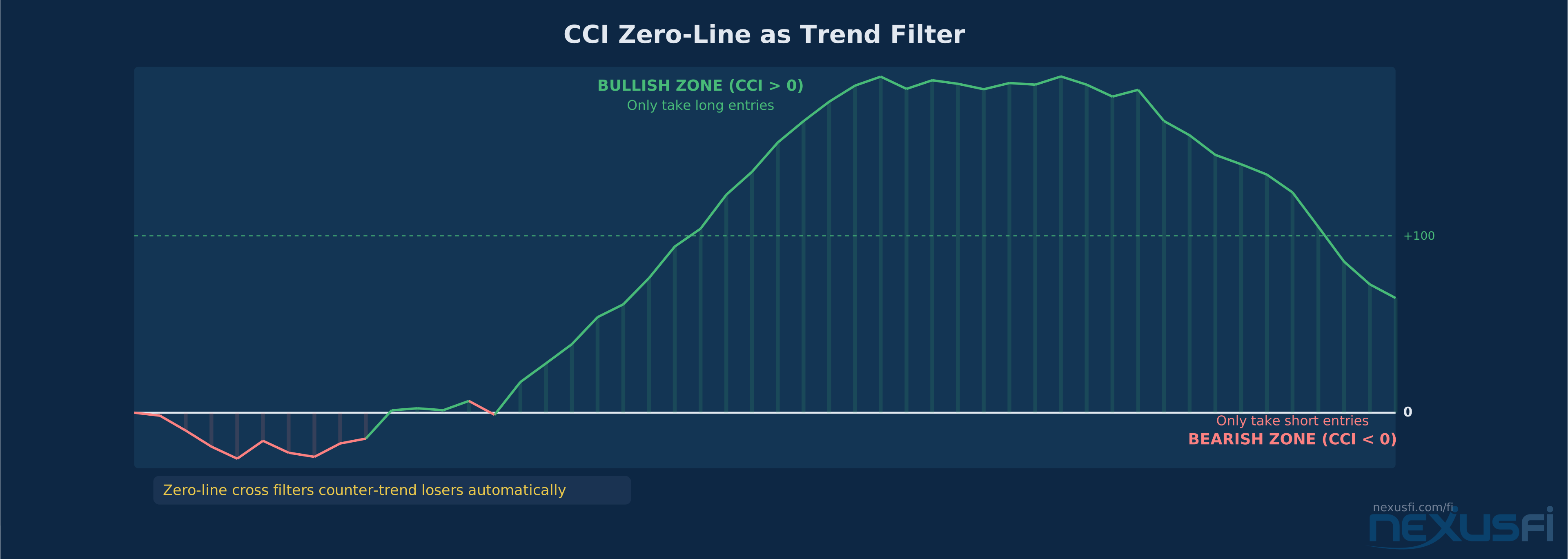
When CCI crosses above zero, price has moved above its recent average — bullish bias. When it crosses below, bearish bias. This is the cleanest application of CCI: a simple trend filter that tells you which side of the market to be on.
The strength of the zero-line as a filter comes from what it represents. Unlike RSI's 50-line (which is an arbitrary midpoint of a bounded scale), CCI's zero line is the actual mathematical baseline — the point where price equals its own moving average. Cross above zero and you're objectively in positive deviation territory.
Use the zero-line cross as a regime filter for other systems: only take long entries from your primary setup when CCI is above zero. Only take shorts when it's below. This single filter eliminates a surprising number of counter-trend losers. As the ESFXtrader method documented in the NexusFi community shows — a system built primarily around CCI zero-line and threshold crosses on Russell 2000 futures generated 426 replies of active discussion because the concept is mechanically sound.
Threshold Cross-Backs (Mean Reversion) #
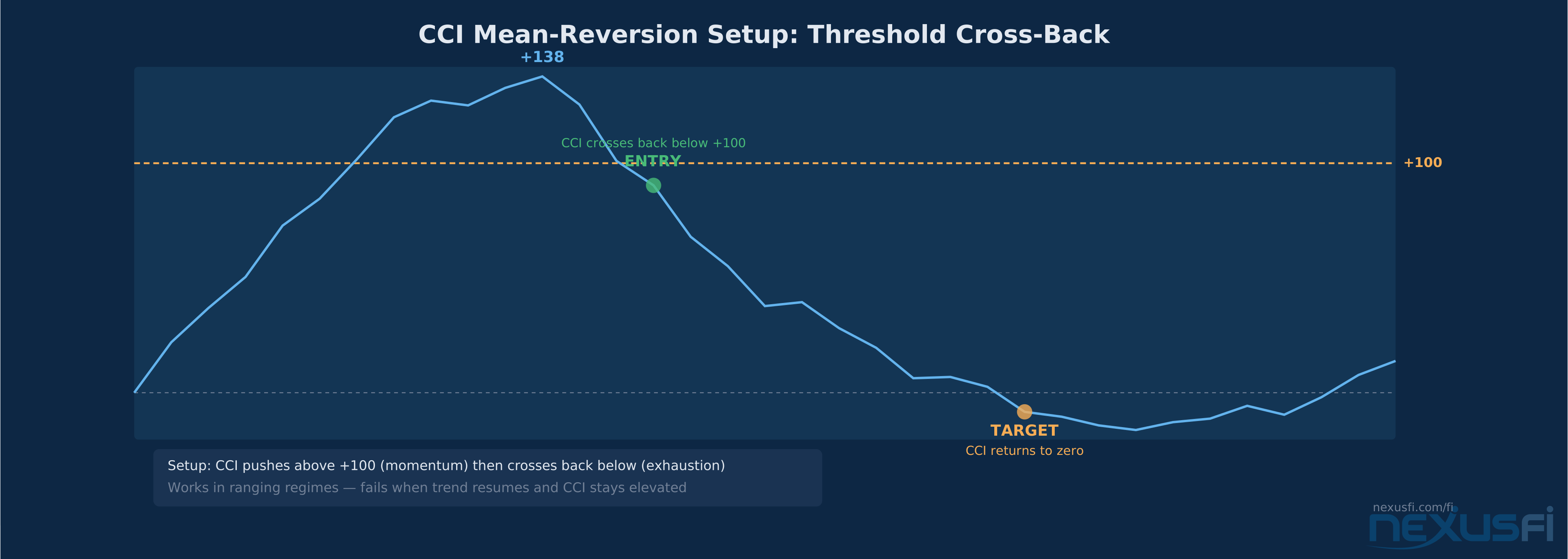
When CCI pushes beyond +100 and then crosses back below it, that's a momentum exhaustion signal. Price overshot its average, and the deviation is starting to normalize. Similarly, CCI crossing back above -100 from below signals downside exhaustion.
The key word is "cross-back." The signal isn't when CCI reaches +100 — reaching +100 in a strong trend is normal and doesn't mean anything is about to reverse. The signal is when CCI has been above +100, confirming strong momentum, and then falls back through the level, indicating that momentum is fading.
Failure mode: In strong trends, CCI can stay above +100 for extended periods. Each time it dips toward +100 and bounces higher, you get a false mean-reversion signal. This is why threshold cross-backs work best when you've already identified a ranging regime — use a higher-timeframe CCI reading between -50 and +50 as a regime filter before trusting mean-reversion signals on the lower timeframe.
Divergence (Price vs. CCI) #
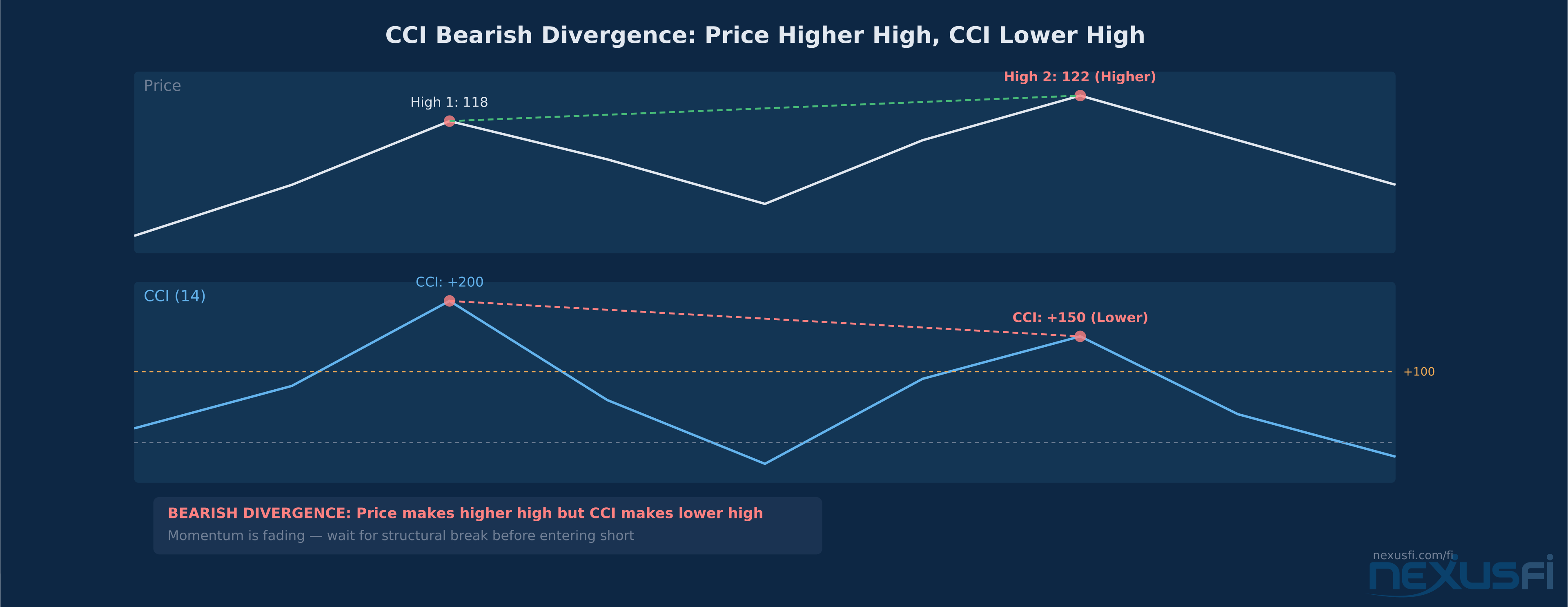
Bullish divergence: price makes a lower low while CCI makes a higher low. Bearish divergence: price makes a higher high while CCI makes a lower high. The momentum is disagreeing with price, which often precedes a reversal.
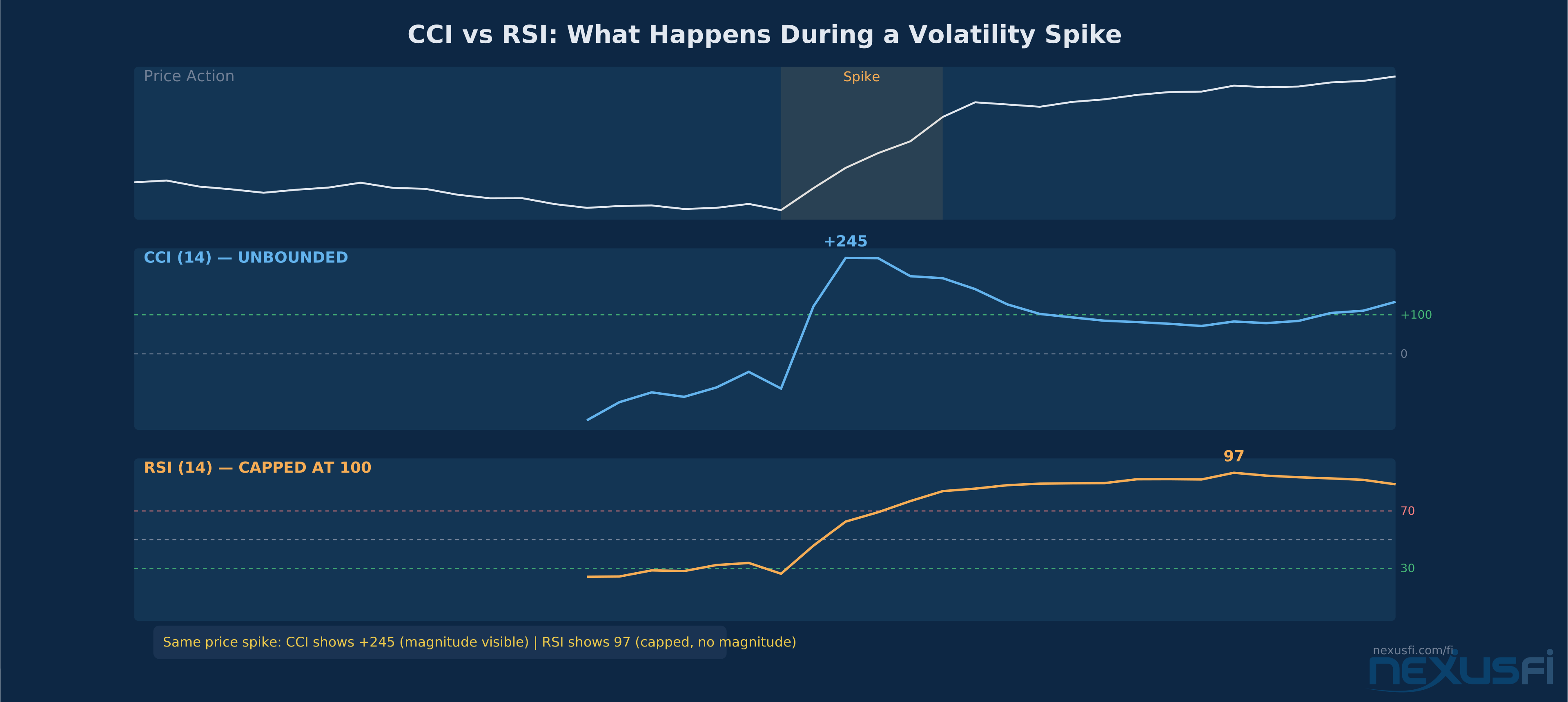
CCI divergence has one advantage over RSI/Stochastic divergence: because CCI is unbounded, the magnitude of the divergence is visible. If CCI's first peak was +250 and the second (with price higher) is +180, you can see that momentum has faded by 70 points. RSI might show 78 vs. 72 — technically divergent, but the difference is muted by the bounded scale.
Failure mode: Divergence is famously early. In strong futures trends, you can see bearish divergence form and persist for days while price continues higher. The divergence itself isn't wrong — momentum really is fading — but the reversal may not come until much later. Never trade divergence alone. Combine it with a structural break: a trendline violation, a failed higher low, or a break below the prior swing. The Jeff Castille CCI approach documented across 936 NexusFi Elite Circle posts emphasizes this: use CCI divergence as an alert, not an entry trigger, until price structure confirms.
Multi-Timeframe Alignment #
Use a higher-timeframe CCI to define the regime. Use a lower-timeframe CCI for entry timing. If the daily CCI is between -50 and +50, the market is in a neutral regime — mean-reversion setups on the 15-minute chart are appropriate. If the daily CCI is above +100, the market is in a sustained uptrend — only take long entries on the lower timeframe, and use zero-line pullbacks rather than threshold cross-backs.
This framework prevents the most common CCI mistake: applying the wrong signal type for the current regime. Mean-reversion signals in a trending market get you run over. Trend-following signals in a range chop you up. The higher-timeframe CCI solves this by telling you which signal family to trust right now.
Trading Setups: Complete Walk-Throughs #
Setup A: Mean-Reversion at Extremes #
Regime requirement: Higher-timeframe CCI between -100 and +100 (range-bound).
Entry: CCI pushes beyond +100 (or below -100) and then crosses back inside the threshold. Wait for a confirming price bar — a rejection wick, an inside bar, or a close back toward the recent range midpoint. Enter on the close of the confirming bar.
Stop: Beyond the extreme bar's high/low plus a buffer (1-2 ATR ticks on intraday, full bar range on daily). The stop placement should respect the instrument's tick structure.
Target: CCI returning to zero is the primary target. Partials at CCI = +/-50 are reasonable. Don't hold for a full reversal to the opposite threshold — mean-reversion trades have a specific profit profile and trying to squeeze more out of them inverts the risk/reward.
Failure mode: MD expansion without real reversal. If volatility increases (CCI's denominator grows), CCI can "cool off" from +150 back to +80 without price actually reversing much. You exit at your target, but the trade barely moved in your favor. Solution: pair with an ATR expansion filter — if ATR has increased more than 50% over the lookback period, tighten the CCI threshold to +/-150 before taking mean-reversion entries.
Setup B: Zero-Line Trend Participation #
Regime requirement: Higher-timeframe CCI clearly above +100 or below -100 (trending).
Entry: On the lower timeframe, wait for CCI to pull back toward zero and then cross back in the trend direction. For longs in an uptrend: CCI dips below +50, approaches zero (or briefly touches it), then turns back up. Enter when CCI crosses above +20 on the way back up, with price holding above a reference level (prior swing low, VWAP, or a key moving average).
Stop: Below the pullback low. The pullback must hold above the prior swing low for the setup to remain valid. If price breaks through that swing, the trend structure is damaged and the trade thesis is invalidated.
Target: Hold until CCI reaches the prior extreme level or until higher-timeframe CCI shows momentum fading. Trail the stop to each higher swing low as the trend progresses.
Failure mode: Range chop around the zero line. If the market is actually transitioning from trend to range, CCI will oscillate around zero, generating repeated small losses. The fix: require CCI to actually reach zero (or close to it) before re-entering, rather than catching every wiggle above and below +20.
Setup C: Divergence-Confirmed Reversal #
Regime requirement: Extended trend that has pushed CCI to extreme levels (+200 or beyond) at some point during the move.
Entry: Identify bearish divergence (price higher high, CCI lower high) or bullish divergence (price lower low, CCI higher low). Wait for a structural confirmation: a break below the prior swing low (for bearish divergence) or above the prior swing high (for bullish). Enter on the break.
Stop: Beyond the divergence extreme — the price high that CCI failed to confirm (for bearish) or the low (for bullish).
Target: The prior CCI extreme's price level, or the midpoint of the recent range. Divergence reversals often retrace 38-62% of the prior trending leg — use Fibonacci levels as a reality check on your target.
Failure mode: Divergence that persists for an extended period without price reversing. This is especially common in trending commodity markets where fundamentals support the direction. The structural confirmation step is critical — without it, you're guessing when the divergence will matter.
Parameter Tuning #
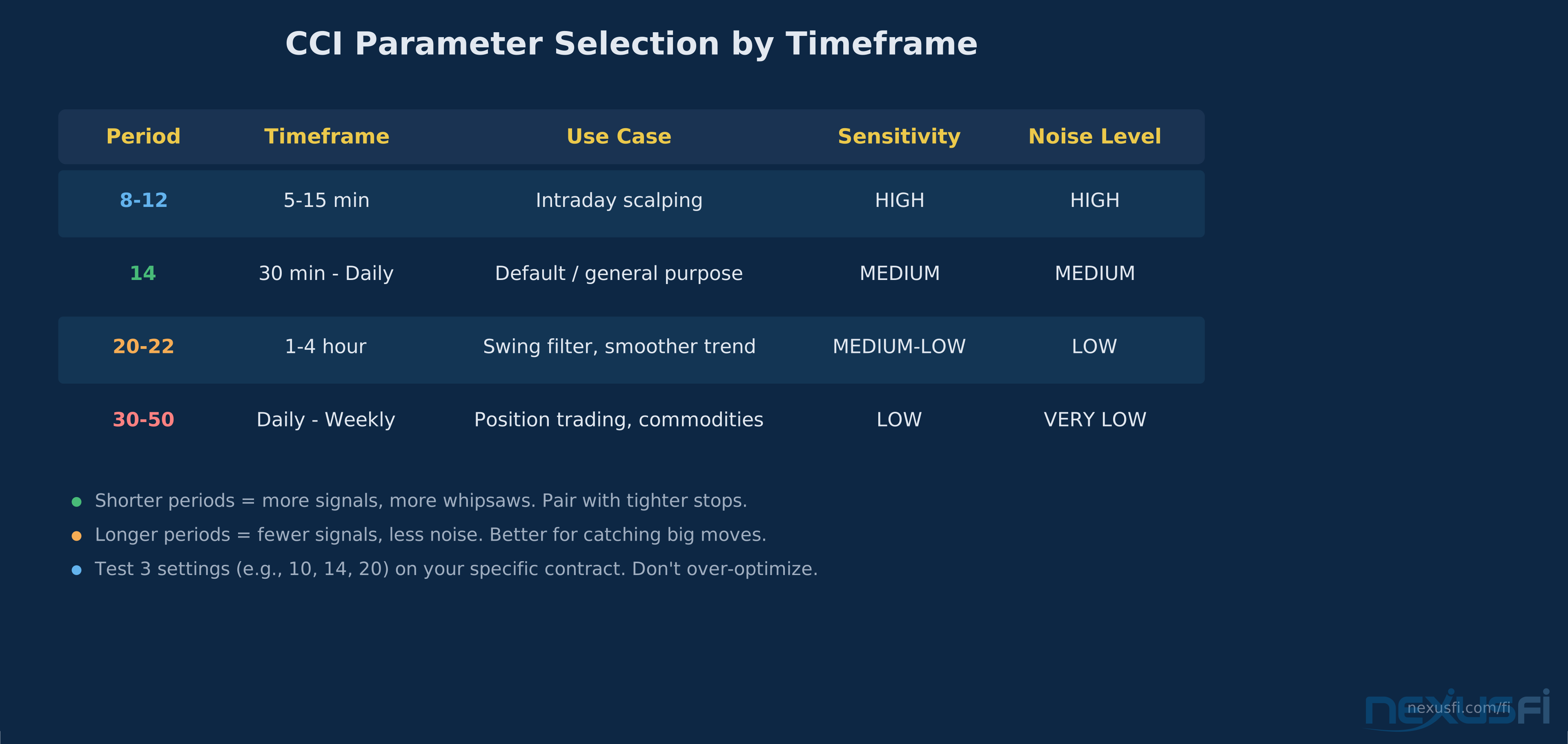
The default 14-period works as a starting point for daily charts on liquid futures (ES, CL, NQ, GC). But experienced traders adjust:
Short periods (8-12): More responsive, more signals, more whipsaws. Works on 5-minute to 15-minute intraday charts where you want quick reactions. Pair with tighter stops and faster exits. For scalping, a 10-period CCI on 5-minute bars provides actionable signals without excessive lag.
Standard period (14-20): The sweet spot for most applications. 14 on daily charts, 20 on hourly charts. Balances responsiveness with noise reduction. If you're building a general-purpose CCI framework, start here.
Long periods (30-50): For swing trading and position trading on weekly charts. Especially effective on agricultural futures with seasonal cycles — as the NexusFi community discussion around CCI methods shows, longer periods capture the bigger cyclical moves that commodity traders care about. 30-period on weekly grains or softs filters out harvest-season noise.
Threshold adjustments: The ±100 threshold works for most regimes, but during persistently trending markets, raising the threshold to ±150 or ±200 prevents premature mean-reversion entries. Test this on your specific contract — highly volatile instruments (natural gas, Bitcoin futures) may need wider thresholds by default.
The relationship between period and threshold is important: shorter periods produce larger CCI swings, so you may want to widen thresholds when using shorter lookbacks to avoid overtrading.
Common Pitfalls and Edge Cases #
Overnight gap whipsaws: In equity index futures (ES, NQ), the Globex open can gap much from the prior session close. This creates an immediate CCI extreme that doesn't represent actual momentum — it's a price adjustment. Filter: wait 15-30 minutes after the session open before acting on CCI signals, or compute CCI only on RTH bars.
Roll-period distortion: Around quarterly rolls, continuous contract data can show CCI spikes that don't exist on front-month data. If you trade rolls actively, switch to front-month data for CCI computation during the roll window. If you're a position trader, be aware that your CCI levels for several bars after the roll may be unreliable.
News-gap spikes: Major economic releases (FOMC, NFP, USDA crop reports) can produce single-bar CCI extremes of +300 or beyond. These are informational — they tell you the magnitude of the surprise — but they're not trade signals by themselves. Wait for a confirming bar before acting on news-spike CCI readings. The mean deviation needs at least a few bars to adjust to the new volatility level.
Thin-market liquidity: In less liquid futures (lumber, frozen OJ, some agricultural contracts), CCI can produce erratic readings because individual prints can move Typical Price much. Lengthen your lookback period on thin contracts — a 20 or 30-period CCI smooths out the noise from individual large orders.
CCI staying at extremes: New traders often assume +200 must reverse. It doesn't. In strong trends — especially in trending commodity markets driven by supply/demand fundamentals — CCI can stay above +200 for weeks. The reading is telling you the trend is strong, not that it's about to end. Only look for reversals when CCI begins to decline from its extreme, not when it first reaches it.
CCI vs. RSI and Stochastic: The Futures Lens #
Understanding the differences helps you choose the right tool for the situation.
Unbounded vs. bounded: CCI's most important structural difference. RSI and Stochastic compress all momentum information into a 0-100 range. CCI preserves the actual magnitude of deviation. During a parabolic move in natural gas, CCI might read +450 while RSI sits at 85. CCI tells you this is an extraordinary deviation — 4.5 times the average. RSI just says "overbought," which it also says during a normal trending day.
Volatility adaptation: CCI automatically adjusts its sensitivity through the Mean Deviation denominator. RSI uses average gains and losses — a form of smoothing that masks sudden volatility changes. Stochastic uses the high-low range of the lookback period — responsive to extremes but not to the average deviation. CCI's approach means its threshold levels remain meaningful across volatility regimes without manual adjustment.
Zero-line significance: CCI's zero line represents a mathematically meaningful point — where price equals its moving average. RSI's 50 line is the midpoint of a bounded scale. Stochastic has no true midpoint signal. For trend filtering, CCI's zero line provides cleaner regime identification.
When to use CCI over RSI/Stochastic: CCI excels in trending markets with potential for extreme moves (commodities, energy futures), in volatile sessions (post-news, post-data), and when you need to quantify momentum magnitude rather than just direction. RSI and Stochastic may still be preferable for tight-range mean-reversion in calm markets where the bounded scale makes comparison easier.
Practical Application #
Building a CCI-based trading framework for futures involves three decisions:
1. Choose your primary signal type based on how you trade. Trend followers should focus on zero-line crossovers and trend participation pullbacks. Mean-reversion traders should focus on threshold cross-backs with regime filtering. Swing traders should focus on divergence with structural confirmation.
2. Set your parameters to match your timeframe and contract. Start with the default 14, test 10 and 20 on your specific setup, and lock in the one that produces the best risk-adjusted results. Don't improve beyond three choices — the marginal difference between a 14 and a 16-period CCI is noise.
3. Add a regime filter. The single biggest improvement to any CCI system is a higher-timeframe regime check. If you trade on 15-minute charts, add a daily CCI check. If you trade on daily charts, add a weekly CCI. Only take signals that align with the higher-timeframe regime.
The ESFXtrader method that generated hundreds of posts of active NexusFi discussion distills to exactly this: CCI on a specific timeframe, clear threshold rules, and consistent application. The magic isn't in finding the perfect parameter — it's in applying a sound framework consistently.
CCI won't make you a profitable trader by itself. No indicator will. But if you need a momentum oscillator that adapts to volatility, preserves magnitude information, and provides a clean trend filter through its zero line, CCI earns its place on the chart. Especially in futures, where the leverage makes magnitude matter.
Knowledge Map
Go Deeper
Build on this knowledgeReferences This Article
Articles that build on this topicCitations
- — TF trading using CCI method-it works (2010) 👍 67“Although this is for TF futures, it works as well for all futures. My setup includes double BB at 20, 2 and 2.”
- — Jeffs CCI (2010) 👍 16“Here's my latest version of the Jeffs Dual CCI......it features the JeffBBand3 indicator. The first standard deviation (1.25) is the -+100 line the second standard deviation (2.”
- — Adaptive CCI for NT8 (2021) 👍 9“I definitely still use the Adaptive CCI, I've tried using other oscillators, Stochastics, RSI, TSI, ROC (Rate of Change) and they all have their own subtle differences but eventually I come back to the CCI.”
- — WK's or ESFXtrader Journal & How I Read Price Action (2014) 👍 14“Traveling back in time to re-post some former posted charts and how my system works to bring others up to date on my complete system. My setup includes double BB at 20, 2 and 2.”
- — Keeping it Simple (2011) 👍 6“Before I start trading I want to understand how CCI interacts with price movement. The idea is to indentify high probability setups. The attached chart shows how CCI20 and CCI6 react to price action.”
- — TF trading using CCI method-it works (2011) 👍 7“Google Woodies CCI Club . Ken Wood (Woodie) created the first system I remember based on that concept about 10 or 15 years ago. Just remember, it's just another indicator.”