



Stochastic Oscillator: The Momentum Gauge That Measures Where Price Sits Within Its Range
Overview #
The Stochastic Oscillator answers one question: where did price close relative to its recent range? That's it. No prediction, no magic — just a normalized measurement of momentum that happens to be extraordinarily useful when you understand what it's actually telling you.
Developed by George Lane in the 1950s, the Stochastic maps closing price to a 0-100 scale based on the highest high and lowest low over a lookback period. A reading of 80 means price closed near the top of its recent range. A reading of 20 means it closed near the bottom. Simple enough — but the way traders misuse those readings has probably cost more money than any other indicator misinterpretation in futures trading.
Here's the core tension: a Stochastic reading of 85 can mean "overbought and ready to reverse" or "strong uptrend momentum" depending entirely on context. As @Donnigan discovered while [trading ES with stochastics] [1]: "I think I may be giving this indicator too much weight in my decisions... maybe I'm confusing myself by trying to measure trend strength and use it for contrary signals at the same time." That confusion is universal, and this article exists to resolve it.
Key Concepts #
%K Line (Fast Stochastic). The raw calculation: %K = ((Close - Lowest Low) / (Highest High - Lowest Low)) × 100. With the default 14-period lookback, this measures where today's close sits within the last 14 bars' range. %K is noisy — it whips around on every tick of closing price.
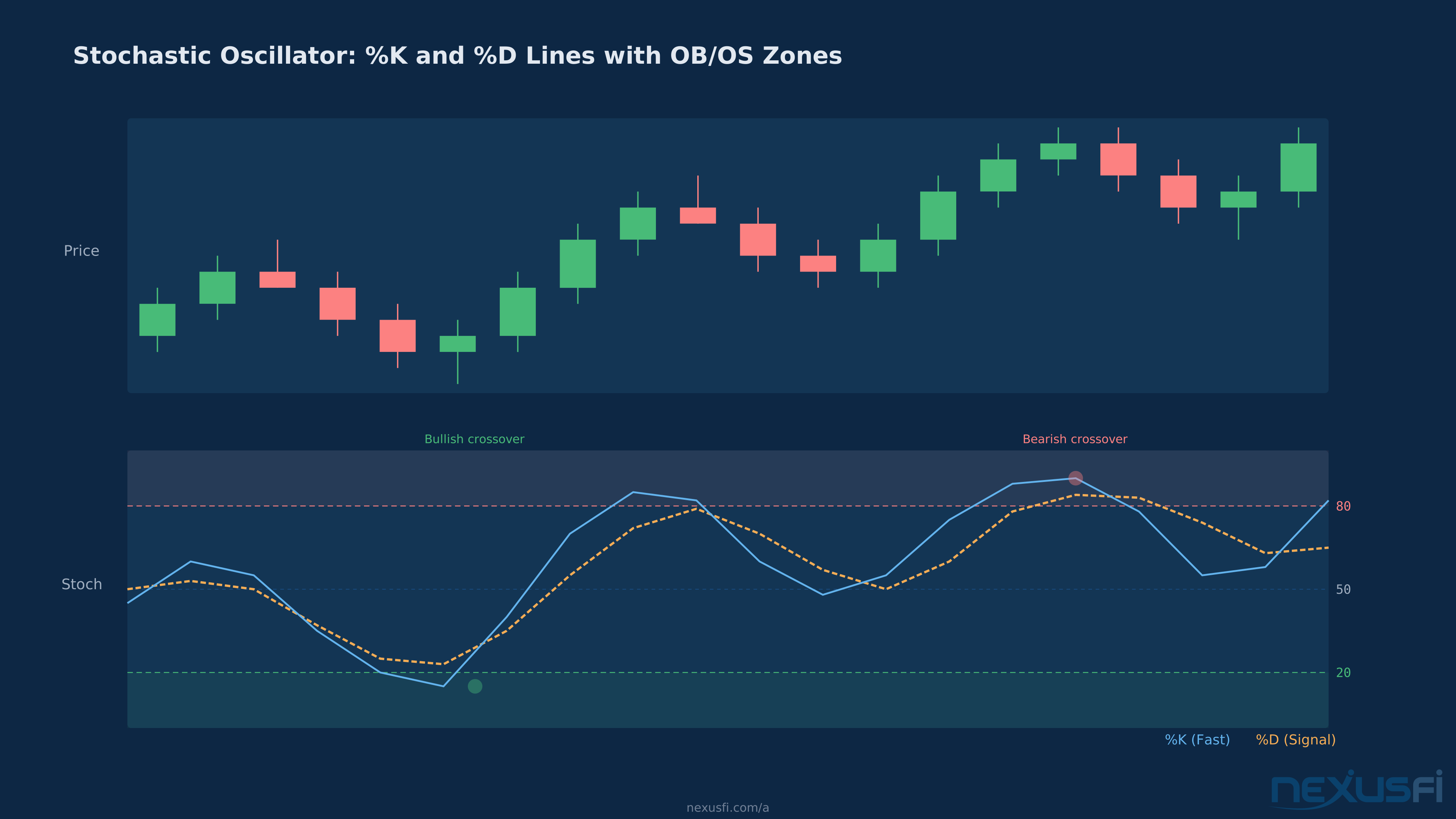
%D Line (Signal Line). A 3-period simple moving average of %K. This smoothed version serves as the signal line for crossover entries. When %K crosses above %D, that's a bullish signal. When %K crosses below %D, bearish.
Fast Stochastic. Uses the raw %K and its 3-period SMA as %D. Extremely sensitive — generates frequent signals, many of them noise. Most futures traders skip this entirely.
Slow Stochastic. Takes the Fast %D (the 3-period SMA of %K) and treats it as the new %K, then smooths that again with another 3-period SMA to create Slow %D. This double-smoothing cuts whipsaws much. The Slow Stochastic is the default for most futures traders and the version discussed throughout this article.
Full Stochastic. Allows custom smoothing periods for all three parameters — %K period, %K smoothing, and %D period. This is what experienced traders actually use. As @Wizard3ootz [recommends in practice] [4]: "I use %K 5, %D 3, and smoothing 5 for short term, and 3:1:3 for long term charts."
Overbought Zone (above 80). Price is closing near the top of its recent range. This does NOT mean price will reverse — it means upside momentum is strong. In a trend, the Stochastic can pin above 80 for extended periods.
Oversold Zone (below 20). Price is closing near the bottom of its recent range. Same caveat — in a strong downtrend, the Stochastic can stay below 20 for dozens of bars while price continues dropping.
How the Stochastic Actually Works #
The Math Behind the Gauge #
The calculation is straightforward. For a 14-period Slow Stochastic on ES 5-minute bars:
- Find the highest high and lowest low of the last 14 bars
- Calculate raw %K: ((Current Close - 14-bar Low) / (14-bar High - 14-bar Low)) × 100
- Smooth %K with a 3-period SMA → this becomes Slow %K
- Smooth Slow %K with another 3-period SMA → this becomes Slow %D
If ES traded between 5800.00 and 5825.00 over the last 14 five-minute bars, and the current close is 5820.00: raw %K = ((5820 - 5800) / (5825 - 5800)) × 100 = 80. Price closed 80% of the way up its recent range.
The Stochastic is bounded between 0 and 100 by construction — it can't escape that range regardless of how extreme price moves become. This is different from unbounded oscillators like MACD, which can expand indefinitely during strong trends.
What the Readings Actually Mean #
Strip away the mysticism: the Stochastic is measuring closing price location within a range. That's all.
- Above 80: Price is consistently closing near recent highs. This tells you buying pressure is dominant RIGHT NOW.
- Below 20: Price is consistently closing near recent lows. Selling pressure is dominant.
- Between 40-60: Price is closing mid-range. No directional conviction from either side.
- Rising from below 20: Buyers are gaining ground against sellers — momentum shifting.
- Falling from above 80: Sellers are gaining ground — momentum shifting.
The critical mistake is treating 80 as a ceiling and 20 as a floor. In trending markets, price routinely lives above 80 or below 20 for extended periods. The reading tells you WHERE you are, not WHERE you're going.
Signal Types #
1. Crossover Signals #
The most basic signal: %K crosses %D.
Bullish crossover: %K crosses above %D below 20 (oversold zone). This is the classic "buy" signal. The theory: momentum has bottomed and is turning up.
Bearish crossover: %K crosses below %D above 80 (overbought zone). Classic "sell" signal. Momentum peaked and is rolling over.
@Donnigan described [three distinct approaches] [1] to trading stochastic crossovers:
- Counter-trend: selling when overbought, buying when oversold
- Trend-following: riding the stochastic when it stays in extreme territory
- Momentum: buying when the Slow Stochastic crosses 61.8 heading up toward overbought
The problem he identified is real: trying to trade all three simultaneously creates contradictory signals. Pick one framework and stick with it for a given market regime.
Filtering crossovers that matter: Not all crossovers are created equal. A %K/%D crossover at 15 (deep oversold) carries more weight than one at 35 (mid-range). Crossovers that occur after the Stochastic has spent 5+ bars in the extreme zone are stronger than quick dips and pops.
2. Divergence Signals #
Divergence is where the Stochastic gets genuinely useful — and where most traders get it wrong.
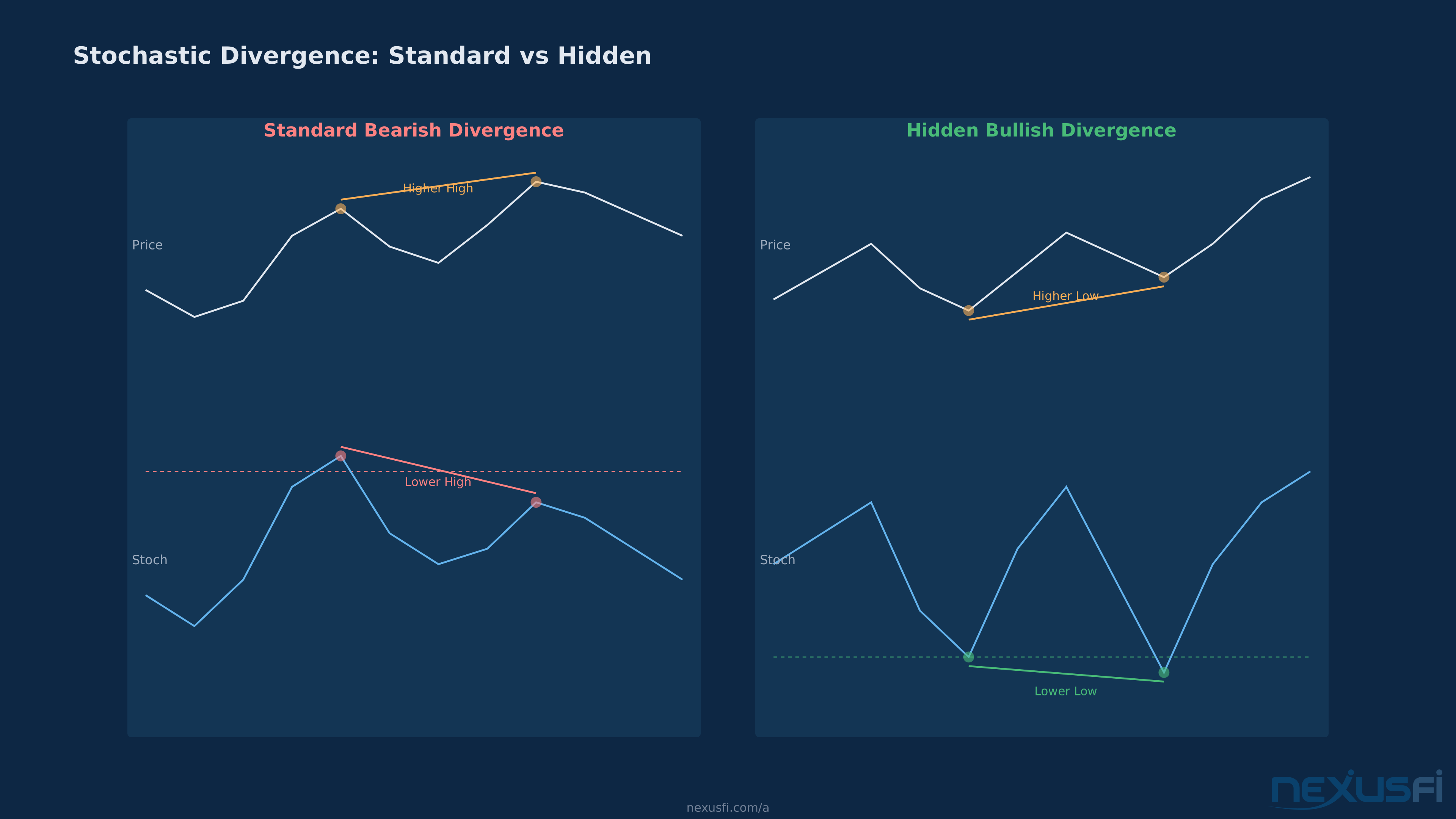
Standard (Classic) Divergence:
- Bearish: Price makes a higher high, Stochastic makes a lower high
- Bullish: Price makes a lower low, Stochastic makes a higher low
Hidden Divergence:
- Bearish: Price makes a lower high, Stochastic makes a higher high
- Bullish: Price makes a higher low, Stochastic makes a lower low
As @cjbooth explained in [a detailed 6E trading breakdown] [2] that earned 37 thanks from the NexusFi community: "Many books out there explain the divergence as the key signal. They are correct but I feel they describe it the wrong way and causes you to have a lot of losing trades." His approach: use standard divergence to confirm W-bottoms and M-tops that occur WITH the trend, not against it. "I in essence am using the Stochastic to confirm entries on the well talked about 'W' bottoms and 'M' tops that occur WITH the trend not against it."
That distinction is critical. Divergence as a counter-trend signal catches reversals sometimes — but divergence as a trend-continuation confirmation is far more reliable.
But here's the deeper truth about divergence. @Fat Tails — one of NexusFi's most respected technical analysts — [reframes divergence entirely] [3]: "Consider that you drive a car on a motorway from Athens to Thessaloniki at 100 mph. Now you slow down to 50 mph. Does this mean that you will return to Athens?" His point: a divergence detects a momentum slowdown, not a reversal. "Whether this is bullish or bearish still needs to be determined." A divergence often describes a flag or a wedge — a pause in the trend, not the end of it.
This reframe changes everything. Don't trade divergence as a reversal signal. Trade it as a momentum-shift alert that requires additional confirmation before acting.
3. Overbought/Oversold Reversals #
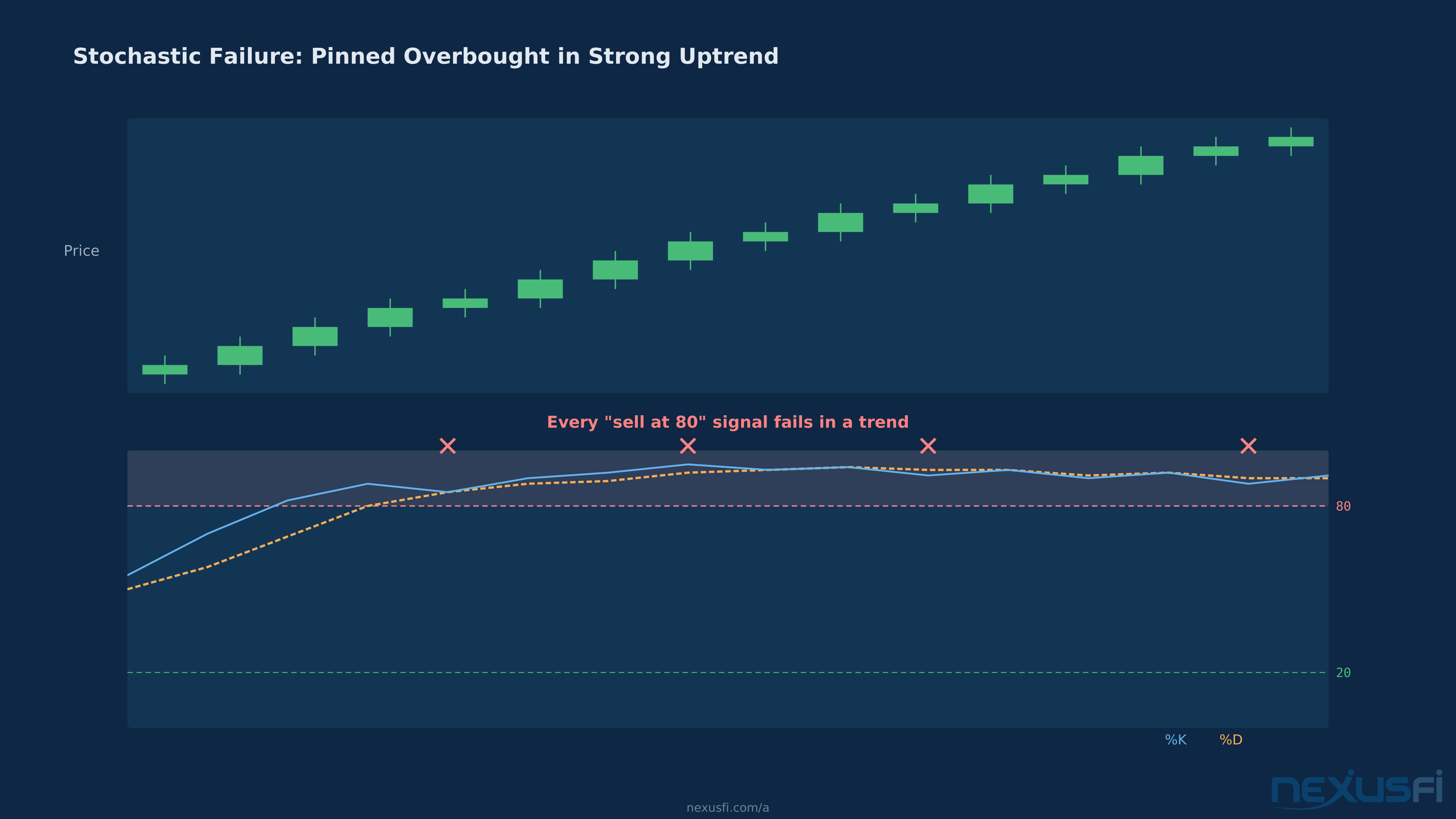
The simplest and most misapplied signal: sell when the Stochastic crosses below 80, buy when it crosses above 20.
When it works: Range-bound, balanced markets where price oscillates between defined levels. The Stochastic is basically measuring the range cycle, and the extremes mark the turning points.
When it fails catastrophically: Trending markets. If ES gaps up on strong earnings data and trends all day, the Stochastic will pin above 80 for hours. Every "sell signal" gets destroyed. The Stochastic can stay overbought far longer than your account can stay solvent.
The regime filter is non-negotiable: Before trading overbought/oversold signals, determine whether the market is ranging or trending. Use moving averages slope, ATR expansion/contraction, or visual assessment of price structure. Overbought/oversold signals work in ranges. They destroy accounts in trends.
Parameter Optimization for Futures #
Standard Parameters #
The Lane default is 14, 3, 3 (lookback, %K smoothing, %D smoothing). This was designed for daily equity charts in the 1950s. Futures markets in 2025 move differently.
Parameters by Timeframe #
Scalping (1-3 min charts): 5, 3, 3 or 8, 3, 3. Shorter lookback captures rapid momentum shifts. The 5-period is extremely responsive — expect more signals and more noise. Good for ES and NQ where momentum shifts happen fast.
Intraday (5-15 min charts): 14, 3, 3 or 10, 3, 3. The classic settings work reasonably well here. For CL, which tends to have stronger trending behavior, consider 8, 3, 3 for faster response.
Swing (60 min - Daily): 14, 3, 3 or 21, 5, 5. Longer smoothing reduces noise for position trades. The 21-period on daily charts captures roughly one trading month of data.
Instrument-Specific Considerations #
ES/NQ (Index Futures): These instruments spend significant time in rotational balance with periodic breakouts. The standard 14, 3, 3 works well during balance periods. Consider 8, 3, 3 during high-volatility trend days to catch momentum shifts faster.
CL (Crude Oil): CL trends harder and longer than index futures. The Stochastic pins in overbought/oversold territory more frequently. Use a longer lookback (21 period) or add a trend filter to avoid counter-trend signals during CL's notorious sustained moves.
ZB/ZN (Treasuries): Bond futures often exhibit cleaner mean-reversion characteristics. The Stochastic's overbought/oversold signals tend to be more reliable on 30-minute and hourly Treasury charts than on comparable equity index charts.
Integration with Other Tools #
The Stochastic oscillator should never be traded in isolation. Here's how it integrates with complementary analysis.
Stochastic + Moving Averages #
Use the 20-period or 50-period moving average as a trend filter:
- Price above MA + Stochastic pullback to 20-40: Look for bullish crossover as trend continuation entry
- Price below MA + Stochastic rally to 60-80: Look for bearish crossover as trend continuation short
This eliminates counter-trend signals that destroy accounts. Only take Stochastic signals in the direction of the moving average trend.
Stochastic + RSI #
The RSI and Stochastic measure momentum differently. RSI compares average gains to average losses; the Stochastic compares closing price to range. When both reach extreme readings simultaneously, the signal has more weight. When they diverge — RSI oversold but Stochastic mid-range — the mixed signal suggests waiting.
Stochastic + Volume Profile #
In volume profile analysis, high-volume nodes (HVNs) act as magnets and low-volume nodes (LVNs) act as speed bumps. A Stochastic oversold reading at a high-volume node carries more weight for a bounce trade than one at a low-volume node. The volume profile provides the "where" while the Stochastic provides the "when."
Stochastic + Order Flow #
Combining the Stochastic with delta analysis creates a powerful confirmation setup. If the Stochastic shows a bullish crossover from oversold AND delta is shifting positive (more buying at ask than selling at bid), the probability of follow-through increases meaningfully. Delta confirms that real buying pressure backs the momentum shift the Stochastic detected.
When the Stochastic Fails #
Every indicator has failure modes. Knowing them prevents expensive lessons.
Trend Day Destruction #
On a strong trend day — the kind where ES moves 80+ points in one direction — the Stochastic pins above 80 (or below 20) and stays there. Every mean-reversion signal fails. Every counter-trend crossover gets run over. If your stochastic-based system lost money 4 out of 5 days this week, check whether those were trend days. The indicator isn't broken; it's being applied to the wrong regime.
News-Driven Gaps #
Economic releases (FOMC, NFP, CPI) create gaps that reset the Stochastic's range calculation. A violent gap up pushes %K to 100 instantly — but the subsequent pullback from the spike isn't a "sell signal." The range context has at the core changed, and the Stochastic needs several bars to recalibrate.
Low-Volatility Chop #
When price is grinding in a 3-4 point range on ES, the Stochastic oscillates rapidly between overbought and oversold on minuscule price changes. The indicator becomes noise. Use ATR as a filter: if ATR has contracted below its 20-period average, Stochastic signals in the current range are unreliable.
Extended Oversold/Overbought Readings #
In strong trends, the Stochastic can remain in extreme territory for 20, 30, 50+ bars. As @Fat Tails [pointed out] [3], divergence during these periods means momentum is slowing — not that a reversal is imminent. "The slowdown does not mean that price reverts." Treating extended overbought readings as sell signals during a bull trend is a capital destruction strategy.
Practical Application: Putting It Together #
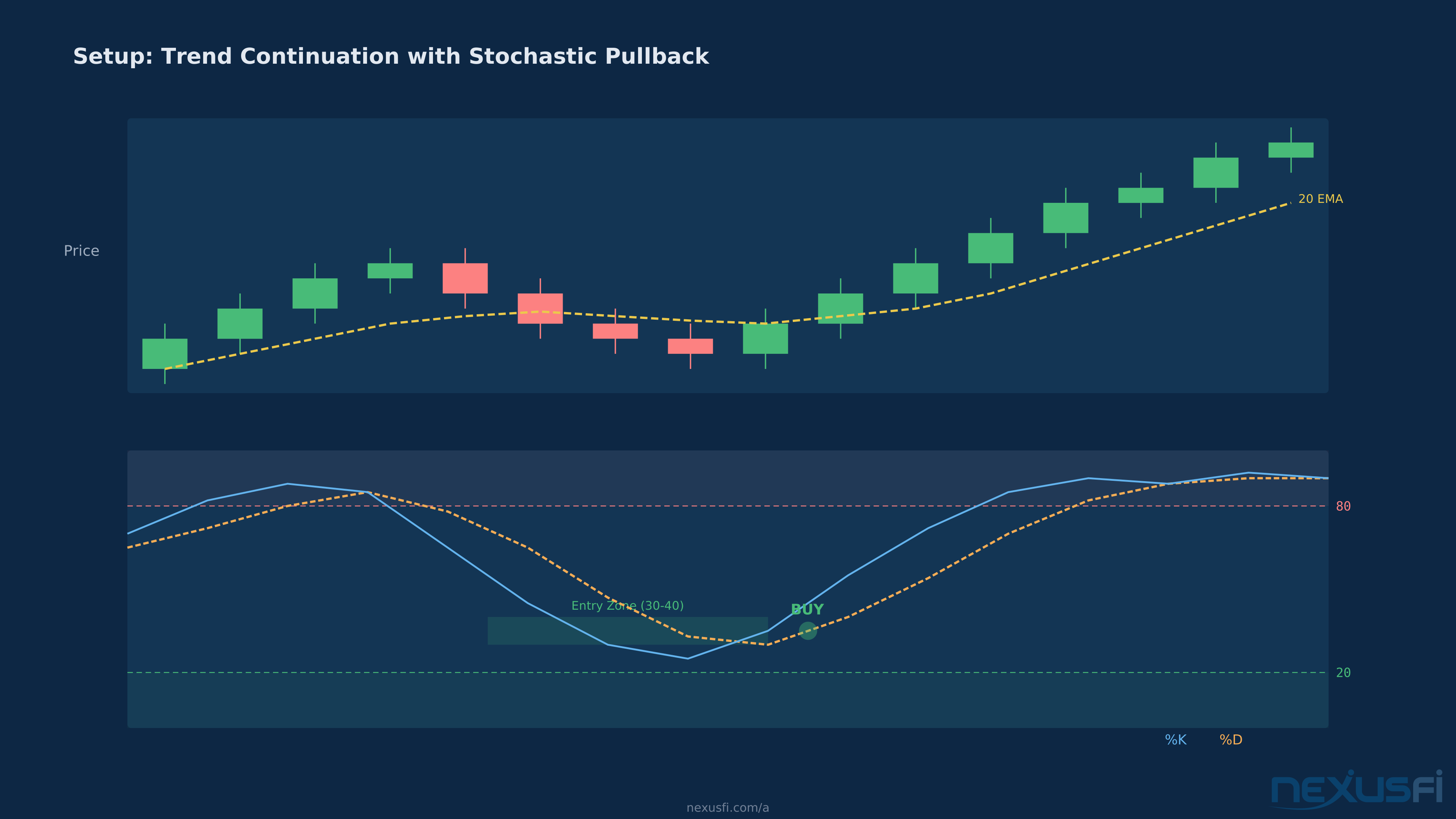
Setup 1: Trend Continuation with Stochastic Pullback #
Market regime: Trending (confirmed by moving average direction and ATR expansion)
- Identify trend direction using the 20 EMA on your trading timeframe
- Wait for the Stochastic to pull back to 30-40 in an uptrend (60-70 in a downtrend)
- Enter when %K crosses above %D (bullish) or below %D (bearish)
- Stop: below the pullback low (long) or above the pullback high (short)
- Target: previous swing high/low or 1.5-2R
This is the highest-probability Stochastic setup because you're trading WITH the trend and using the oscillator purely for timing.
Setup 2: Divergence Confirmation at Key Levels #
Market regime: Any, but requires a structural level
- Identify a key support or resistance level, HVN, or VWAP
- Watch for price to test the level
- Look for Stochastic divergence at the level (bullish divergence at support, bearish at resistance)
- Confirm with volume or delta shift
- Enter on the next bar after divergence confirmation
- Stop: beyond the structural level
- Target: next structural level or 2-3R
The level provides the trade idea. The divergence provides the timing. The volume confirms the setup.
Setup 3: Range Trading with Overbought/Oversold #
Market regime: Range-bound ONLY (confirmed by flat moving averages, contracted ATR)
- Define the range using the session high/low or Value Area boundaries
- At range high: wait for Stochastic to cross below 80
- At range low: wait for Stochastic to cross above 20
- Enter on the crossover candle close
- Stop: beyond the range boundary by 2-3 ticks
- Target: opposite side of the range or mid-range (POC area)
Critical rule: Abandon this setup immediately if ATR expands or price closes beyond the range with conviction. Range trades become trend-fighting losers the moment the range breaks.
Stochastic Momentum Index (SMI) -- The Modern Variant #
The Stochastic Momentum Index, developed by William Blau, measures the distance between the close and the midpoint of the recent range, rather than the close relative to the low. This makes it symmetric around the zero line and often provides cleaner divergence signals.
Several NexusFi members have explored SMI implementations. @JellySkater [discussed SMI parameters] [5] on ThinkOrSwim, and @jlwade123 noted that "the SMI indicator works like an ATR" in terms of measuring range position.
The SMI is worth exploring if you find the standard Stochastic's 0-100 scale limiting, especially for divergence analysis where the zero-line symmetry helps identify momentum shifts more cleanly.
The Bottom Line #
The Stochastic Oscillator is a momentum measurement tool — not a crystal ball. It tells you where price closed within its recent range, and the signals it generates are only as good as the context you apply them to.
Three rules that will save you money:
- Never trade overbought/oversold signals in a trending market. Full stop. Use a trend filter on every Stochastic setup.
- Divergence means momentum is slowing — not reversing. Treat divergence as an alert, not a signal. Require additional confirmation before acting.
- Match parameters to your timeframe and instrument. The 1950s default of 14, 3, 3 on daily equities doesn't translate directly to 5-minute ES charts.
The traders who profit from the Stochastic understand what it measures and what it doesn't. As @Donnigan eventually concluded after testing multiple approaches: narrow your entry conditions, pick one framework (trend-following OR counter-trend, not both), and let the indicator serve its purpose as one input in a multi-factor decision process.
The Stochastic Oscillator is one of several momentum tools in a trader's toolkit. For complementary oscillators, see RSI (Relative Strength Index) and MACD. For volatility context that helps filter Stochastic signals, see Average True Range (ATR) and Bollinger Bands.
Knowledge Map
Go Deeper
Build on this knowledgeReferences This Article
Articles that build on this topicCitations
- — Finding an Edge and Cultivating Consistency (2018) 👍 3“Trading journal entry exploring stochastic crossover challenges -- overbought/oversold vs trend strength confusion”
- — My 6E trading strategy (2011) 👍 37“Detailed 6E strategy using standard and hidden stochastic divergence for W-bottom and M-top confirmation”
- — Question on Divergence (2012) 👍 4“Reframing divergence as momentum slowdown rather than reversal signal -- car analogy”
- — NW Trader's Journal (2019) 👍 1“Practical stochastic settings: %K 5, %D 3, smoothing 5 for short-term; 3:1:3 for long-term”
- — Indicator Parameter? Stochastic Momentum Index (2016) 👍 1“Stochastic Momentum Index parameter discussion on ThinkOrSwim”