



Stochastic RSI (StochRSI): The Momentum-of-Momentum Oscillator for Futures Traders
Overview #
StochRSI is a momentum-of-momentum oscillator. It doesn't measure price directly — it measures where the RSI is relative to its own recent range. That one extra layer of processing is what makes it different from everything else on your chart, and it's why futures traders use it for entry timing when standard RSI feels too slow.
Developed by Tushar Chande and Stanley Kroll in 1994, StochRSI applies the Stochastic formula to RSI values rather than price. The result: an oscillator that reaches overbought and oversold extremes faster, generates more signals, and shows momentum exhaustion earlier than either parent indicator. On a 5-minute ES chart during an active trend day, StochRSI can flip from 0 to 100 and back in fewer bars than RSI even gets close to its overbought zone.
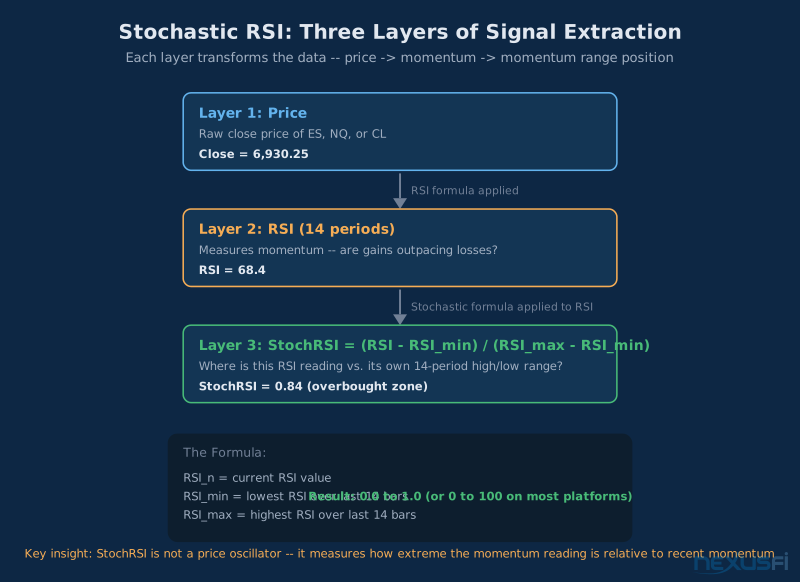
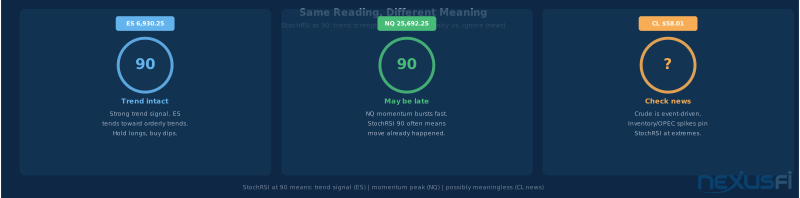
That speed is why traders use it. It's also why traders get hurt by it — the sensitivity cuts both ways. A StochRSI reading of 90 in a strong NQ trend day means something completely different than the same reading in a balanced ES session. Context determines everything.
StochRSI's edge is timing, not direction. Use it to answer tactical questions — "Is this pullback exhausting?" or "Is momentum turning at this level?" — not to predict where the market is going.
Formula and Calculation #
The formula is worth understanding because it shapes everything about how the indicator behaves:
StochRSI = (Current RSI - Lowest RSI over N periods) / (Highest RSI over N periods - Lowest RSI over N periods)
That formula is applied to RSI values, not price. The result is a value from 0 to 1 — or 0 to 100 if the platform multiplies by 100. Most modern charting platforms display StochRSI in 0-100 format.
Step-by-step calculation:
Step 1: Compute RSI. Use the standard RSI formula with your chosen lookback period — typically 14. Wilder smoothing (exponential) is the most common implementation. @Fat Tails noted in the NexusFi Elite Circle that "the NinjaTrader default RSI is producing lots of noise" with standard calculation — Wilder smoothing with a specific exponential factor helps but additional smoothing is often needed for clean signals.
Step 2: Find the RSI range. Over the last N bars of RSI values, identify the highest RSI and the lowest RSI. This is your normalization range.
Step 3: Apply the stochastic formula. Subtract the RSI minimum from the current RSI, then divide by the spread between RSI maximum and RSI minimum. This tells you where today's RSI sits within its recent range.
Step 4 (optional): Smooth the result. Most platforms compute %K and %D — %K is a short moving average of the raw StochRSI, %D is a moving average of %K. Standard smoothing is 3 periods for each. This reduces noise and generates crossover signals between the two lines.
Default parameters on most platforms: RSI length 14, StochRSI lookback 14, %K smoothing 3, %D smoothing 3. Written as (14, 14, 3, 3).
One critical interpretation point: a StochRSI reading of 80 doesn't mean RSI is at 80. It means RSI is sitting at 80% of its recent high-to-low range. If the maximum RSI over the last 14 bars was 72 and the minimum was 40, a StochRSI of 80 corresponds to an RSI around 65.6 — not overbought by traditional RSI standards at all. Always check the absolute RSI level alongside StochRSI for signal quality.
StochRSI vs RSI vs Stochastic #
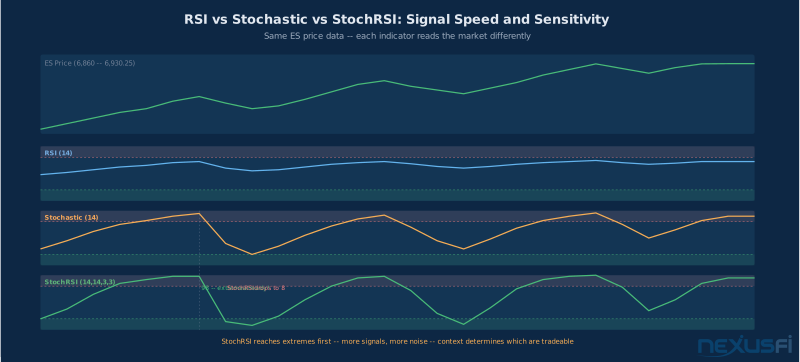
These three indicators get confused constantly. They're related but measuring different things, and using the wrong one for a situation is expensive.
RSI measures price momentum directly. It compares the average of up-closes to the average of down-closes over N periods. RSI is smooth, relatively slow to react, and gives you a clear picture of trend strength and regime. RSI works well for identifying whether conditions are bullish or bearish — it's less useful for precise entry timing.
Stochastic Oscillator measures where the current closing price sits within the recent price high-low range. It's price-based. If ES closed at 6,920 and the last 14 bars had a high of 6,930 and a low of 6,870, the Stochastic reads around 83. It's more reactive than RSI because price moves more than RSI. Stochastic generates clean signals in ranging markets and gets chewed up in strong trends.
StochRSI measures where the current RSI sits within its own recent RSI range. It's the fastest of the three, hitting extremes most often, generating the most signals, and responding to momentum shifts before RSI or Stochastic even registers a change. The cost is noise — in choppy markets, StochRSI can flip between extreme readings with no real signal behind them.
The practical hierarchy for futures day trading:
- RSI: regime filter and trend strength assessment
- Stochastic: price-based mean reversion in ranging markets
- StochRSI: momentum timing -- entry precision, pullback exhaustion, divergence
The NexusFi community has built RSI divergence tools specifically for NinjaTrader. @Big Mike and @Fat Tails have both noted that momentum signals work best when they align with key structural levels rather than as standalone triggers. That principle applies doubly to StochRSI, which generates even more false signals that need structural filtering.
Parameters and Settings #
The defaults (14, 14, 3, 3) are a reasonable starting point but often too slow for intraday futures trading. Here's what each parameter does:
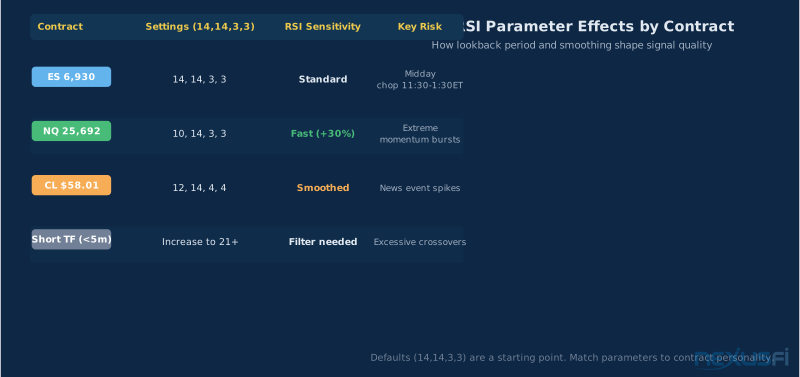
RSI Length (first 14): Shortening this makes StochRSI respond faster. RSI of 10 vs RSI of 14 means the base RSI recalculates over fewer bars. Too short (below 8) and the reading is dominated by individual bar noise. Too long (above 21) and signals come late for intraday use.
StochRSI Lookback (second 14): The window over which you find the highest and lowest RSI for normalization. Shorter lookbacks push StochRSI to extremes more often. Longer lookbacks require a more extreme reading to register overbought or oversold.
%K Smoothing (3): Reduces noise in the raw StochRSI output. Increase to 5 if you're getting excessive crossovers in choppy conditions.
%D Smoothing (3): The signal line — a moving average of %K. Crossovers between %K and %D generate the primary trade signals.
Practical starting points per contract:
- ES: (14, 14, 3, 3) -- standard defaults work well. ES trends cleanly and the default settings provide enough signal quality.
- NQ: (10, 14, 3, 3) -- shorter RSI period for faster response to NQ's higher momentum and larger swings.
- CL: (12, 14, 4, 4) -- slightly more smoothing to filter noise around news events and inventory releases.
Constant parameter optimization is curve-fitting in disguise. Pick settings you understand, test them over a meaningful sample, and stick with them. The indicator isn't broken — your context framework might be.
Trading Signals #
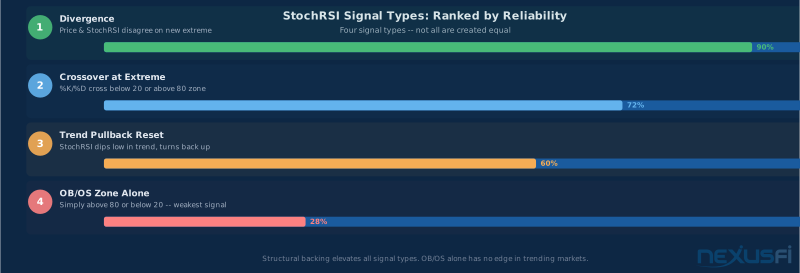
StochRSI generates four types of signals, ranked from most to least reliable:
1. Divergence (highest value) — Price and StochRSI disagree. Price makes a new high while StochRSI makes a lower high (bearish). Price makes a new low while StochRSI makes a higher low (bullish). This warns that momentum is weakening before price reverses. Divergence requires confirmation — it's a setup trigger, not a standalone entry.
2. Crossovers near extremes — %K crossing above %D from below the 20 level (bullish) or %K crossing below %D from above the 80 level (bearish). Crossovers at mid-range are much lower quality. The extreme zone does the work; the crossover confirms the turn.
3. Trend pullback resets — In an established trend, StochRSI dips to the low zone on pullbacks and turns up. That reset tells you the pullback is losing momentum before price has confirmed the bottom. In a downtrend, StochRSI spikes high on counter-trend bounces then turns down.
4. Overbought/oversold zones alone (lowest reliability) — Simply being above 80 or below 20 is not a signal. In a strong NQ trend day, StochRSI can sit between 80 and 100 for 45 minutes straight while price climbs 150 points. @tigertrader at NexusFi framed this directly: "RSI can and will act like a momentum indicator as well as an overbought/oversold oscillator. Markets stay overbought/oversold for longer than before. Pure technical traders should be very careful when they use RSI as an indicator of reversals because it usually points to continuation rather than reversal."
Overbought and Oversold Zones #
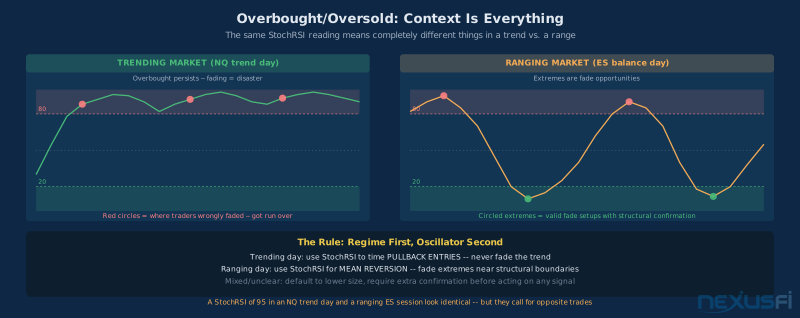
The standard zones are above 80 (overbought) and below 20 (oversold). These zones provide context. They're dangerous as triggers.
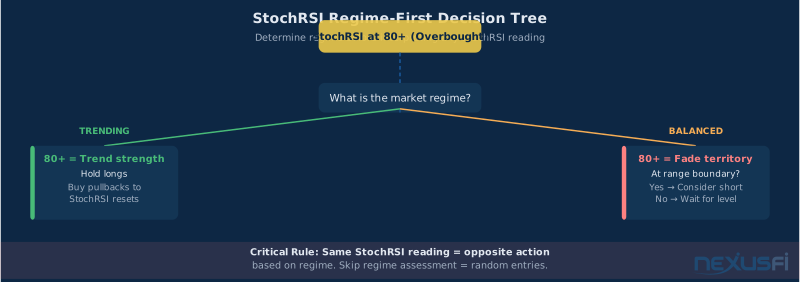
In a trending market, overbought conditions signal strength. When ES or NQ is in a genuine trend day — above VWAP all session, making higher highs and higher lows — a StochRSI reading of 90 doesn't mean "sell." It means the trend is intact. @Big Mike at NexusFi put it plainly: "A lot of people make the mistake of thinking an extreme reading on an oscillator means end of trend, when in fact it often means extremely strong trend — not the end."
In a ranging market, the extremes flip to actionable. When ES is balanced and rotating inside a known range — opening inside value, accepting prices in both directions, no clear directional push — StochRSI extremes at range boundaries align with fade opportunities. The key word is "boundaries." You're not fading the indicator; you're using it to time entries at edges of a range you've already identified through volume profile and market structure.
The practical rule: regime first, oscillator second. Identify whether the market is trending or balanced before interpreting any StochRSI reading. The same number means different things in different contexts.
Divergence: The Most Potent Signal #
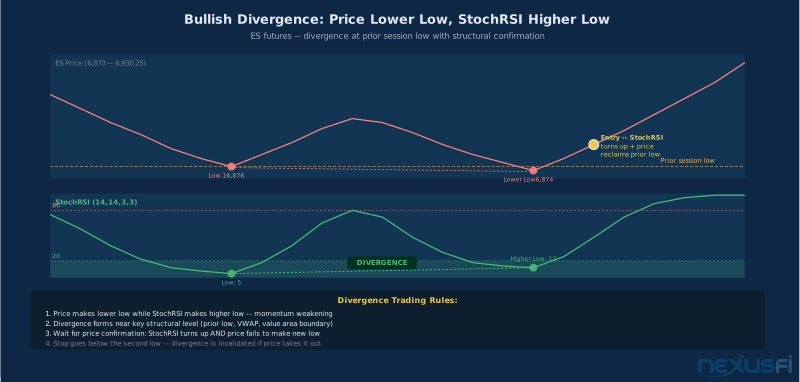
Divergence is where StochRSI earns its keep. When price and momentum disagree, something important is happening under the surface — the market is making a new extreme but doing so on less energy than the previous extreme. That exhaustion often precedes a turn.
Bullish divergence: Price makes a lower low. StochRSI makes a higher low. Sellers pushed price to a new extreme but couldn't sustain the pressure — momentum is weakening on the way down. This sets up a potential reversal or meaningful bounce.
Bearish divergence: Price makes a higher high. StochRSI makes a lower high. Buyers got price to a new extreme but with less momentum — the move is laboring. This often precedes a correction or reversal.
Because StochRSI is more sensitive than standard RSI, divergence shows up earlier. But it can also form and then get overridden quickly if the trend reasserts. @Big Mike built RSI divergence detection tools for NinjaTrader and warned explicitly: divergence tools don't work in strong trends. The divergence signal needs structural backing to be tradeable.
Rules for trading divergence with StochRSI:
Require a structural level. The divergence needs to occur near something that matters — a prior session high or low, a VWAP deviation band, a value area boundary, a volume profile node. Divergence in empty space is just noise. Divergence at a level the market structure says should matter becomes a high-probability setup.
Wait for price confirmation. Don't enter on divergence alone. Wait for price to fail at making a new extreme, or for StochRSI to turn and cross its signal line. @Fat Tails at NexusFi built divergence detection tools specifically because "the indicator redraws many of the divergences" — detecting a first divergence, then extending to detect a second. Human pattern recognition tends to see divergence everywhere once you're looking for it. The mechanical approach requires a defined, objective test.
Define the invalidation clearly. Stop below (bullish) or above (bearish) the divergence swing. Divergence that gets overrun becomes a momentum signal in the opposite direction.
Trend Pullback Entries #
This is the cleanest use of StochRSI in futures day trading. The setup is simple in theory, harder in execution.
You've identified a trend. Price is above VWAP in an uptrend, making higher highs and higher lows. Day type supports continuation. You want to buy a pullback. The question is: where in the pullback do you enter?
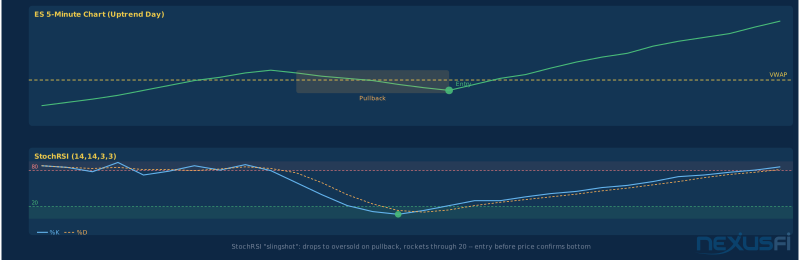
StochRSI gives you a momentum answer. When price pulls back to a structural support — VWAP, a prior swing high acting as support, the value area high — watch StochRSI. If it dips into or near the oversold zone and then turns up (especially with a %K/%D crossover), that's a timing signal that the pullback is losing momentum before price has necessarily shown you the bottom.
This is the "slingshot" pattern: StochRSI drops to an extreme during the pullback, then rockets back up through the 20 level as buying pressure resumes. That rapid reversal in momentum often coincides with large buyers absorbing the final selling on the pullback before pushing aggressively. The StochRSI turn is momentum evidence; order flow is confirmation.
The same pattern works in downtrends for short entries — StochRSI spikes high on the counter-trend bounce, then turns down from extreme levels as sellers reassert control.
The first pullback after a fresh trend reversal is when StochRSI gives its clearest signals — market participants are still transitioning from the prior trend direction, making the momentum exhaustion on that first reset most reliable. Subsequent pullbacks in an established trend tend to be shallower and StochRSI signals less clean.
ES, NQ, and CL -- Contract-Specific Application #
Each futures contract has its own personality, and StochRSI behaves differently across them. Treating all three identically is a mistake.
ES (E-mini S&P 500, 6,930.25): ES trends more cleanly than NQ and has more orderly intraday structure. The default StochRSI parameters (14, 14, 3, 3) work reasonably well on ES. ES respects VWAP and prior day levels predictably, so StochRSI pullback entries work well when aligned with those levels. During range days — which ES gets frequently — the extremes provide clean fade entries near balance boundaries. The biggest ES-specific risk: midday chop. Between 11:30 AM and 1:30 PM ET, ES often trades sideways with no momentum. StochRSI will generate crossovers constantly during this period that mean nothing. Reducing size or sitting out is the professional answer.
NQ (E-mini Nasdaq, 25,692.25): NQ moves faster, trends more aggressively, and has larger momentum bursts. A StochRSI extreme on NQ is often a sign that you're late — the move has already happened. Shorten the RSI input slightly (try 10 instead of 14) to get the signal earlier, but then require more confirmation before acting. NQ's volatility means StochRSI can flash overbought five times during a sustained trend move without any meaningful pullback occurring. For NQ, use StochRSI primarily to identify when a pullback is ending, not when a trend is ending. Reversals on NQ are better identified through market structure than through oscillator extremes.
CL (Crude Oil, $58.01): CL is the most event-driven of the three. Weekly inventory reports (API Tuesday, EIA Wednesday), geopolitical developments, and OPEC announcements can move CL dramatically within minutes. During those events, StochRSI becomes meaningless — the indicator will pin at 0 or 100 during a news spike regardless of the underlying market structure. @Fat Tails' approach of using VWAP as both a trend filter and support/resistance reference applies directly to CL — oscillator signals need that structural context anchor on crude. Outside of news events, CL does respond to StochRSI signals for momentum continuation after an impulsive directional move. CL trends tend to be persistent once they start, and trying to fade them with oscillator signals is expensive.
The Professional Workflow #
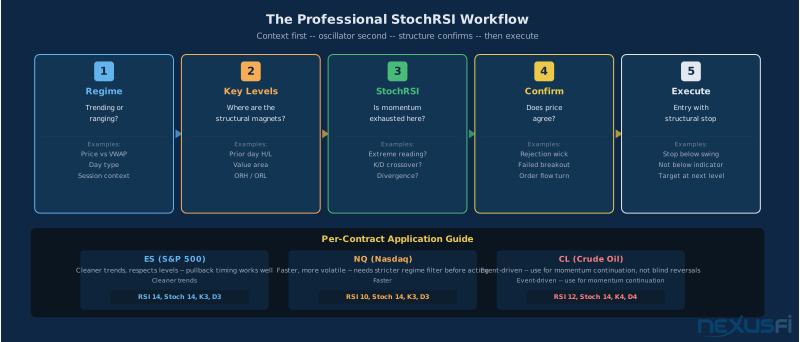
No serious futures trader uses StochRSI as their primary signal source. It's a timing tool — the final step in a process that starts with market structure and ends with risk-defined entry. Here's the professional workflow:
Step 1: Determine the regime. Is today a trend day or a balanced day? Check where price is relative to VWAP. Is the session making higher highs and higher lows? Has price accepted both sides of yesterday's range, or is it rotating within a tight bracket? The regime determines what every StochRSI reading means.
Step 2: Mark the key levels. Prior day high and low. Current VWAP and standard deviation bands. Opening range high and low. Value area high and low. Volume profile nodes from recent sessions. These are prices where the market is likely to react — where you want to be positioned for a trade, not in empty space between levels.
Step 3: Wait for price to approach a key level. This is the patience requirement. You don't watch StochRSI constantly and trade every crossover. You watch price, and when it approaches a level that matters, you start watching StochRSI for timing.
Step 4: Use StochRSI for timing. At the level, is StochRSI in an extreme zone? Is it showing divergence? Is %K turning and crossing %D? If StochRSI confirms the setup, you have a higher-quality trade. If StochRSI is at mid-range without a clear signal, the timing is uncertain.
Step 5: Require price confirmation. A rejection candle. A failure to take out the level. Order flow turning. StochRSI says momentum is turning. Price action has to confirm the turn is actually happening.
Step 6: Execute with structural risk management. Stop placement comes from market structure, not indicator levels. Stop below the pullback swing low (for longs) or above the rally high (for shorts). "Below the 20 level on StochRSI" is not a stop — that's indicator-dependent risk that doesn't map to actual market invalidation.
@tigertrader at NexusFi, who runs the long-running Spoo-nalysis ES thread with tens of thousands of posts, framed this directly: RSI and momentum indicators serve as reference points, not signals. The signal comes from price action and market structure. The indicator tells you whether the conditions for that price action signal are favorable.
Common Mistakes #
The mistakes traders make with StochRSI are consistent and predictable. Understanding them ahead of time prevents expensive lessons.
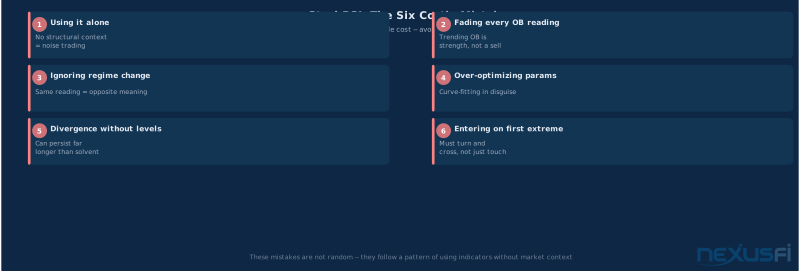
Using it alone. The fastest way to lose money with StochRSI is to treat it as a complete system. "StochRSI crossed above 20 from below — buy." Without context about regime, nearby levels, order flow, and day type, that crossover is meaningless.
Fading every overbought reading. In strong trend conditions, overbought is not a sell signal — it's a confirmation of the trend. During strong trend sessions, professionals are buying every dip while retail traders try to pick tops with oscillators.
Ignoring regime when it changes. Markets transition from trending to balanced and back. A session that starts as a trend day can become balanced after the initial move exhausts. StochRSI interpretations need to update when the regime changes.
Constant parameter optimization. If StochRSI isn't working, the problem is usually not the parameters — it's either the market regime, the lack of structural context, or unrealistic expectations about signal quality. Tweaking (14, 14, 3, 3) to (11, 12, 2, 3) rarely fixes a conceptual misunderstanding of how to use the tool.
Trading divergence without structural backing. The market can continue diverging for much longer than you can stay solvent fading the move. Divergence becomes powerful when it occurs at a price level that the market structure says should matter. Without the structural component, it's just pattern-matching on noise.
Entering on the first bar of an extreme. StochRSI hits 90 and you immediately short. But the indicator just crossed into overbought — it hasn't turned. Entries on the first touch of an extreme zone have much lower win rates than entries after the indicator turns, shows a crossover, or demonstrates divergence.
Applying the same settings to all timeframes without adjustment.
Divergence on StochRSI can persist longer than you can sustain a position against the trend. Always define invalidation with a structural stop, not a willingness to wait for the indicator to eventually agree with your trade.
Platform Settings and Implementation #
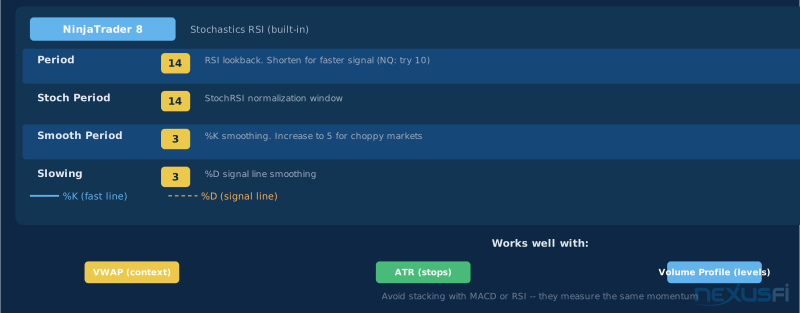
NinjaTrader 8 includes StochRSI as a built-in indicator under "Stochastics RSI." Parameters: Period (RSI period), Stoch Period (stochastic lookback), SmoothPeriod (%K smoothing), and Slowing (%D smoothing). Default is (14, 14, 3, 3).
TradeStation, Sierra Chart, and TradingView all have StochRSI available. All implementations should match if parameters are set identically — verify this when switching platforms by checking a known extreme reading on historical data.
One implementation detail that matters: most platforms display %K and %D as the two lines, not the raw StochRSI. The raw output before smoothing is rarely shown. When you see "StochRSI" on your chart, you're actually looking at the smoothed %K line and the %D signal line. The raw, unsmoothed StochRSI would be much more volatile.
For NinjaTrader users, @Big Mike's RSI divergence tool (available in the NexusFi Elite Circle indicators thread) automates divergence detection on RSI. While it uses standard RSI rather than StochRSI, the detection logic and the community discussion around it covers the key principles of momentum divergence that apply directly to StochRSI divergence trading.
For combining with other indicators: StochRSI pairs well with VWAP for context, with ATR for volatility-adjusted stops, and with volume profile for identifying whether a StochRSI extreme is occurring at a meaningful price level. It works poorly when combined with other momentum oscillators like MACD or RSI — adding those indicators just creates agreement signals that feel confirming but provide no additional information since they're measuring the same underlying momentum.
A practical setup recommendation: add StochRSI as a secondary panel below your primary price chart. Keep it visible but not dominant. Use it to answer specific timing questions rather than as something you watch constantly. The temptation to trade every wiggle in StochRSI is the most expensive habit new futures traders develop.
Knowledge Map
Prerequisites
Understand these firstGo Deeper
Build on this knowledgeReferences This Article
Articles that build on this topicCitations
- — mRSI divergence indicator for NinjaTrader (2012) 👍 45“Divergence tools don't work in strong trends, just like oscillators don't, so a divergence tool built on top of an oscillator tool really, really doesn't work well in strong trends.”
- — mRSI divergence indicator for NinjaTrader (2012) 👍 44“The indicator redraws many of the divergences, that is it detects a first divergence, then extends the line to detect a second divergence. The lines plotted only show the last of all detected divergences within the allowed 50 bar window.”
- — Spoo-nalysis ES e-mini futures S&P 500 (2014) 👍 5“RSI can and will act like a momentum indicator as well as an overbought/oversold condition oscillator. Market dynamics have changed and markets stay overbought/oversold for longer than before. Pure technical traders should be very careful when they use RSI as an indicator of reversals because it usually points to continuation rather than reversal.”
- — Tao te Trade: way of the WLD (2020) 👍 12“All oscillators work perfectly in a relatively narrow range -- when price goes up too far, it comes back down. But when price is in a trend, it goes too far, and then again too far, and then again too far. Every oscillator operates on the same principle. They are measures of the velocity or momentum of price change, not of overbought/oversold.”
- — Spoo-nalysis ES e-mini futures S&P 500 (2015) 👍 11“A lot of people make the mistake of thinking an extreme reading on an oscillator means end of trend, when in fact it often means extremely strong trend -- not the end.”
- — Using VWAP in your trading (2010) 👍 14“I use the session VWAP on all my charts. There are two ways to use it, as a trendfilter and as support and resistance. At the market open CL traded below the pivot range, opening range was in the lower area of the night session range, price traded below VWAP. The preferred breakout direction was down.”
- — The Beast Slayer, Lance's NQ Trading Journal (2015) 👍 5“One of my preferred setups is the first pullback/re-entry after a fresh, new trend reversal. Keep in mind, I'm not waiting for the close of a 5 minute chart or some lagging indicator to tell me I have a new fresh trend underway. My orderflow indicators showed some decent buying going on in that move.”
- — mRSI divergence indicator for NinjaTrader (2012) 👍 31“The NinjaTrader default RSI is producing lots of noise. The standard calculation is done with a Wilder smoothing, which is an EMA with a specific smoothing factor. A momentum indicator based on RSI should always use additional smoothing to suppress unwanted noise.”
- — Risk of Ruin (2012) 👍 39“Optimal F assumes that you follow a fixed fractional betting strategy to achieve optimal geometric growth. The number of contracts that should be traded thus depends on the risk parameter and the current balance of your trading account.”