



Bollinger Bands: The Volatility Envelope Every Futures Trader Needs to Master
Overview #
Bollinger Bands: The Volatility Envelope Every Futures Trader Needs to Master
Bollinger Bands wrap a simple moving average in a volatility envelope — two bands set at standard deviations above and below the centerline. They expand when markets move, contract when they don't, and give you a probabilistic framework for deciding whether price is extended or just getting started.
Here's the thing about Bollinger Bands in futures: they're not support and resistance. Treat them that way and you'll get run over by the first strong trend that walks right through your "level." The bands are a statistical envelope that tells you where price is relative to recent volatility. That context — combined with the right regime filter — is where the actual edge lives.
Key Concepts #
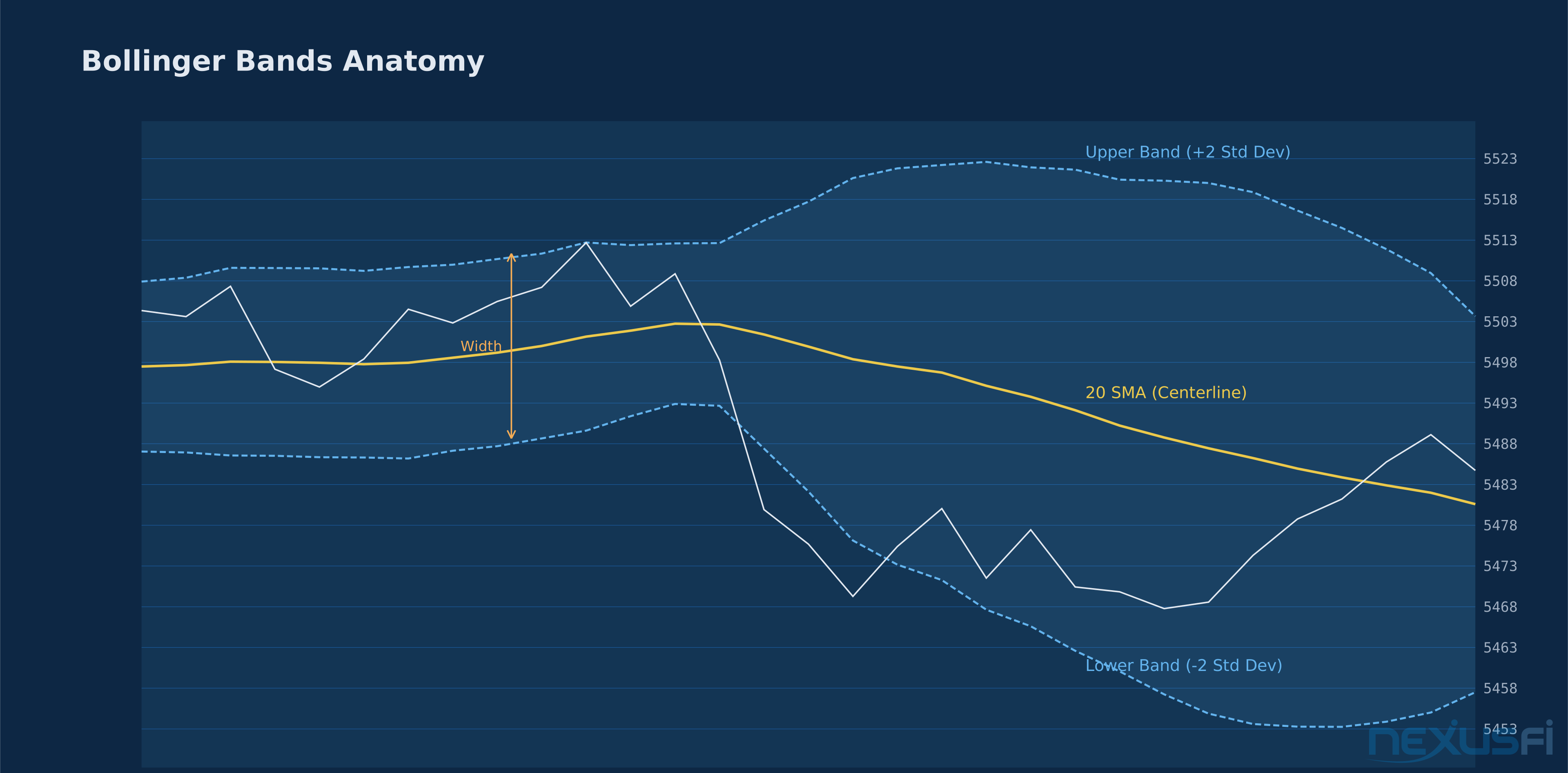
Middle Band (Centerline) — A simple moving average (SMA) of closing prices over N periods. This is your reference point for "fair value" over the lookback window.
Upper and Lower Bands — Set at K standard deviations above and below the SMA. The default parameters are N=20, K=2, which captures roughly 95% of price action under normal distribution assumptions.
Band Width — The distance between upper and lower bands: Upper Band minus Lower Band = 2K times the standard deviation. When width compresses, volatility is low. When it expands, something is happening.
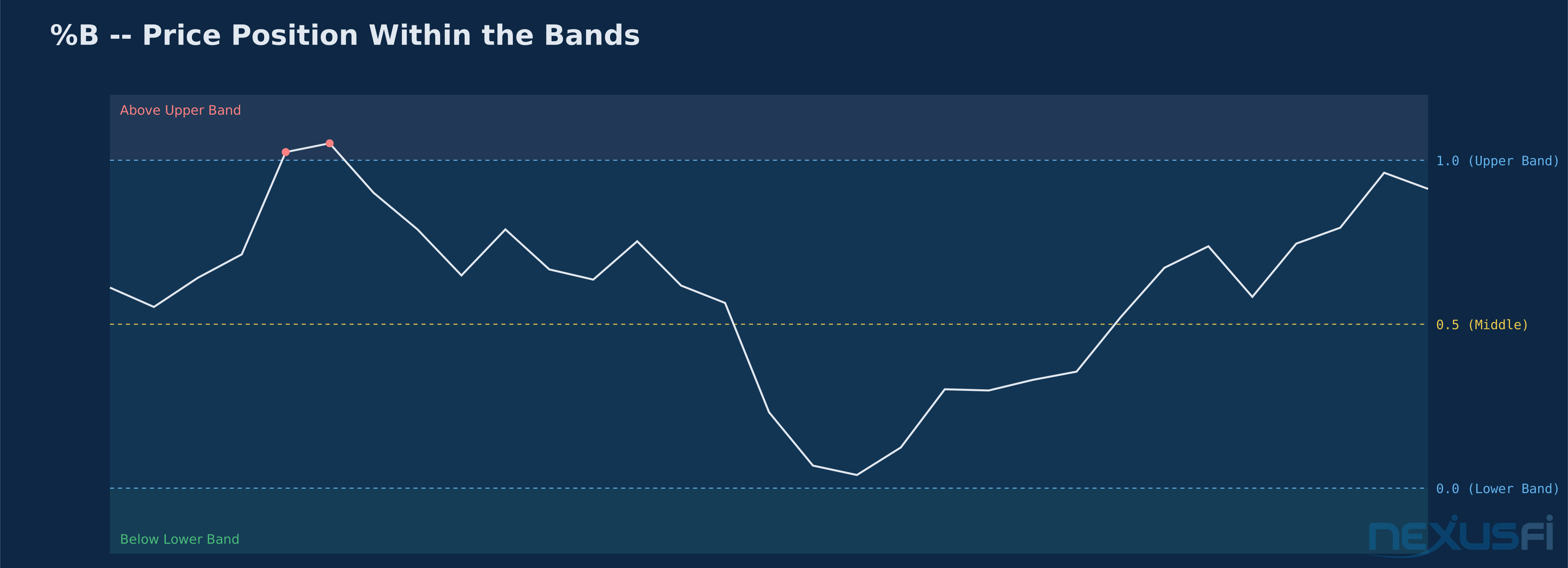
%B — Normalizes price position within the bands. %B = (Price minus Lower Band) / (Upper Band minus Lower Band). At 0, you're at the lower band. At 0.5, you're at the middle. At 1.0, you're at the upper band. Values above 1.0 or below 0 mean price has escaped the envelope.
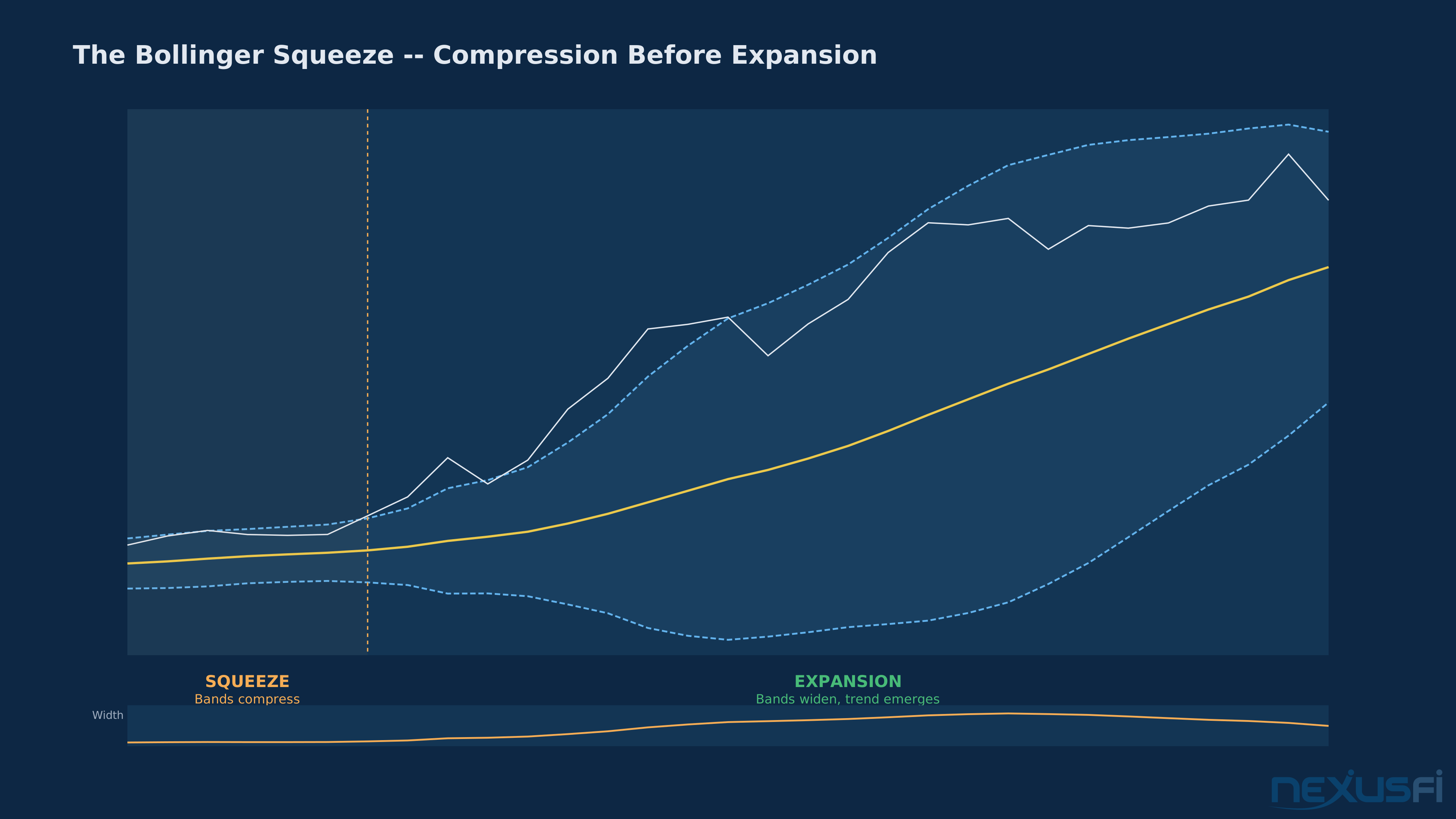
Squeeze — When band width drops to historically low levels relative to recent history, signaling a compression phase that precedes an expansion move. The direction of the expansion is not given by the squeeze itself.
Walking the Bands — When price makes persistent closes near or beyond one band during a strong directional move. This is trend continuation, not exhaustion — don't fade it.
Band Construction -- The Math That Matters #
The formulas are straightforward:
Middle Band = SMA(Close, N)
Upper Band = SMA(Close, N) + K x StdDev(Close, N)
Lower Band = SMA(Close, N) - K x StdDev(Close, N)
Default parameters: N=20, K=2. Price input is almost always the close, though some traders use typical price ((High + Low + Close) / 3). What matters more than the input choice is consistency — pick one and stick with it.
Parameter Sensitivity for Futures #
The defaults work, but they're a starting point. Different contracts have different volatility profiles, and the same parameters behave differently across timeframes.
ES (E-mini S&P 500): N=20, K=2 works well on 5-minute through 1-hour charts. ES has a mean-reverting microstructure on short timeframes, so the default envelope captures exhaustion zones cleanly. Some traders bump to N=30 on hourly charts to smooth out noise.
NQ (E-mini Nasdaq): Same N=20 but consider K=1.8-2.0 on 5-minute charts. NQ is more impulsive than ES — it runs harder and faster through bands. The real filter isn't the parameter set, it's the regime detection (covered in Section 4).
CL (Crude Oil): N=20-30, K=2.2-2.5. Crude is news-driven and prone to volatility shocks around EIA inventory reports and OPEC decisions. A wider K prevents premature fade signals during events. As @Fat Tails explained in a detailed analysis of directional vs. non-directional volatility, "if you color code a Bollinger Band depending on the bandwidth (which is just the standard deviation), then you look at the condition where the N-bar volatility is unusually low compared to intrabar volatility" — that's when you have a genuine compression worth trading.
Session Handling: Compute bands on the full 24-hour series but apply different thresholds by session. During Globex (thinner liquidity), require a close beyond the band plus a buffer before acting. During RTH, tighter thresholds work because execution is cleaner and participation is higher.
%B -- Where Price Sits in the Envelope #
%B normalizes everything to a 0-1 scale:
%B = (Price - Lower Band) / (Upper Band - Lower Band)
The interpretation is clean: 0 is the lower band, 0.5 is the middle band, 1.0 is the upper band. Values above 1.0 mean price closed above the upper band. Below 0 means it closed below the lower.
Close vs. Intrabar — This Distinction Matters in Futures #
A wick through a band is noise. A close beyond a band is a signal. This distinction is critical in futures because intrabar moves can be driven by order book depletion, stop runs, or thin liquidity pockets — none of which have anything to do with the band's statistical meaning.
Practical rule: treat an intrabar band breach as a candidate extreme. Then require either a close back inside the band (fade setup) or multiple consecutive closes beyond the band (trend-walk setup) before entering.
Most practitioners add a confirmation buffer — %B above 1.02 or below -0.02 — before acting on a signal. As @Cashish noted in their trading journal, "%b tells you where price is in relation to the bands, and bandwidth can alert the beginning or end of a trend." The combination of both measures provides far more context than either alone.
The Squeeze -- Compression Before Expansion #
Band width compression is the setup. Expansion is the payoff. But the direction of expansion is never guaranteed — that's where most traders get burned.
How the Squeeze Works #
Band Width = Upper Band - Lower Band = 2K x StdDev
When standard deviation drops, bands contract. When it rises, they expand. The squeeze identifies the compression phase — historically low band width relative to recent history.
The popular BBSqueeze indicator, widely discussed on NexusFi, compares Bollinger Band width to Keltner Channel width.
Bollinger uses standard deviation (directional volatility of closes), while Keltner uses Average True Range (non-directional, range-based volatility).
When Bollinger width drops below Keltner width, the squeeze fires. The histogram shows negative values during compression and transitions to positive on the first bar of expansion.
False Squeeze Identification #
Not every compression resolves into a tradeable move. False squeezes happen when:
- Band width contracts but price is already pressing a band — that's latent directional pressure, not true compression
- ATR stays flat while band width shrinks — a volatility-structure mismatch that usually means chop
- Brief expansion followed by immediate re-compression — the classic "fake breakout, back to range"
As @perryg documented in a NexusFi indicator discussion, "as soon as the BB Width indicator starts to go down and remains in a flat position, you are in a CHOP zone." Width trending downward after a brief pop is the signature of a false expansion.
Squeeze Resolution by Contract #
ES: Squeezes with a flat middle-band slope resolve as mean-reversion snapbacks more often than breakouts. The trade is a fade back to the SMA.
NQ: Squeezes tend to resolve as trend continuations. Persistent closes near a band after the squeeze fires confirm direction — wait for that confirmation before entering.
CL: Squeezes coinciding with scheduled reports (EIA, OPEC) are high-probability directional breakouts. @Fat Tails noted that "it is possible to study the bandwidth of the Bollinger Bands, and if the bandwidth is narrow, this indicates that the price has been trading within a tight range and that a breakout may be imminent."
The Decision Framework -- Fade or Follow #
This is the core intellectual problem with Bollinger Bands. The same indicator tells you to sell at the upper band (mean reversion) AND to hold your long position when price walks the upper band (trend following). Getting this right requires regime identification.
Three Variables That Define the Regime #
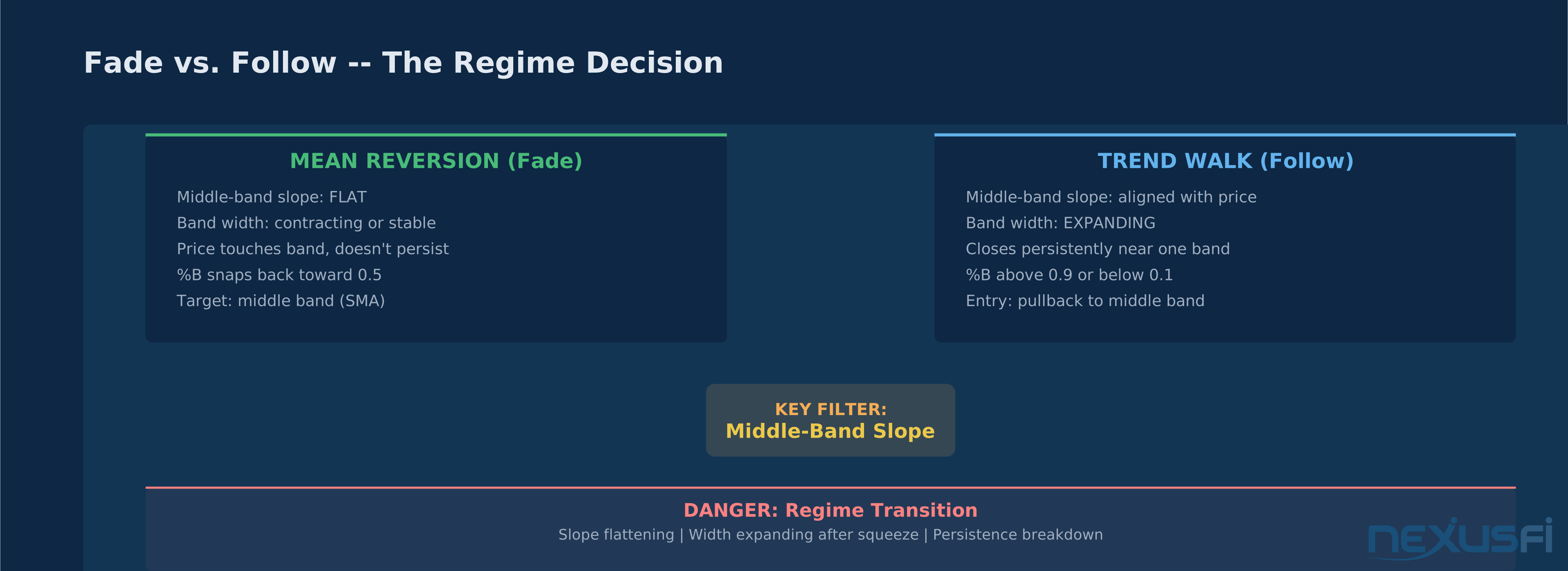
1. Middle-Band Slope: Is the SMA flat, rising, or falling? This is the single most important filter. @Fat Tails demonstrated this with the "MidBandSlope" setting on the Bollinger Universal indicator, showing that "the indicator below is the standard Bollinger Squeeze — Bollinger Bands inside the Keltner Channel" and slope direction determines whether a squeeze resolves up or down.
2. Width Expansion Rate: Is band width growing or shrinking? Expanding width with a sloping centerline confirms a directional regime.
3. Price-Location Persistence: What fraction of recent closes sit near a band? Two or more consecutive closes at %B above 0.9 or below 0.1 indicate persistent directional pressure.
When to Fade (Mean Reversion) #
Fade conditions:
- Middle-band slope is flat (near zero)
- Band width is contracting or stable
- Price touches a band extreme but doesn't persist there
- %B snaps back toward 0.5 after the initial excursion
Target: the middle band. Stop: below the recent low (for a long fade) or a close back beyond the band with a buffer.
ES example: During a balanced RTH session, price wicks below the lower band on a 5-minute chart. The middle band is flat, band width is contracting. The 5-minute close returns to %B = 0.25. Long entry targeting the SMA, stop just below the wick low. This is a bread-and-butter ES fade setup.
When to Follow (Trend Walk) #
Follow conditions:
- Middle-band slope is clearly aligned with price direction
- Band width is expanding
- Closes persistently sit near or beyond one band (%B above 0.9 for bullish, below 0.1 for bearish)
Entry: on pullbacks to the middle band or shallow retests of the band. Stop: the opposite band or below a structural swing level.
NQ example: NQ gaps up, the 5-minute SMA starts sloping steeply upward, band width is expanding, and three consecutive closes print above %B = 0.95. Don't fade this. Enter on a pullback to the rising middle band, stop below the prior swing low.
Regime Transitions #
The dangerous zone is the transition. Watch for:
- Middle-band slope flattening after a trend (regime shift from walk to fade)
- Width expanding after a long contraction (squeeze breakout — wait for direction confirmation)
- Price-location persistence breaking down (closes moving away from the band extreme back toward center)
W-Bottoms and M-Tops -- Pattern Hypotheses, Not Signals #
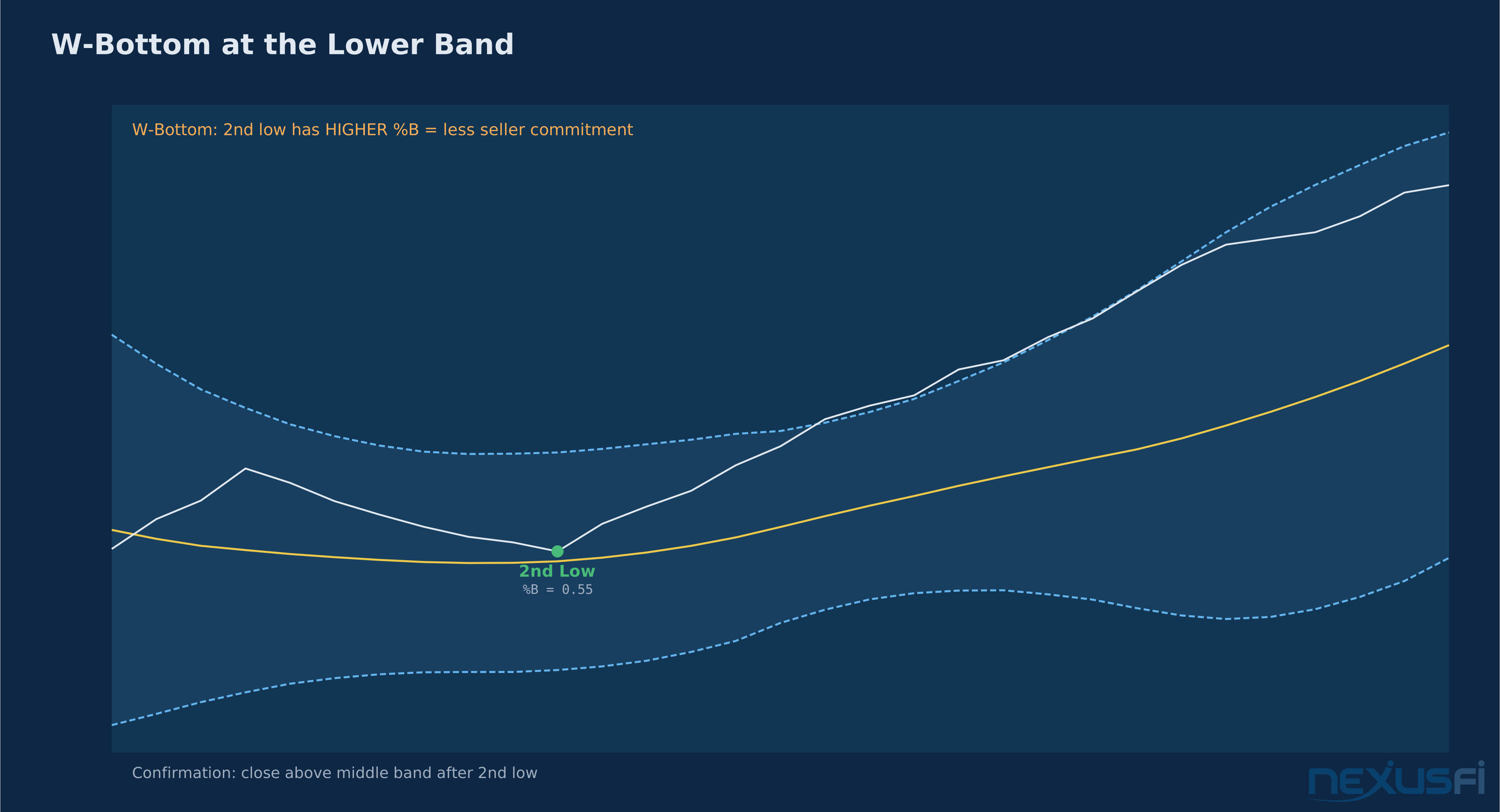
W-bottoms and M-tops at the bands are probabilistic patterns, not mechanical triggers. They work because they reflect diminishing seller/buyer commitment at a statistical extreme.
W-Bottom Confirmation Criteria #
- First low: Price touches or breaches the lower band (%B at or below 0)
- Rally: Price moves toward the middle band
- Second low: Price dips again but %B stays higher than the first dip (diminishing reach — e.g., first dip at %B = -0.10, second at %B = -0.03)
- Confirmation: A close back above the lower band, ideally above the middle band
- Context: The middle-band slope should be flat-to-rising. If it's still falling, the pattern is weak.
The M-top is the mirror image at the upper band. Same logic, inverted.
Futures Application #
ES: W-bottoms on 5-minute charts where the second dip shows higher %B are reliable when the middle band is flattening. Target the middle band initially.
NQ: Fast impulses often prevent the classic "higher second low." Require a confirmed flat middle-band slope before trusting the pattern.
CL: Gaps can invalidate the second-low requirement. Focus on same-session behavior — a second touch within the session with a close back above the band is more meaningful than a pattern spanning sessions.
Futures-Specific Implementation Guide #
Contract Behavioral Differences #
ES — Mean-reversion dominates on short intraday timeframes. Exhaustion fades at band extremes are the primary play during balanced sessions. Walking bands signal trend days — recognize the regime shift early and stop fading.
NQ — Faster impulses, stronger directional volatility. A raw band touch is unreliable as a reversal signal. The midband slope filter is essential — only fade when the SMA is demonstrably flat. As @loantelligence observed when discussing scalping strategies, delta breaking out of its own Bollinger Bands while price is inside its bands signals "a transition move from buy to sell or vice versa."
CL — Highly sensitive to headlines and scheduled reports. Squeeze breakouts are more reliable than band-touch reversals. During API/EIA/OPEC windows, switch from fade mode to breakout mode and use wider K values (2.3-2.5) to avoid getting chopped.
Session Handling #
The same bands behave differently across sessions because liquidity changes everything.
Globex: Thinner liquidity means more wick-like extremes and "tag-and-go" phenomena. Close-based logic becomes critical — ignore intrabar touches. Widen your confirmation buffer.
RTH: Higher participation, smoother volatility dispersion, cleaner regime resolution. Standard thresholds apply. The BBSqueeze indicator is more reliable during RTH because volume supports genuine compression/expansion cycles.
Practical adaptation: Either compute bands on the full 24-hour series with different session thresholds, or run separate band sets for Globex and RTH. Both approaches work — consistency matters more than the specific choice.
Parameter Quick Reference #
ES (5-min): N=20, K=2.0 — fade when MB flat, walk when MB slopes and width expands
NQ (5-min): N=20, K=1.8-2.0 — walk is default, fade only if MB flat AND width below 5% of SMA
CL (30-min): N=30, K=2.2-2.5 — breakout walk during news, fade only post-squeeze with flat MB
Risk Management -- The Part Most Traders Get Wrong #
Structural Invalidation, Not Tick Touches #
A single tick touching a band is not invalidation. A close beyond the band by a buffer AND a middle-band slope flip against your trade direction — that's invalidation.
For a mean-reversion fade from the lower band: place your stop at the lower band minus 0.5K times the current standard deviation (or below the recent structural swing low, whichever is wider). If price closes beyond your stop AND the middle-band slope turns decisively negative, the fade thesis is dead.
Volatility-Aware Stops #
Stop distance scales with current volatility:
Stop Distance = m x StdDev
Where m ranges from 0.5 to 2.0 depending on strategy aggressiveness. For ES fades, m=1.0-1.5 works well. For NQ trend-walks, m=0.5-1.0 provides a tighter trailing stop.
This is the connection
Position Sizing Tied to Band Width #
Wider bands mean more volatility, which means wider stops, which means fewer contracts for the same dollar risk.
Contracts = Risk Dollars / (Stop Distance x Contract Multiplier)
When band width is narrow (tight squeeze), your stop is tight, so you can size larger for a given risk budget. When width is wide, stops are wider, and position size must shrink. This automatic scaling keeps risk constant across volatility regimes.
The band-width histogram provides a quick visual check: if current width is in the extreme 5% of recent history (either very narrow or very wide), adjust sizing so. Very narrow width with a flat middle band is the highest-conviction fade setup — tight stop, reasonable target, and volatility expansion ahead.
The R:R Reality Check #
For mean-reversion trades, the natural target is the middle band. So your reward-to-risk equals the distance from entry to the SMA divided by the distance from entry to your stop. When bands are tight, both distances shrink proportionally — R:R stays roughly constant, but absolute dollar values per trade are smaller. That's fine. Don't chase larger targets just because the R:R looks thin. The probability of hitting the SMA target from a band extreme is much higher than hitting the opposite band.
Where Bollinger Bands Fit -- And Where They Don't #
Bollinger Bands are a volatility framework, not a standalone system. They tell you the statistical context of price — where it is relative to recent behavior and how active that behavior has been. They don't tell you why price is there or where it's going.
Combine with: Order flow for entry timing, delta analysis for directional conviction, VWAP for institutional context, Market Profile for value area reference. The bands define the field; these tools tell you who's playing on it.
Don't combine with: Other volatility bands (Keltner, Donchian) as independent signals — that's redundant. Use Keltner only for squeeze detection, not as a parallel trading system.
Limitations to respect: Bands assume relatively normal price distributions. Fat-tail events (flash crashes, limit moves, gap openings on major news) can blow through bands in ways that have nothing to do with mean reversion or trend walking. In those moments, market structure and order flow matter more than any statistical envelope.
The bands are the framework. The market regime is the filter. Your edge comes from knowing which mode you're in.
Knowledge Map
Prerequisites
Understand these firstGo Deeper
Build on this knowledgeReferences This Article
Articles that build on this topicCitations
- — Advanced Bollinger Band indicator - does it exist? (2012) 👍 4“If you color code a Bollinger Band depending on the bandwidth, then you look at the condition where the N-bar volatility is unusually low compared to intrabar volatility.”
- — How does RSqueeze work? (2012) 👍 44“The squeeze is on when the Bollinger Bands are inside the Keltner Bands. The Bollinger/Keltner thing is measuring two different types of volatility.”
- — How does RSqueeze work? (2012) 👍 31“The indicator below is the standard Bollinger Squeeze -- Bollinger Bands inside the Keltner Channel.”
- — A method to tie R:R directly to volatility (2014) 👍 10“To have a better than 1:1 reward-to-risk ratio the volatility should expand. A traditional way of looking at acceptable entry conditions is the Bollinger Squeeze.”
- — Trading the 6E Old School, With a Twist (2011) 👍 4“%b tells you where price is in relation to the bands, and bandwidth can alert the beginning or end of a trend.”
- — Bollinger Band Width Indicator (2010) 👍 3“As soon as the BB Width indicator starts to go down and remains in a flat position, you are in a CHOP zone.”
- — Is scalping Emini a sustainable trading strategy? (2021) 👍 4“Delta breaking out of its own Bollinger Bands while price is inside its bands signals a transition move from buy to sell or vice versa.”