



Rate of Change (ROC): The Pure Momentum Indicator That Measures Price Velocity in Futures Trading
Overview #
Rate of Change (ROC) is the most honest momentum indicator you can put on a chart. No smoothing, no lag, no proprietary formula. It asks a single question: how much has price moved, as a percentage, over the last n bars? The answer is the entire indicator.
That directness is both ROC's strength and its weakness. What it gains in speed and clarity, it sacrifices in noise filtering. A trader who understands this tradeoff can use ROC as a precision instrument. A trader who doesn't will spend their session chasing false signals across the zero line.
This guide covers everything you need to use ROC effectively in futures: how it's calculated, what it's actually measuring, which signals deserve attention and which don't, how to calibrate the lookback period for ES, NQ, CL, and other instruments, and how it compares to MACD and RSI. You'll also find specific trade examples showing ROC used as a confirmation tool — the role where it genuinely earns its keep.
ROC goes by several names depending on the platform: Rate of Change, Momentum (in some implementations), Price ROC, Percentage Price Oscillator (when smoothed). They all share the same conceptual core, even if the exact outputs differ. This article focuses on the standard percent ROC.
The Formula: What ROC Is Actually Measuring #
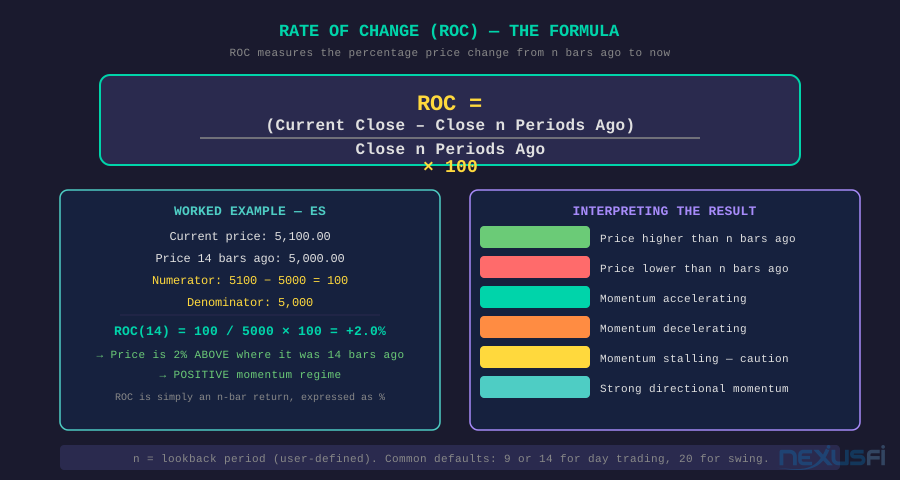
The calculation is one line:
ROC = [(Current Close − Close n Periods Ago) / Close n Periods Ago] × 100
If ES is at 5,100 today and was at 5,000 ten bars ago, ROC(10) = (100 / 5000) × 100 = +2.0%. Price has moved 2% over ten bars. That's the entire indicator.
Some platforms offer a "raw" version without the ×100: ROC = (Current / Prior) − 1. This outputs a decimal rather than a percentage. Both are equivalent — just choose one and be consistent.
A few implementation notes that matter for futures traders:
Use close prices consistently. Some traders experiment with typical price ((High + Low + Close) / 3) or mid-price, but the close is the cleanest input. It's the price traders chose to hold into the next session. It captures commitment.
n is in bars, not minutes. If you're on a 5-minute chart and set n=14, you're looking back 70 minutes. On a 15-minute chart with n=14, you're looking back 3.5 hours. The same period number produces very different lookback windows depending on your chart timeframe. Keep this in mind when switching between timeframes.
Session handling matters. If your platform uses continuous contracts with 23-hour Globex sessions, the lookback will include overnight price action. Some traders use RTH-only sessions to keep intraday ROC signals within regular trading hours. Neither approach is wrong, but mixing them creates inconsistent signals.
ROC is an n-bar return. At its core, ROC is equivalent to the percentage return over the last n bars. Understanding ROC this way makes its behavior obvious: it rises when recent bars have been net positive, falls when they've been net negative, and goes to zero when the current price equals the price n bars ago.
As NexusFi member @Fat Tails observed in a foundational discussion of trend filters:
"The simplest trend filter that translates the idea 'that price is up' is the momentum or rate of change indicator. Momentum is very much comparable to a first derivative. However, price is not a continuous function of time and there are no derivatives for discrete functions, so momentum needs to be calculated over a period."
That framing is exact. ROC is discrete differentiation — the closest thing to a velocity measurement that discrete price data allows. Robert Levy first formalized this in 1967.
Reading the Oscillator: What Each Zone Means #
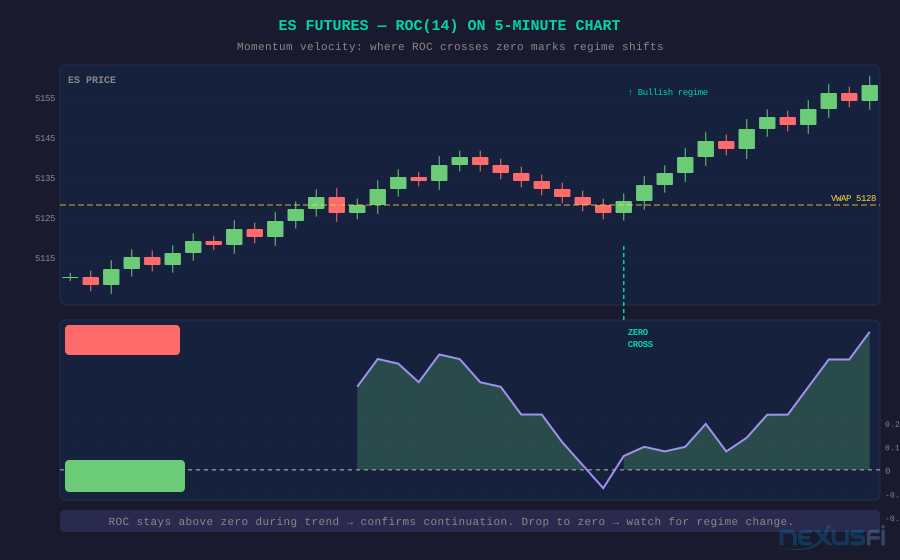
The ROC oscillator displays as a line that fluctuates above and below a zero line. Here's what each state tells you:
ROC above zero: Price is higher than it was n periods ago. Momentum is positive. The market is producing net gains over the lookback window.
ROC below zero: Price is lower than it was n periods ago. Momentum is negative. Sellers have had the edge over the lookback window.
ROC rising: Momentum is accelerating. Not only is price moving in the trend direction, it's moving faster than it was. This is the strongest signal — trend and acceleration aligned.
ROC falling (but still above zero): Momentum is decelerating. Price is still above its n-bar-ago value, but the rate of change is shrinking. The trend may be healthy, or it may be exhausting. Context determines which.
ROC near zero: The lookback period is producing basically no net change. This is often a consolidation or transition state. Not a signal in either direction by itself.
ROC magnitude: The absolute value of ROC tells you how fast momentum is moving. A ROC of +0.5% on ES represents moderate positive momentum. A ROC of +2.0% represents strong positive momentum. Magnitude matters when comparing ROC readings at different points in time.
What ROC cannot tell you: whether price will continue in the current direction, volume quality behind the move, order flow dynamics, or whether you're in a trending versus ranging environment. It's a speed measurement, not a direction prediction.
The Three Signals: Zero Line, Divergence, and Confirmation #
Zero-Line Crossovers #
When ROC crosses from below zero to above zero, momentum has shifted to positive. When it crosses from above to below, momentum has shifted negative. These crossovers define regime changes in momentum terms.
The problem is that zero-line crossovers cannot be traded as standalone signals in futures. Every experienced trader who has applied ROC to live markets reaches the same conclusion. Crossovers work when price is trending cleanly. They whipsaw continuously when price is ranging.
On ES, CL, and NQ during consolidation periods, ROC(14) will cross the zero line four, five, six times without producing a single useful signal. Each cross looks significant on the chart. None of them tells you which direction price is actually going.
The fix is simple but requires discipline: treat zero-line crossovers as regime identifiers, not entry triggers. When ROC crosses above zero, the momentum environment is shifting to positive. Now wait for price to confirm it with a structural break — a break of the most recent swing high, a reclaim of VWAP, a close above the opening range high. ROC sets the context. Price structure sets the entry.
A practical rule worth testing: require ROC to hold above or below zero for at least one to two bars before acting. This filters the whipsaws that occur when ROC dips briefly into positive territory and immediately retreats. A one-bar hold above zero is a noise event. A three-bar hold above zero is a regime shift.
Divergence: When ROC Disagrees with Price #
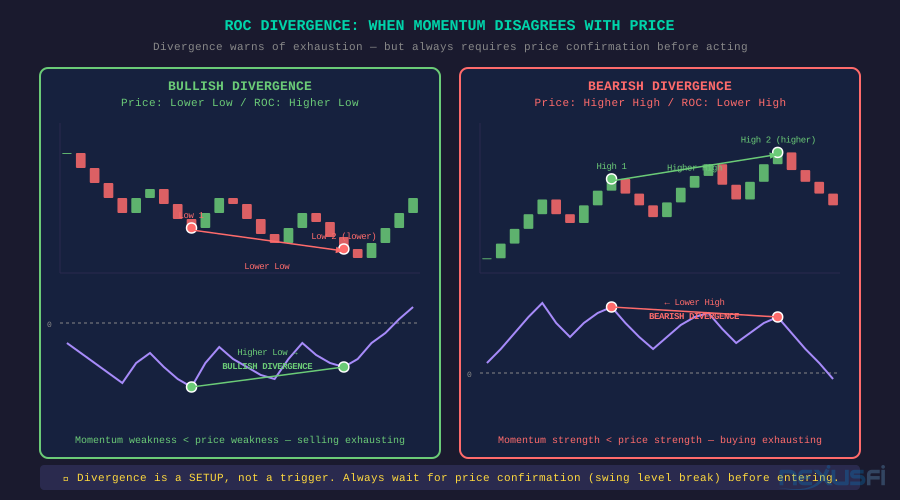
Divergence occurs when price and ROC tell different stories at a swing point:
Bullish divergence: Price makes a lower low, but ROC makes a higher low. Translation: price is weaker than its prior low, but momentum behind the selling is weaker than the prior selloff. Selling pressure is exhausting.
Bearish divergence: Price makes a higher high, but ROC makes a lower high. Translation: price is stronger than its prior high, but buying momentum is weaker than the prior rally. Buying pressure is exhausting.
Divergence is one of the more genuinely useful signals in technical analysis — not because it predicts reversals, but because it quantifies momentum disagreement. When price makes a new extreme that ROC doesn't confirm, you have objective evidence that the move lacks momentum backing. That's useful information.
What divergence is not: a trade trigger by itself. NexusFi member @Fat Tails, writing about divergence trading and the relationship between MACD components, flagged a critical nuance:
"MACD crossovers are dangerous. Often they do not work. Why? The MACD includes both Momentum (1st derivative) and Change of Momentum (2nd derivative)... This does not mean that MACD divergences do not work. I believe that they work much better than RSI or Stochastics divergences. But the divergence of the MACD should be ignored if the trend is still too strong."
That warning applies directly to ROC divergence. Strong trending markets will produce divergence after divergence before finally reversing. If NQ is in a powerful uptrend making new highs, bearish divergence on ROC may appear for fifteen, twenty bars before price actually turns. Trading the first divergence in a strong trend is a reliable way to donate money to the market.
Divergence earns its keep at specific locations:
- Prior day highs and lows
- Value area extremes (VAH and VAL)
- Opening range boundaries after extended moves
- VWAP deviations after news-driven spikes
At these locations, divergence says: the momentum behind this move has weakened right at a level where the market has historically rejected price. That's a setup. The confirmation — price breaking back through a recent swing point in the reversal direction — is the entry.
@imPairsonator explored a sophisticated application in a quantitative trading discussion, examining the second derivative of momentum:
"And now, thanks to RM99's suggestion, a look at the rate of change of rate of change, or: momentum's acceleration. The aim is to get out of assets which despite having high ROC120 (momentum), are starting to fail and thus have lower momentum of momentum (acceleration)."
This is divergence extended to the second derivative: not just ROC versus price, but ROC's own rate of change. When ROC starts declining even while it remains positive, the second derivative is turning negative. That's an early warning, before the first-order divergence becomes obvious.
Momentum Confirmation: ROC's Strongest Application #
All the signals above — zero crosses and divergence — work best as confirmation tools rather than standalone triggers. This is where ROC genuinely earns its place in a trading setup.
The concept is straightforward: something else generates the signal (price breaking a level, an opening range breakout, a volume cluster break), and ROC confirms that momentum is backing the move.
What "confirmation" means in practice:
- Price breaks above the opening range high → ROC(12) crosses above zero simultaneously → confidence in the breakout is higher
- Price pulls back to VWAP in an uptrend → ROC stays above zero throughout the pullback → the pullback is likely continuation, not reversal
- Price makes a strong push to a new high → ROC makes a lower high → momentum is diverging → stay cautious about chasing new longs
The confirmation approach works because it requires two separate information sources to agree. Price structure says: the market is accepting higher prices. ROC says: the rate of change is positive and accelerating. When both agree, the setup is higher quality than either signal alone.
Period Settings: Getting the Lookback Right #
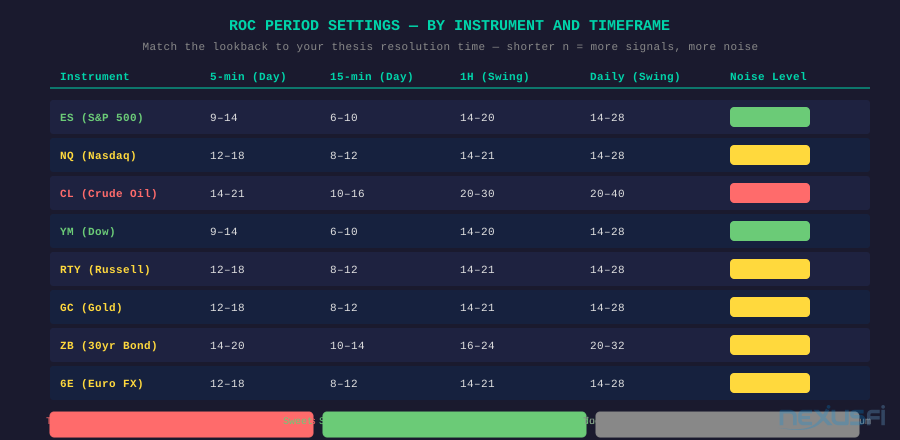
The lookback period (n) is the one input that determines nearly everything about ROC's behavior. There is no universal optimal setting — but there are practical ranges that work for specific instruments and timeframes.
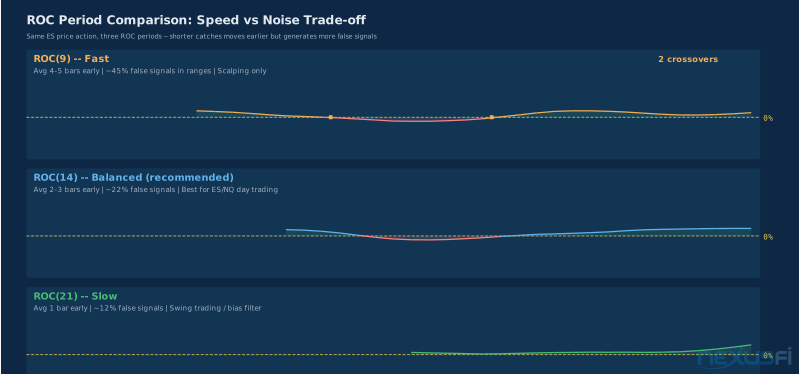
The principle behind period selection: choose n so that one ROC cycle approximately spans your average trade duration. A day trader who holds positions for 30-90 minutes should use a shorter period than a swing trader who holds for 3-5 days.
Day Trading Settings #
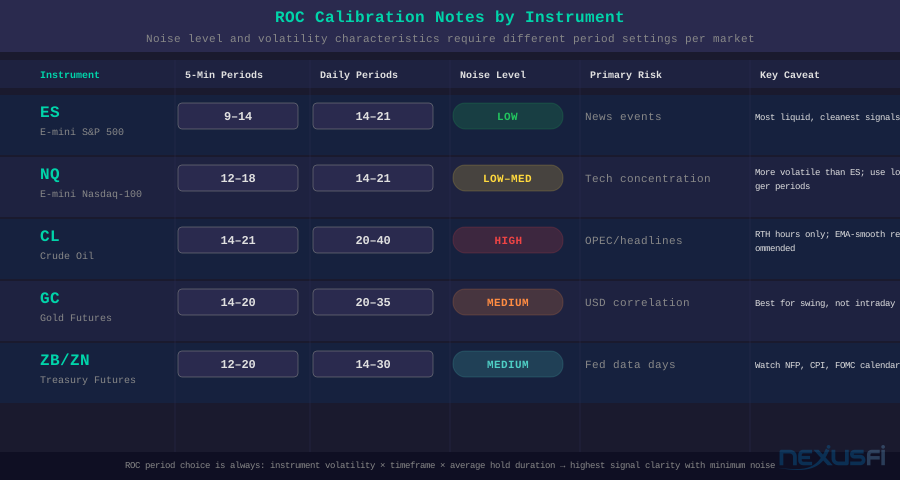
ES (E-mini S&P 500): ROC(9) to ROC(14) on 5-minute charts. ES is the most liquid futures market in the world. Momentum signals propagate cleanly. ROC(12) on 5-minute charts is a solid starting default — it captures about an hour of price history and provides enough reactivity to be useful for intraday trading without generating constant noise.
NQ (E-mini Nasdaq-100): ROC(12) to ROC(20) on 5-minute charts. NQ is more volatile than ES. The larger tick swings can make short-period ROC choppy. Going slightly longer than ES settings — 14 to 18 rather than 9 to 12 — gives cleaner signals with NQ's wider swings.
CL (Crude Oil): ROC(14) to ROC(21) on 5-minute charts. CL is headline-driven and prone to violent short-term moves that have nothing to do with underlying momentum. Shorter periods produce excessive noise. Consider using ROC of an EMA-smoothed price for CL rather than raw close prices — this reduces the impact of isolated spike bars.
15-minute charts: Reduce all periods by about 30-40%. ROC(9) on 15-minute charts is similar in effective lookback to ROC(14) on 5-minute charts.
Swing Trading Settings #
ES and NQ (Daily): ROC(14) to ROC(21). The 14-day ROC is the most common institutional standard for intermediate-term momentum. It covers roughly 3 weeks of trading history. ROC(21) extends this to approximately one month — useful for slower-moving regime analysis.
CL (Daily): ROC(20) to ROC(40). Crude's fundamental drivers — OPEC policy, geopolitical events, seasonal demand patterns — operate on longer cycles than equity momentum. A 14-day ROC on CL is too reactive to news events. A 30-day or 40-day ROC gives a cleaner read on whether the fundamental momentum has actually shifted.
Common Mistakes with Period Selection #
Too short: ROC(5) on a 5-minute ES chart is basically noise. It'll cross zero five or six times per hour. Every tick of price activity creates a new signal.
Too long: ROC(100) on a 5-minute chart is too slow to be useful for day trading. The signal arrives well after the opportunity has passed.
Not adjusting for the instrument: A trader who uses ROC(14) on ES and then applies the same setting to CL without adjustment will find CL's signals unusable. Every instrument needs its own period calibration based on its volatility characteristics.
Not adjusting for timeframe: ROC(14) means something completely different on a 1-minute chart versus a daily chart. Always think in terms of actual time coverage, not just the period number.
ROC versus MACD versus RSI #
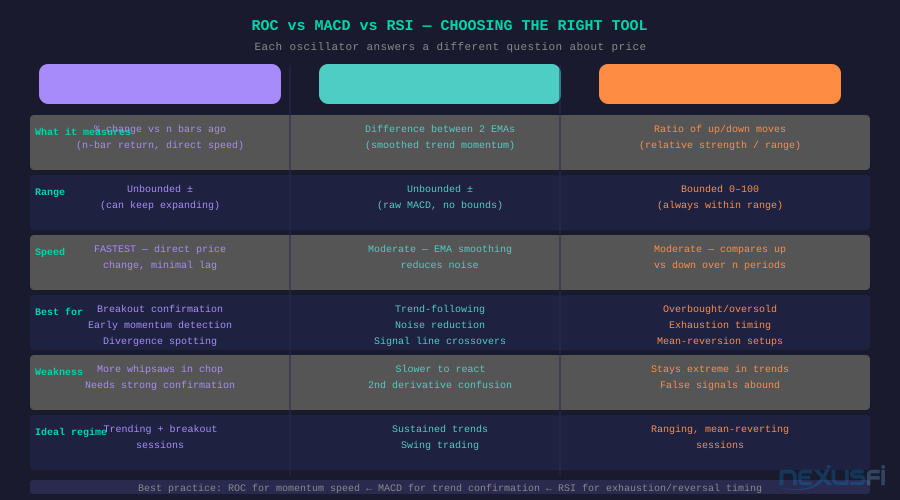
The comparison between these three indicators comes up in almost every discussion of momentum analysis, and it's worth addressing directly because the differences are material.
ROC vs MACD
MACD — Moving Average Convergence Divergence — was invented by Gerald Appel in the late 1970s and is built from the difference between two exponential moving averages (typically 12 and 26 periods), plus a signal line (9-period EMA of the MACD line). It's more complex than ROC and includes two layers of information: the raw MACD line (a momentum indicator) and the histogram (change of momentum).
As @Fat Tails explained in a detailed technical analysis thread:
"The raw MACD is a momentum indicator. It can be used as a trendfilter. The histogram, which is built from the raw MACD and its signal line, indicates change of momentum... The MACD has both a trendfilter, which is the raw momentum MACD, and an entry timing tool, which is the histogram."
This is the key insight: MACD is actually doing two things simultaneously. The raw MACD line is similar to a smoothed ROC — it shows momentum direction. The histogram shows whether that momentum is accelerating or decelerating. This dual structure makes MACD versatile, but it also makes MACD crossovers potentially misleading.
ROC, by contrast, does only one thing: it shows percentage change over n bars. No smoothing beyond what's already in the lookback. No second derivative. Just raw speed.
When to prefer ROC:
- You want an early warning on momentum shifts (ROC reacts faster)
- You're looking for clean zero-line crossovers for regime filtering
- You want to combine with price structure rather than a signal line
- Your chart is already complex and you don't need histogram dynamics
When to prefer MACD:
- You want noise reduction through EMA smoothing
- You want the histogram for momentum acceleration analysis
- You're swing trading and need a slower, more filtered signal
- You want built-in signal line crossovers
ROC vs RSI
The RSI (Relative Strength Index) was introduced by J. Welles Wilder in his 1978 book New Concepts in Technical Trading Systems and is a bounded oscillator (0-100) that measures the ratio of average gains to average losses over n periods. RSI answers a different question than ROC.
ROC asks: how much has price changed? RSI asks: have the recent moves been predominantly gains or losses?
RSI is bounded — it can't go below 0 or above 100. This makes it useful for identifying extreme readings (overbought/oversold). But it also means RSI can stay elevated for an extended period in strong trends without providing actionable reversal signals.
ROC is unbounded. It can keep expanding in either direction as long as price keeps moving. This means ROC doesn't generate overbought/oversold readings the same way — but it also means ROC stays aligned with the actual magnitude of momentum.
Practical rule: use ROC for momentum velocity and regime filtering. Use RSI for exhaustion timing and overbought/oversold context. They complement each other.
Trending vs Ranging: Where ROC Works and Where It Doesn't #
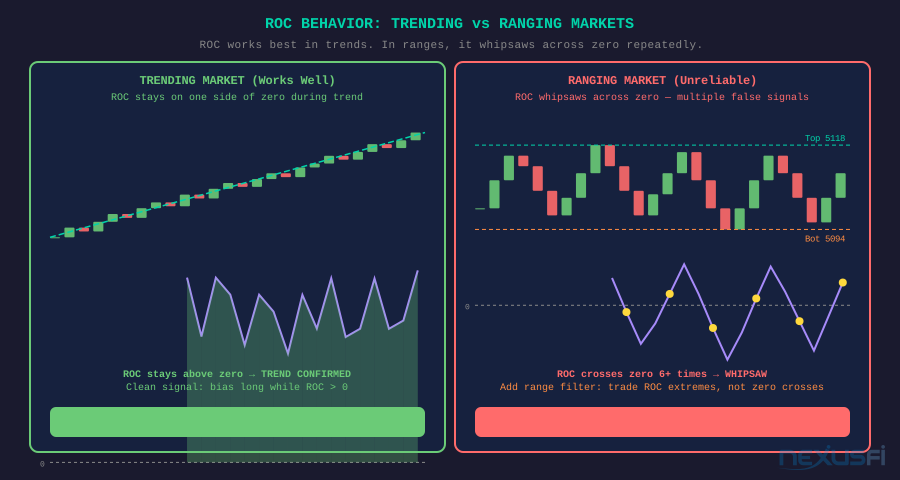
ROC in a trending market is a clean, readable tool. ROC in a ranging market is a whipsaw generator.
In a trend, price is consistently making progress in one direction. The n-bar comparison almost always shows positive (uptrend) or negative (downtrend) results. ROC stays on one side of zero. Zero-line crossovers are rare and meaningful when they occur.
In a range, price oscillates back and forth between support and resistance. Any n-bar comparison is basically random — sometimes the current price is above its n-bar-ago value, sometimes below. ROC crosses zero repeatedly without direction. Each cross looks like a signal. None of them is.
@Botts described this dynamic in a NexusFi thread on a ROC-based volatility indicator:
"The basic ROC (Rate of Change) indicator is actually a 'Momentum' oscillator designed to measure the percent change in price from one period to the next."
In ranging markets, "the percent change from one period to the next" is just market noise recycling back and forth. The indicator is working correctly — it's just that the underlying price action has no directional momentum to measure.
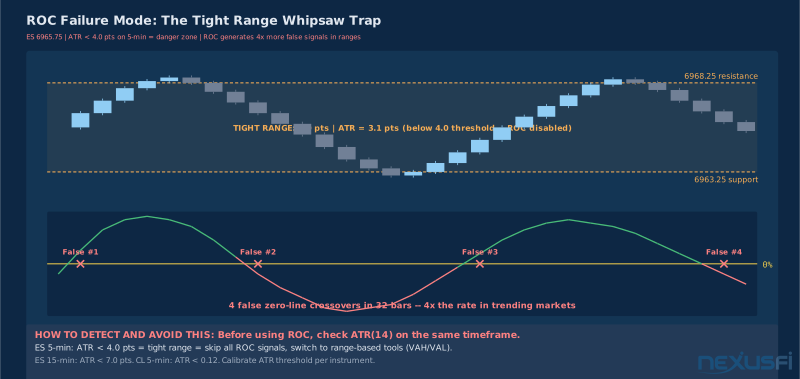
How to identify which regime you're in before applying ROC:
ATR (Average True Range): ATR measures the average range of recent bars. When ATR is expanding, the market is developing directional momentum. When ATR is contracting, the market is compressing into a range. Don't trade ROC zero-cross signals when ATR is in a contraction phase.
VWAP bands: When price is oscillating back and forth through VWAP rather than trending consistently above or below it, you're in a range. ROC signals during these periods will be unreliable.
Market profile: If the session is developing a balanced, symmetrical profile — price distributing in a bell curve shape rather than building a directional skew — you're likely in a range. ROC trend signals don't apply.
Opening range behavior: A narrow opening range followed by extended consolidation is a range signal. A wide opening range with a strong directional move out of the open is a trending signal.
When the regime isn't clear, reduce position size on ROC signals and require stronger confirmation. The worst trades happen when a trader applies trend-following tools in a ranging environment.
The ES Breakout Trade: ROC as Confirmation #
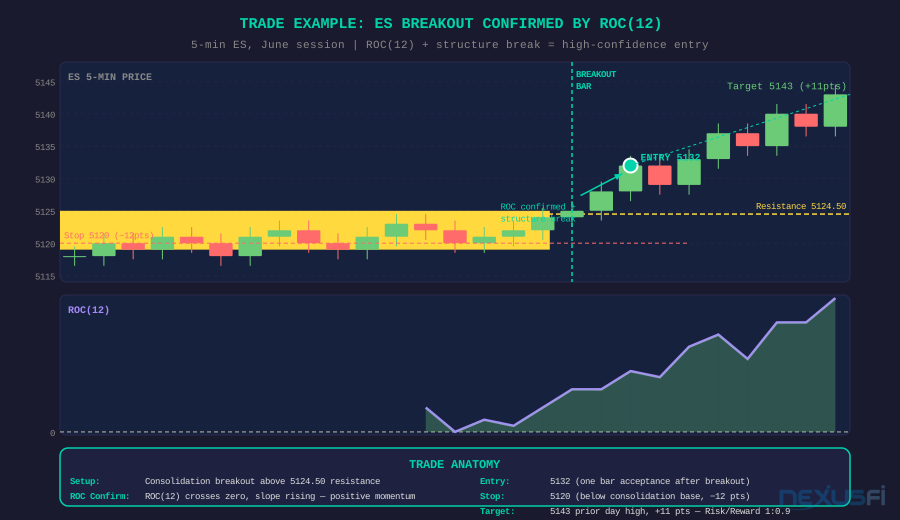
This is the trade pattern where ROC earns its place on the chart. Everything else — zero crosses, divergence, period optimization — builds toward this application.
The Setup:
ES has been consolidating in an 8-point range between 5119 and 5124.50 for fourteen bars on the 5-minute chart. Volume is declining during the consolidation — sellers and buyers are equally balanced. This is a coil.
Watch ROC(12) during the consolidation. It should be oscillating around zero with no directional bias — this confirms the range is genuine, not a slow directional drift.
The Breakout:
A bar closes above 5124.50 on above-average volume. Price breaks through the resistance that's defined the consolidation.
At this exact moment, check ROC(12). Did it:
- Cross from negative or near-zero to positive? ✓
- Continue rising on subsequent bars? ✓
- Cross zero with conviction (not a micro-cross that immediately retreats)? ✓
If ROC confirms momentum backing the breakout, the setup has structural evidence (price broke the level) and momentum evidence (ROC shows net positive movement).
The Entry:
Wait one bar after the breakout for acceptance. This filters the false breaks where price spikes through a level and immediately retreats. One bar of price trading above the breakout level with ROC remaining positive is confirmation. Enter on the next bar open or a micro-pullback to the broken level.
A similar principle applied to discretionary futures trading was articulated by @jlwade123 in a trading journal discussing momentum indicator usage in trending conditions:
"In a trend, as long as SMI is above Zero, I can trust myself to stay in the trade and look for an overbought condition or price crossing the 20 EMA... THE KEY IS TO WATCH THE SLOPE OF THE 20 EMA. The 20 EMA slope confirms the SMI indicator. Never trend trade a flat slope."
The principle transfers directly to ROC: stay in the trade as long as ROC remains above zero with a rising or flat slope. The zero line becomes your exit signal rather than a trailing stop.
The Management:
Stop: Below the consolidation low. If the breakout was genuine, price should not return to within the consolidation zone. If it does, the breakout failed and the thesis is wrong.
Target: Prior day high, next major volume profile node, or VAH — whichever is the next logical structural level. Alternatively, exit when ROC makes a lower high while price makes a higher high (bearish divergence on the mini-move within the larger trade).
Signal Quality Framework: Filtering for High-Probability Setups #
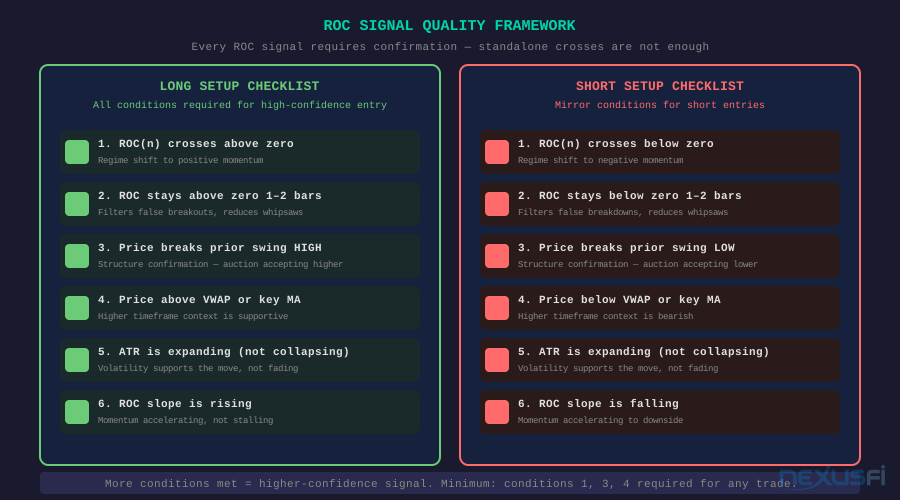
Not all ROC signals deserve the same confidence. The framework below ranks signal quality based on the number of confirming factors present.
Tier 1 — Highest Confidence (all factors present):
- ROC crosses zero with clear conviction (not a micro-cross)
- ROC holds above/below zero for 2+ bars
- Price breaks a prior swing high/low simultaneously
- Price is above/below VWAP or key moving average
- ATR is expanding (market has volatility to move)
- ROC slope is rising (accelerating momentum)
Tier 2 — Good Signal (most factors present):
- ROC crosses zero
- 1-bar hold before entry
- Price breaks a minor structure level
- General trend context supports direction
Tier 3 — Use Caution (minimal confirmation):
- ROC crosses zero
- No price structure confirmation yet
- ATR is flat or contracting
- Market in unclear regime
Tier 4 — Avoid:
- ROC crosses zero in a ranging market
- Multiple zero crosses in recent bars (whipsaw environment)
- News event just occurred (spike-and-reverse risk)
- Major support/resistance directly overhead
The signal quality framework prevents the trap of treating all ROC signals equally. A zero-cross in a trending ES session with ATR expanding and price breaking a swing high is a completely different signal than a zero-cross during a dead CL session with ATR at its 20-day low.
Position sizing can also be calibrated to signal tier. Tier 1 setups warrant full position size. Tier 2 warrants 50-75%. Tier 3 warrants paper trading until the signal context improves.
Combining ROC with Other Indicators #
ROC's value multiplies when paired with indicators that cover its blind spots.
ROC + Average True Range (ATR): ATR tells you whether the market has the volatility to sustain a move. When ATR is expanding and ROC is above zero, the combination suggests a trending market with active participants. When ATR is contracting, don't trade ROC zero-cross signals — the range is too tight for meaningful follow-through.
ROC + VWAP: VWAP provides the institutional price reference for the session. ROC above zero with price above VWAP = aligned momentum and institutional context. This is the cleanest condition for continuation trades. ROC above zero but price below VWAP = momentum is positive but price hasn't reclaimed the institutional benchmark. Exercise caution.
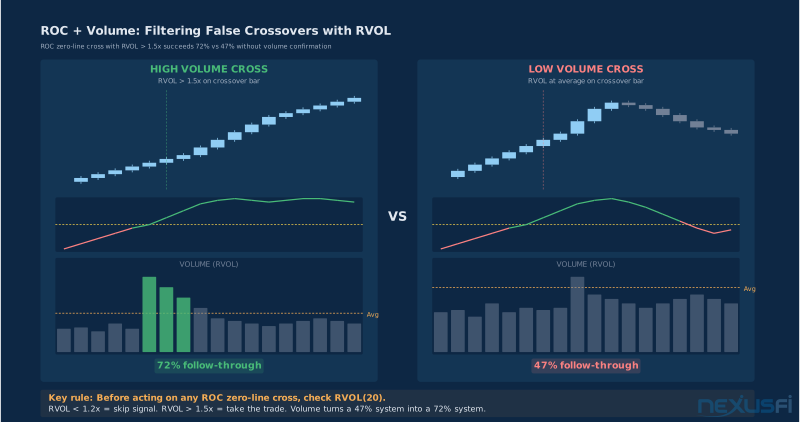
ROC + Bollinger Bands: When price touches the upper Bollinger Band and ROC is making a lower high (divergence), the combination — band extreme plus momentum exhaustion — is a higher-quality reversal setup than either signal alone.
ROC + Multi-Timeframe Analysis: The most powerful application of ROC is multi-timeframe alignment. If the daily chart shows ROC above zero (positive momentum regime), and the 15-minute chart shows ROC crossing above zero from a pullback, you have momentum confirmation at two independent timeframes.
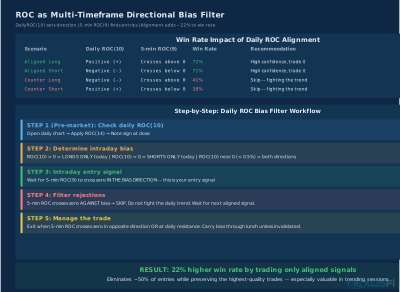
ROC + Momentum Trading: For traders using a pure momentum approach — riding strong directional moves until exhaustion — ROC provides the quantitative confirmation that momentum is genuinely present. Most momentum trading failures come from entering on weak momentum or staying in as momentum decays. ROC tracks both situations explicitly.
ROC on Different Instruments: Calibration Notes #
ES: ES is the most liquid futures contract in the world. Its momentum signals are the cleanest of any US futures instrument. ROC(12) on 5-minute charts produces usable signals without excessive noise. ES trends tend to be smooth and ROC stays on one side of zero during trending phases. Zero-cross whipsaws occur primarily during the lunch hour (12:00-1:00 PM EST) and the last 30 minutes of the session — reduce position size or avoid trading during these windows.
NQ: NQ is more volatile than ES. The NQ futures contract has larger tick swings and a technology-heavy composition that makes it more sensitive to risk-off events. ROC settings for NQ should run slightly longer than ES — 14 to 18 on 5-minute charts versus 9 to 14 for ES. NQ also produces more frequent divergence signals that initially appear bullish or bearish but fail — NQ's volatility means price often returns to levels that create new divergence readings before completing the reversal.
CL: Crude oil futures require the most caution with ROC. CL's price is at the core driven by headline events — OPEC announcements, inventory reports (every Wednesday 10:30 AM EST), geopolitical disruptions. A single headline can move CL 1-2% in seconds, creating an artificial ROC spike that disappears when the market digests the news. Use longer periods (14 to 21 on 5-minute, 20 to 40 on daily) and require stronger price structure confirmation before acting on ROC signals in CL.
GC (Gold): Gold futures behave differently depending on whether they're trading as a safe-haven asset or as a dollar-denominated commodity. ROC on gold performs best when you also have context from the US Dollar Index (DX) and Treasury futures. Gold's momentum signals are more reliable over longer timeframes (swing rather than day trading) because intraday volatility is driven by currency fluctuations that can reverse quickly.
Bond futures (ZB/ZN): Treasury futures have their own momentum dynamics driven by FOMC expectations and economic data releases. ROC on bond futures is useful for measuring whether the bond market is in a trending or ranging phase, but requires awareness of the scheduled data calendar — NFP, CPI, FOMC meetings all create major discontinuities that ROC will register as sharp spikes, not sustainable momentum shifts.
Practical Setup: Getting Started #
Here's a straightforward starting point for incorporating ROC into your trading:
Step 1: Add ROC to your chart. Most platforms label this as "Rate of Change" or "Price ROC." Set the period to 14 for daily/swing charts, 12 for 5-minute day trading charts. Use close as the source.
Step 2: Identify the current regime before looking at ROC signals. Is ATR expanding or contracting? Is price trending with VWAP or oscillating through it? If you're in a range, don't trade ROC zero-cross signals.
Step 3: Use ROC for confirmation, not prediction. Something else generates the setup — a breakout above a prior day high, a pullback to a support level after a trend day, a divergence setup at a value area extreme. ROC tells you whether momentum is backing the setup.
Step 4: Require at least two conditions. ROC zero-cross alone is not enough. ROC zero-cross + price structure break = a signal worth considering. ROC divergence alone is not enough. ROC divergence + price failing at a prior level = a setup worth watching.
Step 5: Exit when ROC contradicts your trade. If you're long and ROC crosses below zero, your momentum thesis has changed. This doesn't mean price will immediately go against you, but the confirmation that kept you in the trade is no longer there. Reduce size or exit and reassess.
Key Takeaways #
ROC is the purest speed measurement available in technical analysis — a direct read on how fast price is moving, expressed as a percentage over a defined lookback. Its simplicity is both its strength and its limitation.
Use ROC for what it does well: identifying momentum regimes (above/below zero), confirming breakouts with positive momentum backing, spotting divergence at key levels as an early warning, and providing an objective exit signal when momentum reverses.
Avoid using ROC as a standalone signal generator. In ranging markets, it's a whipsaw machine. As a confirmation tool in trending markets, it's one of the most transparent momentum readings on the chart.
Period calibration matters. ES and NQ day trading: 9-14 on 5-minute charts. CL day trading: 14-21. Swing trading: 14-21 on daily charts, adjusted longer for volatile instruments like CL.
The zero line is a regime filter, not an entry trigger. Confirmation from price structure — a swing high break, a VWAP reclaim, a level acceptance — transforms a ROC zero-cross from a coin flip into a meaningful signal.
ROC pairs well with ATR for regime context, VWAP for institutional reference, and multi-timeframe analysis for momentum alignment. It belongs in a toolkit, not as the toolkit itself.
Knowledge Map
Prerequisites
Understand these firstGo Deeper
Build on this knowledgeCitations
- — Building Blocks of a Trading System (1) - Trend Filter (2010) 👍 22“The simplest trend filter that translates the idea 'that price is up' is the momentum or rate of change indicator. Momentum is very much comparable to a first derivative.”
- — Auction bar by Fat Tails (2013) 👍 12“MACD crossovers are dangerous. Often they do not work. The MACD includes both Momentum (1st derivative) and Change of Momentum (2nd derivative). Divergences work better than RSI or Stochastics divergences, but should be ignored if the trend is still too strong.”
- — Developing a GTAA system (2012) 👍 28“Take the 30 trading day average price, and divide it by the price 120 trading days ago. This is the smoothed ROC (or momentum). Divide the last smoothed ROC by the smoothed ROC value 20 days ago. This is the acceleration.”
- — Session Toolbox - Trading the Session (Fat Tails) (2013) 👍 239“The raw MACD is a momentum indicator. It can be used as a trendfilter. The histogram, which is built from the raw MACD and its signal line, indicates change of momentum.”
- — Want your NinjaTrader indicator created, free? (2015) 👍 11“The basic ROC (Rate of Change) indicator is actually a 'Momentum' oscillator designed to measure the percent change in price from one period to the next.”
- — Discretionary Trading System vs. Mechanical Trading System (2015) 👍 8“In a trend, as long as SMI is above Zero, I can trust myself to stay in the trade and look for an overbought condition or price crossing the 20 EMA. THE KEY IS TO WATCH THE SLOPE OF THE 20 EMA.”
- — Kaufman Efficiency Study (2011) 👍 10“signal: absolute amount of the last n-bar price move (n-bar momentum). noise: sum of the absolute amounts of the last n 1-bar price moves (1-bar momentum). efficiency ratio: signal/noise * 100.”
- — Developing a GTAA system (2012) 👍 2“Using a 2nd order momentum (acceleration vs. velocity) tends to be more productive. A slowdown in momentum usually tends to be a decent exit point, or at least a heads up that the instrument has run its course in the short run.”
- — Want your NinjaTrader indicator created, free? (2015) 👍 10“You can use regular divergences to detect a slowdown of momentum. The trend is exhausted when the ADX goes below 25 or when the Kaufman Efficiency falls below the chop line.”
- — Find a pullback, programmatically (2019) 👍 5“I used to look at the average of three different Rates of Change to establish a directional bias. I've been pleasantly surprised by how well it works on different intraday time frames, especially to confirm something else you might already be looking at.”
- — Coloring an IndicatorLine by Slope: Questions for Optimal Coding (2012) 👍 14“Slope is just a visualization of momentum. Momentum is the first derivative of price and measures the price change. Normalizing price change means comparing the price change to the average or the typical change.”
- Robert Levy — Relative Strength as a Criterion for Investment Selection (1967)
- J. Welles Wilder — New Concepts in Technical Trading Systems (1978)
- Gerald Appel — Moving Average Convergence-Divergence (MACD) (1979)