



Gap Trading in Futures: Reading the Opening Print and Trading What Happens Next
Overview #
What Gap Trading Actually Is #
A gap is the price difference between one session's close and the next session's open. In futures, gaps show up between the RTH close at 4:00 PM ET and the next RTH open at 9:30 AM ET — even though the contract trades nearly 24 hours. The ETH session moves price, but the gap relative to RTH close is what the strategies are built around.
Gap trading isn't about predicting which direction the market opens. It's about reading the reaction to the gap once RTH starts and executing a plan based on gap size, context, and the first 15-30 minutes of price action.
The community at NexusFi has traded and studied gaps for over 15 years. As one veteran gap trader put it: "Opening gaps in the Emini S&P are pretty much all that I've traded since 2005." ([thegapguy, NexusFi] [1]) That's the kind of focused edge gap trading offers — a repeatable daily setup with quantifiable statistics.
Types of Gaps #
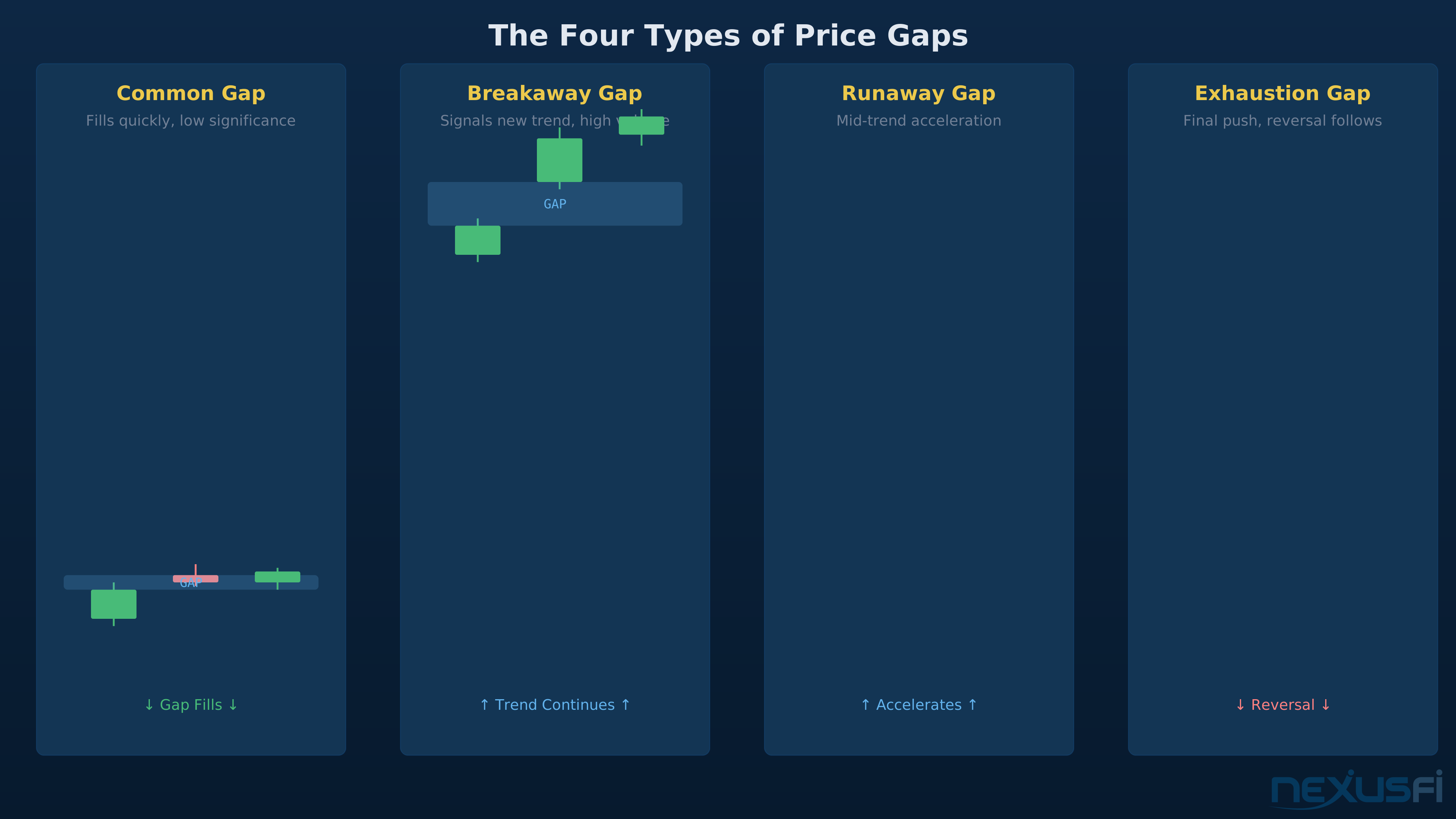
Not all gaps carry the same information. The four classical gap types each tell a different story about what happened overnight and what's likely next.
Common Gaps #
Common gaps are the workhorses — small moves that happen daily and fill with high probability. These gaps occur within an established trading range, don't accompany unusual volume, and represent normal overnight price adjustment rather than genuine sentiment shift. Most ES gaps under 5 points fall into this category.
Breakaway Gaps #
Breakaway gaps launch price out of a consolidation range or off a significant level. They're accompanied by above-average volume, often triggered by news events, earnings, or geopolitical developments. The key signature: the gap doesn't fill during the session. When you see price gap through a level that held for weeks and volume confirms it, that's a breakaway. Don't fight it.
Runaway (Measuring) Gaps #
Runaway gaps appear mid-trend and signal acceleration. The market is already moving, and this gap marks the point where remaining countertrend participants capitulate. Runaway gaps frequently occur at roughly the midpoint of a larger move, which is why they're also called measuring gaps — double the distance from the trend's origin to the gap and you have a reasonable target.
Exhaustion Gaps #
Exhaustion gaps look like breakaway gaps in real time — large gap, high volume, aggressive opening. The difference only becomes clear in hindsight. An exhaustion gap is the final push before reversal. The tell: volume spikes at the open but price fails to follow through. If a large gap up stalls within the first 30 minutes and starts filling, you're likely looking at exhaustion. One trader described it well: "A gap can be interpreted in three ways. A runaway gap, a measuring gap and an exhaustion gap. When a gap fails to close it's not an exhaustion gap." ([Pa Dax, NexusFi] [3])
Gap Fill Probability -- The Numbers #
Gap fill statistics are the foundation of most gap trading strategies. The core question: what percentage of gaps fill (price returns to the prior close) within the same RTH session?
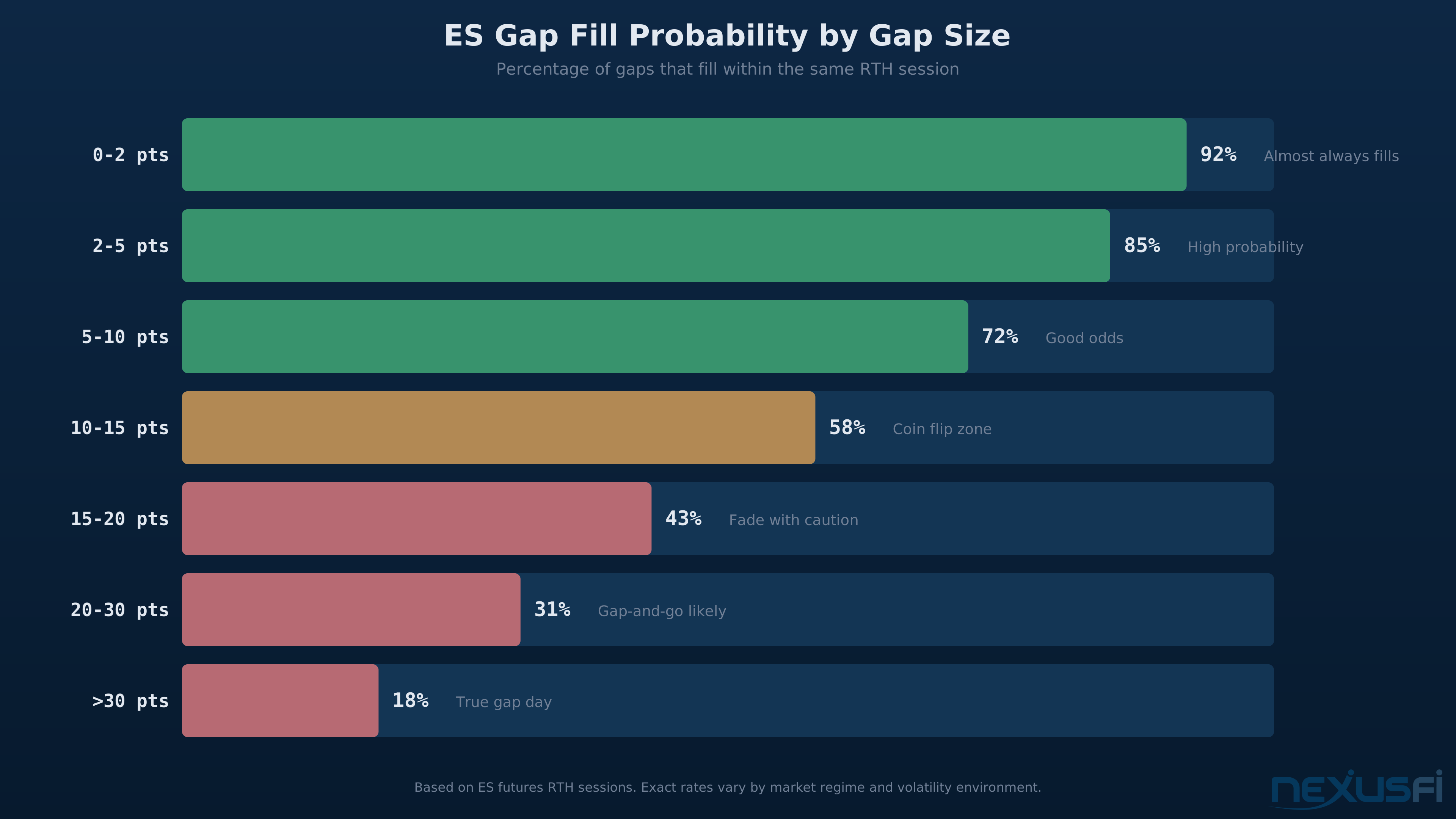
The data tells a clear story. For ES futures:
- Gaps under 2 points: Fill rate above 90%. These are noise, not signal. The fill is almost automatic.
- Gaps of 2-5 points: Fill rate around 85%. Still heavily in favor of mean reversion.
- Gaps of 5-10 points: Fill rate around 72%. Good odds for fading, but context matters more.
- Gaps of 10-15 points: Fill rate drops to roughly 58%. This is the coin flip zone where gap type classification becomes critical.
- Gaps of 15-20 points: Around 43% fill rate. The balance shifts toward continuation.
- Gaps of 20-30 points: Roughly 31% fill rate. Gap-and-go becomes the base case.
- Gaps over 30 points: Under 20% fill rate. These are true gap days — trend days by another name.
One NexusFi member tracked this extensively: "I started looking at ES gaps closing. I tackled this in easylanguage with a strategy first as a gap closing - buy/sell at open, hold to prior day close." ([greenroomhoo, NexusFi] [4]) His backtesting confirmed what the aggregate data shows: small gaps are high-probability fades, but the edge disappears as gap size increases.
The inverse relationship is important: as gap size increases, fill probability decreases but the reward for a successful fade increases. The risk/reward calculus shifts. A 2-point gap that fills 92% of the time gives you 2 points of profit. A 15-point gap that fills 43% of the time gives you 15 points when it works. Expected value: 0.43 x 15 = 6.45 points, versus 0.92 x 2 = 1.84 points. The larger gap is the better trade if you manage the risk correctly.
The Two Core Strategies #
Fade the Gap #
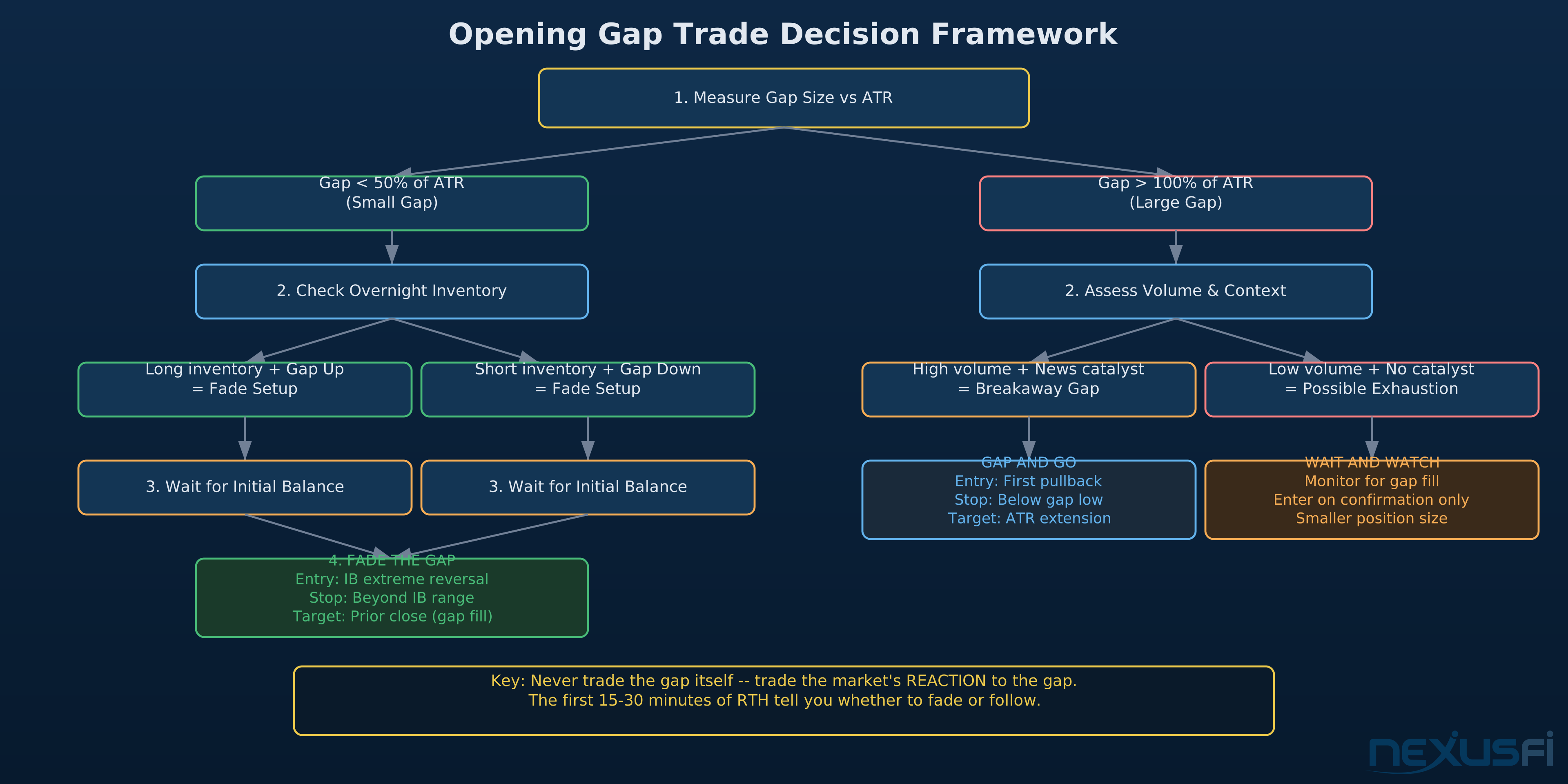
Fading the gap means trading against the overnight move, betting that price returns to the prior close. This is a mean reversion strategy that works best with:
- Small gaps (under 50% of the 14-day ATR)
- Overnight inventory imbalance in the direction of the gap (longs loaded up on a gap up = selling pressure ahead)
- No significant news trigger driving the move
- Price stalling near the open rather than extending the gap
The execution framework:
- Don't trade the open. Wait for the Initial Balance (first 30-60 minutes of RTH) to form.
- Look for rejection. If price tests the IB extreme in the gap direction and gets rejected, that's your setup.
- Enter on the reversal candle. Stop goes beyond the IB extreme. Target is the prior RTH close (full gap fill) or the gap's midpoint (partial fill) for a more conservative target.
A detailed approach from the community: "Fade = a mean reversion trade where I short 'up' gaps or buy 'down' gaps (i.e. trade against the overnight move)." ([thegapguy, NexusFi] [2])
Gap and Go #
The gap-and-go strategy trades with the gap direction, treating the gap as the beginning of a trend day. This works best with:
- Large gaps (over 100% of the 14-day ATR)
- High volume confirming conviction behind the move
- A clear trigger (economic data, geopolitical event, earnings shock)
- Price extending beyond the opening range in the first 30 minutes
The execution framework:
- Measure the gap relative to ATR. Gaps exceeding one full ATR almost never fill same-session.
- Wait for the first pullback. Don't chase the opening move. Let price pull back to the gap area or a VWAP retest.
- Enter on the first higher low (gap up) or lower high (gap down). Stop below the pullback low. Target is an ATR extension from the gap opening.
Community wisdom: "Most gaps don't fill without heat, so entering a gap trade on a pullback to wait for a larger gap often works better." ([shodson, NexusFi] [5])
Overnight Inventory and Gap Context #
The overnight session tells you who's positioned and how. This context is what separates mechanical gap trading from informed gap trading.
Overnight inventory refers to the directional bias of positions accumulated during ETH. If price traded mostly above the prior close overnight (long inventory), those longs are potential sellers at the RTH open. If price traded mostly below (short inventory), those shorts are potential buyers.
Here's the key: gaps that match overnight inventory are less likely to fill, and gaps that oppose overnight inventory are more likely to fill.
- Gap up with long overnight inventory: Longs are already positioned. If the gap holds, no new buying pressure enters. But if it starts to fill, longs bail out and the fill accelerates. Fade setup.
- Gap up with short overnight inventory: Shorts are caught wrong-footed. The gap triggers stop-losses and short covering, providing fuel for continuation. Gap-and-go setup.
- Gap down with short overnight inventory: Same logic in reverse. Shorts are positioned, fade setup.
- Gap down with long overnight inventory: Longs trapped, forced selling, continuation setup.
One trader's systematic approach: "My gap rule says: I do not follow large gaps early. Overnight inventory is important." ([OPP Scalper, NexusFi] [7])
Risk Management for Gap Trades #
Gap trading has specific risk management requirements that differ from other intraday strategies.
Position Sizing by Gap Size #
Scale position size inversely with gap size. A 2-point gap fade on ES might warrant your full position. A 15-point gap fade — where the math says you're basically flipping a coin — gets half position at most. The larger the gap, the more you're trading a lower-probability outcome with a higher reward, and your sizing should reflect that.
Stop Placement #
For fades: Stop goes beyond the IB extreme or the session's opening range, whichever is wider. If you're fading a gap up, your stop is above the high of the first 30 minutes. This stop is non-negotiable — a gap that extends beyond its opening range is telling you the fade thesis is wrong.
For gap-and-go: Stop goes below the low of the first pullback. If that pullback takes price back into the gap, the trade is invalidated.
The "No Trade" Zone #
Some gaps don't fit either strategy cleanly. Gaps in the 50-100% ATR range — too big to fade confidently, too small to trust as breakaways — are the no-trade zone for many gap specialists. Sitting out marginal setups is itself a risk management decision.
Common Mistakes in Gap Trading #
Mistake 1: Trading the open. The first few minutes of RTH after a gap are noise. Algorithms are repricing, stops are triggering, and order flow is chaotic. Wait for the dust to settle.
Mistake 2: Ignoring context. A 10-point gap up on FOMC day and a 10-point gap up on a random Tuesday carry completely different information. The gap number matters, but the why behind it matters more.
Mistake 3: Fading every gap. The 85% fill rate for small gaps is seductive, but that 85% includes the path — price doesn't always go straight to the fill. A gap that "fills" after first extending another 10 points against you isn't a winning trade.
Mistake 4: Averaging into a losing fade. If you faded a gap and it's extending, the thesis is wrong. Adding to the position turns a small loss into a catastrophic one. As any gap trader knows: "The gap was very large in size, beyond my level of tolerance so I did not take a gap trade." ([shodson, NexusFi] [6]) Knowing when to sit out is a skill.
Mistake 5: Ignoring the market's reaction. The gap itself is just information. The reaction to the gap — what happens in the first 30 minutes of RTH — is the trade. A gap up that immediately sells off is different from a gap up that consolidates at the highs. Read the reaction, not the gap.
Building a Gap Trading Playbook #
A systematic approach to gap trading starts with a daily checklist:
- Pre-market (before 9:30 AM ET): Calculate gap size relative to 14-day ATR. Check overnight inventory (was ETH trading mostly above or below prior close?). Note any scheduled events (FOMC, NFP, earnings).
- Opening print (9:30 AM): Classify the gap type. Is this common (small, no trigger), breakaway (large, high volume, through key level), or uncertain?
- Initial Balance (9:30-10:00 AM): Let the first 30 minutes play out. Does the IB contain the opening move, or does price extend? Is volume confirming or fading?
- Decision point (10:00 AM): Based on gap size, overnight inventory, IB behavior, and volume, select your strategy: fade, follow, or flat.
- Execution: Enter with defined stop and target. The target for a fade is always the prior close (gap fill). The target for a gap-and-go is an ATR extension from the open.
- Review: Track every gap trade outcome. Over time, your personal fill rate data for different gap sizes and contexts becomes your real edge.
How Gap Trading Connects to Other Concepts #
Gap analysis integrates with several other frameworks covered in the Academy:
- Market Profile (TPO Charts): Gaps that open outside the prior session's value area carry different implications than gaps within value.
- Initial Balance: The IB is your decision framework for every gap trade. The gap sets up the question; the IB answers it.
- Value Area: Gaps that open above VAH or below VAL of the prior session signal potential trend days.
- Breakout Trading: Breakaway gaps are a specific breakout type with unique confirmation signals.
- Risk Management: Gap trading's defined targets (prior close for fades) make it especially amenable to systematic risk management.
The gap is a daily puzzle. The statistics give you the base rates. The context gives you the adjustment. And the market's reaction gives you the trade.
Knowledge Map
Prerequisites
Understand these firstReferences This Article
Articles that build on this topicCitations
- — Emini gap fill strategy data, books? (2020) 👍 10“Hi Tuglife, Opening gaps in the Emini S&P are pretty much all that I've traded since 2005. In 2008, I wrote a short book/primer called Understanding Gaps and updated it in 2015.”
- — Emini gap fill strategy data, books? (2020) 👍 3“Thank you. The ES is my primary instrument for trading the opening gap though I also trade the YM and NQ and RTY on occasion for diversification purposes mainly.”
- — PA Dax CL, ES and Bund Price Action Trading Log (2020) 👍 5“Well a gap can be interpreted in three ways. A runaway gap, a measuring gap and an exhaustion gap. When a gap fails to close it's not an exhaustion gap so then expect some serious more down.”
- — Master Homework and Statistics Thread (2013) 👍 6“I started looking at ES gaps closing. I tackled this in easylanguage with a strategy first as a gap closing - buy/sell at open, hold to prior day close, etc. I played with it for a while and could not really get it profitable.”
- — shodson's Trading Journal (2011)“Actually, one of the things I've had on my to-do list is to upgrade my gap fading strategy to wait for the gap to get larger after the open if the market opens in a favorable zone.”
- — shodson's Trading Journal (2011) 👍 4“Friday, October 14th, 2011 - The market opened in a favorable gap zone (above yesterday's highs) but the gap was very large in size, beyond my level of tolerance so I did not take a gap trade.”
- — Daytrading ES & NQ (2023) 👍 1“20230921 pre market https://nexusfi.com/attachment.php?attachmentid=335044 We open with a huge gap down This gap adds to yesterdays late sell off spike My gap rule says: I do not follow large gaps early Overnight invemtory is 100% short Of course, th...”
- — Gap Fade the ES (2010) 👍 3“Hi all, I was playing around this morning to try and test the "fade the gap" theory, which is supposed to be one of the easiest plays on the ES. A Strategy to test trading gaps +/- 2 points is attached. It prints results to the output window.”