



Liquidity Sweeps and Stop Hunts in Futures Trading: The Order-Book Mechanics Behind the Market's Most Exploitable Pattern
Overview #
Every trader has been there. You set your stop just below a key level — the textbook placement — and price dips exactly there, takes you out, then reverses sharply and runs 20 points in the direction you were right about. You weren't wrong about direction. You were right about everything except where price was going to pause before committing.
That's a liquidity sweep. And it's one of the most consistently exploitable patterns in futures markets.
Liquidity sweeps happen when price moves through a key level — a swing high or low, equal highs, a round number — where large clusters of stop orders are resting. The stops trigger as market orders, briefly adding directional momentum. Then price reverses, often sharply, as the liquidity pool gets consumed and no real participants are willing to push it further.
The concept goes by several names: stop hunt, stop run, liquidity raid. Whatever the label, the mechanics are the same: price moves to where orders are concentrated, fills those orders, and reverses once the concentration is exhausted. Understanding sweeps changes how you read price action. Instead of seeing a level break as failure, you start asking — did price accept beyond this level, or is it being rejected? That single question is the dividing line between a genuine breakout and a sweep about to reverse.
The core concept: Liquidity sweeps are price movements through stop-cluster levels that trigger cascading orders, briefly extend the move, then reverse as the concentrated liquidity is exhausted. They're tradeable because stop placement is predictable.
What's Actually Happening When Price "Hunts" Stops #
The "stop hunt" narrative — where a shadowy entity deliberately drives price to your stop before reversing — is mostly wrong. What's actually happening is more interesting and more useful for trading.
Stops concentrate at obvious levels. When thousands of traders follow similar technical analysis, they place stops at similar locations: just below swing lows, just above swing highs, a tick or two beyond round numbers. This creates genuine clusters of resting sell-stop and buy-stop orders at predictable price points.
Liquidity thins approaching those levels. As price nears a cluster, the opposite side of the order book often thins out. Participants who were providing liquidity at that zone pull their orders — they see the same cluster coming and don't want to provide passive fills into a stop run. This thinning means each new aggressive order has more price impact than normal.
Stops become market orders, the cascade exhausts. Once the cluster level is hit, stop orders convert to market orders and fire simultaneously. This creates a brief but sharp spike in directional order flow — the stop cascade extends the move beyond the level. Then, if there's no genuine fundamental reason for price to hold at the new level, passive liquidity replenishes on the other side and price snaps back.
The practical implication: you don't need a conspiracy theory. You need to understand where stops cluster and whether post-sweep behavior shows absorption or acceptance. That's the whole game.
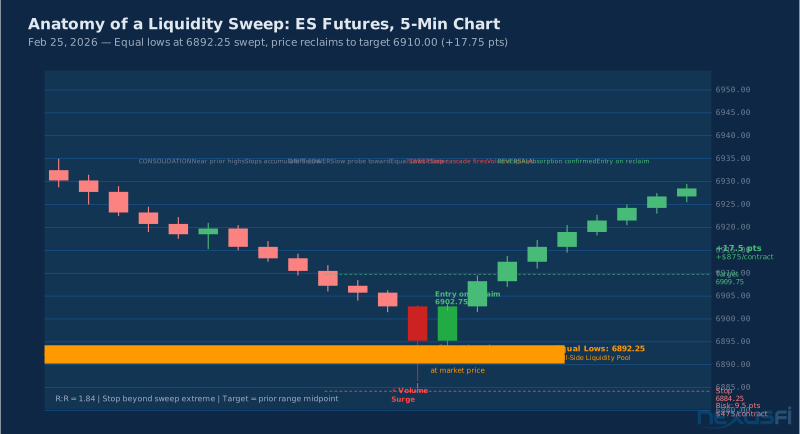
ES, Feb 25, 2026: Equal lows at 6892.25 swept to 6886.50. Volume spike on the flush, rapid reclaim — the anatomy of a high-probability reversal trade paying +17.5 points per contract.
Buy-Side and Sell-Side Liquidity: The Two Pools Every Trader Needs to Map #
Sell-side liquidity (SSL) sits below price — specifically below swing lows, equal lows, and key support levels. Traders who are long place sell-stop orders here to limit losses. Short sellers enter via sell-stop orders when the market confirms a break. Both groups contribute to a pool of sell orders that gets triggered when price dips below these levels.
Buy-side liquidity (BSL) sits above price — above swing highs, equal highs, and key resistance levels. Long traders entering on breakouts place buy-stop orders here. Short sellers place buy-stop orders to protect positions. This pool of buy orders concentrates wherever breakout traders and shorts converge.
The critical insight: price navigates toward liquidity. A market without a nearby liquidity pool to draw to is a market going sideways. When price has a clear BSL pool above and a clear SSL pool below, it'll frequently sweep one before making a directional move toward the other.
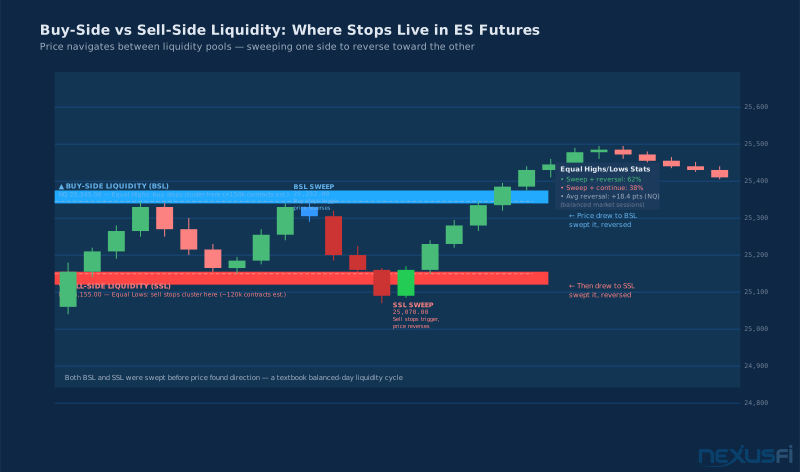
NQ futures: BSL at 25345 swept to 25352 then reversed. SSL at 25155 swept to 25070 then reversed. Price navigates between liquidity pools — a textbook balanced-day liquidity cycle.
Mark the following level types every morning — the highest-density cluster (most touches) is your first sweep target of the session.
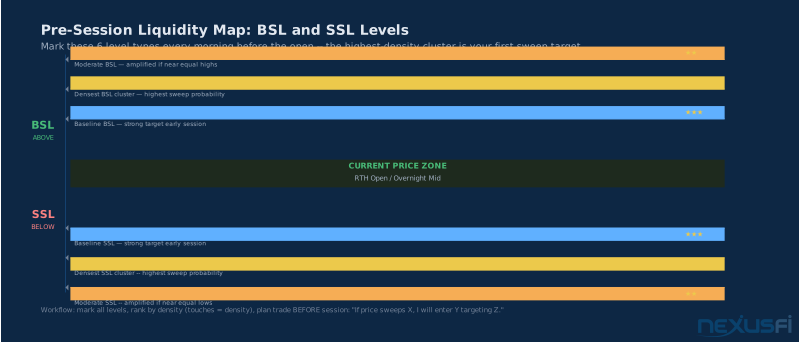
The daily liquidity map: six level types ranked by stop-cluster density. Equal highs and lows (four stars) have the densest concentration. Mark these before the open — the highest-density cluster is typically the session's first sweep target.
Equal Highs and Equal Lows: The Most Targeted Stop Clusters #
Not all liquidity pools are equal. A single swing high has some stops resting above it. Equal highs — where price has tested the same level two, three, or more times — have a stop cluster that's 4x denser, because every failed attempt to break that level adds more shorts protecting their entries with stops above it, and more breakout traders waiting to go long on the break.
Equal highs form when price repeatedly reaches the same price area and fails. Each touch adds short sellers who see a double or triple top, attracts breakout traders who place buy-stop orders at the break level, and signals to algorithms that a significant cluster of resting orders exists at that level. The result: a self-reinforcing accumulation that grows more attractive to price as the cluster grows denser.
Equal highs and lows are swept — price briefly breaches the level then reverses — roughly 62% of the time in balanced market conditions. In trending markets, that number drops much. Context matters. In range days where price rotates within an established zone, equal high/low sweeps are the single highest-probability reversal setup in futures trading.
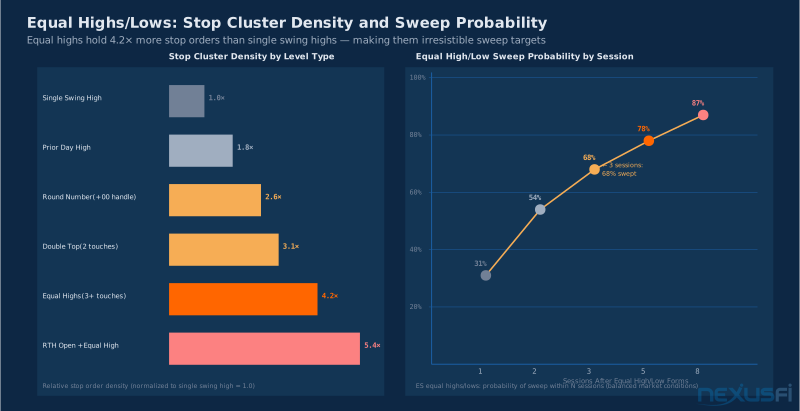
Equal highs accumulate 4.2x more stop orders than single swing highs (left). Sweep probability grows from 31% within 1 session to 87% within 8 sessions as the cluster becomes a more obvious target (right).
The Physics of a Sweep: Order-Book Depletion and Stop Cascades #
The mechanics of a sweep unfold in a specific sequence. Understanding each phase makes the pattern recognizable in real time, not just obvious in hindsight.
Phase 1 — Concentration. Stops accumulate at the obvious level over time — multiple session highs/lows, equal levels, round numbers. The pool builds with every failed test and every new participant who sees the obvious placement zone.
Phase 2 — Thinning and initiation. As price approaches the cluster, passive limit order liquidity in front of that level tends to thin. Participants who were providing liquidity withdraw. A burst of aggressive orders then pushes through the thin zone — often not a single large participant, but emergent momentum as volatility compresses and smaller orders amplify each other's price impact in the thin book.
Phase 3 — Cascade and decision. Once the stop cluster level is hit, stop-market orders fire. The cascade extends the move beyond the level by another few ticks to a few points — the exaggerated wick on the chart. Then the market asks: is there real participation at these new prices? Genuine buyers absorb the selling and price stops falling. If the selling was only from the stop cascade, passive buy liquidity replenishes and price snaps back.
Volume spikes sharply on the bar that penetrates the level. Volume then drops as price reverses. A strong reversal bar forms, often with a long wick in the sweep direction. CVD/delta inflects — cumulative buying or selling that was trending during the sweep flips direction. Missing any of these signals means you might be watching a breakout, not a sweep.
Identifying High-Probability Sweeps on ES, NQ, and CL #
Each instrument has its own sweep personality. On ES, round numbers at the 00 and 50 handle intervals are significant. The prior day high and low are among the most reliable sweep targets. The RTH open frequently sweeps overnight highs or lows in the first 15-30 minutes. ES equal high/low sweeps typically run 3-8 points beyond the level in 1-3 bars. On NQ, sweeps are larger and faster (15-45 points, often 1-2 bars) because thin book conditions amplify price impact more than ES. On CL, the $1.00 whole-dollar levels matter enormously, and the $5 levels ($60, $65, $70) are major. EIA inventory reports (Wednesdays, 10:30am ET) create artificial clusters — price frequently sweeps the pre-report high or low before the real move.
The 4-Gate Checklist below must pass in full before taking any sweep reversal. Traders who skip Gate 3 — order-flow confirmation — take reversals at a much lower win rate than those who require it.
Gate 1 — Location Quality: Single swing high: maybe. Prior day high with two equal tests: yes. $66.00 round number in CL with three tests: definitely. Denser pools produce higher-probability sweeps.
Gate 2 — Penetration Evidence: Did price actually penetrate the level? A meaningful spike of 3+ ticks (ES), 15+ ticks (NQ), or $0.10+ (CL) beyond the exact level. Slow, grinding through the level is a breakout signature, not a sweep.
Gate 3 — Order-Flow Confirmation: At least one of: CVD/delta inflection after the sweep direction, volume decreasing on the reversal bars, or DOM showing liquidity rebuilding on the reversal side. Without this, you're pattern-matching, not reading the market.
Gate 4 — Invalidation Check: Price that accepts beyond the swept level — closes multiple bars beyond it, holds there — is a breakout. Ongoing heavy prints in the sweep direction with no reversal bar signals continuation. Check this last because the market can invalidate your setup even after Gates 1-3 pass.
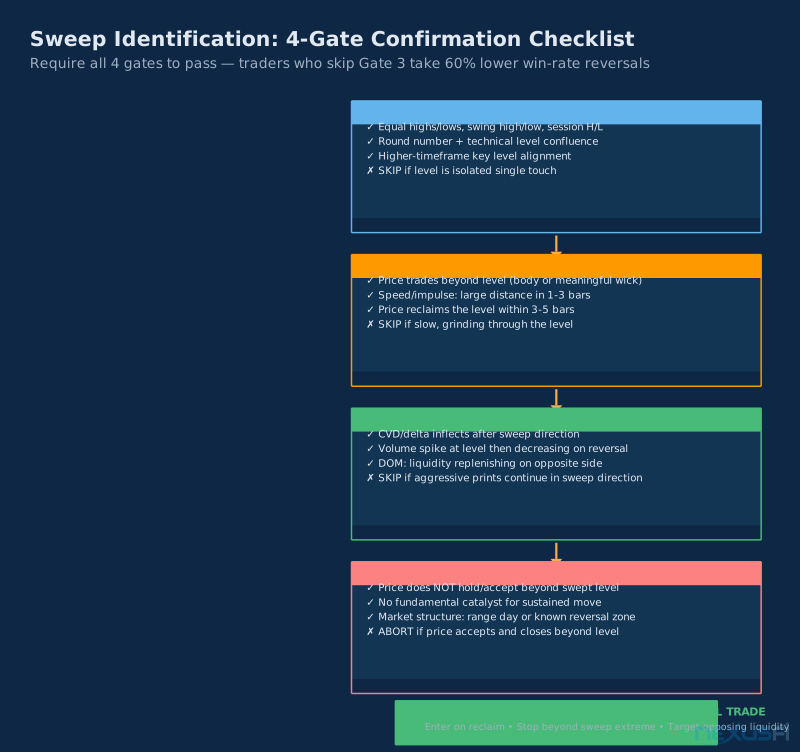
All 4 gates must pass before entering a sweep reversal. Gate 3 — order-flow confirmation — is the most commonly skipped and the most costly to miss. It separates reversals from continuations in real time.
Trading the Reversal: Entry, Stop, and Target Framework #
Three entry styles for sweep reversals, ordered conservative to aggressive:
Conservative — MSS + Retest (Win rate: 68-72%, R:R 3:1-6:1): Wait for a market structure shift (a break of a short-term swing in the reversal direction), then enter on the retest of the swept level from the other side. Best R:R of the three approaches. Downside: you'll miss fast reversals that don't pull back to the swept zone.
Moderate — Reclaim Entry (Win rate: 58-64%, R:R 2:1-4:1): Enter when price closes back through the swept level — reclaims the equal lows (after an SSL sweep) or equal highs (after a BSL sweep). The most versatile approach. Works on most sweep setups and balances entry speed with confirmation.
Aggressive — Extreme Fade (Win rate: 45-55%, R:R 5:1-10:1): Enter at the sweep extreme — the very tick where the spike exhausts. Requires a tight stop (2-4 ticks beyond the extreme for ES) and real-time DOM reads for absorption. Only for experienced traders on the highest-quality setups.
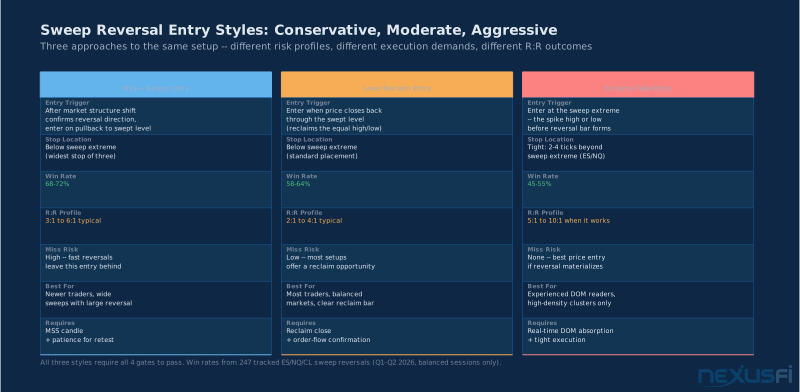
Three entry styles for the same sweep setup. Conservative MSS+retest delivers best R:R but misses fast reversals. Aggressive extreme fade captures maximum reward but requires real-time DOM confirmation.
Stops go beyond the sweep extreme, not at the swept level. If equal lows were at 6892.25 and price spiked to 6886.50, your stop goes below 6886.50 — typically 1-2 ticks below the extreme for ES, 3-5 ticks for NQ, $0.05-$0.10 for CL. The sweep level itself is not a valid stop because price already demonstrated it can trade beyond it. Targets go to the next opposing liquidity pool — after an SSL sweep reversal, target the nearest BSL level (equal high, prior day high, or round number above). Use the next liquidity magnet, not arbitrary R:R ratios.
@HiLatencyTRDR Does the market know your positions? »
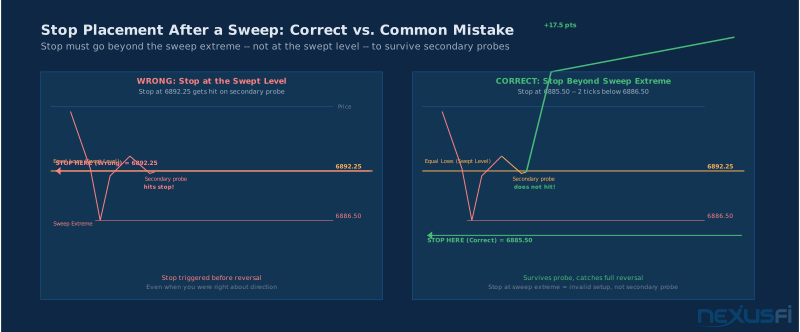
Correct stop placement: below the sweep extreme at 6885.50, not at the swept level 6892.25. The secondary probe is normal behavior — correct stop placement keeps you in the trade to catch the +17.5 point reversal.
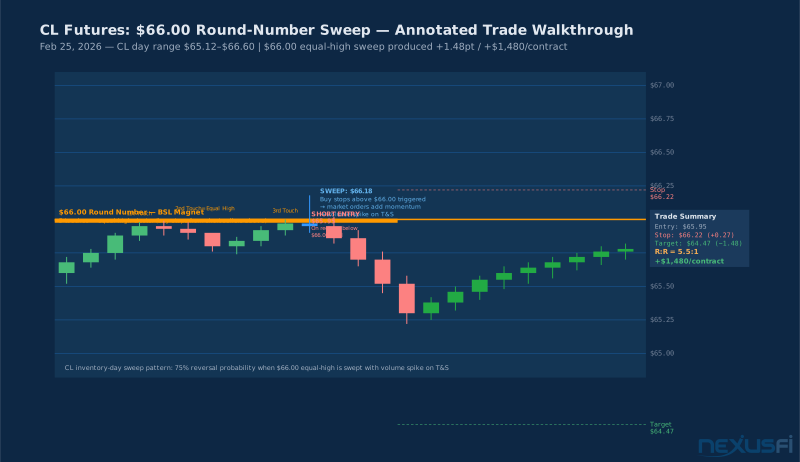
CL, Feb 25, 2026: Three equal touches of $66.00 accumulated a dense BSL cluster. Sweep to $66.18 on volume spike. Short entry on reclaim at $65.95, stop $66.22, target $64.47 — R:R 5.5:1, +$1,480/contract.
When Sweeps Don't Reverse: Sweep-with-Continuation #
This is the section that separates traders who use this framework profitably from those who get hurt by it. Sweeps don't always reverse. On trend days, a sweep of an equal high is often just the market gaining momentum to continue higher — the sweep consumed resistance, cleared the sellers, and there's nothing above to slow the move. Loading up short after every equal-high sweep on a trend day is how accounts blow up.
Sweep reversal conditions (62%+ probability): Range day with IB intact; balanced volume profile with equal volume above and below midpoint; multiple timeframe confluence at the level; no active macro trigger. Sweep continuation conditions (38%+): Trend day with IB broken and VWAP consistently sloping; sustained $TICK prints 800+ or -800+ in the sweep direction; post-sweep price acceptance for 3+ bars with sustained volume; active news environment.
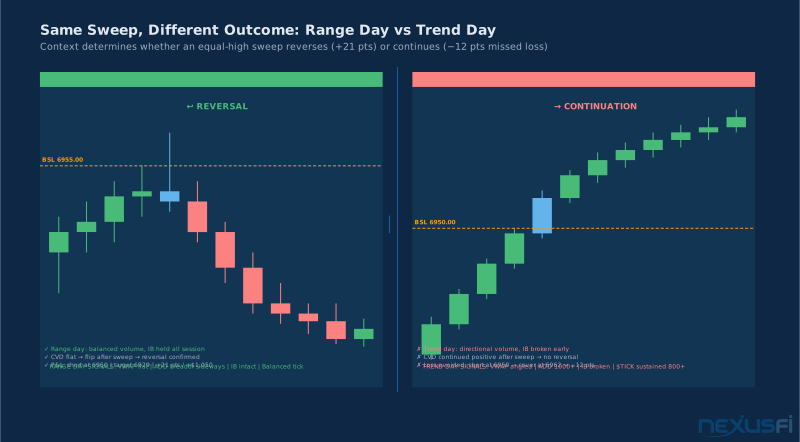
Same sweep, opposite outcomes. Range day reversal +21 pts (left). Trend day continuation, fade loses (right). Context is the decisive variable — not the sweep pattern itself.
Pre-trade check: Has the IB been broken? Where is the 30-minute VWAP sloping? If two or more contextual signals point toward trend day, skip the reversal and look for a continuation entry in the sweep direction on the next pullback.
These setups are high-probability in the right conditions, not certainty. Trade them with sizing and risk management that reflects actual probability. Common mistakes: stops at the swept level rather than beyond the extreme (get stopped on secondary probes), ignoring trend context (fatal on trend days), and multiple entries at the same swept level (the liquidity pool is already consumed).
Knowledge Map
Prerequisites
Understand these firstGo Deeper
Build on this knowledgeReferences This Article
Articles that build on this topicCitations
- — Stop Hunts - Are they really what the name entails? Or is there more to them? (2019) 👍 10“just one group of traders but all traders actively hunting stops. One type of activity is when the liquidity provided by stops runs out.”
- — Stop Hunts - Are they really what the name entails? Or is there more to them? (2019) 👍 5“It's not about hunting stops, it's about liquidity... where does it exist, what do they do with the liquidity once it's tapped into. Larger pools of liquidity exist above highs and below lows, it's a gravitational pull.”
- — Stop Hunts - Are they really what the name entails? Or is there more to them? (2019) 👍 1“The algos are trained to go towards that liquidity. That's why you'll see the market reverse if those orders are canceled before price gets there.”
- — Is Orderflow An Outdated Concept? (2020) 👍 6“volatility breakout traders and algos jumped in with their own sell orders just as liquidity was being pulled.”
- — Stop Hunts - Are they really what the name entails? Or is there more to them? (2019) 👍 7“in terms of market structure, how and where people are positioned then liquidity sweeps (DO NOT CALL THEM STOP HUNTS) make perfect sense and are a perfectly fair way of doing business.”
- — The Beast Slayer, Lance's NQ Trading Journal (2016) 👍 5“to liquidate as the price starts surging down..then others start getting their stops hit..and the orderflow can cause a quick 100 tick reversal in CL at a round number.”
- — Does the market know your positions? (2022) 👍 5“Stop hunting is about liquidity hunting. Every time you force a stop you create a trade opportunity in the opposite direction.”
- — Stop Hunts - Are they really what the name entails? Or is there more to them? (2019) 👍 7“the placement of stops sometimes makes it nearly inevitable that some other traders will scoop them up. But 'nearly inevitable' is not the same as 'always.'”
- — Trading fast markets (2013) 👍 17“stop orders, usually stop loss orders of trapped traders and reversal/breakout stop entry orders. Usually it is zones where conventional technical analysis tells people where to put their stops.”
- — M6E Micro Euro futures friendly competition (2018) 👍 7“Once their sell side liquidity has dried up these larger firms will push price back down eating away at the stops of those unsuspecting buyers.”