



Liquidity in Prediction Markets: Depth, Spreads, and Market Impact
Understanding bid-ask spreads, order book depth, and how liquidity affects your fills — and your trading strategy — on Kalshi and Polymarket.
Overview #
Liquidity is the ability to enter and exit positions at predictable prices without moving the market against yourself. In prediction markets, liquidity determines whether you can actually execute the trades your analysis suggests, at the prices you expect, and exit when you want to.
This article covers the mechanics of liquidity in prediction markets: how spreads and depth work, why some markets are liquid and others are not, how to assess liquidity before trading, and how to adapt your strategy based on market conditions.
In prediction markets, liquidity determines whether you can actually execute the trades your analysis suggests, at the prices you expect, and exit when you want to.
The Bid-Ask Spread: Your Primary Liquidity Metric #
The bid-ask spread is the gap between the best price available to buy YES (the ask) and the best price available to sell YES (the bid). If you can buy YES at 71¢ and sell YES at 69¢, the spread is 2¢.
The spread represents the immediate round-trip cost of entering and immediately exiting a position. A 2¢ spread on a 70¢ contract means you pay roughly 2.9% of the contract's value just to enter and exit — before considering fees.
Why Spreads Exist #
Market makers quote both sides of the market to earn the spread. They take on the risk of holding positions while waiting for offsetting orders. The spread compensates them for:
Adverse selection risk: Some traders have better information. Every time a market maker fills a trade, there's a probability the counterparty knows something they don't. The spread must cover expected losses to informed traders.
Inventory risk: A market maker who has sold a lot of YES now has a short position that could be painful if the probability moves against them. They widen spreads when they have undesirable inventory.
Time value: Market makers tie up capital in positions. The spread compensates for the opportunity cost of that capital.
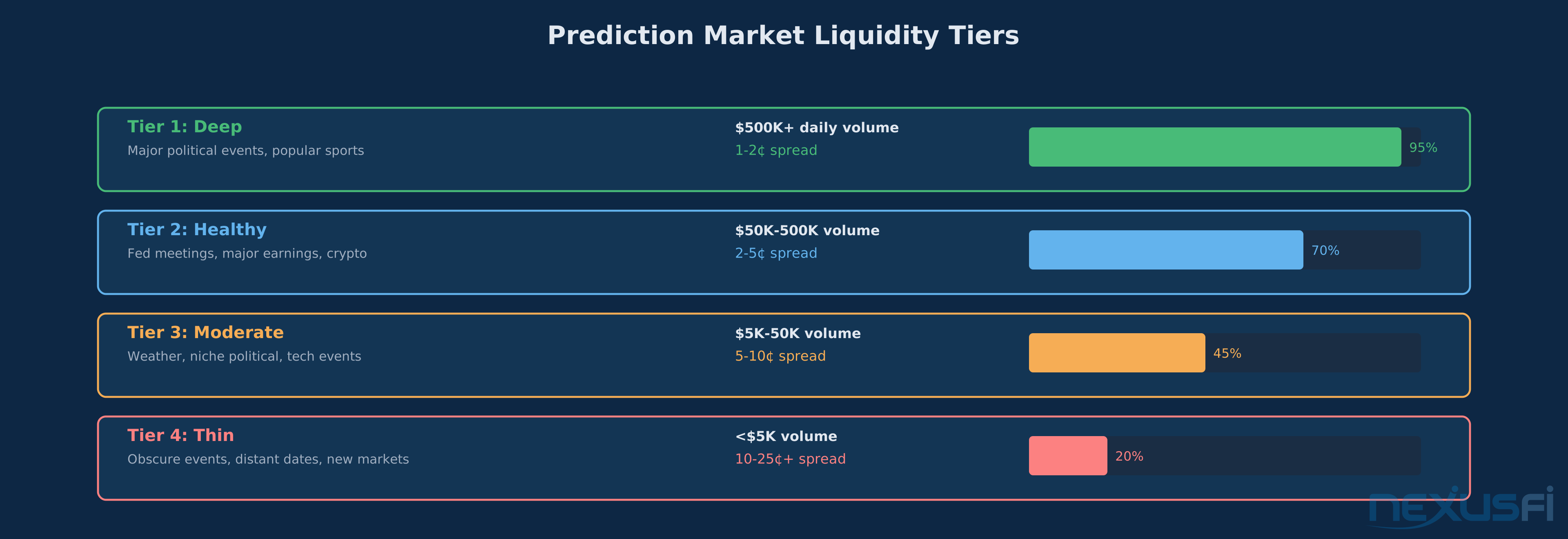
Typical Spreads by Market Type #
- Major elections (Kalshi): 1-3¢ in liquid contracts, often tighter near resolution
- Monthly economic releases (CPI, jobs, Fed rate decisions): 2-5¢
- Smaller elections, specific event markets: 5-15¢
- Very thin or niche contracts: 15-30¢ or more
Wide spreads don't mean you shouldn't trade — they just mean your edge must be large enough to overcome them. A 15¢ edge on a 10¢-spread contract is still a good trade. A 3¢ edge on a 10¢-spread contract is not.
Order Book Depth: Beyond the Spread #
The bid-ask spread tells you the cost of a small trade. Order book depth tells you what happens when you try to trade a larger size.
Every prediction market order book shows the volume available at each price level. If the best ask for YES is 71¢ with $2,000 available, and the next level is 73¢ with $5,000 available, you know you can buy $2,000 at 71¢ but the next $5,000 will cost 73¢.
Reading Depth on Kalshi #
Kalshi shows a simplified order book view that displays the best bid and ask, plus approximate depth. For full order book data, you need Kalshi's API.
Key metrics to extract from the order book:
Top-of-book spread: Best ask minus best bid. The immediate transaction cost.
1% depth: How much capital can you deploy without moving the price by more than 1 percentage point? This is the practical limit for trading without significant market impact.
Depth imbalance: If there's $50,000 of buy interest and $5,000 of sell interest at current prices, the imbalance suggests directional pressure. Prices typically move toward the thinner side.
Refresh rate: Does depth refill quickly after trades? Fast-refreshing markets indicate active market makers. Slow-refreshing or non-refreshing books suggest few market makers and potentially stale prices.
Liquidity Tiers in Practice #
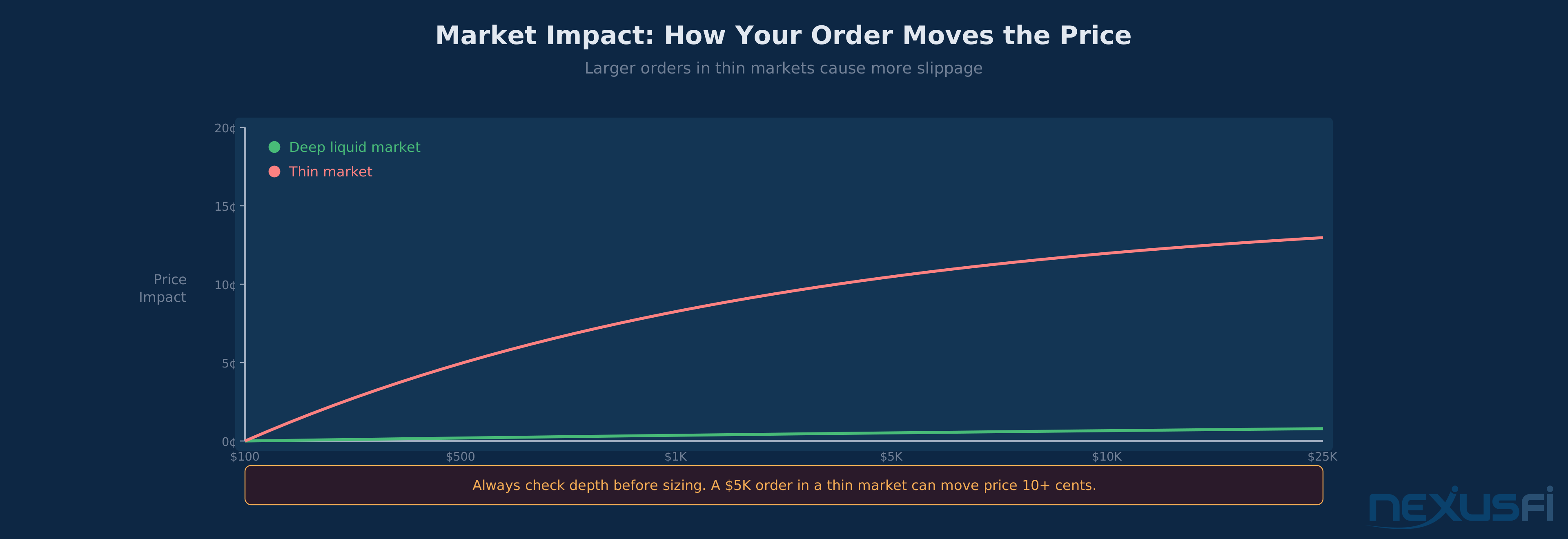
Prediction markets span a wide liquidity spectrum. Understanding where each contract sits helps set appropriate expectations.
Tier 1: Institutional Liquidity #
Markets like major US elections (presidential, Senate races), monthly CPI releases, and quarterly Fed rate decisions attract professional market makers, algorithmic traders, and significant retail flow. These markets typically have:
- Spreads of 1-3¢
- $50,000--$500,000+ of depth within 5¢ of mid
- Active trading around the clock, with higher activity around news events
- Multiple competing market makers compressing spreads
Kalshi's 2026 Super Bowl markets hit over $1 billion in total trading volume — these aren't toy markets. At that scale, spreads become purely a function of information asymmetry, not market immaturity.
Tier 2: Active Markets #
Mid-tier markets include: state-level elections with national significance, individual Fed speaker appearances, major economic releases outside the top tier (retail sales, housing starts), and significant sports events. These markets have:
- Spreads of 3-8¢
- $10,000--$50,000 depth
- Active during peak hours, sparse overnight
- One or two regular market makers
Tradeable, but position sizes should stay within the top-of-book depth to avoid significant impact.
Tier 3: Thin Markets #
Most prediction market contracts fall in this category. Minor elections, specific policy outcomes, niche economic data points, and many crypto/tech event contracts are thinly traded with:
- Spreads of 10-30¢
- Under $5,000 total depth
- Sporadic trading, often no active market maker
- Prices may not move for hours between trades
In thin markets, your position is the market maker. If you buy YES at 65¢ when the ask is 65¢, you immediately create a 65¢ bid from your position. Exiting may require accepting the existing bid (perhaps 50¢), representing a large total round-trip cost.
Polymarket vs Kalshi: Liquidity Comparison #
The two primary prediction market platforms have different liquidity profiles driven by their structural differences.
Kalshi (CFTC-regulated, fiat): Liquidity concentrates in US-accessible event categories: economic data, US elections, sports leagues with US fan bases. Professional market makers participate because it's a regulated venue with USD settlement. The regulatory clarity that Kalshi achieved in 2025-2026 has accelerated institutional participation, deepening liquidity in core markets.
Polymarket (Polygon blockchain, USDC): Historically stronger liquidity for global political events, cryptocurrency-related outcomes, and any market where US regulatory restrictions might limit Kalshi's audience. However, USDC friction (needing to convert USD→USDC via bridge) has historically limited some retail participation. Polymarket's order book depth tends to be shallower than Kalshi's in comparable markets.
Practical guidance: For US economic data and US elections, Kalshi typically offers tighter spreads and deeper markets. For global political events, cryptocurrency events, or anything where Polymarket has a larger user base, check both before deciding.
How Liquidity Affects Trading Strategy #
Liquidity isn't just a cost factor — it shapes what strategies are viable.
Liquidity-Dependent Strategies #
Short-term trading (hours to days before resolution): Works only in liquid markets. In thin markets, the spread cost makes frequent entries and exits unprofitable. Even correct directional calls lose to friction if the spread is 15¢.
Scaling into large positions: In thin markets, building a large position requires accepting progressively worse prices as you work through the available depth. In liquid markets, you can enter quickly without moving prices against yourself.
Exit flexibility: In illiquid markets, your exit options are constrained. If a contract is heading toward an unfavorable resolution, you may not be able to exit without accepting a dramatically lower price. In liquid markets, you can cut losses immediately.
Strategies That Work in Thin Markets #
Buy-and-hold to resolution: If you have genuine edge on a thin market, the round-trip cost only matters once (at entry and at resolution). Entry spread + fees must be covered by your edge, but you don't pay the spread again on exit — contracts resolve at $1.00 or $0.00.
Being the market maker: Post limit orders inside the existing spread. If YES is trading at bid 50¢/ask 65¢, post a bid at 58¢ and an ask at 60¢. You earn the spread when natural buyers and sellers match with you. Requires conviction that fair value is between your bids and asks.
Value hunting at resolution approach: Some thin markets develop tighter spreads as resolution approaches and the outcome becomes clearer, attracting momentum traders. There may be opportunities to enter at resolution-adjacent prices with reduced uncertainty.
Assessing Liquidity Before Trading #
A practical pre-trade checklist for liquidity assessment:
1. Check total open interest: Under $50,000 → thin market caution. Over $500,000 → institutional-grade liquidity.
2. Measure the spread: Bid-ask spread > 5¢ means your edge must be significant to overcome friction. Spread > 15¢ means this is a buy-and-hold market only.
3. Look at recent volume: Was there meaningful trading today? Yesterday? If the last trade was 3 days ago, the stated price may not reflect current information.
4. Check price history: Has the price moved in response to relevant news events? Responsive prices suggest active market participants; stale prices suggest dormant markets.
5. Calculate total round-trip cost: Spread + entry fee + exit fee. For a round trip, all four costs apply. Is your edge larger than this total?
Citations #
- @Fi: Kalshi Hits $1 Billion in Super Bowl Trading Volume — Market depth and volume data for institutional-grade prediction markets
- @Fi: Plus500 Futures Launches US Prediction Markets Through Kalshi Partnership — Institutional participation in Kalshi deepening liquidity
- @Fi: Kalshi, Polymarket, Prediction Markets etc — Community analysis of platform liquidity differences
- @Fi: Google Opens Advertising to CFTC-Regulated Prediction Markets Starting January 21 — Growth in retail participation improving liquidity
- Polymarket 101 — Polymarket Documentation
- How Kalshi Works: Contracts, Odds & Settlement Explained — pm.wiki
This article is part of the NexusFi Academy Prediction Markets series. Full series at /a/prediction-markets/.
Knowledge Map
Prerequisites
Understand these firstGo Deeper
Build on this knowledgeReferences This Article
Articles that build on this topicCitations
- — Event Contracts - New Way to trade the CME Futures markets (2022) 👍 6
- — CME Launching Binary Option Trading (2022) 👍 1
- — Kalshi Hits $1 Billion in Super Bowl Trading Volume (2026)
- — CME Group Launches 24/7 Futures Trading (2025) 👍 3
- — CME Group Event Contracts Blast Past 100 Million Traded (2026)