



Prediction Markets as a Futures Trading Edge: Using Event Contract Probabilities to Improve Sizing, Timing, and Catalyst Risk
Overview #
Prediction markets have crossed a threshold most futures traders haven't noticed yet. Kalshi is valued at $11 billion. CME's event contracts crossed 100 million traded in their first eight weeks. Polymarket processed over $1 billion in Super Bowl volume alone. These aren't novelties — they're becoming pricing infrastructure.
For ES, NQ, CL, GC, and ZB traders, this matters for one specific reason: prediction markets aggregate event probabilities in a way that futures sometimes don't reflect cleanly. When a Kalshi contract on "Fed holds rates in June" trades at 72 cents while Fed Funds futures imply only 65% probability of a hold, something is off. Either the PM participants know something, the PM is mispriced by retail flow, or the two instruments are pricing slightly different things. Figuring out which one applies — and acting on it correctly — is the entire edge.
This article is not about trading prediction markets as a standalone strategy. It's about using them as an input to futures decisions: improving your probability estimates before catalysts, calibrating position size to event uncertainty, and identifying the occasional case where PM pricing tells you the futures market is wrong about something important.
PMs and futures are complementary, not competing. PMs give you event probability. Futures give you reaction magnitude. You need both for a well-calibrated trade. High PM probability on a consensus outcome is not an edge — it's confirmation you're late. The edge lives in tail risk, divergence, and events where PM participants have better information than generalist futures traders.
What Prediction Markets Are -- and What They're Not -- for Futures Traders #
Prediction markets are exchange-traded contracts that pay out based on whether specific events occur. A "Yes" contract on "Fed raises rates in July 2026" pays $1 if the Fed raises rates and $0 if it doesn't. If that contract trades at $0.35, the market is implying 35% probability of a rate hike.
For a full mechanical walkthrough — how Kalshi contracts work, how to open an account, and how to read the order book — see Introduction to Prediction Markets: Trading Event Contracts on Kalshi.
That's it mechanically. What makes them useful — or dangerous — for futures traders is what they measure versus what they don't.
What PMs measure: the probability of a discrete, well-defined event occurring; the collective view of all market participants willing to stake real money on that outcome; and real-time probability updates as new information arrives.
What PMs do NOT measure: how much the futures market will move if the event occurs; whether the futures market has already priced the event; or the conditional reaction including positioning, path dependency, and second-order effects.
Early skeptics raised valid concerns. When CME first launched event contracts in 2022,
For futures traders using PMs as probability inputs — not as standalone trades — this is less of a concern. You're using the contract to calibrate your probability estimate, not betting on the precise final level.
This distinction is the single most important concept in this article. A prediction market can tell you there's a 70% chance the FOMC holds rates. It cannot tell you whether ES goes up or down when they hold — because the market reaction depends on what traders expected, how they were positioned, and what the Fed's statement says beyond the rate decision itself.
Futures traders who understand this boundary will use PMs correctly: as probability inputs, not as directional triggers.
The line between prediction markets and futures is blurring at the exchange level. As NexusFi member
CME event contracts crossed 100 million traded volume in their first eight weeks. For futures traders, PM pricing is becoming increasingly relevant — especially for rate decisions, economic data releases, and geopolitical events. Ignoring PM pricing is no longer a neutral position.
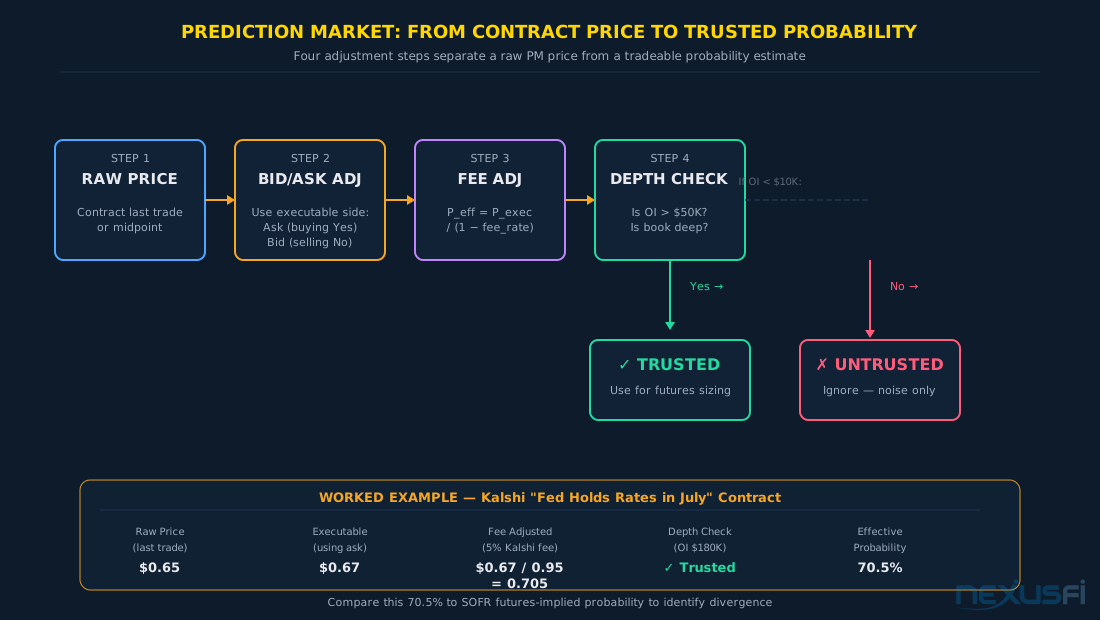
From raw PM contract price to a trusted implied probability — four adjustment steps separate a headline price from a usable probability estimate. Every step changes the number; skipping them creates false confidence.
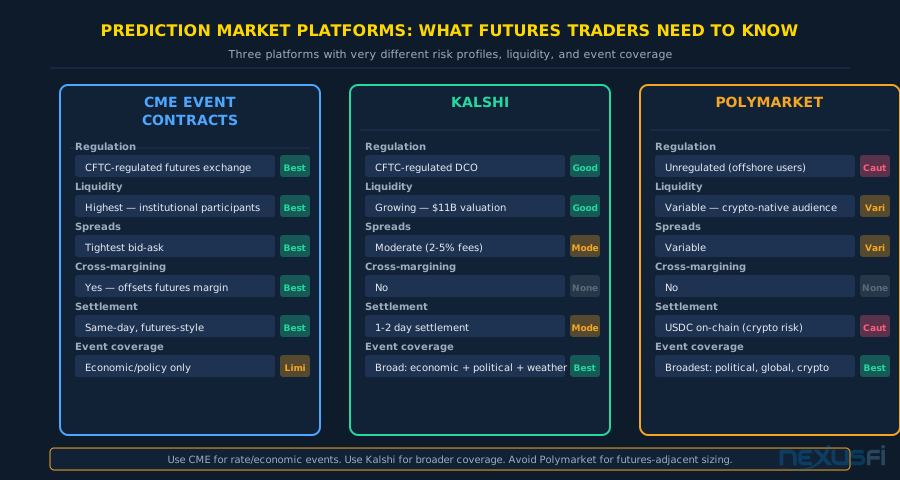
Platform comparison for futures traders using PMs as trading inputs. CME event contracts have cleanest integration with traditional futures; Kalshi has broadest market coverage.
Translating PM Prices into Implied Event Probabilities #
A Kalshi contract showing a last trade at $0.65 doesn't mean 65% probability — at least not without adjustment. Several friction sources distort the raw price.
The Bid-Ask Problem. Always use the executable side. Buying YES = pay the ask. Selling (taking NO exposure) = receive the bid. For a contract with bid $0.63 / ask $0.67: a YES buyer pays $0.67 (67% effective probability). Midpoint is reference only, not execution price.
Fee Adjustment. Platform fees (typically 2--5% on Kalshi, lower on CME event contracts) reduce effective payoffs. Formula: P_effective = P_executable / (1 - fee_rate). Example: ask $0.46, 5% fee → P_effective = 0.484. This matters when comparing PM vs futures-implied probability for divergence analysis.
Liquidity Gatekeeping. PM prices are only meaningful if the order book has real depth. Rule of thumb: below $10,000 total open interest treat as noise; $10,000--$50,000 use with heavy skepticism; above $50,000 probability extraction is more reliable; CME event contracts are generally the most reliable given exchange liquidity standards.
When the book is thin, a few large orders can move the price dramatically without reflecting genuine probability discovery. NexusFi members following Kalshi's OPEC-related event contracts have noted this pattern — "the price was basically whoever placed the last order, not a consensus probability" describes several of the commodity-linked contracts with shallow books.
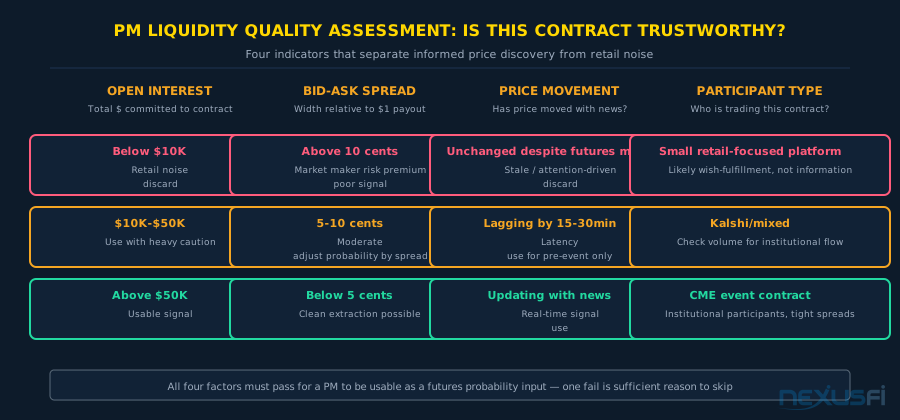
Liquidity tiers for PM probability extraction. Below $10K OI is noise; above $50K provides reliable signals. CME event contracts clear the bar by default.
Comparing to Futures-Implied Probabilities. Once you have a PM-extracted probability, compare it to what the futures market implies. For Fed rate decisions, SOFR futures provide an independent probability estimate via the implied Fed Funds rate. CME's FedWatch tool calculates this directly. When PM probability and futures-implied probability diverge by more than 5--10 percentage points, something is worth investigating. What exactly that means is covered in the divergence analysis section.
Contract Specification Risk: Why the Fine Print Matters #
This is where experienced traders lose money on otherwise correct PM trades. The contract specification — its exact legal settlement criteria — often prices something subtly different from what the headline suggests.
The Specification Mismatch Problem. Consider a PM contract titled "US CPI Above 0.4% for May." That sounds like a simple bet on the monthly inflation print. But the specification might state: "Resolves YES if the Bureau of Labor Statistics reports CPI-U month-over-month change of at least 0.40%, rounded to one decimal place, as published on the initial release date."
Three things can go wrong: (1) Series mismatch — CPI-U headline vs Core CPI are different numbers; if you're thinking about the "number that moves ES," you probably care about core, but the contract prices headline. (2) Rounding — "At least 0.40%" with one-decimal rounding means 0.398% rounds to 0.4% and resolves Yes, while the outcome near the threshold becomes probabilistically ambiguous. (3) Initial release only — BLS frequently revises data; a position that was correct on the eventual revised number but wrong on the initial print resolves against you.
The Mandatory Specification Checklist. Before treating any PM contract as a probability input to a futures trade, verify:
- Exact series: What specific index, metric, or measure does the contract use?
- Settlement source: Which official release, which data provider, which timestamp?
- Rounding rules: What precision does the settlement use? Where's the threshold, and how wide is the ambiguity band?
- Threshold semantics: "At least X" (>=) vs "above X" (>) vs "exceeds X" -- these are different.
- Revision policy: Does the contract settle on the initial print or the final revised figure?
- Time window: Specific date only, or "in any session before X"?
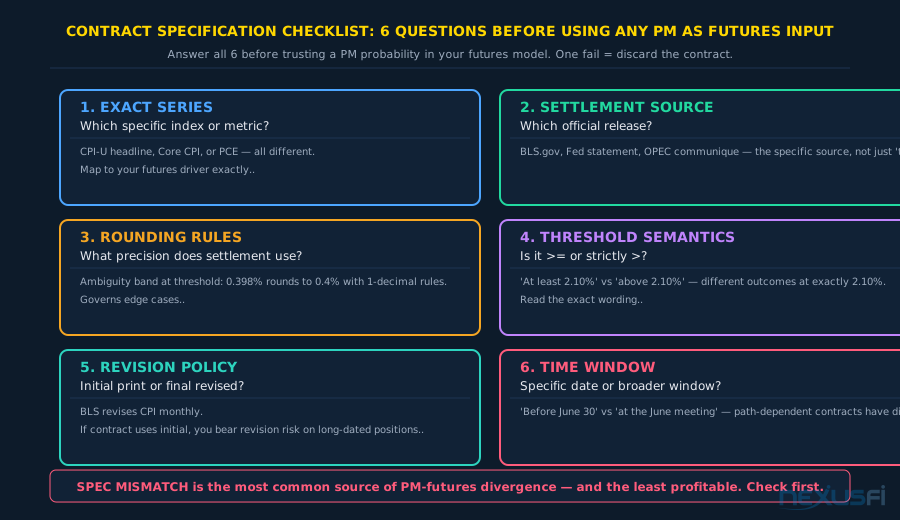
The 6-item specification checklist eliminates most PM contracts as unsuitable for futures trading. Pass all six or discard the signal.
OPEC Example. OPEC cuts are a canonical example of specification risk for CL traders. An event contract on "OPEC+ reduces output by at least 500,000 barrels per day" might resolve "No" even if actual production drops — because the official OPEC communique announced a "voluntary adjustment to support market stability" rather than an explicit "production cut." The resolution source (official OPEC statement) may interpret language differently than how you and the crude market understood the outcome. As @jlabtrades noted after an OPEC decision:
“The whole argument from the contract event houses is that this is peer to peer with clear rules -- but when it comes to OPEC wording, the resolution criteria and market narrative diverge constantly.”
-- @jlabtrades, NFA Raises Concerns About Direct Clearing for Retail Derivatives Traders
Read every contract's "Resolution" or "Settlement" tab before using its price as a probability input. If you can't reconcile the contract definition with your futures thesis precisely, don't use that PM as input. An imprecisely mapped probability creates false confidence, which is worse than no probability at all.
The PM-to-Futures Decision Workflow #
With clean probability extraction and verified specifications, the workflow for using PMs in futures trading follows seven steps.
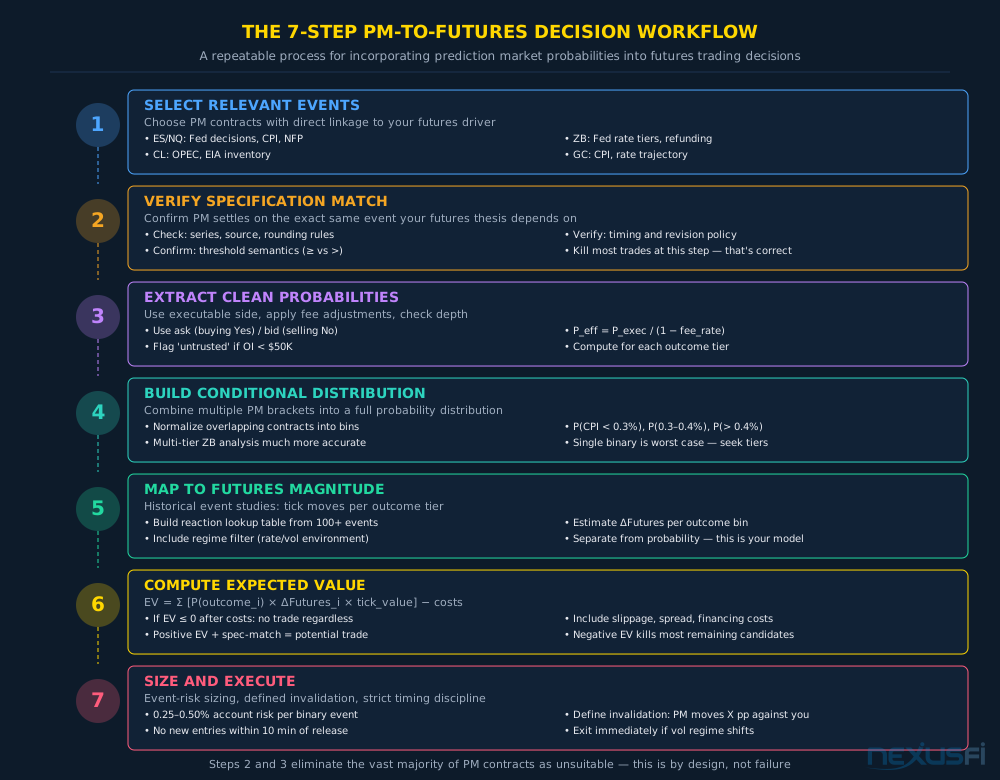
The 7-step PM-to-futures workflow. Steps 2 and 3 eliminate the vast majority of PM contracts as unsuitable — this is correct, not a failure. The workflow is designed to kill bad candidates quickly so time is spent only on genuine opportunities.
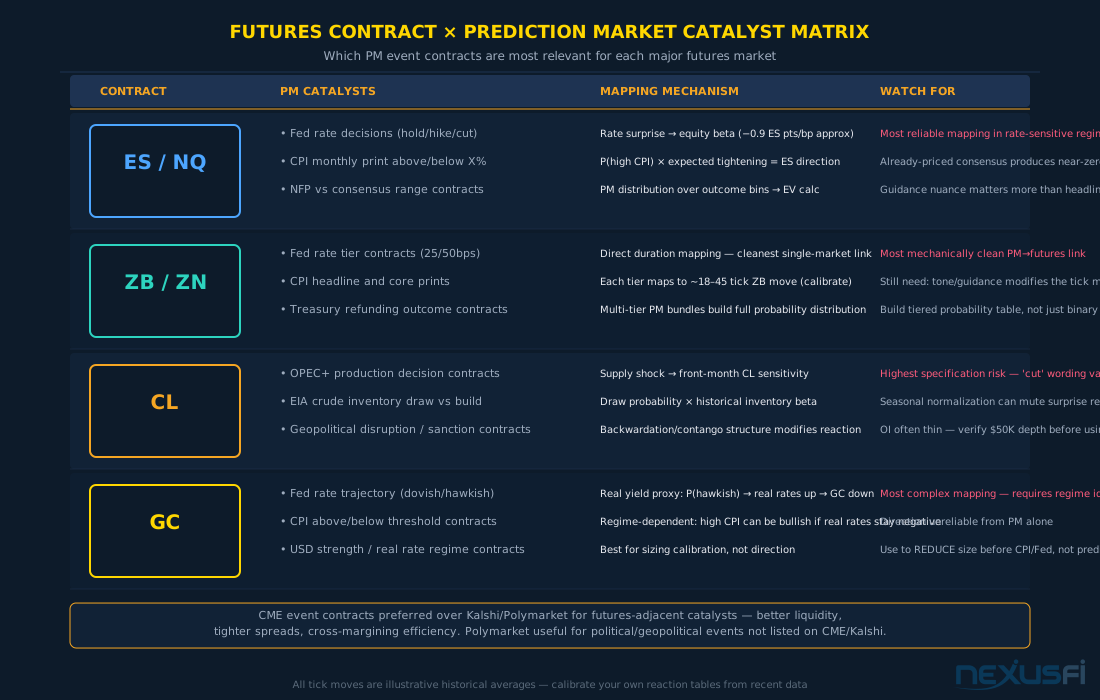
Step 1: Identify Relevant Events. Scan for PM contracts with direct linkage to your futures market's primary drivers. Don't stretch this. The relevant linkages are narrow: ES/NQ connects to Fed rate decisions, CPI prints, NFP, and ISM Manufacturing. ZB/ZN maps to Fed rate decisions, CPI, payrolls, and Treasury refunding auctions. CL maps to EIA crude inventory, OPEC meetings, refinery outage events, and geopolitical disruption contracts. GC connects to Fed decisions, CPI, and real rate trajectory contracts (less common but emerging).
If a PM contract can't be tied directly to a futures driver via a clear mechanism, skip it regardless of how liquid it is.
Step 2: Verify Specification Match. Run through the six-point checklist from the previous section. Confirm the PM is pricing the same event your futures thesis depends on. This step kills most potential trades — and that's correct. Most PM contracts are either too imprecise or too loosely connected to be useful for futures trading.
Step 3: Extract Clean Probabilities. Use executable side pricing, apply fee adjustments, verify order book depth meets your minimum threshold. Flag as "untrusted" if depth is insufficient. Compute P_effective for each event outcome tier.
Step 4: Build a Conditional Distribution. If multiple overlapping PM contracts exist (e.g., "CPI > 0.3%", "CPI > 0.4%", "CPI > 0.5%"), extract a complete probability distribution over outcome brackets. Normalize these into event bins: P(CPI 0.3--0.4%), P(CPI 0.4--0.5%), P(CPI > 0.5%), P(CPI < 0.3%). This gives you a distribution, not just a binary.
Step 5: Map to Futures Magnitude. Use historical event studies to estimate tick moves per outcome tier. For ES and CPI prints, build a lookup table: "When CPI surprises by > 0.1% upside in the current rate environment, ES typically moves X ticks in the first 30 minutes." PM gives you probabilities; historical data gives magnitude per tier. These are independent inputs.
Step 6: Compute Expected Value. EV = Sum of [P(outcome_i) × DeltaFutures(outcome_i)] × tick_value - transaction_costs. If EV is negative or near zero after costs, skip the trade. Transaction costs include futures spread plus slippage. Only proceed if EV is clearly positive after all adjustments.
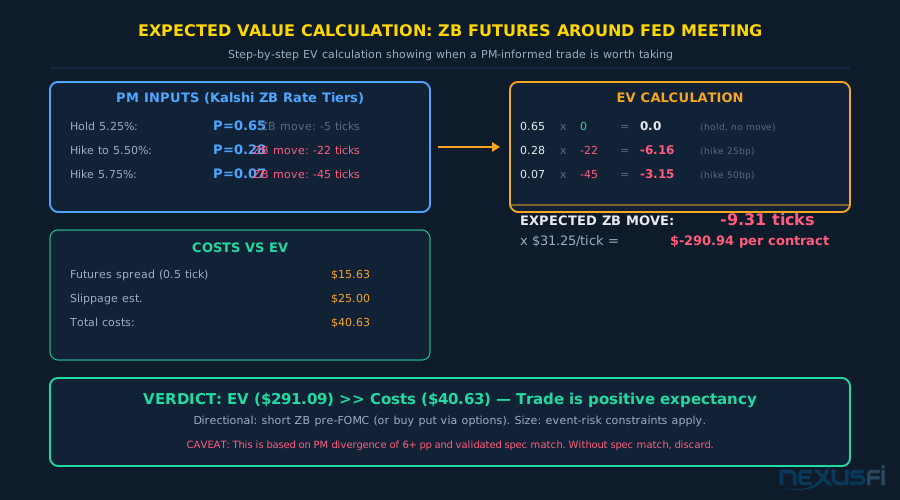
EV calculation from PM probability input to final position sizing decision. Each step reduces apparent edge — only trades surviving all four filters justify entering.
Step 7: Size and Execute with Defined Invalidation. Size using the event-risk framework in the next section. Define your invalidation in advance: if PM moves against your thesis by more than X points before the event, or if futures vol regime changes sharply, exit. The pre-event probability shift is your signal that the market has learned something you haven't.
Probability of Event vs. Magnitude of Futures Reaction #
The most common mistake PM-informed futures traders make: confusing a high-probability outcome with a high-magnitude futures move.
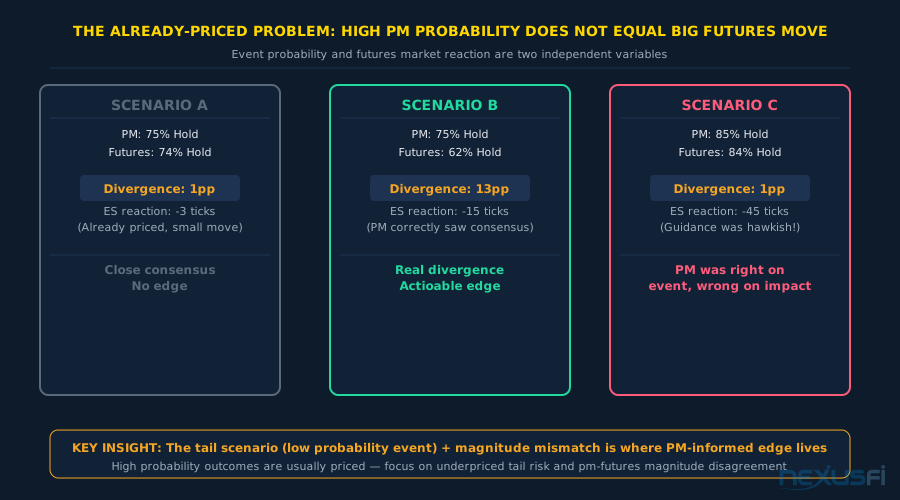
Three FOMC scenarios: high PM probability does not equal large futures move. Scenario C — high consensus hold — still produced a large drop because guidance was hawkish.
Why Fully-Priced High-Probability Events Often Produce Small Moves. When the Fed holds rates at 70% PM probability and CME futures also imply 70%, the futures market has incorporated this probability. If the Fed holds as expected, the futures reaction to the "expected" outcome is minimal. The futures market already priced it.
The large moves happen when: (1) the expected outcome occurs but with unexpected language or guidance (the 90% priced-in rate hold plus hawkish statement); (2) the low-probability outcome occurs (the 30% chance rate cut actually happens); or (3) positioning was wrong-footed — even a correctly priced probability doesn't prevent a large move if the market was skewed long into a hold that the futures subsequently sell.
For ZB specifically: if a "rate hike" PM shows 58% probability and ZB futures already embed 52% of a hike (via rates pricing), the 6-point divergence between PM and futures doesn't mean ZB is pricing the event incorrectly. It might mean PM is measuring the headline hike, futures are measuring the hike plus all the guidance content, or the futures vol term premium accounts for guidance uncertainty that PM can't measure.
The key formula: EV = P(outcome) × ΔFutures(conditional on outcome). The "conditional on outcome" piece requires historical calibration. A 25bps Fed hike in a risk-on environment produces a different ZB reaction than a 25bps hike in an already-hawkish regime. P(event) from PM is one input; the reaction distribution is a separate model.
Tail Risk Is Where the Edge Lives. Experienced traders using PMs for futures are often more interested in the 15--20% scenarios than the 70--80% scenarios. If PM prices the "surprise hike" at 18%, but the magnitude of that outcome would produce a 60-tick ZB sell-off — and the futures market seems to be positioned as if this risk is only 10% — there's a potential asymmetric trade. The asymmetric trade isn't "buy the probability agreement." It's "buy exposure to the underpriced tail, where the PM says more risk exists than the futures market acknowledges."
PM probabilities help identify which regime you're in — whether the trigger risk is well-hedged or still open.
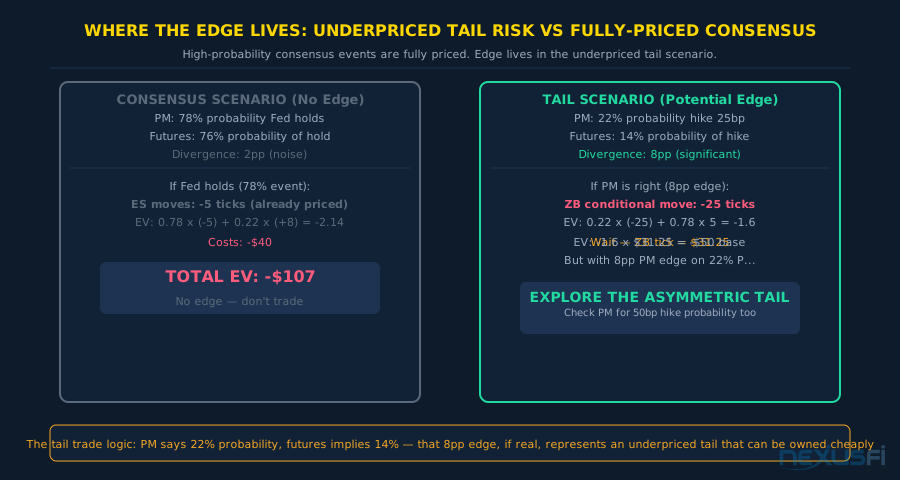
Tail risk is where the real edge lives. The 18% scenario with 60-tick potential often has better EV than the 75% consensus scenario with 5-tick potential.
Reading PM-Futures Disagreement #
When PM-implied probability diverges from futures-implied probability, the source of that disagreement matters. There are four possibilities.
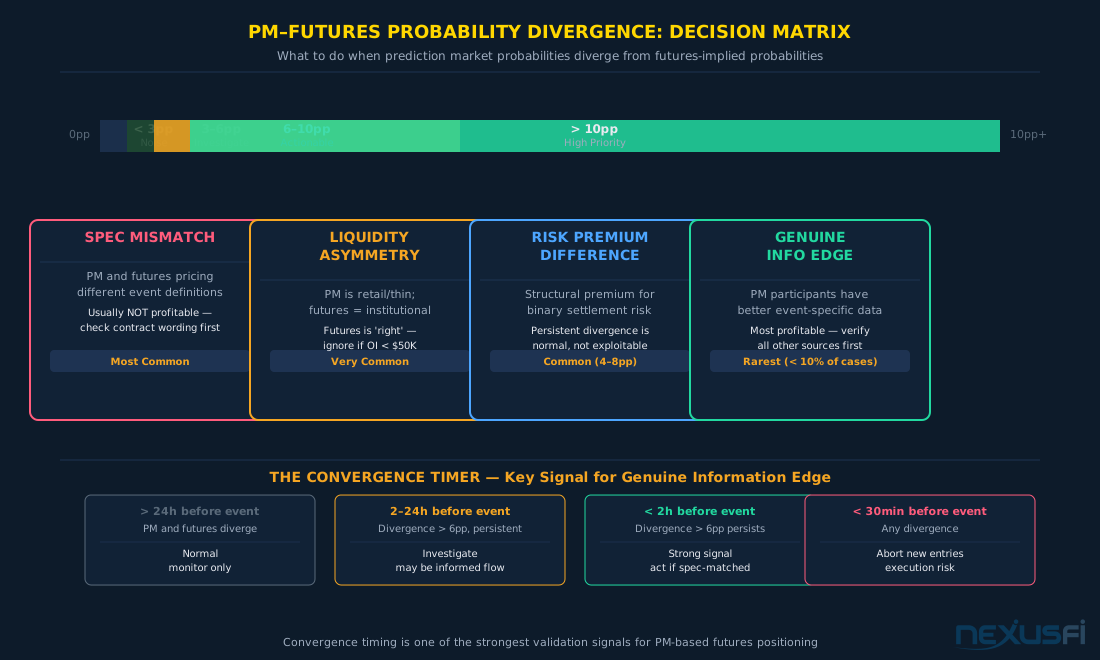
Four sources of PM-futures divergence, ordered from most common (spec mismatch) to rarest (genuine information edge). The convergence timer shows that persistent divergence near an event is the strongest signal — transient divergence is almost always noise.
1. Specification Mismatch (Most Common). The PM and futures are pricing different events. "FOMC raises to 5.50%" is technically different from Fed Funds futures on the June meeting, which price the path-implied rate across all outcomes. Check specification before assuming divergence is informative.
2. Liquidity Asymmetry. PM is retail-dominated and thin; futures represent institutional flow. In this case, the futures price is "right" and the PM is noise. Signs of this: PM bid-ask spread is wide (>5 cents on a $1 contract), total OI is below $50K, the PM price hasn't moved in hours despite futures moving.
3. Risk Premium Differences. PM prices embed a risk premium for holding binary exposure. Futures prices embed hedging demand from commercial participants. These are different risk premia that don't fully cancel. A persistent divergence of 4--8 percentage points may simply reflect this structural difference, not an exploitable mispricing.
4. Genuine Information Asymmetry (Rarest, Most Profitable). PM participants may have genuinely better information for specific event types. Prediction market participants who focus specifically on election outcomes or macro data often have better calibrated probabilities for those events than generalist futures traders. This is the scenario most traders hope for — but it's rare and hard to confirm in real time.
The Practical Decision Tree. When divergence exceeds your threshold (typically >6--10pp), run this sequence: (1) Confirm specification match — if no clear match, dismiss as noise. (2) Check PM liquidity — if below $50K OI, dismiss as noise. (3) Check if divergence is persistent (>2 hours before major print) or transient. (4) If persistent, liquid, and spec-matched: investigate whether PM participants have event-specific expertise that futures traders don't. (5) Only if all checks pass: consider sizing a position that exploits the divergence.
The convergence timing matters too. PM and futures tend to converge as the event approaches and information becomes more public. If you identify a real divergence, the window to act is often 2--24 hours before the event — after that, both markets incorporate new information rapidly.
Event-Risk-Aware Position Sizing #
Binary events produce non-normal return distributions. Standard position sizing based on daily ATR or typical volatility dramatically understates risk during event windows.
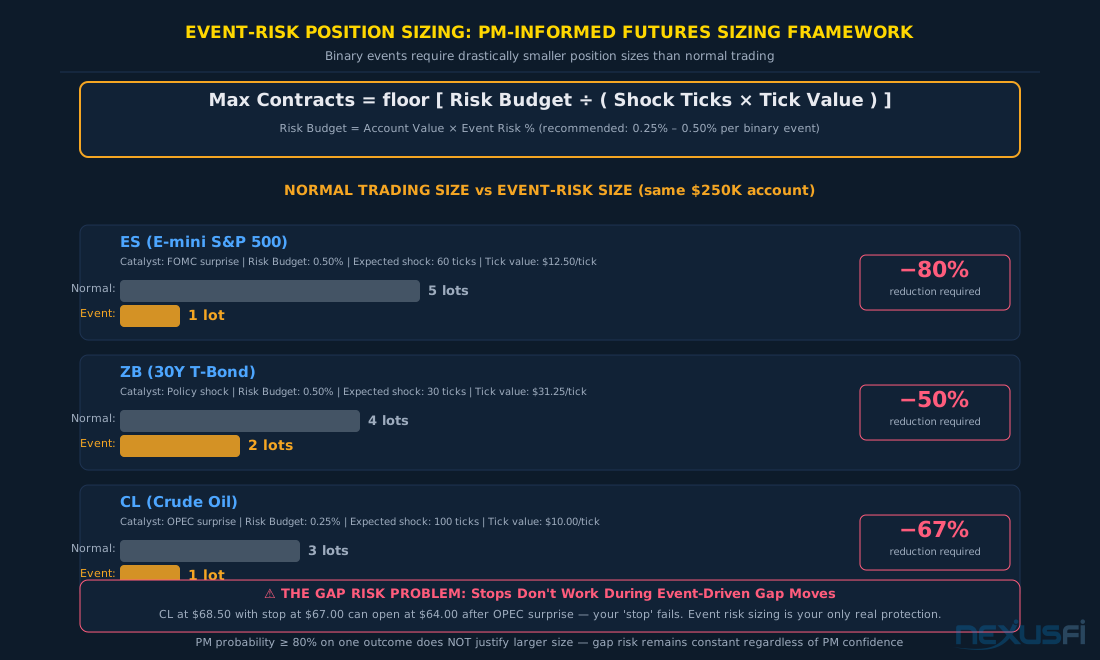
Event-risk sizing reduces standard position size by 60--80% across major futures contracts. The gap risk problem explains why: stops often fail during event-driven moves, making event sizing your only real protection against outsized losses.
Risk Budget Per Event. Allocate 0.25--0.50% of account value per binary event trade. This caps your loss if the adverse scenario occurs AND the market gaps through your stop — a real risk during event-driven moves. If CL is at $68.50 with a stop at $67.00 and OPEC announces a surprise production increase, the open might be $64.00. Your actual loss could be 3--4x your intended stop.
Sizing Formula. Max_contracts = floor(R / (T × V)), where R = risk budget in dollars, T = expected adverse shock ticks, V = tick value. For a deeper treatment of position sizing frameworks for binary event contracts including Kelly Criterion and fixed fractional approaches, see Position Sizing for Binary Event Contracts.
For ES during FOMC: 0K account, 0.5% risk budget = ,250, expected adverse shock 60 ticks, .50/tick. Max contracts = floor(,250 / 0) = 1 contract. Compare to normal sizing of 5 ES lots — event sizing is dramatically smaller. For ATR-based volatility calculations applicable outside event windows, see Volatility-Based Position Sizing.
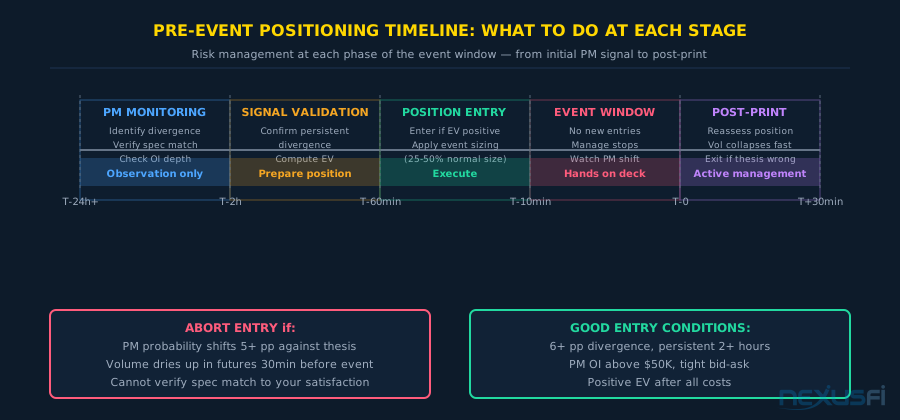
The pre-event execution timeline. T-60 to T-10 is the sizing window. Inside T-10, no new entries. T+0 to T+10 is management only — worst execution environment in futures trading.
Pre-Event Reduction Protocol. As events approach, liquidity typically thins and gap risk increases. Standard practice: at T-60 minutes, review sizing and consider 20--30% reduction from planned size; at T-10 minutes, if not already positioned, abort entry; T-0 to T+10 minutes, no new entries — manage existing positions only. The minutes immediately around a major print are the worst execution environment. Spreads widen, stops sweep multiple levels, and the bid-ask spread on futures can jump to 4--6 ticks even for highly liquid instruments like ES.
PM probability adjustment: if PM shows high certainty (>80%) for one outcome and you're trading with that outcome, you might be willing to hold slightly larger size. But the sizing floor remains the volatility/gap risk constraint above. Never let a high PM probability justify more size than your gap risk budget allows.
Market-Specific Examples: ES/NQ, CL, GC, ZB #

The trigger matrix for four major futures contracts. ZB has the cleanest PM mapping (direct duration link). GC has the least reliable direction prediction from PMs alone. CL carries the highest specification risk due to OPEC wording ambiguity.
ES/NQ: Fed Decisions and CPI. The cleanest PM-to-futures application for equity index traders. Relevant PM contracts: Fed rate decision by X basis points (CME event contracts or Kalshi), CPI above/below consensus. The mechanism is direct: higher-than-expected rate increases are bearish for ES/NQ; lower CPI is bullish.
Typical application: Use PM probability to calibrate your pre-FOMC position size. If PM shows a clear consensus (>75% on one outcome), reduce event sizing — the move may already be largely priced. If PM shows close to 50/50, extreme caution on size regardless of your directional view. @Miesto's FOMC analysis in the "Diary of a simple price action trader" thread noted that examining the high and low of the 4th 10-minute bar after the FOMC Statement release gave better signal than the initial move — context that PM probability can help establish in advance.
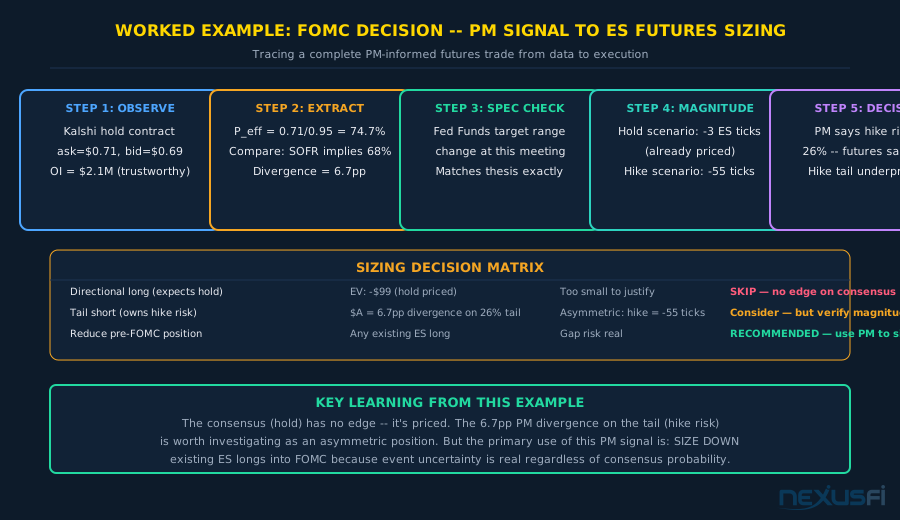
Full FOMC walkthrough. The consensus (hold) has no edge — already priced. The 6.7pp tail hike risk divergence justifies sizing down existing ES longs, not adding new shorts.
CL: OPEC and EIA Inventory. CL event contracts exist on both OPEC output decisions and weekly EIA inventory prints. The EIA inventory application is especially tractable: a "crude inventory draw > 2.5MM barrels" contract priced at $0.58 tells you the PM crowd expects a draw. Cross-reference against crude's current positioning and the crude contango/backwardation structure. If the front month is in backwardation (near-term scarcity priced in) and PM also shows a likely draw, both signals align.
OPEC event contracts require extra specification caution. The political nature of OPEC announcements makes "what counts as a cut" especially ambiguous. Use with heavier spec verification for OPEC-related CL positions, and default to using them only for sizing calibration rather than directional entry.
GC: Real Rates and CPI Trajectory. Gold is the most complex PM mapping. GC responds to real yields, USD strength, and central bank credibility simultaneously. A hot CPI print is bearish for GC only if real rates rise with nominal rates; if real rates stay negative, GC often rallies on inflation fears. The PM-to-GC mapping is regime-dependent — use CPI PMs for sizing calibration, not directional prediction.
ZB: Policy Rate Tiers. The cleanest single-instrument mapping. ZB/ZN futures are directly linked to rate expectations. When Kalshi or CME event contracts provide tiered probabilities — P(cut 25bps), P(hold), P(hike 25bps), P(hike 50bps) — you can construct a complete distribution over rate outcomes and map directly to ZB tick moves.
The mechanism is direct: construct a complete distribution over rate outcomes and map to ZB tick moves. When PM provides P(hold)=0.65, P(hike 25bps)=0.28, P(hike 50bps)=0.07, the conditional expected ZB move = (0.65×0) + (0.28×-22) + (0.07×-45) = -9.3 ticks. This directional expectation plus uncertainty distribution informs both direction and sizing. @sstheo in the "Making a Living with the Micros" thread:
Event sizing discipline is learned through experience, but PM analysis provides a framework to accelerate that learning.“I was FLAT going into the news at 2:00 pm ET. I have learned the hard way that holding through FOMC without defined event-risk sizing is dangerous.”
-- @sstheo, Making a Living with the Micros
Limitations, Failure Modes, and When NOT to Use PMs #
Thin Liquidity. Below ,000 open interest, PM prices are dominated by whoever places the last order — not a consensus of informed participants. Ignore these contracts for futures trading. The apparent "probability signal" is an artifact of low volume, not information discovery.
The "Already Priced" Problem. The most common form of failure: PM shows high probability, you trade with that probability, the event happens exactly as expected, and you lose money because the futures had already incorporated the probability. The test: would a surprise in the OPPOSITE direction be significant news? If no — if the expected outcome is so consensus that the non-expected outcome would barely move the market — then the PM is telling you something the futures already know.
For binary event contracts sizing guidance and how to calibrate position size across different contract types, see the dedicated position sizing guide.
When to Stop Entirely. Exit PM-informed positioning when: PM edge is less than 5pp vs futures-implied probability AND magnitude model has low confidence; order book depth falls below threshold before the event; futures vol regime has shifted much from your historical calibration; or specification match is unverifiable. Platform risk matters for multi-week positions — as @Fi noted, binary event contracts are "fully collateralized upfront — your money sits with the DCO for the entire duration" with no independent segregation verification. Day-of event sizing has less of this risk.
Knowledge Map
Go Deeper
Build on this knowledgeReferences This Article
Articles that build on this topicCitations
- — Kalshi Hits $1 Billion in Super Bowl Trading Volume (2026)“The convergence is real. CME Group already lists event contracts. The line between traditional derivatives and event contracts is eroding.”
- — Plus500 Futures Launches US Prediction Markets Through Kalshi Partnership (2026)“The prediction markets sector recorded $13 billion in notional value in Q4 2025. This isn't a novelty - it's becoming pricing infrastructure.”
- — CME Group Event Contracts Blast Past 100 Million Traded (2026)“As CME scales event contracts, watch for performance bond adjustments and potential cross-margining benefits with traditional futures positions.”
- — Spoo-nalysis ES e-mini futures S&P 500 (2022) 👍 9“Markets that are heavily hedged have less of a chance of an outsized move. Markets that are unhedged have a greater chance of an outsized move.”
- — Making a Living with the Micros (2021) 👍 11“I was FLAT going into the news at 2:00 pm ET. I have learned the hard way that holding through FOMC without defined event-risk sizing is dangerous.”
- — Diary of a simple price action trader (2024) 👍 5“Examined the high and low of the 4th 10min bar after the FOMC Statement - provides better signal than the initial move for ES positioning.”
- — NFA Raises Concerns About Direct Clearing for Retail Derivatives Traders (2026) 👍 1“The whole argument from the contract event houses is that this is peer to peer with clear rules - but when resolution criteria and market narrative diverge, the clear rules become the problem.”
- — NFA Raises Concerns About Direct Clearing for Retail Derivatives Traders (2026) 👍 1“Binary event contracts are fully collateralized upfront - your money sits with the DCO for the entire duration. 9 months of fund custody with no independent entity verifying segregation.”
- — Spoo-nalysis ES e-mini futures S&P 500 (2015) 👍 9“September Fed Funds futures discounting ~40% chance of a hike while economists say 80%+ -- the market hasn't fully priced in the hike as much as the consensus has.”
- — Event Contracts - New Way to trade the CME Futures markets (2022) 👍 6“You not only have to be right about the direction, but also the final level. If you were right to be long but were just a little off on the final level, you can lose 100%.”