



Reading Resolution Criteria: How to Avoid the Most Costly Prediction Market Mistake
The single most important skill in prediction market trading: understanding exactly what your contract resolves on, where the data comes from, and what happens at the edges. Resolution surprises are the #1 source of unexpected losses for traders who skip this step.
Overview #
Resolution criteria are the legal contract you're trading. The title of a prediction market contract is a summary. The resolution criteria are the actual binding definition of what must happen, verified by which data source, at what time, for YES to pay $1.00.
Experienced prediction market traders read the resolution criteria before reading anything else about a contract. If the criteria are ambiguous or don't match what you expected, you don't trade — regardless of how attractive the price looks.
A careful trader reads the resolution criteria and finds: `` The difference between reading the title and reading the criteria: - Initial release only: If the initial is 3.2% and the revision is 2.9%, the market already resolved YES.
This article covers how to read resolution criteria, the common traps they contain, and a systematic review process that prevents the most costly mistakes.
Why Resolution Criteria Matter More Than You Think #
Consider a contract titled "Will CPI come in above 3.0% for March?"
A careless trader reads "CPI above 3.0%" and thinks: I know CPI. I can estimate this. Let me check my economics.
A careful trader reads the resolution criteria and finds:
This market resolves YES if the US Bureau of Labor Statistics (BLS)
reports the Consumer Price Index for All Urban Consumers (CPI-U)
year-over-year change for March 2026 at greater than 3.0% in the
initial release published on the BLS website. This market resolves
based on the initial release only; subsequent revisions do not affect
resolution. 'Greater than 3.0%' means strictly above 3.0% -- a
reading of exactly 3.000% resolves NO.
The difference between reading the title and reading the criteria:
- Initial release only: If the initial is 3.2% and the revision is 2.9%, the market already resolved YES.
- CPI-U specifically: Not CPI-W (which covers wage earners), not Core CPI, not the PCE deflator. CPI-U.
- Year-over-year change: Not month-over-month. Different number.
- Strictly greater than: 3.000% exactly resolves NO.
Any of these details could be the difference between a winning and losing trade.
Anatomy of Resolution Criteria #
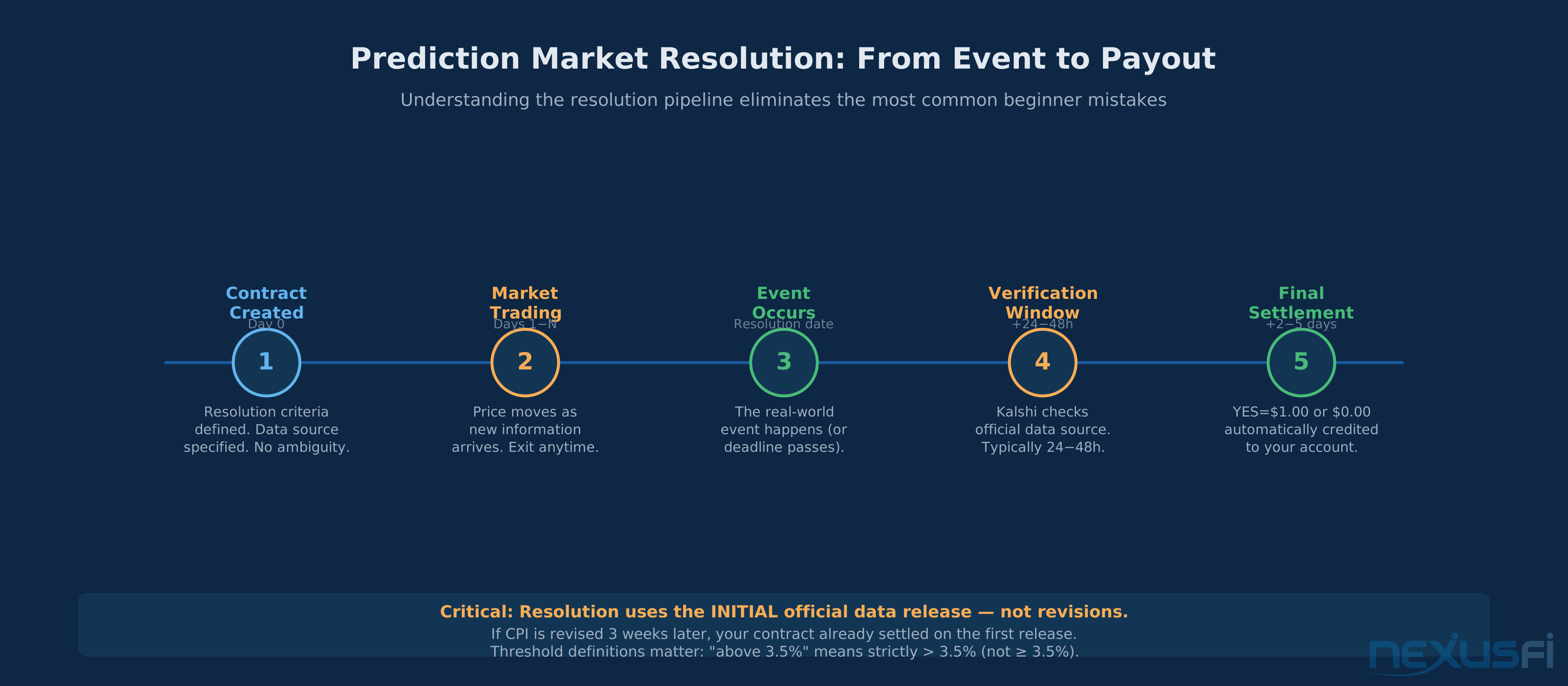
Every well-written resolution criteria contains these components:
1. The Exact Condition #
What must be true for YES to resolve? The condition should be:
- Specific: Not "inflation rises" but "CPI-U year-over-year change exceeds X%"
- Binary: Either happens or doesn't, with no partial credit
- Deterministic: Given the data source, anyone can compute the outcome
2. The Official Data Source #
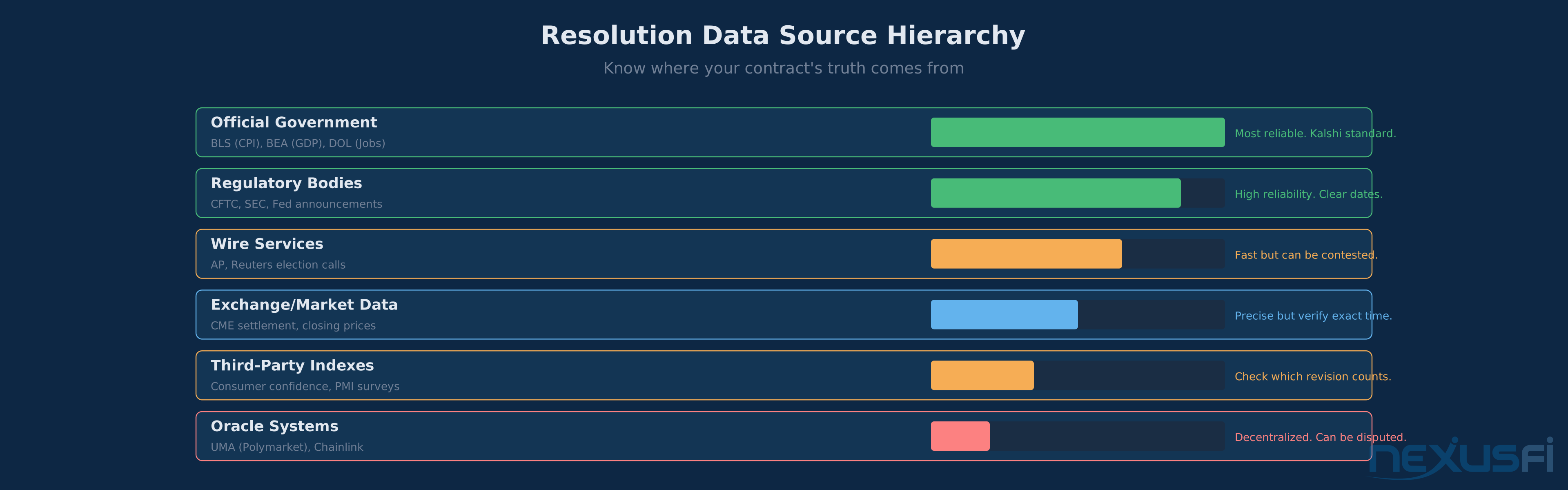
Where does the resolution data come from? Common sources:
- Federal agencies: BLS, Census Bureau, BEA, Federal Reserve FOMC statements
- Sports governing bodies: Official game results from NFL, MLB, FIFA
- Financial data providers: For stock price contracts, typically Bloomberg, Reuters, or exchange data
- Government electoral bodies: Official election certifications
The data source matters because different sources sometimes report different numbers. The BLS initial release differs from the revised release. Bloomberg's stock price may differ from NYSE's official close by fractions of a cent. The resolution criteria specify exactly which source controls.
3. The Timing #
When does the contract resolve?
- Resolution date: The calendar date when resolution is evaluated
- Data release timing: For economic contracts, the resolution is often tied to the data release ("resolves on the date of the March BLS release")
- Cutoff time: Some contracts have intraday cutoffs ("based on settlement price at 4:00 PM ET")
- Settlement window: Kalshi often takes 24-48 hours after the resolution event to finalize and pay out
4. The Threshold Operator #
How is the comparison made?
- Strictly greater than (>): 3.000% resolves NO, 3.001% resolves YES
- Greater than or equal to (≥): 3.000% resolves YES
- At or below (≤): Important for downside contracts
- Equal to: Rarely used but exists for specific outcomes ("exactly 25 basis point cut")
This detail catches traders who assume one operator when the contract uses another. Always verify.
5. Edge Case Handling #
What happens if:
- The event is postponed or cancelled
- The official data source revises the initial figure
- The question becomes ambiguous due to unexpected circumstances
- A tie or boundary condition occurs
Well-written criteria address these explicitly. Poorly written criteria create ambiguity that Kalshi's resolution committee must adjudicate — sometimes unfavorably for both sides.
Common Resolution Traps #
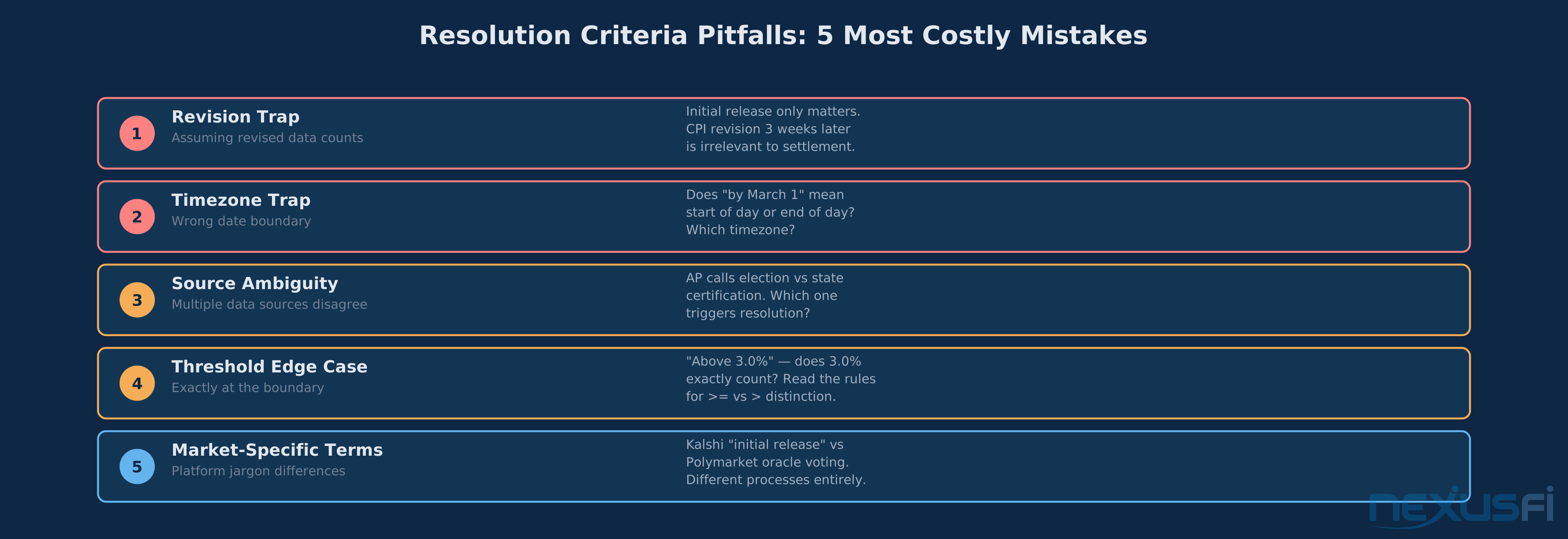
Trap 1: The Data Revision Trap #
The situation: Economic data gets revised frequently. CPI, GDP, employment data — all undergo revisions.
The trap: Assuming the contract resolves on the final, revised figure rather than the initial release.
Example: Initial CPI: 3.2%. Market resolves YES (above 3.0%). Two weeks later, BLS revises to 2.9%. Your YES position paid $1.00 and the revision is irrelevant — the correct outcome.
Reverse example: Initial CPI: 2.8%. Market resolves NO. Revision shows 3.3%. Your NO already settled. The revision doesn't change your payout.
Practical implication: Trade based on what the initial release will show, not what economists think the true number is after revisions.
Trap 2: The CPI vs. Core CPI vs. PCE Trap #
The US tracks several inflation measures:
- CPI-U: Headline inflation for all urban consumers (most common)
- Core CPI: CPI excluding food and energy
- CPI-W: CPI for urban wage earners (used for Social Security adjustments)
- PCE: Personal Consumption Expenditures deflator (Fed's preferred measure)
- Core PCE: PCE excluding food and energy
These measures regularly differ by 0.2-0.5 percentage points. A contract for "CPI above 3.0%" that resolves on CPI-U may have a different outcome than if it resolved on Core CPI.
Always verify: Which specific inflation measure determines resolution? Never assume "inflation" means CPI-U.
Trap 3: The Threshold Boundary Trap #
"Above 3.5%" vs. "At or above 3.5%" can be the difference between YES and NO on a 3.500% print.
This precise boundary case happens rarely, but it happens. The November 2022 CPI print came in at exactly 7.1% — right at a threshold boundary used in several contracts at the time. Traders who read the operator correctly were positioned correctly.
Practical rule: Mentally rehearse the exact boundary case before trading. "If the number comes in at exactly X%, what does this contract resolve?"
Trap 4: The Announcement vs. Implementation Trap #
Fed rate decision contracts: Does "Fed cuts rates" mean: a) The FOMC announces a rate cut decision, OR b) The new lower rate actually takes effect?
Typically, it means the FOMC announcement. The announcement and implementation happen the same day. But for contracts referencing other policy changes (tariff announcements, executive orders, legislative votes), the distinction matters.
"Will the trade tariff be implemented?" resolves differently from "Will the trade tariff be announced?" Always check whether the criteria reference announcement, signing, implementation, or effectiveness.
Trap 5: The Sports Postponement Trap #
For sports contracts:
- Game postponed by one day: Usually resolves on the rescheduled game result
- Game postponed indefinitely: May void and refund positions at cost basis
- Game played under protest: The official result typically controls, not the protest outcome
- Weather delay within the same day: Usually resolves on the actual result
Each sport and platform has specific rules. Read the postponement language carefully.
Trap 6: The Winner-Before-Certification Trap #
For election contracts:
- Does "wins the election" mean winning on election night?
- Or does it mean after official certification?
- What about recounts, court challenges, or disputed results?
2020 US election: On election night, no winner was clear in several key states. Markets that resolved on "projected winner" vs. "certified winner" would have different timelines and potentially different outcomes if an anomalous result occurred.
Always check: Does the criteria reference a projection, a call by major networks, or an official certification?
The 2-Minute Resolution Review Protocol #
Before every trade, answer these five questions:
1. What exactly must happen for YES to resolve TRUE? Paste the exact condition text. Don't paraphrase.
2. What data source determines the outcome? Identify the specific agency, release, and report. Verify it matches what you're actually predicting.
3. What date and time does the contract resolve? Note the timezone. Verify there's no earlier cutoff than you expect.
4. What is the exact threshold operator? Is it strictly greater than, greater than or equal to, or equal to? Test the boundary mentally.
5. What happens if the edge case occurs? What does the contract say about postponement, revision, or ambiguity? If the criteria don't address your specific concern, consider the risk carefully before trading.
If you can answer all five clearly, you understand what you're trading. If any answer is "I'm not sure," the criteria don't address it clearly, or the answer surprises you — reconsider your trade.
How Kalshi's Resolution Committee Works #
For contracts where the resolution isn't immediately clear from the criteria (genuinely ambiguous outcomes, data source disputes, or unusual circumstances), Kalshi's resolution committee reviews and determines the outcome.
When the Committee Gets Involved #
- Disputed data: Two official sources report different numbers
- Postponed or cancelled events: Contract specifies resolution window that passed without the event
- Criteria ambiguity: The event occurred but whether it meets the contractual definition is genuinely unclear
- Edge cases: The exact boundary case the criteria didn't anticipate
How to Protect Yourself #
- Before trading: If you're unsure about resolution, check Kalshi's FAQ or contact support
- Before trading: Search for similar past contracts and how they resolved
- After an ambiguous outcome: Monitor the resolution timeline; it may take longer than usual
The resolution committee's decisions are generally documented and create precedent for future contracts. Fi covered several cases where regulatory clarity affected how platforms structured resolution criteria in CFTC Withdraws Biden-Era Prediction Market Ban, Signals New Regulatory Framework.
Comparing Resolution Criteria Across Platforms #
For the same underlying event, Kalshi and Polymarket may write resolution criteria differently. This creates both opportunity (arbitrage when prices diverge) and risk (assuming they're equivalent when they're not).
Example: Fed Rate Decision
Kalshi: "Resolves YES if the FOMC target range upper bound decreases by 25+ basis points at the November 2025 meeting, as stated in the FOMC's November 2025 statement."
Polymarket: "Resolves YES if the Federal Reserve cuts interest rates in November 2025, as confirmed by the FOMC statement."
These are similar but not identical. Kalshi specifies a 25bp threshold; Polymarket says any cut. If the Fed implements an unusual 12.5bp cut, these contracts would resolve differently.
Don't assume cross-platform price differences represent arbitrage unless you've verified the criteria are truly equivalent.
Practical Application: Build a Criteria Checklist Template #
For traders who regularly trade similar contract types (Fed decisions, economic releases), creating a checklist template saves time while ensuring thoroughness:
CPI Contract Checklist:
- [ ] Measure: CPI-U, Core CPI, CPI-W, PCE, or Core PCE?
- [ ] Series: Year-over-year or month-over-month?
- [ ] Release: BLS initial release (specify date)
- [ ] Threshold: Strictly greater than or at/above?
- [ ] Revision handling: Initial only or includes revisions?
- [ ] Settlement: Day of release or 24-48h after?
Fed Rate Decision Checklist:
- [ ] Decision type: Rate cut, rate hike, or unchanged?
- [ ] Amount: Any cut, exactly 25bp, or 25bp+?
- [ ] Source: FOMC statement, meeting minutes, or projection?
- [ ] Meeting: Scheduled or any unscheduled action included?
- [ ] Timing: Statement release or end of FOMC day?
Building these templates for your most-traded contract types creates both speed and discipline.
Citations #
- @Fi: Kalshi, Polymarket, Prediction Markets etc — Community discussion of contract mechanics and resolution
- @Fi: CFTC Withdraws Biden-Era Prediction Market Ban, Signals New Regulatory Framework — Regulatory framework shaping resolution standards
- @Fi: CME Group Event Contracts Blast Past 100 Million Traded — Scale of event contract markets and resolution precedents
- Kalshi Resolution Guidelines — Kalshi official documentation
- How are prices calculated? — Kalshi Help Center
Knowledge Map
Prerequisites
Understand these firstGo Deeper
Build on this knowledgeReferences This Article
Articles that build on this topicCitations
- — Event Contracts - New Way to trade the CME Futures markets (2022) 👍 6
- — Kalshi, Polymarket, Prediction Markets etc (2025)
- — CME Group Launches 24/7 Futures Trading (2025) 👍 3
- — Nadex AMA - Dan Cook (2019) 👍 5
- — Cboe Eyes Prediction Markets With Regulated Binary Options (2026)