



Trading Sports Event Contracts: Game Winners, Series Outcomes, and Player Props
How prediction markets price sports outcomes differently than sportsbooks — and how traders exploit the gap.
Overview #
You spotted a key starter listed as questionable with an ankle sprain. Game winner YES is sitting at 58 cents on Kalshi. You buy 50 contracts. By tip-off, the player is confirmed out — your contracts jump to 72 cents, and you close the position without watching a single minute of the game.
That's sports prediction market trading. It's not sports betting. Kalshi and Polymarket operate as true exchanges where participants trade against each other rather than against the house — the same structural difference that separates a peer-to-peer marketplace from a casino. With thousands of contracts across NBA, NFL, MLB, NHL, college football, soccer, and more, these platforms have exploded in 2025-2026. And the structural difference changes everything about how you approach sports trading — from position sizing to exit strategy.
This article covers the mechanics, contract types, resolution criteria, and strategies specific to sports event contracts on Kalshi and Polymarket. It builds on the foundations in Introduction to Prediction Markets and How YES/NO Contracts Work.
Prediction markets let you trade sports outcomes like financial instruments — buying at 0.48 and selling at 0.60 without waiting for the final whistle. The edge isn't in picking winners; it's in identifying where the market's implied probability diverges from reality.
Sports Markets vs. Traditional Sportsbooks #
The most important distinction between prediction market sports trading and traditional sports betting is structural. Sportsbooks are dealers: they set lines with a built-in margin (the "vig" or "juice"), typically 4-10%, meaning you need to be right more than 52-55% of the time just to break even. The book always profits unless they misline a game badly.

Prediction markets are exchanges: buyers and sellers set prices, and the platform takes a transaction fee (typically 1-2%) rather than baking a margin into the line. This means:
- No juice to overcome: Your breakeven win rate drops from ~52.5% (typical sportsbook) to ~51% on prediction markets, because you're only paying a small transaction fee rather than fighting a 4-10% vig on every wager. Over hundreds of trades, this difference compounds much.
- Prices are market-determined: If the market is wrong, you can profit. If it's efficient, there's no easy edge.
- You can exit before resolution: Unlike most sportsbooks, you can buy or sell your position as odds change.
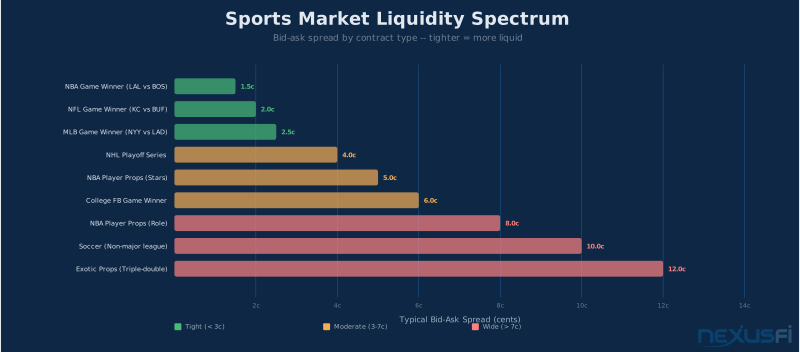
- Thin liquidity on niche markets: Less popular games or exotic props may have wide bid-ask spreads.
The key mental shift: Stop thinking in terms of moneyline odds (+150, -200) and start thinking in implied probabilities. A contract trading at 65 cents means the market assigns a 65% probability to that outcome. Your job is to determine whether the true probability is higher or lower than 65%.
Contract Types on Kalshi and Polymarket #
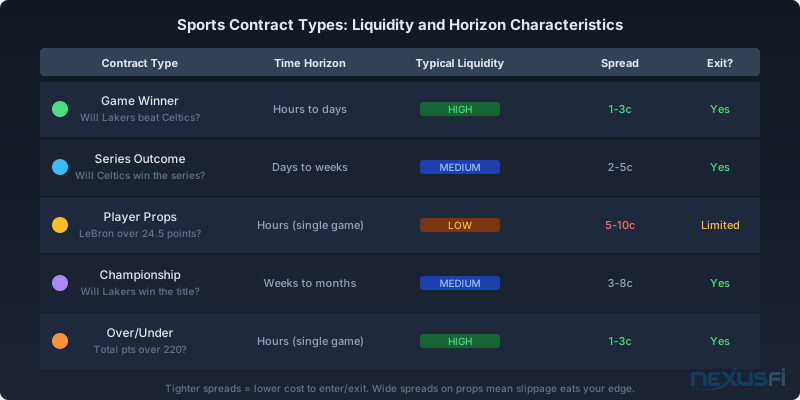
Game Winner Contracts #
The most liquid and commonly traded contract type. A binary YES/NO question: "Will the [Team A] win their game against [Team B] on [Date]?"
- Kalshi: Available for all major US sports. Game winner markets typically open 2-4 days before the game and close at tip-off/kickoff.
- Polymarket: Covers major sports but focuses on higher-profile games; less depth on regular-season matchups.
- Settlement: Based on the official final score. Overtime is included unless otherwise specified in the contract.
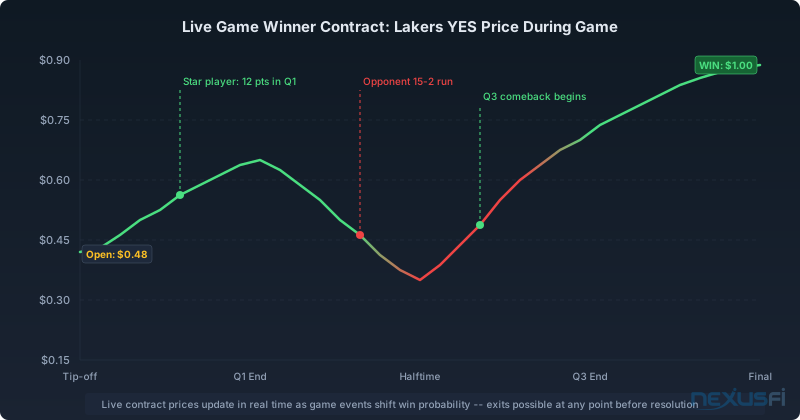
Price example: Lakers vs. Celtics, Kalshi: Lakers YES trading at 0.48 ($0.48). This reflects the market's 48% implied probability the Lakers win. Celtics YES would trade around 0.52 ($0.52), plus both sides absorb fees.
Series Outcome Contracts #
Multi-game series contracts (playoffs, best-of-7 series) asking which team advances or wins the series. These are longer-horizon contracts with more price movement as individual games resolve.
Characteristics:
- Price updates dramatically after each game in the series.
- Higher probability contracts trade with lower implied volatility.
- Teams going up 3-0 in a series trade near 0.95-0.98 (accounting for the rare 3-0 comeback).
- Can hedge a live series position against your game-by-game holdings.
Player Prop Contracts #
Will Player X score more than Y points/touchdowns/goals in a game? Will Player Z record a triple-double? These are binary event contracts tied to individual player performance.
What makes props different:
- Thin liquidity on many prop markets (wide spreads of 5-10 cents are common).
- High information asymmetry — a bettor who follows a team's beat reporters daily has a meaningful edge over the casual market participant who relies on headline injury reports.
- Resolution depends on official league statistics, not box score data from third-party providers.
- Game-time decision players create significant pre-game price uncertainty.
Resolution nuance for props: Always read the exact resolution criteria. "Will LeBron James score more than 24.5 points?" will specify whether overtime counts, how partial games are handled, and what source (NBA.com official statistics) determines the final count.
Tournament and Season Contracts #
Will Team X win the championship? Will Player Y win the MVP award? Will Team Z make the playoffs? These long-dated contracts can be held for weeks or months.
Characteristics:
- Prices move on news (trades, injuries, coaching changes).
- Early in the season: wide bid-ask spreads due to high uncertainty.
- Multiple correlated positions possible (e.g., being long on a team to make playoffs AND long on them to win their division).
- Championship futures contracts behave like options on the team's success — they decay in value as outcomes become less likely, and surge when the team gets hot. Unlike financial options, there's no Greeks framework, but the intuition is similar: time value erodes as the season progresses and fewer games remain to change the trajectory.
Over/Under Contracts #
Will the total score exceed a threshold? Total points, total touchdowns, etc. These are binary: will the game total be over or under a specific number?
Note: Unlike traditional sportsbooks where you bet over or under and get 50/50 odds minus juice, prediction market over/under contracts price the probability directly. A "Total Points Over 220" contract at 0.60 means the market gives 60% odds the game goes over 220.
How Sports Odds Translate to Prediction Market Prices #
Most bettors think in American odds. Here's how to convert:
American odds to implied probability:
- Negative moneyline: Probability = |odds| / (|odds| + 100) x 100%
- Example: -200 -> 200/300 = 66.7%
- Positive moneyline: Probability = 100 / (odds + 100) x 100%
- Example: +150 -> 100/250 = 40.0%
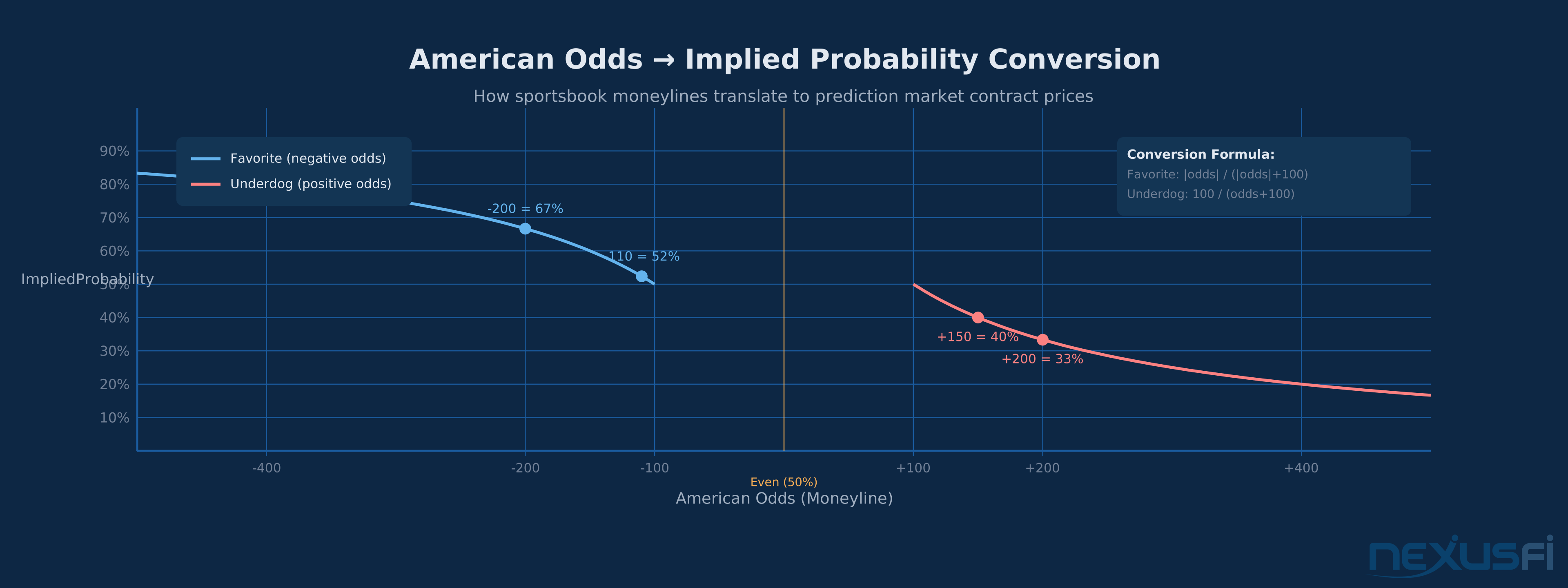
Key insight: When a traditional sportsbook shows -110 on both sides of a game (standard), the implied probability is 52.4% for each side — totaling 104.8%. That 4.8% overround is the sportsbook's built-in margin. On a prediction market, the two sides should sum closer to 100% (minus small transaction fees), which means the prices are closer to "true" probabilities.
Practical application: Compare the sportsbook's implied probability to the prediction market price. If ESPN BET shows a team at -130 (56.5% implied) and Kalshi shows the same team at 0.60 (60% implied), the prediction market is pricing the team as a stronger favorite. Who's right? That's your analytical question.
Resolution Criteria: Where Trades Go to Die #
Every sports contract has specific resolution criteria that determines when and how it settles. This isn't fine print you can skim — it's the contract itself. Getting resolution wrong is the single most costly mistake in prediction market sports trading, and it's the one mistake that no amount of analytical skill can recover from.
A real example: a trader buys 200 contracts on "Will Player X score more than 29.5 points?" at 0.42. The player drops 34 points in regulation and 8 more in overtime — 42 total. The trader expects a $116 payday. The contract resolves NO. Why? The contract terms specified "regulation only." Those 8 OT points didn't count. $84 gone, and it was entirely preventable.
Critical resolution factors to verify before every trade:
- Official source: Which entity determines the outcome? NBA.com, NFL.com, official league statistics, Vegas consensus? If a stat gets corrected days later, which version counts?
- Overtime handling: Most game winner contracts include OT unless specified. But prop contracts are the trap — many exclude overtime performance entirely.
Prop contracts and overtime are one of the most common resolution traps in sports prediction markets. "Will Player X score more than 24.5 points?" may or may not count overtime — and the default varies by platform. On Kalshi, most player props include OT. On other platforms, the answer might be different. Assuming OT counts when it doesn't (or vice versa) has cost traders real money. Read the resolution source before you buy — every single time.
- Game cancellation or postponement: What happens if the game doesn't play? Most contracts specify "No" resolution if the game is not played within a defined window (e.g., "within 48 hours of scheduled start time"). This matters for rain-delay baseball games and weather-impacted outdoor events.
- Player availability: A prop contract for a player who doesn't play at all typically resolves NO (the performance didn't happen). Verify this in the contract terms.
- Stat corrections: Official statistics can be corrected after games. Kalshi and Polymarket specify a resolution window during which corrections can affect the outcome.
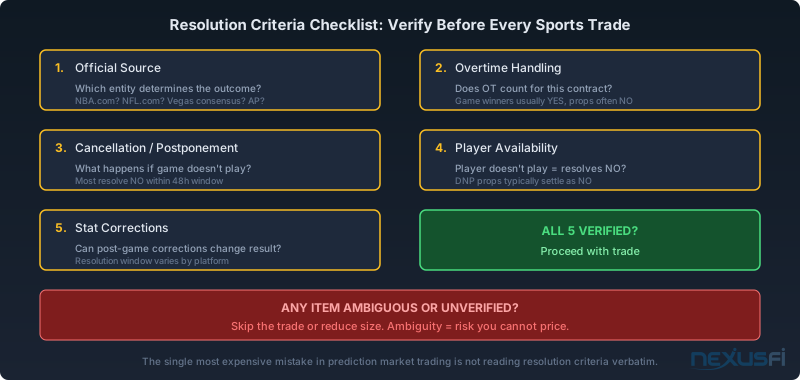
Practical workflow: Before placing any sports prop trade, open the contract's resolution page and read the criteria verbatim. If anything is ambiguous, skip the trade or reduce size. Five seconds of reading has saved more money in prediction markets than any model ever built.
Finding an Edge in Sports Markets #
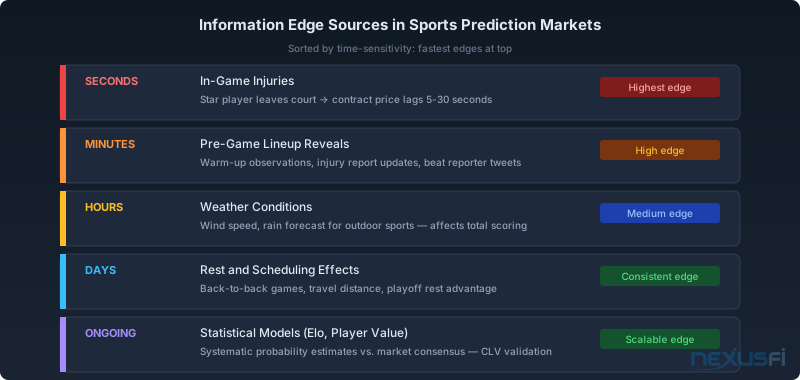
Sports prediction markets are informationally efficient on major games — the Lakers-Celtics game winner price reflects thousands of informed participants and moves fast. But inefficiency lives in the cracks: niche props, early lines, weather-sensitive outdoor games, and moments right after injury news breaks.
Information Edges #
Injury news: Prediction markets are slower to price injury news than professional bettors in some cases, but fast-moving on major stars. Monitor beat reporters, injury reports, and practice participation lists. A key player listed as questionable may not be priced in fully, especially on prop markets.
Lineup information: NBA teams sometimes reveal starting lineup information through pre-game warm-up observations before the official announcement. This information moves prices rapidly.
Weather and conditions: Outdoor sports (NFL, MLB, college football) have documented weather effects on scoring. A game with 30 mph winds has lower expected total points. Check if the market has priced weather appropriately.
Rest and scheduling: Teams on the second night of a back-to-back in the NBA perform measurably worse. Teams with a 10-day rest before a playoff game often play differently than teams in rhythm. These schedule effects are sometimes imperfectly priced.
Major Game vs. Minor Game Efficiency #
Market efficiency varies dramatically based on game prominence. NFL Sunday games during the regular season attract thousands of traders, sophisticated models, and real-time data feeds — information gaps close in minutes. A random Thursday night Mountain West college football game attracts a fraction of that attention, and prices may reflect casual participants rather than calibrated models.
The implication: your edge is inversely proportional to market attention.
Where inefficiency concentrates:
- Regular-season games in smaller markets (less-followed NBA teams, minor-market MLB franchises)
- Early-season games before market participants have calibrated on the new season's data
- Game 1 of a playoff series before the market has established a "feel" for the matchup
- College sports in non-marquee conferences (Sun Belt, MAC, CUSA)
- Niche props (individual defensive stats, third-down conversion rates, assist totals)
- Overnight games in non-US time zones (European soccer, Asian leagues)
Where to avoid expecting an easy edge:
- NFL Sunday afternoon slate (highest attention, fastest-pricing market in US sports)
- NBA playoff marquee matchups (dozens of real-time feeds tracking every possession)
- Super Bowl (the most-analyzed single event in American sports history)
- March Madness first weekend (saturated with public money and sharp action)
Practical calibration check: Before trading, ask how many sophisticated participants are likely in this market. Search Kalshi's order book — if there are only 3,000-5,000 shares available at the best price, you're in a thinner market where your analysis can matter more, but exit risk is also higher. Deeper books (50,000+ shares near best price) signal a heavily-traded market where mispricing is more likely already arbed away.
Data point: A 2024 analysis of Kalshi's NBA markets found that line accuracy (vs. final outcome probability) was 3.2 percentage points tighter for nationally-televised games vs. local-market games. That gap represents the efficiency premium of attention — and it's your opportunity cost when choosing which markets to trade.
Model-Based Approaches #
Many serious prediction market traders build statistical models to generate their own probability estimates and compare them against market prices:
- Elo-based models: Assign each team a numerical rating that updates after every game. Adjust for home-court advantage (worth roughly +3 points in the NBA), rest days, and travel distance. To build one: start with equal ratings (e.g., 1500), update by K-factor x (actual result minus expected result). K-factor of 20 works for most sports. Data sources: Basketball-Reference.com, Pro-Football-Reference.com, or free APIs like balldontlie.io for NBA stats.
- Player-value models: Aggregate player-level efficiency metrics (PER, BPM, WAR depending on sport) to project team performance with the specific lineup playing. These capture rotation changes and injuries better than team-level Elo.
- Regression to mean: Heavy favorites outperform their win probability in the short run but regress over a season. A team on a 15-game win streak isn't necessarily a better bet than their fundamentals suggest — regression is real and consistent across all major sports.
@Massive l's probability analysis puts numbers on this: identical entries with 1:1 targets hit 66% for $95 expectancy, while 4:1 targets hit 36% for $141 — the same risk/reward tradeoff binary contract traders face when choosing between high- and low-probability positions.
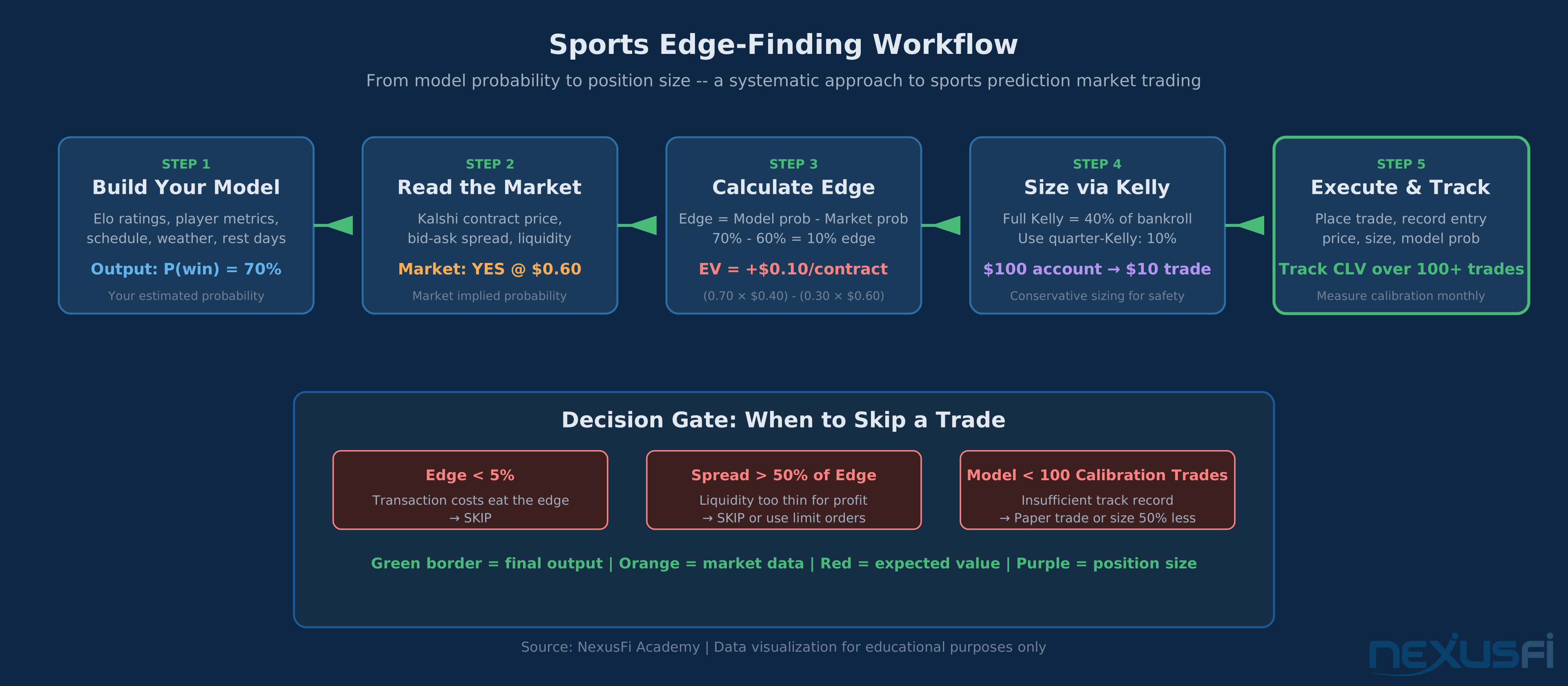
Calculating your edge: If your model gives a team a 70% win probability and the market shows 60%, that's a 10-percentage-point edge. To act on it: buy YES at 0.60. Your expected value per contract is (0.70 x $0.40) - (0.30 x $0.60) = $0.28 - $0.18 = $0.10, or 16.7% expected return on your $0.60 investment. But only if your model is well-calibrated — and that's the hard part. Track your predictions over 100+ events to measure calibration before sizing up.
@kevinkdog's Monte Carlo simulations confirm this — aggressive sizing produced higher median equity but larger drawdowns, making fractional Kelly the pragmatic choice for binary contracts.
The Closing Line Value Principle #
A powerful meta-metric: compare the price at which you traded to the closing price (price just before the game). If you consistently buy at 55 cents and the market closes at 60 cents, you've been finding value (positive Closing Line Value, or CLV). Over large samples, positive CLV correlates with long-term profitability in prediction markets.
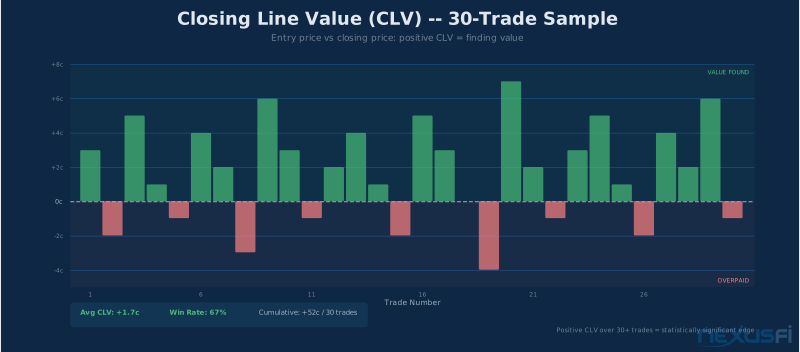
Track your Closing Line Value across 50+ trades before trusting it as a signal. Record every entry price alongside the closing price (the final market price before the event starts). If your average CLV is consistently positive — +2 cents or more — your process is working, even if individual trades lose. CLV is the single most reliable leading indicator of long-term profitability in prediction markets, and it separates lucky streaks from genuine edge.
Platform Comparison: Kalshi vs. Polymarket for Sports #
| Feature | Kalshi | Polymarket |
|---|---|---|
| Regulation | CFTC-regulated, US legal | Decentralized, crypto-native |
| Settlement | USD (cash) | USDC (stablecoin) |
| Sports coverage | Extensive (NBA, NFL, MLB, NHL, college) | Major games; less depth than Kalshi |
| Liquidity | Higher on major US sports | Higher on international sports/global events |
| Player props | Yes, extensive | Limited |
| Access | US residents (KYC required) | International (wallet connection) |
| Transaction fee | ~1-2% of winnings | ~2% of winnings |
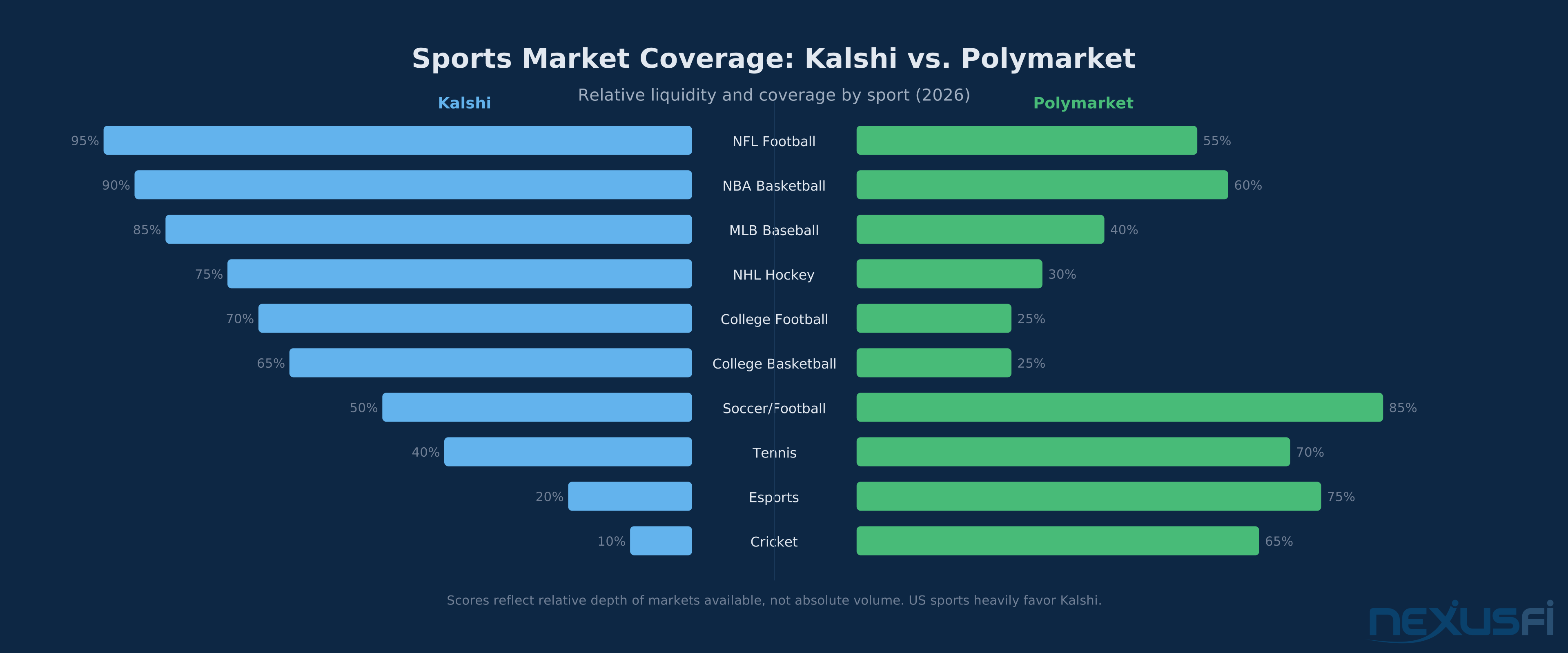
For most US sports traders: Kalshi is the primary venue due to deeper liquidity, broader market selection, and regulatory clarity. Polymarket fills in on international soccer, cricket, esports, and events Kalshi doesn't list.
Risk Management for Sports Trading #
Sports event contracts are binary — they resolve to $1.00 or $0.00 with nothing in between. This all-or-nothing payoff structure makes position sizing the single most important risk management tool. You can't set a stop-loss at a specific price level the way you would with a futures contract; the game plays out, and the contract resolves.
The Base Rate Discipline #
Even a strong favorite to win a game loses sometimes. A team at 80% implied probability loses 20% of the time. If you repeatedly bet 20% of your bankroll on 80% favorites, your ruin probability over 50 bets approaches 50%. Use the Kelly Criterion as a ceiling:
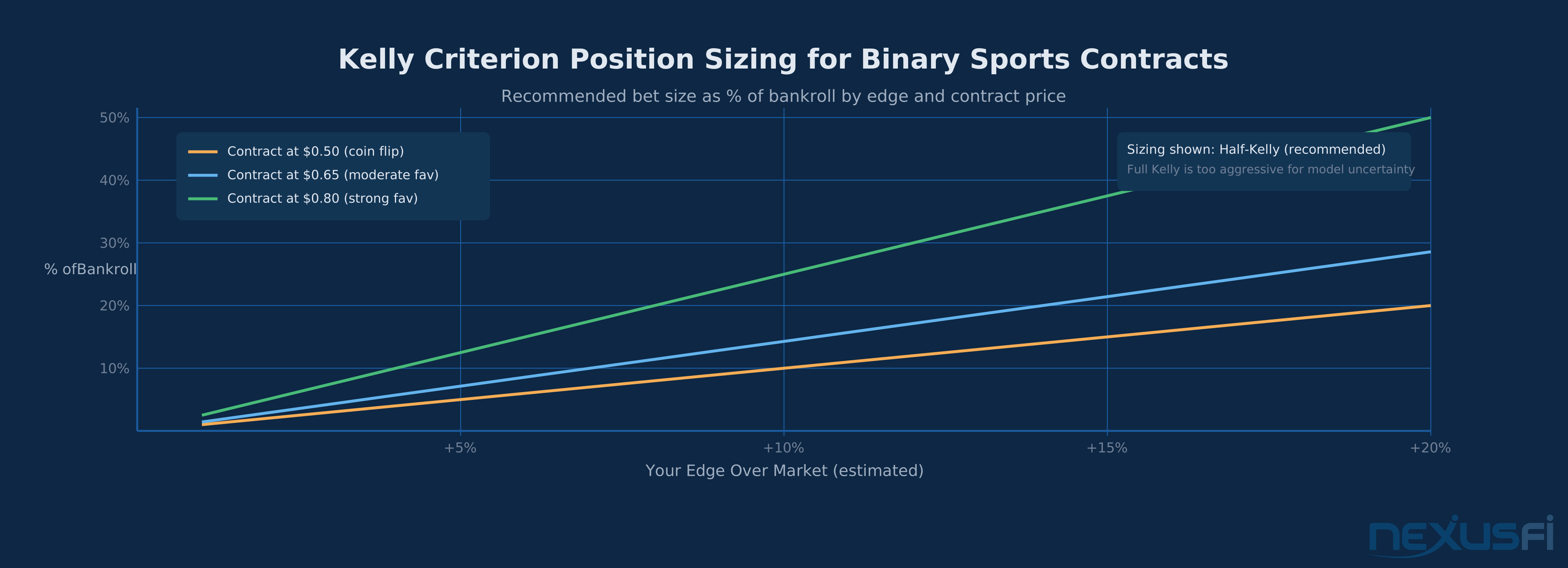
Kelly fraction = (bp - q) / b
Where:
- b = your net odds (if you buy YES at 0.75, you win 0.25 for every 0.75 risked, so b = 0.25/0.75 = 0.33)
- p = your estimated probability the event occurs
- q = 1 - p
If your model says a team has 85% probability and the contract trades at 0.75 (75%):
- b = (1-0.75)/0.75 = 0.333
- p = 0.85, q = 0.15
- Kelly = (0.333 x 0.85 - 0.15) / 0.333 = (0.283 - 0.15) / 0.333 = 0.40 (40% of bankroll)
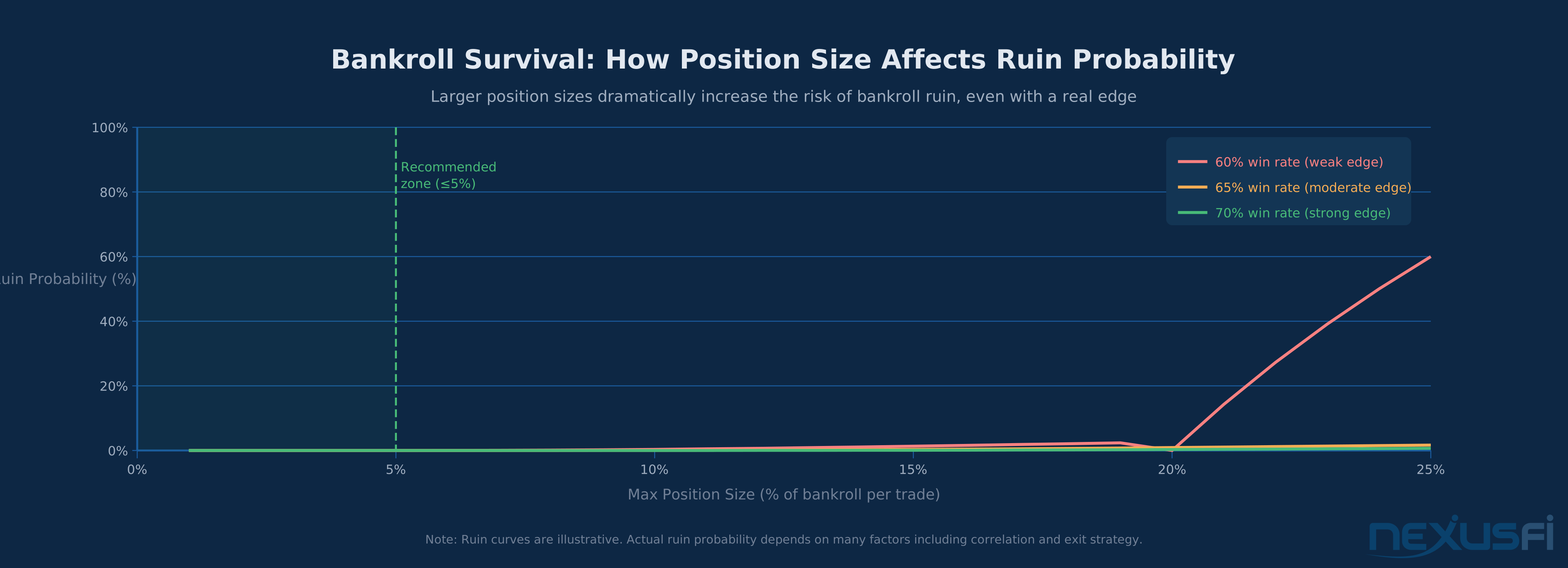
As @Fat Tails documented in the Risk of Ruin thread, quarter-Kelly sizing offers the best balance between growth rate and ruin resistance for strategies with moderate win rates — a principle that applies directly to binary prediction market contracts. At quarter-Kelly, your ruin probability across 50 trades drops below 1% even if your edge is smaller than your model suggests.
This is aggressive. Most serious traders use 25-50% of the full Kelly recommendation (quarter-Kelly or half-Kelly) to account for model error. A 40% full Kelly becomes 10-20% of bankroll in practice.
Diversification Across Sports and Games #
Don't concentrate in a single sport during its season. Diversification across:
- Multiple sports reduces correlation between outcomes — an NBA game result has zero relationship to an MLB game happening the same night, giving you independent risk exposures.
- Multiple games per day (different teams, different risk factors).
- Multiple contract types (game winners for higher liquidity, props for potential information edge, series contracts for longer-horizon positions).
Liquidity Risk #
Liquidity risk on niche sports markets is real and often invisible until you need to exit. A prop contract with a 5-10 cent spread on a $0.50 contract means 10-20% of your position evaporates in round-trip costs alone. That's not slippage you can model away — it's a structural cost that destroys small edges entirely. Only trade markets where the spread is less than half your estimated edge, or use limit orders and wait for fills.
On thin markets — small-market teams, early-season college football, exotic props — wide spreads are the norm, not the exception. The contract price might look attractive, but the cost to enter and exit can eat your entire expected edge. Check the order book depth before placing any trade, and be especially cautious on props for players on teams with small followings.
Tax Treatment of Sports Prediction Markets #
Important note: Kalshi, as a CFTC-regulated exchange, issues 1099s for annual winnings. Sports prediction market income is taxable as ordinary income, not at capital gains rates. Keep detailed records of:
- Entry price per contract.
- Number of contracts.
- Resolution outcome (win/loss/value).
- Exit price (if sold before resolution).
Polymarket, being decentralized, doesn't issue 1099s, but that doesn't mean your gains aren't taxable. You're still responsible for reporting crypto-denominated gains, and the IRS has been expanding its focus on digital asset income. Keep your own records — the blockchain does, and the IRS knows how to read it.
Consult a tax professional familiar with prediction markets and cryptocurrency. This is an evolving area where IRS guidance continues to develop.
Advanced: Live Trading During Games #
Both Kalshi and Polymarket allow trading during live sporting events — contracts remain open until resolution is official. This creates real-time momentum opportunities if you can act faster than the market digests new information.
Here are three concrete live-trading setups with specific entry and exit logic:
Setup 1: Post-Run Momentum Capture (NBA) #
Scenario: Fourth quarter, home team trails by 9 with 5:30 remaining. The market has underdog YES at 0.22 (22% implied win probability). The underdog goes on a 10-0 run in 90 seconds, cutting the lead to 1 point.
The opportunity: Kalshi and Polymarket both update in near-real-time, but the order book typically takes 15-45 seconds to fully reprice after a significant momentum shift. During that window, YES might be available at 0.30-0.35 while the "true" probability is closer to 0.48-0.52 (roughly even game).
Entry: Set a market order for YES when the run starts at 0.26-0.30. Don't chase — if it jumps to 0.40+ in the first 5 seconds, the window is closed. Aim for 30-50 contracts ($8-15 exposure at typical prices).
Exit: Sell when prices stabilize, typically 45-90 seconds after the run ends, or when the spread tightens back to 2-3 cents. Target 0.48-0.55 depending on game time remaining. Exit fully before the final 2 minutes — endgame intentional fouls and free throws create unpredictable resolution.
Risk: The favorite immediately responds with their own run. The key player who drove the comeback fouls out. The market catches up instantly and you're filling at 0.44 instead of 0.30. Accept a 0.5-1 cent loss and exit — don't hold waiting for a further move that may not materialize.
Setup 2: In-Game Injury Mispricing (Any Sport) #
Scenario: Starting QB exits in Q2 of an NFL game with an apparent leg injury and does not return for the possession. The team's backup is a career journeyman with a 58.4% completion rate. The injured team had game winner YES at 0.58 (vs. a 0.42 underdog). You're watching the game live.
The opportunity: Official injury reports lag 3-5 minutes. Platform prices may lag 1-3 minutes as market makers wait for confirmation. A team losing their starting QB at 58% favor should realistically reprice to 0.35-0.42 depending on the backup's track record and game state.
Entry: If the injured player goes to the locker room and the team moves to backup, check the order book immediately. If YES is still showing 0.52+, buy NO (or sell YES if you hold it). Avoid large sizes — you could be wrong about severity.
Exit: Once official injury news hits and the market reprices to fair value (~0.40 for a below-average backup team), exit 80% of your position. Hold the remaining 20% — if the backup outperforms, a second repricing move may come in your favor.
Platform note: On NFL Sundays with multiple simultaneous games, liquidity is split across dozens of markets. Injury repricing on lower-profile games may be slower than on nationally-televised matchups — that's where the window is widest.
Risk: The starter returns after 2 plays (minor tweak). You've sold into weakness at a bad price. Limit this by waiting for the backup to actually take the next snap before entering.
Setup 3: Late Starter Exit / Bullpen Collapse (MLB) #
Scenario: Ace pitcher — ERA 2.8, WHIP 0.97 — exits in the fourth inning after allowing his fourth walk. His team was favored YES at 0.64. The opposing team's bullpen has a 4.8 ERA over the last 30 days. Your team's bullpen: 3.9 ERA, decent.
The opportunity: MLB contracts don't move in real time as dramatically as basketball because baseball is lower-scoring, but starter exits do reprice game winners and total contracts. If the ace leaves early and the bullpen takes over, the run expectancy increases for the trailing team.
- Game winner YES for the exiting pitcher's team: watch for it to drop from 0.64 to 0.50-0.55 (bullpen risk priced in)
- Over/Under: A total-runs-over contract that was at 0.40 before the starter exited may reprice to 0.52-0.58 with weaker arms coming in
Entry logic: Buy Over or the trailing team's YES when the starter officially exits and the Kalshi order book shows limited liquidity at the current price. Limit order at 0.52 for Over, 0.44 for trailing team YES.
Exit: Sell before inning 7 — the market will have fully digested the information by then, and you lose the repricing edge.
Risk: Both bullpens perform well, especially in a pitcher's duel with low scoring. Overpriced Over contracts are the most common loss in this setup.
Challenge: You're competing against professional traders who track live games with sophisticated data feeds. The advantage window after major game events is often measured in 15-90 seconds, not minutes. If you're watching a delayed broadcast, you have no live-trading edge — the prices moved before you saw the play.
Getting Started: Practical Steps #
- Fund your Kalshi account with $50-100: This is enough to take meaningful positions on game winner contracts ($5-10 per trade) while limiting your downside during the learning phase. Start with game winners priced between 0.40-0.60 where a single outcome doesn't wipe a large percentage of your account. Set a per-trade maximum of 10% of your account balance until you've placed at least 20 trades and can evaluate your calibration.
Minimum account context: Kalshi requires a minimum deposit of $10, but $50 gives you meaningful sample size before topping up. Polymarket requires a wallet with USDC — start with $50-75 USDC equivalent. Don't deposit more than you can afford to lose entirely during the first 30 trades.
- Focus on a sport you know deeply: Your information edge is domain-specific. An NBA analyst has a bigger edge on basketball markets than on soccer markets they follow casually. If you follow MLB beat reporters daily, MLB props are your starting market — not NFL just because it's popular.
- Track every trade with calibration data: Record the following for every trade:
- Predicted probability: What probability did you assign before looking at the market price?
- Entry price: What did you pay per contract?
- Outcome: Did the event resolve YES or NO?
- Closing price: What was the final market price before event start?
- Closing Line Value (CLV): Entry price minus closing price (positive = you found value)
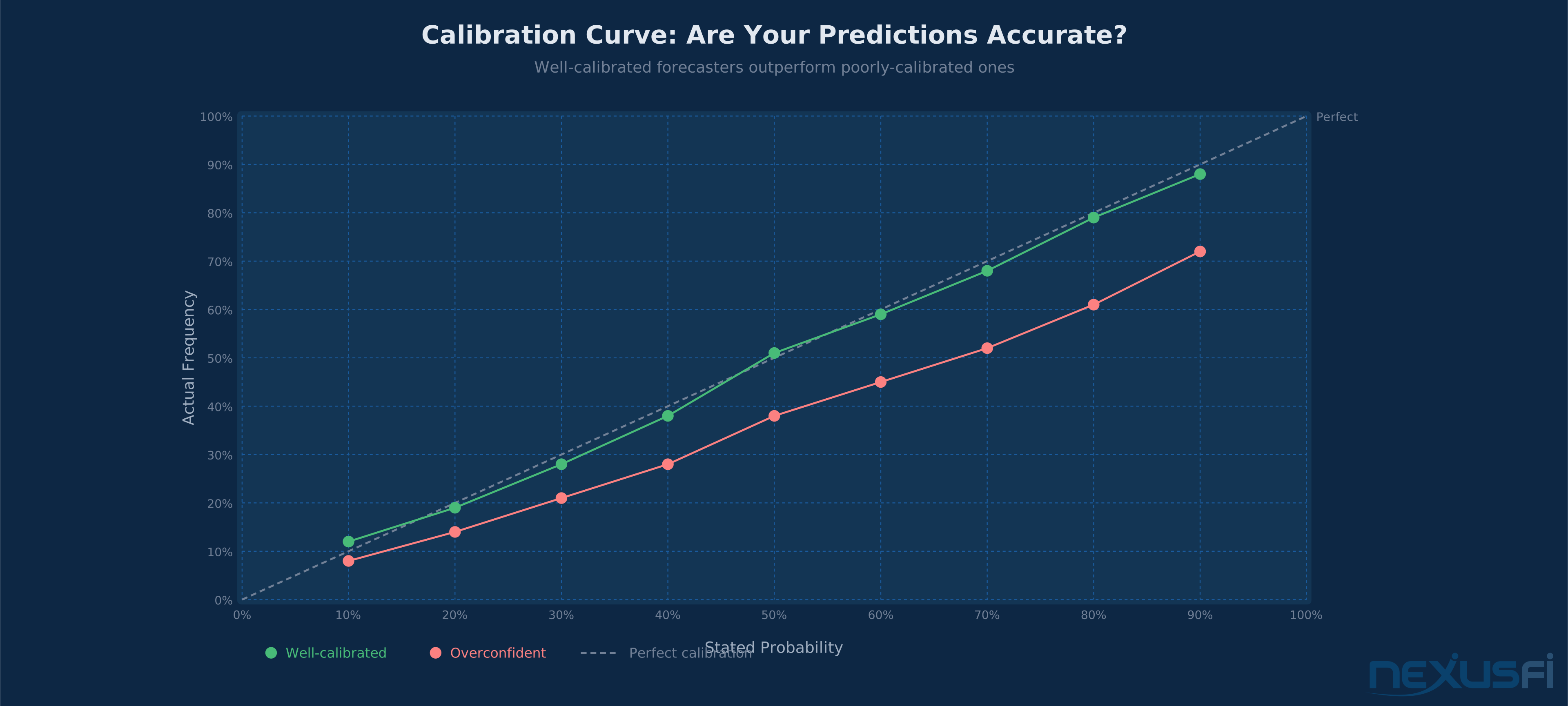
After 50 trades, calculate your calibration score: group trades by your predicted probability range (40-50%, 51-60%, 61-70%, 71-80%). Your win rate in each bucket should approximate the midpoint of that range. If you predicted 65% and won only 48% of those trades, you're overconfident in that range — reduce size or reassess your model for those scenarios.
@SBtrader82's trading journal captures the key shift that separates profitable binary traders from consistent losers: moving from outcome-focused thinking to process-focused risk management. Tracking calibration by probability bucket — not just overall win rate — is the same methodology elite sports traders use to verify their model quality.
- Start with game winners, not props: Game winner contracts are more liquid (2-4 cent spreads vs. 5-10 cents on props) and easier to analyze using team-level data. Props have higher information asymmetry, wider spreads, and more complex resolution criteria — all of which punish beginners.
- Paper trade first: Observe markets for two weeks, make hypothetical trades, and log them in a spreadsheet. See if your predictions were accurate before risking real money. Paper trading won't teach you execution or liquidity management, but it will reveal calibration errors without financial cost.
- Establish a stop-loss rule for your bankroll: Most experienced traders use a 20-25% drawdown rule — if your bankroll drops by 20-25% from its high, stop trading for two weeks and review your trade log. This prevents tilt and forces a structured review of what went wrong before the losses compound. @jamiej83's cascading loss limits — daily 1%, weekly 3%, monthly 6% — are an even tighter version of this discipline.
Further Reading #
- Introduction to Prediction Markets — The fundamentals of how prediction markets work
- How YES/NO Contracts Work — Mechanics of binary contracts
- Implied Probability in Prediction Markets — Converting prices to probabilities
- Risk Management for Prediction Markets — Position sizing and bankroll management beyond sports
Knowledge Map
Prerequisites
Understand these firstReferences This Article
Articles that build on this topicCitations
- NexusFi Discussion“CME to list Sports Event Contracts Dec 2025 - initial advisory for CFTC-regulated sports contracts on Globex”
- NexusFi Discussion“Event Contracts - New Way to trade the CME Futures markets: analysis of CME event contracts vs binary options”
- NexusFi Discussion“CME event contract breakeven analysis accounting for exchange fees and FCM commissions”
- NexusFi Discussion“Risk of Ruin - Kelly Criterion analysis with full vs half Kelly comparison and ruin probability calculations”
- NexusFi Discussion“How advanced mathematics and gaming theory can help you as a trader - probability and model uncertainty”
- NexusFi Discussion“The Tax Thread - Section 1256 contract taxation and futures trading tax treatment discussion”
- — Predictionmarketspicks.com
- — Simplefunctions.dev
- — Kalshi.com
- — Risk of Ruin (2012) 👍 30“With k = 0.25 I will be within the limits of my risk tolerance with a risk of ruin slightly inferior to 1%. I will therefore be betting quarter Kelly. This allows me to risk 2.3% of my account with every bet.”
- — Risk of Ruin (2012) 👍 16“If you bet half Kelly, but leave the other parameters unchanged, the risk of ruin drops to 1.5% (half Kelly) compared to 20% (full Kelly). This may explain why many professional gamblers rather bet half-Kelly than full-Kelly.”
- — SBtrader82's Trading Journal (2023) 👍 6“The big misunderstanding about risk management is that it is a mysterious unsolved problem. It is not. Assuming that you know the winrate and risk/reward of every trade, there is a formula for the exact risk to take. It's the famous Kelly Criterion. With any other approach the equity will grow more slowly and you will reach a drawdown value faster.”